Fair Trade Coffee Certification infographic showing standards, benefits, and criticisms in a hyper-realistic 3D watercolor style with bright studio lighting
Coffee Beans

Fair Trade Coffee Certification: What the Label Actually Promises, Proves, and Can’t Deliver

Fair trade coffee certification is a globally audited trading standard built around four concrete mechanisms: a price floor, a collective premium fund, democratic cooperative governance, and prohibitions on forced and child labour. Understanding how these mechanisms work – and where they break down – is what separates an informed coffee choice from a marketing assumption.

Fair Trade Coffee Certification: What the Label Actually Promises, Proves, and Can’t Deliver Read More »

Infographic illustrating how high elevation improves coffee bean flavor with 3D beans and watercolor texture
Coffee Beans

High Altitude Coffee: The Real Science Behind Why Elevation Shapes Every Sip

High altitude coffee earns its reputation through biology, not branding. Beans grown above 1,200 meters ripen weeks slower than lowland coffee, giving each cherry time to accumulate sucrose, organic acids, and aromatic precursors that translate directly into the brightness and complexity in your cup.

High Altitude Coffee: The Real Science Behind Why Elevation Shapes Every Sip Read More »

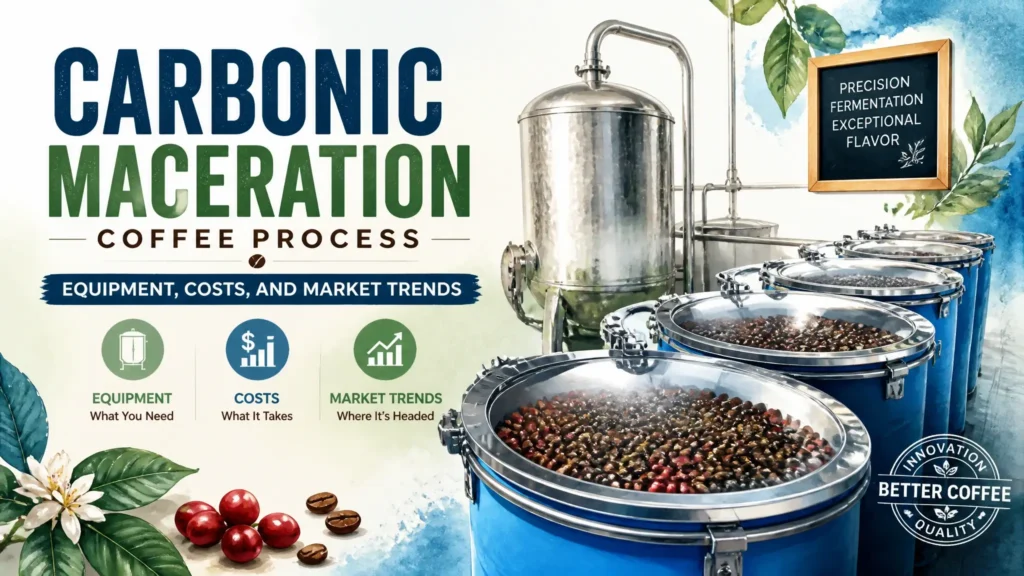
Featured image for The Complete Guide to Carbonic Maceration Coffee article showing a hyper-realistic 3D watercolor infographic with clean typography and bright lighting.
Coffee Beans

Carbonic Maceration Coffee: The Complete Guide from Farm Science to Cup Quality

Carbonic maceration coffee transforms whole, intact cherries inside CO₂-pressurized tanks – a method borrowed from Beaujolais winemaking and thrust into specialty coffee by Saša Šestić’s 2015 World Barista Championship win. It produces intense tropical fruit, lactic acidity, and syrupy body, but it also carries production risks that most guides never mention.

Carbonic Maceration Coffee: The Complete Guide from Farm Science to Cup Quality Read More »

Featured image for The History of Carbonic Maceration from Wine to Coffee article, hyper-realistic 3D watercolor infographic with bright studio lighting
Coffee Beans

The History of Carbonic Maceration Coffee: From Pasteur’s Laboratory to the Specialty Coffee Revolution

Carbonic maceration carries one of specialty coffee’s most compressed origin myths – a technique routinely credited to a 2015 competition win actually traces through French oenology, a 19th-century microbiologist, and a structural translation challenge that no wine textbook ever solved. Understanding where it came from changes how you use it.

The History of Carbonic Maceration Coffee: From Pasteur’s Laboratory to the Specialty Coffee Revolution Read More »

Scroll to Top