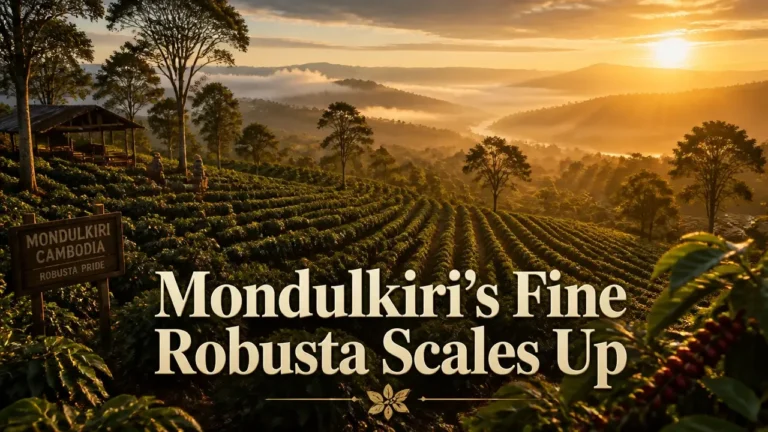

A new public–private collaboration in eastern Cambodia is aiming to turn Mondulkiri province’s recently recognised Fine Robusta into a larger, climate-resilient supply of specialty coffee at a time when domestic demand far exceeds local production.
The agreement, signed on a Tuesday under the presidency of Minister of Agriculture, Forestry and Fisheries H.E. Dith Tina, brings together Kofi Co., Ltd., the SNV Netherlands Development Organisation and the Dutch Fund for Climate and Development (DFCD) to “improve the quality and expansion of coffee cultivation in line with market demand and to increase the productivity,” according to a report on the collaboration from the Cambodian government news outlet វិមាន៧មករា.
The initiative in Mondulkiri aims to “promote and develop coffee crops” and to “train more farmers on coffee cultivation in accordance with international standards,” the same government report stated. Cambodia’s Ministry of Agriculture, Forestry and Fisheries figures cited in that report show the country produced 675 tonnes of coffee beans in 2021, down 28 percent from 940 tonnes in 2020, underscoring how limited national output still is.
By contrast, Cambodia consumes around 20,000 tonnes of coffee each year, while domestic production accounts for only a fraction of that demand, resulting in significant imports, according to the Cambodia Coffee Association as reported by the Khmer Times on 25 May 2026.
Within this context, Mondulkiri has emerged as Cambodia’s main coffee-growing province. The Khmer Times report noted that the province has more than 580 hectares under coffee cultivation, producing over 1,600 tonnes annually. A separate article in the Phnom Penh Post cited 2023 figures of about 725 tonnes per year harvested from 525 hectares, with 365 farming families involved, highlighting differing estimates from local authorities and media sources.
The same Phnom Penh Post report stated that Mondulkiri’s robusta beans were recently rated as “Fine Robusta” by the Coffee Quality Institute (CQI), a significant endorsement for a country better known internationally for rice and pepper than for coffee. “This is a significant achievement that brings pride to our country,” said Song Kheang, director of the Mondulkiri Provincial Department of Agriculture, Forestry and Fisheries, in that article. “It showcases our ability to produce high-quality coffee, contributes to the local supply and enables us to sell abroad, which in turn generates income for our farmers.”
Song Kheang added that officials are “currently training farmers while urging them to expand their land for coffee cultivation,” and that they are “working hard because this coffee has the potential and value that can provide people with a good income,” according to the Phnom Penh Post. In a field visit reported separately by the Khmer Times, department director Sok Kheang said, “We train farmers to grow coffee in accordance with safety standards and improve productivity,” and noted that partner companies have been helping farmers improve soil quality and expand cultivation to meet market demand.
Mondulkiri’s elevations range from 500 to 1,200 metres above sea level and support both robusta and arabica coffee, the Khmer Times reported. In the same article, provincial authorities said they plan to expand plantations by an additional 2,000 hectares over the coming years. Robusta coffee is “more resilient and easier to cultivate under local conditions, while arabica, which commands higher market prices, thrives at elevations above 800 metres,” the newspaper added.
On the private sector side, SNV described a related DFCD-backed project in a November 2022 note as focusing on “climate-resilient and inclusive coffee value chains” in Cambodia, including agroforestry systems and climate-resilient robusta varieties in the Lower Mekong basin. SNV stated that DFCD had approved a EUR 283,750 grant funding agreement with Kofi Co. Ltd. to support the development of a business investment proposal for this value chain.
By the second quarter of 2024, Kofi had “successfully contracted 83 farmers, established a milling facility and identified suitable areas for coffee expansion” in Mondulkiri, according to a September 2024 SNV case study titled “Partnering with businesses for agri-food transformation.” In that same case study, Kofi’s chief financial officer, Chhay Mony, said, “We are committed to promoting a sustainable coffee supply chain that will improve farmers’ livelihoods and contribute to broader climate adaptation efforts.”
At the national level, Minister Dith Tina expressed hope that coffee from Mondulkiri would gain visibility beyond Cambodia’s borders. “I hope that this collaboration, as well as Cambodian coffee grown in Mondulkiri province, will go beyond the local market by entering the international market in the future,” he said at the signing ceremony, according to វិមាន៧មករា.