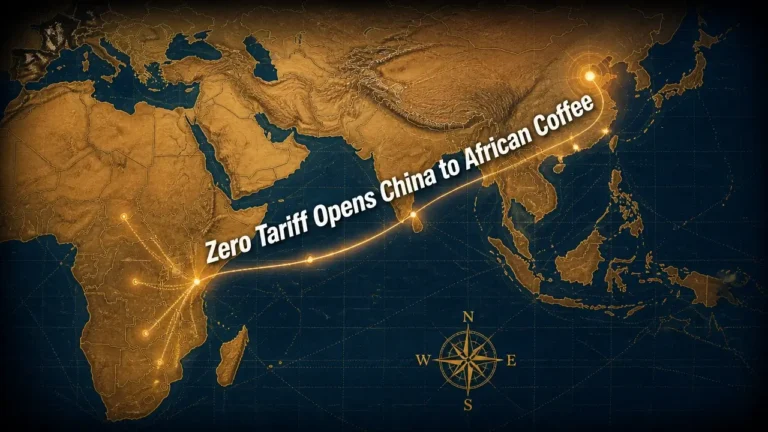

China is opening its market to coffee beans from every African nation with diplomatic ties, cementing a shift that is drawing the continent’s producers deeper into the world’s fastest‑growing major coffee market. Under GAC Announcement No. 68, published May 20 in Beijing, the General Administration of Customs of China will grant full quarantine and phytosanitary access to eligible coffee bean imports from all 53 such African countries starting July 20, 2026.
According to People’s Daily Online, coffee beans become only the second category of African agricultural products, after dried chilies, to receive continent‑wide quarantine access. The new framework builds on an earlier tariff overhaul: as trade outlet Asafi reports, green coffee entering China from all 53 African partners previously faced an 8% tariff and roasted coffee 15%, but both rates dropped to zero on May 1, 2026.
Those fiscal changes are already visible in recent trade numbers. Asafi notes that in the first five months after an initial phase of China’s zero‑tariff policy took effect in December 2024, the value of African coffee imports into China surged 145.7% year‑on‑year. Separately, news site AnewZ reports that China imported US$170 million worth of African coffee in 2023, with a compound annual growth rate of 42% between 2014 and 2023.
The new quarantine rules will standardize how that trade flows. The full text of GAC Announcement No. 68, posted on regulatory portal szepz.com, sets a unified sampling regime: for the first two years of trade, exporting countries must sample at least 2% of each shipment on arrival, and this proportion may drop to 1% after two years without phytosanitary issues. Xinhua, via People’s Daily Online, adds that several African origins, including Ethiopia and Burundi, had already secured individual market access, while Mauritius, Angola, Togo, Guinea, Liberia and Sao Tome and Principe have submitted export applications under the expanded framework.
China’s demand backdrop is unusually strong. Industry publication Coffee Intelligence calculates that Chinese coffee consumption has risen by an average of 21% annually since 2010, far above the global average of 1.8%, and that the country now consumes just over 2.9 million 60‑kilogram bags. At the same time, Coffee Intelligence points out that per‑capita consumption remains low at around 0.15 kilograms, underscoring the room for further growth.
For African exporters, China is already becoming a major destination. A feature on the China International Import Expo (CIIE) website states that Ethiopia exported over 34,000 tons of coffee to China in the 2024–2025 fiscal year, earning US$218 million and making China its fourth‑largest coffee market, with an average annual sales volume increase of 27%. The same CIIE article notes that Ethiopia produces about 600,000 tons of coffee annually and that this production supports millions of livelihoods.
At the company level, Ethiopian exporter Awo Coffee illustrates how the shift is playing out. In an interview with Chinanews.net, Awo Coffee general manager Tesfaye Gebru said, “We prioritize maintaining the unique quality, taste and aroma of top‑notch Ethiopian Arabica coffee. Since we began in 2014, the fast‑growing Chinese coffee market has emerged as our primary export destination.” He added that in 2025 the company had shipped 200 tonnes of high‑quality Ethiopian green coffee beans to China and the Middle East, with 70% of these exports directed to China.
Chinese roasters are also adjusting their sourcing strategies. In a profile by lifestyle outlet Daily Secrets, Wang Ling, general manager of Changsha Saturnbird Coffee, said the company was pursuing more direct procurement in the Ethiopian highlands to “benefit both grower and drinker.”
Behind the policy change is a broader trade relationship that is expanding quickly. According to state‑owned newspaper Global Times, overall China‑Africa trade reached US$348 billion in 2025, up 17.7% year‑on‑year. AnewZ reports that under the zero‑tariff arrangement African coffee exporters gain further cost advantages in China, while importers there save around US$320 per tonne in import levies alone, in addition to value‑added tax savings.
Logistics and processing patterns are also evolving. Trade consultancy Jade Premium argues that China’s combination of zero‑tariff treatment for African coffee and simplified phytosanitary entry procedures is reshaping global supply chains, making China a cost‑efficient processing hub for duty‑free African green coffee that can then be exported as finished products to Southeast Asian markets.
On the ground in China, regional trade gateways are already reflecting the shift toward African origins. Export‑focused outlet ExportFocus Africa reports that Kunshan city imported 650 million yuan worth of green coffee beans in the first quarter of 2026, and that African suppliers accounted for more than 12% of China’s total green coffee bean imports during this period.
Several observers say the new access is only a starting point. AnewZ notes that while China’s policy moves are generally seen as positive, “turning market access into meaningful market share will require investment in logistics, consistent quality standards and stronger supply chains – areas where many African producers are still developing capacity.”