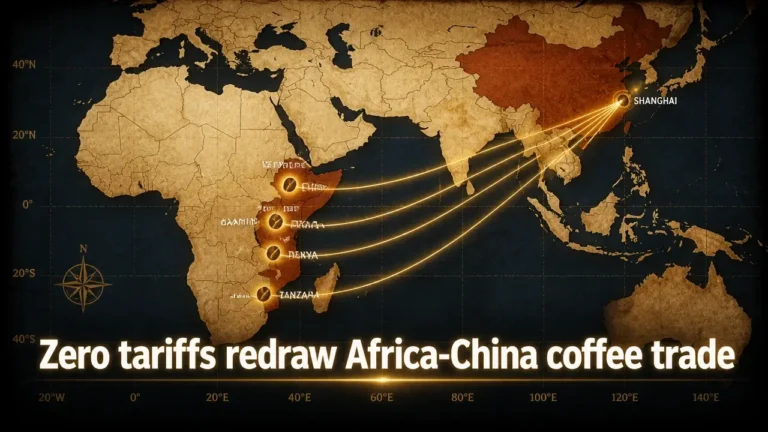

China is opening its market to coffee beans from every African country with which it has diplomatic ties, combining full quarantine access and zero tariffs in a policy shift that exporters and Chinese importers say is already redrawing trade flows.
According to Xinhua, China’s General Administration of Customs (GAC) announced that from July 20, 2026, eligible coffee beans from all 53 African partner countries will be able to enter the Chinese market under unified phytosanitary requirements. This follows an expanded zero-tariff regime that took effect on May 1, 2026, under which the previous minimum 8% tariff on raw coffee beans and 15% on roasted beans from these 53 countries has been abolished, as reported by Asafi.com and New Telegraph.
Before the new quarantine decision, only seven African countries, including Ethiopia and Burundi, had export access for coffee to China, New Telegraph reported. Xinhua and the Global Times note that while Ethiopia and Burundi already held quarantine approval, Mauritius, Angola, Togo, Guinea, Liberia and Sao Tome and Principe have lodged export applications and may proceed once they meet GAC requirements.
The tariff shift is occurring against a backdrop of rapidly deepening China–Africa trade. Xinhua reported that China’s trade with the 53 participating African countries reached a record US$348.08 billion in 2025, and US$92.16 billion in the first quarter of 2026, up 26.8% year-on-year. The Global Times, citing official data and the Chinese Foreign Ministry, stated that China–Africa trade surpassed 800 billion yuan (about US$110 billion) in the first four months of 2026 for the first time, with China’s imports from Africa rising 11.2% year-on-year and extending an eight-month streak of growth.
Coffee is becoming a visible part of that story. China Daily reported that China’s total coffee imports jumped from 59,100 metric tons in 2015 to 213,300 tons in 2024, while annual per capita consumption climbed from 42 grams to 151 grams. Within that growth, Asafi.com stated that the value of African coffee imported into China rose 145.7% year-on-year in the first five months after an initial phase of zero tariffs introduced in December 2024.
Shanghai has emerged as a key gateway. New Telegraph reported that the city handled 38% of China’s overall coffee imports and 40% of African coffee imports in 2025. From January to April 2026, Shanghai’s total coffee imports reached 2.67 billion yuan (about US$392 million), up 15.5% year-on-year, while imports of African green beans surged 129.5% to 583 million yuan, according to the same report.
For Chinese importers, the policy mix of quarantine access and zero tariffs is changing cost calculations. “The full zero-tariff coverage of African coffee beans has hugely expanded our sourcing options and given us a powerful cost advantage for supply-chain optimization,” said Wang Xinguo, general manager of Ningbo Beiyuan Co., Ltd., in comments to Xinhua.
At the retail end, that advantage is already visible on the menu, according to operators in Shanghai’s Hongqiao coffee trading hub. “Because of the zero tariffs, the cost of a cup of Ethiopian coffee can be more than 20% lower than coffee of similar quality from elsewhere,” said coffee importer representative Cao Zhiren at the Hongqiao Import Commodity Exhibition and Trade Center, as reported by the Global Times.
African exporters are also re-orienting their strategies around China. Asafi.com reported that Ethiopia supplies 65% of Africa’s coffee exports to China, with Uganda providing 18%, Tanzania 9% and Kenya 4%. The Forefront Mag quoted Tesfaye Gebru, general manager of Ethiopia’s Awo Coffee, as saying that since the company began in 2014, “the fast-growing Chinese coffee market has emerged as our primary export destination” and that its shipments to China of around 140 tons of green beans and 20 tons of processed coffee in 2024 have been growing at roughly 10% annually.
Kenyan specialty exporter Utake Coffee is seeing similar pull. Speaking to Ghanamma.com, founder Mbula Musau said that “Chinese customers truly appreciate specialty coffee” and “want to know exactly where the coffee comes from, who grew it, and how it was processed.” She added that “with zero tariffs, our price competitiveness will improve markedly” in China.
The policy window has a defined duration. The Global Times reported that China has implemented a two-year zero-tariff period covering all tariff lines for 53 African countries from May 1, 2026 to April 30, 2028, while GAC’s quarantine announcement for coffee beans from all 53 partners will take effect on July 20, 2026.