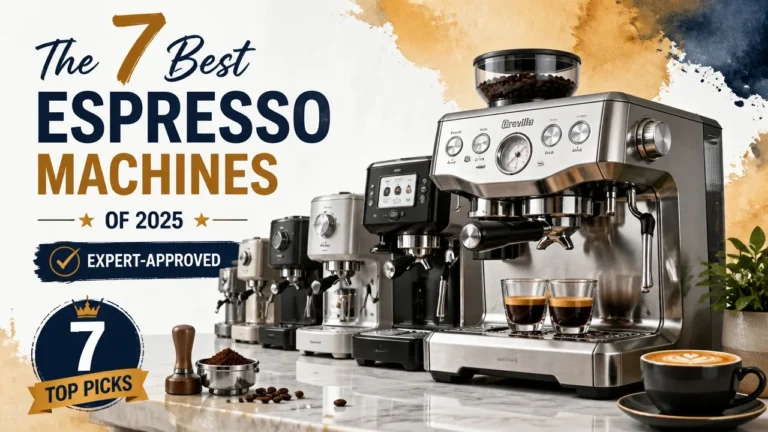

The best espresso machines don’t win on spec sheets – they win on the morning you’re running late, the fourth milk drink of a dinner party, or the moment you realize the grinder you skipped is the reason every shot tastes wrong. This guide covers seven machines across every meaningful price tier, from De’Longhi to Lelit Bianca V3, and ranks them on the criteria that actually determine whether a machine earns counter space.
What no published ranking will tell you upfront: there is no standardized taste or extraction benchmark behind any of these lists, including this one. What this guide substitutes instead – 9-bar capability, boiler architecture, basket type, wand performance, warm-up time, footprint, and parts availability – is stated openly so you know exactly what’s being measured, and what isn’t.
Key Takeaways on Best Espresso Machines
- The grinder matters more than the machine – a $179 setup with a real burr grinder out-cups a $1,200 machine fed by a blade grinder.
- “15-bar” and “20-bar” labels describe pump maximums, not brew pressure; the spec that matters is 9-bar stability at the group head.
- Pressurized baskets hide grind errors and cap cup quality; single-wall non-pressurized baskets are where real espresso begins.
- Thermal architecture determines drink count, not prestige – thermoblock for one drink, dual boiler for six.
- Total system cost – machine plus grinder, scale, tamper, basket, and first-year consumables – is the only number worth comparing across tiers.
- The machine that earns counter space is the one that matches your morning friction tolerance and drink count, not the one with the most impressive spec sheet.
How We Ranked the 7 Best Espresso Machines for Home Use in 2025
There is no single best espresso machine. That’s not a cop-out – it’s the most useful thing this guide can tell you before you read another word. The right espresso machine comes down to six variables: budget band, counter footprint, milk-drink volume, control tolerance, repairability appetite, and morning friction. Every machine on this list clears a real threshold on those axes. None of them clears all six simultaneously.
Here are the seven picks up front, so you can self-sort before reading the full breakdowns:
- De’Longhi Stilosa EC260BK – the proof that real espresso has a floor price, with work
- Breville Bambino Plus – the fastest legitimate path to microfoam in the smallest footprint
- Breville Barista Express / Impress – one box, one plug, one learning curve
- Gaggia Classic Evo Pro – the machine people repair instead of replace
- Flair 58 / Cafelat Robot – lever-driven extraction with zero electronics in the shot path
- Lelit Bianca V3 – dual-boiler, flow-profiling endgame for the serious home barista
- Jura Z10 / Philips LatteGo – one-touch convenience with a maintenance tax most reviews don’t mention
Before you read the individual sections, keep two axes in mind: learning patience (how much dial-in ritual you’ll tolerate) and morning tolerance (how many steps between you and the first cup feel acceptable at 6 a.m.). The verdict section closes on those two axes explicitly. Score yourself while you read.
No published ranking – not CoffeeGeek, not CoffeeBlog, not Whole Latte Love – runs comparative extraction testing or cites external taste studies. This one doesn’t either. What it does instead is name the observable proxy signals: 9-bar group pressure, boiler architecture, basket diameter, wand type, warm-up time, decibel output, footprint, and parts and service availability. The deeper hierarchy that practitioners actually operate on is grinder first, then pressure-capable machine, then PID temperature stability – in that order. Mainstream guides rank the machine first and push endgame models. That sequencing error is the single largest mistake in this category, and it costs readers money.
Pressure, Basket, and Thermal Fundamentals
Brew pressure is the most abused number in espresso marketing. When a machine advertises “15 bar” or “20 bar,” that number describes the pump’s maximum rated output – not the pressure at the group head during extraction. Espresso extracts at roughly 9 bar. A machine that can’t regulate down to that figure, or that has no OPV (over-pressure valve) to limit it, will over-extract regardless of what’s printed on the box. The spec that matters is whether the machine holds approximately 9 bar at the group, not the ceiling on the pump’s capability.
Basket type is the second thing to understand before any other spec. Pressurized (double-wall) baskets add a second layer of resistance after the puck, which papers over grind inconsistency and produces something that resembles espresso without requiring a dialed-in grind. They’re training wheels with a ceiling. Non-pressurized single-wall baskets expose every grind and dose error directly – and that exposure is where real espresso begins. The moment you swap to a single-wall basket, the grinder becomes the most important variable in the system.
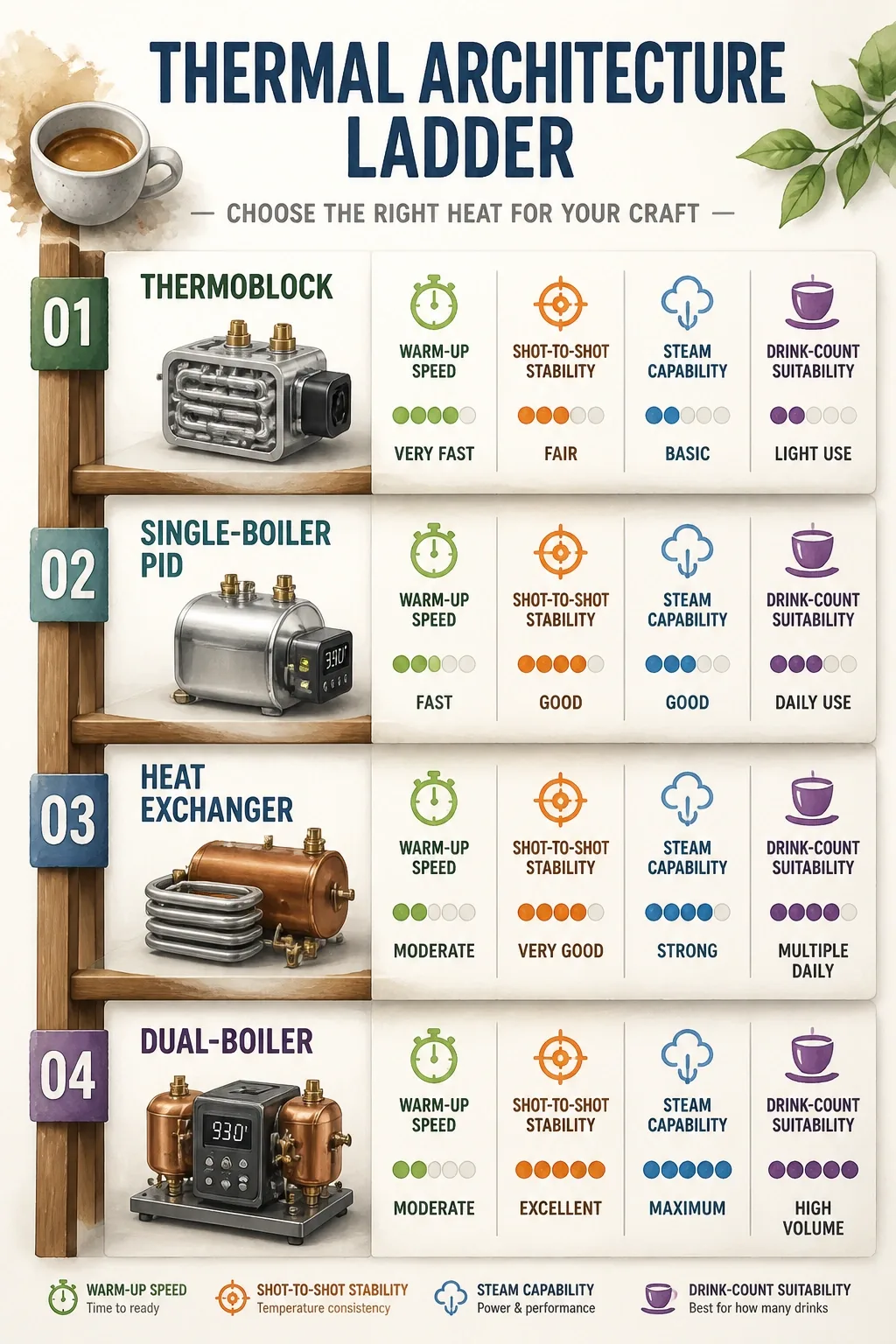
Thermal architecture is the ladder that determines what you can do and how fast you can do it:
- Thermoblock / ThermoJet – heats water on demand, ready in 3 seconds, but carries small thermal mass. Excellent for one or two drinks; by the fourth shot, temperature drift is measurable.
- Single boiler with PID – stable brew temperature, but steaming and brewing share the same boiler. There’s a purge sequence between pulling a shot and texturing milk. Tolerable for one drink; annoying for a household.
- Heat exchanger (HX) – brew and steam simultaneously from separate circuits sharing one boiler. The brew path needs a cooling flush before each shot to bleed off residual heat. This tier’s named picks – the Profitec Pro 500 PID and the Bezzera LUCE – reward the ritual with real throughput.
- Dual boiler – independent circuits for brew and steam, each held at its own temperature by a dedicated PID. Repeatable, back-to-back capable, and priced accordingly. The trade-off is counter depth, cost, and a longer warm-up window.
The thermal tier you need scales directly with your drink count. One espresso a morning is a thermoblock problem. Six milk drinks for guests is a dual-boiler problem.
Here’s a visual breakdown of how those architecture choices stack up:
Understanding these extraction limits often leads enthusiasts to weigh stove-top alternatives by evaluating moka pot vs espresso machine differences.
Steam, Grinder, and Counter Criteria
Steam wand type is where the marketing-to-reality gap is widest. A panarello or froth-sleeve wand injects air automatically and produces large bubbles – it makes hot milk, not microfoam, and latte art is not achievable from it. A single-hole “pro” wand is the entry point for real microfoam; it requires technique but rewards it. Commercial multi-hole wands deliver dry, fast steam at a pace that’s genuinely hard to appreciate until you’ve used one: the Bezzera LUCE’s commercial wand moves 5 oz of milk to 140°F in roughly 16 seconds. A panarello cannot approach that number. If you care about latte art or back-to-back milk drinks, wand type is the first filter to apply.
Grinder-first budgeting is the principle this entire guide is built on. Reserve $150–$400 for a dedicated burr grinder unless the machine includes one. The inversion that matters: a $179 machine fed by a proper burr grinder out-cups a $1,200 machine fed by a blade grinder, every time. The grinder controls grind size distribution, which controls extraction evenness. The machine controls temperature and pressure. Both matter. The grinder matters first.
“You should also know that if you don’t have a proper grinder, you will never achieve perfect espresso. Even if you have a $2,000 Breville Dual Boiler machine, your espresso will not be right. A good grinder is more important than the espresso machine itself – and the De’Longhi Stilosa is case in point. With a good grinder and professional technique, you can achieve technically perfect espresso with just a $149 machine.” – Peter Wolinski, Tom’s Guide
That hierarchy – grinder before machine – is the single most under-communicated truth in this category. A cheap machine with a great grinder is a better system than the reverse, and the price math usually confirms it.
Counter and durability criteria deserve more than a footnote. Measure your usable footprint and your cabinet clearance (machines with rear water tanks need pull-out access; tall steam wands need vertical clearance) before committing to a model. On finish construction: white powder-coating holds color over years; UV-yellowing plastics and painted trim do not. Check parts availability before aesthetics – a machine with no replacement group gaskets in three years is a landfill item, not an appliance.
If you want to see how different wand types perform side by side before committing, this video breaks down the mechanics clearly:
Buyer Friction Matrix and Pick Identity
The Buyer Friction Matrix that closes this guide runs on two axes: learning patience (how much puck prep and dial-in ritual you’ll accept) and morning tolerance (how many steps feel acceptable before the first cup). Neither axis correlates with price. Some readers with $3,000 budgets belong in the super-automatic tier; some readers with $300 budgets belong in the manual lever lane. Know which quadrant you’re in before the individual sections pull you toward a machine that fits the spec sheet but not the morning.
The deeper sequencing to carry through every section: grinder > pressure-capable machine > PID temperature stability. That’s the practitioner hierarchy. The mainstream guide hierarchy – machine first, endgame model pushed hardest – is the single largest structural error in this category, and it’s the one most likely to leave you with a beautiful machine producing mediocre espresso because the grinder was an afterthought.
De’Longhi Stilosa EC260BK: Best Budget Espresso Machine Under $200
The De’Longhi Stilosa EC260BK proves that real espresso has a floor price – and that floor is around $179. It’s a compact machine with a 51mm portafilter, a 15-bar-rated vibrating pump, a panarello-style steam wand, and pressurized double-wall baskets in the box. It is not a toy. It is also not a finished system.
The trap in the under-$200 category is the AMZCHEF-class “20-bar” machines that advertise a bigger pump number while trading away pressure stability, build quality, and basket compatibility. The Stilosa qualifies as a legitimate entry machine for three specific reasons: the pressurized basket is swappable for a single-wall non-pressurized 51mm basket, the design is serviceable, and parts are supported. The no-name 20-bar class offers none of those three things. A higher pump ceiling with no OPV and no parts ecosystem is not a better machine – it’s a better-marketed one.
The total entry cost is not $179. Budget a non-pressurized 51mm basket, a burr grinder in the $150–$400 range, a tamper that actually fits 51mm (many don’t – measure before buying), a scale, and fresh beans. That stack costs more than the machine. This is not a problem with the Stilosa; it’s the honest accounting for what espresso actually requires at any price.
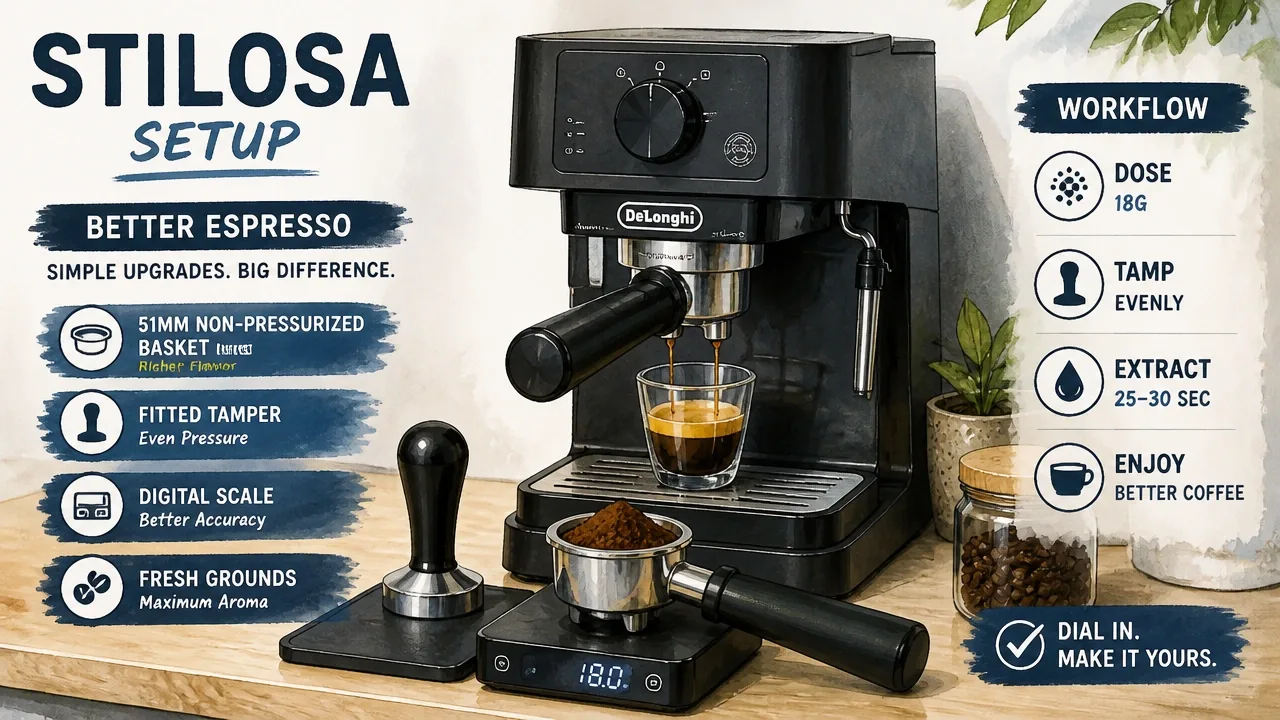
Where the Stilosa falls short is equally specific. The panarello wand cannot produce latte-art microfoam – not with better technique, not with more practice. The 51mm portafilter ecosystem is narrower than 58mm, with fewer basket and accessory options. There is no PID, so temperature drifts between shots. The water tank and drip tray are small, and the light build quality sets a realistic lifespan expectation. None of this is a scandal at $179; all of it is information.
Who this is for: espresso-only drinkers on a tight budget who are willing to learn puck prep and invest in a real grinder. Community practitioners openly mock the “you have to spend $1,500 to get real espresso” line that dominates enthusiast forums, and the Stilosa is the counter-evidence – but only with an upgraded basket, a real grinder, and honest puck prep. It’s proof of the floor, not an endorsement of the ceiling. If your morning starts with a latte and you’re making two or more drinks, go directly to the Bambino Plus or the Gaggia Classic Evo Pro.
Affiliate Disclosure
This post contains affiliate links, meaning I may earn a commission if you make a purchase through these links, at no additional cost to you. As an Amazon Associate, I earn from qualifying purchases. I only recommend products I genuinely believe will add value.
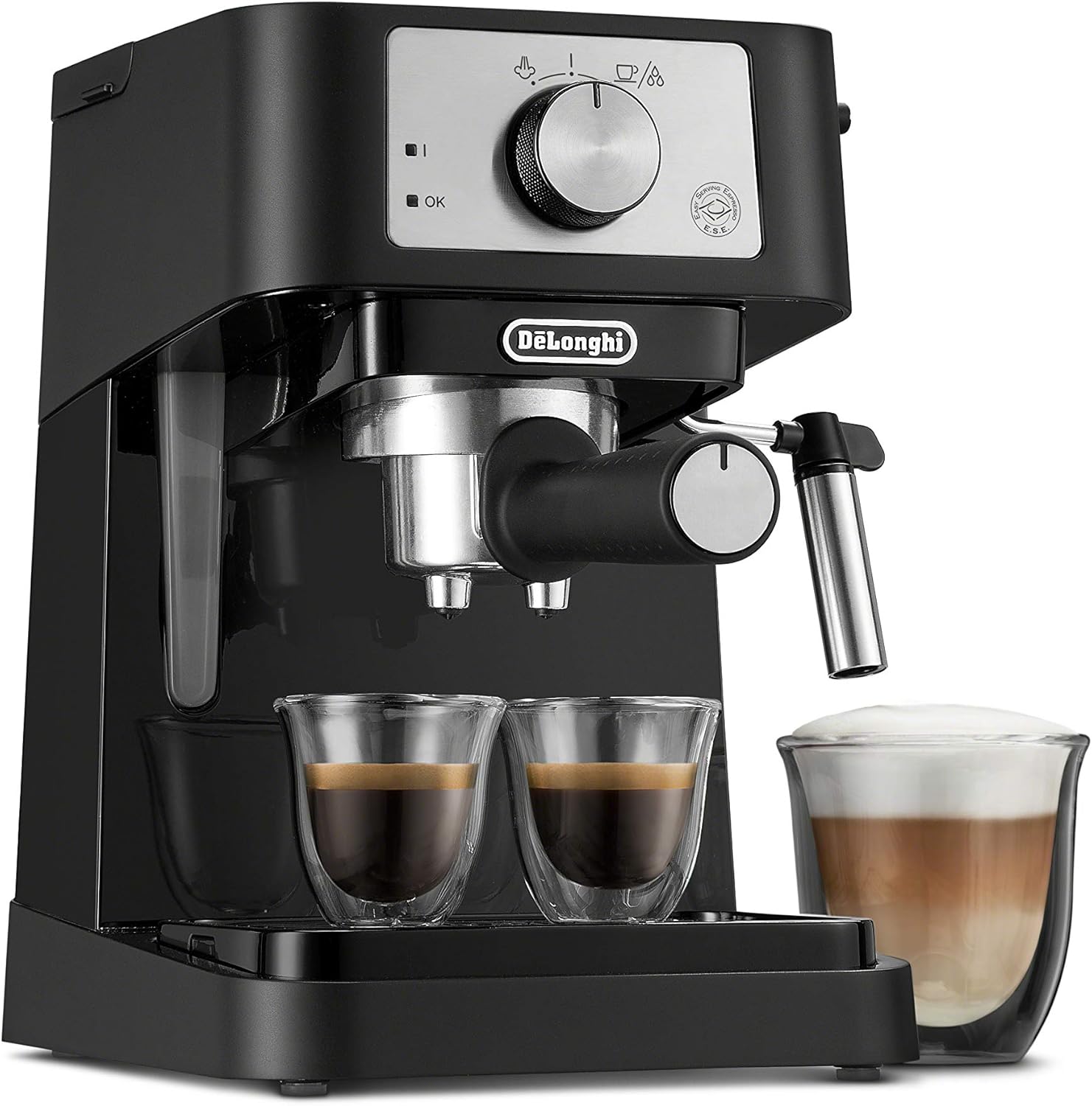
De'Longhi Stilosa Compact Manual Espresso Machine, Manual Milk Frother
- Please refer to user guide or user manual or user guide (provided below in PDF) before first use
- Includes Portafilter, measuring scoop/tamper and two filters for single or double espresso
- Stainless steel boiler is engineered to last long and work for years
- Manual steam wand to texture milk for lattes and cappuccinos
Breville Bambino Plus: Best Compact Espresso Machine for Small Kitchens
The Breville Bambino Plus is the value inflection point of this entire list – the machine where speed, pressure control, and price converge in the smallest footprint on the market. It runs a 54mm portafilter, a factory-set 9-bar OPV (so the pressure question is answered before you ask it), and a ThermoJet heating system that reaches brew temperature in roughly 3 seconds. Operating noise sits around 50–55 dB – quieter than the grinder you’ll put next to it.
The thermal trade-off is real and should be stated plainly: a thermoblock heats fast because it has small thermal mass. For one or two drinks, that’s a feature. By the fourth consecutive shot, temperature drift is measurable. This is the compact class’s actual price of admission – not a defect, not a design flaw, just the physics of heating a small volume of water quickly. If your household regularly pulls four milk drinks in a row, the Bambino Plus is the wrong architecture.
Milk workflow is where this machine earns its category. The automatic steam wand textures milk to a usable silky consistency without any technique – it’s the fastest legitimate route to drinkable microfoam for a first-timer. Switching to manual mode is where latte art actually gets learned, because it requires you to control the wand position and steam duration yourself. “Texturing” and “heating” are not the same thing: the auto mode heats milk to a target temperature with some texture; the manual mode lets you build the rolling vortex that produces pourable microfoam. Both modes are available on the same wand.
Missing pieces worth naming: no grinder, a small water tank, and a lightweight chassis that can slide across the counter during a hard tamp. A non-slip mat solves the last problem for under $10. A dedicated grinder solves the first one for $150–$400. These are not disqualifying gaps – they’re the predictable costs of a machine designed to be compact first.
Who this is for: small kitchens with 14 inches of counter space, one-to-two-drink mornings, anyone attempting latte art for the first time, and readers who want to move fast without sacrificing real pressure control. Who should look elsewhere: households pulling four milk drinks before 9 a.m.

Breville BES500BSS Bambino Plus Espresso Machine, Brushed Stainless Steel
- MICROFOAM MILK TEXTURING: Cappuccino maker and latte machine has an automatic steam wand allowing you to adjus…
- PRECISE DOSE GRINDING: This semi-automatic espresso machine allows you to achieve a consistent and balanced es…
- WATER PRESSURE: Low pressure pre-infusion gradually increases pressure at the start and draws out all flavors …
- RECEIVE 2 FREE BAGS OF SPECIALTY COFFEE: Included when you purchase and register any Breville coffee machine; …
- FASTER HEAT UP TIME: Coffee maker includes innovative ThermoJet heating system that achieves extraction temper…
Breville Barista Express / Impress: Best Espresso Machine with a Built-In Grinder
The appeal of the Breville Barista Express is honest and should be argued fairly: one plug, one counter footprint, one learning curve. The machine integrates a conical burr grinder into the case, uses a 54mm portafilter, includes integrated PID temperature control via thermocoil heating, and pairs a manual steam wand with a grind-adjust dial that teaches the relationship between grind size and shot time. The Impress model adds an assisted tamping mechanism that removes one of the most common beginner errors. Total price lands within reach of a mid-tier machine plus a mid-tier grinder – which is exactly why it’s the standard beginner recommendation.
The ceiling is equally honest and should be named without burying it: the built-in grinder has coarse adjustment steps and limited burr quality relative to a dedicated grinder in the same price range. When you outgrow it – and most home baristas do, within one to two years of serious dialing-in – you replace the machine, not the grinder. The grinder is permanent. That’s the fixed upgrade ceiling, set on the day of purchase.
Thermal and milk behavior are solid for the tier. The thermocoil plus PID holds decent shot-to-shot temperature stability. There is a wait between steaming and brewing – the single boiler needs to shift temperature – but it’s manageable for one-drink mornings. The manual steam wand can produce real microfoam with practice and is a genuine step up from a panarello. It rewards technique rather than replacing it.
The community criticism of this machine is consistent and worth stating rather than softening: enthusiasts call the built-in grinder the weak link, and they’re right. The correct framing is to score the Barista Express as a bundle decision – compare it as machine-plus-grinder in one line item against a compact machine paired with a dedicated $200–$400 burr grinder. At that comparison, the bundle sometimes wins on convenience and sometimes loses on grind quality, depending on which dedicated grinder you’re pricing against it.
Who this is for: gift buyers who want a complete system, beginners who refuse to buy a separate grinder in year one, and anyone who wants everything on one counter. Who should skip it: readers who already own a good burr grinder. Buy a machine-only pick and keep your grinder.

Breville BES870XL Barista Express Espresso Machine, Brushed Stainless Steel
- MANUAL HAND-TEXTURED MICROFOAM: The powerful steam wand on this cappuccino maker and latte machine is designed…
- PRECISE DOSE GRINDING: Integrated precision conical burr grinder on bean-to-cup espresso machine grinds on dem…
- WATER PRESSURE: Low pressure pre-infusion gradually increases pressure at the start and draws out all the flav…
- RECEIVE 2 FREE BAGS OF SPECIALTY COFFEE: Included when you purchase and register any Breville coffee machine; …
- PRECISE ESPRESSO EXTRACTION: Digital temperature regulation (PID) delivers water at precisely the right temper…
Gaggia Classic Evo Pro: Best Long-Term, Repairable Espresso Machine
The Gaggia Classic Evo Pro is not an appliance. It’s a shrunk-down commercial machine – 58mm portafilter, single stainless boiler with a factory-installed PID on the Evo Pro model, rocker switches, and a pro-style steam wand. It looks like a machine that belongs on a café counter because its design lineage runs directly from one.
The ownership argument for this machine is specific and documented. Parts are available. The repair process is documented across multiple communities. The modification ecosystem – including Gaggiuino-class aftermarket control builds that add flow profiling and advanced temperature management – changes the machine’s behavior without replacing the machine. People buy this machine, keep it for a decade, pass it on, and it still pulls shots. That’s the value axis it wins on, and no spec sheet can communicate it.
The brew/steam trade-off deserves no spin. A single boiler means the machine uses the same water reservoir for brewing and steaming – at different temperatures. Between pulling a shot and texturing milk, you wait for the boiler to climb in temperature, then purge, then steam. For one drink in the morning, this is tolerable. For a dinner party where you’re making four cappuccinos in sequence, it’s hostile. Be honest about your drink count before buying this machine.
The 58mm portafilter is the standard against which every other machine in this list is measured. Full-size baskets, tampers, distribution tools, puck screens, and accessories exist in abundance for 58mm. The ecosystem is mature, competitive, and cheap. This is a real advantage over 51mm and 54mm systems.
Modification risk must be stated alongside the reward. Gaggiuino-class builds involve working around mains electricity and a pressurized boiler. They void the warranty. This is a hobbyist path with real consequences – not a plug-in upgrade – and readers should go in with that understanding rather than discovering it mid-build.
If the same DNA with pre-infusion built in rather than bolted on is appealing, the 2025 Gaggia Classic GT at $1,699 adds pre-infusion at 3 g/s with programmable 2/8/12-second presets. Whole Latte Love files it as the value pick in that tier. It’s the same family at a different budget – not a replacement recommendation, but a natural next step for readers who want the Classic’s repairability with factory-level refinement.
Who this is for: long-horizon buyers, tinkerers, and espresso-first drinkers who want one excellent drink rather than four fast ones.
Enthusiasts drawn to repairability and modular upgrades can read a deeper gaggia classic pro enthusiast review detailing the ecosystem of modifications available.

Gaggia RI9380/49 Classic E24 Espresso Machine, Thunder Black, Small
- Solid Steel Housing, Made in Italy
- 9 Bar Espresso Extractions
- Stainless Steel 58mm Commercial Portafilter
- Commercial Three Way Solenoid Valve
- Uncoated Aluminum Boiler
Flair UPDATED / Cafelat Robot: Best Manual Espresso Machine for Purists
The Flair UPDATED and Cafelat Robot run on lever-driven pressure rather than a pump. There are no boiler electronics in the shot path – hot water from a separate kettle, a preheated group, and your arm generate the pressure that extracts the espresso. The fit and finish on both machines surprises people who assume “manual” means budget: these are precision instruments that cost more than most entry semi-automatics.
The real feature of this class is the feedback loop. Because you generate the pressure, you feel channeling and resistance in real time through the lever. A channeled puck doesn’t just produce bad espresso – it tells you it’s channeling, through the lever’s behavior. Manual machines teach extraction faster than any automatic machine because the variable is literally in your hand. No sensor, no app, no readout – just pressure, resistance, and the resulting cup.
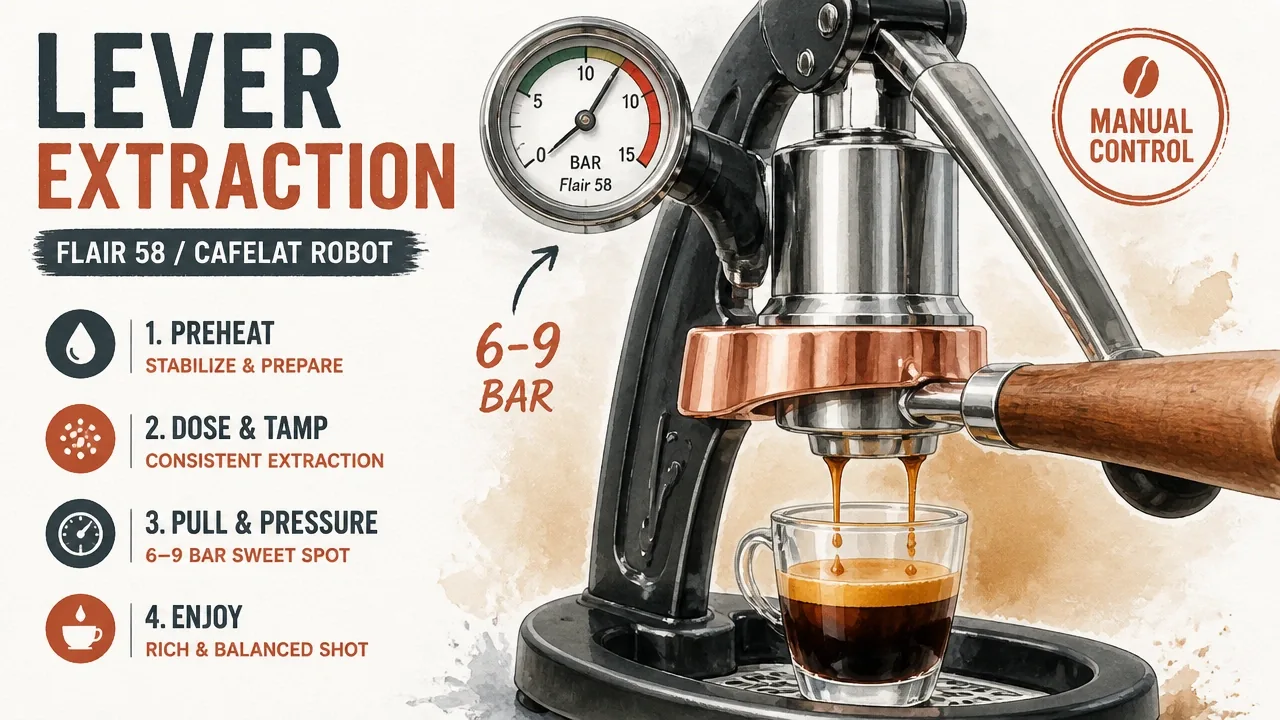
The honest cost of this class is not financial – it’s procedural. There is no steam wand (milk drinkers need a separate frother or a different machine entirely). There is a preheat ritual. There is one shot at a time. There is no automation to hide bad puck prep – this class punishes stale or inconsistent grounds harder than any other on this list. A quality grinder is not optional here; it’s the system.
“Manual” does not mean cheap. The total system – grinder, kettle, scale, and lever machine – is where the money goes, and it goes fast. These machines are not a budget path to espresso; they are a different philosophy about what espresso should require.
On the Buyer Friction Matrix, this is the maximum-faff / minimum-electronic-failure-risk quadrant. The lowest chance of a component failing; the highest daily ritual cost of any pick on the list. Readers who rate their morning tolerance low should disqualify themselves here regardless of how good the espresso is. The preheat routine and one-shot-at-a-time capacity are the two most-cited pain points in community discussion, and both are permanent features of the category, not bugs that future models will fix.
Who this is for: espresso-only drinkers, small-space and travel users, and anyone who wants to understand extraction before buying a dual boiler. Multi-drink households should look at the Lelit Bianca V3.

Flair UPDATED Espresso Maker - Classic: All manual lever espresso maker for the home - Pressure gauge and two portafilters included
- HANDCRAFT SHOTS OF ESPRESSO - With the Flair Espresso Maker, you have a complete manual espresso machine that …
- FULLY MANUAL & COMPLETELY BEAUTIFUL – The Flair Classic is a 100% human-powered, direct lever espresso press. …
- ADVANCED & BEGINNER ESPRESSO BREWING – The relaunched Flair Classic comes with both our Bottomless 2-in-1 Port…
- BUILT TO LAST WITH A WARRANTY – The Flair Classic is made from durable materials like cast aluminum and stainl…
- EASY TO CLEAN – The Flair Classic manual espresso machine is the only manual espresso maker with a completely …
Lelit Bianca V3: Best High-End / Professional Espresso Machine for Home
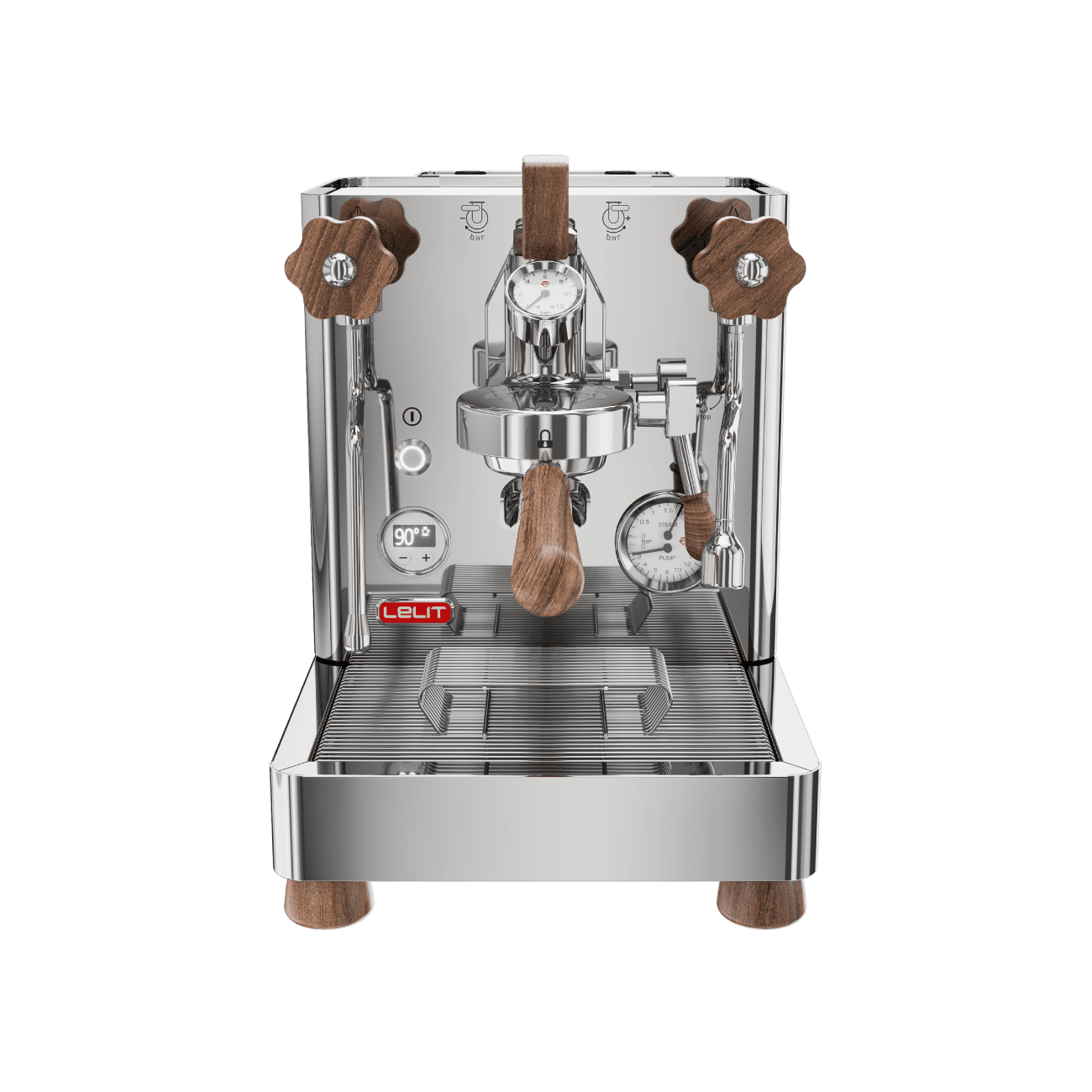
The Lelit Bianca V3 is for the home barista who has already outgrown a single boiler and owns a grinder they trust. It runs a prosumer dual boiler, an E61 group head, a flow-control paddle, 58mm portafilter, dual PID temperature control, a rotary pump, and operates on either tank or plumbed-in water. The ECM Synchronika II occupies the same tier with comparable architecture and a stronger service network in some markets – the two machines are the practical ceiling of home espresso before the price curve goes vertical.
Dual boiler matters in daily use in a way that’s hard to appreciate until you’ve lived with a single boiler. Independent brew and steam circuits mean no purge dance, repeatable temperature on every shot, and back-to-back milk drinks without waiting. This is the direct payoff of the thermal architecture ladder from the first section – the architecture that was a theoretical advantage on paper becomes a concrete morning difference when you’re making three cappuccinos.
Flow profiling closes the loop from the manual lever section. The paddle varies flow and pressure during extraction, giving lever-like pressure control with pump-machine repeatability. This is why the dual-boiler, flow-profiling tier is called endgame: it delivers the tactile feedback of a lever machine without sacrificing throughput or steam capacity.
Ownership reality deserves equal weight. The E61 group head requires a long warm-up before the first shot – budget 20–30 minutes. Counter depth and cabinet clearance are genuine constraints for smaller kitchens. Maintenance is a real routine: backflushing, water quality management (the rotary pump is sensitive to scale), and periodic gasket service. The plumb-in decision affects kitchen layout permanently. These are not objections to the machine – they’re the correct expectations to set before buying it.
On total cost of ownership, the flagship math is instructive. The La Marzocco Speedster lands around $15,000–$16,000, with ten-year maintenance costs exceeding its purchase price. The GS3, originally around $6,800 and now closer to $10,000, adds $7,500 or more in service over a decade. The Bianca V3 at approximately $3,000 delivers near-GS3 paddle functionality at a fraction of the package cost. The two machines most frequently crowned “best espresso machine in the world” are, on CoffeeGeek’s own ownership math, not the best buy – capability and ownership cost are different axes, and buyers conflate them constantly. The Bianca V3 is where the curve bends.
Who this is for: two-milk-drink households, daily flow profiling enthusiasts, and anyone who has already been through a single-boiler machine and knows exactly what they’re upgrading toward.
https://www.lelit.com/en-us/product/bianca-pesbn03
The heritage of modern prosumer engineering traces back through classic commercial architecture detailed in this vintage espresso machines restoration guide.
Jura Z10 & Philips LatteGo: Best Super-Automatic (Bean-to-Cup) Reality Check
The Jura Z10 and Philips LatteGo do everything inside a sealed case from one button: grind, dose, tamp, extract, steam. The Jura Z10 is the premium expression of the category – refined milk system, wide drink menu, premium finish. The Philips LatteGo is the accessible entry point, notable for a simpler milk-path design that reduces one of the category’s chronic maintenance problems. Both machines deliver on the one-touch promise.
What you genuinely trade away is worth naming precisely: grind adjustment granularity, dose control, puck-prep feedback, and the ability to upgrade the grinder. The internal burr set is the machine’s permanent ceiling – identical to the built-in grinder problem in the Barista Express, but sealed inside a case you can’t open without voiding the warranty.
Maintenance reality is the section of every super-automatic review that reads like a footnote and should read like a chapter. Daily rinse cycles. Frequent milk-path cleaning. Periodic descaling. Brew-unit cleaning on a schedule. The specific failure mode that reviews consistently avoid naming: internal moisture and residue inside the brew group, including mold growth in machines whose owners skipped the cleaning cadence. This is not a rare edge case – it’s the category’s most common long-term failure mode, and it’s entirely owner-driven.
Long-term reliability and repair economics follow a predictable pattern. Proprietary internals mean dependence on a service network. Out-of-warranty repair costs on a Jura frequently rival the price of a new entry-level machine. The correct way to evaluate this category is to price the first five years of ownership, not the sticker – factor in descaling tablets, milk-path cleaner, and one service call, then compare that number to a semi-automatic alternative.
The decision gate is simple: if you will not commit to the cleaning cadence, don’t buy the category. The machine’s real failure mode is owner neglect rather than component failure. Super-automatics that are cleaned consistently perform consistently for years. The ones that aren’t become expensive compost bins.
Who this is for: multi-drinker households, office-style mornings, guests, and buyers who rank one-touch convenience above dial-in control. Who should look elsewhere: anyone who wants to taste what a specific bean can actually do.
For those seeking hands-off convenience without manual puck preparation, exploring top-tier super automatic espresso machines review insights reveals how far automated brewing has evolved.

Jura Z10 Aluminum White
- VERSATILITY: A world first for hot and cold brew coffee specialties; choose from 32 options
- OPERATION: Touchscreen display, optional Artificial Intelligence, equipped with WiFi Connect for use with J.O.…
- CUSTOMIZATION: Customize, duplicate, rename and reposition coffee favorites
- GRINDER: Exclusive Product Recognizing Grinder adjusts in a fraction of a second to the predefined consistency…
- TECHNOLOGY: Pulse Extraction Process, Cold Extraction Process and Eighth-generation Brewing Unit

PHILIPS 3300 Series Fully Automatic Espresso Machine, LatteGo Milk System
- 6 PRESETS, ENDLESS COMBINATIONS: Choose from espresso, coffee, iced coffee, cappuccino, latte macchiato or sim…
- YOUR COFFEE IN ONE TOUCH, TAILORED TO YOU: Automatically grinds, tamps and brews at the push of a button with …
- LATTEGO PROPRIETARY MILK SYSTEM: Frothed. Foamed. Your milk, your way, automatically. LatteGo is the fastest t…
- INVEST IN YOU: Love café-quality coffee? Bring it home with the No.1 Super Automatic Espresso Machine in the U…
- POWERFUL FILTER AND EASY MAINTENANCE: Thanks to the AquaClean filter, by changing the filter after being promp…
The Verdict: Which Espresso Machine Fits Your Morning
Every machine on this list clears a real threshold. None of them is universally correct. The question is which one matches the two axes you’ve been scoring yourself on: learning patience and morning tolerance.
Persona Matches and System Costs
Here’s how the Buyer Friction Matrix resolves into named picks – and what each persona actually costs in year one:
| Persona | Machine | + Grinder | + Scale/Tamper/Basket | Year-One Total (Est.) |
|---|---|---|---|---|
| Budget starter, willing to learn | De’Longhi Stilosa EC260BK | $150–$250 | $50–$80 | $380–$510 |
| Small kitchen, one or two lattes | Breville Bambino Plus | $150–$250 | $50 | $500–$650 |
| One-box beginner or gift | Barista Express / Impress | Built-in | $50 | $750–$900 |
| Long-term enthusiast, tinkerer | Gaggia Classic Evo Pro | $200–$400 | $60–$80 | $860–$1,180 |
| Espresso purist, micro-footprint | Flair 58 / Cafelat Robot | $200–$400 | $60 | $760–$1,060 |
| Two-milk-drink household, flow profiling | Lelit Bianca V3 | Already owned | – | $3,000+ |
| Zero-faff, multi-drinker home | Jura Z10 / Philips LatteGo | Built-in | – | $900–$2,000 + maintenance |
Sticker price is the least useful number in this category. The system cost – machine plus grinder plus accessories plus first-year consumables – is the number that determines whether the purchase makes sense.
The off-retail paths are worth naming explicitly. Used E61 dual boilers surface at $600–$1,600 and represent real capability at a discount. A Stilosa-plus-hand-grinder build lands around $250 all-in. A compact machine paired with a dedicated burr grinder comes in under $1,000. These paths exist and they’re legitimate – but they carry a risk that new-machine purchases don’t: no warranty, unknown service history, and no recourse if the previous owner skipped maintenance. The discount on a used machine is compensation for that risk, not free money. Readers new to espresso should take the new-machine path and let experienced buyers arbitrage the used market.
Avoidance Criteria and Closing Answer
The skip list, stated directly: no-name 20-bar vibrating-pump machines with no OPV and no parts ecosystem; buying a dual boiler before owning a grinder you trust (the grinder is still the first purchase, regardless of budget); treating a built-in grinder as a permanent upgrade platform when it isn’t; and buying a super-automatic without accepting the cleaning cadence that makes it work.
One more thing worth saying plainly: big names, feature lists, and steep prices are frequently disconnected from daily benefit. Influencer-driven pick updates are not always disclosed as sponsored content, and a machine that earns a “best of” badge in January based on a two-week loan is not the same as a machine that earns counter space after two years of daily use. Weigh disclosed promotion against recorded daily use, and weight the latter more heavily.
The machine that earns counter space is the one that matches your friction tolerance and your drink count. Capability rankings and flagship crowns are, for most kitchens, a distraction from that single test. Run the two-axis check: how much ritual can you sustain on a Wednesday morning when you’re already late, and how many drinks do you actually make before noon? The machine that clears both thresholds is the right machine. Everything else is a better-marketed wrong answer.
Frequently Asked Questions About Best Espresso Machines
What is the highest rated espresso machine for home use?
There’s no single answer because no published ranking uses standardized extraction benchmarks. The Lelit Bianca V3 consistently lands at the top of prosumer lists for delivering dual-boiler, flow-profiling capability at a fraction of La Marzocco pricing – but “highest rated” only means something if the rating criteria match your actual use case.
Is De’Longhi or Breville better for home espresso?
It depends on what you’re optimizing for. Breville’s 9-bar OPV and ThermoJet make the Bambino Plus the faster, more pressure-accurate compact machine. De’Longhi’s Stilosa is the lower-cost entry point with a swappable basket ecosystem. Neither brand is categorically better – the machine architecture matters more than the badge.
What is the best espresso machine right now for someone who hates morning complexity?
The Breville Bambino Plus for milk drinkers who want speed without sacrificing real pressure control, or a super-automatic like the Philips LatteGo if you want a single button between you and a latte – provided you’ll commit to the daily cleaning routine.
How much should I actually budget for a complete home espresso setup?
Budget the system, not the machine. A real entry setup – machine, burr grinder, tamper, scale, and non-pressurized basket – runs $380–$650 at the budget tier. A mid-range all-in-one setup lands $750–$1,200. A serious single-boiler setup with a dedicated grinder runs $900–$1,500. Add 10–15% annually for consumables and maintenance.
Why do so many espresso machines advertise 15 or 20 bar if espresso only needs 9?
Because pump maximum sounds more impressive than brew pressure stability, and most buyers don’t know the difference. A 20-bar pump that can’t regulate down to 9 bar at the group will over-extract every shot. The OPV or OPD setting – not the pump ceiling – is the spec that determines shot quality.
When does it make sense to buy a used espresso machine?
When you already understand what you’re buying and can evaluate service history. Used E61 dual boilers at $600–$1,600 represent real value for experienced buyers who know what to inspect. For first-time buyers, the absence of warranty and unknown maintenance history makes the discount a risk premium, not a deal.
What’s the actual difference between a heat exchanger and a dual boiler machine?
A heat exchanger (HX) machine uses one boiler for steam and routes brew water through a separate internal tube – you can brew and steam simultaneously, but the brew path needs a cooling flush before each shot to bleed off excess heat. A dual boiler has two completely independent boilers, each held at its own temperature, so every shot is repeatable without any flush ritual. Dual boiler costs more and weighs more; the payoff is consistency at volume.
Can a super-automatic espresso machine grow mold inside?
Yes, and it’s more common than reviews acknowledge. The milk path and brew group retain moisture between uses, and machines that skip daily rinse cycles and periodic deep cleaning develop residue and mold inside the brew unit. It’s an owner-behavior failure, not a manufacturing defect – but it’s the category’s most common long-term problem and a real reason to price the cleaning cadence before buying.
References
- I thought $149 was too cheap for a good espresso machine, but De’Longhi proved me wrong | tomsguide.com