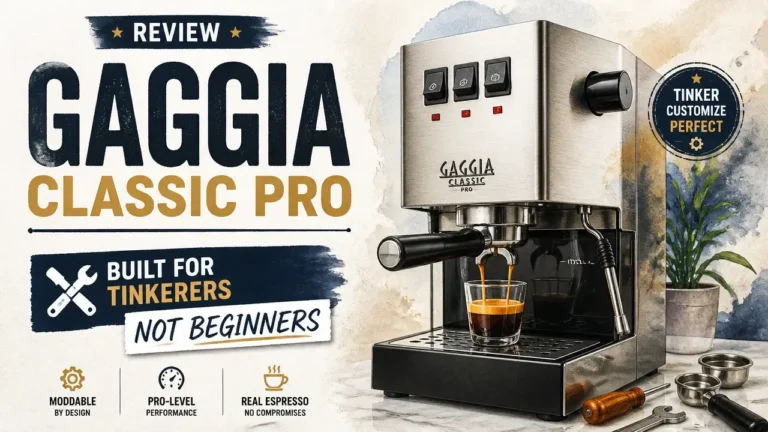

The Gaggia Classic Pro is one of the most polarizing espresso machines at its price point — not because it’s flawed, but because it’s honest. It was built for a specific kind of person, and it makes no apologies about that.
Slip a PID inside it, swap the OPV spring, and it punches well above its $450 price tag. Leave it stock and expect push-button results, and it will quietly make you miserable. That gap between those two outcomes is the whole story.
This Machine Will Disappoint You – Or Become Your Obsession
The Gaggia Classic Pro E24 is not a beginner machine. That’s not a criticism – it’s the most useful thing I can tell you before you spend $450. If you walked in here hoping someone would confirm your impulse buy, I’m going to slow you down for five minutes. If you walked in because you’ve been eyeing this machine for months and you already know what temperature surfing means, sit down – this is going to feel like a green light.
The GCP has earned a reputation as “the gold standard for budget machines” , and that reputation is completely deserved – for one specific type of buyer. That buyer is not someone who wants one-touch lattes before a morning meeting. It’s a tinkerer who sees a $75 PID kit as a fun Saturday project, not a frustrating workaround. The machine is built like a tank, pulls genuinely excellent shots, and has one of the deepest modding ecosystems of any home espresso machine on the planet . But it earns none of that praise out of the box without effort.
One Amazon reviewer put it plainly: “It’s built like a tank, and makes amazing shots, but definitely not a machine for those who don’t want to learn the process.” That sentence is doing a lot of work. The Gaggia Classic Pro is not a machine you buy – it’s a machine you build a relationship with. And like any relationship worth having, it asks something of you first.
The Gaggia Classic Pro’s Core Strengths
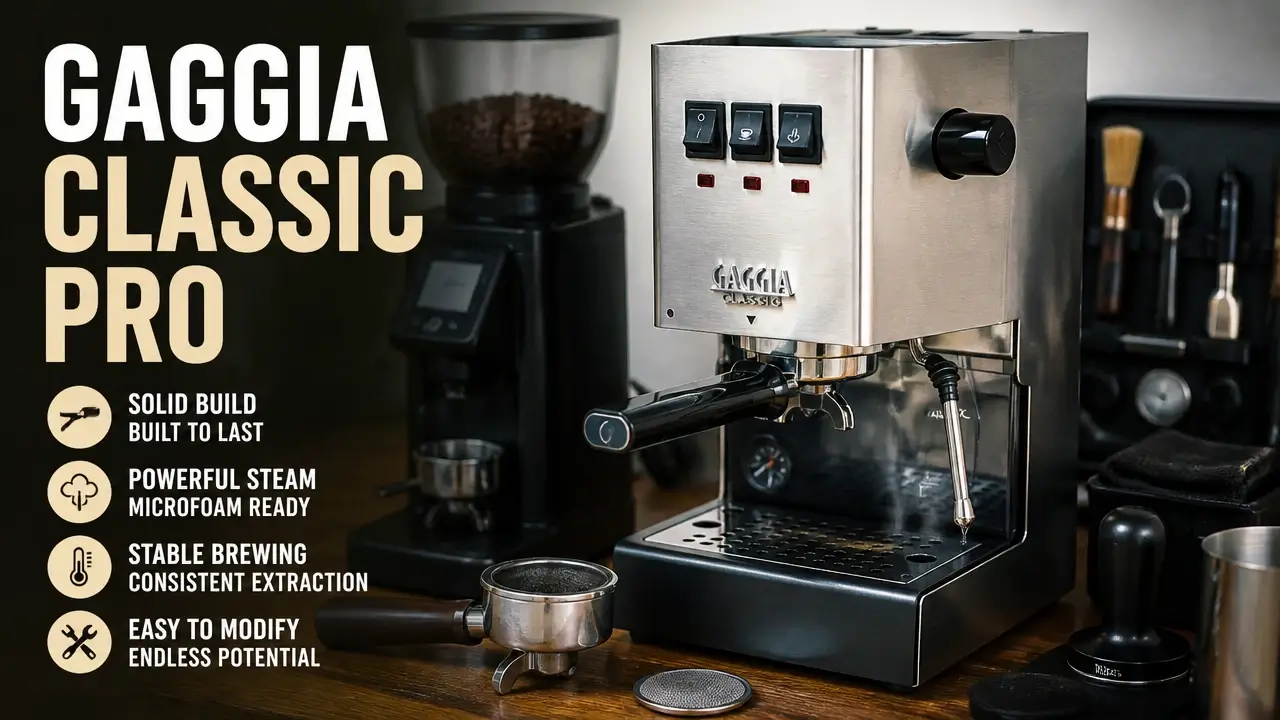
Every design decision inside the Gaggia Classic Pro E24 is a quiet invitation to upgrade, maintain, and eventually master the machine – and that’s exactly what separates it from every sealed, convenience-first rival at this price point.
Start with what you can see and feel. The 17-gauge stainless steel body and 19-pound frame give it a presence on the counter that feels genuinely different from plastic-chassis competitors. One r/espresso user who bought a second-hand Gaggia Classic in 2006 reported it was still their daily driver 17 years later . That kind of longevity isn’t luck – it’s the payoff of serviceable, repairable engineering.
The Brass Boiler Upgrade That Ended “Boilergate”
The E24’s new brass boiler – approximately 100ml, roughly 30% larger than the aluminum unit in earlier models – resolved what the community had been calling “Boilergate”: a coating failure issue where the old aluminum boiler’s lining would flake and contaminate shots over time . Brass doesn’t have that problem. It’s more thermally stable, it corrodes far less readily, and it signals that Gaggia was listening when the community got loud. The larger volume also modestly improves back-to-back shot capability, though the machine is still a single-boiler design – more on that later.
The 58mm Portafilter Advantage
The commercial-style 58mm portafilter is the feature that makes the GCP’s modding ecosystem possible. It’s “really heavy” and well-balanced , and more importantly, it opens the door to an enormous universe of aftermarket baskets, tampers, distribution tools, and pressure profiling accessories – all built to the same 58mm standard used in professional café equipment. No other machine at this price point offers that. The Breville Bambino Plus uses a 54mm group. The Barista Express has a proprietary portafilter. The GCP’s 58mm architecture is the reason community-driven mods like the Gaggiuino – a full open-source pressure profiling controller – exist and thrive.
The OPV Spring and Solenoid Valve
The factory-calibrated 9-bar OPV (over-pressure valve) and three-way solenoid valve are two more features that punch above the machine’s price. The solenoid releases pressure after the shot, which means dry pucks and no portafilter sneeze when you twist it off – a small thing that matters enormously in daily use. And if you want to dial the OPV down to 7 or 8 bar for more forgiving extractions? “You can get 3 OPV springs for $12 on eBay. And it takes 5 minutes” . That’s the modding ecosystem in miniature: real upgrades, accessible parts, minimal tools.
The aftermarket goes much further. A PID kit – which adds precise electronic temperature control to the boiler – runs about $75 on AliExpress and takes roughly two hours to install . It transforms the machine’s consistency in a way that no amount of temperature surfing can fully replicate. And the community around it is genuinely one of the best resources in home espresso: “Literally any question you have, someone has the answer” .
The included plastic tamper, by contrast, is – and I say this with full diplomatic restraint – a deliberate signal. It’s just about better than nothing , and its presence in the box is the machine’s way of telling you to budget for a real one immediately. That’s not an oversight. It’s the machine being honest about what it is: a platform, not a complete kit.
Here’s a walkthrough of a full PID installation on the Gaggia Classic Pro – including the OPV spring swap, before-and-after temperature stability graphs, and a shot-pulling comparison that shows exactly what the mod unlocks.
Under the Hood: Full Technical Specs, Real Costs, and Maintenance
No spin here. This section is just the data – what you get, what it costs, and what you’ll need to budget beyond the sticker price.
Core Specifications:
- Boiler: Brass, approximately 100ml (3.5 oz)
- Water Reservoir: 72 oz / 2.1L
- Pump: 15-bar Ulka; OPV calibrated to 9 bar
- Wattage: 1,425W (per SERP data) / 1,200W (Amazon listing – a minor discrepancy worth noting)
- Weight: 19–20 lbs depending on source
- Portafilter: 58mm commercial standard
- Steam Wand: 3.75 inches usable length
- Max Cup Height: 3.3 inches
- Heat-Up Time: Approximately two minutes
- Colors: Multiple options available
Price Reality Check:
The machine lists at $450.06 on Amazon (with 400+ units bought in the past month at time of writing) and $549 on the official Gaggia North America site . The sticker price, however, is not the real price.
Here’s what you’ll actually spend to make a genuinely good shot:
- Quality grinder: The single most important purchase. “Put 70% of your money into a grinder” . Budget $150–$300 minimum for a capable burr grinder.
- Decent 58mm tamper: $20–$50. The included plastic one is a placeholder.
- Stainless milk pitcher: $15–$25.
- Descaler: Gaggia-brand recommended; budget for periodic use.
- Optional PID kit: ~$75 if you want consistent temperature control.
- Optional OPV springs: ~$12 for three.
Factor those in, and the “real price tag” for a properly equipped GCP setup sits closer to $700–$800 – which, interestingly, puts it in the same conversation as the Rancilio Silvia.
Operating Quirks Worth Knowing:
The drip tray grille has a protective coating that must be peeled off before first use – easy to miss, and it will smell if you don’t. The water tank is “kind of tricky” to remove , which becomes mildly annoying in a small kitchen. There’s no dedicated hot water tap, but there’s a workaround: open the steam wand, then press steam and brew simultaneously . Inelegant, but functional.
Maintenance:
The simple, open architecture is one of the GCP’s genuine advantages here. Descale periodically. The three-way solenoid keeps the group head clean passively. Gasket replacement every few years. Parts are widely available, guides are everywhere, and “you can maintain it, repair it, mod it, and potentially keep it going for decades” . The single-boiler design reduces internal complexity, which is part of why the machine is so serviceable – but it also means you’re pausing between brew and steam, which has real workflow implications for anyone making multiple milk drinks.
This post contains affiliate links, meaning I may earn a commission if you make a purchase through these links, at no additional cost to you. As an Amazon Associate, I earn from qualifying purchases. I only recommend products I genuinely believe will add value.
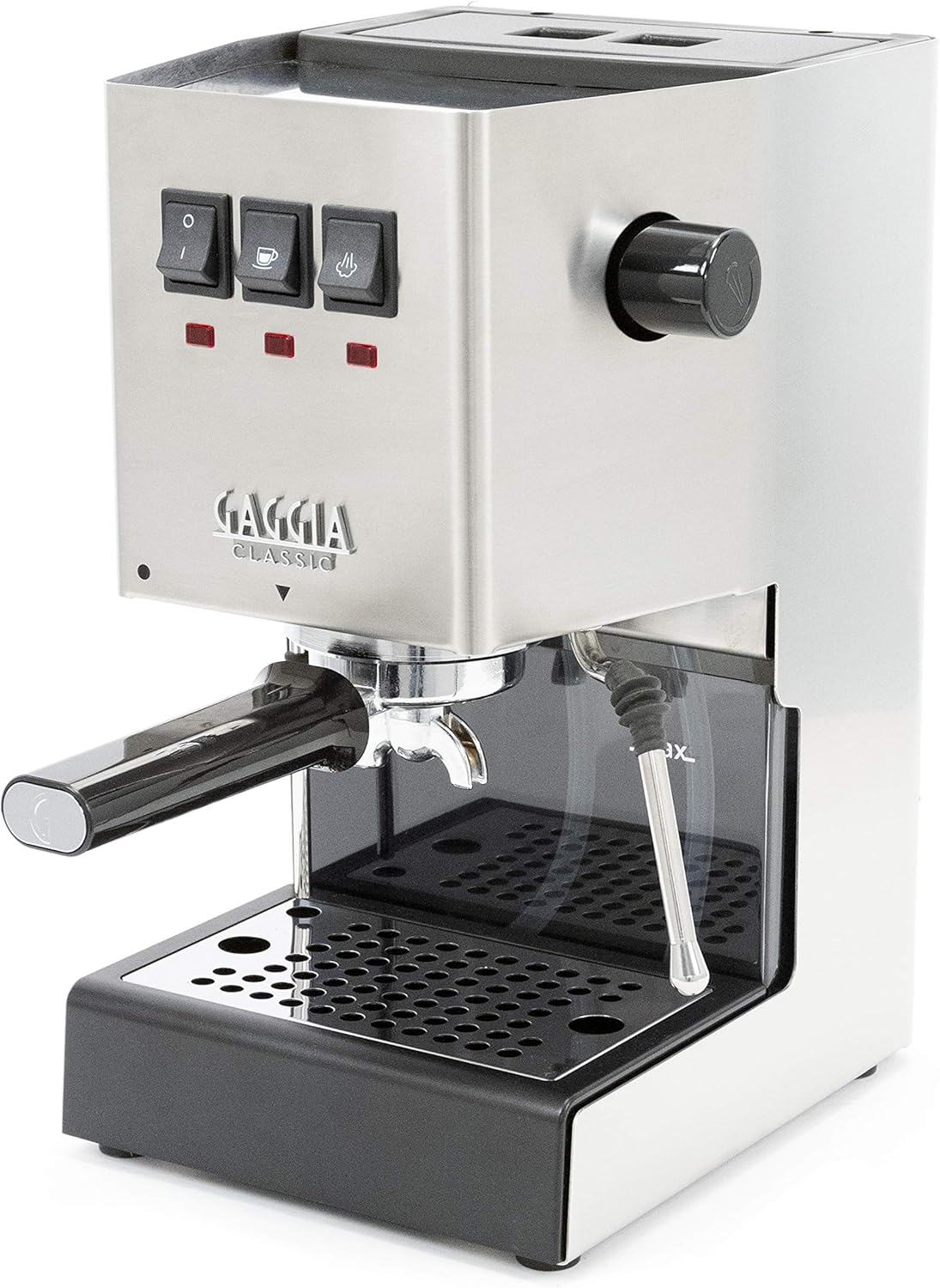
Gaggia RI9380/46 E24 Espresso Machine, Brushed Stainless Steel
- Solid Steel Housing, Made in Italy
- 9 Bar Espresso Extractions
- Stainless Steel 58mm Commercial Portafilter
- Commercial Three Way Solenoid Valve
- Commercial Steam Wand
Where the Gaggia Classic Pro Stands in the Espresso Machine Market
The Gaggia Classic Pro occupies a position in the sub-$500 espresso segment that no other machine quite fills – and understanding that position is the fastest way to know whether it belongs in your kitchen.
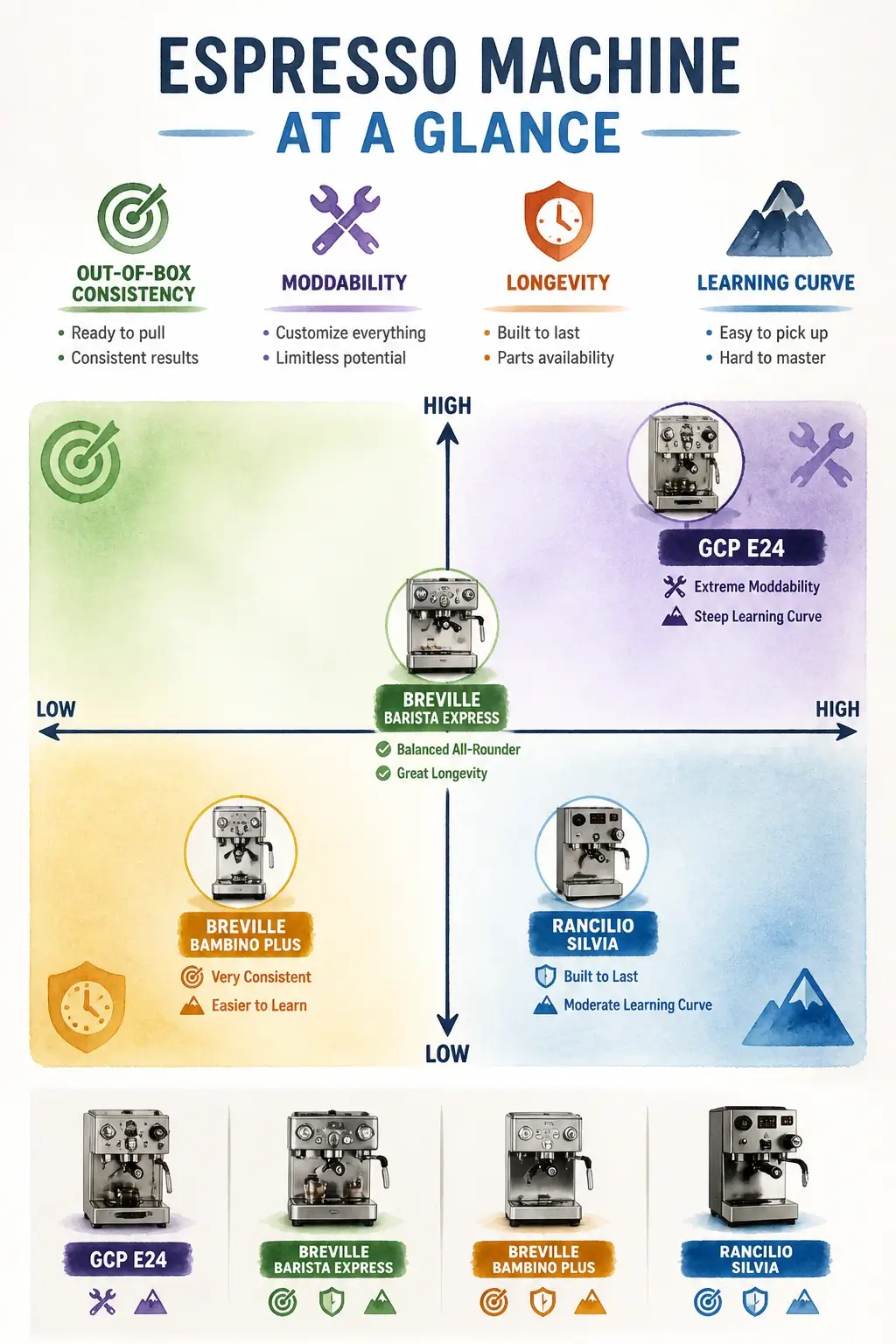
At $450, it sits directly alongside the Breville Bambino Plus at $498. On paper, these two machines are competitors. In practice, they are built for completely different people. The Bambino Plus heats up in three seconds, auto-steams milk, and is genuinely forgiving for beginners – but it uses a 54mm portafilter, has almost no aftermarket support, and is essentially a sealed appliance. You buy it, you use it, you don’t touch the internals. The GCP is the opposite on every axis.
Step up to the Rancilio Silvia at $700–$800, and you get a better out-of-box experience and a more refined single-boiler build – but you’re still dealing with a single boiler, still without a PID from the factory, and now you’ve spent significantly more. The Breville Barista Express bundles in a grinder and a PID, which sounds convenient until you realize the built-in grinder creates a ceiling on your upgrade path. When you outgrow it, you’re stuck.
The Gaggia Classic Up, at $849, is essentially a factory-modded GCP – it includes a PID, preinfusion, and a pressure gauge. If you want the GCP experience without the wiring project, that’s your machine. And if your budget stretches to $1,000, the Profitec Go adds adjustable pressure and a PID in a more refined package .
For a completely different workflow, the Flair 58 exists – manual, no boiler, a very different kind of project – but it comes with “its own pain points” and isn’t a direct substitute.
The GCP’s unique selling proposition is specific and almost impossible to replicate at this price: a full-size commercial 58mm group, a 9-bar OPV, a three-way solenoid valve, a brass boiler, and one of the most active aftermarket modding communities in home espresso – all under $500. The official marketing frames it as delivering café-quality extractions out of the box. The community and professional reviewers consistently show that consistent results require either learned temperature surfing or a PID mod. That gap is real, and it’s the gap that sorts the right buyer from the wrong one.
Here’s a side-by-side look at how the GCP stacks up against its closest rivals across the features that actually matter for this decision.
While Gaggia champions traditional manual workflow, those weighing appliance-style convenience against entry-level prosumer capability should compare these mechanics against the best breville espresso machines currently dominating the market.
The Honest Truth: Why This Machine Will Frustrate Convenience Seekers
The Gaggia Classic Pro will produce genuinely excellent espresso – but it will not do it automatically, immediately, or without asking you to learn a few things first. For the wrong buyer, those requirements don’t feel like a learning curve. They feel like a broken product.
The most immediate friction point is temperature. Without a PID, the GCP’s boiler runs on an unregulated thermostat that overshoots its target temperature after heating up. Pull a shot immediately after the ready light comes on, and you’re likely extracting into a scalding group head. The fix is a purge – running a few seconds of water through the group head before locking in the portafilter – but this is a ritual that has to become second nature. “I found my espresso to be way too hot. I’d recommend always purging the group head for a few seconds before pulling a shot” . That kind of necessary ritual is exactly what the convenience-seeking buyer wants to avoid, and exactly what the tinkerer finds satisfying once it’s internalized.
The steam situation is similarly nuanced. The GCP’s steam is genuinely more powerful than what you get from the Bambino Plus or the Barista Express – when timed correctly. The catch is that “correctly” means starting to steam about five seconds before the steam light comes on, to catch the boiler at peak pressure . The 3.75-inch wand with no ball joint also limits how you can position the pitcher, which makes microfoam a real skill check rather than a guided process. You can get excellent results. It takes practice.
Then there’s the accessory tax. The plastic tamper in the box needs to be replaced before your first serious shot. The machine doesn’t include a milk pitcher. And if you don’t already own a quality burr grinder, the GCP will expose every weakness in a mediocre one – inconsistent grind size is the fastest way to make this machine look bad, and it’s almost always the grinder’s fault, not the machine’s.
Lauro Fioretti, an espresso equipment and grinding specialist interviewed in Perfect Daily Grind’s coffee technology coverage, explains the extraction instability that temperature swings create at the grinder level:
“When the temperature [inside your grind chamber] is increasing, you see that your shot times get shorter and shorter and shorter. So your coffee is extracting faster, so they have to tune up the grinder to make it finer, finer, and finer to compensate for this effect.”
That dynamic – where temperature instability cascades from boiler to grinder to shot – is the core technical argument for the PID mod. Without it, you’re chasing a moving target every morning.
The single boiler’s 100ml volume also creates a real workflow bottleneck for anyone making multiple milk drinks. Pulling a shot and then waiting for the boiler to climb to steam temperature, then waiting again for it to cool back down for a second shot – that sequence feels glacial when you’re making lattes for two people. Every missing convenience feature on this machine – no PID, no auto-steam, no hot water tap, a small drip tray, a fiddly water tank – is a conscious trade-off to keep the architecture open, serviceable, and affordable. For the tinkerer, these are the price of admission to a platform worth owning. For the convenience seeker, they’re just friction.
The E24’s brass boiler fixed the Boilergate corrosion saga that damaged the machine’s reputation in earlier iterations , but mixed durability signals in Amazon reviews – some units reportedly failing within the first week – may unsettle anyone who just wants a reliable appliance and has no interest in opening the case.
Buyers seeking effortless one-touch morning routines rather than hands-on extraction mechanics will find significantly better alignment within our curated selection of super automatic espresso machines.
The Final Verdict: Buy It if You Tinker, Skip It if You Want Simplicity
The Gaggia Classic Pro E24 is the gold standard for budget espresso machines – but that title only holds for the person who’s willing to earn it. Here’s where I land.
Buy this if:
- You’re a tinkerer or aspiring hobbyist who sees a $75 PID kit and a 5-minute OPV spring swap as a fun Saturday project, not a warranty concern .
- You value long-term ownership and want a machine you can repair, mod, and keep running for decades rather than replace every three years .
- You already own – or are budgeting for – a quality burr grinder and understand that the grinder is where most of your investment should go .
- You want access to the full 58mm accessory ecosystem: aftermarket baskets, precision tampers, distribution tools, and community-driven projects like the Gaggiuino open-source pressure profiling controller.
Skip this if:
- You want push-button convenience and one-touch milk drinks. The Breville Bambino Plus – three-second heat-up, automatic microfoam, genuinely forgiving for beginners – is the right machine. It does everything the GCP refuses to do, and it does it without asking anything of you first.
- You’re a complete beginner with no interest in the mechanics. Temperature surfing, group head purging, and puck prep will feel like obstacles, not rituals.
- You need to make multiple milk drinks in quick succession. The single boiler and warm-up times will test your patience in ways that feel unreasonable if you didn’t sign up for it.
- You’re worried about long-term reliability and have no desire to open the case. The E24 brass boiler resolved Boilergate, but if mixed durability signals in early Amazon reviews make you nervous, a machine with a stronger out-of-box reliability reputation will serve your peace of mind better.
For the excluded group – the convenience seeker, the busy household, the beginner who just wants excellent coffee with zero friction – the Breville Bambino Plus at $498 is the honest recommendation. It’s not a lesser machine for that buyer. It’s the right machine. The GCP doesn’t compete with it; they’re solving different problems for different people.
For the tinkerer, the aspiring home barista, the person who already spent Sunday afternoon watching PID installation videos and found themselves genuinely excited? The Gaggia Classic Pro E24 is, without ambiguity, your machine. Buy it, mod it, and join one of the best communities in home coffee. You’ll still be pulling shots on it in 2040.
Key Takeaways on Gaggia Classic Pro
- The Gaggia Classic Pro E24 rewards tinkerers and punishes convenience seekers — knowing which one you are is the only buying decision that matters.
- The E24 brass boiler resolves the “Boilergate” corrosion issue from earlier models, making this the most reliable version of the machine to date.
- The 58mm commercial portafilter unlocks an enormous aftermarket ecosystem unavailable on any direct competitor at this price point.
- Budget the real cost at $700–$800 once you factor in a quality grinder, tamper, and optional PID — the sticker price is just the starting point.
- Without a PID mod, temperature surfing and group head purging are non-negotiable daily rituals, not optional techniques.
- The Breville Bambino Plus is the genuinely better choice for beginners who want push-button results — not a consolation prize, but the right tool for a different job.
Frequently Asked Questions About Gaggia Classic Pro
Does the Gaggia Classic Pro need a PID to pull decent shots?
No, but your consistency will vary without one. Temperature surfing — purging the group head and timing your pull carefully — can get you close, but a $75 PID kit removes the guesswork entirely and is the single most impactful upgrade you can make.
What’s the difference between the Gaggia Classic Pro and the Gaggia Classic Up?
The Classic Up ($849) is essentially a factory-modded GCP — it includes a built-in PID, preinfusion, and a pressure gauge. If you want those features without the wiring project, the Up is worth the premium; if you enjoy the mod process, the standard GCP gives you the same destination for less money.
How long does the Gaggia Classic Pro take to heat up?
Around two minutes to reach brewing temperature, but that’s not the full picture. You’ll want to add a group head purge after the ready light comes on to flush excess heat — so realistically, budget three to four minutes before your first shot.
Is the Gaggia Classic Pro good for milk drinks like lattes and cappuccinos?
It can produce excellent microfoam, but the 3.75-inch steam wand with no ball joint demands real technique. The bigger issue is the single boiler — switching between brew and steam temperatures creates waiting time that makes back-to-back milk drinks genuinely slow.
What grinder should I pair with the Gaggia Classic Pro?
Spend at least as much on the grinder as you’re comfortable with — the community rule of thumb is 70% of your total budget on the grinder. Entry-level options like the Baratza Encore ESP or the DF64 are common starting points; going cheap here will make the GCP look worse than it is.
Can I use the Gaggia Classic Pro with ESE pods?
Yes, the machine includes a pressurized basket that accepts ESE (Easy Serve Espresso) pods, but most serious users swap immediately to an unpressurized basket for full control over extraction with fresh ground coffee.
How hard is the OPV spring swap on the Gaggia Classic Pro?
It’s genuinely simple — about five minutes, no specialist tools, and replacement springs cost around $12 for a set of three on eBay. Dialing the OPV down from 9 bar to 7–8 bar is typically the first mod most users make, and it has a noticeable effect on shot quality.
What exactly was “Boilergate” and is it fixed in the E24?
Earlier Gaggia Classic models used an aluminum boiler with an internal coating that could flake off over time, contaminating shots and eventually failing. The E24 switched to an uncoated brass boiler — more thermally stable, corrosion-resistant, and with roughly 30% more volume. The issue is resolved in this generation.
References
- r/espresso community threads — reddit.com
- Gaggia Classic Pro product listing and review data — amazon.com
- Gaggia Classic Pro full review — wholelattelove.com
- Gaggia Classic Pro analysis and mod guides — home-barista.com
- How ground coffee temperature causes uneven espresso extraction — perfectdailygrind.com