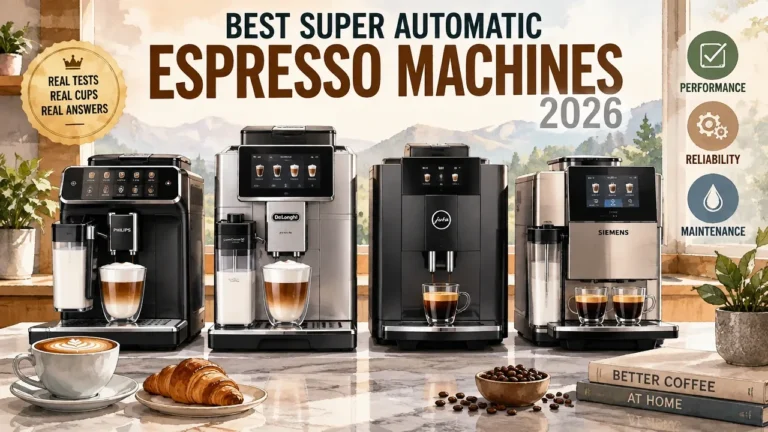

The best super automatic espresso machines promise a barista-quality shot at the press of a button – and they mostly deliver, right up until the milk circuit grows something you don’t want to think about. That gap between the marketing promise and the maintenance reality is where most buyers get burned.
This guide ranks four serious contenders – the Gaggia Magenta Plus, De’Longhi Magnifica Evo, Terra Kaffe TK-02, and Philips 3200 LatteGo – not by who has the flashiest touchscreen, but by brew group serviceability, milk sanitation design, grinder friction with real-world beans, and what you’ll actually spend over two years of daily use.
Key Takeaways on Best Super Automatic Espresso Machines
- Pressurized brew chambers simulate barista crema mechanically – you’re trading micro-dialing precision for push-button repeatability, not getting equivalent extraction.
- Milk circuit design is the single most important hygiene variable: tubeless systems (Philips LatteGo) are dramatically easier to keep clean than tubed carafes.
- Damp grounds in any waste tray can support mold within 48 to 72 hours – daily emptying and open-air drying are maintenance minimums, not optional habits.
- Removable brew groups (Gaggia, De’Longhi, Philips) keep long-term service costs predictable; sealed internal groups add professional refurbishment expenses that compound over years.
- Oily dark roasts accelerate burr gumming and hopper buildup in ceramic grinder machines – medium roasts extend cleaning intervals noticeably.
- The “pays for itself” payback math is real only if you account for beans, milk, filters, descalers, lubricant, electricity, and eventual repairs – not just the sticker price versus café spend.
How We Ranked These Super-Automatics: Convenience, Sanitation, and True Cost
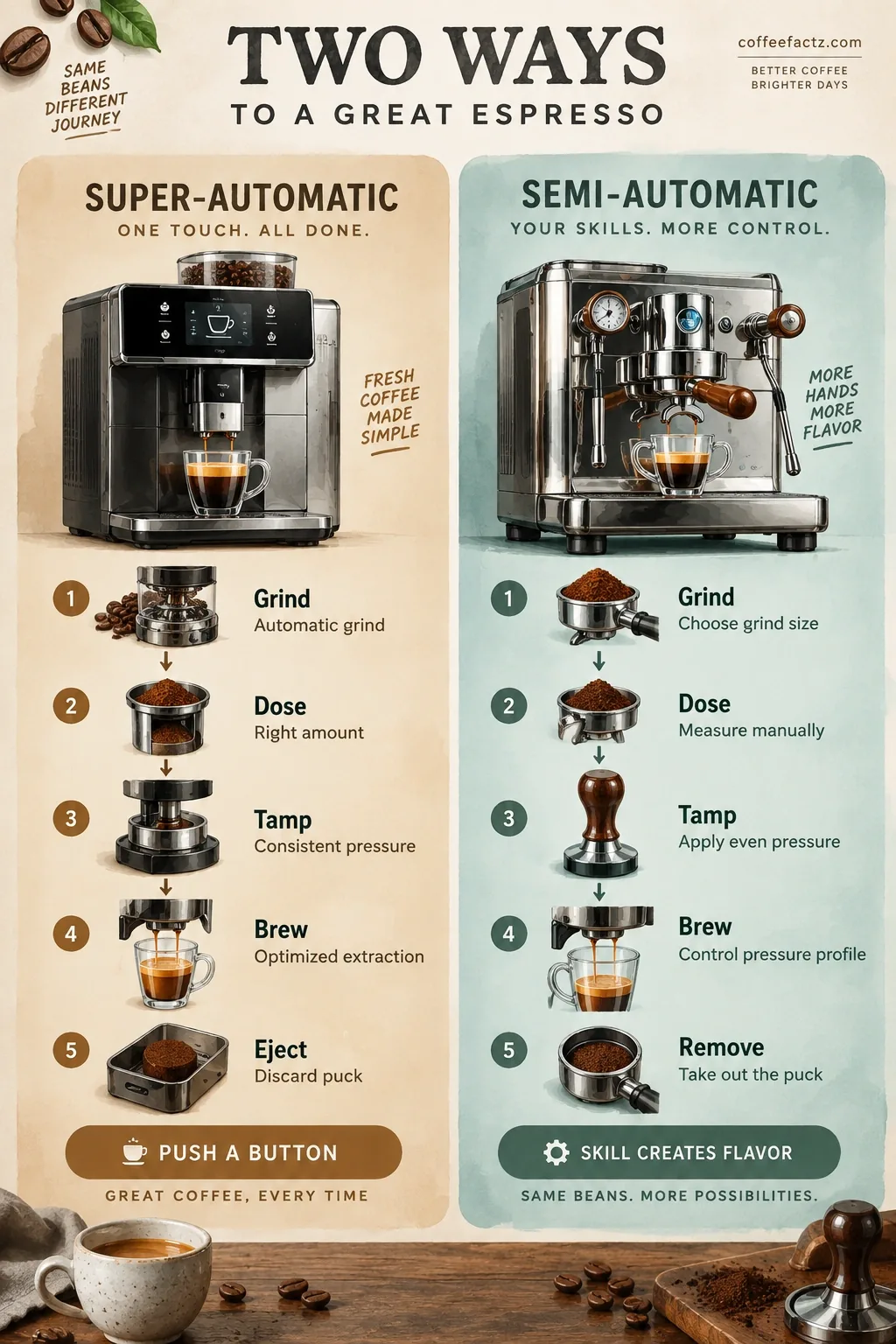
Every super-automatic on this list automates the five steps that separate a great espresso from a mediocre one: grinding, dosing, tamping, brewing, and puck ejection. For busy professionals and multi-user households, that’s a genuinely compelling trade. Nobody has to remember the right grind setting at 6:30 AM. The machine just handles it.
But here’s the part the spec sheet skips: every one of those automated steps creates a surface that needs cleaning. The question isn’t which machine makes the best espresso on day one. It’s which machine you’ll still be maintaining correctly on day 400.
Push-Button Workflow Mechanics
The super-automatic workflow is built around pressurized brew chambers and mechanical flow restrictors. These components are doing something specific: they’re simulating the thick crema you’d get from a trained barista pulling a non-pressurized shot at a calibrated 9 bars. The crema looks right. The cup often tastes right. But the underlying physics are different – you’re not getting true barista extraction with manual puck prep, fine burr calibration, or pressure profiling. You’re getting a very convincing mechanical approximation.
For most people drinking espresso at home, that approximation is perfectly satisfying. For someone who wants to dial in a single-origin light roast to 0.1g precision, a super-automatic will feel like a creative straitjacket. That’s not a flaw – it’s a deliberate design priority: repeatability over micro-control.
The real ranking starts where marketing stops. Once you accept the convenience trade-off, the meaningful differences between machines come down to three things: how well the milk system handles daily hygiene, how accessible the brew group is for weekly maintenance, and what the machine actually costs to run over two years.
Here’s a look at how the super-automatic workflow compares to a semi-automatic setup across those dimensions:
Ownership Benchmarks and Budget Tiers
Ranking these machines on a single linear scale would be misleading. As Epicurious correctly notes, there is no single best espresso machine for everyone – the right pick depends on your workflow, budget, automation preference, and how much daily upkeep you’ll realistically commit to. So this guide uses fit-based placement across three price tiers: budget (under $1,000), mid-tier ($1,000–$2,000), and premium ($2,000+).
Within each tier, machines are evaluated on five criteria: milk system type, brew group access, mold and damp grounds risk, grinder heat and oily-bean friction, and two-year ownership costs. These aren’t arbitrary categories – they’re the variables that determine whether a machine is still pulling clean shots in year three or sitting in a repair queue.
On lifespan: bean-to-cup machines aren’t disposable appliances. According to data compiled by Novebar from Graindexpert’s March 2026 analysis, entry-level machines (under roughly $375) typically last 6 to 9 years, mid-range models stretch to 8 to 10 years, and high-end machines can reach 10 to 15 years – but only when weekly brew group rinsing, regular descaling, milk system cleaning, and prompt waste tray hygiene are non-negotiable habits, not occasional chores.
Gaggia Magenta Plus: The Enthusiast’s Manual-Microfoam Super-Automatic
The Gaggia Magenta Plus occupies a specific niche: it’s a super-automatic that hasn’t fully surrendered control to the machine. The commercial-style steam wand is the tell. Most bean-to-cup machines hide a one-touch frother behind a sleek panel. Gaggia kept the wand exposed – and that single design choice changes who this machine is for.
Affiliate Disclosure
This post contains affiliate links, meaning I may earn a commission if you make a purchase through these links, at no additional cost to you. As an Amazon Associate, I earn from qualifying purchases. I only recommend products I genuinely believe will add value.

Gaggia Magenta Plus Super-Automatic Espresso Machine, 60 ounces,Black
- On the Fly Programming: Making changes to your favorite drinks has never been easier. Any time you brew a drin…
- Full Color Display: Your favorite drinks have never looked better! Crisp icon based navigation makes brewing f…
- Commercial Steam Wand: The best milk drinks are prepared with a true commercial steam wand. Gaggia puts authen…
- One Size Fits All: The updated drip tray and cup riser are an innovative and simple solution to prevent splash…
- Compact Design: Based on the Anima series espresso machines, the Magenta Plus inherits the same slim design at…
Ceramic Burr Settings and Steam Wand Operation
The Magenta Plus runs 5-setting ceramic flat burrs inside a notably compact chassis. Five steps isn’t a wide range – you’re working with coarser adjustments than you’d get on a dedicated grinder – and that limited granularity shows when you’re trying to dial in a light roast versus a medium. The grind steps are meaningful enough for everyday espresso, but if you’re chasing extraction precision across a rotating roster of single-origins, you’ll hit the ceiling quickly.
Where the machine earns its enthusiast label is the steam wand. Remove the Panarello sleeve, and you have a genuine manual steaming setup: you’re controlling the pitcher angle, the steam pressure, and the vortex yourself. That’s how microfoam for latte art actually gets made – not by a one-touch frother, but by a skilled hand. As Craft Coffee Spot points out, most fully automatic machines produce thick foam suitable for cappuccino but fall short of the silky microfoam a latte demands. The Magenta Plus is a rare exception among super-automatics, but only if the owner actually learns to use the wand. If you skip the learning curve and leave the Panarello on, the advantage is entirely theoretical.
One friction point worth knowing: dark oily roasts can cause problems in this hopper. The oils from heavily roasted beans coat the vertical funnel and gradually gum up ceramic burrs, slowing grind consistency and requiring more frequent cleaning. Medium roasts behave significantly better here. If your daily driver is a dark French roast, factor in more frequent hopper cleaning.
Brew Group Cleaning and Waste Tray Hygiene
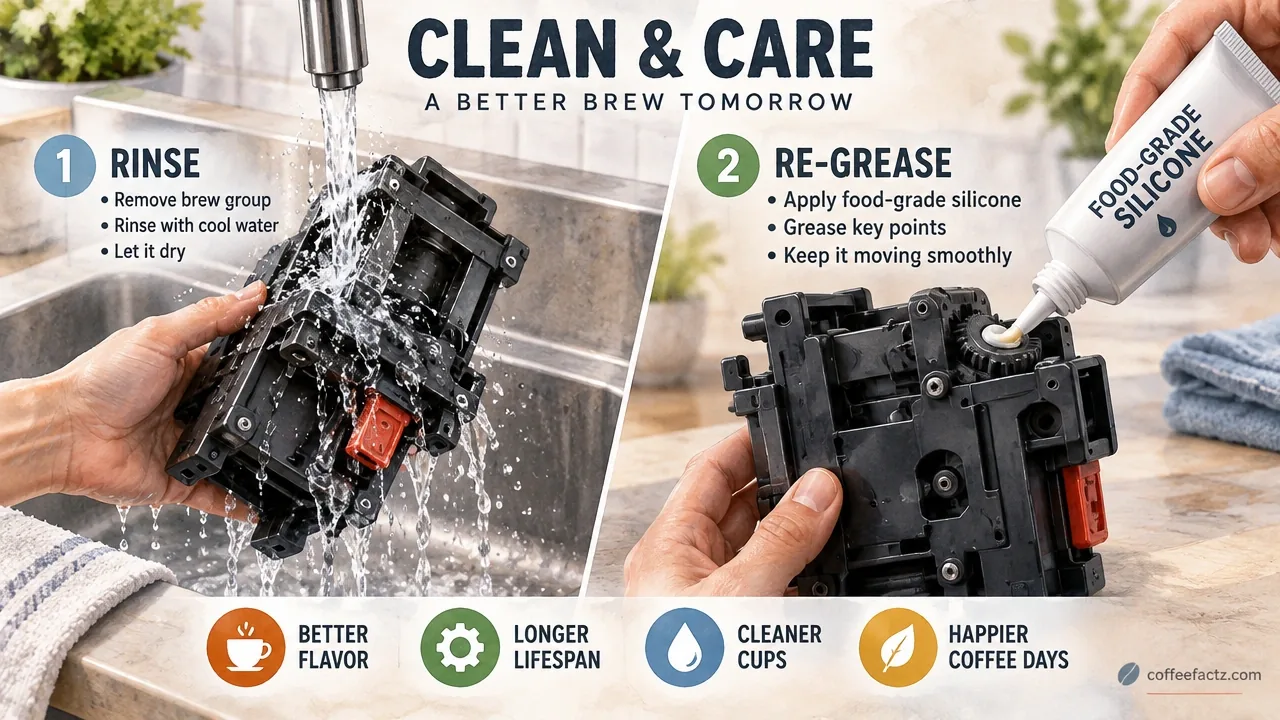
The Magenta Plus has a removable brew group – and this matters more than most buyers realize at purchase. Pull it out weekly, rinse it under the tap, apply a thin coat of food-grade silicone grease to the seals, and you’ve done the core maintenance. It takes about five minutes once you’ve done it a few times.
“The brew group is the heart of every fully automatic coffee machine, and should be cleaned regularly. The removable brew group allows you to clean it thoroughly just by rinsing it under the tap.” – Philips, Manufacturer of fully automatic espresso machines
That simplicity is the counterargument to sealed internal groups found in machines like Jura, which require proprietary chemical cleaning tablets and periodic professional servicing. A user-serviceable group keeps long-term maintenance costs predictable and in your control.
The waste tray is a different story. Spent pucks land in a warm, damp internal container, and that environment is exactly what mold needs to get started. Enthusiast forums consistently report that 48 to 72 hours is roughly the window before damp grounds become a sanitation problem – not an exaggeration, just the physics of warm, humid organic material sitting in an enclosed space. Empty the tray daily, leave it open to air-dry, and you won’t have an issue. Let it sit over a long weekend, and you will.
De’Longhi Magnifica Evo (ECAM29084SB): The One-Touch Mainstream Benchmark
If the Gaggia is for people who want to stay involved, the De’Longhi Magnifica Evo is for people who want to step back entirely. The LatteCrema system handles milk automatically. The one-touch beverage icons are self-explanatory. The interface requires no learning curve. For a multi-user household where different people want different drinks, this machine makes a compelling case.
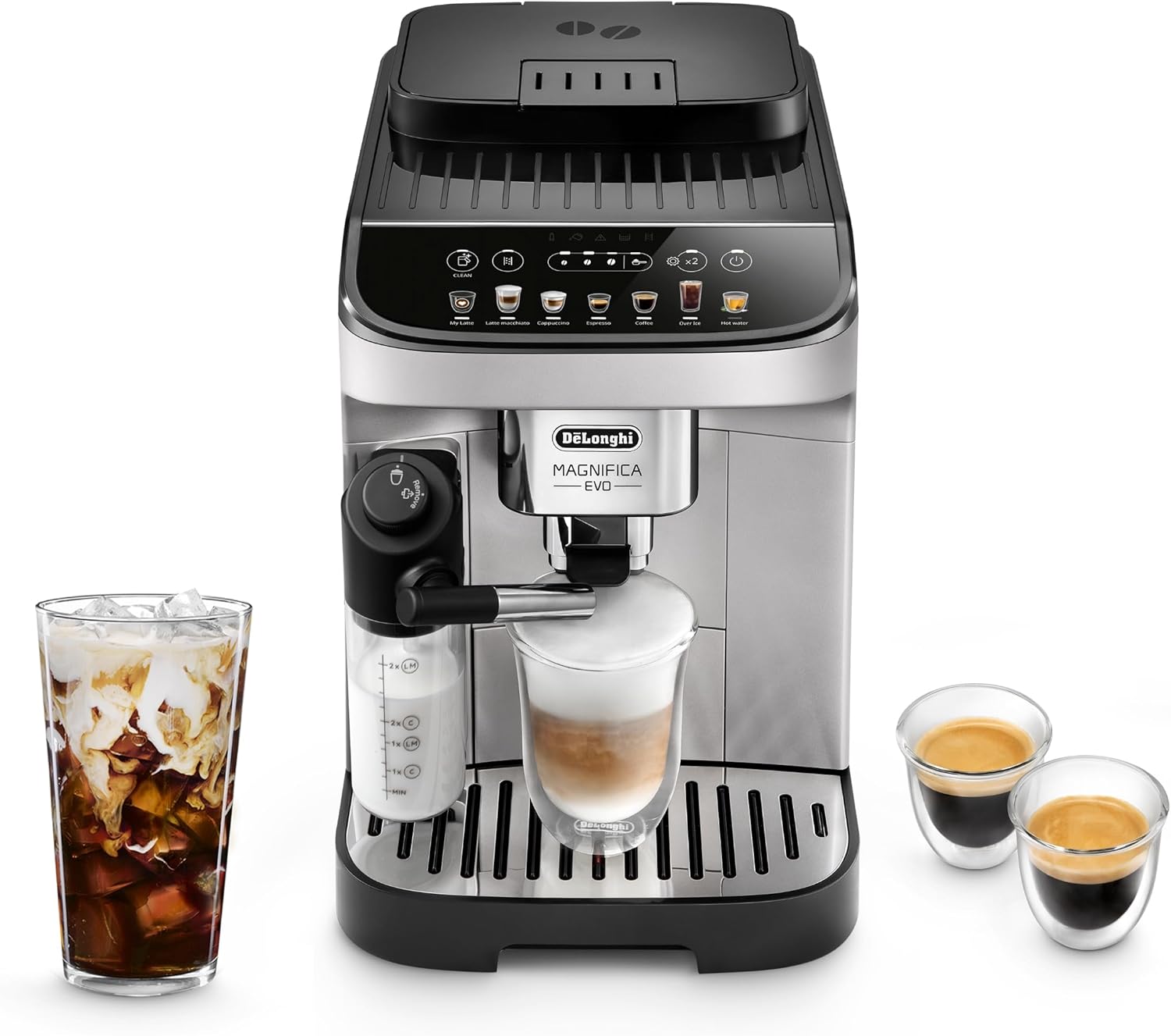
De'Longhi Magnifica Evo Automatic Espresso Machine, Milk Frother, Silver
- PERSONALIZE WITH MY LATTE: Allows you to personalize and save your own recipes
- EASY TO CLEAN: Removable and dishwasher-safe parts for easy cleaning
Conical Burr Grinding and Automatic Frother Performance
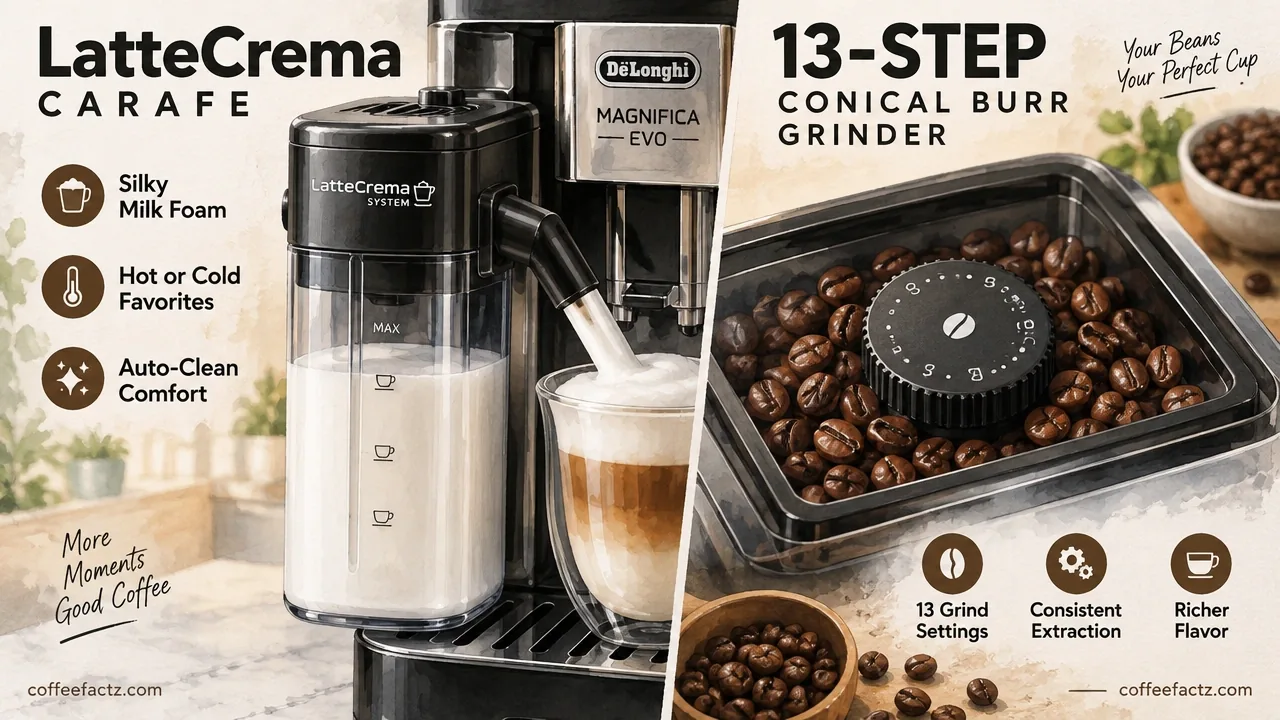
The Magnifica Evo uses a 13-step steel conical burr grinder – a meaningful step up in range from the Gaggia’s five-step ceramic setup. Thirteen steps gives you real flexibility across roast profiles, and steel conical burrs handle the daily grind load for medium roasts with consistent particle distribution. They do still need periodic cleaning; steel burrs aren’t immune to oil buildup, just more tolerant of it than ceramic equivalents.
The proprietary LatteCrema automatic milk frother is the headline feature. One button produces cappuccino or latte foam without any manual technique. Compared to a manual steam wand, it’s slower to produce genuine microfoam texture, and the foam density sits closer to the cappuccino end of the spectrum than a true flat-white texture. Compared to tubeless carafes like the Philips LatteGo, the LatteCrema uses internal milk pathways – which means the cleaning routine is more involved. More on that in a moment.
Brew Group Service, Carafe Hygiene, and Waste Container Management
The Magnifica Evo’s brew group is removable and follows the same weekly maintenance rhythm as the Gaggia: rinse under the tap, re-grease the seals with food-grade silicone, and replace. If you compare this to a sealed internal group – the kind found in higher-end Jura models – the difference in long-term service costs is significant. Sealed groups require proprietary chemical tablet cycles and, eventually, professional refurbishment that can run several hundred dollars. A user-serviceable group keeps that cost near zero if you stay consistent.
The LatteCrema carafe is where the Magnifica Evo’s convenience promise gets complicated. The carafe and its internal milk pathways need a daily rinse – not a weekly rinse, a daily one. Milk residue left in warm internal tubing overnight creates exactly the conditions for bacterial growth and, over time, calcified buildup that’s difficult to clear without chemical descalers. TechRadar’s review of the machine explicitly flags that users must empty the grounds container and drip tray daily, clean the brewing group frequently, and leave components open to dry overnight. That’s not a minor footnote – it’s a daily commitment that the one-touch interface somewhat obscures.
The damp grounds risk follows the same 48-to-72-hour logic as every other machine in this category. A study published in Applied Microbiology and Biotechnology isolated 272 filamentous fungi from coffee pulp and husk environments, noting that the combination of residual proteins, sugars, and high humidity creates conditions for rapid microbial colonization – with Aspergillus and Penicillium among the genera that establish quickly. Damp grounds in a sealed waste tray are a functionally similar environment. Empty it daily, leave the tray open to dry, and this isn’t a problem. Let it accumulate, and you’re not just dealing with mess – you’re dealing with mold.
The Magnifica Evo’s convenience only holds if you accept that the daily sanitation loop is part of the deal.
Terra Kaffe TK-02: The Smart-Connected Hybrid Experiment
The Terra Kaffe TK-02 approaches the super-automatic category from a different angle: instead of refining the mechanical workflow, it layers connectivity on top of it. Wi-Fi recipe profiling, pre-infusion pressure staging, and a dual-hopper design for both espresso and drip brewing are the headline differentiators. Whether those features justify the added complexity depends entirely on how you actually use the machine day to day.

Terra Kaffe TK-02 Super Automatic Espresso Machine - White
- FULLY CUSTOMIZABLE DRINKS - This fully automatic espresso machine offers over 100,000 drink combinations, givi…
- ROASTER-APPROVED ESPRESSO SETTINGS - Unlock expert-level espresso by scanning QR codes on TK Shop coffee purch…
- DRIP COFFEE AND ESPRESSO - With its advanced hybrid brew unit, our espresso coffee machine can prepare authent…
- SMART TECHNOLOGY - Every drink you create is automatically saved to your personal Terra Kaffe account, keeping…
- AUTOMATIC WAKE AND SLEEP - Use the app to set your machine's auto-wake and sleep times, so it’s always ready w…
Wi-Fi Recipe Profiling and Pressure Staging
The TK-02’s smart-connected design lets you adjust brew recipes through a companion app – grind coarseness, brew temperature, shot volume, and pre-infusion duration can all be tuned remotely. What you can’t do via app is override the machine’s fundamental pressurized brew architecture. The extraction physics are still super-automatic; the app refines parameters within that envelope, it doesn’t replace the envelope with true barista-grade non-pressurized extraction.
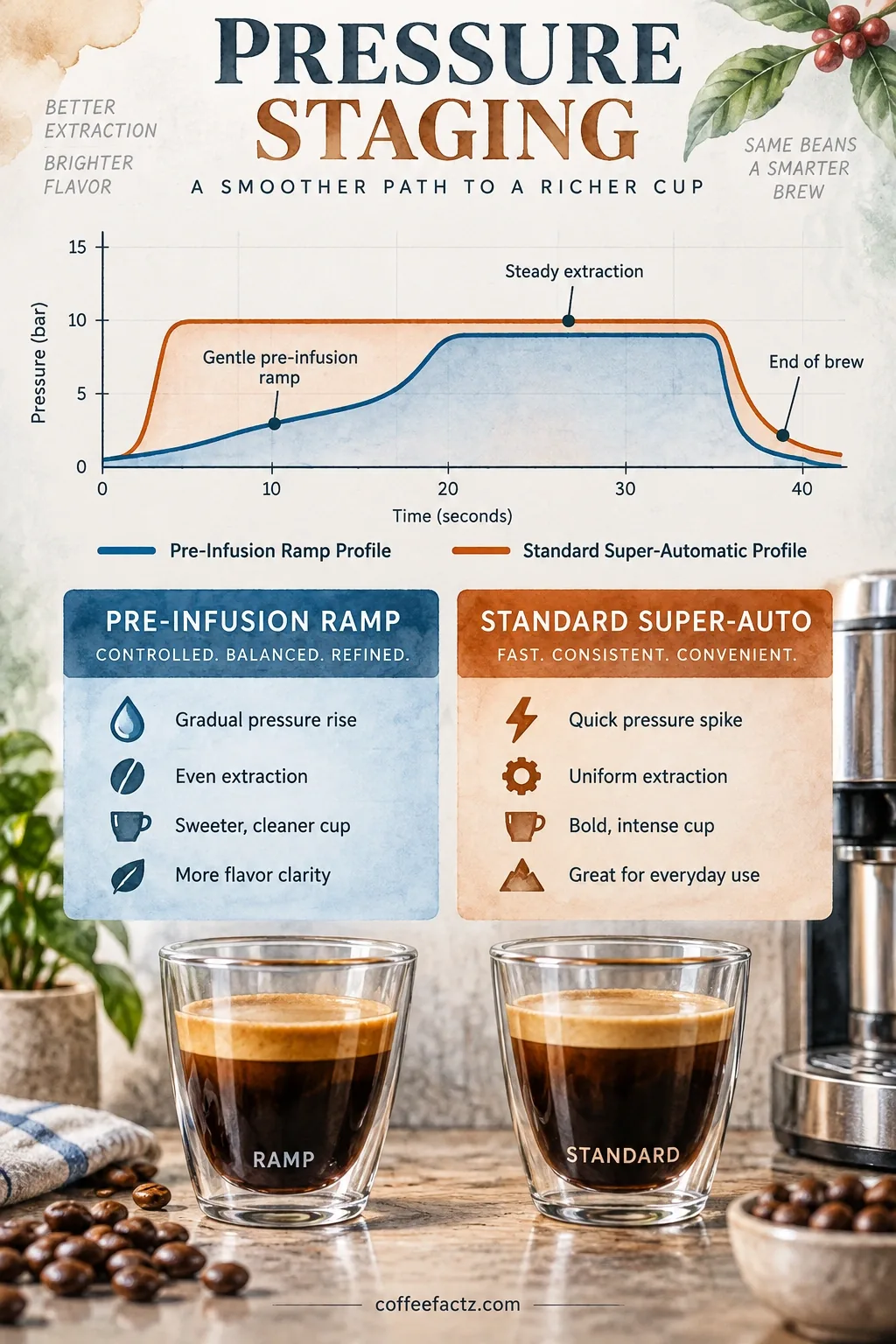
The pre-infusion pressure staging is the more mechanically interesting feature. By briefly saturating the puck at low pressure before ramping to full brew pressure, the TK-02 allows more even water distribution through the coffee bed. The practical result is reduced channeling and more consistent extraction shot-to-shot – a genuine improvement over standard one-pressure super-automatic brew cycles, particularly for medium roasts where extraction consistency matters most.
What the connectivity doesn’t address is the ownership math. Terra Kaffe and some reviewers frame the machine’s price as an investment that “pays for itself” by replacing café visits – but that calculation typically counts only the retail price of a daily latte against the machine’s sticker price, ignoring beans, milk, water filter replacements, descaling solution, grouphead lubricant, electricity, and eventual repair costs. The TK-02’s smart features are a legitimate workflow upgrade. They’re not a financial shortcut.
Dual-Hopper Bean Handling and Brew Group Upkeep
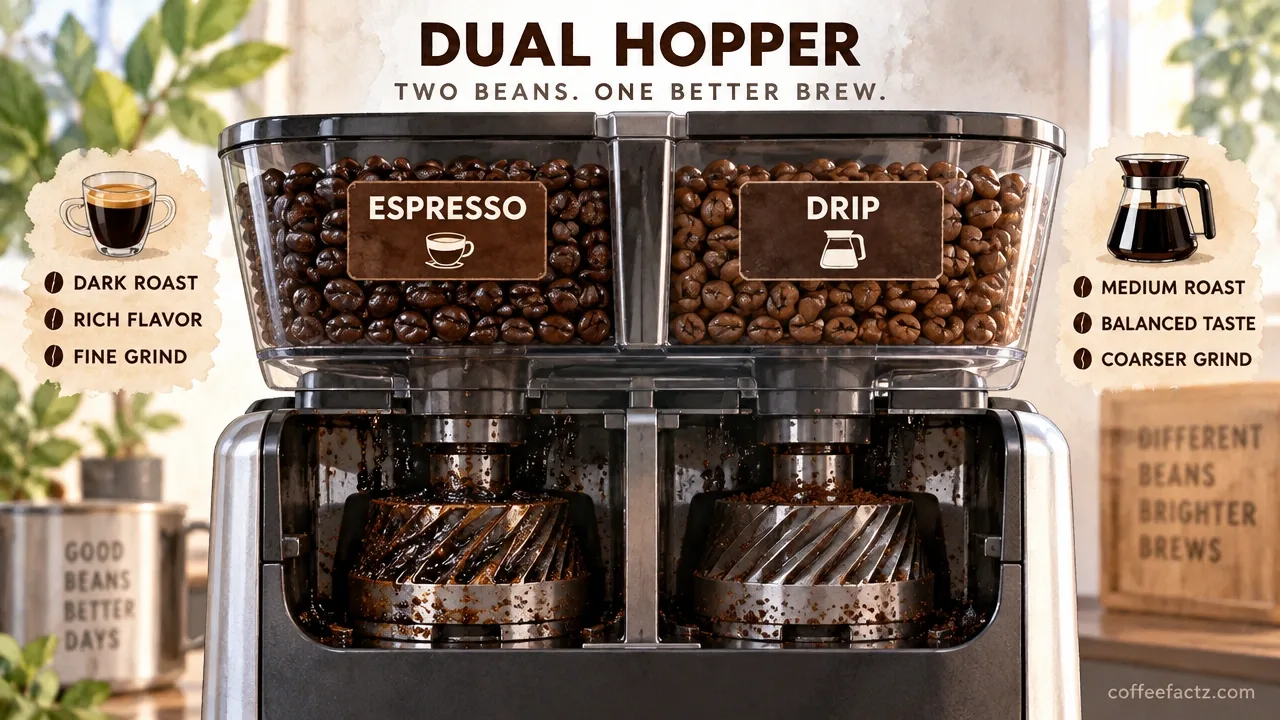
The dual-hopper design is the TK-02’s most practical differentiator for households with mixed coffee preferences. One hopper handles espresso beans; the other handles drip-style coffee. That means a household where one person wants a cortado and another wants a filter-style morning cup can accommodate both without swapping beans or using a separate machine. The flexibility is real.
The maintenance implications, however, are also real. Two hoppers mean two surfaces accumulating bean oils, two grinder paths to monitor for buildup, and twice the cleaning frequency if you’re running different roast profiles. Oily dark roasts are particularly problematic in a dual-hopper setup – the oils coat hopper walls and gradually gum burrs faster than medium roasts do, and in a dual-hopper machine, you may not notice the buildup in one hopper until grind consistency starts dropping.
Brew group maintenance follows the standard removable-group protocol where applicable: weekly rinsing and re-greasing. The waste tray damp grounds risk is identical to every other machine in this category – 48 to 72 hours is the window before you have a mold problem, not a hygiene inconvenience. If the TK-02 is equipped with a milk system, that circuit needs daily rinsing for the same reasons that apply to the Magnifica Evo’s LatteCrema.
Philips 3200 Series with LatteGo (EP3241/54): The Low-Maintenance Milk Sanitation Pick
The Philips 3200 LatteGo was designed around a specific problem: milk circuits are where super-automatics go wrong. Internal tubing, valves, and pathways that touch warm milk every morning and then sit idle for 18 hours are a hygiene liability. Philips’ answer was to eliminate the tubing entirely.

Philips 3200 Series Fully Automatic Espresso Machine, LatteGo Milk Frother, 5 Coffee Varieties, Intuitive Touch Display, 100% Ceramic Grinder, AquaClean Filter, My Coffee Choice, Black (EP3241/54)
- 5 AROMATIC COFFEES: Enjoy your favorite coffees for special moments. Whether you crave an espresso, coffee, am…
- INTUITIVE TOUCH DISPLAY: The irresistible taste and aroma of coffee from fresh beans is just one touch away. O…
- PERFECT TEMPERATURE AND AROMA: The Aroma Extract system intelligently strikes the optimum balance between brew…
- 2 PARTS, NO TUBES MILK SYSTEM: Our 2 parts milk system has no tubes or hidden parts and can be cleaned in as l…
- AQUACLEAN FILTER: By changing the filter after being prompted by the machine, you will not need to descale you…
Tubeless Carafe Design and Residue Control
The patented two-part LatteGo milk system is the machine’s defining feature. There are no internal milk tubes. The carafe connects directly to the machine’s steam outlet via two simple contact points, and the entire milk-contact assembly separates into two pieces that rinse clean under a tap in under 30 seconds. Compare that to a tubed carafe system, where milk residue can accumulate in internal channels that are difficult to inspect and harder to dry completely.
The tubeless design doesn’t make the machine maintenance-free – it makes the maintenance frictionless enough that you’ll actually do it. A quick rinse after every use takes less time than it takes to pour a glass of water. That’s the real engineering achievement here: not eliminating the cleaning step, but making it so low-effort that skipping it feels lazier than doing it.
One point worth stating clearly: even a tubeless system needs prompt rinsing. Milk residue left in the carafe for several hours still creates a surface for bacterial growth, even without internal tubing. And the waste tray still accumulates damp grounds with the same 48-to-72-hour mold risk as every other machine in this category. The LatteGo system removes the hardest maintenance problem; it doesn’t remove maintenance entirely.
Ceramic Grinder, Water Filtration, and Brew Group Service
The 12-step ceramic burr grinder gives the Philips 3200 a reasonable range for daily medium-roast grinding. Twelve steps is more than the Gaggia’s five but fewer than the De’Longhi’s thirteen, and the ceramic composition handles everyday grinding quietly and consistently. The limitation shows with oily dark roasts: oils from heavily roasted beans coat ceramic burr surfaces faster than they coat steel, and without regular cleaning, grind consistency degrades noticeably over weeks of daily use. If your bean rotation includes a lot of dark roasts, plan for more frequent hopper cleaning than the manual suggests.
The AquaClean mineral filtration system is a genuinely useful feature for long-term cost management. By filtering calcium and magnesium from the water before it reaches the boiler, AquaClean reduces the rate of scale buildup – which means descaling cycles happen less frequently. The catch is that the filter replacement schedule matters: a clogged or expired filter stops filtering, and scale builds up at the normal rate regardless of whether the machine thinks it’s protected. Follow the replacement intervals, and AquaClean earns its place in the ownership math. Ignore them, and it’s just a marketing claim.
Brew group maintenance follows the same user-serviceable protocol as the Gaggia and De’Longhi: remove weekly, rinse under the tap, re-grease the seals with food-grade silicone lubricant, and replace. The contrast with sealed internal groups – the kind that require proprietary chemical tablet cycles and periodic professional service – is worth keeping in mind when comparing machines at different price tiers. A removable brew group is a meaningful long-term cost advantage, not a minor convenience feature.
Verdict: Which Super-Automatic Fits Your Counter and Your Maintenance Reality?
There is no universal best super-automatic espresso machine. What exists is a best machine for your specific workflow, your honest assessment of daily maintenance commitment, and the actual two-year cost you’re willing to absorb. Here’s how these four machines sort out.
Gaggia Magenta Plus is the pick for espresso drinkers who want to stay involved in the milk process. The manual steam wand is a genuine differentiator – but only if you invest time in learning it. If you’re making lattes and care about microfoam texture, no other machine in this group gives you the same hands-on control at this price. The weekly brew group re-greasing is a real maintenance commitment; treat it as a ritual rather than a chore, and it’s manageable.
De’Longhi Magnifica Evo is the pick for households where multiple people want multiple drinks and nobody wants to think about technique. The LatteCrema system and 13-step grinder make it the smoothest daily operator in the group – but that convenience depends entirely on accepting a daily milk circuit rinse as non-negotiable. Skip that step consistently, and you’ve traded a convenience machine for a maintenance problem.
Terra Kaffe TK-02 is the pick for households with genuinely mixed coffee needs – someone who wants espresso and someone who wants drip – and who are interested in app-guided recipe refinement. The pre-infusion staging is a legitimate extraction improvement. The dual-hopper flexibility is real. Just go in knowing that the smart features add complexity to the maintenance picture, not simplicity, and that the “pays for itself” math only holds if you ignore most of the actual ownership costs.
Philips 3200 LatteGo is the pick for beginners and anyone who’s been burned by a milk circuit before. The tubeless design genuinely solves the hardest maintenance problem in this category. The AquaClean filter reduces descaling frequency when followed correctly. The ceramic grinder is consistent for medium roasts. This is the machine where the gap between “what the spec sheet promises” and “what daily ownership feels like” is smallest.
True Cost of Ownership Over Two Years
The table below estimates realistic two-year running costs for each machine, beyond the sticker price. Figures are approximate ranges based on standard consumable pricing and typical usage patterns for a household pulling two to four shots daily.
| Cost Category | Gaggia Magenta Plus | De’Longhi Magnifica Evo | Terra Kaffe TK-02 | Philips 3200 LatteGo |
|---|---|---|---|---|
| Approximate Machine Price | ~$700 | ~$800 | ~$1,095 | ~$800 |
| Water Filter Cartridges (2 yr) | ~$30–$50 | ~$30–$50 | ~$30–$50 | ~$60–$80 (AquaClean) |
| Descaling Solution (2 yr) | ~$30–$50 | ~$30–$50 | ~$30–$50 | ~$20–$40 (reduced frequency) |
| Milk Circuit Cleaner (2 yr) | ~$20–$30 | ~$40–$60 | ~$30–$50 | ~$10–$20 (tubeless) |
| Grouphead Lubricant (2 yr) | ~$10–$15 | ~$10–$15 | ~$10–$15 | ~$10–$15 |
| Estimated 2-Year Total | ~$790–$845 | ~$910–$975 | ~$1,195–$1,260 | ~$900–$955 |
Two points about that table: first, it doesn’t include electricity or beans, which add meaningful cost across all four machines at daily use. Second, sealed internal groups – a design used by brands not covered here – add professional service costs that can run $150–$400 per service visit, a cost that user-serviceable groups on all four machines above largely avoid.
The reliability window of 4 to 12 years is real, but the variance is almost entirely explained by maintenance discipline, not machine quality. Weekly brew group rinsing and re-greasing, regular descaling on schedule, daily milk system rinsing, and prompt waste tray emptying are the four habits that determine whether your machine is still pulling clean shots in year eight or sitting in a repair queue in year three.
The best super-automatic isn’t the most connected or the most luxurious. It’s the one whose maintenance routine you’ll actually maintain – because the machine that gets cleaned every day will always outperform the machine that doesn’t, regardless of what either one costs.
Frequently Asked Questions About Best Super Automatic Espresso Machines
How often does a super-automatic brew group actually need cleaning?
Most manufacturers recommend removing and rinsing the brew group weekly for daily users. Re-greasing the seals with food-grade silicone at the same interval keeps the mechanism moving smoothly and prevents premature wear.
Can you use any whole bean in a super-automatic, or do roast levels matter?
Roast level matters more than most buyers expect. Medium roasts grind cleanly and leave minimal residue. Dark oily roasts coat hopper walls and burrs with sticky oils that accelerate buildup and degrade grind consistency faster – expect more frequent cleaning if dark roasts are your default.
What happens if you skip descaling for a few months?
Scale buildup narrows the boiler and internal water pathways, reducing flow rate and brew temperature consistency. Over time, a heavily scaled machine pulls weaker, cooler shots and eventually triggers sensor errors or pump failure. Descaling on schedule is the single most effective way to extend machine lifespan.
Is a more expensive super-automatic actually more reliable, or just more featured?
Price buys features and build quality, but reliability over time is more closely tied to maintenance discipline than machine tier. A mid-range machine cleaned consistently will outlast a premium machine that’s neglected – the 4-to-12-year lifespan range reflects that gap almost entirely.
Do super-automatics work with pre-ground coffee?
Most have a bypass doser for pre-ground, but it’s a secondary function – the grinder is the primary design intent. Pre-ground coffee also bypasses the freshness advantage that makes bean-to-cup machines worth owning in the first place.
Why do milk circuits develop mold so quickly in automatic machines?
Warm milk leaves protein and fat residue on every surface it contacts. When that residue sits in a warm, partially enclosed environment overnight, it provides both the nutrients and the humidity that mold needs to establish. Tubeless designs reduce the surface area at risk; tubed systems have more internal pathways where residue can hide.
Is Wi-Fi connectivity on a machine like the Terra Kaffe TK-02 a genuine improvement or just a selling point?
It’s a genuine improvement for people who actually use recipe profiling – adjusting brew temperature, pre-infusion time, and shot volume through an app is more convenient than navigating on-machine menus. For users who find a setting they like and stick with it, the connectivity adds complexity without meaningful daily benefit.
How do I know when my machine’s ceramic burrs need replacing?
The clearest signal is grind inconsistency at a setting that previously worked well – shots running too fast or too slow without any change in bean or setting. Ceramic burrs typically last longer than steel in terms of sharpness, but oil buildup from dark roasts can mimic the symptoms of dull burrs, so clean thoroughly before assuming replacement is needed.
References
- Applied Microbiology and Biotechnology – Biotechnological management of coffee pulp | horizon.documentation.ird.fr
- How Long Does a Bean-to-Cup Coffee Machine Last | novebar.com
- Philips Fully Automatic Espresso Machine Brew Group Care Guide | documents.philips.com