
Vintage espresso machines aren’t museum pieces, they’re living mechanisms that still pull extraordinary shots. The Faema E61’s thermosiphon brew group changed how the world understood extraction, and Achille Gaggia’s lever mechanism rewrote pressure physics before most engineers had language for it.
Restoring one means reading chrome like a doctor reads skin, every pit and patina tells you what failed and why. Get it right, and you don’t just own history. You operate it, serve from it, and in a café setting, build an entire identity around it.
The Icons That Defined Espresso
Three vintage espresso machines (the Faema E61, the Gaggia Orione, and the La Pavoni Europiccola) didn’t just arrive on the market; they each broke something that everyone else had accepted as fixed. These weren’t incremental upgrades. They were the moments when espresso stopped being a workaround and became an art form. Understanding what each one changed, and who changed it, is the whole reason a restored example is worth the effort, the money, and the skinned knuckles.
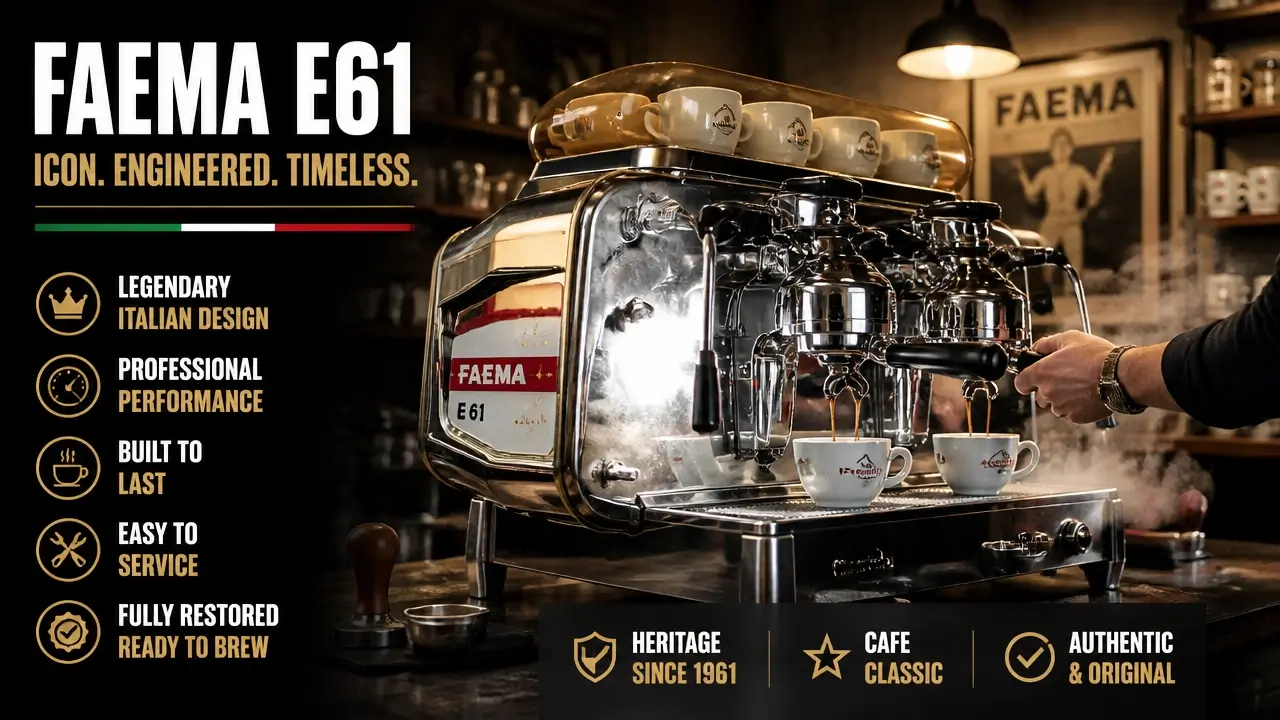
The Faema E61 and the end of steam pressure
Before 1961, most espresso machines pushed water through coffee using steam pressure. It worked, but it was inconsistent, temperature spiked, pressure wandered, and every shot was a negotiation with physics. Ernesto Valente ended that argument with the Faema E61.
His solution was a motorized pump that pulled cold water directly from the supply line and pushed it through a heat exchanger at a steady nine bars. The water never sat in a boiler long enough to overheat. It passed through on its way to the group, picking up the right temperature as it moved: a continuous thermal loop now called the thermosiphon brew group. The E61 group head, named for the solar eclipse of that year, became the template that nearly every commercial espresso machine still copies today. The shape of the group, the pre-infusion chamber, the flow path, all of it traces back to Valente’s original drawings.
That stability wasn’t just a technical achievement. It meant a barista in Milan could pull the same shot at 7 a.m. and 7 p.m. without adjusting anything. Consistency at scale: that was the real invention.
The Gaggia Orione and the birth of crema
Go back a decade further, to the late 1940s, and you find Achille Gaggia solving a different problem. Steam-driven machines ran at low pressure, roughly one to two bars, which produced a thin, bitter cup. Gaggia’s insight was mechanical: replace steam with a spring-loaded lever that a barista compressed by hand, then released. When the spring snapped back, it drove a piston through the group at eight to ten bars of pressure: a sharp, controlled spike that forced water through the coffee in a way steam never could.
That pressure spike did something nobody had planned for. It emulsified the coffee oils into a dense, reddish-brown foam that settled on top of the shot. Gaggia called it crema naturale and used it as a marketing point. Customers who’d never seen it before thought the machine was broken. Then they tasted it.
The Gaggia Orione wasn’t just a better espresso machine. It invented the product that the word “espresso” now describes. Every shot pulled anywhere in the world today, on a modern pump machine or a vintage lever, is chasing the pressure profile that Gaggia’s spring first produced.
The La Pavoni Europiccola and espresso in the home
The third pivot happened in the same year as the E61. In 1961, the La Pavoni Europiccola, originally designed by Giuseppe Peroni, brought the lever machine down to a size and price that a home user could actually consider. Where café machines required plumbing, three-phase power, and a trained operator, the Europiccola needed only a stovetop, a wall socket, and a willing pair of hands.
The design was compact and uncompromising. You filled the boiler by hand, waited for pressure to build, then pulled the lever yourself, feeling the resistance of the puck, learning to read the flow by touch and timing. There was no automation to hide behind. The machine gave you total control and zero forgiveness, which is exactly why it built the cult it did.
For the first time, serious espresso wasn’t something you went out to get. It was something you made, at home, with a machine that sat on your counter like a small piece of industrial sculpture.
Kent Bakke, former CEO of La Marzocco and founder of the Bakke Coffee Museum in Seattle, puts the cultural weight of these machines plainly:
“There was so much emphasis on design with these early lever machines, it was almost like inventing a new beverage. It also opened up the idea of having a machine on a bar in front of customers to attract people to come in and see how baristas made drinks.”
That visibility mattered. These machines weren’t hidden in a back kitchen, they were the show. The gleaming brass, the lever in motion, the barista’s hands, all of it was theater that pulled people through the door.
What Bakke is pointing at is the same thing that makes a restored example worth pursuing today: these machines carry the mechanical DNA of every espresso innovation that followed. The thermosiphon, the spring lever, the compact home boiler: each one solved a real problem in a way that nobody had before. The rest of this guide is about understanding those mechanisms well enough to bring them back to life.
While historical spring-levers defined the dawn of home espresso, modern enthusiasts seeking entry-level convenience without the restoration project often look toward best espresso machines under 500 for accessible daily brewing.
The Mechanical Soul of Vintage Espresso
The lever mechanism at the heart of vintage espresso machines isn’t a primitive precursor to modern pump systems, it’s a pressure-profiling tool that specialty coffee engineers are still trying to replicate electronically. When a barista pulls the lever down, they compress a spring. When they release it, that spring doesn’t deliver a flat, constant force. It unwinds. And that unwinding is the whole point.
How the Spring-Lever Mechanism Works
The spring starts compressed at roughly 9-10 bar of force against the piston. As the piston travels down through the cylinder, the spring extends, losing tension, and pressure drops naturally toward 6 bar by the end of the shot. That declining pressure curve isn’t a flaw in the system. It’s the espresso machine performing exactly as intended.
Here’s why that matters for extraction: high pressure at the start drives water into the dry puck fast, saturating it evenly. As resistance drops and the puck opens up, the pressure backs off, which means the water slows down just as the soluble compounds become easier to pull. You get the body and intensity from the high-pressure opening, and the sweetness and balance from the tapered finish. A flat pump curve at a constant 9 bar doesn’t make that distinction. It just pushes.
Arno Holschuh, coffee technologist and Chief Customer Officer of Bellwether Coffee, puts the engineering logic plainly:
“The soft pre-infusion concept originally comes from lever machines, where the puck was initially exposed to boiler pressure (say 1.5 bar) before the piston delivers higher pressures (as high as 11 bar, decreasing to around 7 to 9 bar by the end of the shot). In that case, the machine uses two different pressures.”
That two-pressure architecture, passive boiler pre-infusion followed by a spring-driven declining extraction, is what lever enthusiasts using pressure transducers have been documenting for years. The profile they’re measuring is the same one specialty roasters now spend thousands of dollars on electronic profiling machines to program. The spring lever does it mechanically, every single shot, with no software involved.
Spring Fatigue and Bore Integrity
The spring doesn’t last forever at full fidelity. Over decades of compression cycles, spring fatigue sets in: the metal loses some of its elasticity, and the uncompressed height shortens. A fatigued spring delivers a flatter, lower-pressure profile than the machine was designed to produce. You won’t feel it in the lever pull. You’ll taste it in the cup: less body, less separation between the early and late extraction phases.
This is why measuring uncompressed spring height and compression rate isn’t optional during restoration (it’s diagnostic). A spring that measures short is already telling you the pressure curve has drifted.
The other variable is the bore itself. The lever cylinder that the piston travels through wears over time, developing micro-scoring and ovality that lets pressure bypass the piston seal. When that happens, you lose bar pressure mid-shot and the declining curve becomes erratic rather than controlled. Restoring proper piston seal fidelity means bore honing, precision machining to bring the cylinder back to spec so the seal can do its job. This isn’t a parts swap. It requires a machinist’s equipment and measurement tolerances, and skipping it means a new seal will fail prematurely in the same worn bore.
Boiler Systems and Temperature Without PID
While the lever handles pressure, the boiler handles temperature, and vintage machines solved that problem in three distinct ways, each worth understanding on its own terms.
The La Pavoni Europiccola uses a dipper tube system: water is drawn directly from the boiler into the group. Simple, compact, and entirely dependent on the operator’s timing and technique to manage temperature. Let the boiler run too hot, you scorch the shot. Too cool, you under-extract. The machine gives you full control and full responsibility.
The Gaggia Orione moves toward a heat exchanger arrangement, separating brew water from boiler water to give the operator more thermal buffer: the boiler runs at steam pressure while a separate circuit conditions the brew water to a lower temperature.
The Faema E61 represents the most sophisticated passive thermal solution of the era: the thermosiphon group. Hot water from the boiler circulates continuously through the heavy brass group head via convection: no pump, no electronics. The group absorbs heat, stores it in its thermal mass, and releases it evenly into the puck at the start of extraction. The result is temperature stability that modern machines achieve with PID controllers and thermocouples. The E61 does it with physics: density differentials driving a continuous loop of hot water through a precisely engineered channel geometry.
| Machine | Lever Type | Pressure Profile | Boiler System | Temperature Stability | Key Mechanical Innovation |
|---|---|---|---|---|---|
| Faema E61 | Semi-automatic group-actuated brew lever | Pump-driven preinfusion; pressure maintained in brewing range rather than manually declined | Thermosiphon circulation through the brew group | Passive thermal regulation via continuous hot-water circulation, reducing temperature swings without PID | E61 brew group with thermosiphon-heated mass and mechanically actuated preinfusion |
| Gaggia Orione | Spring lever | Declining pressure curve (starts near 9-10 bar, tapers downward through the shot) | Heat exchanger boiler arrangement | PID-free temperature control through boiler heat balance and operator timing | Spring piston lever mechanism that stores energy and releases a natural pressure curve during extraction |
| La Pavoni Europiccola | Direct manual lever | Operator-controlled pressure, capable of approximately 9 bar at full lever force | Dipper / boiler-water immersion design | PID-free stability from boiler heat management and user timing | Compact domestic piston lever that brought lever espresso into the home |
Why This Forgives Grind Errors
There’s a practical extraction benefit to pressure profiling that gets less attention than it deserves: forgiveness. A flat 9-bar pump machine is unforgiving of grind inconsistency because the pressure is constant, any channeling or uneven resistance gets exploited immediately and runs for the full shot duration.
A declining pressure curve naturally reduces the driving force as the shot progresses. If a weak spot in the puck starts to channel, the dropping pressure reduces the flow differential that would otherwise accelerate that channel. It’s not a guarantee against channeling, but it’s a mechanical damper on the damage. That’s why experienced lever users often describe shots as tasting more balanced even when the grind wasn’t dialed in perfectly: the machine’s physics are working with the extraction, not just driving through it.
That engineering reality is exactly what makes these machines worth the restoration effort. The mechanism isn’t charming because it’s old. It’s worth preserving because it works in a way that’s genuinely difficult to replace.
The inherent forgiveness of pressure profiling bridges the gap between classic lever mechanics and the temperature stability found in today’s rated semi-automatic espresso machines.
Sourcing & Teardown: The First Moves That Prevent Disaster
Disciplined disassembly workflow is what separates a successful vintage espresso machine restoration from a box of mismatched parts you can’t reassemble. Before a single bolt moves, you need a system, because a 1960s Faema E61 or a pre-1980 La Pavoni doesn’t come with a second chance if you strip a thread or lose track of where a gasket lived. The restoration community’s hard-won lesson is simple: the teardown is the restoration. Get it wrong here, and everything downstream costs you double.
Photographic Documentation Before Anything Else
Photographic documentation isn’t optional, it’s the golden rule every professional restorer operates by. Shoot every angle before you touch the machine. Then shoot again after each component comes off. Label your photos sequentially: Panel 1, Bracket 2, Boiler Flange 3. When you’re three hours deep and holding a mystery spring, that photo sequence is the only map you have back.
Lay every removed component out on a clean surface in the exact order it came off. Some restorers use a sheet of kraft paper and write the location directly underneath each part with a marker. Others use numbered zip-lock bags. The method doesn’t matter, the discipline does. A labeled sequential layout means reassembly is a read-back, not a puzzle.
Francesco Bernasconi, Sales Manager at Dalla Corte and manager of their Second Chance refurbishment program, puts it plainly:
“It should be stripped down completely. All panels and trays need to be removed to leave the frame with the piping, group heads, and boilers still intact. From there, each part can be carefully removed from the framework. They should be inspected for any signs of damage and thoroughly cleaned.”
Notice what he’s describing: a staged removal, not a wholesale dismantle. The frame stays intact while you work outward-in. That sequence exists for a reason: it keeps the boiler and group head supported while you strip the surrounding components, so nothing torques or stresses a fitting it shouldn’t.
Building Your Parts Sourcing Strategy
Start with the original schematics. Faema, Gaggia, and La Pavoni published parts diagrams, some survive as scanned PDFs on restoration forums, others through manufacturer archives. If you have a schematic, you have part numbers. If you have part numbers, you have a fighting chance.
When schematics don’t exist or parts numbers lead nowhere, the community fills the gap. Home-Barista and Coffeegeek carry decades of model-specific threads where someone has already measured the boiler flange on your exact machine and posted the O-ring dimensions. Facebook groups dedicated to vintage espresso machines are surprisingly active and model-specific. Dedicated suppliers like Espresso Parts, Orphan Espresso, and various Italian parts houses stock seals, gaskets, and thermostats for common models.
Here’s the honest reality the restoration community rarely says out loud: there is no centralized cross-reference database for orphan parts. The question “What O-ring fits a 1970 Gaggia Orione boiler flange?” has no clean answer in any single source. Until someone builds that database, the answer is manual measurement (calipers on the groove, then fabrication). Viton sheet gaskets cut to spec are the working solution for truly orphaned components. It’s slower, but it seals better than a close-enough substitute that isn’t quite right.
For aggregate costs, go in with open eyes. Individual parts look cheap (a thermostat runs around €5, a full gasket set under €10) but no guide totals the full picture. By the time you’ve sourced seals, descaling chemicals, replacement wiring, and possibly a custom-fabricated part or two, a project machine that looked economical can quietly double its cost. Budget for the unknown.
Thread Compatibility Pitfalls
A thread pitch gauge is non-negotiable before you source a single fitting. This is not a suggestion, it’s the single most reported cause of post-restoration pressure-joint leaks in the community.
Vintage European machines mix two thread standards that look nearly identical but are mechanically incompatible. BSP threads (British Standard Pipe) sit at a 55° thread angle. Metric threads sit at 60°. They will engage, enough to feel like they’re seating, but they will not seal under pressure. You’ll get a joint that holds during a cold hydrostatic test and weeps the moment the boiler heats up and the metal expands.
The fix is adapters, but the frustrating reality is that adapter requirements are model-specific and no guide compiles a master list of which machines need which adapter. Measure every fitting with a thread pitch gauge before ordering anything. When in doubt, bring the original fitting to a hydraulic supply shop, they’ll identify the standard in 30 seconds.
Safe Disassembly Order
Work from outside in, top to bottom, and document every connection before you disconnect it.
- Remove bodywork first: side panels, top panel, drip tray. This exposes the frame without disturbing any plumbing.
- Drain and disconnect water lines: open the steam wand and hot water tap to relieve pressure, then disconnect supply lines. Label each line with masking tape before it comes off.
- Disconnect electrical connections: photograph the terminal block before touching a wire. Label each wire with numbered tape flags that match your photos. A wrench set with metric and BSP-appropriate sockets handles the mechanical fasteners; don’t improvise with adjustable wrenches on brass fittings.
- Detach the group head: this usually involves unbolting from the boiler flange. Support it as it comes free; the group head on a lever machine is heavier than it looks.
- Extract the boiler last: it’s the heaviest component and the most fragile in terms of fittings. With everything else removed, it has room to come out cleanly.
- Lay all fasteners by location: every bolt, every washer, every clip goes into a labeled container corresponding to where it came from.
Asbestos Insulation: Stop and Contain
Any machine manufactured before 1980 may contain asbestos insulation wrapped around the boiler or steam pipes. It was a standard thermal material for decades and it looks like grey or white fibrous wrap, sometimes intact, sometimes crumbling.
If you find it, stop the teardown immediately. Do not brush it, vacuum it, or continue working around it. Disturbed asbestos fibers are a serious inhalation hazard, and no restoration project is worth that exposure. Call a licensed asbestos abatement professional for containment and removal before the teardown continues. This isn’t overcaution, it’s the only responsible path forward.
Video: La Pavoni Professional 1998 Restoration Saga: Part 1 walkthrough of safely disassembling a vintage lever espresso machine.
With the machine fully stripped and every component laid out and photographed, you now have a clear view of what decades of scale, worn seals, and mineral buildup actually look like inside. That’s where the next phase begins, reviving the internals and bringing the exterior back to the gleam it had when it left the factory.
Reviving the Heart: Descaling, Polishing, and Seal Renewal
Decades of mineral scale, oxidized chrome, and hardened gaskets are what separate a working vintage espresso machine from a display piece. The cleaning and polishing work you do here determines whether the machine brews safely or fails dangerously, and the difference between those two outcomes usually comes down to chemistry you can’t see and mistakes that look fine until they aren’t.
Let’s start with what’s inside the boiler, because that’s where the real risk lives.
Safe Descaling and Post-Cleaning Structural Inspection
The safe descaling protocol for vintage machines is more specific than most guides admit, and the gap between “close enough” and “correct” is the difference between a clean boiler and a pitted one.
The chemistry that actually works — and why concentration matters
Citric acid is your best option for copper and brass systems. It chelates calcium and magnesium deposits without attacking the base metal, at the right concentration. The problem is that most DIY guides say “soak overnight in citric acid solution” without specifying how strong that solution should be. That’s where machines get damaged.
At concentrations above 4%, or with extended soak times at elevated temperatures, citric acid shifts from dissolving mineral deposits to attacking the copper itself. According to ASTM B154 corrosion testing data, overexposed copper alloys can lose 0.05–0.15 mm of wall thickness per year, and in a boiler that’s already 40 or 50 years old, that’s not a margin you have.
The correct protocol: 2–4% citric acid solution, heated to 60–70°C, for 20–30 minutes maximum. After draining, flush the system with a baking soda and water solution to neutralize residual acid. That neutralization step gets skipped constantly, and it matters, residual acid accelerates future mineral re-deposition on the very surfaces you just cleaned.
Sulfamic acid is an acceptable alternative for heavier scale, but it demands the same concentration discipline and a full neutralization rinse.
The galvanic trap nobody warns you about
Here’s something almost no restoration guide addresses directly: never mix dissimilar metals in the same descaling bath.
If you drop copper boiler components, brass fittings, and any aluminum or stainless hardware into the same acidic solution, you’ve just built a galvanic cell. The acid acts as an electrolyte, current flows between the dissimilar metals, and the less noble material, often the aluminum, pits aggressively. You won’t see it happening. You’ll see the result when a fitting cracks under pressure three months later.
The rule is simple: one metal family per bath, every time.
Why epoxy is not a boiler repair
This needs to be said plainly, because a widely circulated DIY restoration guide recommends epoxy patching for boiler leaks and pinhole failures. It is mechanically unsound as a permanent fix on a pressure vessel, and here’s the physics behind why.
Copper expands at roughly 16.5 µm/m·°C. Structural epoxy expands at 25–35 µm/m·°C. Every time the machine heats from room temperature to brewing temperature, a 75°C swing, daily, those two materials are trying to move at different rates while bonded together. That shear stress accumulates with each thermal cycle. Based on thermal expansion coefficient data for copper alloys and structural adhesives, fatigue failure typically occurs within 2–6 months of regular use.
When that bond fails on a pressurized boiler running at 1.4 bar and 95°C, you’re not looking at a slow drip. You’re looking at a spray of near-boiling water, a genuine second-degree burn risk.
If the boiler has a structural failure, a crack, a separated flange, a pinhole that’s grown, the repair is brazing or part replacement. That’s it. Surface patching on a pressure vessel is not a restoration; it’s a deferred failure.
Dezincification: the check most restorers skip
After descaling, before you reassemble anything, inspect every brass fitting and the group head under good light. Look for areas that appear pinkish, slightly discolored, or that feel softer or more brittle than the surrounding material. That’s dezincification: a corrosion process where zinc leaches out of the brass alloy, leaving behind a porous copper matrix that looks intact but has lost most of its structural strength.
A dezincified fitting will hold pressure right up until it doesn’t. It can’t be cleaned back to health. If you find it, the part gets replaced, no exceptions.
Arkadiy Chernov, a coffee professional who restored a 1950s lever machine from the ground up, describes the baseline reality of this work:
“The Filcafe came in dirty, dusty, and with heavy scale buildup in the boiler and pipelines. A thorough disassembly and clean was needed. Lots of detergent, soaking in vinegar solution overnight, scouring pads, and car polish for exteriors did the job. The machine was salvaged in its entirety, except for the small boiler gasket (a rubber seal).”
Chernov’s approach captures something important: even a machine that looks like a lost cause usually isn’t, but the one component that couldn’t be saved was a seal. That’s not a coincidence. Rubber and silicone gaskets are the first things to go, and the cleaning process accelerates that failure if the seals aren’t replaced as part of the same job.
Chrome Polishing and Complete Seal Renewal
Once the internals are clean and structurally sound, the chrome polishing and seal replacement work happens in parallel, exterior and internal simultaneously, so you’re not reassembling clean components into a machine that still has hardened gaskets waiting to weep.
Polishing chrome without destroying it
The chrome on a vintage espresso machine is almost always a thin plating over a brass substrate, typically 0.5 to 1 micron of hard chrome. That sounds durable, but aggressive buffing wheels or abrasive compounds will cut through it faster than you’d expect, exposing the brass underneath and creating a repair that’s far more involved than the original tarnish.
Use a non-abrasive specialist metal polish, Bar Keepers Friend Cleanser works well for surface oxidation and light staining, applied by hand with a soft cloth. For deeper tarnish or pitting, a soft polishing wheel on a low-speed rotary tool is acceptable, but keep the pressure light and the speed down. Let the polish do the cutting, not the wheel. Work in small sections, wipe frequently, and check your progress before continuing. The goal is to restore the reflective surface, not to remove material.
For heavily pitted chrome that’s lost adhesion to the substrate, replating is the honest answer. A good polish can improve the appearance, but it can’t rebuild what isn’t there.
Finding and replacing every seal
A complete seal renewal means every seal, not just the ones that are visibly leaking. On a vintage machine, a gasket that looks intact has still been heat-cycled hundreds or thousands of times. The material has hardened, compressed, and lost its memory. It will fail.
Work through the machine systematically:
- Group head gasket: the primary seal between the portafilter and the group. This is the one that gets replaced most often, and for good reason. On machines where the original profile is discontinued, cut a custom gasket from food-grade viton sheet using the old gasket as a template and a sharp punch set.
- Boiler flange gaskets: wherever the boiler sections join. These are under sustained heat and pressure. Replace them even if they look fine.
- Steam wand O-rings: small, easy to miss, and the first thing to fail under steam pressure. Viton O-rings in the correct durometer handle the temperature range; standard nitrogen will harden and crack within months.
- Solenoid and valve seats: if your machine has a solenoid valve, the seat O-rings are critical. A weeping solenoid seat will cause pressure loss that mimics pump failure.
Before installing any new seal, lubricate it with a thin film of food-grade silicone grease. This does two things: it seats the gasket evenly under compression, and it extends the seal’s service life by preventing the rubber from bonding to metal surfaces under heat. Don’t use petroleum-based lubricants, they degrade rubber and contaminate the brew path.
Clearing the group head flow path
While the group is disassembled for seal replacement, take the dispersion screen, jet, and solenoid core apart completely. Scale and coffee oils accumulate in the microscopic pilot orifices that control flow, and a partially blocked orifice creates uneven pre-infusion pressure that you’ll feel in the cup long before you diagnose the cause.
Soak these components in a Cafiza solution (follow manufacturer concentration, typically 1–2g per liter at 90°C) for 20–30 minutes to dissolve coffee oils and protein deposits. For the pilot orifices specifically, a fine wire, a single strand from a guitar string works perfectly, clears blockages without enlarging the opening. Never use a drill bit. The orifice diameter is engineered; changing it changes the pressure profile.
Rinse everything thoroughly before reassembly. Cafiza is a strong alkaline cleaner, and any residue left in the flow path will end up in someone’s espresso.
Wiring the Past for Modern Safety
Electrical system upgrades are the single most dangerous gap in vintage espresso machine restoration, and the most consistently ignored. Every popular guide, forum thread, and commercial teardown video will tell you to unplug the machine before you work on it. Not one of them tells you what to do after you plug it back in. That’s the gap we’re closing here.
Before we get into the how, here’s why this matters beyond theory. According to the National Fire Protection Association report on home fires caused by electrical failure or malfunction (2015-2019), electrical failures were responsible for 13% of U.S. home structure fires and accounted for 21% of the related property damage. That data isn’t specific to espresso machines, but a 1960s boiler running on its original two-prong cord, plugged into an unprotected outlet, is exactly the kind of appliance those numbers are built on.
Here’s how you fix it, step by step.
Document before you touch anything. Photograph the original wiring from every angle. Label every wire with heat-resistant tape before disconnecting a single terminal. Your goal is to replicate the routing exactly, you’re upgrading the materials, not redesigning the architecture. The original layout exists for thermal and spatial reasons that aren’t always obvious until something goes wrong.
Replace the cord and plug first. The original two-prong, unpolarized plug has to go. Replace it with a heavy-gauge, three-conductor grounded cable, 14 AWG minimum, rated for the machine’s amperage draw. This isn’t cosmetic. The third conductor is your ground fault return path: the wire that carries fault current safely to the panel breaker instead of through whoever is touching the machine. Once the new cord is installed, the machine should only ever be plugged into a GFCI-protected circuit. A GFCI outlet trips in under 25 milliseconds when it detects even 5 milliamps of leakage to ground, fast enough to prevent cardiac arrest. This is non-negotiable.
Pull the asbestos insulation — carefully. Many machines from this era wrapped their boilers and steam pipes in asbestos rope or tape. If yours does, stop. Bag it in sealed plastic, label it as hazardous material, and dispose of it through a licensed service. Don’t sand it, don’t cut it dry, don’t blow compressed air across it. Once it’s out, re-wrap the boiler and any high-temperature pipe runs with modern ceramic-fiber heat shield material. It handles the same temperatures, it doesn’t shed carcinogenic fibers, and it won’t crumble into your wiring over the next thirty years.
Re-wire with TGGT or equivalent high-temperature wire. Standard PVC-insulated wire softens and cracks near a boiler. TGGT 14 AWG, a dual-layer fiberglass and PTFE insulated wire rated for continuous service above 200°C, is the correct replacement. Some sources mention this gauge in passing. None of them explain why: the wire has to survive not just today’s operating temperature, but decades of thermal cycling. Replicate the original routing exactly, secure it away from moving parts and hot surfaces, and use the same terminal types the machine was built with wherever possible.
Install a solid-state relay (SSR) in series with the original power switch. This is the move that preserves the vintage appearance while protecting the irreplaceable mechanical contacts underneath. The original switch was never designed to cycle high amperage loads thousands of times, that’s what kills vintage contactors. The SSR takes the heavy switching load electronically, while the original switch simply signals it. The machine looks exactly the same from the outside. The switch lasts indefinitely.
Add high-limit thermal cut-outs and a manual-reset safety thermostat. These are your last line of defense against a dry-fire event: the scenario where a failed pressure switch or relay leaves the heating element energized with no water to absorb the heat. A high-limit thermal cut-out mounted directly on the boiler body trips at a set over-temperature threshold and kills power to the element. The critical detail: it must be a manual reset type. The Specialty Coffee Association is explicit on this point:
“High limit switches are the other required line of defense. If the temperature in the boiler exceeds that which the pressure valve should have released, the limit switch removes power from the elements. The switch also cannot automatically reset itself, a technician is required to assess the cause and then reset the switch.”
An auto-reset cut-out will just cycle the element back on into the same dangerous condition. Manual reset means a human has to investigate before the machine runs again. That’s the design intent, and it’s the right one.
The SCA also draws the threshold clearly for everything else in the circuit:
“Anything above 50 volts to ground in a machine has to be tested or carry a separate approved certification to be installed on a machine. The idea is that this is the threshold for posing a threat of injury to someone using the machine… Wires have to be approved to demonstrate they can handle the current and voltage needed to make things work.”
Every component you install in the live circuit (SSR, cut-out, thermostat, terminal block) needs to be rated for the machine’s operating voltage and current. This isn’t optional specification-matching. It’s the difference between a safe appliance and a fire waiting for the right conditions.
Test before you plug into mains. After reassembly, run a continuity check on the ground path from the chassis to the plug’s ground pin. Then use a megohmmeter to check insulation resistance between the live conductors and the chassis, you’re looking for values in the megaohm range. Any reading that’s low tells you there’s a fault path through the metal body that a GFCI will eventually trip on, or worse, that a user will complete.
The step that no restoration guide anywhere includes: perform a dielectric voltage withstand test (a Hi-Pot test) at 1.5 kV between live parts and the machine chassis before the machine leaves your bench. This is standard procedure in electrical appliance service. It confirms that no water intrusion, compromised insulation, or wiring fault creates a shock path through the body of the machine under operating stress. It’s the electrical equivalent of a pressure test. You wouldn’t skip a pressure test. Don’t skip this.
The wiring work described here aligns with the intent of NEC Article 422 for appliance repair: ground fault path continuity, over-current protection, and insulation integrity. A vintage espresso machine that hasn’t been through these checks isn’t restored. It’s a hazard with a beautiful exterior, and the only person who knows the difference is the one who did the work.
Pressure Testing: The Final Gatekeeper
A reassembled vintage espresso machine is just a hypothesis until pressure testing proves it. Every seal you replaced, every flange you torqued, every gasket you seated, none of it means anything until the system holds water and steam under real working load. This is where the restoration either earns its certificate or sends you back to the bench.
Why Hydrostatic Testing Comes First
The hydrostatic pressure test is the safest way to stress a restored boiler because water, unlike steam, doesn’t compress. If something fails under hydrostatic load (a cracked flange, a weeping seal, a gasket that seated wrong) the release is a drip or a slow weep, not a violent pressure event. You fill the boiler completely, bleed all the air out, then pressurize with a hand pump to roughly 1.5 times the working pressure. Then you wait. Five minutes minimum. You’re not looking for catastrophic failure. You’re hunting for the slow, quiet betrayal: a bead of water forming at a joint, a fitting that starts damp around its threads.
If anything weeps, you don’t just retighten and retest. You mark it, depressurize fully, disassemble that joint, inspect the seating surface, and reseal from scratch. A vintage espresso machine that passes hydrostatic test with a “tighten and hope” fix hasn’t really passed.
Star Pattern Tightening and Flange Integrity
Before you ever pressurize, the mechanical foundation has to be right. Every multi-bolt flange on these machines (boiler end caps, group head flanges, heat exchanger collars) needs to be torqued in a star pattern, not in a circle. The reason is mechanical: tightening in sequence around the circle pulls the gasket unevenly, creating a high-compression zone on one side and a loose zone opposite it. That loose zone is where the leak lives.
Star pattern tightening distributes clamp load evenly across the gasket face in stages. First pass at roughly one-third torque, second at two-thirds, final pass at spec, always crossing to the opposite bolt. On a vintage machine where the flange faces may have minor surface irregularities from decades of use, even load distribution is the difference between a seal that holds and one that weeps at 9 bar the moment the pump kicks on.
Reading the Pressurestat Against the Safety Valve
Once the boiler holds water under hydrostatic load, the next test is live, and this is where the pressure-stat and safety valve relationship becomes the thing you’re actually verifying. The pressurestat is your operating governor: it cuts power to the heating element when boiler pressure reaches the set point, typically around 1 to 1.2 bar on a single-boiler machine. The safety valve is your last line of defense if that governor fails.
Hylan Joseph, West Coast service manager for Espresso Partners and current chair of the Coffee Technicians Guild Leadership Council, describes exactly how to validate this relationship during a live heat-up:
“The pressure relief valve (PRV) is a simple, though precisely calibrated and tested, spring‑operated valve… The unit should be observed while heating to verify that steam pressure can reach the set pressure. Steam should not leak at the boiler set point (which will be below the set point of the PRV). Then the boiler set point is raised to above the normal boiler set point, but just below the ‘blow off’ point marked on the PRV. No steam should escape.”
What Joseph is describing is a two-stage ladder test. First, confirm the pressurestat cuts out cleanly at its set point with no steam escaping anywhere, that’s your normal operating confirmation. Then deliberately raise the set point into the gap between normal operation and the safety valve’s rated blow-off pressure. If steam escapes during that second stage, something is wrong with either the PRV calibration or a sealing surface upstream of it. The safety valve on a restored vintage espresso machine isn’t decorative. It’s the component that keeps a brittle 60-year-old boiler from becoming shrapnel.
The Leak Map Before Final Sign-Off
The pressure testing protocol isn’t complete at the boiler. Work outward systematically: boiler to group, group to portafilter, steam circuit to wand, water inlet to pump. Each junction is a potential failure point, and vintage machines compound that because you’re often mixing original brass fittings with new silicone seals and possibly thread adapters that weren’t part of the original spec.
A useful practice is a leak map: before the first live brew, coat every fitting junction lightly with soapy water while the machine is at full working pressure and temperature. Bubbles don’t lie. A joint that looked dry during hydrostatic test can still weep under the thermal expansion of a fully heated boiler, because brass and steel expand at different rates and a cold-tight seal isn’t always a hot-tight seal.
When the soap film stays flat, every fitting stays dry across a full heat cycle, and the pressurestat cuts in and out cleanly within spec, that’s your passed certificate. The restored vintage espresso machine isn’t just beautiful at that point. It’s proven.
The Collector’s Market for Vintage Espresso Machines
A fully restored Faema E61 isn’t just a machine anymore: it’s a documented artifact, and the market prices it that way. But “the market” for vintage espresso machines is fragmented, continent-dependent, and almost entirely relationship-driven. Understanding how value gets assigned here is the first step to not leaving money on the table or overpaying for a beautiful paperweight.
What Actually Drives Vintage Espresso Machine Value
Four factors stack on top of each other to set the price, and they’re not weighted equally.
Model rarity sits at the foundation. The Faema E61 had a substantial production run, which keeps supply relatively accessible. The Gaggia Orione was produced in far smaller numbers, and that scarcity alone adds a floor to its price regardless of condition. The La Pavoni Europiccola occupies a middle ground: widely produced, but the early pre-1970s examples with original brass components are genuinely rare.
Component originality is where most sellers lose or gain serious ground. Original paint, factory-stamped group heads, period-correct gauges, and unmodified boilers carry a premium that reproduction parts simply can’t replicate. A machine with its original Sirai pressurestat and factory wiring loom, even if worn, is worth more to a serious collector than one fitted with modern replacements, even excellent ones. Originality is provenance made physical.
Documented restoration quality matters more than the restoration itself. A machine that was rebuilt by a known technician, with a paper trail showing what was replaced, what was pressure-tested, and what was left original, commands a measurable premium over an identical machine restored anonymously. The documentation you built during your own restoration process, the photographs, the parts log, the test results, is a direct financial asset at resale.
Functional state closes the gap. A machine that pulls a shot, holds pressure, and has a verified safety valve is worth significantly more than one that “just needs a little work.” That phrase costs buyers money every time.
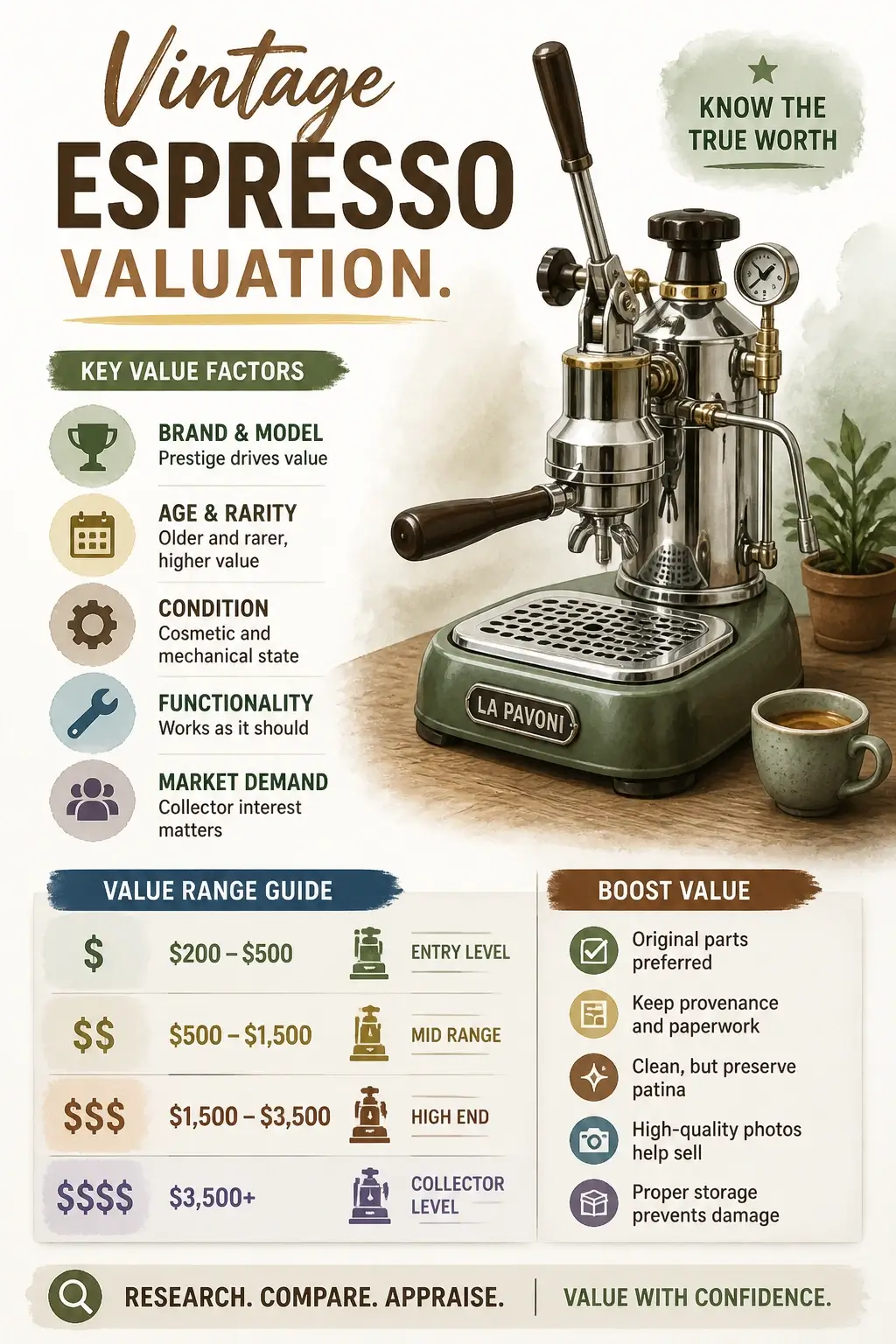
Realistic Price Windows by Machine
These ranges reflect the current market across North America and Western Europe, expect the lower end in Eastern Europe and parts of Asia, and the higher end in Australia and Scandinavia, where import costs and local scarcity push prices up.
- Faema E61 — Unrestored, running: $800–$1,800. Professionally restored with documentation: $2,500–$4,500. Exceptional examples with full originality: $5,000+.
- Gaggia Orione — Unrestored: $600–$1,400. Restored: $2,000–$3,800. The rarity premium kicks in hard here for pre-1965 examples.
- La Pavoni Europiccola — Unrestored: $300–$700. Restored: $900–$2,200. Early brass-group models with original components: $2,500–$3,500.
These aren’t fixed numbers. A single auction with two motivated bidders can push a Faema E61 past $6,000. A private sale between forum members might land the same machine at $2,800. The spread is real, and it’s why knowing where you’re buying or selling matters as much as knowing what you have.
Where the Buying and Selling Actually Happens
The vintage espresso machine market runs on a loose hierarchy of trust and specialization.
eBay is the widest net. You’ll find everything from barn-find disasters to legitimately restored machines. The problem is that eBay rewards photography, not mechanical integrity. A machine can look stunning in twelve photos and be a plumbing nightmare underneath. Use it for price discovery and for sourcing unrestored machines you plan to rebuild yourself, not as your primary channel for buying a finished restoration.
Specialty auction houses like Coffee Equipment Auctions operate in a narrower, more knowledgeable space. Listings tend to come with more honest condition notes, and the buyer pool is sophisticated enough that pricing reflects actual market reality rather than wishful thinking.
Forum classifieds, particularly Home-Barista and the German-language Kaffee-Netz, are where the most informed transactions happen. Sellers here know their audience, which means they document more thoroughly and misrepresent less frequently. Buyers can ask technical questions directly and expect real answers. The trade-off is that good machines move fast and the community is small enough that a bad transaction follows your username for years.
Curated Instagram sellers have emerged as a legitimate channel, particularly for aesthetically exceptional machines. The best of them function like micro-dealers: they source, restore, photograph, and sell with a consistent standard. The worst are flippers who learned that good lighting sells machines that good mechanics wouldn’t. Vet them by asking for pressure test documentation before you engage on price.
The Community Behind the Machines
The people who care about these machines have built real infrastructure around that obsession.
The Lever Espresso Forum and the Home-Barista community are the closest thing this hobby has to institutional knowledge. Restoration threads there stretch across years, with members documenting every step of rebuilds on specific serial-numbered machines. If you’ve done your restoration well, posting it there isn’t just sharing, it’s establishing provenance in a community that will remember it.
SCA events occasionally feature vintage espresso competitions and heritage showcases, and the Milan Coffee Festival’s heritage corner draws serious collectors and restorers from across Europe. These in-person gatherings are where relationships get built, and where private sales happen between people who’ve already established trust online.
Social media restoration circles, particularly on Instagram, have created a parallel community that skews younger and more visually oriented. They’re less technically deep than the forums but genuinely enthusiastic, and they’ve brought new buyers into the market who wouldn’t have found it otherwise.
The “Like New” Trap
Jon Ferguson, an espresso equipment service technician and tech writer for Barista Magazine’s Tech Talk Online, puts the core problem directly:
“Determining the value of a used espresso machine is much more complicated than looking up what the value of a used car will be, as the automotive industry has much more infrastructure, certifications, and regulations in place than the used espresso machine market. To my knowledge, there are no general Kelley Blue Book-type guides for used espresso machines. Even if there were, I would personally still want to kick the tires, in the proverbial sense. If I couldn’t do that, I would highly reconsider my purchasing decision.”
That absence of standardized valuation infrastructure is what makes documentation so powerful, and so rare. Most sellers don’t have it. If you do, you’re not just selling a machine. You’re selling certainty in a market that runs almost entirely on uncertainty.
A machine that looks pristine but has no pressure test record, no parts log, and no verifiable service history is a gamble regardless of how good the photos are. The chrome can be flawless while the boiler flanges are one heat cycle away from weeping. Before you pay a premium for “like new,” ask for the documentation that proves it. If the seller can’t produce it, price accordingly, or walk.
The Café Centerpiece: Vintage Machines as Business Assets
A fully restored vintage espresso machine behind your counter isn’t just functional equipment, it’s a branding statement that no modern stainless box can replicate. The Faema E61’s chrome curves, the hiss of a lever machine, the visible mechanical theater of pressure building through a spring group: these things stop people mid-step. Customers photograph it. They ask about it. They come back because of it.
That’s the upside. But the business case only holds if you treat the machine as a serious commercial asset, not a showpiece with a side function.
What the ROI Actually Looks Like
The numbers work differently than with modern equipment. A restored Faema E61 or comparable vintage machine carries a higher upfront cost than a mid-range commercial unit, but it depreciates differently too, often appreciating in condition and value if maintained well. The ROI factors aren’t purely throughput-based. You’re buying foot traffic, social media content, press coverage, and a differentiation story that specialty coffee shops spend thousands trying to manufacture through interior design alone.
The catch is that vintage espresso machines have no tolerance for neglect. A modern volumetric machine will limp along through inconsistent cleaning. A vintage lever or semi-automatic group will tell you immediately (in the cup and in the failure) when maintenance has slipped.
Barista Training and Maintenance as Non-Negotiables
This is where most café owners miscalculate. They invest in the restoration and then hand the machine to staff who’ve only ever pulled shots on a modern E61-group clone. The mechanics are related but not the same. Lever pressure profiling, manual temperature surfing on a single-boiler system, reading the machine’s physical feedback: these are skills that require a specific training curriculum, not a one-hour orientation.
Jason Bond, International Business Manager at Cafetto — a specialist manufacturer of cleaning and sanitation products for espresso machines — puts it plainly:
“On top of investing in high-quality cleaning products, implementing proper daily and weekly cleaning schedules for espresso machines and grinders is of the utmost importance. Essentially, this also means that baristas need to receive the right level of training… By training staff properly and creating rigorous cleaning schedules, coffee shops will get the best out of their espresso machines and grinders.”
With vintage machines, that principle isn’t a best practice, it’s a survival requirement. The seals you spent hours sourcing and fitting will fail prematurely if backflushing protocols aren’t adapted to the machine’s specific group design. The boiler you descaled and resealed will scale back up in months if your water treatment and cleaning schedule aren’t calibrated to the machine’s actual cycle volume.
Building the Maintenance Schedule Around the Machine
Modern commercial machines are engineered around predictable service intervals and standardized parts. Vintage espresso machines reward a more attentive, relationship-based maintenance approach. Build your schedule around three layers:
- Daily: Group cleaning adapted to the specific group type (no blind portafilter backflush on machines not designed for it), steam wand purging, exterior wipe-down with non-abrasive products that won’t strip chrome or lacquer.
- Weekly: Full boiler pressure check, group seal inspection, gasket and screen removal and soak, water level and sight-glass verification.
- Quarterly: Full descale cycle using products matched to your boiler material (copper, brass, and stainless each have different tolerances), pressure stat calibration check, and a visual inspection of all electrical connections you upgraded during restoration.
This isn’t more work than maintaining a modern machine, it’s different work. And it’s work that keeps your branding asset from becoming a liability.
Maintaining the meticulous routine required for vintage boilers stands in stark contrast to the effortless workflow delivered by contemporary bean to cup espresso machines designed for automated precision.
The Café Identity Equation
The vintage espresso machine as café centerpiece works best when the story is told, not just displayed. A small card explaining the machine’s provenance, a brief staff script about its history, even a framed photograph of the restoration process, these transform a beautiful object into a conversation that customers carry with them. That word-of-mouth is the real ROI multiplier that no spreadsheet captures cleanly.
The full arc from understanding what makes these machines exceptional, through the documented and methodical restoration, to operating one safely at commercial volume, it all leads here. A vintage machine done right isn’t a compromise between beauty and function. It’s proof that the two were never in conflict.
Key Takeaways on Vintage Espresso Machines
- The declining pressure profile of a spring lever isn’t a flaw; it’s the mechanical secret that modern machines try to replicate electronically.
- Originality drives value more than aesthetics: a machine with factory paint and worn loom often out-prices a restored one.
- Skipping electrical upgrades on a vintage machine isn’t nostalgia; it’s a fire risk that even a GFCI can’t fully mitigate alone.
- A restored vintage espresso machine depreciates backwards: its value climbs if you document the rebuild properly.
- The real cost of a project machine isn’t the purchase; it’s the unseen parts—fabricated seals, thread adapters, and the labor you didn’t budget.
Frequently Asked Questions About Vintage Espresso Machines
Q: Why does my restored lever machine pull sour shots?
A: Sour shots usually mean the dispersion screen’s pilot orifices are clogged with old coffee oils. Even a full rebuild can miss these tiny passages. They restrict water flow and cause uneven extraction. Soak them in Cafiza and clear with a wire, never a drill bit.
Q: Can I pressure test a lever group without a gauge?
A: You can use a wooden puck substitute to feel resistance, but you won’t see pressure drops that signal spring fatigue. A portafilter gauge is the only way to verify the declining curve. Without it, you’re tasting for problems that the gauge would confirm instantly.
Q: What’s the one electrical upgrade most restorers skip?
A: Replacing vintage insulation. Original asbestos or crumbling fiberglass leaves wiring exposed. Ceramic-fiber wrap and TGGT high-temp wire are modern equivalents. Skipping this risks a short that could ruin the machine or worse.
Q: How do I check for dezincification in brass fittings?
A: Look for a pinkish hue or a soft, brittle feel. Scratching with a fingernail may reveal a coppery color beneath. Even if it holds pressure now, the fitting is weak and must be replaced immediately to avoid sudden failure under heat.
Q: Why is a drill bit dangerous for cleaning jets?
A: A drill bit removes metal and enlarges the orifice, changing the designed flow rate. That throws off pre-infusion and extraction pressure permanently. Use a single guitar string strand instead; it clears buildup without altering the hole size.
Q: Can I install a modern pump in a vintage E61?
A: Yes, but match the original profile. The E61 group expects a gentle ramp-up; too strong a pump can over-pressurize and cause gasket failure. Use a bypass pump set to 9 bar and test preinfusion before pulling shots.
References
- A History of the Espresso Machine – perfectdailygrind.com
- Pressure and Flow – dailycoffeenews.com
- How Espresso Machines are Refurbished Step by Step – perfectdailygrind.com
- Lever Romance: How I Restored a 70-Year-Old Espresso Machine – perfectdailygrind.com
- The Wonderful World of Pressure Relief Valves – dailycoffeenews.com
- What Does It Mean to Be UL Listed? – sca.coffee
- Things to Keep in Mind When Buying a Used Espresso Machine – baristamagazine.com
- How to Clean Espresso Machine & Grinder – perfectdailygrind.com