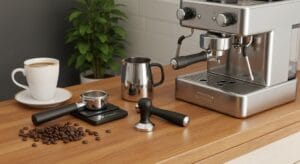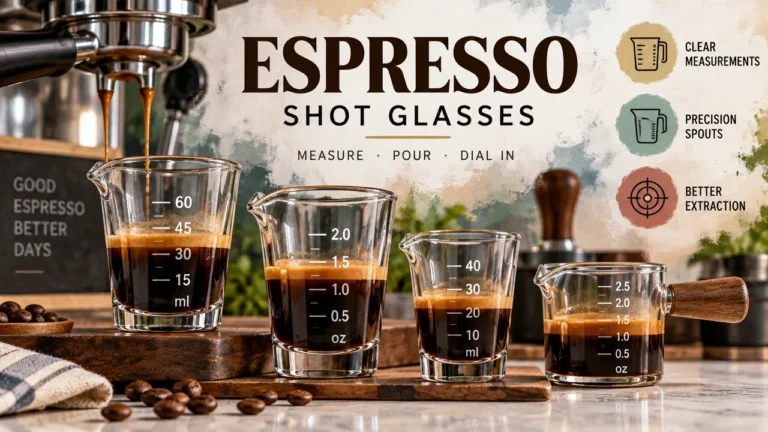

A properly selected espresso cup with spout is one of the most underestimated tools behind the bar-not because the graduation lines are accurate, but because they don’t need to be. The glass earns its place by letting you watch two streams diverge in real time, split a double cleanly, and sit stably on a scale while the actual measurement happens in grams.
The problem is that most buyers compare marking precision and ignore the three things that actually determine whether a glass works: machine clearance, capacity headroom above target yield, and whether it survives the cleaning regime they run. Get those right, and the brand comparison almost resolves itself.
Once you have optimized your espresso workflow, you can elevate your morning brew further by exploring standout vessels designed for casual sipping and aesthetic appeal.
If durability and temperature retention are your primary concerns rather than watching the extraction through glass, you might want to explore alternatives like stainless steel espresso cups for your setup.
Once you have dialed in your extraction workflow and glassware, evaluating the liquid in the vessel requires a deeper sensory analysis, much like what you will learn in this guide on Coffee Cupping Defect Detection The protocol.
Key Takeaways on Espresso Cups With Spout
- Volumetric markings show stream comparison and pour splitting-they don’t verify yield; a 0.1g scale does.
- Machine clearance is the most overlooked spec; measure your drip tray gap before comparing any glass.
- Capacity should exceed your target yield-a 1 oz glass is undersized for a standard double espresso.
- Borosilicate glass withstands thermal shock roughly three times better than soda-lime, making it the only sensible material for daily espresso use.
- In commercial rotation, buy for inventory replenishment, not single-unit longevity-discard-on-chip is the professional standard.
- When a scale is present, improvised vessels like jiggers or bell pitchers become legitimate substitutes because grams replace graduation lines.
Shot Glass Markings Tell You Direction, Not Destination
The spouted measuring shot glass-sometimes called a graduated demitasse-has two jobs, and neither of them is yield verification. Its first job is stream diagnosis: you can watch the flow rate, color, and consistency of extraction in real time and catch a channeling problem before it ruins the cup. Its second job is turbulence-free splitting, where a clean pour from the spout transfers a double into two latte or cappuccino bases without the aeration that a direct portafilter pour introduces.
The graduated markings themselves span the standard thresholds most baristas work within: single, double, ristretto, and lungo reference lines, typically in both fluid ounces and milliliters. The Specialty Coffee Association places a standard double espresso at roughly 60ml, though practitioners pulling on modern equipment frequently observe the double cup sitting closer to 70ml once crema is accounted for-which is precisely where the problem begins.
Crema is mostly air. When a shot lands in the glass, the crema layer inflates the apparent volume by several milliliters, then collapses over the next thirty to sixty seconds as the gas escapes. What the graduation line shows you mid-pull and what it shows you a minute later are two different numbers, and neither one is the number you actually need. That number is mass, measured on a 0.1g scale, because grams don’t compress and don’t settle.
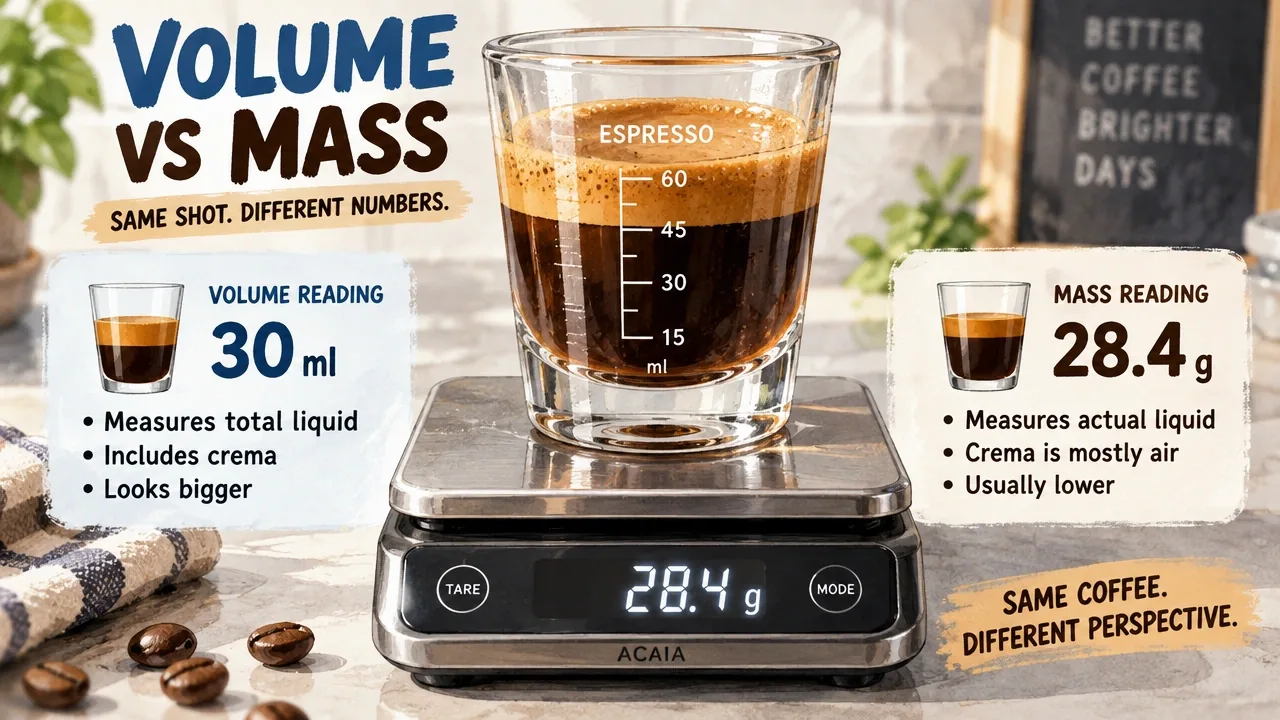
This is the single most important reframe in shot glass selection: the markings are useful for comparing pours against each other and for splitting volume consistently, but scale compatibility outranks marking precision as a selection criterion. A glass that sits stably on a 0.1g scale while catching the shot beats a prettier glass with finer printed lines every time. And there’s a capacity implication that follows directly from this: a 1 oz vessel is almost certainly undersized for a standard double. Your glass’s marked capacity band should exceed your target yield, not match it-because the crema needs somewhere to go.
Six Things That Actually Separate a Good Shot Glass from a Bad One
Before comparing any specific glass, lock in the rubric. Every recommendation below is evaluated against the same six criteria, and understanding them in advance means you can apply them to any glass you encounter-including options that aren’t on this list.
Spout Geometry and Machine Clearance
Spout geometry determines what you can do with the pour. Dual-spout configurations let you split a double across two cups simultaneously, which is the cleanest way to build two latte bases from a single pull, and they let you compare both streams side-by-side to diagnose channeling-if one stream runs thin and pale while the other runs dark and fast, the portafilter has a distribution problem. V-shaped spouts reduce splashing during transfer and give you more directional control when pouring into a narrow cup.
Machine clearance is the criterion almost no buyer considers, and it’s conspicuously absent from most community threads on this topic. The vertical gap between your portafilter basket and your drip tray sets a hard ceiling on glass height. Minimizing the drop distance reduces splatter and limits heat loss between basket and glass. As a worked example: the DeLonghi Dedica has a drip tray clearance of roughly 75mm, which means a glass taller than about 55–60mm simply won’t fit without removing the tray. Measure your own gap before you buy anything, and treat that number as a hard constraint-not a preference.
Marking Durability and Thermal Material Behavior
Marking method separates glasses that age gracefully from ones that become illegible. Etched or engraved graduations are physically cut into the glass surface and survive dishwasher cycles without fading. Printed or painted lines sit on the surface and wear off-sometimes within months of regular commercial washing.
Material choice determines both thermal behavior and longevity. Borosilicate glass has a coefficient of thermal expansion of roughly 3×10⁻⁶ °C⁻¹, which is approximately one-third that of standard soda-lime glass. A thermal stress analysis published in the Bulletin of the American Ceramic Society calculated that borosilicate can withstand a temperature differential of around 183°C before fracture, compared to roughly 55°C for soda-lime glass-and found that heat-strengthening soda-lime glass didn’t meaningfully close that gap. In practical terms: borosilicate survives the daily cycle of cold glass meeting a near-boiling shot far more reliably than soda-lime, and it offers the optical clarity that lets you actually watch crema develop during extraction.
The thermal stress fracture threshold for borosilicate glass is approximately 183°C versus roughly 55°C for soda-lime glass, with heat-strengthening providing no substantial improvement in fracture resistance for soda-lime cookware. – From the study “Shattering Glass Cookware” – Bulletin of the American Ceramic Society
The double-wall insulated vs. single-wall tradeoff layers on top of this. Double-wall glass retains heat longer and keeps the shot warmer during transfer, but the air gap between walls reduces visibility-you’re trading diagnostic clarity for temperature retention. Single-wall borosilicate gives you the full picture of what’s happening in the glass, which matters more during dialing than during service.
Base Stability and Capacity Bands
Base stability is a safety and precision issue simultaneously. A wide, weighted base resists tipping when a hot portafilter rests across the rim between pours-a common handling habit in busy workflows-and it stays planted on high-vibration commercial drip trays that would walk a lighter glass toward the edge.
Capacity follows a simple rule: target the 2–3 oz (60–90ml) band for standard espresso work. An undersized glass is a false economy-you either lose crema over the rim or you pull short to accommodate the vessel, which means the glass is controlling your extraction rather than the other way around. The one context where this hierarchy shifts is when the glass is being used for chai, milk-based drinks, or any drink where the volume is already known and weighed separately. In that case, durability and known volume outrank spout design, and marking precision becomes genuinely secondary.
The Commercial Workhorse Tier: Thick Double-Spout Glass
Cafe Rotation Durability Signals
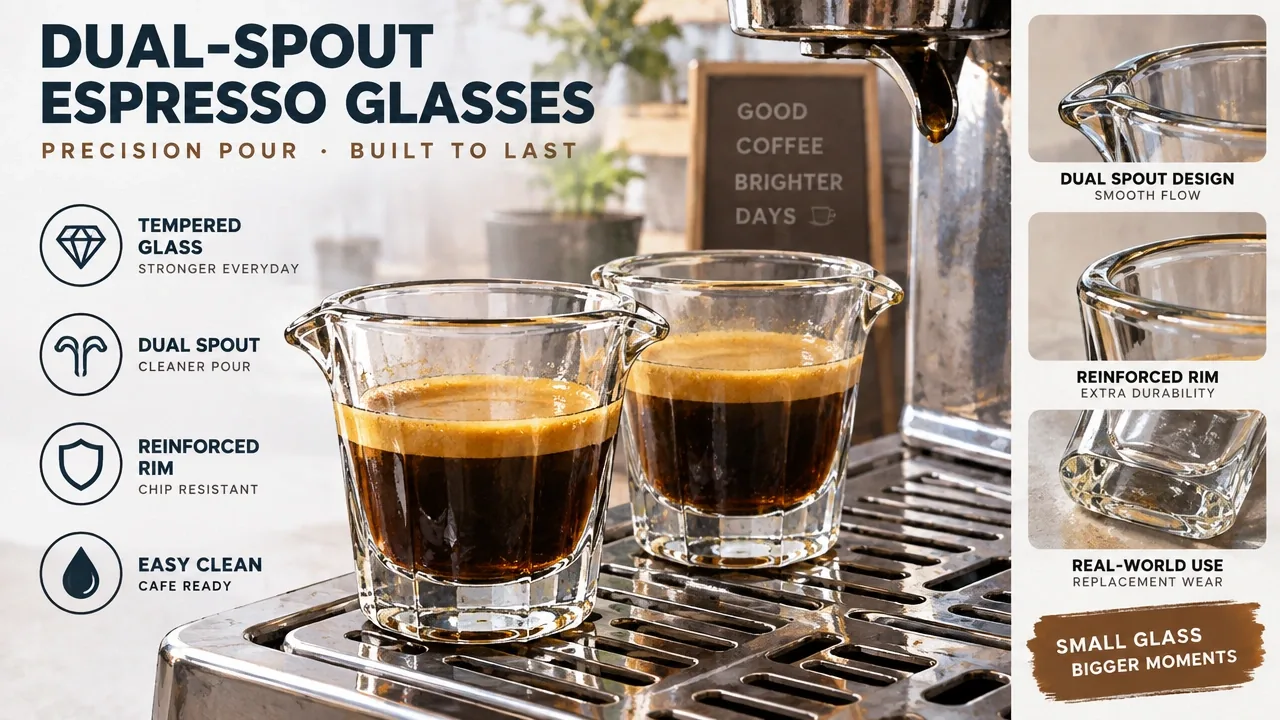
The defining characteristic of the commercial workhorse tier isn’t a brand-it’s a construction archetype: thick-walled, dual-spout tempered glass built to absorb the handling reality of high-volume service. Rhinowares, Rattleware, and JoeFrex are the three names that surface consistently as reference implementations of this type, and the reason is straightforward. Super-thick glass with spouts on both sides repeatedly demonstrates the ability to take serious impact in cafe environments without the immediate failure pattern that thinner alternatives show.
Dishwasher safety is non-negotiable at this tier-handwashing is a workflow tax that busy cafes can’t sustain. But dishwasher-safe doesn’t mean indestructible, and the honest durability reality of commercial rotation is this: the replacement cadence in busy cafes is discard-on-chip, not repair. Chipped or cracked glass is treated as a safety item and pulled from rotation-typically every three months under heavy use. This means the relevant purchasing question isn’t “how long will one glass last?” but “how easy is it to replenish inventory?” Buy for rotation management, not for the longevity of a single unit.
The materials split matters here. Standard soda-lime glass-the construction behind certain budget options, including the well-documented failure pattern typical of conventional mass-market glassware-breaks disproportionately often under the same handling that thick borosilicate survives. The breakage isn’t just more frequent; it tends to be more dramatic, because soda-lime glass under thermal stress can fail suddenly rather than showing visible damage first. That’s the durability gap that separates the two shelves.
Pour-Splitting Workflows and Capacity Headroom
The dual-spout workflow has two distinct applications. The first is splitting a double across two separate cups simultaneously-both streams pour at the same time, the volume divides roughly evenly, and two latte bases are built in a single pull without a second pour. The second is sequential single-stream pouring into one cup at a time, which gives you more directional control and lets you stop and assess between pours.
Capacity headroom is what makes this workflow clean. If your target yield on a double is 70ml-a common real-world figure once crema volume is included-a glass marked to exactly 60ml is already full before the shot finishes. Select a vessel whose marked band sits above your target yield, so the crema has room to expand and you can observe the full extraction without overflow.
When transitioning from split shots to larger single servings, utilizing proper double espresso mugs ensures your thermal mass and volume headroom match the extraction capacity.
Affiliate Disclosure
This post contains affiliate links, meaning I may earn a commission if you make a purchase through these links, at no additional cost to you. As an Amazon Associate, I earn from qualifying purchases. I only recommend products I genuinely believe will add value.
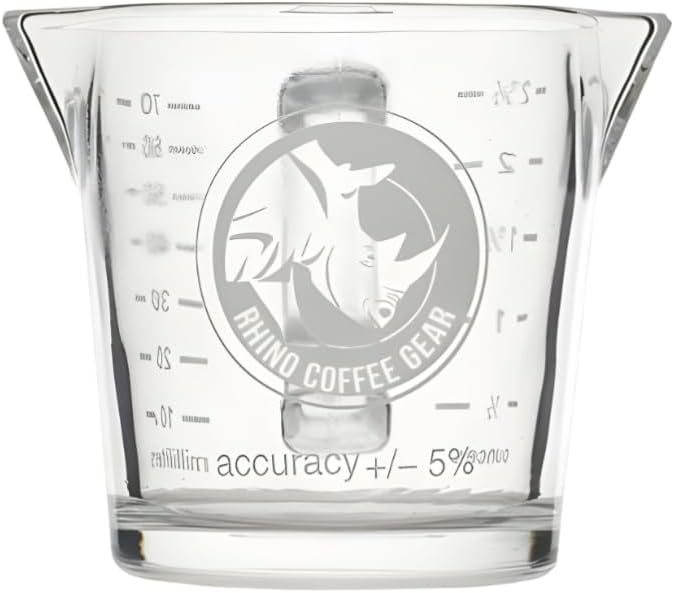
Rhino Coffee Gear Double Shot Glass, 1 Count (Pack of 1)
- Double spouts, convenient pouring handle
- Graduated marks in ounces (. 5oz increments) and milliliters (10ml increments)
- Accurate to within +/- 5%
- Dimensions: 2. 83"/ 72mm diameter across the top of the spouts, 2. 36"/60mm tall
- Rhino wares logo on the front of the glass
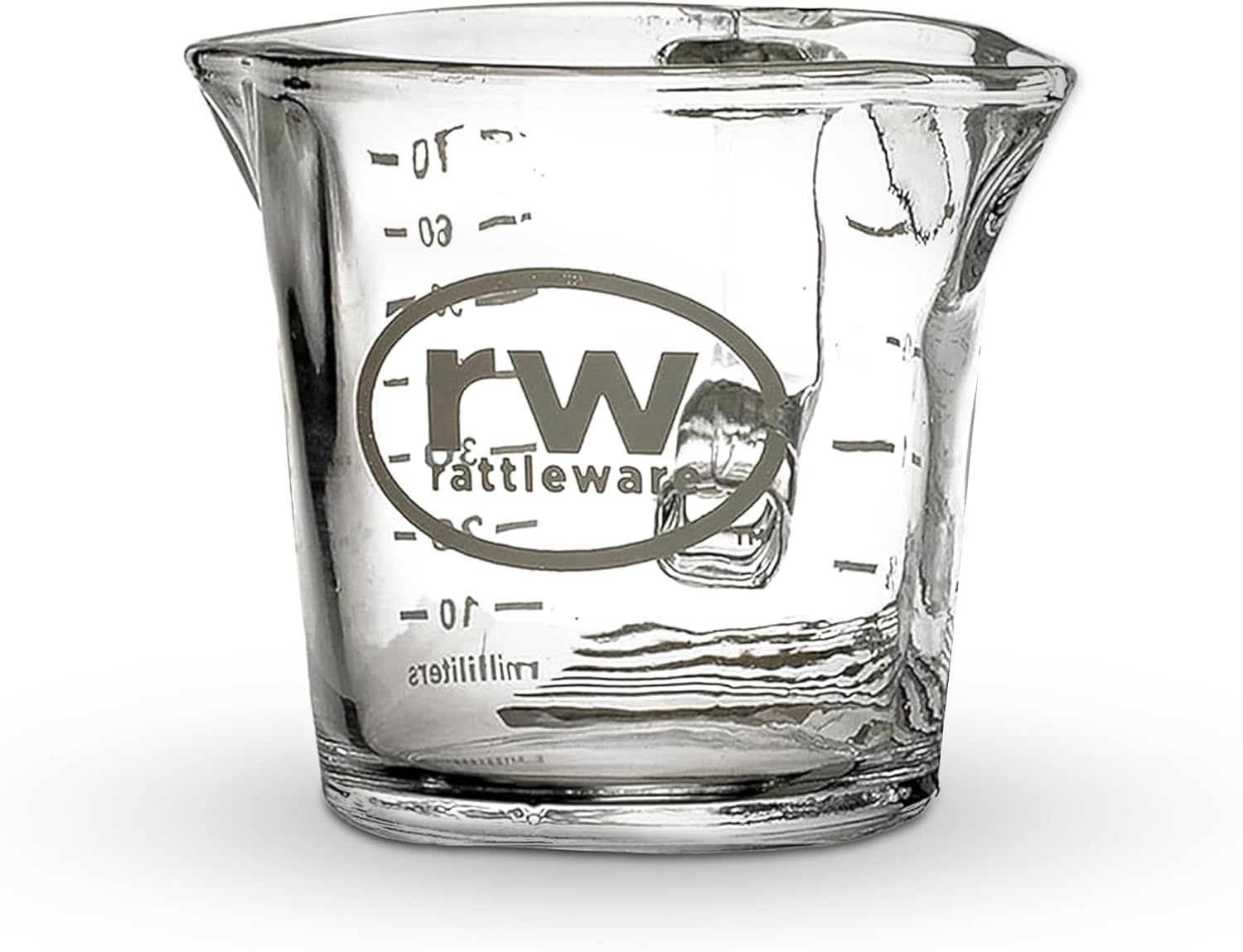
Rattleware 3oz Espresso Shot Glass Pitcher with Double Spout, Measuring Cup
- 𝐋𝐎𝐎𝐊 𝐆𝐑𝐄𝐀𝐓 𝐎𝐍 𝐘𝐎𝐔𝐑 𝐓𝐀𝐁𝐋𝐄: Our shot glasses are thick and durable shot glasses are perfect for your bar cart, b…
- 𝐇𝐈𝐆𝐇-𝐐𝐔𝐀𝐋𝐈𝐓𝐘 𝐆𝐋𝐀𝐒𝐒 𝐂𝐎𝐍𝐒𝐓𝐑𝐔𝐂𝐓𝐈𝐎𝐍: Rattleware espresso shot glasses are made of premium glass for a clear view o…
- 𝐁𝐔𝐈𝐋𝐓 𝐅𝐎𝐑 𝐅𝐔𝐍 𝐀𝐍𝐃 𝐋𝐎𝐍𝐆𝐄𝐕𝐈𝐓𝐘: Designed to last through countless toasts, parties, and relaxing evenings sipping…
- 𝐂𝐋𝐄𝐀𝐑 𝐌𝐀𝐑𝐊𝐈𝐍𝐆𝐒 𝐅𝐎𝐑 𝐏𝐑𝐄𝐂𝐈𝐒𝐄 𝐌𝐄𝐀𝐒𝐔𝐑𝐄𝐌𝐄𝐍𝐓: Produced by Rattleware, renowned for high-quality coffee preparation t…
- 𝐄𝐋𝐄𝐆𝐀𝐍𝐓 𝐄𝐍𝐓𝐄𝐑𝐓𝐀𝐈𝐍𝐈𝐍𝐆 𝐒𝐎𝐋𝐔𝐓𝐈𝐎𝐍: With a simple yet classy design that's distinct in shape, these shot glasses ar…
The Precision Tier: Scales, Handleless Vessels, and Dialing Workflow Upgrades
Mass-First Extraction Protocol and Category Gaps
If you own a 0.1g scale, the role of the shot glass changes fundamentally. The mass-first workflow is straightforward: place the vessel or serving cup directly on the scale, tare it, pull the shot, and read yield in grams. The glass becomes a stream-diagnostic tool-a way to watch what’s happening during extraction-rather than the primary measurement device. The graduation lines shift from being the answer to being a rough reference, and the scale does the actual work.
Scale recommendations split cleanly by budget. The Acaia Lunar is the precision reference at this tier: fast response time, compact footprint that fits under most portafilters, and Bluetooth logging for those who track extraction data over time. The Brewista scale covers the budget alternative without sacrificing the 0.1g resolution that makes yield measurement meaningful.
This tier also exposes the most significant structural gap in how the market currently categorizes shot glasses. The standard framing-Best Overall, Best for Pouring, Best Value, Best Insulated, Best Durable-doesn’t reflect what practitioners actually rank for. Cafe durability, thick double-spout construction, dishwasher safety, regional availability, and budget alternatives are the actual decision variables for the people who use these glasses daily. The category labels are editorial convenience, not practitioner logic.

Acaia Lunar Scale
- Accurate, Instant Feedback
- Robust, Waterproof Design
- Easy-to-Read LED Screen
- Rechargeable via USB-C
- Sleek, Space-Saving Design

Brewista Smart Coffee Scale III with Timer, 2kg/0.1g High Precision Scale for Espresso and Pour-Over Coffee, Portable Mini Digital Kitchen Scale with Automatic Timing, Rechargeable, 5 Modes
- BREW LIKE A PRO: Our coffee scale offers a generous 2000-gram capacity with 0.1g precision. Its drop-by-drop a…
- 5 USER MODES: Our coffee scale’s 5 smart modes allow seamless switching between manual and auto modes. With it…
- EVERYTHING YOU NEED: Combining a 2000g (70 oz) capacity, USB rechargeable battery, 0.1g high precision, auto t…
- Compact, Portable, and Professional: This coffee scale weighs only 200g and is roughly the size of an adult's …
- BREWISTA CRAFTED FOR EXCELLENCE: At Brewista, we carefully manage every step, from concept to creation. Guided…
Grip-Free Form Factors and Final Serving Ware
Handleless shot glass forms-including the notNeutral Vero, Kruve vessels, and the Espressoparts Hearth-interact with scale platforms and short machine clearance in ways that handled glasses don’t. Without a handle projecting from the side, the glass sits flat and centered on the scale surface, and the footprint is smaller, which matters when drip tray clearance is tight. Handleless geometry also eliminates the leverage problem: a handle gives a tipping force somewhere to act, and a wide flat base without one is inherently more stable under portafilter resting.
There’s also a broader workflow question worth naming: many baristas pull final shots directly into pre-warmed ceramic or porcelain serving cups, bypassing the shot glass entirely for service. In this workflow, the glass is a development and dialing instrument used during recipe calibration, not the vessel the customer ever sees. That’s a legitimate use case, and it changes the durability calculus-a glass used only for dialing sessions doesn’t need cafe-rotation toughness, but it does need marking legibility over time.
That legibility question is genuinely unmeasured territory. Sources catalog marking types-etched, printed, dual-scale-but nobody has systematically tracked degradation rates across cleaning regimes. Community discussion covers chipping and breakage extensively but almost never addresses line wear. Treat etched vs. printed as a durability question with a known direction but an unmeasured rate, and err toward etched if your cleaning regime involves anything abrasive or high-temperature.

notNeutral Vero Glass Clear (1, 3 oz)
- Please note that notNeutral's Vero line is a hand-pressed glass product, and natural color variations will occ…
- Dishwasher- and microwave-safe
- Volume: 3 oz. (90 ml)
- Size: 2.5" H x 2.5" W
- Made in the USA

KRUVE Propel Server - Daddy Got Coffee Edition
- Better Tasting Espresso – Enhance flavor with a scientific design that uses headspace, internal fins, and doub…
- Cool To The Touch – Enjoy thermal control with double-walled glass coffee cups that stay cool while keeping dr…
- Universal Fit – The PROPEL espresso glasses are designed to work seamlessly with home and commercial espresso …
- Unique Swirl Design – Featuring patent-pending fins and a convex bottom, the PROPEL lets you stir your espress…
- Durable And Safe – Crafted from hand-blown, laboratory-grade borosilicate glass, these drinking glasses are be…
Budget and Improvised Options: What Works, What Fails, and Where the Savings Come From
Value-Tier Tradeoffs and Substitute Vessels
The budget tier is honest about its tradeoffs, and the tradeoffs are manageable if you understand them. Inexpensive double-walled 2 oz shot glasses from Amazon and the Brewista value option both deliver functional pour-splitting and stream visibility at a fraction of the commercial tier’s price. What you’re trading is wall thickness, marking method, and service life. The glass is thinner, the markings are typically printed rather than etched, and the service life under commercial rotation is shorter. For home use with moderate dishwasher frequency, the service life gap shrinks considerably.
Improvised alternatives are more situationally valid than most guides acknowledge. A metal bell pitcher or a jigger substitutes effectively when you’re weighing on a scale rather than reading lines-the volume markings become irrelevant because grams are doing the measuring. Plastic measuring cups in a Cambro-style format exist as a disposable-volume workaround, particularly useful in high-throughput testing scenarios where you’re pulling many shots in sequence and don’t want to interrupt workflow for washing.
The community verdict on improvisation is worth stating plainly: a jigger stops being a compromise and becomes a vessel the moment grams replace lines. Improvisation is a legitimate strategy when and only when a scale is present. Without a scale, you’re guessing at yield with a tool that wasn’t designed for the temperature or pour dynamics of espresso-and that’s where the improvisation fails.
Premium Claims and Market Access Limits
The premium tier deserves some honest scrutiny. When a 0.1g scale is doing the yield measurement, the marginal accuracy gain from a more expensive shot glass is difficult to quantify-and the community has begun to push back on its own recommendations here. Several well-regarded glasses carry price premiums that are harder to justify once you accept that dialing accuracy lives in the scale, not the vessel. The glass earns its premium through durability, marking longevity, and spout geometry-not through measurement precision that the scale already provides better.
Regional availability compounds this. Several brands that appear consistently in English-language recommendation lists simply aren’t purchasable at reasonable cost outside North America and Western Europe. For a meaningful share of readers, the practical recommendation isn’t the community’s consensus pick-it’s whatever thick-walled borosilicate double-spout glass is actually available in their market at a sensible shipping cost. Principles travel better than brand names.
Which Shot Glass Belongs on Your Bar
The ranking resolves by workflow and context, not by tier snobbery. Here’s how to match the glass to the setup.
Cafe durability pick: Thick double-spout borosilicate in the Rhinowares / Rattleware / JoeFrex class, purchased as rotation inventory rather than as a single prized unit. Dishwasher-safe, dual-spout for workflow efficiency, and thick enough to survive the handling reality of commercial service. Budget for replacement on a three-month cycle under heavy rotation.
Home precision pick: A handleless marked glass-notNeutral Vero, Kruve, or Espressoparts Hearth-paired with a 0.1g scale. The glass serves stream diagnosis and pour-splitting; the scale handles yield verification. Etched markings preferred for longevity, single-wall borosilicate preferred for visibility during dialing.
Budget pick: A value-tier double-walled glass or an improvised scale-first setup using a jigger or bell pitcher. State the printed-marking caveat plainly: expect the lines to fade with regular dishwasher use, and plan accordingly. If a scale is present, the marking degradation matters less.
Before you finalize any purchase, run this four-point check:
| Check | What to Confirm |
|---|---|
| Machine clearance | Measure the gap between portafilter and drip tray; glass height must fit with room to spare |
| Capacity headroom | Marked band should exceed your target yield, not match it |
| Dishwasher safety | Confirm if your cleaning regime requires it |
| Marking method | Etched survives longer; printed fades-match to your cleaning intensity |
The capacity check alone eliminates more bad purchases than any brand comparison. A 1 oz glass is undersized for a standard double, and that single mismatch turns a diagnostic tool into a frustration.
Close on the frame that opened this piece: the best espresso cup with spout for your setup is the one that sits stably on your scale, clears your drip tray, and lets you watch two streams diverge. Everything else-finish, brand, price tier-is secondary to those three mechanical facts. The glass is a diagnostic instrument. Once you treat it as one, the buying decision gets a lot simpler.
Frequently Asked Questions About Espresso Cups With Spout
What is a cup with a spout?
It’s a small graduated vessel-typically 2 to 3 oz-with a V-shaped or dual pour spout designed to transfer espresso cleanly into a cup or split a double shot across two bases without turbulence or splashing.
What are the cups that catch espresso called?
They’re most commonly called shot glasses or demitasse cups, but the spouted graduated version used in professional dialing is specifically a measuring shot glass or spouted espresso pitcher-distinct from a standard demitasse, which has no spout or graduation markings.
Why is it called a demitasse?
Demitasse is French for “half cup,” referring to the small serving size of espresso relative to a standard coffee cup. The name describes the vessel’s capacity, not its shape-which is why a modern spouted shot glass and a classic handled demitasse can both carry the term.
Where can I buy an espresso cup with a saucer?
Specialty coffee retailers like Espressoparts, Seattle Coffee Gear, and brand-direct sites for notNeutral or Acaia carry spouted espresso glasses; Amazon carries budget double-walled options, though regional availability varies significantly for premium brands outside North America.
Do etched markings on shot glasses actually last longer than printed ones?
Yes, consistently. Etched graduations are physically cut into the glass surface and survive repeated dishwasher cycles; printed lines sit on the surface and begin fading within months of commercial-frequency washing, though home users on gentle cycles may see longer service life.
Does a more expensive shot glass improve dialing accuracy?
Not meaningfully, once a scale is in the workflow. Dialing accuracy lives in the 0.1g scale reading grams, not in the graduation lines. Premium glass earns its price through durability, spout geometry, and marking longevity-not through measurement precision the scale already provides better.
Can I pull espresso directly into a ceramic serving cup instead of a shot glass?
Yes, and many experienced baristas do exactly that once a recipe is dialed in. The shot glass is primarily a development tool for watching extraction in real time; a pre-warmed ceramic or porcelain cup is often the better final vessel for temperature retention and mouthfeel.
How do I know if a shot glass will fit under my portafilter?
Measure the vertical distance between the bottom of your portafilter basket and the top of your drip tray surface. Your glass height must be comfortably below that number-on a DeLonghi Dedica with roughly 75mm clearance, for example, a glass taller than about 55–60mm won’t fit without tray removal.
References
- Shattering Glass Cookware – Bulletin of the American Ceramic Society | rroeder.nd.edu