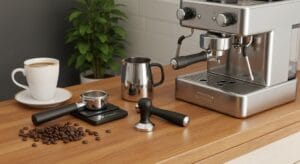

The best Italian espresso cups are sensory instruments before they’re tableware – and the geometry of the interior bottom, the thickness of the rim, and the fired density of the wall each shape what lands on your palate in ways no brand name can override. Most buying guides skip this entirely and hand you a ranked list built on prestige and aesthetics.
This guide doesn’t. Every format here – from the 2 oz solo demitasse to the cortado vessel to the stainless steel guest-service pick – is evaluated against the same seven axes, with the drink context driving the verdict rather than the manufacturer’s marketing department.
Once you understand how vessel geometry and porcelain density shape your palate, you can take your sensory evaluation skills further by exploring Coffee Cupping Defect Detection The protocol to identify unwanted variables in your brew.
Key Takeaways on Best Italian Espresso Cups
- Heat retention and preheatability outrank aesthetics – espresso is at its best between 150°F and 160°F in the cup.
- Capacity-to-yield matching is the first filter: 2–3 oz for a single shot, 3–4 oz for a double, no exceptions.
- Fully vitrified hard-paste feldspathic porcelain from heritage bar-supply makers is the thermal and sensory benchmark for straight espresso.
- A matched saucer, a usable handle, and a clean narrow rim edge are practitioner priorities that most published guides ignore entirely.
- Ceramic surface texture measurably shifts perceived acidity and aftertaste – material is a tasting variable, not just a durability one.
- Untested vintage and thrift ceramics carry real lead-glaze risk; verify lead-free status before daily use.
How a Demitasse Actually Earns Its Slot
Every espresso cup guide gives you a different winner, and the reason is simple: they’re not all measuring the same thing. Some rank by brand heritage, some by aesthetics, some by what photographs well. This guide uses a fixed scoring system – seven axes, applied to every format – so you can see exactly where any cup wins, where it compromises, and whether that trade-off matters for the way you actually drink.
The seven axes are: drink-size match, heat retention and preheatability, lip thickness and mouthfeel, handle and saucer ergonomics, durability, aesthetics, and price-to-value. Every subsequent section is scored against these same criteria, and the weighting is shown explicitly so you can disagree with it and still use the framework.
The Thermal Baseline
Espresso is at its best between 150°F and 160°F in the cup. That single fact repositions the entire evaluation: heat retention and preheatability outrank surface aesthetics by design, not by opinion. A cup that photographs beautifully but drops 20°F in the first thirty seconds is failing at its primary job. Standard demitasse dimensions run 2–4 oz total capacity, and that range is not arbitrary – it’s the band where Italian bar service has landed after decades of calibration.
Capacity-to-Yield as the First Filter
Before thermal mass, before rim profile, before aesthetics, there is one filter that eliminates more wrong purchases than any other: does the cup match the volume you’re actually pulling? A 2–3 oz cup for a single shot, a 3–4 oz cup for a double. This is the sizing logic. An oversized cup spreads crema thin across excess wall surface, accelerates heat loss through that same surface, and flattens the tactile experience before the first sip.
The practitioner community and published review sites diverge sharply on what comes next. Review sites weight brand name, design, and collector value. Practitioner communities in specialty coffee forums weight qualitative mouthfeel and drink-size matching above all else, treating manufacturing standards as a baseline rather than a differentiator. That weighting conflict is worth naming once, clearly: this guide aligns with the practitioner hierarchy, because the cup serves the drink, not the other way around.
The editorial rule here is equally simple – every entry must justify its inclusion against a real drinking context. Brand prestige is not a drinking context.
Heritage Italian Porcelain: Nuova Point, IPA, d’Ancap and Tognana
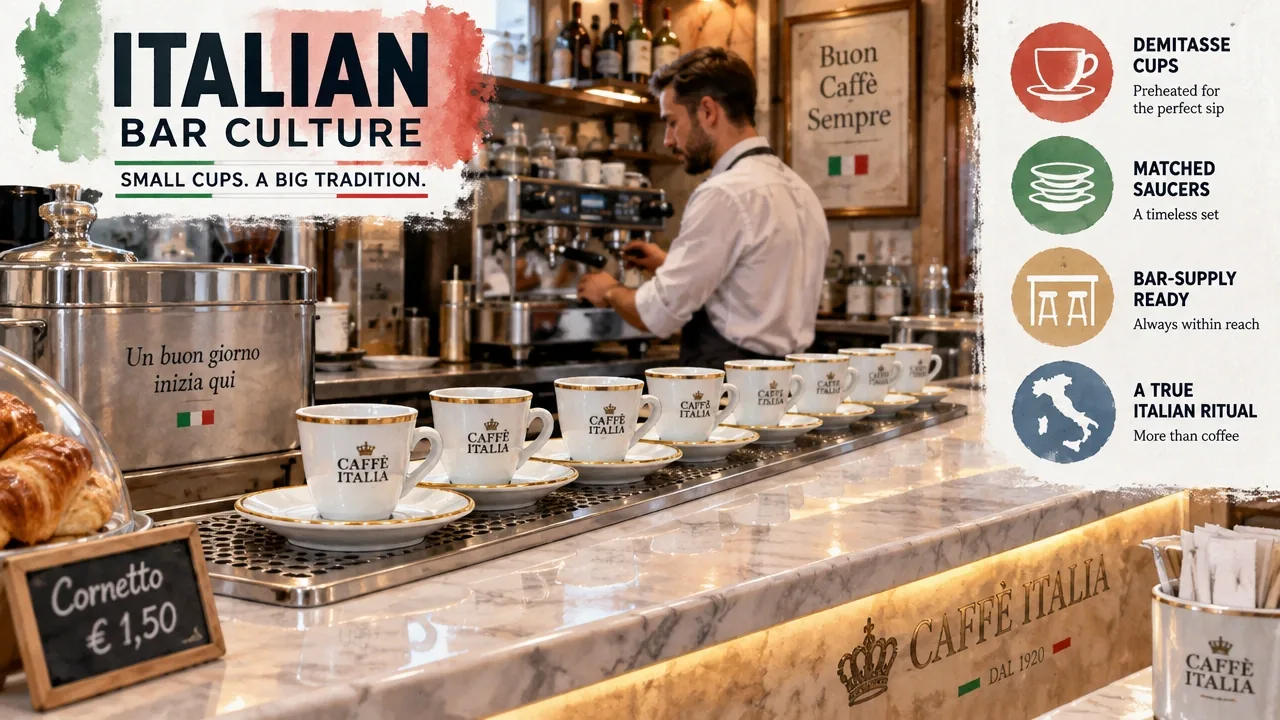
What actual Italian bars put on the counter isn’t a lifestyle product – it’s bar-supply porcelain, sourced from a handful of heritage manufacturers whose entire business is the professional counter. Understanding what makes those cups physically different from lifestyle tableware is the first step toward choosing any cup correctly.
Bar-Supply Lineage and Counter Placement
Nuova Point, IPA, d’Ancap, and Tognana are the reference manufacturers for the Italian demitasse form. These are not design-led brands that also happen to make espresso cups – they are bar-supply operations whose cups are calibrated to the demands of a working espresso counter: high-volume preheating, stacking, repeated washing, and service at pace. Rosenthal sits at the top of the heritage tier on finishing quality; IPA trails it; the illy line has been improving in weight and finishing quality across successive generations. The differentiator within this tier is finishing – the precision of the rim edge, the consistency of the glaze, the tolerance on wall thickness – not the brand name on the base.
These cups are the reference point for the Italian demitasse form precisely because they were never designed for a shelf. They were designed for a counter.
Feldspathic Geometry and Preheat Protocol
The material is specific: thick-walled hard-paste feldspathic porcelain (porcellana dura feldspatica), high-fired and fully vitrified. Full vitrification means the body is non-porous, taste-neutral, and dimensionally stable across repeated thermal cycling. More practically, it means the cup acts as thermal mass – it stores heat and releases it slowly into the drink – rather than functioning as a heat sink that pulls temperature away from the shot.
The shape engineering compounds this. A convex or egg-shaped interior bottom funnels crema toward the center rather than letting it cling to the wall and disperse. A tapered rim delivers mouthfeel without interference. The 2–3 oz format matches Italian bar service volumes with no excess surface to cool against.
“The espresso cup for professional use must have three basic characteristics. The first concerns the inner bottom, which must have the typical oval shape to allow the crema to develop correctly and to ensure the coffee’s aromas remain unaltered.” – Carlo Barbi, CEO of Club House, Italian porcelain manufacturer
That oval interior isn’t an aesthetic choice – it’s an engineering decision about where the crema goes and how long it holds. The shape determines the surface area the crema must cover, which determines how quickly it disperses, which determines how the aromatics behave in the first ten seconds after extraction.
The executable preheat protocol is this: bring the cup to 130–150°F before extraction, either by running hot water through it or by keeping it on a preheated surface. Fully vitrified porcelain tolerates this thermal cycling without crazing – the microscopic surface fracturing that happens to lower-fired earthenware when it’s repeatedly heated and cooled. That tolerance is a manufacturing property, not a care instruction.
There’s a tension worth holding here: a thick body builds thermal mass, but a thin lip reads mouthfeel more directly. The best bar cups resolve this by being thick through the body and resolving into a clean, narrow edge at the rim. Inspect that rim edge on any candidate. If it’s blunt, the cup has prioritized durability over drinking experience. The widely cited “5 mm wall plus matching saucer” Italian standard is a design convention, not a validated specification – field preference is qualitative, centering on mouthfeel and correct drink-size matching rather than any single measurement.
The wine-glass logic applies here too: the vessel shape concentrates or disperses aroma before the liquid reaches your nose. But porcelain adds a variable glass never has – it stores heat, and how much it stores is a manufacturing decision, not a marketing one.
The 2 oz Single Shot Demitasse
A 2 oz cup is not simply a small cup. The geometry is deliberate, and it changes what the shot tastes like.
The ~2 oz (≈60 ml) demitasse is the classic Italian solo cup and the default counter serve. Its narrower opening and tulip or tapered rim concentrate aroma toward the nose before the liquid reaches the lip. A rounded interior preserves crema across the surface of the drink. A thin rim delivers mouthfeel with no ceramic interference between the shot and the palate. These are sensory functions, not stylistic choices.
The failure mode of up-sizing a solo is specific and consistent: crema spreads across a wider surface, cools faster against the excess wall area, and the tactile experience flattens into something that reads as “coffee in a small mug” rather than espresso. The drink hasn’t changed – the geometry has, and the geometry changes the perception.
The use case is equally specific: straight espresso and ristretto drinkers, tasting flights, and anyone pulling single shots at 1:1–1:2 ratios. If that’s your drink, this is your format.
Practitioners calibrate by fill proportion, not label capacity. A 40 ml espresso in a 60 ml cup, filling roughly two-thirds, is the visual benchmark the community uses. This is a practical sanity check before you buy a set: pour your standard yield into any candidate cup and see where it lands. If it’s at the rim, the cup is undersized. If it’s below the halfway mark, you’re drinking espresso from a coffee mug.
Community sourcing for this format skews deliberately inexpensive. The position is that a solo cup is a high-frequency demitasse – it’s used multiple times a day, it gets stacked, it gets washed, occasionally it gets dropped. Thrift finds, antique store discoveries, and local-potter pieces are rational choices for this format, not compromises. The geometry matters; the provenance doesn’t.
Affiliate Disclosure
This post contains affiliate links, meaning I may earn a commission if you make a purchase through these links, at no additional cost to you. As an Amazon Associate, I earn from qualifying purchases. I only recommend products I genuinely believe will add value.

2 X Espresso Porcelain Cups and Saucers 2Oz Capacity Cc 75 Height Mm 58
- A set of 2 x espresso cups & saucers
- A beautiful addition to the home for enjoying perfect coffee
- Capacity cc 75, height mm 58
The 3 oz Doppio Cup
The question “why can’t I just pull a double into my 2 oz cup?” has a very direct answer: because the liquid will sit at the rim, the crema will shear against the lip as you pour, and the drink will be cold before the last third. The 2 oz format is engineered for a single yield. A doppio needs headroom.
The 3 oz demitasse – and up to 4 oz – provides enough volume to hold the crema ring intact and leave room for a spoon without crowding the rim. That headroom is functional, not generous. It determines whether the crema survives the pour and whether the drink is drinkable to the last sip at the right temperature.
The crossover utility is real and worth naming: a 3–4 oz cup doubles as a cortado or flat-white vessel at roughly 1:1 coffee-to-milk. This is the natural bridge between pure espresso service and milk-drink territory, and it’s why the 3 oz format is the most versatile single purchase in the demitasse category.
Preheating matters more at this size, not less. Greater exposed surface area means faster heat loss, so the preheat window is higher stakes for a doppio than for a solo. A cold 3 oz cup will drop a double espresso below the optimal temperature band before the crema has settled.
The 45–60 ml sub-band within this category is where manufacturers have started experimenting with geometry rather than just scaling the 2 oz form. Cups in this range now ship with internal agitation fins designed to influence crema and aroma delivery. Cortado-specific 45 ml vessels exist precisely because the standard 3 oz demitasse is slightly too generous for a true 1:1 drink. These are geometry variables, not upgrades – they change how the drink presents, so treat them as preference-driven picks rather than performance improvements.
The practitioner resistance to over-specification is sharpest in this format. The community optimizes by how the cup fills and feels at the lip with the actual drink in it, not by the capacity number printed on the base of the cup.

Bialetti Ceramic Espresso Cup Set - Multi Coloured (6pk)
- Exclusive Bialetti design. Exclusive octagonal shape
- Embossed Bialetti logo
- Ceramic
- Made of Quality Material
Saucer Ergonomics and Counter Stackability
The saucer is not decorative. Neither is the stacking profile. Both are operational variables that determine how a cup performs in actual service – and both are largely ignored by published buying guides.
Matched Dish Carry Dynamics
The matched saucer is the Italian bar convention for a reason. Saucer diameter relative to the cup base determines stable one-handed carry – the physics of a heavy ceramic cup on an undersized saucer are not forgiving. The saucer serves a dual role: spoon rest and drip tray. A saucer that’s too small fails both functions and makes the set look improvised regardless of the cup’s quality.
Handle design is the other overlooked ergonomic variable. Full-finger clearance determines whether you can grip the cup without touching the body – relevant when the cup is hot from preheating. Heat transfer through the handle itself varies by thickness and material. Balance when the cup is filled to the intended ratio affects how the carry feels and whether the drink stays level. These are functional criteria, and they belong in any serious evaluation.
The practitioner test for a matched set is functional rather than visual: cup and saucer should sit as one unit you can carry, set down, and drink from without adjusting your grip. If the saucer is decorative-only – if it wobbles, if the cup slides across it, if it’s too small to catch a drip – the set fails regardless of the porcelain’s quality or the brand’s heritage.
Saucer pairing, a genuinely usable handle, lip thickness, and nose clearance for aroma are the practitioner priorities that published evaluations largely omit. This is where connoisseurs separate from designers.
Commercial Storage and Wear Resistance
Counter economics start with the stacking profile. A cup’s foot geometry – the ring on the base – determines whether it stacks cleanly at height or wobbles after the third cup. Straight-walled stackable sets and cup stands or racks are the commercial solution. In a home context, foot geometry still determines whether your cups store neatly or require individual placement.
Durability under stacking and washing is where material makes its most practical difference. Thick vitrified porcelain resists the rim-to-foot chipping that happens in a working stack – the contact point between a stacked cup’s rim and the foot of the cup above it is the highest-stress point in daily storage. Thin china and glass are the chipping risks in any stack that gets used. If a cup can’t survive its own storage, it’s not a working cup.
The Material Matrix: Porcelain vs Bone China vs Artisan Ceramic vs Glass vs Stainless
The material question is almost always framed as a durability question. It isn’t. Material is primarily a sensory variable – it governs the heat curve, the tactile feedback at the lip, and measurably, the perceived taste of the coffee itself.
Vitrified Versus Translucent Bodies
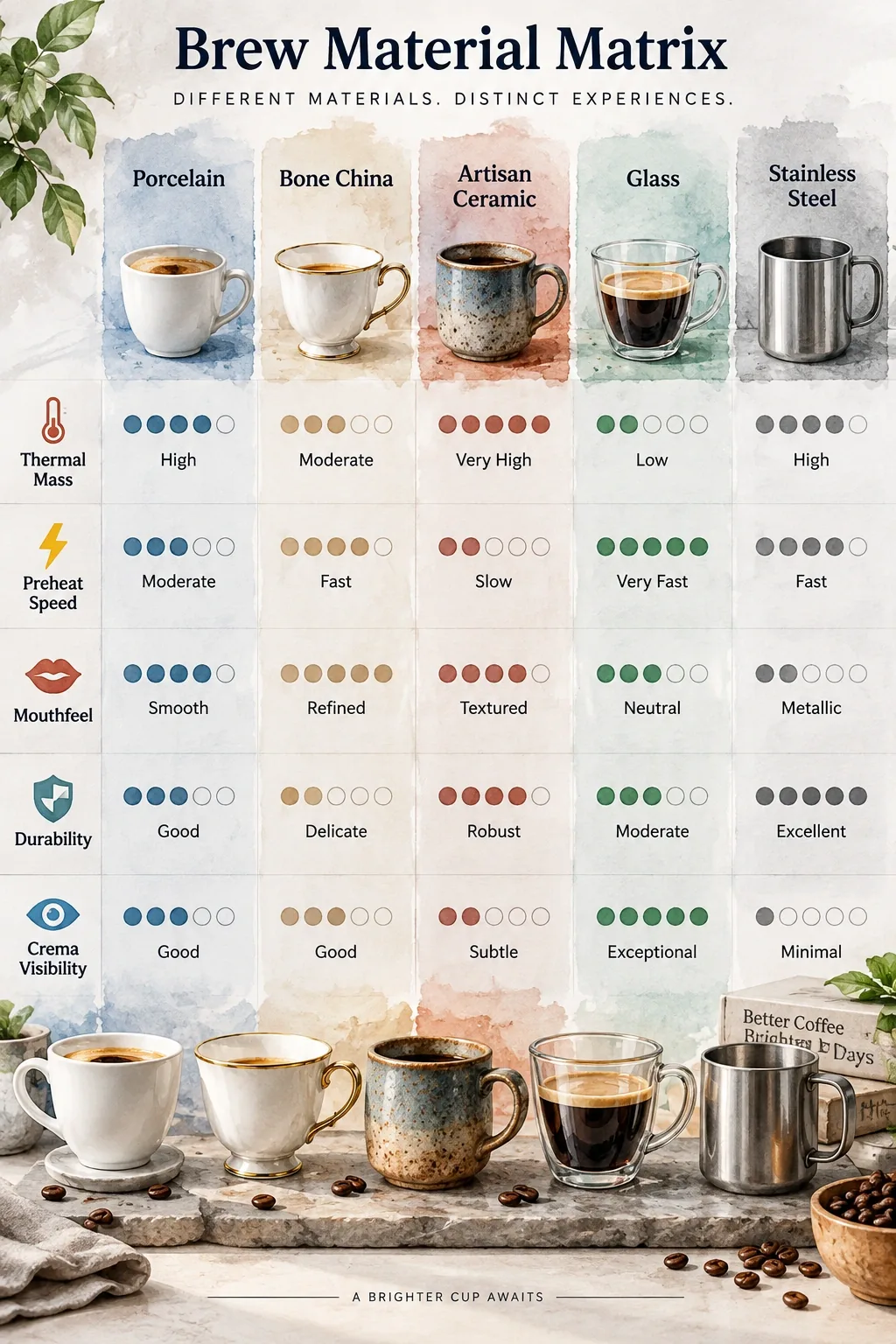
Hard-paste porcelain and bone china are not interchangeable. Porcelain’s full vitrification produces a dense, non-porous body with genuine thermal mass – it holds heat and releases it slowly. Bone china’s bone-ash composition produces translucency, thinner walls, and lighter weight, but at the cost of higher chip risk and lower thermal mass. What each does to mouthfeel is direct: the thinner walls of bone china read differently at the lip than the resolved-narrow-edge rim of a well-made porcelain demitasse.
Material is a tasting tool as much as a thermal one. A peer-reviewed study in Food Quality and Preference tested specialty coffee served in rough versus smooth ceramic cups with Q-graders and amateur consumers. Q-graders rated the coffee as significantly more acidic from the rough ceramic cup than from the smooth one, and both experts and amateurs judged the aftertaste as significantly drier from the rough cup. Body perception was not significantly affected by surface texture. The finding is specific and worth holding: ceramic texture shifts perceived acidity and aftertaste – which means the surface finish of your cup is an active participant in the tasting experience, not a passive container.
Reactive Glazes and Double-Wall Insulation
Artisan ceramic and stoneware bring reactive glazes, thicker walls, and tactile surfaces that many drinkers find more pleasurable to hold. The thermal mass is high – sometimes higher than vitrified porcelain – but preheating is slower and less even because the body’s porosity and density vary more across handmade production. If you preheat consistently, artisan ceramic is a genuine contender. If you preheat inconsistently, the thermal behavior is less predictable than factory-fired porcelain.
Glass splits into two distinct categories. Single-walled borosilicate is a visual experience – watching crema form and layer is genuinely satisfying – but it offers almost no thermal retention and requires consistent preheating. Double-walled borosilicate is the insulation strategy for anyone who doesn’t preheat: the air gap between the walls dramatically slows heat loss and keeps the exterior cool to the touch. The visual advantage is retained. The trade-off is that double-walled glass is more fragile than it looks and significantly more expensive than single-walled.
Unbreakable Service Vessels
Stainless steel is the genuinely overlooked pick in this category, and the practitioner community treats it as a serious option rather than a compromise. Unbreakable, insulated, and chemically neutral – stainless steel survives what porcelain cannot, which makes it the operative choice for guest service, high-breakage environments, travel, and outdoor bars.
The one caveat is honest and specific: a metal rim reads differently at the lip than porcelain. It’s not worse – it’s different, and for some drinkers it’s a meaningful tactile distinction. The taste-neutrality question is often raised and the answer is straightforward: stainless steel does not impart flavor. What it does govern, like every other material, is the heat curve, the tactile feedback, and the durability profile. For the contexts where breakage is the primary operational risk, those three variables make stainless the correct answer.
Colorways: Classic White, Matte Black and Vintage Retro Bistro
Color and finish do change something beyond shelf aesthetics – but what they change is narrower than most guides suggest.
Classic white is the Italian bar default for functional reasons, not traditional ones. Maximum crema contrast makes the shot’s quality visible immediately. White is the easiest color to match when a single cup chips and needs replacing. It’s also the easiest to evaluate for staining over time. These are operational advantages, not aesthetic preferences.
Matte black is the contemporary design-led option, and it carries a specific practical consequence: a matte exterior changes the perceived lip finish. The surface reads slightly more textured at the rim than a high-gloss white, which shifts the tactile experience. Crema contrast is also dampened – the dark background makes the golden-brown layer harder to read visually, which matters if you use crema color and coverage as a quality indicator.
Vintage retro bistro styles – striped and saturated café colorways – read as nostalgic counter service and are typically sold as matched sets with coordinating saucers. The visual coherence is the primary value. These sets are harder to replace cup-by-cup when one breaks, which is worth factoring into a purchase for daily use.
The practical glaze realities for dark and patterned finishes are worth stating plainly: crema legibility decreases, staining behavior is harder to monitor, and dishwasher wear on decorative surfaces is faster than on undecorated glaze. A hand-wash-only decorated cup in a daily-use context is a maintenance commitment, not a premium feature.
What the design premium actually buys is finishing, artwork, and collectibility. Designer and art-series cups – Julius Meinl’s Matteo Thun collaboration at roughly €23, curated illy art collections, designer sets in the $70 range often discounted to around $55 – charge for those properties, not for measurably better thermal behavior or mouthfeel. Published buying guides skew heavily toward premium and collector aesthetics. Practitioner communities push back. The vault data shows no performance correlation with price at this tier.
Hidden Gems and Budget Tiers: Thrift, Vintage, Local Potter, Non-Espresso Vessels
The category’s best-kept secret is that the performance ceiling of a $1 thrift find and a $70 designer cup are closer than the price gap suggests – and one of those options carries a safety risk that no competing guide mentions.
Secondhand and Repurposed Sourcing
The practitioner community’s position on budget sourcing is consistent and well-reasoned: the solo cup is a high-frequency consumable, and spending premium money on a vessel that gets used multiple times a day, stacked, washed, and occasionally dropped is not rational optimization. Thrift stores, antique markets, online marketplaces, and local potters are legitimate sourcing channels, not fallback options.
Non-espresso vessels are also legitimate picks. Small glassware from spirits or liqueur service can outperform dedicated espresso cups on mouthfeel and size matching – the category label on the vessel is irrelevant if the geometry is right. Practitioner finds include a $1 vintage Japanese double-walled set, Japanese Soma-ware double-walled ceramics, and thin glassware repurposed from the spirits shelf, all of which sit functionally alongside the designer tier at a fraction of the cost.
The community also pushes back on the belief that dedicated espresso cups are necessary at all. If a vessel matches your drink size and reads well at the lip, it qualifies. The drink doesn’t know what category the cup was sold in.
Dual-Wall Construction and Safety Verification
Double-walled ceramic is a niche material with a specific functional advantage: the air gap between the inner and outer wall provides insulation without preheating. Japanese double-walled ceramic traditions have refined this construction over generations, and contemporary versions offer genuine thermal performance for drinkers who don’t preheat consistently. The trade-off is that double-walled construction adds weight and wall thickness, which affects the lip profile.
The safety screening procedure for secondhand ceramics is the part no competing guide prints, so it’s worth stating clearly.
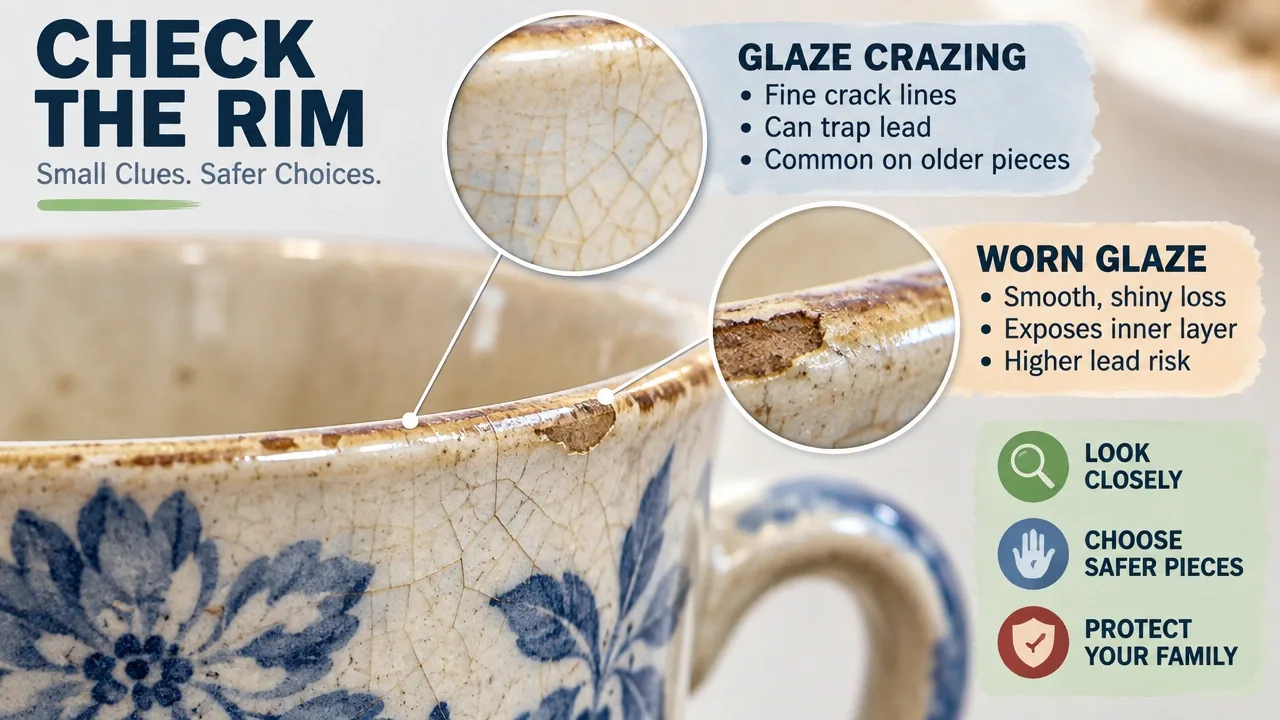
Inspect glaze crazing – the network of fine cracks in the glaze surface – particularly at the rim. Crazing creates pathways for liquid to reach the ceramic body beneath the glaze, and in older or lower-quality ware, that body may not be food-safe. Inspect the rim for worn or leaching glaze: a rim that has lost its glaze surface through repeated washing or chipping is a contact point where the underlying material is now directly touching your lip and the drink. Prefer known-manufacturer vitrified ware when sourcing secondhand, because full vitrification means the body itself is non-porous and food-safe even if the glaze is compromised. Verify lead-free status before daily use – vintage ceramics, particularly those produced before the 1990s in certain markets, may contain lead in the glaze. Untested vintage ceramics should be treated as high risk until verified. This warning does not appear in competing guides, which is a meaningful omission given how actively the community sources from this channel.
For drinkers prioritizing extended heat retention without the ritual of thermal flushing, exploring modern double wall espresso innovations provides an alternative thermal strategy.
Verdict: The Use-Case Lineup
There is no single best Italian espresso cup. There is a best cup for each drinking context, and the decision map is shorter than the category’s complexity suggests.
Straight espresso and ristretto: a preheated 2 oz thick-walled porcelain demitasse with a clean, narrow rim. This wins on thermal mass, crema geometry, and mouthfeel simultaneously – there is no other format that does all three as well.

Fima thatsArte.com - Italian Ceramic Espresso Cup & Saucer Ricco Deruta Blu - Hand Painted Cup, Made in Italy Ceramics, Handmade Coffee Cups, Italian Ceramics Deruta, Italian Pottery
- Our Italian espresso cup with saucer is entirely handmade and hand-painted in Deruta. It is crafted by Fima, a…
- The pattern hand-painted on this small cup and its saucer is Ricco Deruta, a very popular Italian ceramics des…
- Espresso coffee is not just a drink; it’s a moment of pure pleasure. The small cups are as much part of the ex…
- The shape of our hand painted Deruta espresso cups meets the demand of Italian espresso lovers. Its rounded in…
- Our made-in-Italy espresso cups and saucers measure 4.7 inches (cup 2.3 x 2.1h inches). They are made of Derut…
Doppio: a 3 oz demitasse, preheated, from the same heritage porcelain tier. Headroom for the crema ring, room for a spoon, and enough wall mass to hold temperature through the drink.

De'Longhi DLSC308 Porcelain Espresso Cup & Saucer, Set of 2,70 ml
- Set of 2 espresso cups with saucers.
- Exclusive Italian Design by De’Longhi.
- Produced by Tognana, an Italian market leader of ceramic ware manuafacturing.
- Made of white porcelain.
- Designed with the perfect shape to deliver a creamy espresso.

Bialetti Octagonal Cups, Set of 4, Matte Black and Rose Gold, 75 ml, Not Dishwasher Safe
- Set of 4 cups: perfect for sharing coffee breaks with whoever you want!
- Original and iconic octagonal shape: design of the Moka Bialetti in cup format
- Bialetti quality and design for a perfect cup to preserve the taste and texture of the cream for a delicious c…
- Single cup capacity: 75 ml
Cortado and flat white: a ~135 ml tumbler or dedicated cortado vessel. The notNeutral Vero Cortado is the verified practitioner pick here; a 135 ml Picardie-style tumbler is the budget-rational alternative. A 45 ml cortado-specific cup exists for drinkers who want precision at the 1:1 ratio.

notNeutral Vero Glass Clear (2, 4.25 oz)
- Please note that notNeutral's Vero line is a hand-pressed glass product, and natural color variations will occ…
- Dishwasher- and microwave-safe
- Volume: 4.25 oz. (125 ml)
- Size: 3" H x 3" W
- Made in the USA

Duralex - Picardie Tumbler, Clear, 4 3/8 ounce, Set of 6
- Set includes six 4 3/8 ounce glasses; Diameter: 2.75 inch / 6.9 cm, Height: 2.875 inch / 7.2 cm, Volume: 13 cl…
Cappuccino and latte: a wider, latte-appropriate mug – Acme-style cups for milk texture, or a notNeutral latte mug. The demitasse format is wrong for these drinks; don’t force it.

notNeutral Lino Porcelain Cup & Saucer Large Latte 12 oz (White, 12 oz, 2)
- Fine porcelain
- Dishwasher-and microwave-safe
- Volume: 12 oz. (360 ml)
- Cup: 2.875" H x 6" W - Saucer: 6.25" diameter
- Made in Sri Lanka

ACME Classic Tulip Cup and Saucer Set - Red
- Classic Tulip Cup: 3.15in x 2.95 x 1.9in Capacity: 170ml/5.75oz
- Saucer: 5.5in
- Material: Durable Porcelain
- Dishwasher Safe
Iced espresso: double-walled borosilicate glass. The visual advantage is real, and the insulation strategy is correct for a cold drink that doesn’t benefit from preheating.

Aquach 16oz Double Walled Glass Coffee Cups Set of 2, Insulated Tumblers
- [BOROSILICATE GLASS FOR THERMAL STABILITY] Crafted from thermal-resistant borosilicate glass mug material, thi…
- [AUTHENTIC 16 OZ CAPACITY FOR VARIOUS BREWS] Standing 6.0" tall with a 3.2" wide rim, each cup holds an authen…
- [INNOVATIVE SINGLE-WALL RIM FOR SMOOTH SIPPING] Featuring a unique lidless design with a fire-polished single-…
- [DOUBLE-WALLED INSULATION AND SWEAT-PROOF GRIP] The insulated glass coffee mug features a two-layer structure …
- [SECURE PACKAGING FOR THOUGHTFUL GIFTING] Shipped in internal slot packaging to defend against transport movem…
Guest service and high-breakage environments: insulated stainless steel. Antique C 18/10 INOX or WMF ware for sourcing depth; contemporary insulated stainless for straightforward procurement. The metal rim is the only concession, and for this context, it’s an easy one.

WMF Mocha Jug Gourmet Cromargan Stainless Steel, 340 ml
- Material: Cromargan stainless steel | Dimensions: Height: 9cm, diameter: 8cm, Volume 340ml, suitable for 6 cup…
- This mocha decanter made of high-quality Cromargan rust-free stainless steel 18/10 is perfect for preparing a …
- The long handle keeps your hands out of the danger zone at all times.
- The pour edge allows for drip-free pouring and the decanter can be washed in the dishwasher, of course.
- The benefits: Practical kitchen aids for various tasks. Thought through functionality. Made of Cromargan: Stai…

RECAPS 80ml Stainless Steel Espresso Cups Set (Stainless Steel)
- Suitable Capcity (Small Cup 80ml):Enjoy this set of 2 Insulated espresso cups. Each shot holds 80ml / 2.7 oz. …
- Premium Quality:The double espresso cups is made of 304 stainless steel and is drop resistant and durable, com…
- Thoughtful Design:The double wall espresso shot cups designed for easy handling and prevents burning hands. Wh…
- Clean in Seconds: The metal espresso cup are super easy to clean. wash the espresso cups by hand or put them i…
- You Won't Be Disappointed: For our espresso cups,if you have any question,please feel free to contact and we w…

Topyond 4oz Insulated Espresso Cup, Dual Wall Stainless Steel
- Premium Quality Materials: Our Coffee Mug is crafted from high-quality 304 stainless steel, ensuring its durab…
- Rustproof and Practical: The coffee mug is designed to resist rust, making it a sturdy and lightweight option …
- Elegant and Classy: The interior of the coffee mug features a wire drawing process, enhancing its texture and …
- Efficient Heat Insulation: Our coffee mug adopts a double-layer design with hollow insulation. This innovative…
- Versatile and Gift-worthy: This coffee mug is perfect for a wide range of beverages, including coffee, latte, …

Foraineam Double Layer Vacuum Insulated Stainless Steel Cups 16 oz Drinking Glasses Beer Water Tumblers Unbreakable Metal Hot & Cold Drinking Cups for Home Restaurant Bar Party Camping, Set of 2
- Double Wall & Vacuum Insulated: Our stainless steel tumblers have double-wall heat insulated design that can e…
- Food-grade Material & Unbreakable Structure: Made of premium food-grade 304 stainless steel, these water cups …
- Easy to Clean & Dishwasher Safe: The stainless steel drinking cups are easy to wash by hand and also support d…
- Diamond Pattern Design: Features diamond pattern, these stainless steel glasses look gorgeous and special. The…
- Perfect Size for Multiple Use: Each water tumbler measures 3.4" Dia. x 6.3" H (8.6 x 16cm). Easy to hold and l…
The top overall slot belongs to authentic, high-fired, thick-walled Italian porcelain, matched to the dose you actually pull and preheated to 130–150°F. That’s not a brand recommendation – it’s a specification. Vitrified hard-paste porcelain from a heritage bar-supply maker, an egg-shaped interior bottom, a matched saucer, and a capacity that fits your yield. Those four criteria are verifiable before purchase.
The overrated signals you should now be able to spot: the notion that one cup works across all formats, the assumption that price correlates with thermal performance, and the claim that double-walled construction is a necessity rather than an insulation strategy for people who skip preheating. None of those hold up against the seven-axis framework.
The tier logic that replaces a ranking is this: budget tier (thrift, antique, local potter) for high-frequency daily use; mid-range workhorses pulled from daily service for hosting; premium and designer tier for finishing, artwork, and collectibility. Spend at the tier that matches your drink frequency, not your shelf pride.
The best Italian espresso cup is the one whose geometry matches how you drink. Authenticity is verifiable. The rest is preference.
Frequently Asked Questions About Best Italian Espresso Cups
What cups do Italians actually use for espresso at the bar?
Italian bars use thick-walled, fully vitrified hard-paste porcelain demitasses from bar-supply manufacturers like Nuova Point, IPA, d’Ancap, and Tognana – not lifestyle tableware. The cups are preheated, matched with a saucer, and sized to 2–3 oz for a single shot.
Who makes the best espresso cup?
There’s no single answer, because the best cup depends on the drink format. For straight espresso, heritage Italian bar-supply porcelain from makers like d’Ancap or Nuova Point leads on thermal mass and crema geometry. For cortados, the notNeutral Vero Cortado is the verified practitioner pick.
Does preheating really make a measurable difference?
Yes, and the difference is largest for the doppio format. Greater exposed surface area means faster heat loss, so a cold 3 oz cup can drop a double espresso below optimal temperature before the crema has settled. Preheat to 130–150°F before extraction.
Why does the interior shape of the cup matter?
An egg-shaped or convex interior bottom funnels crema toward the center rather than letting it spread and cling to the walls. That geometry preserves the crema layer longer and concentrates aromatics – it’s an engineering decision, not an aesthetic one.
Can I use a non-espresso vessel and get the same result?
If the vessel matches your yield volume and reads well at the lip, it qualifies – the drink doesn’t know what category the cup was sold in. Small spirits glassware and repurposed Japanese ceramics are legitimate practitioner picks that outperform dedicated espresso cups on mouthfeel in some cases.
Is bone china a reasonable alternative to hard-paste porcelain?
It works, but with trade-offs. Bone china’s thinner walls and lighter weight reduce thermal mass compared to vitrified porcelain, and its higher chip risk makes it a less practical choice for daily stacking and washing. The lip feel is different – thinner, which some drinkers prefer – but the heat curve is less forgiving.
What’s the actual risk with vintage or thrift espresso cups?
Vintage ceramics produced before the 1990s in certain markets may contain lead in the glaze. Glaze crazing and rim wear create pathways for that glaze to contact the drink directly. Treat untested vintage ware as high risk until verified lead-free – a home lead-test kit costs a few dollars and takes minutes.
Does spending more money on a designer espresso cup improve the coffee?
No. Designer and art-series cups charge for finishing quality, artwork, and collectibility – not for measurably better thermal behavior or mouthfeel. The performance ceiling of a well-sourced $5 thrift find and a $70 designer cup is closer than the price gap suggests.
References
- Carlo Barbi on choosing the right cup for each coffee | comunicaffe.com
- Cup texture influences taste and tactile judgments in specialty coffee | doi.org (Food Quality and Preference)