
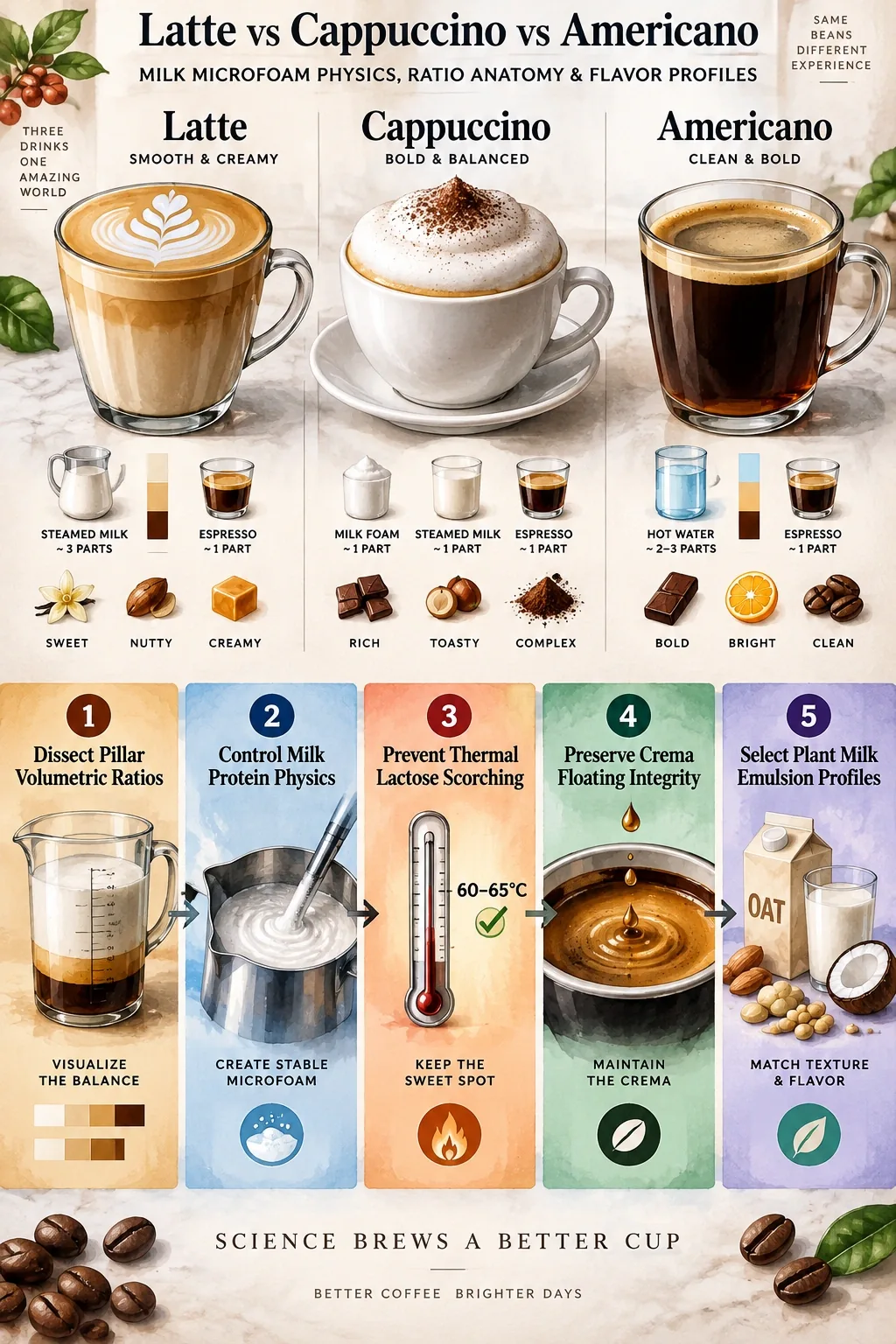
The latte vs cappuccino vs americano comparison breaks down three of the most ordered espresso-based drinks into their structural anatomy. A latte (caffe latte in Italian) combines a double shot of espresso with approximately 4 parts steamed milk and a thin microfoam layer, producing a milk-forward, mellow drink. A cappuccino divides the cup into equal thirds (espresso, steamed milk, and thick dry or wet foam), producing a more espresso-intense, textured experience. An Americano dilutes espresso with hot water at roughly 1:3 ratio, with no milk, producing a long black coffee with a thin crema layer.
Understanding the milk steaming physics that differentiate latte microfoam from cappuccino foam explains why each drink cannot simply be made by adjusting the same milk preparation.
Key Takeaways on latte vs cappuccino vs americano
- A latte combines espresso with steamed milk at a 1:4 ratio with a thin microfoam layer; a cappuccino divides the cup into equal thirds (espresso, steamed milk, foam) for a 1:1:1 ratio; an Americano dilutes espresso with hot water at 1:3 to 1:4 ratio with no dairy.
- Latte microfoam and cappuccino foam require different steam wand techniques: latte foam is produced by briefly introducing air then submerging the wand to homogenize fine bubbles into the milk; cappuccino foam requires sustained surface-level air introduction to build a larger, drier foam volume.
- The critical milk steaming temperature window is 135-150°F (57-65°C): whey proteins begin denaturing at 135°F to stabilize bubbles, peak microfoam quality occurs at 145°F, and protein structures collapse into coarse foam above 160°F in a process that cannot be reversed by cooling.
- A Long Black (water first, espresso poured on top) preserves the crema layer intact on the surface; an Americano (espresso first, water poured on top) disperses the crema through the liquid; both contain the same ingredients at the same ratio but differ in crema presentation.
- A latte’s high milk volume (4:1) conceals espresso extraction defects; a cappuccino’s 1:1:1 ratio amplifies espresso character; an Americano with no dairy is the clearest indicator of espresso extraction quality since every flavor note is directly perceptible without dairy moderation.
The Three Drinks: Ingredient Ratios and Cup Anatomy

Latte: The 1:4 Milk-Dominant Espresso Drink
A standard caffe latte consists of:
- 1 part espresso (typically 1-2 shots, approximately 30-60ml)
- 4 parts steamed milk (approximately 120-240ml depending on cup size)
- A thin layer of microfoam (approximately 5-8mm at the surface, incorporated into the drink)
The latte’s defining characteristic is the microfoam texture: milk steamed to 150°F (65°C) with the steam wand positioned to introduce and integrate fine air bubbles into the milk structure, creating a glossy, liquid-like foam that sits on the surface and pours with the milk rather than sitting above it as a separate layer.
What produces the latte’s flavor: the high milk-to-espresso ratio (4:1) means milk lactose sweetness and fat richness are the dominant flavor notes, with espresso providing a backdrop of coffee bitterness and aroma. A latte is the correct choice when the goal is espresso flavor without espresso intensity: the espresso is present but softened by milk volume. The fat content of the milk used changes the flavor profile significantly: whole milk produces a sweet, creamy, rounded cup; skim milk produces a thinner, less sweet cup with more perceptible espresso bite.
Latte size range: the standard latte is served at 8 oz (Short/single shot), 12 oz (Tall/single or double shot), or 16 oz (Grande/double shot) in commercial cafe settings. Specialty cafes often prepare a traditional 5-7 oz latte in a ceramic cup, with 2 shots and proportionally less milk for a stronger espresso character than the larger commercial sizes.
Cappuccino: The 1:1:1 Thirds Architecture
A traditional Italian cappuccino divides the cup (typically 5-6 oz total) into three equal parts:
- 1 part espresso (approximately 30ml, 1 shot)
- 1 part steamed milk (approximately 30ml)
- 1 part foam (approximately 30ml of textured milk foam)
The cappuccino’s foam can be prepared in two styles:
Wet cappuccino: the milk is steamed to produce a foam with higher liquid content, silkier texture, and foam that integrates slightly with the espresso rather than floating as a distinct layer. Wet cappuccino foam resembles a thicker version of latte microfoam.
Dry cappuccino: the milk is aerated more aggressively, producing a stiffer, drier, higher-volume foam that sits clearly above the liquid components as a distinct layer. The espresso and milk in a dry cappuccino are more separated in the cup, and the drinker encounters espresso intensity as they drink through the foam layer.
What produces the cappuccino’s flavor: the equal-thirds ratio means espresso is present at approximately 1/3 of the cup volume, making it significantly more espresso-forward than a latte at the same espresso shot count. The foam layer insulates the espresso-milk mixture from temperature loss and provides texture that changes the sensory experience: drinking through foam adds a textural contrast and slows the pace of the drink.
Traditional cappuccino limit: 6 oz maximum: Italian barista tradition holds that a cappuccino should not exceed 6 oz (180ml) in total volume. At larger volumes, maintaining the 1:1:1 ratio requires adding proportionally more espresso (which is often not done in commercial cafe settings), producing a drink that is effectively a large latte with more foam rather than a true cappuccino. The “extra large cappuccino” served at many commercial chains is technically a latte with a dry foam top.
Americano: Espresso Diluted with Hot Water
An Americano (also called Caffe Americano) is espresso combined with hot water, typically at a 1:3 to 1:4 ratio (1 part espresso to 3-4 parts hot water). A standard double-shot Americano:
- 2 shots of espresso (approximately 60ml)
- Hot water (approximately 120-180ml)
- Total volume: 180-240ml (6-8 fl oz)
- No milk
Origin of the Americano: the drink is historically attributed to American soldiers stationed in Italy during World War II, who found straight espresso too intense and diluted it with hot water to approximate the drip coffee flavor they were accustomed to. The name reflects this American modification of Italian espresso culture.
Long Black vs Americano: the crema difference: a Long Black (popular in Australia and New Zealand) is prepared by adding espresso shots on top of hot water. An Americano adds hot water on top of espresso shots. The order of combination matters: adding espresso on top of water (Long Black) preserves the crema layer intact on the surface, because the water supports the espresso as it is poured. Adding water on top of espresso (Americano) partially disperses the crema through the drink, reducing crema coverage on the surface. Visually and texturally, a Long Black has a more intact crema layer; an Americano has a dispersed crema that blends more fully into the liquid.
Step-by-Step: Milk Steaming Physics That Separate Latte from Cappuccino
The Milk Protein Denaturation Window: 135-150°F (57-65°C)
The physical difference between latte microfoam and cappuccino foam is produced by controlling the milk steaming process within a specific temperature range and adjusting steam wand positioning.
What happens to milk proteins during steaming: Whole milk contains two primary protein fractions: casein (80% of total milk protein) and whey proteins (20%). At temperatures above 135°F (57°C), whey proteins begin to unfold (denature), exposing their hydrophobic regions. These unfolded proteins stabilize air bubbles that are introduced into the milk by the steam wand, creating foam. The quality of the foam depends on:
- The size of the air bubbles introduced (smaller bubbles = smoother, finer, more stable foam)
- The degree of protein unfolding (controlled by temperature)
- The homogenization of air bubbles into the milk body (controlled by wand positioning)
Target temperature range for espresso milk: 135-150°F (57-65°C):
- At 135°F (57°C): proteins begin denaturing; minimal foam forms; the milk has a sweet, thin texture
- At 145°F (63°C): optimal latte microfoam zone; proteins are sufficiently denatured to stabilize fine bubbles; the milk has developed maximum sweetness through lactose concentration without any scorching
- At 150°F (65°C): acceptable for cappuccino foam with more aeration; some additional bubble structure forms
- At 160°F (70°C): protein structures begin to collapse and re-aggregate; foam becomes coarse, large-bubbled, and unstable; the milk develops a slightly cooked or flat taste as volatile flavor compounds evaporate
Why exceeding 160°F (70°C) is irreversible: once milk proteins denature beyond the foam-stabilization threshold and begin to re-aggregate (clump together), the process cannot be reversed by cooling. Milk that has been heated past 160°F will not produce quality microfoam in subsequent steaming attempts. This is why professional baristas check milk temperature by touching the pitcher during steaming and remove the steam wand before the milk reaches 150°F, relying on residual heat to bring the temperature to 155-160°F maximum.
Steam Wand Positioning: The Air Introduction Variable
The difference between latte microfoam and cappuccino foam begins with steam wand positioning:
For latte microfoam (fine bubble integration):
- Position the steam wand tip just below the surface of the milk (approximately 5-10mm depth)
- Angle the pitcher to create a circular rotation of the milk
- Allow a brief “air introduction” phase at the start (the “chirping” sound) to introduce a controlled amount of air, then submerge the wand slightly to homogenize the bubbles into the milk body
- Total steaming time: 20-30 seconds for a 6-8 oz pitcher
The result is milk with fine, integrated bubbles that produce a glossy, pourable surface texture. When poured into espresso, the milk integrates with the espresso, the microfoam floats to the top as a thin creamy layer, and latte art can be drawn in the microfoam.
For cappuccino foam (drier, higher-volume foam):
- Position the steam wand at the milk surface (not submerged)
- Allow more aggressive air introduction throughout a longer portion of the steaming time
- The milk volume will increase significantly (good-quality cappuccino foam can triple the original milk volume)
- Stop steaming at 140-145°F (60-63°C) because the drier foam insulates the temperature; the milk inside the foam will continue rising in temperature after the wand is removed
Plant-Based Milk Alternatives: Foam Behavior Differences
| Milk Type | Foam Quality | Notes |
|---|---|---|
| Whole dairy milk | Excellent microfoam and cappuccino foam | Reference standard; highest fat and protein |
| Oat milk (barista edition) | Very good microfoam; adequate cappuccino foam | Added rapeseed oil and stabilizers improve foaming |
| Soy milk | Good microfoam; variable cappuccino foam | Isoflavone proteins foam well but can separate at high temp |
| Almond milk (regular) | Poor; curdles at espresso contact temperature | Low protein content; insufficient for stable foam |
| Coconut milk | Poor foam; high fat disrupts protein network | Produces thin, collapsing foam |
| Oat milk (non-barista) | Adequate to poor | Lower fat and stabilizer content; inconsistent results |
Why oat milk became the dominant specialty cafe alternative: oat milk’s combination of naturally present beta-glucan (a fiber that acts as a foam stabilizer), added rapeseed oil in barista formulations, and relatively low heat-curdling risk made it the first plant-based milk to produce latte art-quality microfoam consistently. Almond milk’s low protein content means it lacks the protein network necessary to stabilize foam bubbles.
Critical Flavor Variables: Espresso Quality and Ratio Control
The Same Espresso, Three Different Drinks
All three drinks begin with espresso, but the espresso quality impact is different in each:
Latte: the large milk volume (4:1 ratio) absorbs and moderates espresso defects. A slightly over-extracted or under-extracted espresso is largely concealed by milk sweetness. This is why lattes are often used in commercial settings where espresso consistency is variable: milk covers mistakes.
Cappuccino: the 1:1:1 ratio means espresso takes up approximately 1/3 of the cup by volume, and the foam provides less physical dilution than liquid milk. A flawed espresso shot is more perceptible in a cappuccino than in a latte. The direct espresso contact with the foam (as the drinker drinks through the foam layer to reach the espresso-milk below) amplifies espresso character.
Americano: no milk to moderate espresso quality. Every flavor note of the espresso shot is present in the diluted form, including any extraction defects. A sour Americano indicates under-extracted espresso; a harsh, bitter Americano indicates over-extraction. The Americano is the clearest diagnostic tool for espresso quality of the three drinks.
Caffeine Content Comparison
| Drink | Espresso Shots | Approximate Caffeine |
|---|---|---|
| 8 oz latte (1 shot) | 1 | 63mg |
| 12 oz latte (1 shot) | 1 | 63mg |
| 16 oz latte (2 shots) | 2 | 126mg |
| Traditional cappuccino (1 shot) | 1 | 63mg |
| Double cappuccino (2 shots) | 2 | 126mg |
| Standard Americano (2 shots) | 2 | 126mg |
The caffeine content of each drink depends entirely on the number of espresso shots, not the drink format. A 1-shot latte and a 1-shot cappuccino contain identical caffeine. The Americano’s reputation for being “stronger” than a latte relates to its direct espresso flavor (no milk to moderate it) rather than caffeine content.
Frequently Asked Questions About latte vs cappuccino vs americano
What is the difference between a latte and a cappuccino?
The primary difference is the milk-to-espresso ratio and foam structure. A latte uses approximately 4 parts steamed milk to 1 part espresso, with a thin integrated microfoam layer, producing a milk-dominant, mild espresso flavor. A cappuccino uses equal thirds (1 part espresso, 1 part steamed milk, 1 part foam) in a smaller cup (5-6 oz), producing a more espresso-forward, textured drink with a distinct foam layer. The cappuccino has a stronger espresso character because the milk volume is lower relative to the espresso, and the foam provides textural contrast rather than diluting the espresso flavor.
Which has more caffeine: latte, cappuccino, or Americano?
Caffeine content is determined by the number of espresso shots, not the drink format. A single-shot version of any three drinks contains approximately 63mg of caffeine. A double-shot version of any of the three contains approximately 126mg. If comparing a traditional small cappuccino (1 shot, 63mg) against a large commercial latte (2 shots, 126mg), the latte contains more caffeine because of the extra shot, not because of the format. At equal shot counts, all three contain the same caffeine.
Is an Americano just black coffee?
An Americano and black drip coffee contain similar flavor profiles (espresso-strength coffee diluted with water) but are produced differently. Drip coffee passes hot water through ground coffee in a filter, extracting at lower pressure over 3-5 minutes. An Americano extracts espresso at 9 bars of pressure in 25-30 seconds, then dilutes it with hot water. The espresso extraction method produces different flavor compounds than the drip method: espresso extracts more oils and Maillard compounds due to high pressure, giving Americanos a slightly different (often more complex, more bitter) flavor profile than comparable drip coffee, even at the same caffeine content.
What milk is best for latte art?
Whole dairy milk produces the best microfoam for latte art because its fat (3.5%) and protein content support fine bubble formation and a glossy, pourable texture that flows smoothly for pattern drawing. Among plant-based alternatives, barista-edition oat milk (formulated with added rapeseed oil and stabilizers) comes closest to whole milk microfoam quality and is the standard specialty cafe alternative. Regular (non-barista) oat milk, almond milk, and coconut milk produce inferior foam for latte art due to lower protein content or destabilizing fat compositions.
References
- Illy, A. and Viani, R., Espresso Coffee: The Science of Quality | Academic Press | sciencedirect.com
- Specialty Coffee Association, Milk Science and Steaming Standards for Espresso Beverages | sca.coffee