

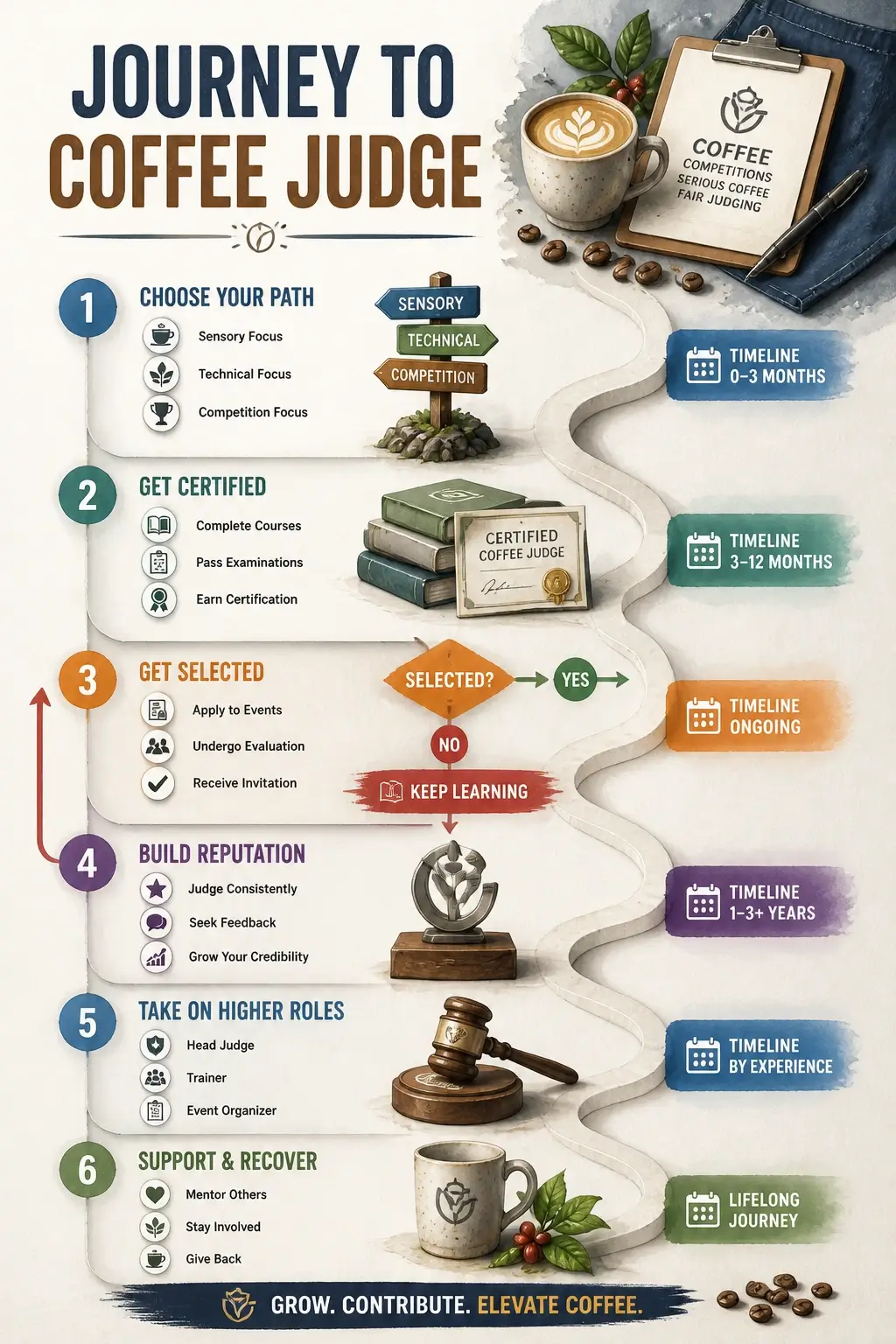
Serious coffee competition judging runs on two completely separate tracks, and most guides only describe the first one. You can hold a valid WCC certification, appear on your national roster, and still never get the call – because certification proves you’re eligible, not that you’ve been chosen.
The path from experienced barista to working judge runs through national body gatekeepers, a two-day certification gauntlet, a new 2027 prerequisite that changes the entry requirements for everyone, and a reputation-building phase that no official document actually explains. Here’s the full picture.
Before pursuing a certification, it helps to familiarize yourself with the various types of coffee competitions to understand where your expertise will be most valuable.
Key Takeaways on How to Become a Coffee Competition Judge
- Sensory and technical judging are separate certifications; you cannot test for both in the same cycle, so choose based on your actual professional strength.
- From 2027, all new WCC certification applicants must hold a WCC Judge Skills Program certificate before applying – this is a mandatory prerequisite, not optional prep.
- “Equivalent competition” experience is undefined in official WCC documentation; get written confirmation from your national body before paying any fees.
- Passing certification makes you eligible, not selected – actual judging slots are filled at the Lead Head Judge’s discretion, with no published criteria or timeline.
- The trust-building phase between certification and selection is the most under-communicated requirement in the pathway; every calibration session is a live audition.
- WCC judging is entirely volunteer work – the return is credibility, network access, and competitive insight, not income.
Sensory or Technical: Choose Your Track Before Anything Else
Two distinct roles exist inside every World Coffee Championships panel, and they share almost nothing except the competition floor. Choosing between them is your first real decision – and you cannot test for both in the same certification cycle, so choosing wrong costs you a full year.
The sensory judge role is what most people picture. You taste every cup served, evaluate aroma, flavor balance, tactile mouthfeel, and aftertaste, then translate those perceptions into a numerical score using the Coffee Value Assessment system. The job demands calibrated palates – not just a preference for good coffee, but the trained ability to score consistently against a defined standard and defend those numbers under deliberation.
The technical judge role operates from behind the bar. You’re watching the competitor’s workflow, cleanliness, consistency, timing, and adherence to competition rules and regulations. You don’t taste anything. Your score reflects the precision and discipline of execution, not the quality of the drink in the cup. It’s a different cognitive mode entirely – operational pattern recognition rather than sensory discrimination.
Before you pick a direction, read through the history of the world barista championship to understand how judging standards have evolved across disciplines. The role you choose should map to where your professional strength actually sits. Sensory judges live in nuance and subjectivity; technical judges live in process and compliance. Neither is harder. They’re just different instruments.
The framing that matters most here isn’t “which sounds more interesting.” It’s “which one reflects how I already think about coffee.” Because both roles require you to perform at a peer level with experienced WCC panelists from day one.
According to Trent Rollings, a certified World Coffee Championships sensory judge, the job isn’t about individual palate authority – it’s about collective calibration. He describes judging as a team sport where knowing when to assert your score and when to question your own calibration are equally important skills. Getting out of sync with your panel isn’t a personality issue; it’s a technical failure.
That framing reframes the whole choice. The question isn’t “am I a good taster?” It’s “can I hold a consistent position under deliberation pressure while staying genuinely open to being wrong?” That same discipline applies to technical judges defending a workflow score. Pick the track where you can answer yes most honestly.
According to Defne Ceyda Okay, barista market development specialist at Oatly and SCA Shadow Coordinator in Türkiye, competition standards give judges a shared language – but that language has to stay alive. She argues that a judge’s responsibility is to stay consistent within the scoring system while remaining genuinely open to what sits outside its current definitions, because coffee evolves faster than the standards written to describe it.
That tension – consistency and openness operating simultaneously – is the real skill set both tracks demand. The scoresheet is a floor, not a ceiling.
Your track decision often mirrors the specific competitive domain you plan to specialize in, which becomes particularly apparent when comparing barista vs brewers cup standards.
Prerequisites and the 2027 Deadline: What It Takes to Qualify
The World Coffee Championships baseline requirement is specific: one year of judging experience at WCC level, or two years at the national level. Neither is a soft guideline. You need documented, verifiable records of those years – not a rough estimate, not a list of events you remember attending.
Audit your judging history before you do anything else. Pull your records, identify the events, confirm the dates, and check whether each entry qualifies as national-level or WCC-level experience. Gaps here will stop your application before it reaches a reviewer.
Now the change that matters most for anyone entering the pathway in 2027 or later: all new WCC certification applicants must hold a WCC Judge Skills Program certificate. This is no longer optional. The Judge Skills Program covers scoring systems, competition rules, and the full Coffee Value Assessment framework. It’s a structured prerequisite, not a refresher course – think of it as the gatekeeper exam before the gatekeeper exam.
The judging criteria used at championships are detailed and discipline-specific. Understanding them before you sit the Judge Skills Program isn’t optional prep work; it’s the baseline literacy the program assumes you already have.
One critical warning about the language in official documentation. Both WCC materials and national body guidelines like those from SCAI use phrases such as “ICC league or equivalent competitions” when describing qualifying experience – without ever defining what “equivalent” actually means. That ambiguity has real consequences. If your judging history includes regional events, specialty competitions, or international leagues that don’t carry an obvious WCC or national-body stamp, do not assume they count.
Contact your national body directly. Request written confirmation that your specific judging history meets the threshold before you pay any certification fees. That written confirmation protects you if questions arise later in the process, and it forces the national body to give you a concrete answer rather than a vague one.
Navigating Your National Body and the Certification Gauntlet
National Body Gatekeepers and Certification Announcements
WCC does not accept direct applications from individual judges. The gatekeepers are national governing bodies – ASCA (Australian Specialty Coffee Association) for Australia, SCAI for Indonesia, and their equivalents in every other market. Your first task is identifying your national body and finding its official communication channels.
These bodies announce calibration and certification events through their own websites, newsletters, and social media. There’s no central WCC calendar that aggregates these announcements. Miss the announcement window and you’re waiting for the next cycle. Follow your national body’s channels actively, not passively.
The Certification Event: Exams, Simulations, and Calibration
The certification event runs across two days. Day one typically covers written exams on coffee theory, competition rules, and the scoring system. Day two moves into practical performance – candidates judge full competition routines in real time, using actual scoresheets, under observation.
The practical component is where most candidates underestimate the difficulty. It’s not enough to mark a scoresheet accurately. You have to articulate and defend your scores in real deliberation scenarios alongside other candidates and assessors. A technically correct score that you can’t explain under pressure is a liability, not an asset.
Calibration is the core skill being tested throughout. The assessors aren’t looking for the candidate with the sharpest individual palate or the most precise workflow eye. They’re looking for candidates who can achieve consistent scoring alignment with a peer panel. A brilliant outlier who can’t converge is a problem on a competition floor. A solid, reliable scorer who reads the room and holds their position under scrutiny is an asset.
On the cost side: WCC does not publish its certification fee structure publicly, but ASCA’s model offers the only concrete public benchmark available. ASCA calibration sessions run between $150 and $450 AUD plus GST, depending on the event type and accreditation level. Use that range as a planning baseline for your own national body, while knowing your actual costs may differ. Budget conservatively.
Certification Is Not Selection: The Hidden Gap
Certification vs. Selection: Understanding the Separate Phases
WCC judge certification is free upon passing. It’s valid for three years. And it certifies you as eligible – nothing more.
This is the point where most guides stop, and it’s the most expensive misunderstanding in the entire pathway. Passing certification places you in a pool of qualified candidates. It does not assign you a judging seat, guarantee you an invitation, or trigger any automatic next step. The selection mechanism is entirely separate.
Actual judging slots at competitions are filled at the discretion of the Lead Head Judge or national organizer. They choose from the certified pool. The criteria they use, the timeline they operate on, and the weight they assign to different factors are not documented in any official WCC publication. You will not receive a rejection letter. You will simply not receive a call.
Factors That Influence Lead Judge Selection
What influences that call? Reputation within the community, demonstrated calibration consistency, reliability at prior events, and relationships built through sustained engagement with the people running those events. Certified judges appear on national rosters that organizers consult when building panels – but appearing on a roster is table stakes, not a guarantee.
Here’s the mechanism that no official source describes clearly: the people selecting judges are the same people running calibration sessions. Every calibration event you attend, every deliberation you participate in, every time you articulate a score under pressure – those are all observed. The “silent interview” starts the moment you pass certification and continues indefinitely.
There are no published criteria for what moves a certified judge from the roster to the panel. No timeline, no scoring rubric, no formal review. Selection is a trust decision made by experienced practitioners who have watched you work. The only way to influence it is to be consistently present, consistently calibrated, and consistently useful in the spaces where those practitioners operate.
Building the Reputation That Gets You Selected
The period between certification and selection is the phase the official documentation doesn’t acknowledge. Here’s how to use it deliberately.
Volunteer at local and regional competitions in non-judging roles. Station runner, scribe, timekeeper – take whatever role gets you on the competition floor. Visibility matters. Organizers remember who showed up, who was reliable, and who understood the environment without needing to be managed. Reading about the profiles of famous champions gives you useful context on the competitive culture, but being physically present in the room is what builds the relationships that lead to selection.
Study the rules and scoresheets obsessively. Underestimating rule knowledge is one of the most common beginner mistakes, and it’s visible to experienced organizers immediately. A certified judge who stumbles on a rules question during deliberation signals that their preparation stopped at passing the exam. Depth of rules command is one of the clearest proxies for how seriously a candidate takes the role.
Practice sensory calibration at home using publicly available scoresheets and video footage of past competition routines. Watch archived routines, score them independently, then compare your scores against documented results or discuss them with other candidates. The goal is to build the internal consistency that makes you a reliable panel member – not to develop a strong personal opinion about every cup.
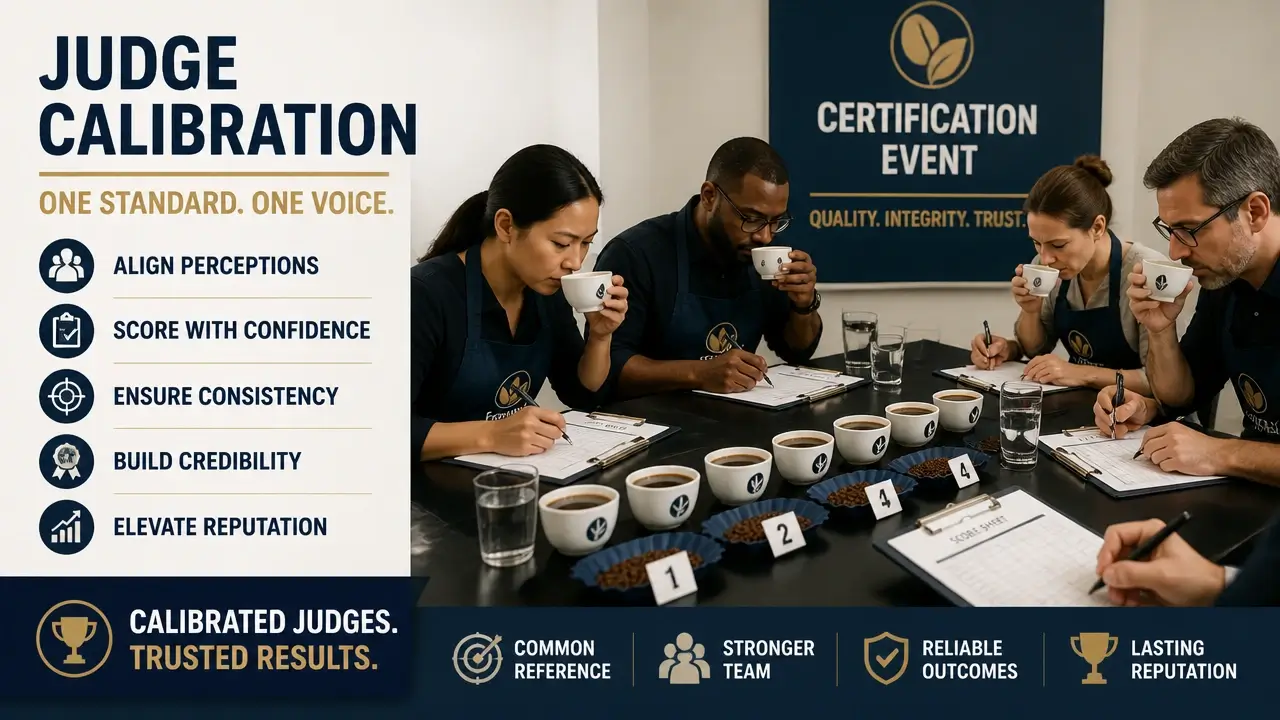
Treat every calibration session as a live audition. Maintenance calibration isn’t administrative. It’s the primary venue where decision-makers observe how you think, how you hold a position, and how you respond when your score diverges from the group. Every session is part of the selection process, whether the organizers announce it or not.
The core mechanism here is trust. Judging communities are small and long-memoried. The people deciding who gets on a panel have usually worked alongside the candidates for years. There is no shortcut around that trust-building phase – it’s the single most under-communicated requirement in the entire judging pathway, and no source in the official documentation addresses it directly.
Failure, Recovery, and Alternative Paths Into the Room
Failing calibration is not a career-ending event. Reapplication in a future cycle is possible, and the path back is well-defined – at least in the jurisdictions that have bothered to document it.
ASCA is the only national body that publicly describes what happens when a candidate doesn’t pass. Every other source in the landscape either treats failure as a dead end or ignores it entirely. That silence is a trust gap, and it causes candidates to walk away from a pathway they could have stayed on.
The documented recovery roles for candidates who don’t pass certification are: Scribe, Shadow Judge, Timekeeper, and Station Runner.
- A Scribe assists with scoring documentation during live competition, staying close to the scoring process without making independent judgments.
- A Shadow Judge observes alongside the official panel, scores privately, and calibrates internally – building alignment without the pressure of a live result.
- A Timekeeper manages station timing, which requires deep familiarity with competition rules and flow.
- A Station Runner facilitates movement between competitors and panels, giving candidates a ground-level view of how the competition operates mechanically.
These roles are not consolation prizes. They’re strategic positions that keep you inside the competition environment, building relationships and deepening rules knowledge while you wait for the next certification window. The candidates who use these roles actively – not just as attendance credits, but as learning environments – come back to the next certification cycle with a measurably stronger foundation.
If your national body doesn’t document these recovery pathways publicly, ask directly. Use ASCA’s model as the reference point: “Does your organization offer roles like Scribe, Shadow Judge, or Timekeeper for candidates between certification cycles?” If the answer is no, advocate for it. If the answer is yes but undocumented, get it in writing.
The True Cost: Time, Money, and the Volunteer Reality
WCC judges are not paid. There is no honorarium, no day rate, no travel stipend from WCC for judging services. This is not buried in the fine print – it’s the foundational reality of the role, and almost no guide states it plainly at the start.
Here is a realistic cost breakdown, using publicly available data:
| Cost Category | Benchmark | Source |
|---|---|---|
| Calibration/accreditation fees | $150–$450+ AUD per session | ASCA public fee schedule |
| National body membership | Varies by tier; ASCA “Coffee Professional” level as baseline | ASCA |
| WCC Judge Skills Program | Fee TBC by national body | WCC (2027 mandate) |
| Travel and accommodation to calibration events | Market rate; varies by location | No published benchmark |
| Ongoing travel to competitions | Market rate; varies by event | No published benchmark |
None of the six major sources covering the judging pathway address compensation. That silence isn’t an oversight; it’s a structural feature of how judging is framed within the specialty coffee community. The language that appears consistently across ASCA documentation and practitioner accounts describes judging as “selfless,” as “an honor,” and as “the best seat in the house.”
That framing is honest, not cynical. The real return on judging isn’t financial. It’s a credibility signal that communicates expertise at a level that résumé lines can’t replicate. It’s access to an elite professional network built on shared standards and mutual respect. It’s an insider understanding of how competition scores are constructed – knowledge that sharpens a barista’s primary craft in ways that training alone can’t deliver.
The judges who persist through the full pathway – certification, the silent interview, the recovery roles if needed, the renewal cycles – are not doing it for income. They’re doing it because they value the seat more than the salary. That’s the honest assessment every serious applicant deserves before they commit.
Frequently Asked Questions About How to Become a Coffee Competition Judge
How long does the full judging certification process take from start to selection?
The minimum documented timeline is one to two years of qualifying judging experience before you can even apply, plus the certification cycle itself. Getting selected for a panel after certification adds an unpredictable additional period that depends entirely on your national body’s competition calendar and the Lead Head Judge’s discretion.
Can a barista with no prior competition experience become a certified judge?
No. WCC requires either one year of judging at WCC level or two years at national level – that experience must be documented and verifiable. You need to be inside competitions as a participant or official before you can enter the certification pathway.
What happens if you let your WCC judge certification lapse?
Certification is valid for three years and can be renewed once by calibrating and judging at a World Championship. If you miss the renewal window, you’d need to re-enter the certification process. Check your national body’s specific rules, since ASCA’s model adds a one-year grace period for re-testing.
Do WCC judges need to re-certify separately for each competition discipline?
Sensory and technical certifications are separate tracks, and you can hold both – just not tested in the same cycle. If you want to judge across multiple WCC disciplines, you’ll need to complete certification for each one independently.
Is the WCC Judge Skills Program available online or only in person?
WCC hasn’t published full delivery details for the 2027 mandate publicly yet. Contact your national body directly to ask about format, scheduling, and fees – they’re the delivery channel for most WCC training programs at the national level.
How competitive is the selection process for a first-time certified judge?
There’s no published data on selection rates, but the competition for panel slots is real. Certified judges who have built visible relationships through volunteering, calibration attendance, and community engagement are consistently prioritized over candidates who passed the exam and went quiet.
Can someone judge at WCC events without being from the host country?
Yes. WCC judge panels are international, and certified judges from any country can be selected by the Lead Head Judge regardless of nationality. Your national body’s roster is the entry point, but selection isn’t geographically restricted.
What’s the difference between a Shadow Judge and a Panel Judge at a WCC event?
A Panel Judge holds a certified, active judging role and their scores contribute to official results. A Shadow Judge observes the same routines, scores privately, and calibrates internally – their scores don’t affect outcomes. Shadow judging is a developmental role, not a competition role.
References
- How to Judge Coffee Competitions: Addressing the Challenges | perfectdailygrind.com