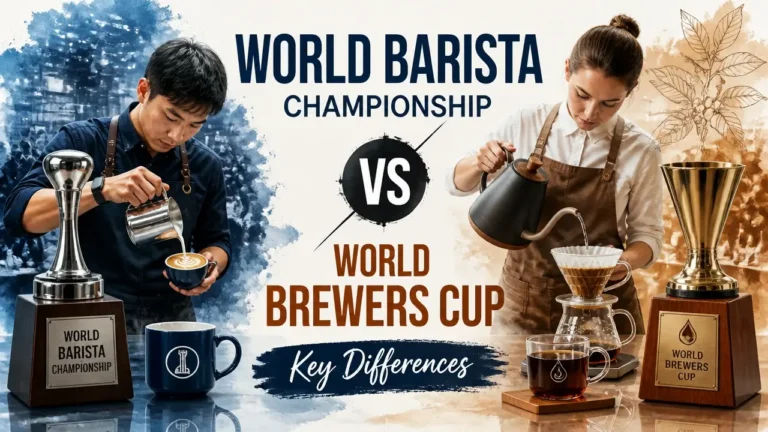

The World Barista Championship and the World Brewers Cup are not two versions of the same ambition. They test different instincts, reward different minds, and open different doors. Both fall under the World Coffee Events umbrella, both are fed by national championships, and both sit at the pinnacle of specialty coffee. But the professional they produce looks nothing alike.
Choose the wrong one and you spend a year training for a stage you were never built for. Choose the right one and the preparation alone reshapes how you think about coffee for the rest of your career.
Key Takeaways on World Barista Championship vs World Brewers Cup
Understanding how these two elite events fit into the wider landscape requires examining the full spectrum of types of coffee competitions recognized globally.
- The WBC and WBrC are organized by World Coffee Events and both require winning a national championship to qualify.
- The WBC tests espresso performance, milk craft, and stage presence across a 15-minute timed presentation.
- The WBrC tests manual-filter extraction precision and the ability to articulate sensory outcomes to judges.
- WBC success opens doors to brand ambassadorships and media visibility; WBrC success builds technical authority within roasting and supply-chain circles.
- Preparing for the WBC can cost more than US$10,000; the WBrC carries lower equipment costs but demands deep sensory and narrative investment.
- Volunteering or judging at both events before committing to either is the most efficient way to identify which competition actually fits your professional identity.
Beyond the Trophies: What Each Championship Really Tests
The World Barista Championship (WBC) is the premier global competition for espresso-based performance: a timed stage presentation where a barista serves espresso, milk drinks, and an original signature beverage to a panel of judges. The World Brewers Cup (WBrC) is the world’s elite manual-filter-brewing competition, where the evaluation centers on extraction quality and the competitor’s ability to articulate what’s happening in the cup. Both events are organized by World Coffee Events and run annually, with competitors earning their spot by winning a national championship in their home country.
That shared structure is where the similarity ends.
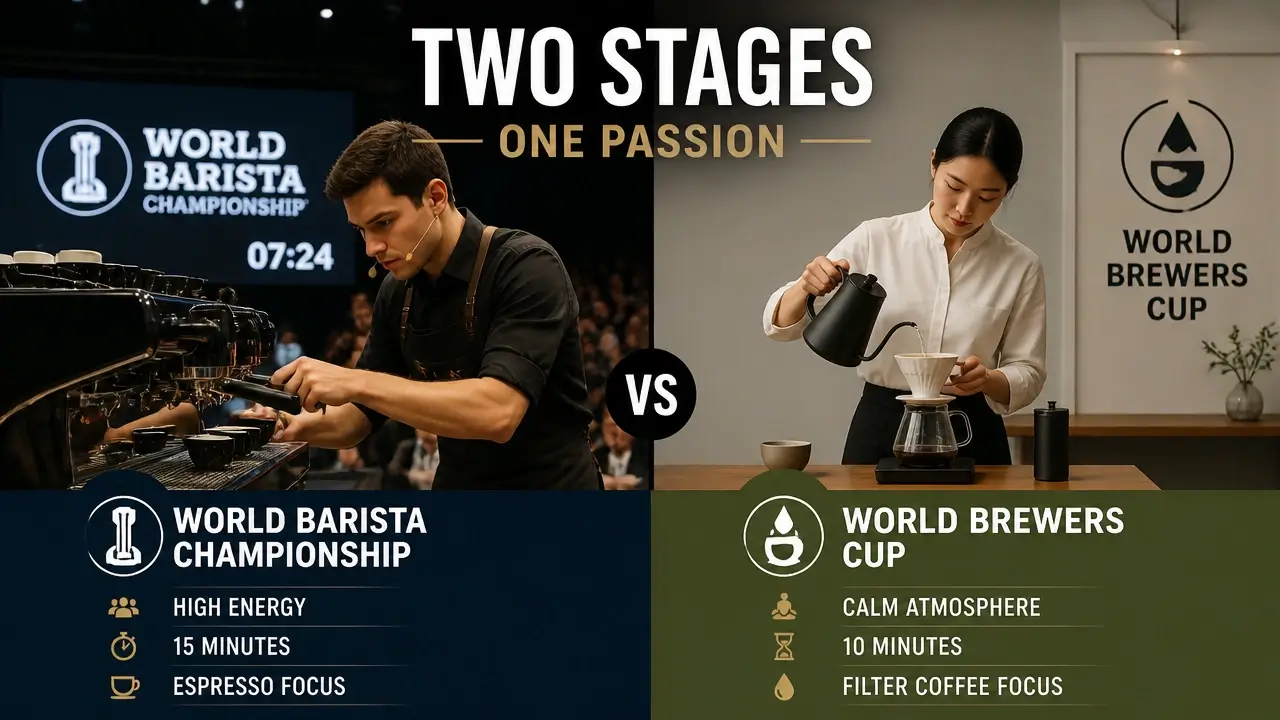
The WBC validates a specific professional identity: the barista as stage performer, espresso technician, and milk-craft artist. It asks whether you can manage a multi-beverage workflow under a countdown while holding the room’s attention. The WBrC validates something else entirely: the brewer as extraction scientist, sensory communicator, and equipment specialist. It asks whether you understand what’s happening inside the coffee at a molecular level and whether you can make a panel of judges understand it too.
According to Morgan Eckroth, 2022 US Barista Champion and content marketing specialist for Onyx Coffee Lab, competing at the World level now demands access to resources and equipment that is both increasingly necessary and increasingly difficult to secure.
That resource gap is real and worth naming early. Both championships require serious preparation investment, but the type of investment differs sharply. The WBC front-loads cost into hardware: espresso machines, grinders, and specialty ingredients. The WBrC front-loads cost into time: hours at the cupping table, dialing in brew ratios, and building a coffee narrative from scratch.
According to Justin Bull, 2025 U.S. Brewers Cup Champion, competition was never the goal in itself. He entered to push his own limits, sharpen his palate, learn to dial in more precisely, and understand brewing at a deeper level. For him, the Brewers Cup was one of the few paths available to accelerate that growth without pursuing a formal Q certification.
That framing matters. Bull’s experience points to something both championships share beneath their surface differences: the preparation process is often more transformative than the result. The stage or the cupping table, the trophy or the near-miss – what changes a competitor’s career is the disciplined thinking the training demands.
The WBC rewards what you do under pressure in front of an audience. The WBrC rewards how well you understand and explain what’s in the cup when everything is stripped back to water and coffee. Those are not the same skill, and they do not belong to the same career path.
Head-to-Head: Format, Judging, and the Moment of Truth
The format differences between the two championships are not cosmetic. They are structural, and they reveal exactly what each competition considers valuable.
The WBC gives competitors 15 minutes to serve four judges four espressos, four milk-based drinks, and four original signature drinks. Technical scores cover grind management, milk texturing, and station cleanliness. Sensory scores evaluate the taste, balance, and harmony of every beverage served. The competitor speaks continuously throughout, narrating their choices, their coffee, and their creative process while simultaneously pulling shots and steaming milk. The clock is always running.
The WBrC runs in two rounds. The first is a compulsory service: every competitor brews the same pre-provided coffee, on the same grinder, with the same water. No variables are introduced from the outside. The differentiation comes entirely from the brewer’s technique and their ability to describe what they’re tasting. The second is an open service, where the competitor selects their own coffee and brings their own equipment. No pressurized brewing methods are allowed. The evaluation weighs brewing technique, flavor description accuracy, and presentation.
| World Barista Championship | World Brewers Cup | |
|---|---|---|
| Time | 15 minutes | Two rounds (compulsory + open) |
| Beverages | 4 espresso, 4 milk, 4 signature | Manual filter only |
| Competitor’s Coffee | Yes (open round) | Compulsory round: provided; Open round: competitor’s own |
| Scoring Focus | Technical execution + sensory quality | Brewing technique + sensory description accuracy |
| Audience Interaction | Continuous narration, live energy | Quiet, direct judge conversation |
| Silent Period | No | Yes, during compulsory round |
The score sheet architecture reinforces this. In the WBC, technical and sensory scores carry roughly equal weight, meaning a competitor who brews brilliantly but fumbles the presentation will lose ground to someone who delivers both cleanly. In the WBrC, sensory description is woven directly into the technical score. A brewer who extracts a perfect cup but cannot articulate why it tastes the way it does will not win. Communication is not a bonus category; it is part of the technical standard.
Before you decide whether any of this is worth the investment, it helps to understand are coffee competitions worth it from a career ROI perspective. The format you choose shapes the answer.
You can see exactly what judges experience from inside the WBrC in the video below.
The Barista’s Arena: Performance, Career Doors, and the Hidden Cost of the Stage
WBC competitors tend to share a recognizable profile: working baristas, café owners, and trainers who have built deep espresso-menu mastery and are comfortable holding a room. They are not just coffee technicians. They are presenters, and the competition demands both skills at once.
The career trajectory that follows a strong WBC result is the most visible in the specialty coffee world. High-placing competitors regularly land brand ambassadorships with equipment manufacturers and green coffee importers, roles in espresso machine R&D, consultancy work with café groups, and slots as hosts or judges at international coffee events. The WBC has historically attracted the most mainstream media attention of any coffee competition, which means sponsors notice it and general audiences have at least heard of it. That visibility has real commercial value.
The skills the WBC specifically builds are worth naming precisely:
- Multi-beverage workflow management under a hard countdown, with no room for hesitation
- Signature drink development, which requires genuine R&D: flavor pairing, recipe testing, and sourcing specialty ingredients
- Public speaking under pressure, narrating a technical process to an audience while executing it simultaneously
- Dynamic problem-solving, because equipment misfires on unfamiliar stages and the competitor must adapt without breaking stride
Statistical Data: Preparing for and competing at the World Barista Championship at a high level regularly costs competitors more than US$10,000 when equipment rental, specialty ingredients, travel, and coaching are factored in. – Source: Perfect Daily Grind
That number deserves to sit on its own for a moment. The espresso machine alone can represent a significant portion of that budget, and competitors often need access to the specific model they plan to use for months of practice before the event. Milk-steaming consistency across multiple consecutive pours on an unfamiliar machine in a competition hall is a genuine technical challenge, and building that muscle memory is not cheap.
The broader impact of coffee competitions on the industry is well documented. You can read more about that in this analysis of the impact of coffee competitions on the industry, which covers how WBC results have historically shaped equipment trends and consumer expectations.
The WBC’s cons are real: the financial barrier is high, the physical and mental stress of a 15-minute high-stakes performance is significant, and there is an inherent subjectivity in the performance component that pure sensory scoring cannot fully eliminate. A competitor who brews an exceptional espresso but delivers a flat presentation will score lower than one who performs both with equal confidence.
The pros, though, are equally real. The WBC connects competitors to a global community, opens doors to leadership and media roles that few other coffee credentials match, and forces a level of creative discipline around espresso development that most café careers never demand.
According to Mikael Jasin, 2024 World Barista Champion, the competitors who break through at the World level are not the ones who study winning routines and replicate them. They are the ones who identify the patterns everyone else is following and then deliberately build something that cuts against them.
That insight is the clearest possible description of what the WBC actually rewards at its highest level. Technical execution is the floor, not the ceiling. The ceiling is creative courage under pressure.
The Brewer’s Laboratory: Where Extraction Meets Eloquence
WBrC competitors come from a different part of the coffee industry. Green buyers, roasters, quality managers, and barista trainers who spend their professional lives at the cupping table and behind a refractometer. Many are already respected figures in supply-chain or roasting circles before they ever step onto a competition stage.
According to Tetsu Kasuya, World Brewers Cup Champion and creator of the widely adopted 4:6 Method, the technique emerged from exhaustive repetition: hundreds of individual extractions, each one documented, each one adjusting a single variable. He would brew, record the result, adjust the pour sequence, and start again. The 4:6 Method was not invented. It was discovered through accumulated data.
Tetsu Kasuya later identified the core insight that makes the method work: the final 60% of total brew water serves only one function. It controls strength. The first 40% controls flavor direction. Once a brewer internalizes that, the entire pour-over process becomes a set of deliberate levers rather than a ritual.
That level of analytical thinking is exactly what the WBrC rewards. The competition is not asking whether you can brew a clean cup. It is asking whether you understand why that cup tastes the way it does, and whether you can explain the mechanism to a panel of judges in real time.
The science behind this matters. A peer-reviewed study from the UC Davis Coffee Center, published in the Journal of Food Science, updated the classic Coffee Brewing Control Chart by mapping brew ratio, total dissolved solids (TDS), and extraction yield directly to sensory outcomes. Bitterness and sweetness correlate measurably with TDS and extraction percentage. The study confirms that a brewer who controls these variables precisely can design specific flavor profiles rather than stumbling into them. That is the intellectual foundation the WBrC is built on.
The career trajectory for top WBrC competitors looks different from the WBC path, but it is not less prestigious within the specialty coffee world. High placers move into lead sensory roles at roasteries, write brewing guides that become industry references, consult on consumer brewer design, and become sought-after competition coaches and judges. The prestige is technical rather than theatrical, which means it carries more weight with roasters, importers, and green buyers than with the general public.
According to Todd Goldsworthy, 2016 US Brewers Cup Champion and WBrC finalist, the compulsory round’s standardized conditions – same water, same grinder, same coffee – are precisely what make the competition meaningful. When every variable is equalized, what remains is the brewer’s skill. He saw that format as the most honest possible test of what a competitor can actually do.
The WBrC’s honest limitations are worth naming. It is less known outside specialty coffee, so the immediate career boost is internal: credibility with roasters and importers rather than broad media attention. The compulsory round is also uniquely brutal. Every competitor uses the same coffee, which means differentiation rests entirely on technique and storytelling. A brewer who extracts a technically correct cup but delivers a flat, jargon-heavy narrative will lose to someone who brews with equal precision and makes the judges feel what’s in the cup.
The Hario V60, pour-over technique, and immersion methods are the tools, but the real instrument is language. Translating tasting notes into a compelling narrative that educates rather than recites is a skill most coffee professionals never develop, and the WBrC demands it explicitly.
The equipment cost advantage is real. Manual brewing gear is a fraction of the espresso setup required for the WBC, which lowers the financial barrier significantly. But the time investment in sensory calibration, brew method refinement, and narrative construction is substantial in its own right.
Finding Your Stage: Which Championship Mirrors Your Coffee Identity
The real question here is not which competition is better. It is which one will make people automatically associate your name with the craft you want to be recognized for.
Both paths lead to serious professional outcomes. Both demand serious preparation. The decision comes down to which professional identity already lives inside the work you do every day.
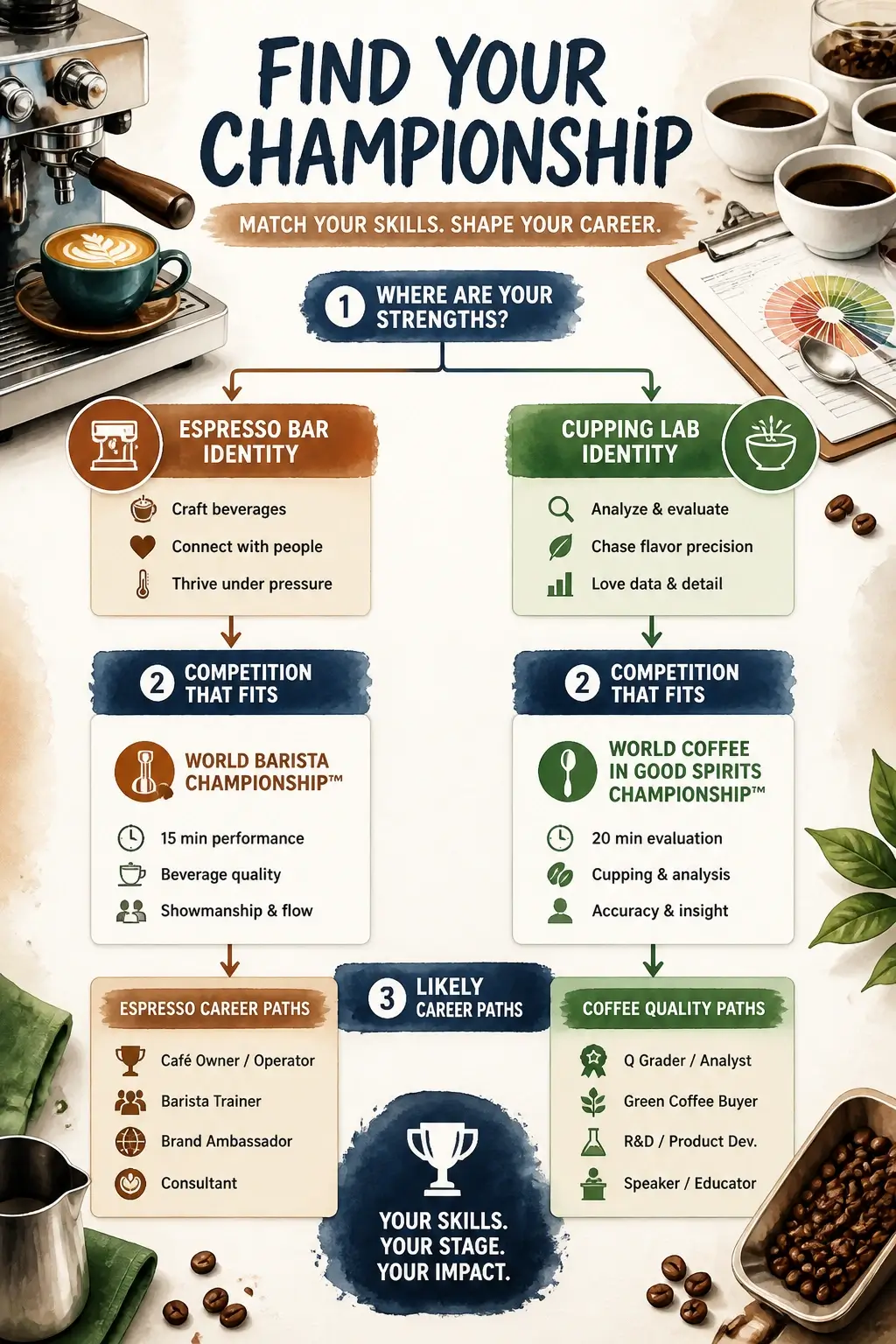
Consider the WBC if the espresso bar is your natural habitat. If you love developing signature drinks, enjoy the rhythm of a busy service, want your name attached to high-profile café brands and equipment partnerships, and can hold a narrative while simultaneously steaming milk and pulling shots – the WBC is the stage built for you. Your skills are already pointing there.
Consider the WBrC if your instinct when you taste a coffee is to reach for a refractometer and start adjusting variables. If you can talk for ten minutes about a single coffee’s acidity structure, see yourself shaping a roastery’s buying decisions rather than a café’s daily service, and find more satisfaction at the cupping table than on the competition floor – the WBrC rewards exactly that mind.
For those still uncertain, the most practical first step is to judge or volunteer at both events before committing training resources. The atmosphere of each competition tells you something that no rulebook can. The WBC feels like a concert. The WBrC feels like a seminar. One is not more serious than the other – they are serious in different registers.
The skills each competition builds are complementary, not competing. A barista who understands extraction science at the WBrC level will pull better espresso. A brewer who has survived a WBC-style performance will communicate their craft more confidently. But choosing a starting lane matters because it clarifies your learning priorities and focuses your preparation time.
Whichever path you choose, the preparation will do more for your career than the trophy. The process of building a WBC routine forces creative R&D discipline most café careers never demand. The process of preparing a WBrC open service forces sensory precision most roasters never develop. The value is in the calibration, not the podium.
For a broader look at how these events fit into the full competitive ecosystem, the ultimate guide to coffee competitions covers the complete landscape of World Coffee Events and how national qualifications feed into each.
Frequently Asked Questions About World Barista Championship vs World Brewers Cup
What is the World Barista Championship?
It’s the world’s premier espresso-based competition, where baristas have 15 minutes to serve four judges espresso, milk drinks, and an original signature beverage while narrating their process. It’s organized by World Coffee Events and fed by national qualifying championships.
How do you qualify for the World Barista Championship?
You qualify by winning the national barista championship in your country. Each nation affiliated with World Coffee Events holds its own qualifying competition, and the national winner earns the right to represent their country at the world event.
Can you compete in both the WBC and the WBrC in the same year?
Technically the competitions are separate events with separate qualification paths, so a competitor would need to win two different national titles. In practice, the training demands of each are significant enough that most serious competitors focus on one.
Why does the WBrC include a compulsory round with the same coffee for everyone?
It’s a deliberate design choice to isolate the brewer’s skill from the coffee’s quality. When every competitor uses identical beans on the same grinder with the same water, the only variable left is technique and communication. It’s the most honest test of what the brewer can actually do.
Is the World Brewers Cup less prestigious than the World Barista Championship?
Not within specialty coffee. The WBrC carries enormous credibility with roasters, green buyers, and sensory professionals. It’s less visible to general audiences, but in the circles where brewing science matters, a WBrC result carries significant weight.
What does a WBC signature drink actually need to include?
The signature drink must be an original non-alcoholic beverage with espresso as the base. Beyond that, the creative direction is entirely the competitor’s. Ingredients, presentation, and narrative are all part of the score, which is why signature drink development is one of the most resource-intensive parts of WBC preparation.
How important is storytelling in the World Brewers Cup?
Extremely important. Sensory description is woven into the technical scoring, not treated as a separate performance category. A brewer who extracts a technically correct cup but delivers a flat or inaccurate flavor description will score lower than one who brews with equal precision and communicates what’s in the cup with clarity and specificity.
What’s the 4:6 Method and why does it matter for WBrC preparation?
Developed by World Brewers Cup Champion Tetsu Kasuya, the 4:6 Method divides the total brew water into two functional phases: the first 40% controls flavor direction, and the final 60% controls strength. It gave brewers a systematic framework for intentional extraction rather than intuitive guesswork, and it’s become one of the most studied approaches in competitive manual brewing.
References
- Winning Coffee Competitions and Baristas’ Personal Brands | perfectdailygrind.com
- Justin Bull Rebounds to Win U.S. Brewers Cup | baristamagazine.com
- Interview with World Brewers Cup Champion Tetsu Kasuya | perfectdailygrind.com
- How Baristas Can Stand Out at Competitions | perfectdailygrind.com
- Should the World Barista Championship Use a Compulsory Coffee? | perfectdailygrind.com
- Journal of Food Science: A New Coffee Brewing Control Chart | uoregon.edu