
Professional coffee cupping is not a fancy word for tasting. It’s a controlled measurement process – one where every variable is stripped away so the coffee itself has nowhere to hide. The Specialty Coffee Association built a 100-point scoring system around it, and the entire global specialty trade depends on that shared standard to move green coffee from farm to roaster.
Understanding how cupping works changes how you think about every cup you’ve ever made. Once you see the mechanism, casual brewing and structured evaluation stop looking like the same activity. They’re not even asking the same question.
Key Takeaways on What Is Coffee Cupping
- Coffee cupping is a standardized sensory evaluation method, not casual tasting – every variable except the coffee itself is controlled.
- The SCA 100-point scale scores ten distinct attributes; a coffee must hit 80 points to qualify as specialty grade.
- Cupping eliminates brewing variables so that different coffees can be compared on a neutral, identical baseline.
- “Animal-like” and “ashy” are defect descriptors under SCA standards, not neutral flavor notes – sources claiming otherwise are wrong.
- The slurp is not theatrical; it aerates the coffee across the palate and retro-nasal passage, where most flavor perception happens.
- You can run a legitimate cupping session at home with two coffees, a scale, and a spoon – no professional lab required.
Coffee Cupping Is a Formal Evaluation Method, Not Just Fancy Tasting
I keep hearing “cupping” mentioned in coffee videos and cafes. Is it just a fancy word for tasting, or is it something different entirely?
Coffee cupping is a standardized method the coffee industry uses to objectively evaluate and compare the aromas and flavors of brewed coffee by removing all brewing variables. Every cup is prepared the same way, with the same ratio, the same water temperature, the same steep time. The method is the constant. The coffee is the variable.
Think of it like wine tasting done seriously. A sommelier doesn’t just drink a glass and say whether they liked it. They evaluate color, nose, structure, finish, and balance against a known reference point. Coffee cupping works the same way – it’s a structured sensory evaluation with a specific protocol, not a leisurely experience.
The physical mechanics look nothing like your morning routine. Coffee grounds steep directly in hot water with no filter. You taste using a spoon, not a mug. You’re not there for caffeine or comfort. You’re there to measure.
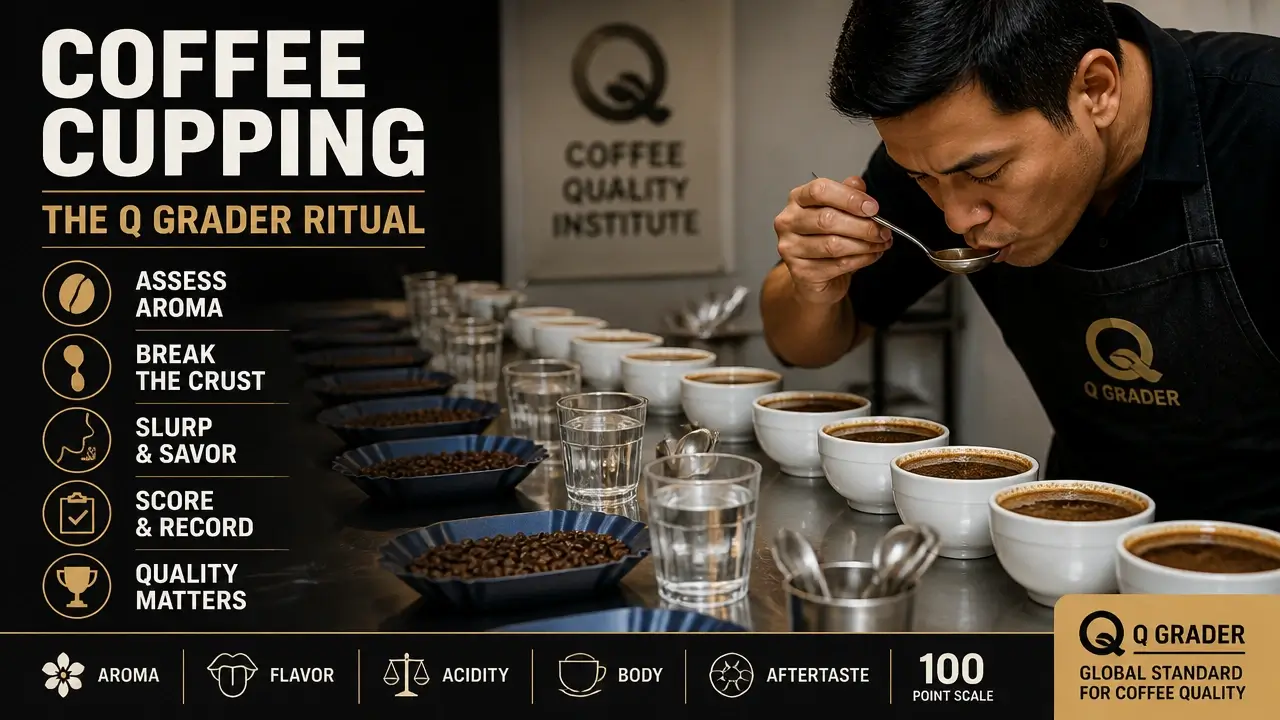
This practice runs through every level of the supply chain. Producers use it to check their harvest before it ships. Buyers use it to decide which lots to purchase. Roasters use it to verify that a batch matches the intended profile. Q Graders – licensed coffee quality evaluators certified by the Coffee Quality Institute – use it to assign the official scores that determine whether a coffee qualifies as specialty grade.
Cupping emerged in the late 19th century out of practical necessity. Traders needed a consistent way to evaluate coffee shipments before buying, and no single brewing method was neutral enough to serve as a fair baseline. The protocol that exists today grew directly from that commercial problem. If you want the full arc of how it developed, the history of coffee cupping traces that evolution from trading floors to modern sensory labs.
One thing worth clearing up immediately: cupping is not an exclusive club. Professionals rely on it daily, but home enthusiasts cup regularly to sharpen their palates and understand their coffee more deeply. The barrier to entry is lower than most people assume.
A natural transition here – before we get into the step-by-step procedure, it helps to understand exactly what problem cupping was designed to solve.
Why Brewing Alone Can’t Tell You What Cupping Can
Every brewing method you already use introduces variables that change what ends up in your cup. A pour-over changes flavor through filter type, pour rate, and drawdown time. A French press changes it through steep time, grind size, and immersion temperature. Espresso compresses all of that into a high-pressure extraction with a dozen adjustable parameters. Each method produces a different version of the same coffee – and none of them tells you what the coffee actually tastes like on its own terms.
Cupping eliminates all of that. No filter. No pressure. No variable water flow. Just grounds, hot water, time, and a spoon. The result is a preparation that’s as close to a neutral baseline as you can get, which is exactly what you need when your goal is comparison and measurement rather than enjoyment.
The industry uses cupping for three distinct purposes. First, quality assessment: evaluating green coffee lots to determine whether they meet grade standards before purchase. Second, consistency checking: roasters cup finished batches against a reference roast to confirm the profile is repeatable. Third, flavor profiling: building a shared vocabulary that travels across languages and time zones so that a producer in Ethiopia and a buyer in Tokyo are describing the same cup the same way.
That last point is where cupping becomes genuinely powerful. When a Q Grader in Colombia assigns a coffee a score of 85, a roaster in Berlin knows precisely what that means – because both are working from the same protocol, the same scoring form, and the same reference standards developed by the Specialty Coffee Association. It’s a shared language with grammar rules everyone agreed on.
The side-by-side format amplifies everything. When you cup a high-acidity Kenyan next to a heavy-bodied Sumatran, the differences that would be subtle in a single mug become stark and obvious. Identical preparation makes contrast visible.
Here’s the part most beginner guides skip entirely: professional cupping is not just descriptive. It’s numerical. The SCA evaluates coffee on a 100-point scale across ten distinct attributes, and a coffee must score above 80 to qualify as specialty grade. That number is not a feeling. It’s a calculated result from a structured form with specific criteria.
Approximately 5% to 10% of the world’s annual coffee harvest qualifies as specialty grade. – Source: Agriculture Institute
That scarcity is the whole reason the evaluation ritual exists. When only a small fraction of global production meets the threshold, you need a reliable, repeatable way to find it. Cupping is that instrument.
The Cupping Procedure, Step by Step
The SCA protocol follows a fixed sequence. Every step has a reason behind it – understanding the “why” of each stage makes the whole ritual click into place.
Grinding and dosing comes first. Coffee goes into the grinder at a medium-coarse setting, roughly the texture of sea salt. The standard ratio is approximately 1:18 coffee to water by weight – about 11 grams of coffee to 200 milliliters of water. Each sample gets its own cup or bowl, and every cup in the session gets the exact same dose. Consistency here is not optional; it’s the foundation everything else rests on.
The dry aroma stage happens before any water is involved. The cupper leans in and smells the freshly ground coffee in the cup. What you’re detecting at this stage is called fragrance – the volatile aromatic compounds released the moment the cell walls of the coffee bean are broken open by grinding. These compounds start escaping immediately, which is why the dry sniff happens right after grinding, not ten minutes later.
The pour uses water just off boiling, poured directly onto the grounds until the cup is full. No filter sits between the water and the coffee. The grounds saturate and begin extracting immediately, and a layer of floating particles forms on the surface.
The four-minute steep is the extraction window. A crust of grounds forms on top, and underneath it, aromatic gases accumulate. The coffee is extracting, and those gases are building pressure against the underside of that crust.
Breaking the crust is the most sensory-rich moment in the entire process. The cupper uses a spoon to push through the floating grounds, bringing their nose directly over the cup as the crust breaks. The trapped aromatic gases release in a concentrated burst. This is where the most vivid and immediate sensory impressions appear – the wet aroma of the coffee at its most expressive point.
Skimming follows immediately. The cupper removes the floating foam and remaining grounds from the surface using two spoons, clearing the liquid for tasting. Grounds left in the cup would interfere with mouthfeel evaluation and introduce bitter extraction artifacts.
The slurp is the step that looks strangest to outsiders. The cupper dips a spoon into the liquid and aspirates it forcefully across the palate – not sipping, but spraying. This aerates the coffee mid-inhalation, distributing it across the entire tongue and driving it into the retro-nasal passage, where a large portion of flavor perception actually happens. A timid sip misses most of what the coffee is doing.
Tasting across temperatures is the final variable. Cuppers evaluate the coffee multiple times as it cools from hot to warm to room temperature. Acidity perception sharpens as the coffee cools. Some sweetness that was hidden at high temperature becomes obvious at 50°C. A complete evaluation captures the coffee at all three stages.
One procedural note worth flagging: some commercial blog guides describe a “two-spoon” technique where one spoon enters the communal cup and a second transfers the coffee to the taster’s mouth. This is a hygiene workaround some cafes use at public events. It is not the standard SCA protocol. The professional norm is one spoon per taster – each cupper uses their own spoon, dips it directly into the cup, and slurps from it. If you see the two-spoon instruction presented as standard, it isn’t.
What You’re Actually Evaluating: The Tasting Framework
The procedure puts coffee in your mouth. The evaluation framework tells you what to do once it’s there. These are two different skills, and most beginner guides only teach the first one.
Five Sensory Attributes Every Cupper Scores
Fragrance and aroma cover what you smell. Fragrance is the dry coffee before water; aroma is the wet coffee after the pour and crust break. Both matter because different volatile compounds are detectable at different moisture levels.
Flavor is the combined impression on the palate – the full range of tastes and aromas perceived while the coffee is in your mouth. It’s the broadest attribute and the hardest to isolate because it overlaps with everything else.
Acidity is one of the most misunderstood attributes for beginners. In cupping, acidity describes brightness and liveliness – the quality that makes a coffee feel alive and dynamic on the palate. It’s desirable when balanced. It’s not sourness, which is a defect. A well-calibrated Kenyan or Ethiopian coffee has high, clean acidity. A coffee with processing errors has sourness. These are not the same thing.
Body is mouthfeel – the weight and texture of the liquid. A Sumatran wet-hulled coffee often has a heavy, almost syrupy body. A washed Ethiopian can feel light and tea-like. Neither is objectively better; both are evaluated against what’s appropriate for the coffee’s origin and processing method.
Aftertaste is what lingers after you swallow or spit. Long, clean, pleasant aftertaste is a positive attribute. A short, rough, or unpleasant finish pulls the score down.
The SCA Flavor Wheel, developed with World Coffee Research, gives cuppers a standardized vocabulary to attach to these perceptions. Instead of “tastes fruity,” a calibrated cupper says “dried fruit, tamarind, dark cherry” – specific descriptors that map to a shared reference system. This is what makes communication across the supply chain possible.
Side-by-side comparison is where these attributes become legible. Tasting a single coffee in isolation makes it harder to calibrate your perception. Tasting a bright Kenyan next to a low-acid Brazilian makes the acidity difference impossible to miss.
The SCA 100-Point Scale and the Specialty Threshold
The five sensory attributes above are not the complete picture. The SCA cupping form evaluates ten attributes total: the five core ones plus uniformity (whether all five cups in a sample taste the same), clean cup (absence of off-flavors from seed to cup), sweetness, balance, and overall impression. Each attribute gets a numerical score. The scores sum to a total out of 100.
The threshold that matters: 80 points. A coffee scoring below 80 is not specialty grade, regardless of how interesting it tastes. Above 80, the scale breaks into tiers:
| Score Range | Classification |
|---|---|
| 90–100 | Outstanding |
| 85–89 | Excellent |
| 80–84 | Very Good |
| Below 80 | Not Specialty Grade |
This is not subjective preference. The form has specific criteria for deducting points based on defects and imbalances. A “taint” – a minor off-flavor that appears in some but not all cups – costs two points per occurrence. A “fault” – a major defect – costs four points per occurrence. Trained cuppers don’t just feel their way to a number. They follow a structured deduction process.
Calibration training exists precisely because different people perceive the same coffee differently. Professional cuppers regularly cup the same samples together and compare scores to align their palates to shared reference points. The goal is intersubjectivity – not that everyone has the same perception, but that their scoring lands within an agreed range of tolerance.
A peer-reviewed analysis of five annual editions of the Minas Gerais Coffee Quality Contest – which uses SCA and COE sensory analysis protocols – found that tasters’ performance was consistent and repeatable across multiple cuppers and years. – From the study “Coffee Science: Tasters’ Performance in a Coffee Quality Contest in Brazil“
What this confirms is that the SCA protocol isn’t just a framework for individuals. It’s a measurement instrument that produces reliable results when applied consistently. Cupping is not a tasting party where everyone shares impressions. It’s a calibrated measurement process that the global specialty trade depends on to move quality coffee from origin to consumer.
The scoring form is what separates “I like this” from “this coffee objectively meets specialty standards.” A reader who understands that distinction understands something the readers of most beginner guides do not.
What the Internet Gets Wrong About Cupping
Professional cupping is defined by the SCA and CQI protocols. Those documents are public, specific, and peer-reviewed through decades of professional practice. When a claim about cupping appears in only one source and contradicts those standards, that’s a signal worth paying attention to.
Krzysztof Blinkiewicz, Founder of Red Ink Coffee, Authorised SCA Trainer, and Q Grader, describes what happens when the system breaks down: “Pointwashing is the inflation or misrepresentation of coffee scores, whether intentional or accidental, to give a coffee more value than it actually has.”
That problem – scores that don’t reflect reality – is only possible because the system normally works. The SCA protocol exists to make scores meaningful and transferable. When someone deviates from the protocol or misapplies the scoring criteria, the number loses its reference point. This is why understanding what the real standards say matters, not just for professionals, but for anyone reading a score on a coffee bag.
A few specific misconceptions circulate widely enough to address directly.
The “animal-like and ashy” myth. One widely read reference source claims that descriptors like “animal-like” and “ashy” are “not necessarily considered negative attributes” in coffee cupping. Under SCA standards, this is incorrect. “Animal-like” notes are associated with fermentation defects and stinker-bean contamination categories. “Ashy” notes fall under roast defects including baked and scorched profiles. Both are faults that reduce a coffee’s score. The source that claims otherwise provides no citation and no differentiation between neutral sensory description and quality evaluation. The SCA Flavor Wheel and the official cupping form are the reference points – not unsourced glossaries.
The noon palate rule. A Michelin Guide interview quotes a coffee founder claiming that cupping must happen before noon because “after 12 pm, your palate is too warm to be tasting coffee properly.” This claim appears in no SCA or CQI training material. No sensory science supports a hard noon cutoff for palate temperature affecting tasting accuracy. Professional cuppers evaluate coffee throughout the day, across time zones, on production schedules that run from early morning through late afternoon. This is one person’s personal preference, stated with the authority of expertise. It is not a rule.
The filtering principle here is simple: when you encounter a cupping “rule” that sounds authoritative, ask whether it comes from the SCA protocol, the CQI training curriculum, or peer-reviewed sensory science. If the answer is none of the above, treat it as opinion. The specialty coffee world has no shortage of confident voices. The SCA documentation is what separates standards from preferences.
Aroma descriptors in professional cupping are not free association exercises. They serve an evaluative function – the cupper is detecting the presence or absence of specific characteristics and defects against a known standard, not brainstorming flavor poetry. Some aromas signal quality. Others signal processing errors or storage problems. Knowing which is which is what calibration training builds.
How to Cup Coffee at Home This Weekend
You don’t need a professional lab. You don’t need a group of trained cuppers. You need two different coffees, a kitchen scale, and about thirty minutes of focused attention.
Setting Up Your Home Cupping Station
The equipment list is shorter than most guides imply. You need:
- Identical bowls or cups – one per coffee (250–300 ml capacity works well)
- A burr grinder – even an entry-level one works; consistency matters more than precision
- A kitchen scale that reads in grams
- A kettle – any kind, with a thermometer if you have one
- Spoons – one per cup, or one per person if you’re cupping with someone else; any soup spoon works
- At least two different coffees to compare
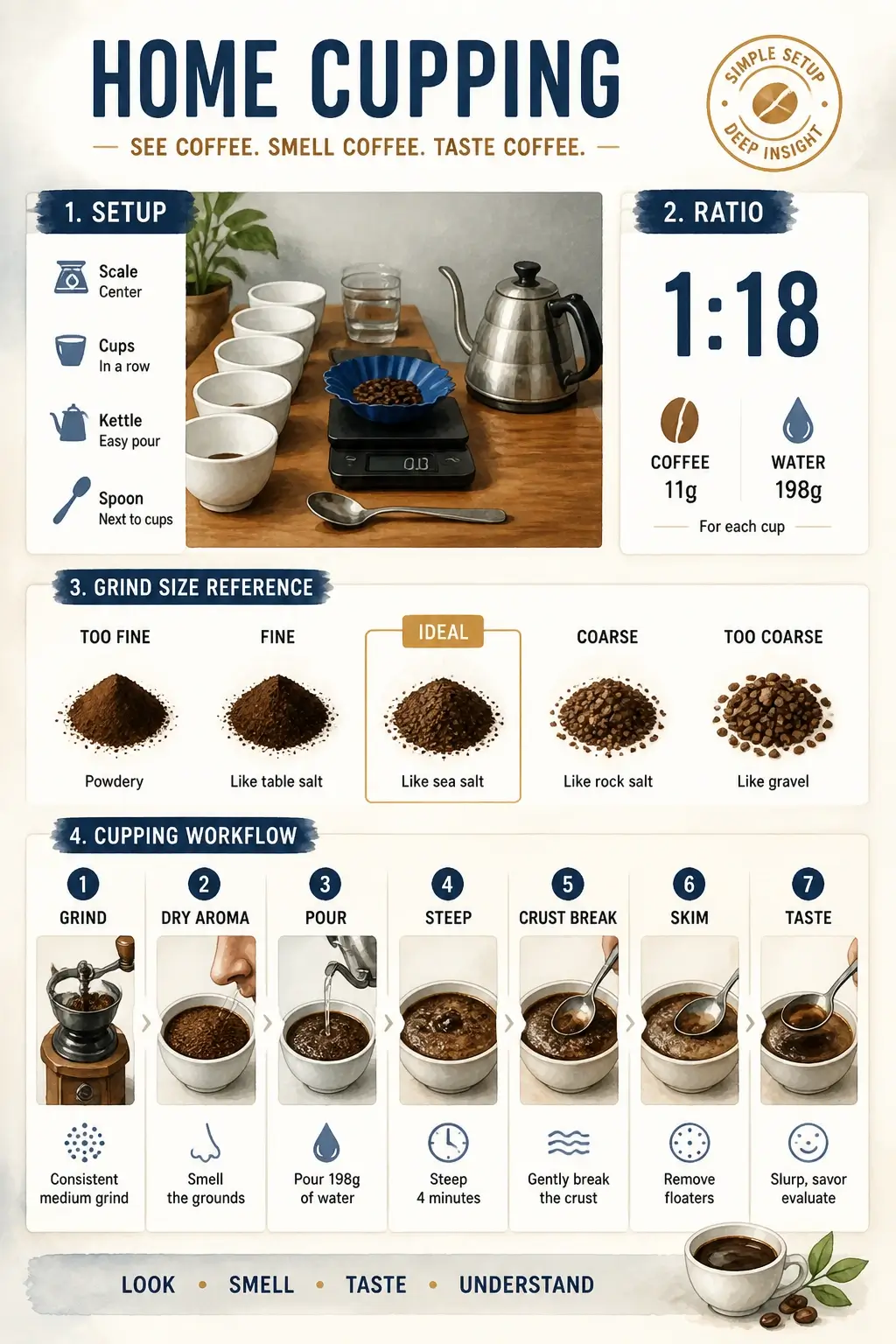
The home-friendly ratio mirrors the professional standard: 1:18 coffee to water by weight. For a practical starting point, 11 grams of coffee to 200 ml of water per bowl. Weigh the coffee. Measure the water. Ratio consistency is what makes the comparison fair.
Grind setting: medium-coarse, the texture of coarse sea salt. If your grinder has numbers, start in the middle and adjust slightly coarser if the grounds look like fine sand. Grind each coffee fresh, immediately before the session, and smell the grounds in the bowl right after – the aromatic window is short.
The side-by-side format is the whole point. One coffee alone gives you information. Two coffees together give you contrast, and contrast is where learning happens. Choose coffees that are genuinely different: a washed Ethiopian next to a natural Brazilian, or a light roast next to a medium. The bigger the difference, the more obvious the sensory gap.
These instructions follow the standard SCA protocol adapted for home use – not the commercial blog variations flagged earlier. You can trust the process because it comes from the same source material professionals use.
For a deeper dive into equipment choices, tasting techniques, and sensory development, the coffee cupping guide covers the full scope of what the practice can teach you.
Here’s a visual overview of how the home setup and workflow come together:
Running the Tasting and Evaluating What You Find
Once the station is set, the procedure runs in a fixed order. Work through it once and it becomes instinct.
Grind, then smell dry. Grind each coffee directly into its bowl. Before anything else, lean in and smell the dry grounds. Note the first impression – is it bright and floral, earthy, chocolatey, sharp? Write it down. One word is enough at this stage.
Pour at once. Heat water to just off boiling (around 93–96°C). Pour onto all cups simultaneously, or as close to it as possible. Fill each cup completely. Start a four-minute timer.
Break the crust at four minutes. Use a spoon to push through the floating grounds in each cup, nose close to the surface. This is the most information-dense moment of the session. Breathe in deliberately. Write down what hits you – this wet aroma is often more specific than the dry fragrance.
Skim the surface. Use two spoons to remove the floating foam and remaining grounds from each cup. The liquid should be clear enough to taste without interference.
Slurp at three temperatures. Dip your spoon and aspirate the coffee forcefully across your palate – spray it, don’t sip it. Do this at hot, warm, and near-room temperature for each cup. Different things appear at different points. Acidity sharpens as the coffee cools. Sweetness often emerges in the middle temperature range.
For each coffee, use this simple evaluation template:
| Attribute | What to Notice |
|---|---|
| Fragrance / Aroma | What you smell dry and wet – specific if possible |
| Flavor | Overall impression on the palate |
| Acidity | Brightness or liveness – is it vibrant, flat, or sour? |
| Body | Weight and texture – light, medium, or heavy? |
| Aftertaste | What lingers after you swallow – pleasant, short, rough? |
You’re not chasing a numerical score. You’re building the habit of noticing. The goal is to find words for what you taste and to recognize how those words change between the two cups sitting in front of you.
You can do this alone. There’s no requirement for a group, a roastery visit, or a guided event. Solo cupping works because the comparison between the two cups in front of you does the teaching. Your palate calibrates itself against the contrast.
The coffee already in your kitchen is enough to start. Two bowls, two coffees, thirty minutes on a weekend morning. That is cupping.
Frequently Asked Questions About What Is Coffee Cupping
How long does a cupping session actually take?
A standard session runs 45 minutes to an hour from grinding through final evaluation. The coffee itself steeps for four minutes, but tasting continues across three temperature stages as it cools, which takes another 20–30 minutes.
Can you swallow the coffee during cupping, or do professionals always spit?
Both are common. Spitting is standard when evaluating large numbers of samples in a single session – it prevents caffeine overload and palate fatigue. For a home session with two or three coffees, swallowing is fine.
Why does cupping use no filter between the grounds and water?
Every filter type changes what ends up in the cup. Paper filters absorb oils; metal filters let sediment through. Removing the filter entirely gives the most neutral extraction baseline, so the differences you taste come from the coffee, not the filter material.
What’s the difference between a Q Grader and a regular barista?
A Q Grader holds a certification from the Coffee Quality Institute, earned through a rigorous multi-day examination that tests sensory acuity, SCA protocol knowledge, and calibration accuracy. A barista prepares coffee for service. The skills overlap but the certifications serve different functions.
How do you know if your palate is calibrated well enough to cup accurately?
You don’t need perfect calibration to start. Calibration is built through repeated comparison, not through innate ability. Cup the same coffee twice under identical conditions and compare your notes – consistency in your own perception is the first benchmark.
Does roast level affect how you evaluate a coffee during cupping?
Yes, meaningfully. Darker roasts suppress origin-specific acidity and fruit notes while amplifying roast-derived bitterness and body. Light roasts tend to express more of the origin’s terroir. Neither is wrong, but the evaluation framework expects you to assess what the coffee is doing, not what you prefer roast-level-wise.
Why does the same coffee taste different at different temperatures during cupping?
Volatile aromatic compounds behave differently at different temperatures, and human taste receptors have varying sensitivity ranges. Acidity perception sharpens as liquid cools. Sweetness often becomes more apparent in the 50–60°C range. A coffee that tastes flat when hot can open up dramatically at room temperature.
Is there a difference between cupping and a traditional coffee tasting event at a café?
Usually, yes. Café tasting events often use a simplified format adapted for public engagement, which may include the two-spoon hygiene workaround or a looser ratio. A professional cupping follows the SCA protocol exactly. Both are valuable, but only the standardized version produces scores that are comparable across sessions and locations.
References
- Exploring Global Specialty Coffee Market Trends & Key Players | agriculture.institute
- Coffee Science: Tasters’ Performance in a Coffee Quality Contest in Brazil | doi.org
- Resolving Discrepancies in Coffee Cup Scores | perfectdailygrind.com