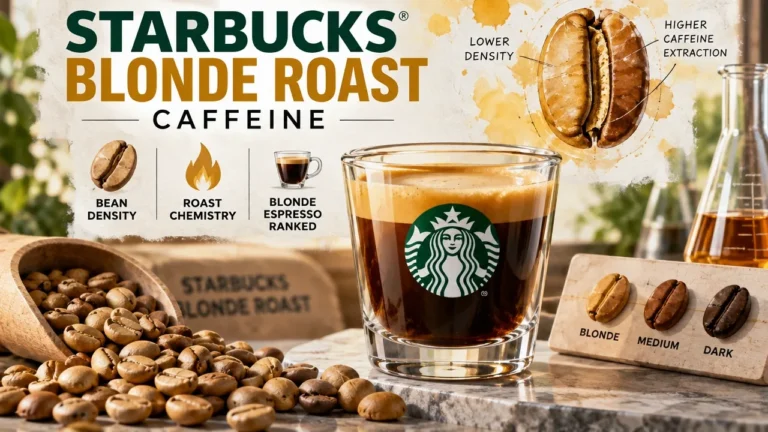

Starbucks Blonde Roast caffeine sits at 360mg for a Grande – 50mg more than Pike Place and 100mg more than Dark Roast – and most people ordering it have no idea why. The answer isn’t in the flavor profile or the name. It’s in the physics of what heat does to a coffee bean before it ever hits the grinder.
Understanding that mechanism changes how you read every caffeine claim on the menu. The roast spectrum, the density math, the espresso shot differential – once those are clear, the ordering decisions make themselves.
Key Takeaways on Starbucks Blonde Roast Caffeine
- Blonde Roast leads at every cup size: 180mg (Short), 270mg (Tall), 360mg (Grande), and 475mg (Venti) – all higher than Pike Place and Dark Roast at the same volume.
- The caffeine advantage comes from bean density, not roast chemistry – lighter roasts retain more mass per volume scoop, which means more caffeine enters the same amount of water.
- Caffeine does not meaningfully degrade during roasting; measured variation between roast profiles is less than 0.1%, making heat destruction a non-factor in any real-world comparison.
- Blonde Espresso delivers roughly 85mg per shot versus Signature’s 75mg – a 13% premium that compounds across every shot in a multi-shot drink.
- Blonde Roast is not less acidic than Dark Roast; the shorter roast retains more organic acids, and pH measurements often show Blonde as the more acidic option.
- A Grande Blonde Roast at 360mg puts you at 90% of the FDA’s 400mg daily caffeine ceiling – dose discipline matters regardless of which roast you choose.
What “Blonde” Actually Means in Starbucks’ Roast Spectrum
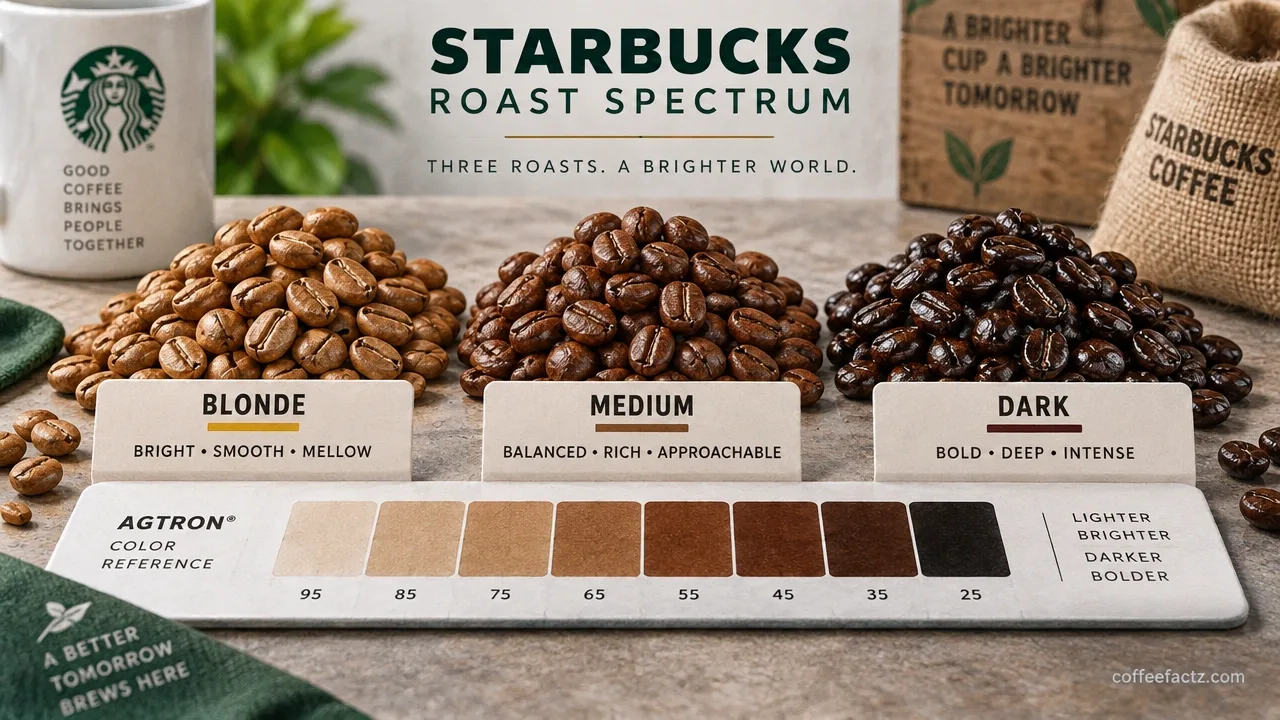
Starbucks Blonde Roast is the lightest stop on a three-tier spectrum that also includes Medium (Pike Place) and Dark (French Roast, Italian Roast, Sumatra). Blonde sits at the cool end of the roasting curve – end-of-roast occurs just before or around first crack, with temperatures in the 355–400°F range over a 7–9 minute roast cycle. On the Specialty Coffee Association’s color scale, that places it in the “very light” category, quantified by an Agtron color window of 95–85. Starbucks uses that Agtron window as its internal reproducibility target – the number that keeps Blonde tasting like Blonde batch after batch, regardless of which roaster or facility produced it.
That Agtron range is also the single data point brand-owned pages don’t publish, and it matters because it anchors every downstream characteristic: the bean’s retained density, its preserved acidity, and ultimately, its caffeine dose.
Before we go further, one distinction needs to be clear. Blonde Roast coffee and Blonde Espresso are different products. Blonde Roast coffee is the light-roast bean brewed through standard drip or pour-over methods. Blonde Espresso is that same light-roast coffee pulled through a 9-bar espresso machine – the same hardware and pressure as Signature Espresso, but a fundamentally different raw material. Conflating these two is the origin of most caffeine misinformation you’ll find about Starbucks’ lighter offerings. The roast curve numbers – 355–400°F, 7–9 minutes – are the cause of everything that follows: density retention, acidity retention, and caffeine dose. Keep that chain in mind.
The Blonde Roast Paradox: Why Lighter Beans Carry More Caffeine by Volume
Blonde Roast’s caffeine advantage is real, and it’s rooted in physics – not marketing. At the Grande (16 oz) benchmark, Starbucks’ own nutrition figures put Blonde at 360mg, Pike Place at 310mg, and Featured Dark Roast at 260mg. That’s a 50mg gap over Pike and a 100mg gap over Dark from the same cup size. The mechanism behind that gap is bean density, and it operates at the level of cellular structure.
Density Retention and Bean Physics
During roasting, coffee beans expand and shed mass. Water evaporates. Organic compounds volatilize. The cellular walls swell as CO₂ builds internal pressure. The longer and hotter the roast, the more mass the bean sheds and the more its structure opens up. A dark-roasted bean is physically larger, structurally more porous, and significantly less dense than the green bean it started as.
Chahan Yeretzian, Professor of Chemistry and Head of the Coffee Excellence Center at Zurich University of Applied Sciences, quantified this transformation precisely: during roasting, bean volume increases up to 80%, around 20% of dry matter is lost for dark roasted coffee, and average density drops from roughly 1.3 kg/m³ for green beans down to 0.7 kg/m³ for dark roast, while porosity climbs to about 0.5.
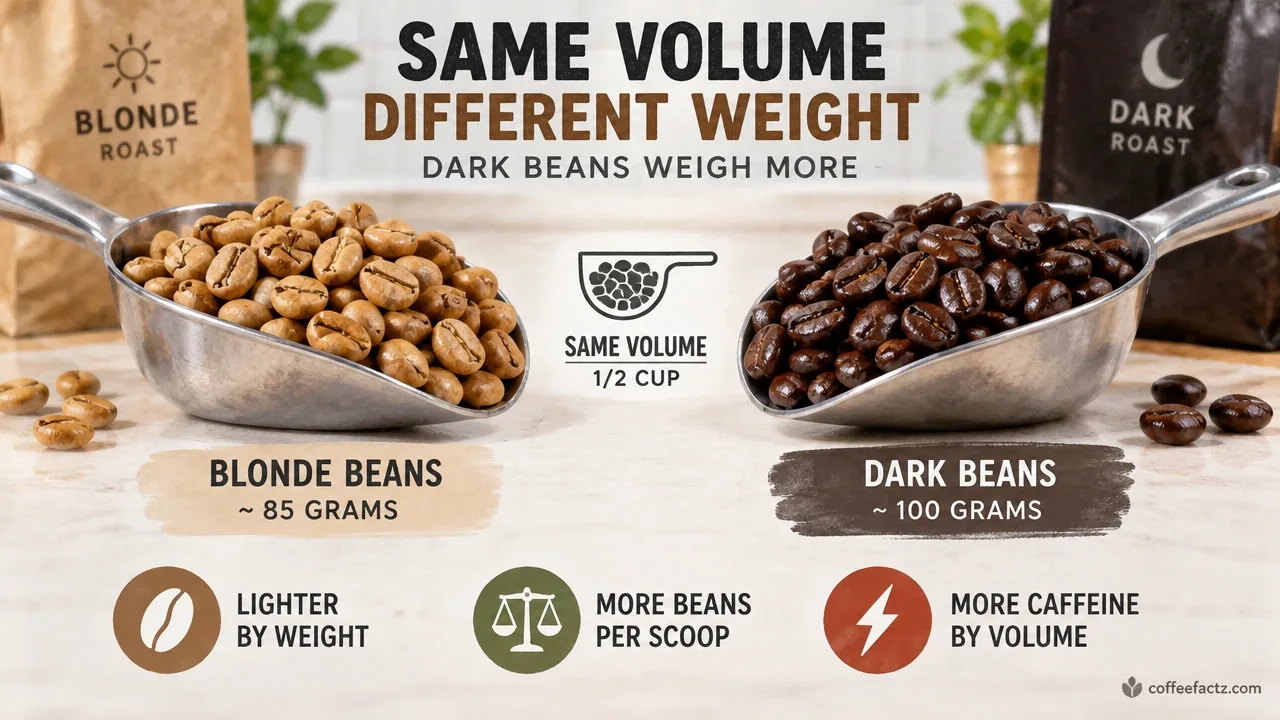
Blonde Roast stops the process earlier. Less time in the drum means less mass lost and less cellular expansion. A Blonde bean is denser and heavier than a Dark bean of the same physical volume. When a barista scoops coffee by volume – which is exactly how drip coffee is dosed at scale – a scoop of Blonde beans contains more total mass than the same scoop of Dark beans. More mass means more caffeine entering the same volume of water.
The blonde advantage is real but precise: it comes from denser, heavier beans, not from any special caffeine-generating property of light roasting.
Serving Benchmarks and the Dosing Offset
The Grande comparison – Blonde 360mg, Pike Place 310mg, Dark 260mg – is the clearest evidence of the density effect at work.
According to Starbucks’ published nutrition figures, a Grande (16 oz) Blonde Roast brewed coffee contains about 360mg of caffeine, a Grande Pike Place (medium) about 310mg, and a Grande Featured Dark Roast about 260mg – lighter roasts retain marginally more caffeine because they spend less time in the roaster. – Source: Starbucks Coffee Roasts Explained
There’s one detail that makes this comparison honest: Starbucks uses a fractionally smaller scoop for Blonde drip. The brand applies a dosing offset that narrows the brewed gap between Blonde and darker roasts. The 50mg and 100mg differentials you see in those nutrition figures already account for that offset. Without it, the spread would be wider.
This is also where most caffeine comparisons fall apart. Dry-bean caffeine concentration, brewed caffeine per cup, and volume-versus-mass weight are three independent measurements. Any claim that “Blonde has more caffeine” without specifying which dimension it’s measuring is incomplete. The Grande benchmark is a brewed-caffeine-per-cup number – the most useful metric for a Starbucks customer, and the one that holds up under scrutiny.
The Thermal Degradation Myth: Do Dark Roasts Burn Off Caffeine?
The thermal degradation myth goes like this: high roasting temperatures sublimate or combust caffeine, which is why dark roasts feel weaker. It’s intuitive, it’s widely repeated, and it’s wrong in the way it matters most.
The chemistry is straightforward. Caffeine is thermally stable at roasting temperatures. Roasting occurs between 385–435°F. Caffeine’s sublimation point sits around 178°C (roughly 352°F), which sounds close enough to roasting temperatures to be alarming – but the bean’s internal moisture, cellular matrix, and pressure dynamics prevent meaningful caffeine loss during the roast cycle. The bean isn’t a dry, open system. It’s a pressurized cellular structure that holds caffeine in place even as surface temperatures climb.
The measured consequence of this stability is decisive. A study published in Heliyon tracking caffeine content in green coffee and after roasting at 160°C, 180°C, and 220°C for 10–40 minutes found that caffeine varied only narrowly across all conditions – from 9.880 mg/g in green beans to 11.87 mg/g at the most aggressive roast profile. The authors attributed this pattern to caffeine’s thermostability and to the loss of thermolabile compounds that effectively concentrate caffeine as a percentage of remaining dry mass. In first-order kinetics, caffeine’s D-values (the time required to reduce concentration by 90%) were 666 minutes at 160°C, 526 minutes at 180°C, and 454 minutes at 220°C – far larger than chlorogenic acid’s 94, 55, and 38 minutes at the same temperatures. Caffeine’s higher melting point (238°C) compared to chlorogenic acid (207°C) and caffeic acid (223°C) further confirms its thermal resistance.
What does leave the bean during roasting: water, CO₂, sugars, and organic volatiles. The molecule coffee drinkers worry about is not the molecule that escapes. The roast chemistry above 400°F costs the bean cellular structure and mass – and that lost mass is precisely why dark-roast beans are less dense and deliver less caffeine per volume scoop. The correct lens for caffeine comparisons between roasts is density, not roasting heat.
The Serving Size Hierarchy: Exact Caffeine Benchmarks from Short to Venti
Blonde Roast’s caffeine ladder across Starbucks’ size range gives every customer a concrete number to order against.
| Size | Volume | Blonde Roast Caffeine |
|---|---|---|
| Short | 8 oz | 180 mg |
| Tall | 12 oz | 270 mg |
| Grande | 16 oz | 360 mg |
| Venti | 20 oz | 475 mg |
Blonde leads at every size against Medium and Dark at the same volume. These are brewed-coffee numbers – they apply to drip and pour-over Blonde Roast, not to espresso-based drinks, which pull from a separate extraction path covered in the next section.
One caveat worth naming: the Venti figure is the most contested on this ladder. Practitioners note that the +4 oz jump from Grande to Venti (475mg vs 360mg = +115mg) doesn’t scale linearly with the +4 oz volume increase. Cup size grows faster than extraction yield scales, which means the per-ounce caffeine concentration at Venti is slightly lower than at Grande. The number is accurate; the scaling isn’t perfectly proportional.
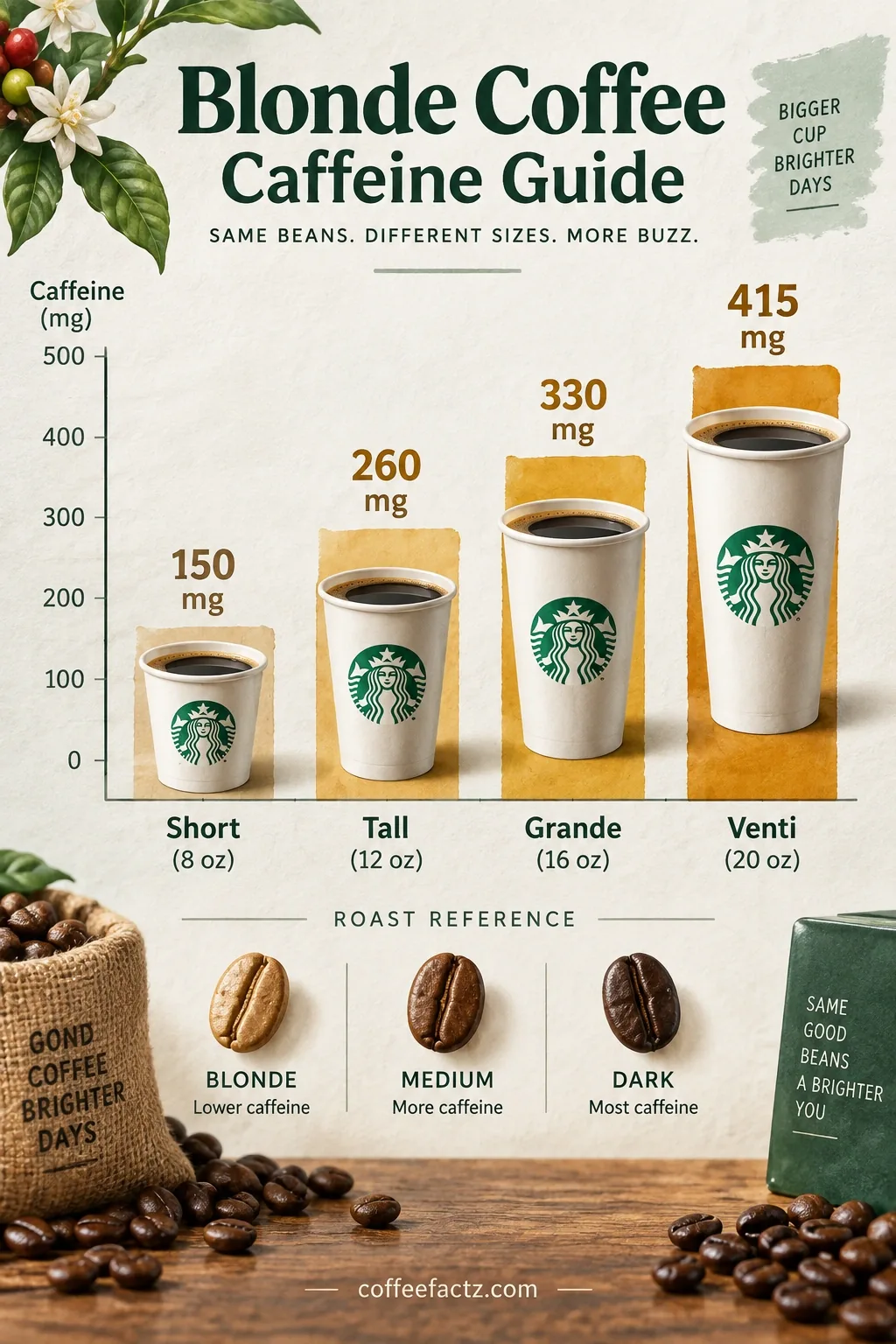
Generic coffee blogs typically publish only a single 8 oz brewed value and leave Short, Tall, Grande, and Venti blank. The table above is the complete picture – the only caffeine reference a Starbucks Blonde drinker needs for brewed coffee.
Blonde Espresso vs Signature Espresso: The 85 vs 75 mg Shot
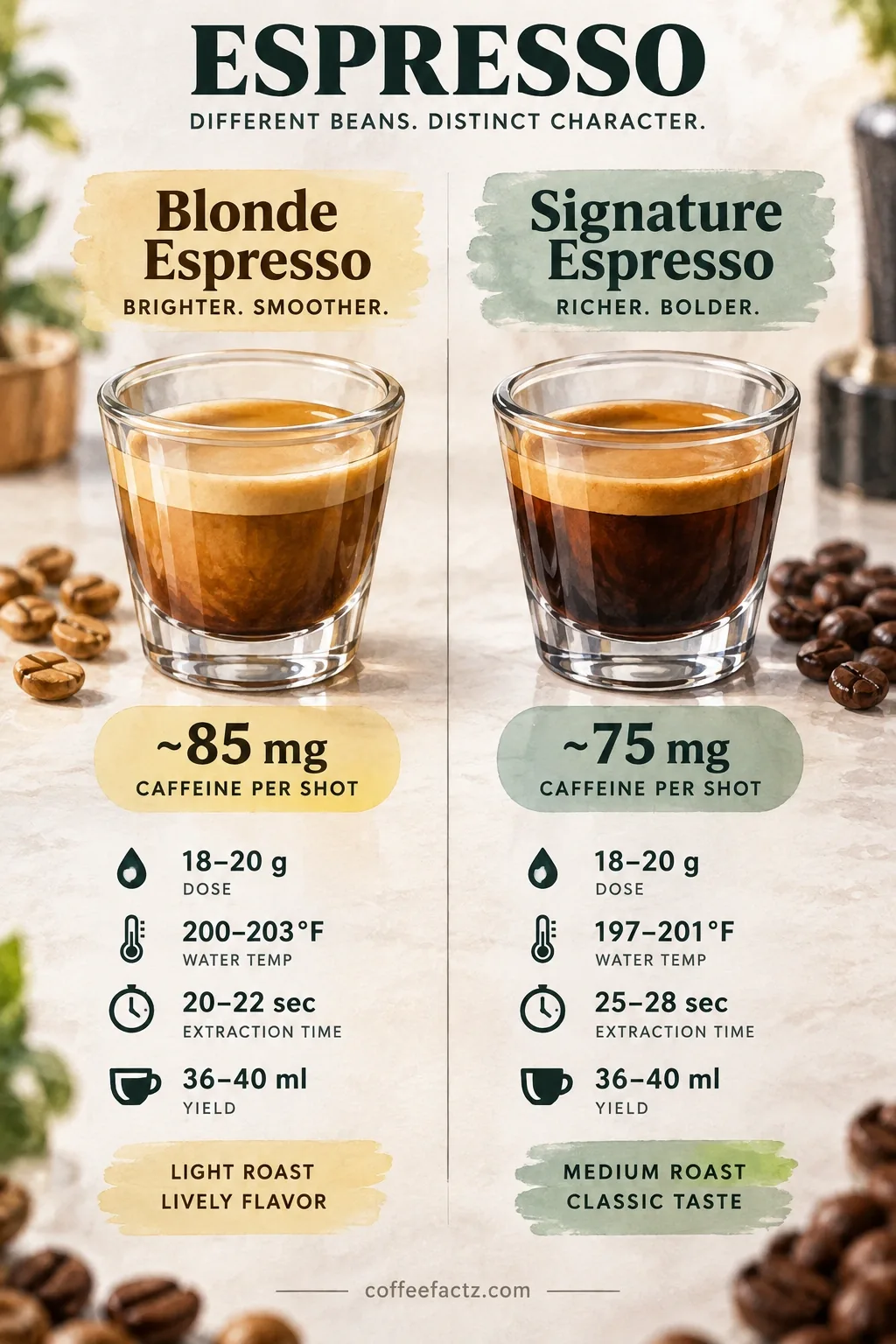
Blonde Espresso delivers roughly 85mg of caffeine per shot. Signature Espresso delivers roughly 75mg. That’s a 13% premium per pull – and it compounds.
Dose Differential and Extraction Parameters
The mechanism is the same one driving the brewed-coffee gap: denser raw material. Both Blonde and Signature Espresso use the same 9-bar extraction method and the same equipment. The difference is entirely in the bean. A denser Blonde bean packs more caffeine mass into the same dose weight.
Because the bean is denser, extraction parameters shift to match. Blonde espresso typically requires a finer grind and water temperature in the 94–96°C range, compared to 91–93°C for Signature, to avoid sour under-extraction. Pull it at Signature parameters and you’ll get a thin, acidic shot that undersells the bean’s actual caffeine content. Starbucks dials this in at the machine level, but home baristas replicating the blonde espresso pull need to account for both variables.
Blonde espresso isn’t a gentler, friendlier shot – it’s a higher-dose shot pulled from a denser raw material, with extraction parameters tuned to match.
Multi-Drink Impact and Menu Availability
Swapping Blonde into a multi-shot drink like a Vanilla Latte adds roughly 20–30mg across the full drink – entirely from the shot base, with no change to milk, syrup, or volume. In a double-shot build, that’s two 10mg premiums compounding simultaneously.
Blonde Espresso is available as a substitution in hot and iced espresso beverages across the Starbucks menu. It is not the register default – you have to ask for it by name. For enthusiast-level orderers, the blonde swap is the single highest-leverage caffeine decision available at the counter: one word changes the shot base, raises total caffeine by 13% per shot, and doesn’t require a larger cup or an extra shot.
Blonde Iced & Cold: How Extraction Dynamics Change in Cold Drinks
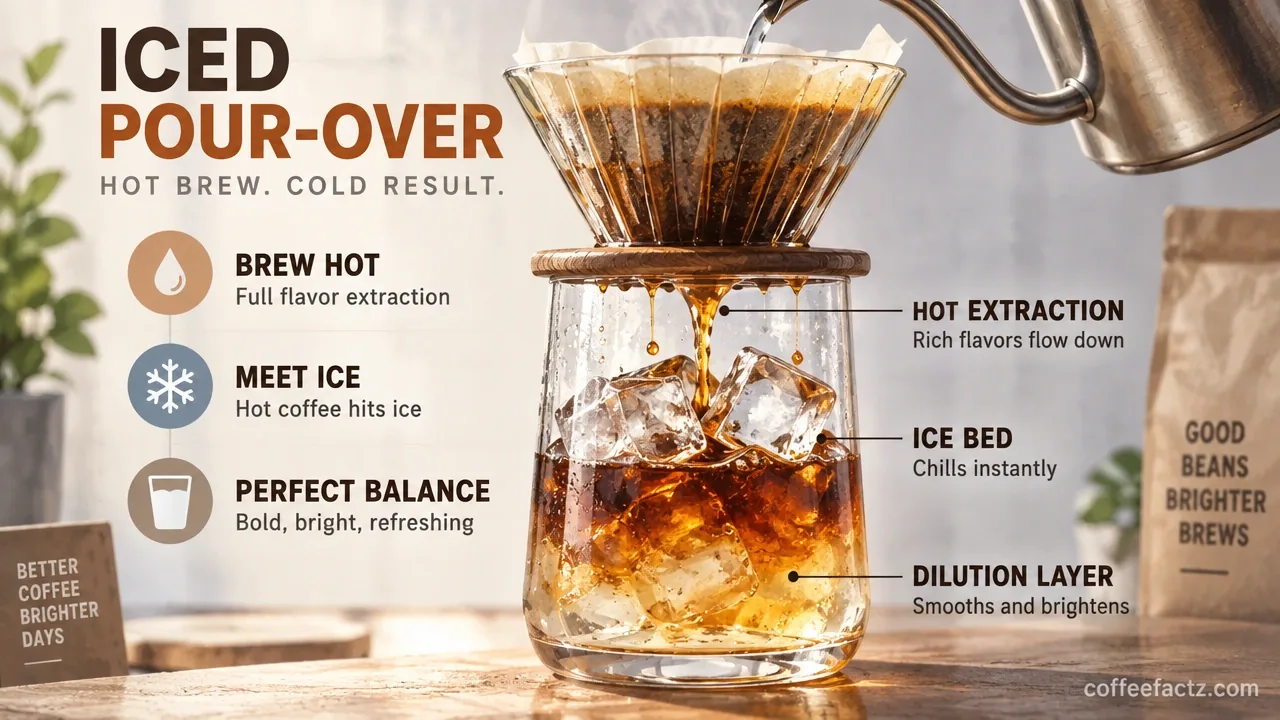
Iced Blonde coffee – whether a pour-over or an Americano – is built through hot extraction delivered over ice. The caffeine count doesn’t fundamentally change; the extraction dynamics do.
In an iced Blonde pour-over, hot water passes through ground Blonde beans at brewing temperature, then the resulting brew hits ice immediately. Contact time, grind size, and the dilution ratio from ice melt all differ from hot brewed service. A tighter grind compensates for the faster extraction needed before dilution. The ice adds volume but dilutes the final concentration – the total caffeine in the cup stays close to the equivalent hot size, but the per-ounce concentration drops.
Caffeine is stable across temperature changes. Ice dilution doesn’t degrade caffeine – it redistributes it across more liquid volume. What changes is extraction efficiency, which is set before the ice ever touches the drink: grind size, brew temperature, and contact time are the variables that determine how much caffeine leaves the bean and enters the water.
There’s a sensory reason Blonde works particularly well over ice. The shorter roast preserves citrus and crisp toasted malt aromatics that darker roasts replace with smoky, pyrolytic compounds. Those lighter aromatic compounds survive chilling better than the heavier pyrolytic profiles in dark roast – which is why an iced Blonde pour-over tastes bright and clean rather than flat and muted.
Flavor Chemistry, Acidity, and the CGA Health Question
Blonde Roast’s flavor chemistry is a direct product of its abbreviated time in the drum. The shorter roast preserves sweet, citrus, and crisp toasted malt notes – flavor compounds that extended heat exposure converts into the smoky, caramelized, pyrolytic profiles characteristic of dark roast. Neither profile is superior; they’re products of the same chemical process at different stages of completion.
Tasting Profile and the Acidity Correction
One persistent misconception: Blonde is gentler on the stomach because it’s less acidic. The opposite is closer to true. Blonde retains more acidic compounds – specifically the organic acids that extended roasting degrades. Dark roast’s longer heat exposure breaks down a meaningful portion of those acids, producing a chemically less acidic cup. Blonde can register more acidic than dark roast on a pH measurement.
Thomas Hofmann, Professor of Food Chemistry and Molecular Sensory Science at the Technical University of Munich, makes a related point about roast duration and bitterness: a longer roast at lower temperature reduces the formation of harsh bitter compounds like Phenylindanes, meaning the consumer gets a less bitter cup over time. Roasting time shapes the bitterness profile; caffeine, notably, doesn’t drive bitterness and isn’t meaningfully degraded during roasting.
That finding has a practical implication for Blonde. Its shorter roast means more of those bitter precursors remain intact – which is part of why Blonde espresso benefits from precise extraction parameters. Pull it wrong and the acidity and bitterness compounds both show up uninvited.
Antioxidant Retention and Safe Intake Limits
Blonde Roast retains more chlorogenic acid (CGA) than darker roasts – CGA is an antioxidant that degrades with prolonged heat exposure. That’s a measurable fact. What isn’t supported by reliable evidence is the claim that higher CGA retention makes Blonde’s caffeine hit harder or absorb faster in the bloodstream. The pathway connecting CGA levels to caffeine absorption rates in humans is under-documented. Don’t assert it as fact, and be skeptical of sources that do.
The health variable that actually matters is total caffeine intake. The FDA recommends ≤400mg caffeine per day for healthy adults. A Grande Blonde Roast at 360mg puts you at 90% of that ceiling in a single cup. Social media reports of 1,000mg/day consumption sit well outside safe guidance – that’s not a roast-choice question, it’s a dose-discipline question. Neither Blonde nor Dark is categorically healthier. Caffeine totals are the variable that determines physiological load.
Barista Ordering Playbook: How to Get More Caffeine from Blonde
The blonde espresso swap is the most efficient caffeine decision available at a Starbucks register. One substitution, no extra volume, no additional shots – just a denser raw material in the portafilter.
Start with the drinks where the swap makes the most mechanical sense: Flat White, Cortado, and Macchiato. These are high-ratio espresso drinks where the shot is a large fraction of total liquid volume, so the 13% per-shot premium has proportionally more impact than it would in a milk-heavy 20 oz latte. Blonde espresso also produces a softer crema acidity than Signature in these builds, which reads as cleaner rather than thinner.
Ordering script: say “blonde espresso” explicitly when ordering any hot or iced espresso beverage. It is not the register default. The barista defaults to Signature unless you specify. “Can I get that with blonde espresso?” is the complete phrase.
For home brewing: grind finer for blonde espresso than you would for a medium or dark roast. The denser bean requires more surface area exposure to extract efficiently at the same contact time. In a French press, the opposite applies – use a coarse grind. A fine blonde grind clogs the press filter and produces a silty, over-extracted cup that obscures the bean’s actual flavor and caffeine profile.
The final read on Blonde Roast caffeine is straightforward. Blonde is Starbucks’ highest-caffeine roast per volume and per shot. The practical gap over Pike Place is meaningful – 50mg at Grande – but not mythical. Once you understand the density math and the shot differential, the choice between Blonde, Medium, and Dark becomes a flavor decision. The caffeine math is already solved.
Frequently Asked Questions About Starbucks Blonde Roast Caffeine
How much caffeine is in a Starbucks Blonde Roast?
A Grande (16 oz) Blonde Roast brewed coffee contains 360mg of caffeine. The full size ladder runs 180mg (Short), 270mg (Tall), 360mg (Grande), and 475mg (Venti).
What’s the highest caffeine option at Starbucks?
Blonde Roast brewed coffee is Starbucks’ highest-caffeine roast by volume. A Venti Blonde Roast at 475mg is the single highest-caffeine standard menu item for brewed coffee.
Does weighing coffee by mass close the gap between Blonde and Dark?
Yes, significantly. The density advantage only applies when you dose by volume – a scoop. If you weigh your dose in grams, a Blonde bean and a Dark bean of equal mass contain nearly the same caffeine, because the density difference is neutralized.
Why does Blonde Espresso need a finer grind than Signature Espresso?
Blonde beans are denser and harder, so they require more particle surface area to extract efficiently at the same contact time and pressure. A coarser grind on a Blonde bean produces an under-extracted, sour shot.
Is Blonde Roast harder on the stomach than Dark Roast?
It can be, for acid-sensitive drinkers. Blonde retains more of the organic acids that extended roasting degrades, so it registers as more acidic – not less – compared to dark roast on a pH scale.
Does chlorogenic acid in Blonde Roast make caffeine absorb faster?
No reliable evidence supports that claim. Blonde does retain more CGA than darker roasts, but the pathway connecting CGA levels to caffeine absorption rates in humans hasn’t been established in the research literature.
Can I substitute Blonde Espresso into any Starbucks drink?
Yes – Blonde Espresso can be swapped into any hot or iced espresso-based beverage on the menu. You have to request it explicitly; the register default is Signature Espresso.
Is 200mg of caffeine equal to a cup of Starbucks coffee?
Not for Blonde Roast. A Tall (12 oz) Blonde Roast comes closest at 270mg, and a Short (8 oz) sits at 180mg. A standard 8 oz drip coffee from most other sources runs roughly 95–165mg, so Starbucks Blonde runs higher than the typical reference point for “a cup of coffee.”
References
- Chahan Yeretzian – Roasting-Induced Changes in Coffee Bean Chemistry | pubs.acs.org
- Thomas Hofmann – Elucidating the Bitter Taste of Coffee, SCA Expo Lectures 2019 | sca.coffee
- Thermostability of Bioactive Compounds During Roasting Process of Coffee Beans – Heliyon | pmc.ncbi.nlm.nih.gov
- Starbucks Coffee Roasts Explained | coffeenearyou.com