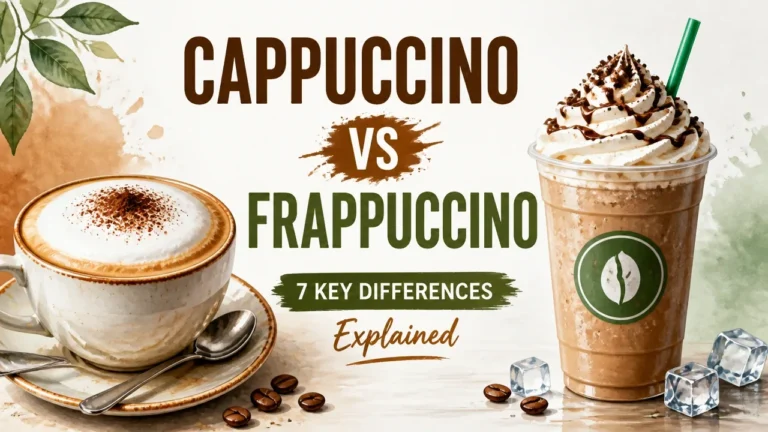

Cappuccino vs Frappuccino looks like a simple hot-versus-cold choice, but that framing misses the real story. One drink traces its roots to Italian café culture and is built on a fresh espresso shot, steamed milk, and a layer of microfoam. The other is a trademarked Starbucks product blended with ice, syrup, and a pre-made base that sometimes contains no coffee at all.
Understanding what separates them, structurally, physically, and nutritionally, gives you the tools to order exactly what you actually want every time.
Key Takeaways on Cappuccino vs Frappuccino
- A Frappuccino is not a frozen cappuccino; the ingredients, build method, temperature, and physical structure are all different categories of drink.
- The temperature gap between the two drinks exceeds sixty degrees, and that gap changes aroma, bitterness, and sweetness perception before a single sip.
- Espresso concentration and total caffeine per serving are two different numbers; a large Frappuccino can carry more total caffeine than a small single-shot cappuccino.
- Cappuccino microfoam is a protein-stabilized gas-in-liquid foam; a Frappuccino is a sugar-and-fat-stabilized frozen suspension. Both are called “creamy,” but they respond to time and heat in completely different ways.
- Sugar in a Frappuccino is a structural ingredient, not just a flavor additive; cutting it changes the texture of the drink, not just the taste.
- A cappuccino is a coffee you can drink daily; a Frappuccino is a dessert that happens to contain coffee, and ordering it that way sets accurate expectations.
What Cappuccino and Frappuccino Actually Are
Cappuccino and Frappuccino are not two versions of one drink. They belong to different categories entirely, and the confusion between them costs people the drink they actually wanted.
A cappuccino is a hot Italian espresso drink: one shot of espresso, steamed milk, and a layer of milk foam, traditionally served in a small 6 oz cup. That’s the whole recipe.
A Frappuccino is a cold, blended, sweetened beverage built from ice, milk, flavored syrup, and either a coffee base or a creme base, almost always finished with whipped cream. Starbucks created it, trademarked the name in the 1990s, and it has no Italian heritage whatsoever.
That last point matters more than it sounds. Cappuccino grew out of Italian café culture and became a standardized espresso-bar drink with a recognizable build across thousands of independent cafés. The Frappuccino is a proprietary product line, not a drink category. The word tells you the brand and the recipe family. It doesn’t tell you the contents.
Here’s the misconception worth clearing up before anything else: a Frappuccino is not a cappuccino that someone froze. The ingredients are different, the build method is different, the serving temperature is different, and the physical structure inside the cup is different. They share a syllable, not a recipe.
A few terms will come up throughout this comparison, so here’s what each one means in plain English:
- Espresso: a small, concentrated shot of coffee brewed by forcing hot water through finely ground coffee under pressure.
- Shot: one serving of espresso, roughly 1 oz.
- Coffee base: a pre-prepared liquid concentrate Starbucks uses in coffee Frappuccinos instead of a fresh espresso shot.
- Creme base: the same blended-drink build, but with no coffee at all. Sweetness and flavor come from syrup alone.
That last one carries a practical consequence beginners often miss. Ordering a Frappuccino at Starbucks without specifying coffee base or creme base means you might get a drink with zero caffeine. And ordering something called a “Frappuccino” somewhere other than Starbucks gets you a generically different blended drink, because the name is trademarked and the recipe doesn’t travel.
Hot vs Cold: The Serving Temperature Gap
Serving temperature is not a cosmetic detail. It is the single variable that drives nearly every other difference between these two drinks, and the actual size of the gap is bigger than most people picture.
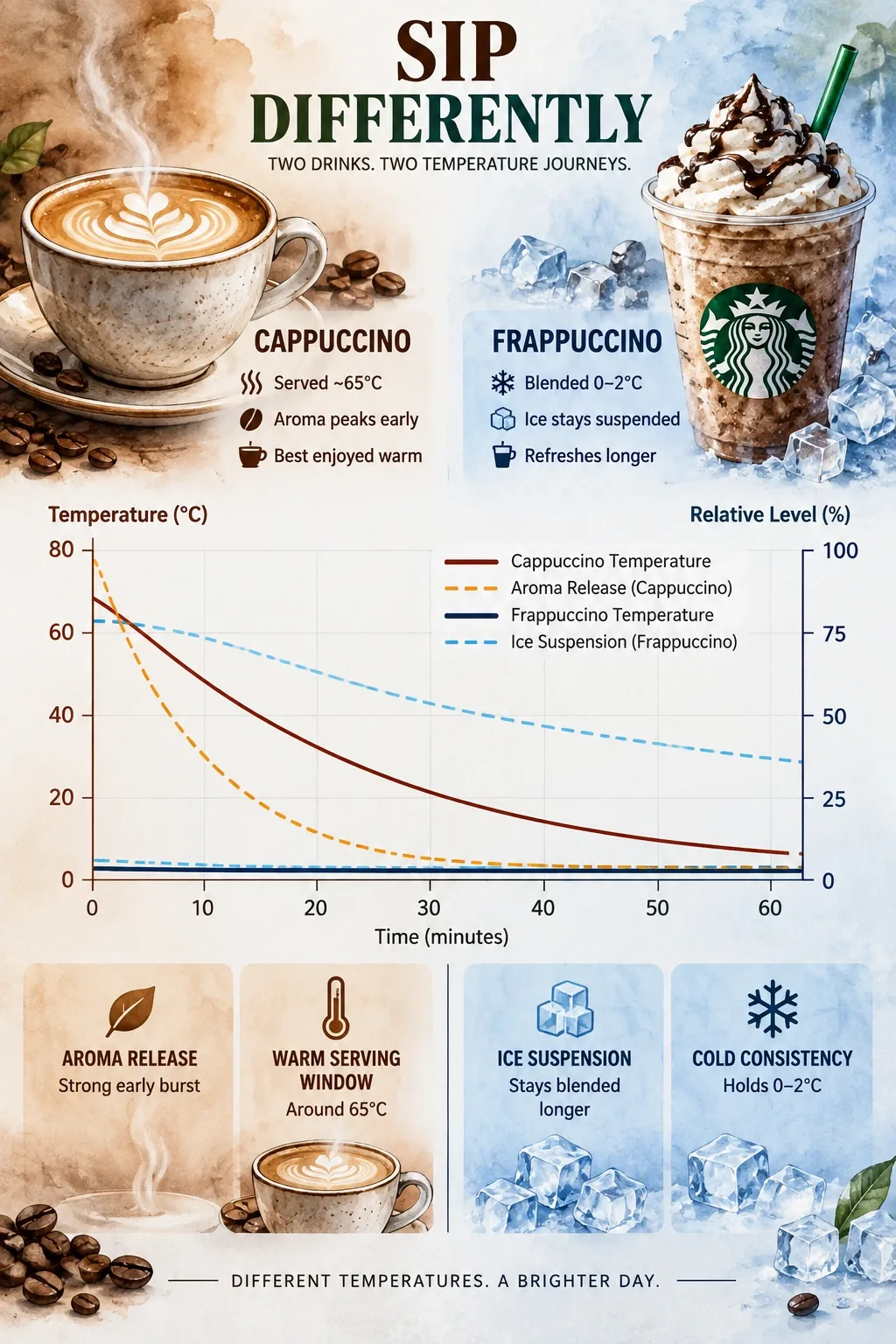
A properly made cappuccino targets a milk steaming temperature of roughly 65°C / 149°F and is meant to be drunk within a few minutes while the foam still holds its structure. That ceiling exists for a reason. Push the milk above that point and the proteins change, the natural sweetness of the milk drops, and the foam starts to collapse. The drink has a short window.
A Frappuccino is blended with ice and served cold through a straw, designed to be sipped slowly. The blended structure holds at roughly 0–2°C, just above freezing.
That’s a spread of more than sixty degrees between the two drinks.
The cold end is not simply “iced.” A Frappuccino is engineered to sit just above freezing so the ice crystals stay suspended in the mixture instead of melting into water. That’s why a Frappuccino turns watery and thin as it sits rather than simply warming up. The drink has a practical drinking window too, but it’s measured in minutes of warming, not minutes of cooling.
Temperature also changes what you taste. Cold suppresses bitterness and aroma. Heat amplifies both. So the same coffee compound reads completely differently depending on which cup it’s in, and that gap is baked into the drink’s design before a single sip.
What’s in the Cup: Espresso Extraction vs Frappuccino Concentrate
The question “which one has real coffee” has a clear answer. The question “which one is stronger” does not, and the difference between those two questions is where most comparisons go wrong.
Pressurized Shot Mechanics
Espresso is the entire coffee foundation of a cappuccino. Finely ground coffee gets packed into a portafilter, and hot water is forced through it under pressure, typically around 9 bars, to produce a small, concentrated shot in about 25–30 seconds. The result is intense, layered, and nothing like drip coffee.
That process is inherently variable. The bean variety, the grind size, the dose in the portafilter, and the skill of the barista pulling the shot all shift the flavor. Two cappuccinos from two different cafés can taste noticeably different even if both were made “correctly.”
Here’s a useful video that breaks down the mechanics of espresso extraction and the tools behind it:
Batch Base and Caffeine Metrics
A Frappuccino skips the fresh shot entirely. Instead, it uses a pre-prepared coffee base, a liquid concentrate made in batches, blended with ice, milk, and syrup. The coffee flavor is consistent and repeatable because the recipe is fixed, not because a barista is pulling a shot to order.
Creme-base Frappuccinos contain no coffee base at all. The flavor comes from syrup.
Now, the “which is stronger” question. Strength means two different things, and they don’t point the same direction:
- Concentration: how intense the coffee flavor is per ounce. Espresso wins here by a wide margin.
- Total caffeine per serving: how many milligrams of caffeine are in the whole cup. This depends on serving volume and recipe, not on drink category.
A single-shot cappuccino in a 6 oz cup carries roughly 60–70 mg of caffeine. A large Frappuccino made with coffee base can carry significantly more, depending on size and how the base is measured. The static “mg per shot” figures most comparisons quote are meaningless without size and recipe attached. Assuming espresso always means the most caffeine is one of the most common beginner mistakes in coffee ordering.
Milk Structure: Velvety Microfoam vs Blended Ice Emulsion
The cappuccino feels silky. The Frappuccino feels thick. Most people accept that and move on. But the reason behind it explains why each drink behaves the way it does over time, and why you can’t replicate one with the other’s equipment.
Steam-Textured Protein Architecture
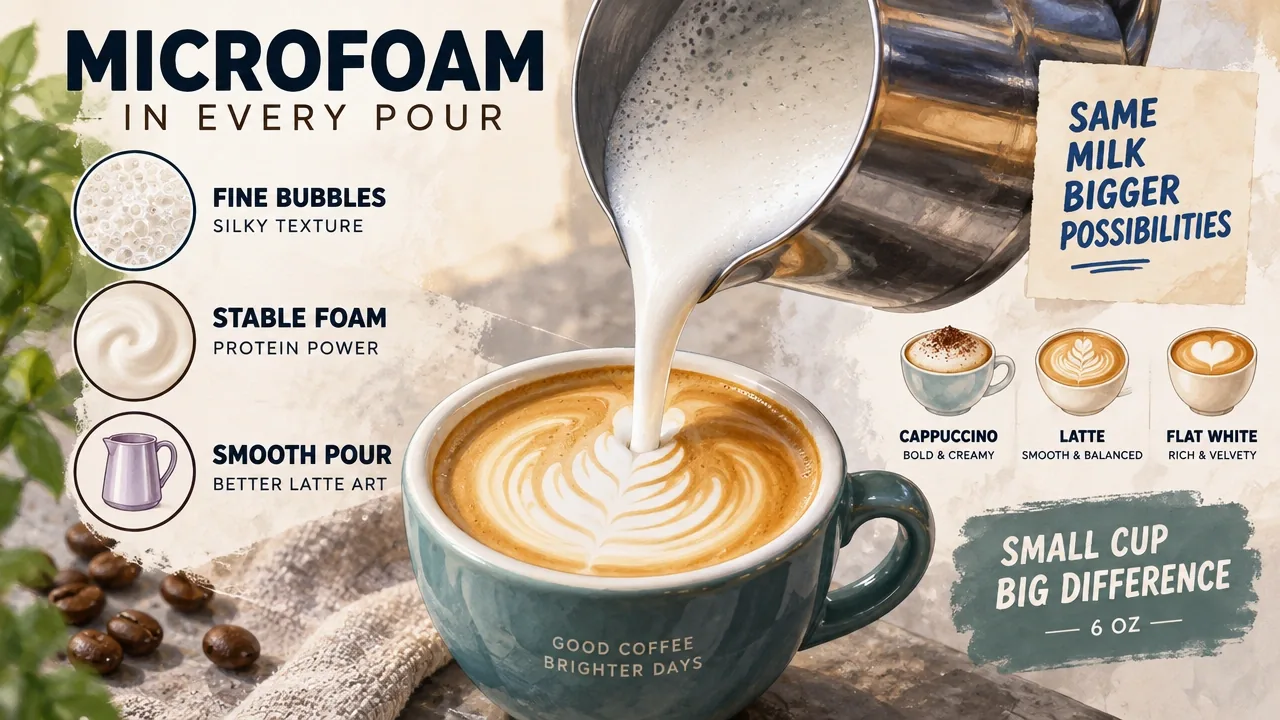
Microfoam is what makes a cappuccino feel the way it does. Cold milk goes into a pitcher, a steam wand is submerged just below the surface, and steam forces air into the milk while heating it. The result is millions of tiny bubbles held in place by milk proteins that coat each bubble and slow its collapse. That structure is the cappuccino’s velvet layer.
The classic cappuccino build is layered: espresso at the bottom, steamed milk in the middle, foam on top. The traditional shorthand is a 1:1:1 ratio, equal thirds of each component.
That ratio is less standardized than it sounds, though. Published definitions say “equal parts,” “one-third each,” and roughly 1:1.5 espresso to milk, and almost none specify whether foam counts as milk or whether the ratio is by volume or by weight. Two cafés can each serve “a traditional cappuccino” and hand you visibly different drinks. The practical fix: order by cup size and foam level, not by ratio.
Frozen Slush Suspension Mechanics
A Frappuccino has no layers and no foam. Ice, milk, and syrup go into a blender and get pulverized into a thick, uniform slush where ice crystals, milk fat, and sugar are suspended together throughout the cup.
The structural difference is more fundamental than “layered vs mixed.” Microfoam is a gas-in-liquid foam stabilized by milk protein. The bubbles hold because protein coats them and slows their collapse. A Frappuccino is a solid-in-liquid suspension stabilized by sugar and fat. The ice crystals stay suspended because the mixture is formulated to resist freezing solid at serving temperature.
Both drinks get described as “creamy,” but one is a foam and the other a blended ice emulsion, which is exactly why they respond differently to time, heat, and stirring.
An Annual Review of Food Science and Technology study on protein-stabilized food foams confirms the mechanism: proteins adsorb at the air-liquid interface to form a cohesive, viscoelastic film that reduces surface tension and slows drainage. In contrast, frozen sugar-and-fat systems rely on a particulate matrix of partially coalesced fat globules and ice crystals that trap air and resist movement through the increased viscosity of the frozen continuous phase.
In plain terms: the cappuccino’s foam is fragile and alive, held together by protein chemistry. The Frappuccino’s slush is dense and mechanical, held together by freezing physics. Stir one with a spoon and it recovers. Let the other warm up and it collapses into sweet, thin liquid.
Sugar and Calorie Load
The calorie gap between these two drinks is real, but the reason behind it is more interesting than “one has sugar and one doesn’t.”
Baseline Energy Ranges
A cappuccino’s calories come almost entirely from milk. With whole milk in a standard 6 oz cup, you’re looking at roughly 60–80 kcal. Swap to oat milk or a larger cup and the number climbs, but the broad zone is 60–150 kcal, with no added sugar unless you stir some in yourself.
A Frappuccino’s calories come from a stack of ingredients, each adding to the total: the coffee or creme base, the syrup pumps, the milk, and the whipped cream on top. The broad range runs 250–510+ kcal depending on size, syrup load, and toppings. Sugar and cream are part of the recipe, not optional extras.
The variance inside the Frappuccino category is wider than the cappuccino’s entire range. A 250 kcal Frappuccino and a 510 kcal Frappuccino are both Frappuccinos. Choosing the category tells you less than choosing the size and customizations.
Modification Levers and Routine Positioning
Four variables control the calorie load on either drink:
- Size – the single biggest lever on both drinks.
- Milk type – whole milk vs skim vs oat vs almond each carries a different fat and calorie count.
- Syrup pumps – each pump at Starbucks adds roughly 20 kcal and 5g of sugar.
- Whipped cream – adds roughly 80–110 kcal on its own.
Adjusting any of these moves the number, but on a Frappuccino, it also changes the texture. Sugar and fat in a blended drink are functional ingredients, not just flavor. They control how the mixture freezes, how thick it pours, and how long it holds together. Cutting syrup or switching to skim milk makes the drink thinner and causes it to separate faster. “Same drink, fewer calories” is a compromise, not a free swap.
The practical rule of thumb: a cappuccino is a coffee you can drink every day without much thought. A Frappuccino is closer to a dessert that happens to contain coffee.
Preparation Equipment: What Each Drink Demands
Both drinks are makeable at home. But the equipment that produces each one is specific to the physical structure inside the cup, and buying the wrong tool doesn’t get you halfway there. It gets you a different drink.
Espresso Machine Requirements
Making a cappuccino at home requires:
- An espresso machine capable of pulling a pressurized shot and steaming milk. This is the non-negotiable piece.
- A portafilter to hold the ground coffee during extraction.
- A tamper to compress the grounds evenly before the shot pulls.
- A milk pitcher to hold and maneuver the milk during steaming.
- A thermometer to monitor milk temperature and stop before 65°C.
- A 6 oz cup – this one matters more than people expect.
That last item is worth pausing on. A traditional cappuccino is a small drink. When home brewers pour the same 1:1:1 build into a 10–12 oz mug, the milk proportion shifts and the cup’s heat retention changes. The result lands closer to a lukewarm latte than a cappuccino. Match the cup to the drink and the drink improves immediately.
The real bottleneck in home cappuccino making is the steam wand and the technique. A blender cannot make microfoam. Milk frothers and handheld whisks produce large, unstable bubbles, not the tight protein-stabilized microfoam a steam wand creates.
Blender Configuration Standards
Making a Frappuccino at home requires:
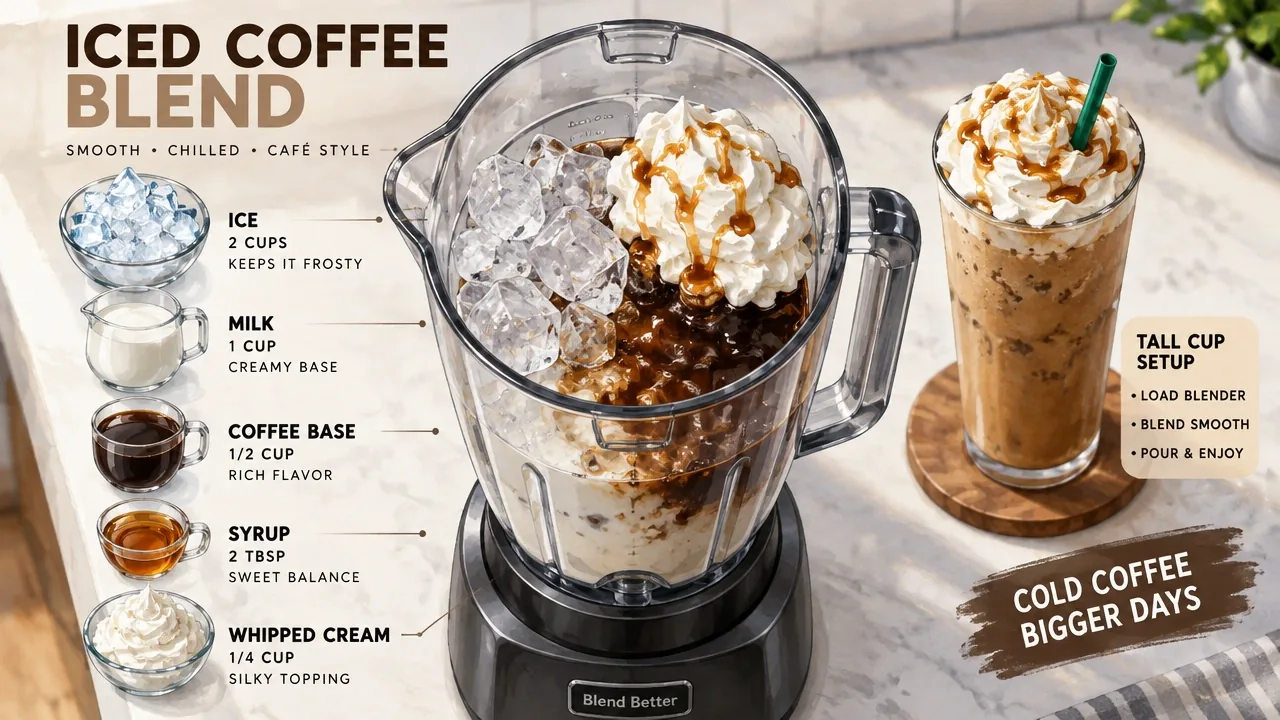
- A high-speed blender capable of crushing ice without leaving chunks.
- Ice in the right proportion to liquid, typically more ice than most people expect.
- A coffee or creme base, or strong chilled coffee as a substitute.
- Milk, syrup, and any sauces called for by the recipe.
- Whipped cream, a tall cup, and a straw for serving.
The real bottleneck here is the ice-to-liquid ratio. Too much liquid and the mixture won’t hold its slush texture. Too little and the blender strains and leaves ice chunks. Pouring iced coffee over ice and calling it a Frappuccino produces a completely different drink, because the blended structure requires the ice to be pulverized and suspended, not floating.
Owning a blender is necessary but not sufficient. If the mixture lacks the sugar-and-fat balance the recipe depends on, the blended structure won’t hold and the drink separates before you finish it. A low-sugar home version will taste thin and watery, not just lighter.
First-purchase advice: buy equipment for the drink you will actually make most often. Don’t buy both an espresso machine and a high-speed blender hoping to cover both categories. They serve different physical systems.
Mouthfeel: How Each Drink Actually Feels
Every structural and temperature difference covered so far converges into the sensory experience in the cup. This is where the abstract becomes immediate.
Tasting Sequence Profiles
A cappuccino delivers a layered sequence. The drink arrives warm and aromatic. The first contact is a soft layer of foam on the lip, light and slightly airy. Then steamed milk spreads across the tongue. Then, underneath, the bitterness of the espresso at the base. Because the drink is built in layers, it changes as you drink it. The first sip and the last sip are noticeably different.
Luigi Odello, Secretary General of the Istituto Nazionale Espresso Italiano and the Istituto Internazionale Assaggiatori Caffè, describes the certified Italian cappuccino’s foam as white with a brown border of varying thickness, and its aroma as intense, layered with soft floral and fruit notes backed by stronger tones of milk, toasted cereals, caramel, chocolate, vanilla, and dried fruit. The body, he notes, is substantial, expressing itself as a persuasive, cream-like sensation with high spherical perception, supported by a mild bitterness and a barely perceptible, balanced acidity. Astringency is practically absent.
That description captures something the standard comparison articles miss: the certified cappuccino’s sensory profile is a system, not just a flavor. The foam structure, the milk temperature, the espresso bitterness, and the aroma all arrive in a sequence that changes as the drink cools and the layers mix. The drink is designed to be consumed quickly, before that sequence collapses.
A Frappuccino delivers a uniform experience. Cold, thick, sweet, and creamy from the first sip to the last. Everything is blended together, so there are no layers to move through. Sipped through a straw, sweetness arrives first, and coffee flavor sits behind it. The experience is consistent rather than evolving.
Thermal and Textural Perception
Cold suppresses bitterness and aroma. This is not subjective preference. It’s a physiological response: taste receptors are less sensitive to bitter compounds at low temperatures, and volatile aromatic compounds release more slowly from cold liquids. So a Frappuccino’s sweetness and creaminess read stronger not because there is more sugar relative to a cappuccino’s espresso, but because the cold is actively suppressing the competing signals.
Heat does the opposite. A hot cappuccino amplifies both aroma and bitterness, which is why the experience feels more intense and why the drink rewards attention rather than casual sipping.
The structural difference changes mouthfeel in a specific way. Microfoam feels light because it is mostly gas held in a thin protein film that breaks apart on contact with a warm tongue. The foam collapses, the milk spreads, and the sensation is brief and clean. A blended suspension feels thick because it is dense with ice crystals, fat globules, and sugar syrup that coat the palate and keep releasing sweetness as the ice melts.
That melting is worth paying attention to. The last third of a Frappuccino tastes noticeably sweeter and thinner than the first third, because as the ice crystals melt, they dilute the mixture while releasing the concentrated sugar trapped in the slush. If you dislike that finish, drink it faster or order a smaller size. Ordering it “less sweet” removes texture along with sugar, and you lose the structure you came for.
The cappuccino is racing its own cooling curve. The Frappuccino is racing its own warming curve. Both have a window. Neither is built to be nursed indefinitely.
Verdict: Which One Should You Order?
Neither drink is better. That’s the honest answer, and it’s more useful than a ranking.
A cappuccino is a hot coffee built for routine drinking, a focused sensory experience that takes about five minutes to finish at its best. A Frappuccino is a cold, sweet treat built for occasional or warm-weather drinking, closer to a dessert than a morning coffee. Asking which is better is like asking whether a steak is better than ice cream. The answer depends entirely on what you’re hungry for.
And to close the original question for good: a Frappuccino is not a frozen cappuccino. Different ingredients. Different build method. A sixty-degree temperature gap. Different physical structure inside the cup. Different calorie profile. The shared syllable is a coincidence of branding, not a family resemblance.
Four questions to find your drink:
- Do I want it hot or cold?
- Sweet, or not sweet?
- How many calories do I want in this cup?
- Do I need predictable caffeine?
If hot and not sweet, a cappuccino is the answer. If cold and sweet and you’re fine with a dessert-level calorie count, a Frappuccino works. If you need predictable caffeine, specify coffee base on the Frappuccino side, and ask for shot count on the cappuccino side.
Ordering scripts:
- Cappuccino: name the cup size and the number of shots. “A double cappuccino in a 6 oz cup” is a complete order.
- Frappuccino: name the size, specify coffee base or creme base, and state your syrup level. “A grande Frappuccino with coffee base, two pumps of syrup” is a complete order.
Three facts worth keeping from this comparison: the temperature gap is roughly sixty degrees, not a minor chill. The foam in a cappuccino and the slush in a Frappuccino are physically different systems that behave differently over time. And the sugar in a Frappuccino is doing structural work, not just adding sweetness, which is why cutting it changes the texture, not just the taste.
One honest addition: a meaningful number of coffee drinkers reject both options when asked to choose, answering “neither” or “just a strong black coffee.” If you drink coffee for the coffee rather than for sweetness or creaminess, neither drink is your daily default. The cappuccino is by far the closer of the two. The Frappuccino is best understood as a dessert that happens to contain coffee. Knowing that is more useful than a winner declaration.
Frequently Asked Questions About Cappuccino vs Frappuccino
Is a Frappuccino just a frozen cappuccino?
No. A Frappuccino is a trademarked Starbucks blended beverage built from ice, syrup, milk, and a pre-made base. A cappuccino is a hot Italian espresso drink made with a fresh shot and steamed milk. They share a syllable, not a recipe.
Which is better, Frappuccino or cappuccino?
Neither wins outright because they serve different purposes. A cappuccino is a focused hot coffee for daily drinking; a Frappuccino is a cold, sweet treat closer to dessert. The better question is what you actually want in the moment.
Which has more caffeine, a cappuccino or a Frappuccino?
It depends on size and recipe. A single-shot cappuccino in a 6 oz cup carries roughly 60–70 mg of caffeine. A large coffee-base Frappuccino can exceed that, depending on how the base is proportioned. Creme-base Frappuccinos contain no coffee at all.
What is the difference between a cappuccino and a Frappuccino at Starbucks?
At Starbucks, a cappuccino is a hot espresso drink with steamed milk and foam, made to order with fresh shots. A Frappuccino is a cold blended drink made with a pre-prepared coffee or creme base, ice, syrup, and whipped cream. The build process, temperature, and calorie profile are entirely different.
Why does a Frappuccino get watery as it sits?
The blended structure depends on ice crystals staying suspended in a sugar-and-fat mixture held just above freezing. As the drink warms, those crystals melt and dilute the mixture. The drink isn’t warming up the way a hot coffee cools down; it’s losing its structural integrity from the inside out.
Can I make a cappuccino without an espresso machine?
Not a true one. The microfoam that defines a cappuccino’s texture requires a steam wand. Handheld frothers and whisks produce large, unstable bubbles, not the tight protein-stabilized microfoam that makes the drink feel the way it does. You can approximate it, but the result is a different drink.
Why does a Frappuccino taste sweeter at the bottom?
As you drink it, the ice crystals in the suspension melt and release the concentrated sugar trapped in the slush. The last third of the drink is genuinely more diluted and sweeter than the first. If that finish bothers you, a smaller size solves it faster than ordering fewer syrup pumps.
Is there a version of either drink without caffeine?
Yes on both sides. A cappuccino made with decaf espresso contains minimal caffeine. A creme-base Frappuccino contains no coffee base at all, so caffeine comes only from any chocolate or tea syrups added to the recipe.
References
- Role of Proteins on Formation, Drainage, and Stability of Liquid Food Foams | annualreviews.org
- Cappuccino Italiano Certificato | beverfood.com