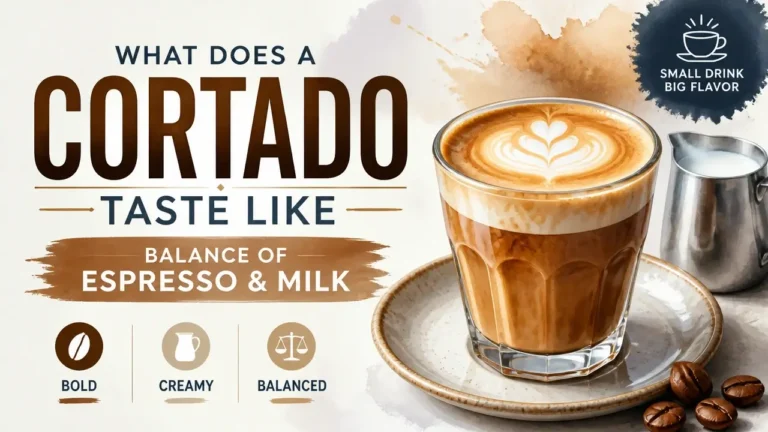

A properly built cortado delivers something most espresso-milk drinks can’t: the full character of the espresso, softened just enough to be approachable, without losing any of its identity. The milk doesn’t take over – it cuts the edge, the way the Spanish word “cortar” literally describes.
What you get in the glass is bold, clean, and balanced – dark chocolate and caramel intact, bitterness dialed back, and a velvety texture that’s nothing like a latte or cappuccino. Understanding why that works starts with the structure.
What a Cortado Actually Is
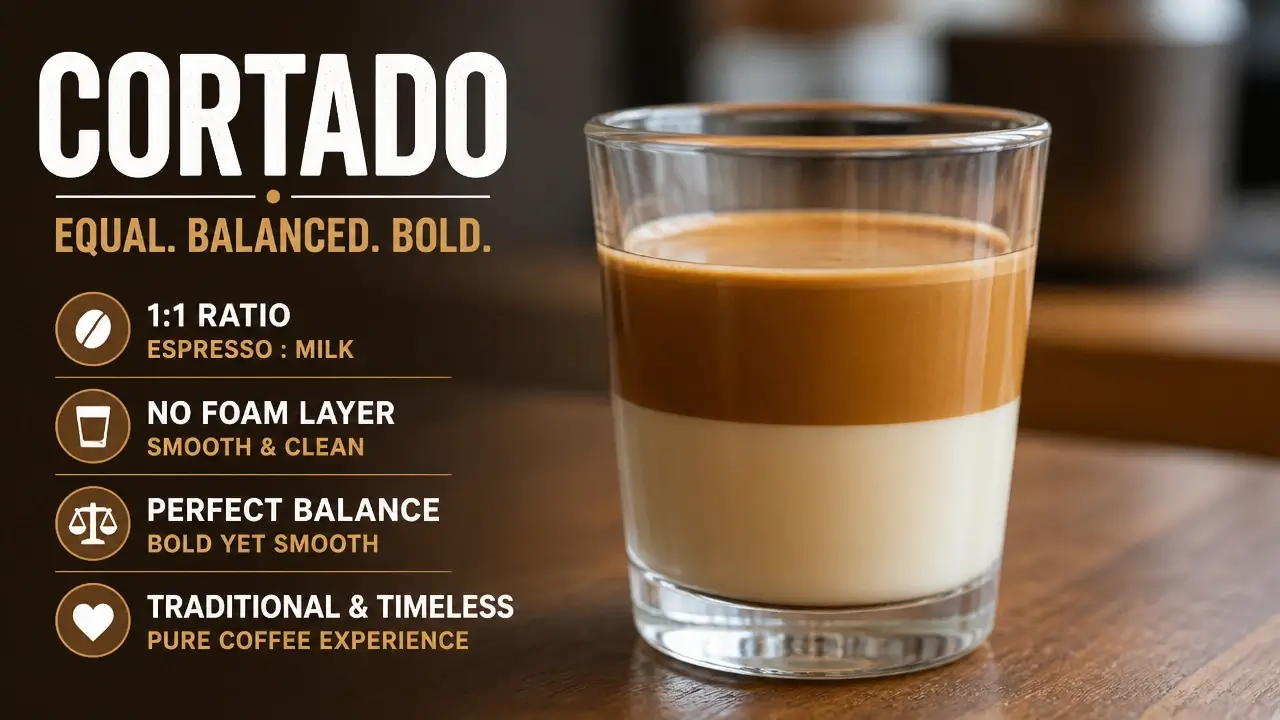
A traditional cortado is a Spanish espresso drink built on exactly equal parts espresso and lightly steamed milk – a strict 1:1 ratio served in a small, clear glass of roughly 4 to 5 oz, with no dry foam and no added sweetener. That’s the whole architecture. Everything about how this drink tastes flows directly from that single structural constraint.
The milk’s job here is specific and limited. It doesn’t transform the espresso into something creamier or more approachable the way a latte does. It cuts it – reduces the sharp acidity and bitterness just enough to smooth the experience without diluting the coffee’s character. Think of it less like blending and more like adjusting a volume knob: the espresso is still clearly in charge, just turned down one notch from its most aggressive setting.
The milk texture matters as much as the volume. A cortado uses milk steamed to a warm, velvety state – minimal microfoam, fully integrated, with no defined foam layer sitting on top. It’s silk, not foam. Barista Magazine, the leading trade journal for the global specialty coffee industry, describes the milk as “slightly steamed but not to the point where much texture is created,” and draws a clear line: a cortado is not meant to carry the thick foamed top of a latte or cappuccino.
The glass matters too. Serving in a small, clear cortado glass isn’t aesthetic preference – it’s a functional signal that you’re getting the right volume and can see exactly what you ordered. And because the drink contains no added sugar, any sweetness you taste comes entirely from the lactose naturally present in the milk.
What a Proper Cortado Tastes Like
A well-made cortado delivers a smoother, sweeter, and richer espresso profile than a straight shot – but it stays unmistakably espresso-forward. The milk doesn’t mask the coffee; it frames it. Whatever tasting notes your espresso carries – dark chocolate, toasted hazelnut, caramel sweetness, or a fruity brightness in lighter roasts – those notes come through clearly, just without the harsh edges.
Here’s what the milk actually does mechanically: the warm liquid raises the pH of the espresso slightly, which dials back the perception of both bitterness and sharp acidity. You lose the aggression, but none of the depth. The result sits in a specific sensory zone – savory and espresso-driven, with a subtle natural sweetness from lactose that you’d describe as “not sweet” if someone asked, but noticeably rounder than a straight shot.
The velvety mouthfeel is its own thing. That light microfoam creates a clean, almost silky sensation on the palate – distinctly different from a latte’s heavier, creamier body, and nothing like the airy, almost dry texture of a cappuccino’s stiff foam. It’s integrated, not layered.
Sprudge, the leading global coffee publication, frames it well: the cortado’s name comes from the Spanish verb “cortar” – to cut – alluding to the milk gently cutting the bitter, strong flavors of espresso. Not as potent as a straight shot, not nearly as mild as a latte, the drink earns its reputation through simplicity and balance.
If you want a quick quality check: a cortado that tastes watery has too much milk. One that tastes harsh has too little, or the milk wasn’t steamed properly. One with noticeable foam on top has drifted into macchiato or cappuccino territory. The ideal is a clean, bold espresso flavor with rounded edges and a silky finish – no single element dominating.
The Spanish “Cut” Coffee and Its Origins
The cortado traces back to Spain – most likely the Basque region – where the name simply meant what the drink does: espresso cut with a small measure of warm milk. It wasn’t designed as a menu item or a specialty offering. It was a working person’s morning ritual.
Picture the traditional café scene: a small glass on a zinc counter, consumed standing up in two or three minutes, often with a glass of water alongside and a sugar packet left untouched. The Spanish Basque origin of cortado reflects a specific cultural logic – people wanted the intensity of espresso with just enough milk to take the bite off, without turning the drink into the prolonged, milky experience of a café con leche. Speed and concentrated flavor defined the ritual. The café con leche contrast is useful here: where café con leche is roughly half coffee and half hot milk, built for slow sipping, the cortado is the opposite impulse – quick, strong, balanced.
The drink spread through Latin America with Spanish immigration and eventually reached the global specialty-coffee movement, where it found a new home in third-wave cafés. In San Francisco, Blue Bottle Coffee began serving it in a Libbey Gibraltar glass – a small, squat rocks glass – and the name “Gibraltar” became common enough in U.S. cafés that many people still don’t realize they’re ordering the same drink with a different name.
What stayed constant through all of that geographic movement was the core structure: the 1:1 ratio and the absence of foam. The glassware changed. The name changed. The ratio didn’t.
Inside Starbucks’ Cortado: What They Actually Build
The Starbucks cortado recipe is built around three ristretto shots of Blonde Espresso combined with steamed milk in an 8-oz short cup. To understand what that means for the taste, you need to understand both components.
Ristretto is a short-pull espresso extraction – less water pulled through the same amount of coffee grounds, which concentrates the sweeter, earlier-extracting compounds and leaves behind some of the harsher bitter notes. The Blonde Espresso roast is Starbucks’ lighter roast option, which contributes a buttery, biscuit-like, subtly sweet flavor profile compared to their standard darker roast. On paper, both choices push the drink toward a sweeter, smoother outcome.
The steaming target runs between 130–150°F, which produces a thin layer of microfoam – and here’s where the first structural departure from tradition appears. That microfoam creates a slight frothy top, which a traditional cortado explicitly doesn’t have.
The ratio issue is more significant. Three ristretto shots yield roughly 1.5 to 2 oz of liquid. An 8-oz cup means the remaining 6 to 6.5 oz is steamed milk. That’s closer to a 1:3 or 1:4 espresso-to-milk ratio – which is latte territory, not cortado territory. The espresso intensity that defines the traditional drink gets meaningfully diluted.
The intended flavor outcome is real and pleasant on its own terms: buttery, smooth, subtly sweet, with the Blonde Espresso’s lighter roast character coming through. Starbucks built this as a menu item designed for broad palatability – not as an attempt to replicate a Spanish café cortado. That distinction matters when you’re deciding what to order.
Here’s a look at how the drink is assembled behind the bar:
The Ratio Showdown: Cortado vs. Every Other Milk Drink
The cortado’s 1:1 ratio places it at one specific point on the espresso-milk spectrum, and knowing where everything else sits makes the differences immediately clear.
Here’s the full comparison in one place:
| Drink | Espresso-to-Milk Ratio | Milk Texture | Foam Layer | Typical Serving Size | Intensity |
|---|---|---|---|---|---|
| Cortado | 1:1 | Warm, velvety microfoam | None (integrated) | 4–5 oz | Very High |
| Flat White | ~1:2 | Silky, integrated microfoam | Minimal | 5–6 oz | High |
| Cappuccino | ~1:1:1 (espresso:milk:foam) | Steamed milk + stiff foam | Thick, dry | 5–6 oz | Medium-High |
| Latte | ~1:3 to 1:4 | Creamy, steamed milk | Thin cap | 8–12 oz | Medium |
| Macchiato (traditional) | Espresso + dollop | Minimal | Small foam dollop | 2–3 oz | Very High |
| Gibraltar | ~1:1 | Warm, velvety microfoam | None | 4–5 oz | Very High |
The milk texture hierarchy is worth spending a moment on, because the ratios alone don’t tell the whole story. A latte’s milk is steamed longer and to a higher volume, creating a creamier, heavier body. A cappuccino’s foam is stiff enough to hold its shape – it sits on top rather than integrating. A flat white uses ristretto shots and silky microfoam for a smooth, integrated result. The cortado’s milk is the most restrained of all: just enough warmth and velvety texture to modify the espresso, nothing more.
The Gibraltar question comes up constantly. A Gibraltar is a cortado served in a specific Libbey Gibraltar glass – the drink inside is identical. Most specialty coffee enthusiasts treat the terms interchangeably, and they’re right to.
Is a cortado stronger than a latte? Yes, clearly. Same espresso, far less milk, smaller total volume. The coffee flavor is proportionally more concentrated in every sip. Calling a cortado “a small latte” misses the structural point entirely – a latte’s ratio fundamentally changes the flavor balance, not just the size.
Sprudge’s editorial board put it directly: in terms of milk volume, the cortado sits smaller than a cappuccino and larger than a macchiato – a drink size many consider ideal. Their position on chain interpretations is equally direct: if you’re going to put a cortado on the menu, make it a cortado. If it’s an 8-oz espresso-and-milk drink, there’s already a name for that.
The Authenticity Gap: Does the Starbucks Cortado Hold Up?
The cortado authenticity standards aren’t arbitrary gatekeeping – they’re the mechanical requirements that produce the specific flavor experience the drink is named for. When those standards slip, you’re not getting a slightly different cortado. You’re getting a different drink with the same label.
Three Non-Negotiable Markers – and Where the Chain Version Fails
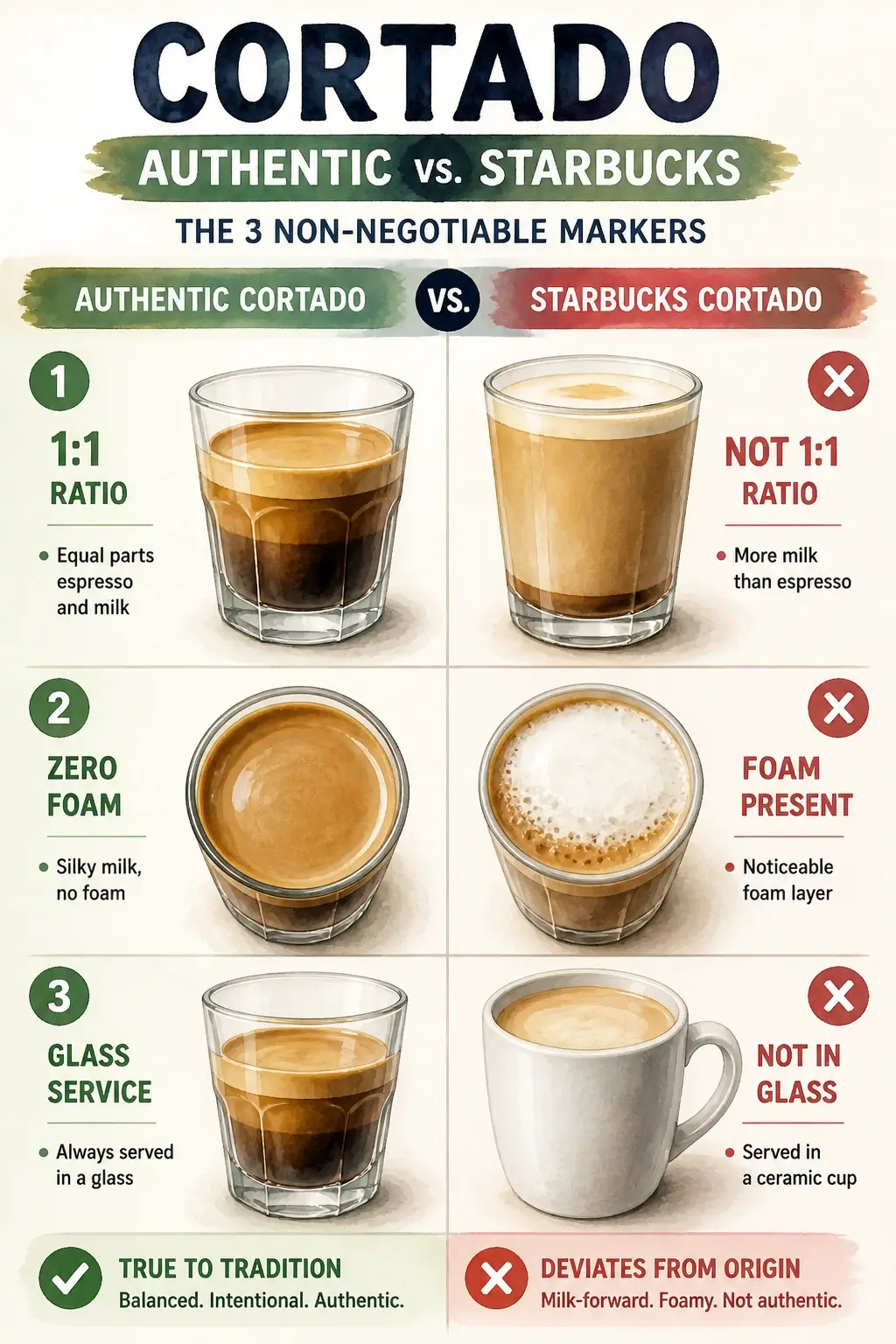
The three markers that define an authentic cortado are the strict 1:1 espresso-to-milk ratio, the complete absence of a dry foam layer, and ideally, glass service. These aren’t stylistic preferences – each one directly affects what lands on your palate.
The coffee enthusiast community’s critique of the Starbucks version is consistent across forums and subreddits: the ratio exceeds 1:1 by a significant margin, the microfoam produces a visible frothy top that violates the zero-foam standard, and the paper cup substitution removes the sensory and visual cues that signal you’re drinking the right thing. One widely read blog review described the Starbucks cortado as “pretty close” to authentic and rated it favorably – but Reddit coffee enthusiasts systematically pulled that apart. Their argument: “pretty close” isn’t close at all when the ratio is off by a factor of three and there’s foam where there shouldn’t be any.
Tasmin Grant, writing for Perfect Daily Grind – the industry’s go-to resource for specialty coffee professionals – didn’t soften the assessment. Grant described the Starbucks build as “almost twice the size of a cortado by specialty coffee’s standards” and called the naming choice linguistic dereliction. The three ristretto shots in an 8-oz cup, Grant argued, produce something that contradicts what coffee drinkers seeking an authentic cortado are actually looking for.
The Information Gap Between Marketing and Reality
The promotional narrative around the Starbucks cortado and the enthusiast community’s verdict exist in almost complete opposition – and until now, most readers have only encountered one side.
The blog review that awarded a 10/10 with no noted downsides reflects a real pattern: positive-only review bias shapes how most people form expectations before they’ve tasted something. Research published in the Journal of Consumer Research documents exactly this dynamic – consumers heavily weight average user ratings when forming quality inferences, yet those ratings frequently don’t correlate with objective product quality. The illusion of validity takes hold, and the marketing narrative becomes the dominant signal.
A separate study on specialty coffee consumers, published in Ciência e Tecnologia de Alimentos, found that extrinsic information – descriptive labels, origin claims, promotional framing – shifts consumers’ actual sensory perceptions before they’ve taken a single sip. Call something “buttery and biscuity” and people are more likely to taste that, regardless of what’s actually in the cup. Research in Frontiers in Psychology reinforces this further: visual and contextual cues tied to premium framing raise expectations of sweetness, acidity, and quality independently of the coffee itself.
What that means practically: the information gap between what the Starbucks cortado is marketed as and what it actually delivers by traditional standards is real, measurable, and being actively exploited by the promotional narrative – whether intentionally or not. The Reddit community’s critique isn’t contrarianism. It’s the correction.
How to Order a Cortado That Actually Tastes Like One
Getting a cortado that matches the blueprint – even at a chain – is genuinely possible. It just requires a specific order rather than a menu tap.
The core hack, refined through extensive Reddit testing by enthusiasts who cared enough to deconstruct the recipe: ask for a triple ristretto espresso (Blonde Espresso if you want the lighter, sweeter profile) with steamed whole milk or half-and-half on the side in a short cup. Combine them yourself. You control the ratio, you avoid the unwanted foam layer, and you get something that actually resembles the 1:1 balance a traditional cortado is built on.
The cost difference is worth knowing about. Community reports document a price gap of roughly $3.50 for the custom build versus $6.50 for the menu cortado – nearly half the price for a drink that’s closer to the real thing. Authenticity doesn’t have to cost more.
Real-world variability is the honest caveat here. Barista familiarity with this custom request varies considerably. Some will steam half-and-half without hesitation and hand it to you in a separate cup. Others will look at you like you’ve asked for something in a foreign language. The approach that works consistently: be specific, be polite, and if there’s confusion, simplify it to “triple espresso and a small steamed milk on the side.” You can do the combining yourself.
Beyond the chains, this gets much easier. Walk into any independent specialty coffee shop and ask for a traditional cortado with no foam, served in a glass. At a third-wave café, that’s a two-second exchange. The barista knows exactly what you mean, and what arrives will be the drink this entire article has been describing – equal parts espresso and steamed milk, no foam, no fuss, in a small clear glass.
That’s the whole point of understanding the structure first. Once you know what the 1:1 ratio actually does and why the foam-free milk texture matters, you can walk into almost any café in the world and get what you came for – no guesswork required.
Key Takeaways on Cortado
- A cortado’s defining structure is a strict 1:1 espresso-to-milk ratio with no dry foam and no added sweetener – everything else flows from that.
- The milk’s role is to cut sharp acidity and bitterness, not to dilute the espresso’s character or introduce texture.
- A well-made cortado tastes bold and espresso-forward, with natural dark chocolate or caramel notes intact and a subtle lactose sweetness.
- The Starbucks cortado uses three ristretto shots in an 8-oz cup, which pushes the ratio closer to 1:3 – latte territory, not cortado territory.
- A cortado is stronger than a latte because the same espresso volume is paired with significantly less milk, concentrating every sip.
- Ordering a triple ristretto with steamed whole milk on the side at a chain costs roughly half the menu price and gets you closer to the traditional build.
Frequently Asked Questions About Cortado
What is a cortado most similar to?
A cortado is closest to a flat white – both are espresso-forward drinks with integrated microfoam and minimal dairy. The flat white uses slightly more milk and typically ristretto shots, making it marginally softer, but the flavor profile sits in the same bold, balanced territory.
Is a cortado sweet or bitter?
Neither dominates. A properly made cortado is savory and espresso-driven, with a subtle natural sweetness from the milk’s lactose that rounds out the bitterness without making the drink taste sweet. If it tastes noticeably bitter, there’s too little milk or the espresso is over-extracted.
Is a cortado stronger than a latte?
Yes, significantly. Both drinks typically use the same amount of espresso, but a cortado’s 1:1 ratio means you’re drinking far less total liquid – so the coffee flavor is proportionally more concentrated in every sip compared to a latte’s 1:3 or 1:4 ratio.
What does it feel like to order a cortado at a specialty café?
At a third-wave café, it’s a completely normal, two-second order – the barista knows exactly what you mean and will hand you a small glass with no foam. At a chain, expect to specify “no foam” and be prepared to clarify the size, since menu versions often deviate from the traditional build.
Can the espresso roast change how a cortado tastes?
Absolutely. A darker roast pulls out more bitter, smoky notes that the milk softens into a dark chocolate profile. A lighter roast keeps fruity or floral notes intact, and the milk’s softening effect makes those brighter flavors even more accessible. The 1:1 ratio amplifies whatever the espresso brings.
Why does a cortado taste different from a macchiato if both are small?
A macchiato is espresso marked with just a small dollop of foam – there’s almost no liquid milk involved. A cortado uses equal parts steamed milk, which meaningfully softens the acidity and adds a velvety texture. The macchiato stays harsh and concentrated; the cortado is balanced and smooth.
Does the type of milk change the cortado’s flavor?
Yes, noticeably. Whole milk adds a richer, slightly creamier sweetness. Half-and-half pushes that further toward a buttery texture. Oat milk introduces its own subtle sweetness and a thicker body. The 1:1 ratio means any flavor the milk brings is proportionally significant – more so than in a latte where the espresso gets diluted anyway.
What’s the difference between a cortado and a Gibraltar?
They’re the same drink. A Gibraltar is a cortado served in a specific Libbey Gibraltar glass – the name became common in U.S. specialty cafés, particularly in San Francisco. The ratio, milk texture, and flavor are identical. The glass is the only difference.
References
- What Is a Cortado? – Barista Magazine
- The Cortado: History, Flavor, and What Makes It Distinct – Sprudge
- Starbucks’ Cortado and the Naming Problem – Perfect Daily Grind
- Getting Behind the Bar at Starbucks to Make the Cortado – Divine.ca
- Navigating by the Stars: Investigating the Actual and Perceived Validity of Online User Ratings – Colorado.edu (Journal of Consumer Research)
- Into the Minds of Coffee Consumers: Perception, Preference, and Impact of Information in the Sensory Analysis of Specialty Coffee – Scielo.br
- Virtual Terroir and the Premium Coffee Experience – Frontiers in Psychology
- Starbucks Cortado Hack: Community-Reported Price Comparison – Cyanneeats.com