
Widely misunderstood green tea caffeine content sits in a surprisingly wide band-from under 15 mg in a roasted hojicha to over 70 mg in a concentrated matcha-and the difference isn’t random. Variety, growing method, and how you brew all pull that number in different directions.
Get those variables right, and green tea becomes one of the most controllable caffeine sources in your kitchen. Get them wrong, and you’ll wonder why your “gentle” afternoon cup is keeping you up at night.
Green Tea vs. Coffee and Black Tea: A Caffeine Comparison
Standard green tea caffeine content clocks in at 30–50 mg per 8-oz cup-roughly one-third of brewed coffee’s ~96 mg and slightly below black tea’s 40–70 mg range-making it a moderate, low-spike option for anyone managing daily intake. That one-third relationship is the number worth anchoring to: it’s real, it’s consistent across sources, and it gives you an immediate gut-check any time you’re weighing a cup of green tea against a morning coffee. At the far quieter end of the spectrum, decaf green tea drops to just 1–8 mg, and herbal teas contain zero caffeine entirely.
Here’s a clean look at where each beverage sits before we get into the variables that move those numbers:
| Beverage | Caffeine per 8-oz Serving |
|---|---|
| Brewed Coffee | ~96 mg |
| Black Tea | 40–70 mg |
| Green Tea | 30–50 mg |
| Decaf Green Tea | 1–8 mg |
| Herbal Tea | 0 mg |
So is green tea high in caffeine compared to coffee? No-not even close. It’s a moderate, low-spike option that gives you a real but gentle lift without the sharp peak that a full cup of coffee produces.
There’s one catch that almost every health guide quietly skips, though. Every number in that table assumes an 8-oz serving-the kind you’d measure with a kitchen measuring cup, not the kind you’d pour into your actual mug. A standard drip coffee at most cafés comes in at 12–16 oz, which pushes that “96 mg coffee” closer to 150–200 mg in the real world. Most green tea drinkers brew at home and tend to stick closer to standard sizes, but if you’re using a 12-oz mug-which is pretty common-you’re already at 45–75 mg before you’ve considered anything else. The gap between green tea and coffee stays real, but it narrows faster than the textbook numbers suggest. The 400 mg daily limit can creep up on you when your pour is bigger than your assumption.
Dr. Joanna Kochman, Ph.D. in Health Sciences at the Department of Human Nutrition and Metabolomics, Pomeranian Medical University, puts the raw leaf numbers in sharp relief:
“The content of caffeine in green teas was found to fall within the range of 11.3–24.67 mg/g, while in matcha it amounted to between 18.9 and 44.4 mg/g.”
Notice what that tells you: even at the dry-leaf level, matcha nearly doubles the caffeine concentration of standard green tea. By the time you account for the fact that matcha involves consuming the entire leaf rather than just an infusion, that gap in your cup becomes even more pronounced-which is exactly where we need to go next.
Why Not All Green Teas Are the Same: Matcha, Gyokuro, Sencha, and More
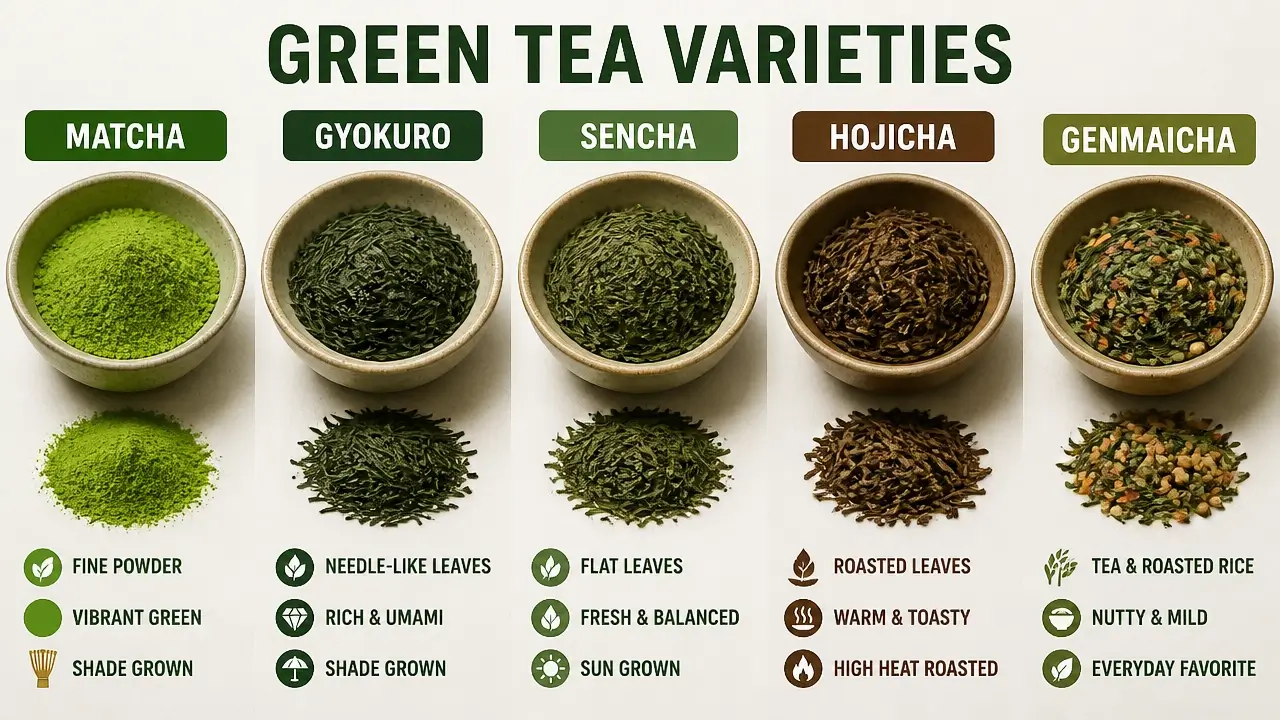
Green tea varieties don’t share a single caffeine identity-matcha, gyokuro, sencha, and hojicha each land in different ranges because of fundamentally different growing conditions, processing methods, and the simple question of whether you’re drinking an infusion or ingesting the whole leaf. Understanding what drives those differences gives you a reliable map for choosing the right tea for your energy needs, rather than guessing from the label.
Here’s how the main varieties stack up per 8-oz cup, along with the mechanism behind each number:
- Matcha: 30–70+ mg. You’re consuming stone-ground whole leaf powder suspended in water, not just an infusion. Every milligram of caffeine in that leaf goes into your cup. Higher-grade ceremonial matcha, prepared with more powder, sits at the top of that range.
- Gyokuro: 30–40 mg. This is Japan’s premier shade-grown green tea. Covering the plants for several weeks before harvest forces them to produce more caffeine and amino acids as a stress response-which is why gyokuro punches above its weight for a tea that brews at relatively low temperatures.
- Sencha: 20–30 mg. The everyday workhorse of Japanese green teas. Sun-grown and minimally processed, it’s the baseline-reliable, consistent, and lower than both matcha and gyokuro.
- Hojicha and Genmaicha: under 15 mg. Roasting degrades caffeine at the molecular level; genmaicha blends tea with toasted rice, diluting the caffeine per gram of actual leaf. Both are genuinely low-caffeine options.
The practical takeaway is straightforward: if you want the strongest, most sustained lift, matcha is your pick. For a gentle afternoon cup that won’t compete with your sleep, reach for hojicha or genmaicha.
Here’s a look at how those varieties compare visually before we go one level deeper into why the numbers can still surprise you within each category.
Now, those ranges above are reliable-but they’re not precise in the way a pharmaceutical dose is precise. Caffeine content shifts meaningfully based on the tea plant’s cultivar (its genetics), the harvest season (first-flush spring leaves tend to run higher in caffeine than autumn pickings), and the growing region. Shaded Japanese teas consistently outperform open-sun Chinese greens in caffeine concentration. The common wisdom that “green tea has 20–45 mg” is falsely precise in practice. Your specific bag or loose leaf can sit outside that range for reasons that have nothing to do with how you brewed it-it’s simply where and when it was grown. This explains why two people both drinking “Sencha” can feel noticeably different effects, and it frees you from the frustrating exercise of chasing an exact number that doesn’t exist for any given batch.
Dr. Keiko Unno, Ph.D. in Pharmacology and Associate Professor at the University of Shizuoka, confirmed the gyokuro outlier status in her comparative research:
“Gyokuro contained more amino acids and caffeine than any other green tea, while catechins were the lowest in these teas, except for Hojicha.”
That last detail matters for a health-conscious reader: gyokuro’s caffeine advantage comes at the cost of lower catechin levels-the antioxidant compounds many people drink green tea to get. Shade-growing shifts the plant’s chemistry toward caffeine and amino acids and away from catechins. There’s no single “best” green tea; there’s only the right one for what you’re actually optimizing for.
How to Control Caffeine in Your Cup: Brewing Time, Temperature, and Tea‑to‑Water Ratio
Controllable brewing parameters-steeping time, water temperature, and tea-to-water ratio-give you direct hands-on leverage over how much caffeine ends up in your cup, even from the exact same leaves. The extraction dynamics here are straightforward: caffeine is water-soluble, and the speed and completeness of its release depends on heat, contact time, and how much leaf surface is available. Pull any of these three levers, and you change the outcome.
Here’s what the numbers look like in practice:
- Steeping time: A 2-minute steep extracts approximately 25–35 mg of caffeine; extending to 5 minutes pushes that to 40–50 mg. Time is your most accessible control.
- Water temperature: Standard green tea brewing at 175°F–185°F curbs caffeine release relative to boiling water. Hotter water accelerates extraction aggressively-the same leaves, a full rolling boil, and a longer steep can nearly double your caffeine output.
- Tea-to-water ratio: Adding an extra teaspoon of loose leaf or dropping a second teabag into the same cup multiplies your caffeine dose proportionally. More leaf surface means more extraction, period.
The quick-reference rule: for a lighter caffeine cup, steep short and cool. For a stronger boost, steep longer, use more leaf, and don’t be afraid of slightly hotter water. Keep in mind that longer, hotter extractions also pull out more bitter compounds-so you’re always balancing caffeine and flavor simultaneously.
This video walks through the practical logic of water temperature for tea if you want to see the reasoning in action:
To get a sharper sense of the timing, one tea company has published extraction curves that show you almost minute-by-minute what’s happening in your teapot. According to Sugimoto’s published figures-brand-reported, not independently verified-roughly 60% of a leaf’s total caffeine is extracted at 176°F within the first 60 seconds. That number jumps to approximately 90% at the 2-minute mark. The implication is significant: the biggest caffeine leap happens very early in the steep. If you’re targeting a low-caffeine cup, a 60-second steep makes a genuine, measurable difference. Beyond two minutes, you’re getting diminishing caffeine returns mostly at the cost of increased bitterness. You’ve already captured most of what the leaf has to offer.
Dr. Anna Herman, Ph.D. in Pharmaceutical Sciences at the Department of Pharmacognosy and Natural Compounds Research, Poznan University of Medical Sciences, confirmed the time-extraction relationship across tea types:
“Longer brewing times significantly raised both components (e.g., yellow tea caffeine levels rose to 53 ± 16.9 mg/200 mL at 10 min; p < 0.05)."
That statistically significant jump at 10 minutes-compared to shorter steeps-reinforces the practical point: if you’re leaving your teabag in the mug while you answer emails, you’re not drinking the same cup you intended to make. Steep time is the easiest variable to control, and it’s the one most people accidentally ignore.
The L‑Theanine Difference: Why Green Tea Energy Feels Calm and Focused
Naturally occurring L-theanine-a free-form amino acid found almost exclusively in the tea plant-crosses the blood-brain barrier and is associated with increased alpha-wave brain activity, the pattern linked to relaxed, wakeful focus rather than the aroused alertness that caffeine alone produces. It’s the most plausible biological explanation for why a cup of green tea feels qualitatively different from a cup of coffee at the same caffeine dose. The claim is everywhere in wellness marketing, and the underlying biology is real-but those two facts don’t automatically mean the same thing.
The widely cited synergy works like this: L-theanine is thought to modulate caffeine’s absorption curve, smoothing out the spike-and-crash pattern and reducing the subjective jitteriness that some people experience from caffeine alone. The result many people report is a state of calm alertness-present, focused, not wired. Shade-grown teas like matcha and gyokuro are richer in L-theanine than sun-grown varieties, which is one reason those teas tend to produce a more pronounced version of this effect.
Dr. Lekh Raj Juneja, Ph.D. in Organic Chemistry and Chief Scientific Officer at Taiyo Kagaku Co., Ltd., who has studied theanine’s neurochemical properties directly, describes the relationship in precise terms:
“Theanine has been known to act antagonistically against paralysis induced by caffeine.”
That’s a mechanistically specific claim-not “it takes the edge off” but a documented counter-action at the neurological level. It suggests the interaction is real and measurable in certain contexts, even if the consumer-facing version of the story has been stretched considerably beyond what the research confirms.
If you’re curious how the caffeine content compares to a popular café beverage, see the Starbucks Matcha Latte caffeine details.
Here’s a look at how L-theanine and caffeine interact within the body:
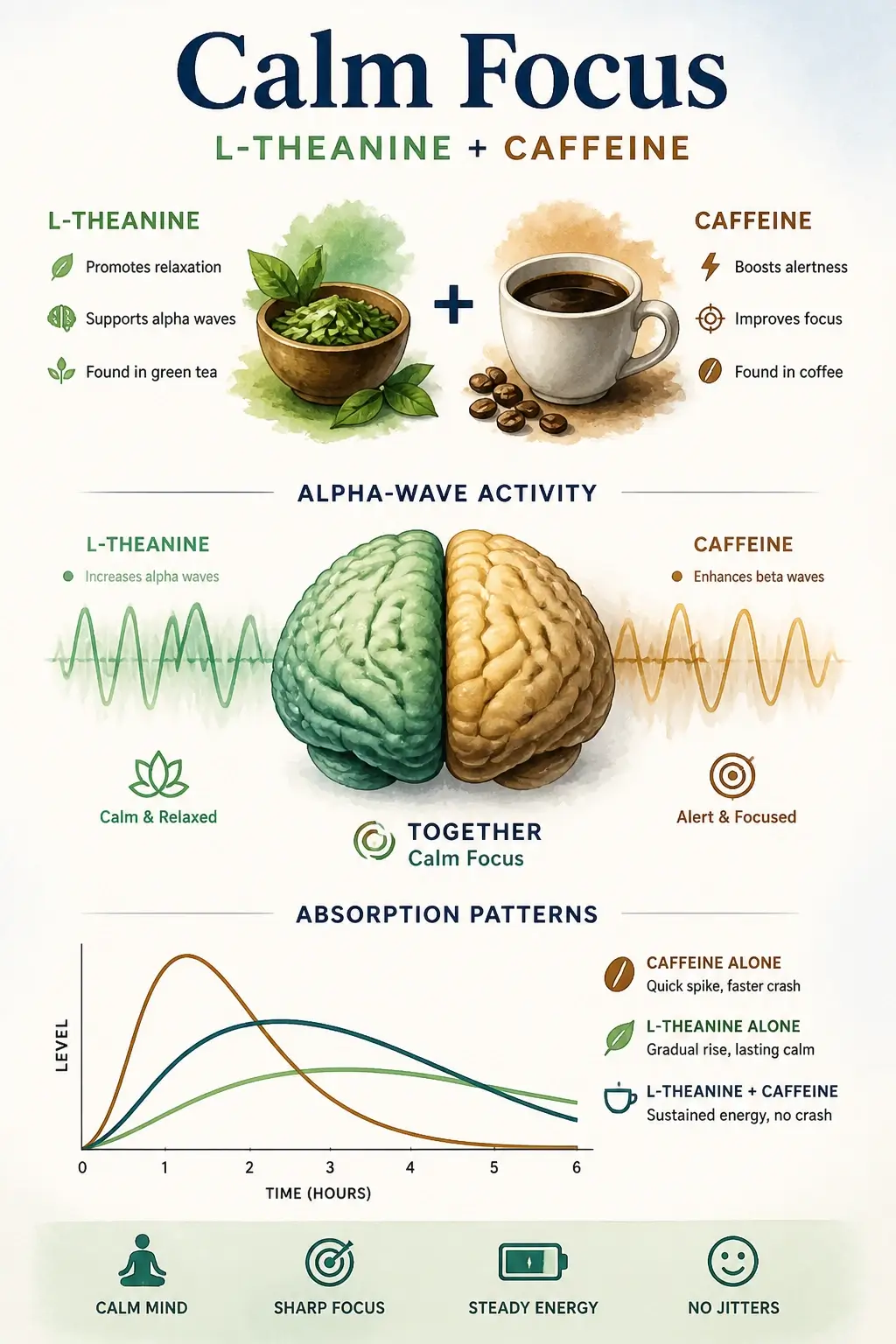
Now here’s where a health-conscious reader needs a clear-eyed filter. The “calm energy” claim has been enthusiastically amplified by the tea industry, and when you trace the citations behind it, the picture gets murkier. WebMD-a medically rigorous, institutionally cautious reference-omits any mention of L-theanine smoothing caffeine’s effects entirely. The sources that do push the “takes the edge off” narrative most confidently-tea brands and café marketing-offer no links to peer-reviewed clinical trials or neuroscience studies. That’s not a reason to dismiss your experience. A lower total caffeine dose, the ritual of slowly sipping a warm cup, and the genuine alpha-wave activity associated with L-theanine may all combine to produce something that feels meaningfully different-and probably is. But attributing all of that to a single, definitively mapped molecule-on-molecule pharmacological interaction goes further than the current evidence supports. Enjoy the calm focus. Just know you’re experiencing a genuine phenomenon that the science has partially explained and the marketing has fully claimed.
How Much Is Too Much? Safe Caffeine Limits and Health Considerations
Established caffeine safety guidelines give you a reliable outer boundary, but they’re built around an “average” healthy adult-and the health-conscious person reading this may have variables that move their personal ceiling well below the published number. Green tea caffeine content is low enough that most people never approach the limit through tea alone, but the interactions and edge cases are worth knowing before they catch you off guard.
Dr. Jennifer L. Temple, Ph.D., Associate Professor and Director of the Nutrition and Health Research Laboratory at the University at Buffalo, defines the thresholds with clinical precision:
“The threshold of caffeine toxicity appears to be around 400 mg/day in healthy adults (19 years or older), 100 mg/day in healthy adolescents (12–18 years old), and 2.5 mg/kg/day in healthy children (less than 12 years old).”
Those numbers are your ceiling-not your target. Everything below is about understanding where your personal version of that ceiling actually sits.
Safe Caffeine Thresholds and Decaffeination Recommendations
The 400 mg daily caffeine limit for healthy adults, established by both the FDA and the Mayo Clinic, translates to roughly 8–10 cups of standard brewed green tea per day at 30–50 mg per cup. In practical terms, green tea is unlikely to push a healthy adult past that ceiling through tea alone-you’d have to be drinking it almost continuously. The limit becomes relevant when you’re stacking green tea on top of coffee, pre-workout supplements, or other caffeine sources across the day.
During pregnancy, the calculus changes. Medical groups widely recommend staying under 200–300 mg of caffeine daily, which puts the green tea ceiling at roughly 3–4 cups maximum-and that’s assuming no other caffeine sources. If you’re also having a morning coffee or a caffeinated soda, green tea may need to come out of the picture entirely on some days.
For anyone who wants the ritual and the polyphenols without the caffeine, the decaffeination method matters more than most people realize. CO₂ decaffeination removes caffeine using pressurized carbon dioxide without chemical solvents, which preserves significantly more of the tea’s healthy polyphenols than ethyl acetate or methylene chloride methods. If you’re buying decaf green tea for health reasons-not just to avoid stimulants-look for CO₂-processed brands specifically.
Hidden Health Interactions: Iron Absorption, Medications, and Supplement Risks
Health interactions with green tea extend well beyond caffeine itself, and catechins and tannins-the same compounds responsible for many of green tea’s antioxidant properties-are the source of a few interactions worth knowing. The most common one catches people by surprise: catechins and tannins bind to non-heme iron (the kind found in plant foods and supplements), reducing its absorption meaningfully. If you’re managing iron levels through diet or supplementation, avoid drinking green tea within one hour of an iron-rich meal or your iron supplement. The timing fix is simple; the interaction itself is well-documented.
Two specific medication interactions are worth flagging for anyone on regular prescriptions. Research published in Clinical Pharmacology & Therapeutics demonstrated that green tea catechins-primarily EGCG-inhibit the intestinal transporter OATP1A2, which is essential for nadolol absorption. In healthy volunteers, concurrent green tea ingestion reduced nadolol’s peak concentration and total exposure by approximately 85%, producing a marked decrease in its antihypertensive effect. That’s not a subtle interaction-that’s a medication losing most of its efficacy. Green tea can also affect the absorption of certain statins, including atorvastatin, through related transporter mechanisms.
Concentrated green tea extract in supplement form carries a separate and more serious risk: it has been linked to liver injury at high doses. Brewed tea, even consumed liberally, doesn’t approach the extract concentrations associated with those cases-but if you’re taking a green tea extract capsule for weight loss or antioxidant purposes, that’s a different risk profile than your morning cup.
Here’s the part that most safety guides quietly sidestep. The 400 mg limit is presented as a universal number, but individual genetics create real variation in how long caffeine stays active in your system. People with the CYP1A2 “slow metabolizer” gene variant clear caffeine significantly more slowly-meaning a single cup of green tea can produce effects that last for hours longer than the average person experiences. Pregnancy-related changes in liver enzyme activity compound this further. And when you add drug-caffeine competition in the liver to the picture, your functional safe threshold may sit well below 400 mg without you ever knowing it. WebMD is the only major consumer source that lists drug interactions with green tea, but it never connects those interactions back to the daily limit-leaving a meaningful gap for anyone on blood pressure or cholesterol medication. If you’re taking any regular prescription, especially for cardiovascular conditions, treating 200 mg as your practical daily ceiling and watching for sleep disruption or heart palpitations as early warning signals is the conservative and sensible approach. The goal isn’t to make green tea feel dangerous. It’s to make sure the safety framework you use actually fits the body you’re living in.
For a comparison of caffeine levels in black tea, see our detailed guide on black tea caffeine content.
Key Takeaways on Green Tea Caffeine Content
- Green tea caffeine content averages 30–50 mg per 8-oz cup, roughly one-third of brewed coffee’s ~96 mg.
- Matcha delivers the highest caffeine of all green teas because you consume the entire leaf, not just an infusion.
- Steeping for 60 seconds extracts approximately 60% of available caffeine; two minutes captures roughly 90%, with diminishing returns after that.
- L-theanine is a real amino acid with documented neurological activity, but the “calm energy” claim has outrun the clinical evidence behind it.
- The 400 mg daily limit applies to healthy adults; pregnancy, slow caffeine metabolism, and certain medications can lower your personal ceiling significantly.
- Green tea catechins reduce nadolol absorption by approximately 85% and can interfere with iron absorption-timing and medication awareness matter.
Frequently Asked Questions About Green Tea Caffeine Content
Is green tea high in caffeine compared to coffee?
No, green tea is not high in caffeine compared to coffee. A standard 8-oz cup of green tea contains 30–50 mg, while the same size brewed coffee delivers around 96 mg-making green tea roughly one-third the caffeine load.
Does the type of green tea bag or brand change how much caffeine you get?
Yes, it does, and more than most people expect. Caffeine varies by cultivar, harvest season, and how tightly the leaves are packed into the bag-two “green tea” products from different brands can differ by 15–20 mg per cup without either label being wrong.
Can you actually reduce caffeine by steeping green tea for a shorter time?
Yes, and it works faster than most guides suggest. About 60% of available caffeine extracts within the first 60 seconds at standard green tea temperatures, so a short steep genuinely produces a lower-caffeine cup-not just a weaker-tasting one.
Does green tea affect how well statins work?
It can, yes. Green tea catechins-particularly EGCG-interfere with intestinal drug transporters that some statins rely on for absorption, including atorvastatin. If you’re on a statin, it’s worth spacing your green tea and medication by at least a couple of hours and checking with your prescribing doctor.
What is the least healthy way to consume green tea?
High-dose concentrated green tea extract supplements carry the most documented risk, including cases of liver injury that have no equivalent in brewed tea consumption. Brewed green tea, even in generous quantities, doesn’t approach the extract concentrations associated with those adverse events.
Is matcha stronger than regular green tea for caffeine?
Yes, consistently. Matcha ranges from 30 mg on the low end to over 70 mg per serving at higher powder ratios, compared to 20–30 mg for standard sencha. The difference comes from ingesting the whole leaf rather than discarding it after steeping.
How many cups of green tea can you drink during pregnancy?
Most medical guidelines recommend keeping total caffeine under 200–300 mg per day during pregnancy, which translates to roughly 3–4 cups of green tea maximum-assuming no other caffeine sources. If you’re also having coffee or soda, that ceiling gets reached faster than you might think.
Does green tea interfere with iron absorption from food?
Yes, it does. Catechins and tannins in green tea bind to non-heme iron and reduce how much your body absorbs. The practical fix is straightforward: wait at least an hour after an iron-rich meal or iron supplement before drinking green tea.
References
- Caffeine in Green Tea and Matcha: Molecular Analysis – mdpi.com
- Green Tea Variety Comparison: Amino Acids and Caffeine – mdpi.com
- Brewing Time and Caffeine Extraction in Tea – mdpi.com
- Theanine as a Functional Food Additive – sciencedirect.com
- Caffeine Toxicity Thresholds Across Age Groups – frontiersin.org
- FDA: How Much Caffeine Is Too Much – fda.gov
- Green Tea Ingestion Reduces Plasma Concentrations of Nadolol – pubmed.ncbi.nlm.nih.gov