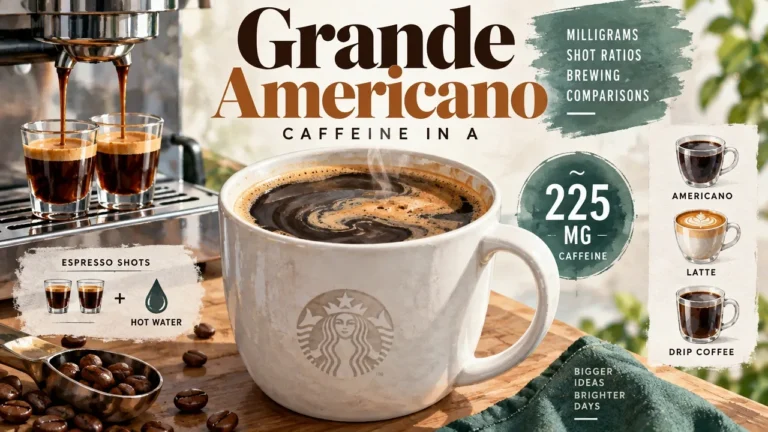

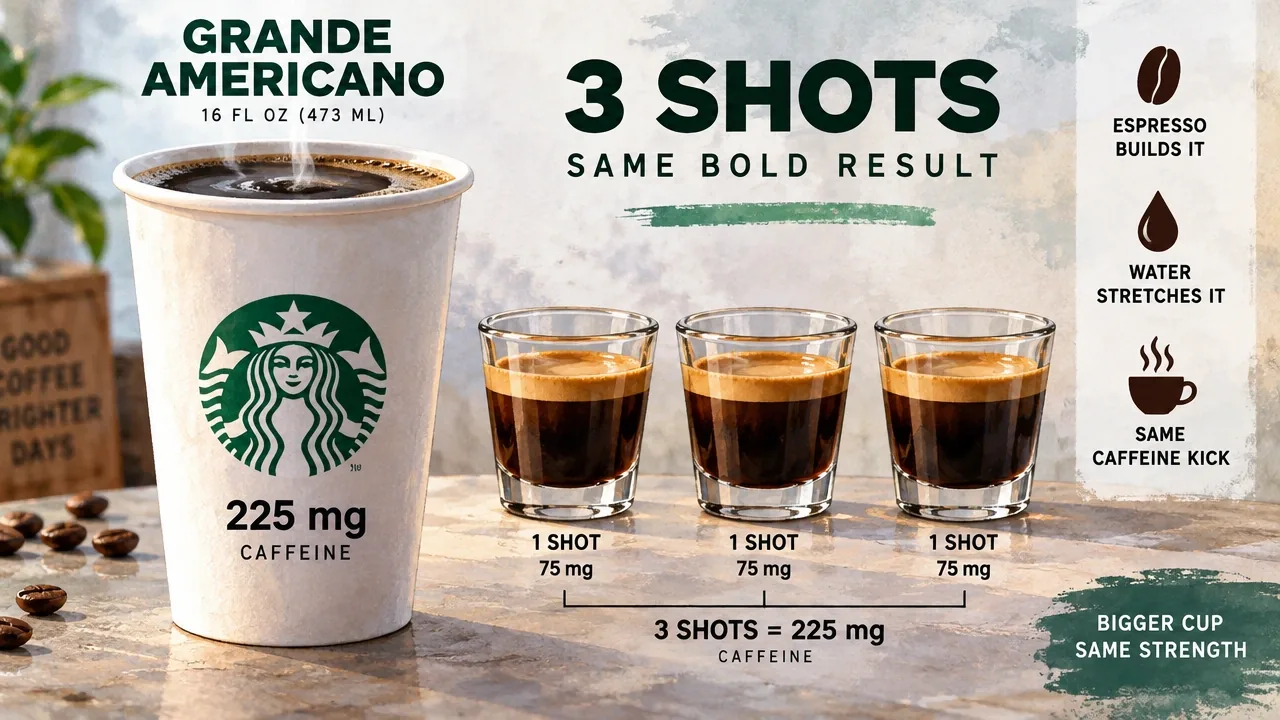
Grande Americano caffeine sits at exactly 225 mg, pulled from three standard espresso shots, each contributing 75 mg. That number surprises most people who assume the Grande size follows the standard two-shot Starbucks formula.
The confusion runs deeper than a simple shot count. Hot water, extraction chemistry, roast level, and your own genetic makeup all shape what 225 mg actually means for your body. Here’s how all of it works.
Key Takeaways on Grande Americano Caffeine
- A Grande Starbucks Americano contains 225 mg of caffeine from three espresso shots at 75 mg each, not the commonly assumed 150 mg from two shots.
- Adding hot water to make an Americano dilutes caffeine concentration per sip, but leaves the total milligrams you consume completely unchanged.
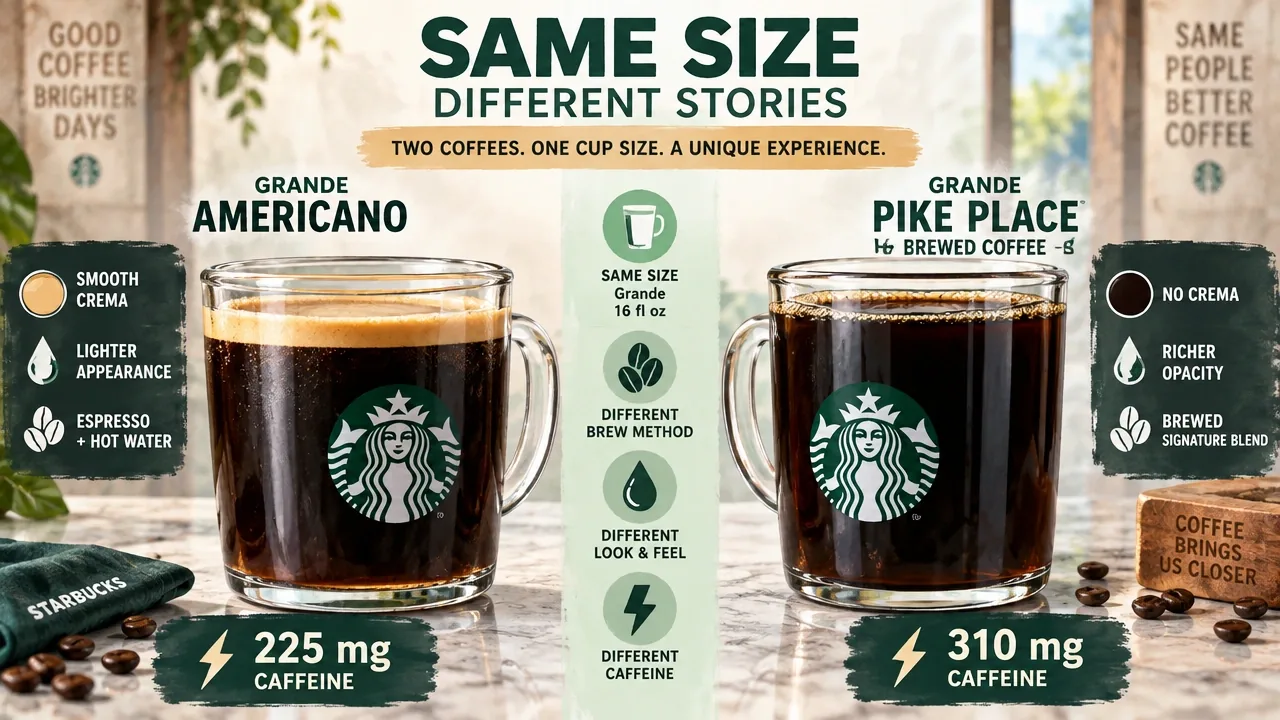
- A Grande Americano has less caffeine than a Grande Pike Place brewed coffee, which delivers roughly 310 mg, despite tasting sharper and more intense.
- Venti Iced Americano matches the Grande at 225 mg because it uses three shots; the extra volume is water and ice, not espresso.
- Lighter roasts like Blonde espresso can add approximately 10 mg per shot, pushing a three-shot Grande to around 255 mg.
- At 225 mg, a single Grande Americano approaches or exceeds the 200 mg single-dose guideline and exhausts the entire daily limit for pregnant individuals.
The Grande Americano Caffeine Baseline: 225 mg, 3 Shots, 16 oz
A Grande Americano contains exactly 225 mg of caffeine, drawn from three standard espresso shots at 75 mg each. This is not the same as a standard Starbucks Grande hot drink, which defaults to two shots. Americanos run a different shot formula, and the Grande is where that divergence first becomes visible.
The Caffè Americano is espresso diluted with hot water. That’s the whole recipe. Starbucks doesn’t brew the drink like drip coffee or use a different bean. They pull espresso shots and add hot water to fill the cup. The water changes the volume and the concentration per sip. It does not change the shot count or the total caffeine.
The two-shot assumption comes from conflating the standard Starbucks hot drink pattern with the Americano recipe. A Grande latte uses two shots. A Grande flat white uses three. A Grande Americano uses three. If you’ve been estimating 150 mg, you’ve been off by a full espresso shot, or 75 mg.
What a Caffè Americano Actually Is and How Espresso Extraction Works
A Caffè Americano is espresso shots plus hot water. That’s the complete mechanical definition. The water added after the shot is pulled doesn’t interact with the coffee grounds, doesn’t change the extraction, and doesn’t alter the caffeine already dissolved in the espresso. It simply fills the cup.
The caffeine itself comes entirely from the extraction process. Inside an espresso machine, hot water at roughly 90 to 96°C (195 to 205°F) gets forced through tightly packed, finely ground coffee at approximately 9 bars of pressure. That combination of heat and pressure pulls caffeine and flavor compounds out of the grounds in about 25 to 30 seconds. Caffeine is highly water-soluble, so it dissolves readily under those conditions.
The espresso shot is the fixed caffeine unit in the drink. Once it’s pulled, the caffeine is locked in. Adding hot water to make an Americano expands the serving size but leaves the caffeine total unchanged. Water volume determines concentration per sip, not total dose.
Here’s a closer look at the mechanics inside the machine itself:
Shot Count and Caffeine Breakdown Across Starbucks Americano Sizes
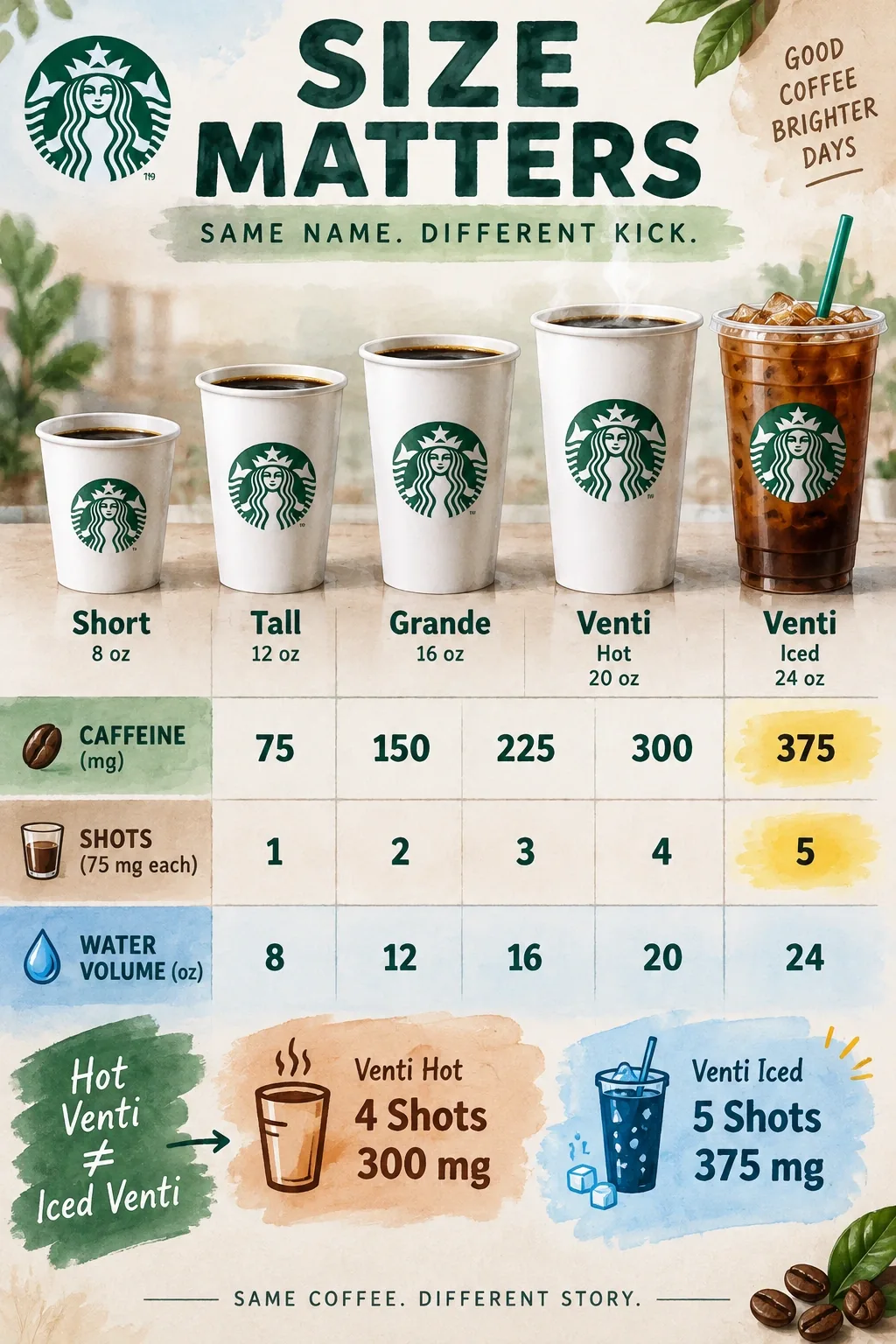
Starbucks Americano sizes don’t follow the same shot-per-size logic as standard hot drinks. The standard hot drink formula adds one shot for Short, one for Tall, two for Grande, and two for Venti. Americanos break that pattern at the Grande mark and beyond.
Here’s the full picture across every size:
| Size | Water Volume | Shot Count | Total Caffeine |
|---|---|---|---|
| Short | 8 fl oz | 2 shots | 150 mg |
| Tall | 12 fl oz | 2 shots | 150 mg |
| Grande | 16 fl oz | 3 shots | 225 mg |
| Venti Hot | 20 fl oz | 4 shots | 300 mg |
| Venti Iced | 24 fl oz | 3 shots | 225 mg |
Short and Tall both land at 150 mg despite different water volumes. Grande jumps to 225 mg with a third shot. Venti Hot goes to 300 mg with four shots. Venti Iced, despite being the largest physical cup, holds three shots and matches the Grande at 225 mg.
That last comparison trips people up. A Venti Iced Americano is 24 fl oz, but it contains the same caffeine as a 16 fl oz Grande. The extra volume is ice and water, not espresso. Several third-party sources incorrectly list both Venti sizes at 4 shots and 300 mg. The Venti Iced recipe is three shots. Verify the current Starbucks recipe directly if precision matters to you, because these figures can shift with menu updates.
Americano vs Brewed Coffee: Why Bolder Taste Doesn’t Mean More Caffeine
A Grande Americano delivers 225 mg of caffeine. A Grande Starbucks Pike Place brewed coffee delivers roughly 310 mg. The Americano tastes sharper, more intense, almost austere. The brewed coffee often tastes mellow by comparison. And yet the brewed coffee has about 85 mg more caffeine in the same size cup.
This gap comes down to extraction mechanics, not flavor.
Espresso uses a short contact time, around 25 to 30 seconds, with high pressure and a small amount of water. That process concentrates dissolved solids, volatile aromatic compounds, and organic acids in a tiny volume. Those compounds are what your palate reads as intensity and boldness. The caffeine is there too, but it’s not the source of the perceived strength.
Drip brewing works differently. Water flows through the grounds over several minutes at lower pressure. The longer contact time and higher total water volume extract more caffeine overall, even though the resulting liquid tastes lighter. More caffeine ends up in your cup because the extraction runs longer and uses more water to do it.
Taste intensity tracks dissolved solids and volatile compounds. Total caffeine tracks contact time, water volume, and grounds-to-water ratio. Those are two different measurements, and they don’t move together in a predictable direction.
The Dilution Physics: Water Volume vs Total Caffeine Ingestion
Adding water to espresso does not reduce the caffeine you consume. This is the single most persistent misconception about the Americano format, and it’s worth being direct about the mechanics.
Caffeine concentration and total caffeine ingested are different quantities. Concentration describes how many milligrams exist per unit of liquid. Total ingestion describes how many milligrams enter your body when you finish the drink. Adding water changes the first number. It doesn’t touch the second.
In a Grande Americano, the 225 mg extracted from three espresso shots disperses through 16 fl oz of liquid. That works out to approximately 14.06 mg per fl oz, or 47.55 mg per 100 ml. Each individual sip carries less caffeine than a sip of straight espresso would. But if you drink the whole cup, you’ve consumed the full 225 mg. The caffeine molecules don’t disappear when water surrounds them.
Think of it this way: if you dissolve a teaspoon of salt in a small glass of water, then pour that into a larger pitcher of water, the salt content in each sip drops. But every grain of salt is still in the pitcher. Drain the pitcher and you’ve consumed all of it.
The practical implication is straightforward. Ordering a larger Americano doesn’t automatically mean more caffeine. The shot count determines the dose. The water determines how concentrated each sip feels.
Decaf Americano Realities: Residual Caffeine in Swiss Water vs Chemical Decaf
A Decaf Americano is not caffeine-free. No commercially decaffeinated coffee is. Decaffeination removes most of the caffeine from green coffee beans before roasting, but some residual caffeine always survives the process.
Two methods dominate commercial decaffeination, and they differ in how they strip caffeine from the bean. The Swiss Water Process uses hot water and activated carbon filters. Green beans soak in water that has already been saturated with coffee’s soluble compounds (except caffeine), which pulls the caffeine out while leaving other flavor molecules behind. The caffeine-laden water then passes through carbon filters that trap the caffeine. No chemical solvents touch the beans.
Chemical solvent decaffeination uses methylene chloride or ethyl acetate to bond with and extract caffeine molecules directly from the green beans. The solvent is then removed through steaming, and the beans are dried before roasting. Both methods are approved for food production, and both leave trace caffeine behind.
How much caffeine remains depends on the specific process, the bean variety, the roast, and how the espresso is extracted. The residual amount varies enough that no fixed milligram figure applies cleanly across all decaf Americanos. If you’re managing caffeine intake for medical reasons, decaf Americano should be treated as low-caffeine, not caffeine-free.
What Shifts Your Actual Caffeine Yield: Bean, Roast, Temperature, and Extraction
The 225 mg figure for a Grande Americano is a reference point built on Starbucks’s standard recipe with standard espresso beans and standard extraction parameters. In practice, several variables can push that number higher or lower.
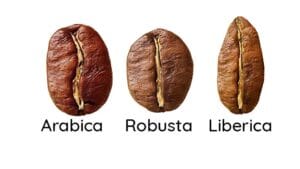
Bean species is the foundation. Robusta beans contain roughly twice the caffeine of Arabica by weight. Starbucks uses Arabica, which sets the baseline lower than a Robusta blend would.
Roast level is where most people’s intuition fails them. Darker roasts taste more intense, but lighter roasts can retain slightly more caffeine by mass because prolonged heat degrades some caffeine during roasting. Starbucks’s Blonde roast adds approximately 10 mg per shot compared to the standard espresso roast, which would push a three-shot Grande Americano to around 255 mg if made with Blonde espresso.
Water temperature matters because caffeine solubility increases with heat. Extraction at the lower end of the recommended range, closer to 90°C (195°F), pulls slightly less caffeine than extraction at 96°C (205°F).
Grind size, pressure, and contact time interact directly. A finer grind increases surface area and pulls more from the grounds. Higher pressure and longer contact time extract more dissolved solids, including caffeine. Over-extraction raises both bitter compounds and caffeine yield, though not in a perfectly proportional relationship.
Batch variability in real-world café settings can be significant. A 2003 laboratory analysis of the same 16 oz Breakfast Blend from the same Starbucks outlet recorded caffeine values ranging from 259 mg to 564 mg across six consecutive days. The recipe was identical each time. The variation came from grind consistency, extraction timing, and equipment calibration. The 225 mg figure is accurate as a recipe target, not as a guaranteed outcome on every single pull.
Health Math: How a Grande Americano Fits Your Daily Caffeine Limit
The 225 mg in a Grande Americano represents a moderate-to-high single dose by most clinical standards. Understanding where it fits in your day requires knowing the actual limits and the biology behind them.
General guidance for healthy adults sets the ceiling at 400 mg of caffeine per day, with no more than 200 mg in a single sitting. A Grande Americano at 225 mg sits just above that single-dose guideline. For pregnant individuals, the recommended daily maximum drops to 200 mg total. A single Grande Americano would consume the entire daily budget.
The American Heart Association’s scientific statement on caffeine and cardiovascular disease provides the metabolic context:
Caffeine is metabolized primarily by the liver enzyme CYP1A2, which handles more than 95% of caffeine clearance. Half-life ranges from 2 to 12 hours, averaging 4 to 5 hours in healthy adults. Moderate caffeine consumption up to 400 mg per day is associated with lower cardiovascular disease risk, including reduced incidence of coronary heart disease, stroke, heart failure, and atrial fibrillation. – From the American Heart Association scientific statement on caffeine and cardiovascular disease
That half-life range explains why the same 225 mg dose lands differently on different people. CYP1A2 fast metabolizers clear caffeine in 2 to 3 hours and can tolerate an afternoon Americano without disrupting sleep. Slow metabolizers may still have significant caffeine circulating 8 to 10 hours later. Smoking speeds up CYP1A2 activity and shortens half-life. Pregnancy slows it considerably, which is part of why the recommended limit drops so sharply.
Practical timing rule: stop caffeine consumption 8 to 10 hours before your target sleep time. If you sleep at 11 pm, your last Grande Americano should be around 1 to 3 pm.
Total daily intake tracking matters because caffeine accumulates across sources. A Grande Americano at 225 mg, a can of soda at 35 mg, a square of dark chocolate, and a headache medication can stack you past 400 mg without a second cup of coffee.
Two additional coffee-specific health factors are worth knowing. Moderate consumption of 3 to 5 cups per day is associated with reduced cardiovascular risk in the research literature. However, unfiltered coffee (French press, Turkish, moka pot) contains diterpenes called cafestol and kahweol that can raise LDL cholesterol. Paper filters trap those compounds. An Americano, made from espresso pulled through a portafilter and diluted with water, sits in a category closer to filtered coffee than French press. Finally, coffee consumed close to meals can reduce iron absorption because chlorogenic acids bind to non-heme iron. If iron status is a concern, a 60-minute gap between your Americano and an iron-rich meal is a reasonable buffer.
Christopher Hendon, Assistant Professor of Chemistry and Biochemistry at the University of Oregon and leader of an SCA-funded espresso extraction project, describes a future where electrochemical analysis of coffee extracts maps specific molecular families to individual sensory preferences, making it possible to engineer a shot of espresso calibrated to exactly what a given person enjoys.
That research direction makes the 225 mg figure even more interesting. The caffeine number is fixed by the recipe, but the molecular composition of those three shots, and how your body processes them, is far more variable than the label suggests. Knowing your metabolizer type and your total daily stack is what turns a general guideline into a number that actually applies to you.
Frequently Asked Questions About Grande Americano Caffeine
How many shots does a Grande Americano get?
A Grande Americano gets three standard espresso shots. This differs from most Grande hot drinks at Starbucks, which use two shots as the default.
How much caffeine is in a Starbucks Americano Grande?
It contains 225 mg of caffeine, calculated as three shots at 75 mg each. That figure assumes standard Starbucks espresso, not Blonde roast, which runs slightly higher.
Is 200 mg of caffeine a lot?
For most healthy adults, 200 mg is a moderate single dose that sits at the upper boundary of what many guidelines recommend consuming at one time. Whether it’s “a lot” for you depends on your CYP1A2 metabolism speed, body weight, caffeine tolerance, and what else you’ve had that day.
Is an iced Americano stronger than iced coffee?
Not by total caffeine. A Grande Iced Americano has 225 mg; a Grande Starbucks Cold Brew or iced brewed coffee can exceed that. The iced Americano tastes more concentrated because espresso extraction produces a denser liquid, but taste intensity and caffeine dose are separate measurements.
Does ordering a larger Americano always mean more caffeine?
No. A Venti Iced Americano and a Grande Americano both contain 225 mg because both use three shots. The Venti Iced cup is larger, but the extra liquid is water and ice. Shot count is what determines caffeine, not cup size.
Can the same Grande Americano have different caffeine levels on different days?
Yes. Grind calibration, extraction time, water temperature, and equipment consistency all affect actual yield. The 225 mg figure is the recipe target, not a guaranteed measurement on every pull.
Does a decaf Americano have any caffeine at all?
It has some. No commercial decaffeination process removes caffeine completely, whether Swiss Water or solvent-based. The residual amount varies by process, bean, and extraction, so decaf Americano is low-caffeine, not caffeine-free.
How does the Blonde roast change the caffeine in a Grande Americano?
Blonde roast adds roughly 10 mg per shot compared to Starbucks’s standard espresso blend. A three-shot Grande made with Blonde espresso would come in around 255 mg rather than 225 mg.
References
- Caffeine and Cardiovascular Disease: A Scientific Statement From the American Heart Association | ahajournals.org
- UO’s Dr. Coffee Leads Effort to Extract the Essence of Espresso | news.uoregon.edu