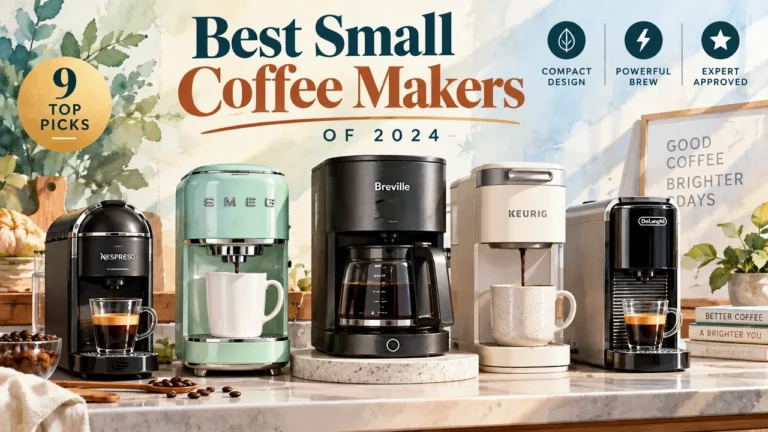

The best small coffee makers don’t announce themselves by cup count – they earn their place on your counter by fitting your actual mug, your actual morning, and your actual kitchen shelf. Most buyers discover too late that a “5-cup” machine brews 25 ounces, a number that sounds generous until you’re filling a 12-ounce travel tumbler and coming up short.
This guide evaluates nine compact brewers – from a $20 Amazon Basics switch machine to the SCA-certified OXO Brew 8-Cup – against criteria that matter in real kitchens: physical footprint, low-volume extraction quality, build durability, and the hidden costs that never appear on the product page.
Key Takeaways on Best Small Coffee Makers
- “5-cup” labels mean 25 ounces – roughly two standard mugs, not five; always buy by ounce capacity, not cup count.
- Most drip machines underperform at small volumes because their water distribution is optimized for full carafes.
- Physical footprint requires four measurements: width, depth, height, and vertical clearance for water tank access.
- Annual maintenance costs – filters, descaling, and replacement carafes – add $10 to $40 per year regardless of machine price.
- The OXO Brew 8-Cup is the only machine on this list with SCA certification and a verified 10-ounce minimum brew volume.
- The Bunn My Cafe MCU’s stainless steel tank is the most durable long-term choice for buyers who’ve grown tired of replacing budget plastic machines.
How We Chose the 9 Best Small Coffee Makers: Compact Criteria That Actually Matter
Before a single machine made this list, it had to survive a straightforward test: does it actually fit where you think it will, and does it brew well at the volume you’ll actually use? Those two questions eliminate more options than any spec sheet comparison ever could.
The coffee industry doesn’t have a universal definition of “small” or “compact.” No standard exists. That means every brand gets to define the word however flatters their product most – usually by cup count, which, as you’ll see, is a number that tells you almost nothing useful.
Physical Footprint Benchmarks
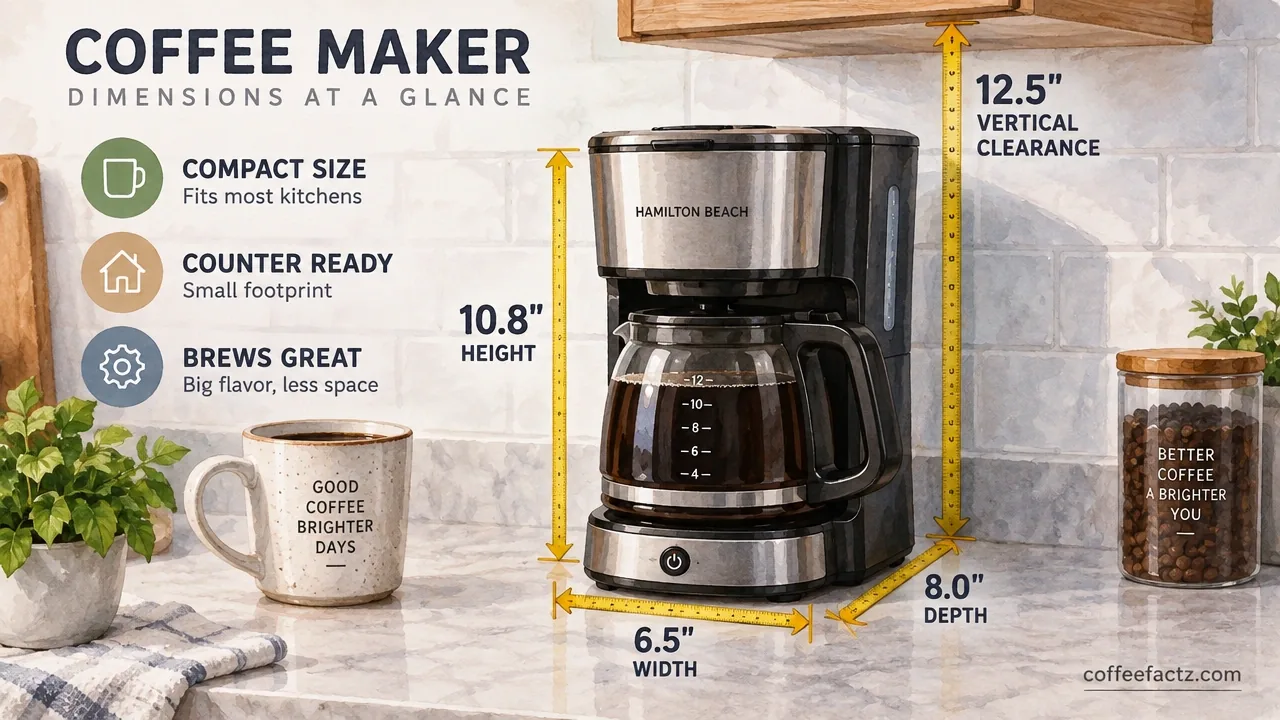
“Small” needs four numbers to mean anything: width, depth, height, and vertical clearance for water tank access. A machine that’s narrow but 14 inches deep will hijack your counter just as thoroughly as a full-carafe brewer. Height matters doubly if you have upper cabinets – many compact machines require the lid to swing open or the reservoir to lift straight up, adding three to five inches of clearance you need to plan for.
The table below is the comparative reference point for every machine evaluated in this guide. Most blogs compare cup count and price. This one adds the dimensions and maintenance costs they leave out.
| Model | Actual Oz Capacity | Brew Time | Dimensions (W×D×H) | Materials | Warranty | Est. Annual Maintenance | Price (Approx.) |
|---|---|---|---|---|---|---|---|
| Amazon Basics 5-Cup | 25 oz | ~8 min | 7.5″×9″×11″ | Plastic/glass | 1 year | $5–$15 (filters, descale) | ~$25 |
| Elite Gourmet EHC4128 (4-Cup) | 20 oz | ~7 min | 6.5″×8.5″×10.5″ | Plastic/glass | 1 year | $10–$20 (filters, descale) | ~$20 |
| Elite Gourmet EHC-5055 (5-Cup) | 25 oz | ~8 min | 7″×9″×11″ | Plastic/glass | 1 year | $10–$20 (filters, descale) | ~$25 |
| KRUPS Newer Model Drip | 25 oz | ~8 min | 7.5″×9.5″×11.5″ | Plastic/glass | 2 years | $10–$20 (filters, descale) | ~$35–$50 |
| Mr. Coffee 5-Cup Mini Brew | 25 oz | ~8 min | 7″×9″×11″ | Plastic/glass | 1 year | $10–$20 (filters, descale) | ~$25 |
| OXO Brew 8-Cup | 40 oz (min 10 oz) | ~9 min | 8.5″×12″×14″ | Plastic/stainless | 2 years | $15–$30 (filters, descale) | ~$140 |
| Bunn My Cafe MCU | Varies by pod/grounds | ~1 min | 8″×10.5″×13″ | Stainless tank | 1–3 years | $20–$40 (pods, descale) | ~$100–$130 |
| Melitta Aromaboy | ~15 oz | ~6 min | 5.5″×7.5″×10″ | Plastic | Limited (EU) | $5–$15 (filters, descale) | ~£30–£45 |
| Technivorm Moccamaster Half-Pot | 20 oz (half setting) | ~6 min | 8″×11″×13.5″ | Aluminum/BPA-free plastic | 5 years | $15–$25 (filters, descale) | ~$200–$250 |
The dimensions listed are approximate and based on published manufacturer specifications and community-sourced measurements. Verify against your specific cabinet clearance before ordering.
Low-Volume Extraction Standards
Here’s a problem that almost no product listing will tell you: most standard drip machines are engineered to perform at full capacity. The water distribution system, the shower head geometry, and the heating element are all tuned for a full carafe. Brew half a pot – or less – and you often get uneven water distribution across the grounds, shorter contact time, and a brew that tastes thin or sour.
This is why low-volume extraction performance became a primary ranking criterion. The machines on this list were evaluated against: small-volume brew performance, SCA certification status, minimum brew volume, filter compatibility, temperature stability, build quality, ease of use, sourcing availability, actual ounce capacity, and plastic-free internals. Those are the same benchmarks serious home-brewing communities use – and they differ considerably from the “best overall / best budget / best simple” categories most listicles default to.
On temperature: a peer-reviewed study published in Scientific Reports tested drip brewing at 87°C, 90°C, and 93°C while holding total dissolved solids and extraction percentage constant. The finding was counterintuitive – brew temperature within that range had no meaningful effect on sensory profile. What did matter was the consistency of flow rate and the uniformity of water distribution across the grounds bed. For small-batch drip brewing specifically, this reframes the priority: chasing a precise temperature is less important than buying a machine that distributes water evenly, especially at low volumes where channeling is far more likely.
The practical upshot: a cheap machine with a mediocre heating element but a well-designed shower head may outperform an expensive machine with a great thermostat but a single-point pour at small brew volumes.
Buyer Friction and Evaluation Logic
Two dimensions that trip people up constantly: width and depth together. A machine advertised as “slim” is often slim in one direction and deep in the other. Measure your counter from the wall to the cabinet edge before you order anything.
Two features that sound useful but quietly add failure risk: built-in grinders and complex touchscreens. Both add mechanical complexity to a machine you’re using daily. If long-term reliability matters more than convenience features, the simpler the control interface, the better. A switch that clicks on and off has essentially nothing to break.
Two habits that extend the life of any machine on this list: use filtered water and follow the manufacturer’s descaling schedule. Mineral scale is the leading cause of heating element failure in small drip brewers – and it’s entirely preventable. Budget an extra $10 to $30 per year for descaling solution regardless of which machine you buy.
Every product evaluation in this guide follows the same four-step structure: a core Fact about the machine’s design, the Reason that design choice was made, the Impact it creates in daily use, and an Advisor Verdict that tells you plainly who should buy it and who should skip it.

One more thing worth anchoring before the reviews: the cup-label problem. It affects every machine on this list, so
Wirecutter Senior Editor Marguerite Preston points out that most manufacturers measure a “cup” at about 5 ounces, while the average coffee mug holds 10 to 12 ounces – meaning a labeled “5-cup” machine might only fill two real mugs, not five.
Keep that in mind every time you see a cup count in a product name. The actual ounce capacity column in the table above is the number that actually matters for your morning.
Amazon Basics 5-Cup Coffee Maker with Reusable Filter
The Amazon Basics 5-Cup is the closest thing the coffee world has to a utility knife: not exciting, not precise, but reliably present and genuinely cheap. At around $25, it’s the entry point for buyers who want hot coffee in their mug without spending more on the machine than on a month of beans.
The reusable filter is the smartest thing about this machine. Paper filters cost $5 to $15 per year depending on how often you brew – not catastrophic, but the reusable mesh eliminates that cost entirely and removes one more thing to run out of on a Tuesday morning. It also reduces a small failure point: you can’t forget to buy filters if you don’t need them.
The switch operation is a feature disguised as a limitation. There’s no timer, no programmable settings, no LCD panel. You flip it on, it brews, you flip it off. That simplicity means there’s almost nothing mechanical to fail. For a machine at this price point, fewer moving parts is a genuine advantage.
Where the design makes its trade-offs visible: the plastic construction throughout. At budget price points, plastic is how manufacturers hit their margins, and it’s not inherently a problem for casual daily brewing. What it does mean is that the carafe, the filter basket, and the housing are all subject to the fatigue that comes with daily heat cycling over two or three years. Some users in enthusiast communities report flavor contamination from older plastic components – this makes sense mechanically, since heat accelerates off-gassing from certain plastics. It’s not a guarantee, but it’s worth knowing.
Temperature stability is likely basic. There’s no published data confirming this machine meets the 195°F threshold that Consumer Reports uses as its brew-performance benchmark. At this price, you’re not buying precision – you’re buying convenience.
Hidden costs to factor in: descaling solution ($5–$10 per year), and eventually a replacement carafe if the glass cracks. The reusable filter itself can wear and require replacement after 12 to 18 months of daily use.
Affiliate Disclosure
This post contains affiliate links, meaning I may earn a commission if you make a purchase through these links, at no additional cost to you. As an Amazon Associate, I earn from qualifying purchases. I only recommend products I genuinely believe will add value.

Amazon Basics 5 Cup Drip Coffee Maker with Glass Coffee Pot (0.8 Qt), Auto Shut-off, Auto Pause, Removable Filter Basket, Matte Black
- AUTO SHUTOFF: Built-in 2-hour automatic shutoff ensures safety and energy savings
- SLEEK DESIGN: Modern, polished appearance complements any contemporary kitchen with a compact 5-cup capacity
- PAUSE & POUR: Auto-pause lets you grab a cup mid-brew without mess
- STURDY CARAFE: Duralife glass carafe features an ergonomic handle for drip-free pouring
- SIMPLE CLEANING: Removable filter basket makes grounds disposal and maintenance effortless
Buy this if you want the lowest possible spend, the simplest possible operation, and you’re not particular about extraction precision. It’s a workhorse for someone who drinks one or two mugs a day and doesn’t want to think about their coffee maker.
Skip this if you care about small-batch extraction quality, durable materials, or you notice when coffee tastes slightly off. There are better options at modest price steps up.
Elite Gourmet Automatic 4-Cup Coffee Maker (EHC4128)
The Elite Gourmet EHC4128 makes a compelling case for itself with one number: its physical footprint. At approximately 6.5 inches wide and 8.5 inches deep, it’s genuinely one of the smallest drip machines available. If counter space is your binding constraint – not budget, not brew quality, but literal square inches – this machine earns serious consideration.
The 4-cup capacity translates to roughly 20 ounces of actual coffee. For a single drinker filling one standard 12-ounce mug, that’s enough for a full mug with a small top-up, or a generous single pour. The design is clearly built around the solo morning drinker.
The automatic keep-warm plate is where the trade-off appears. Keep-warm functions maintain the carafe at a low heat after brewing – convenient if you pour slowly, problematic for flavor if the coffee sits for more than 20 to 30 minutes. Heat degrades brewed coffee relatively quickly, introducing bitter notes as compounds continue to break down. If you pour your coffee immediately after brewing, this is a non-issue. If you tend to pour a second cup 45 minutes later, the keep-warm plate is working against you.
Low-volume water distribution is the extraction concern here. A 4-cup machine brewing 20 ounces is operating near the lower limit of what most standard drip shower heads are designed to saturate evenly. The risk is channeling – water finding the path of least resistance through the grounds rather than saturating the entire bed – which produces uneven, under-extracted coffee. It doesn’t always happen, but it’s worth knowing the mechanism.
Hidden costs: paper filters (this machine uses standard cone or basket filters depending on the basket design – verify before ordering), descaling solution, and eventual carafe replacement.
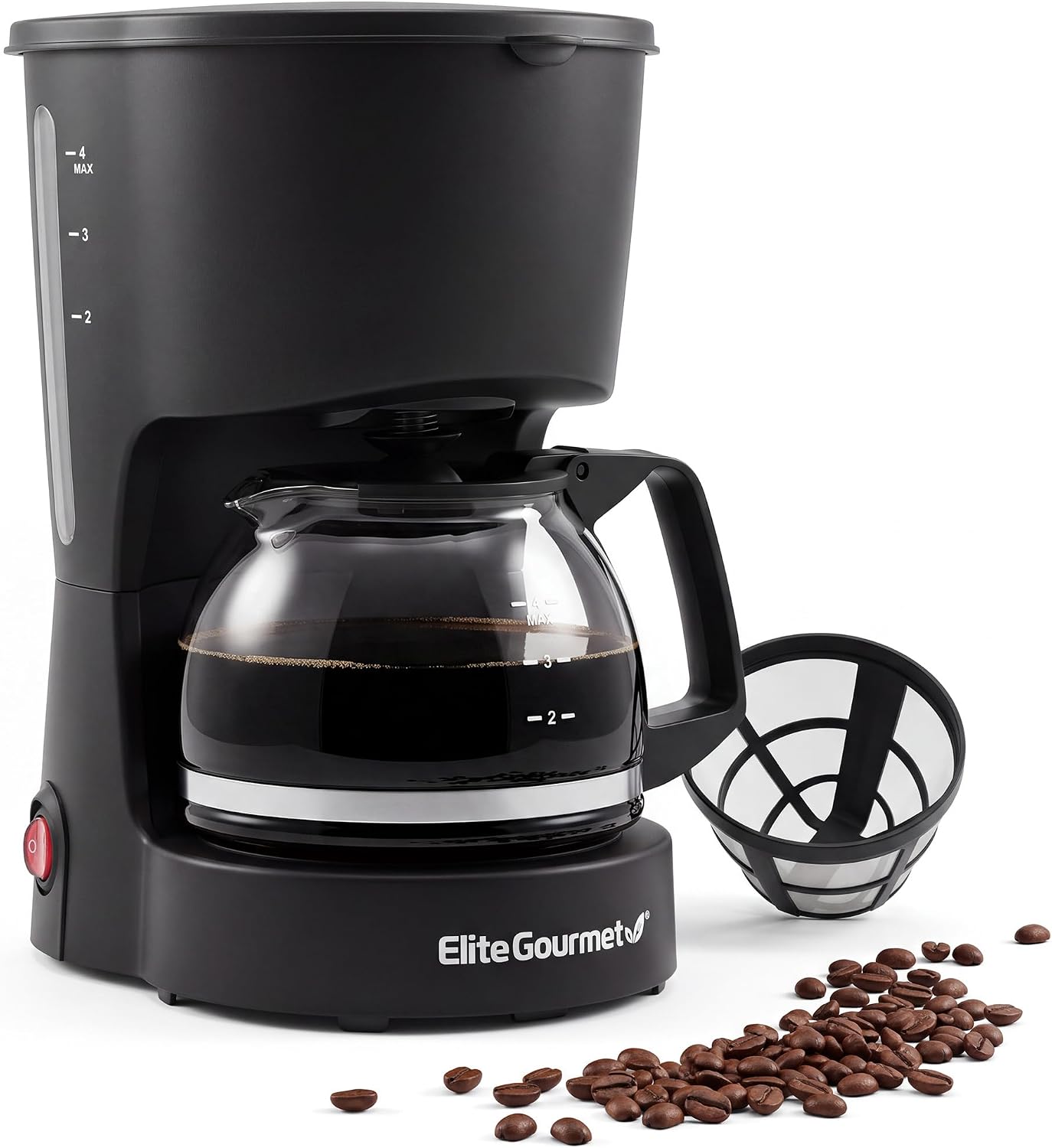
Elite Gourmet EHC4128 Automatic 4-Cup Drip Coffee Maker, Black
- SEMI-TRANSPARENT WATER RESERVOIR holds up to 4 cups of water capacity with a level indicator to always ensure …
- 4 CUP GLASS CARAFE for brewing the perfect quantity of hot fresh coffee for an individual or a small group of …
- PAUSE 'N SERVE allows a quick pour of fresh coffee in the middle of the brewing cycle if you're running low on…
- KEEP WARM FUNCTION automatically turns on when brewing to keep your coffee hot & fresh.
- RE-USABLE FILTER with removable filter basket is easy to clean and better for the environment by reducing the …
Buy this if you drink one mug per morning, your counter space is genuinely tight, and you want the smallest drip footprint available at a budget price. This machine was built for exactly that person.
Skip this if you’re brewing for two people, you need reliable small-batch extraction, or you want temperature performance that meets any measurable standard. The 5-cup step-up may be a better compromise.
Elite Gourmet Automatic 5-Cup Coffee Maker (EHC-5055)
The Elite Gourmet EHC-5055 is the natural comparison point to the 4-cup model above – same brand, same budget tier, slightly more volume. The question worth asking before you choose between them is whether the extra 5 ounces (roughly 20 oz versus 25 oz) changes your actual morning.
For a single drinker: probably not. For two people splitting the carafe over small mugs: the difference might be exactly one more pour. That’s the honest math.
What doesn’t change between the two models is the budget build quality. The EHC-5055 uses similar plastic construction throughout, a similar heating element, and a comparable automatic keep-warm function. The same extraction caveats apply: low-volume water distribution at partial fills can be uneven, and the keep-warm plate will degrade flavor if coffee sits.
Interestingly, the EHC-5055 is one of the machines that Consumer Reports tested for brew performance, specifically verifying whether it met the recommended guideline of 195°F or above, maintained for five to six minutes. That’s the minimum threshold for proper extraction. Whether it consistently hits that mark at partial fill volumes is a separate question – full-carafe performance and small-batch performance don’t always track together.
Plastic taste risk is a realistic concern with extended use. Daily heat cycling through budget-grade plastic components can introduce off-flavors over time, particularly if descaling is neglected and mineral scale forces the heating element to work harder.
Hidden costs: paper filters, descaling tablets or solution, and replacement carafe. Budget $15 to $25 per year for consumables.

Elite Gourmet EHC-5055 Automatic 5-Cup Brew & Drip Coffee Maker with Pause N Serve Reusable Filter, On/Off Switch, Water Level Indicator
- Too coarse a grind, too little coffee, or insufficiently tamping the grounds before brewing can all lead to in…
- It is important to note that the amount of espresso extracted will vary depending on the grind size and amount…
- SEMI-TRANSPARENT WATER RESERVOIR holds up to 5 cups of water capacity with a level indicator to always ensure …
- 5 CUP GLASS CARAFE for brewing the perfect quantity of hot fresh coffee for an individual or a small group of …
- PAUSE 'N SERVE allows a quick sneak of fresh coffee in the middle of brewing of you're running low on time or …
Buy this if you need slightly more volume than the 4-cup but don’t want to spend more than $30. It’s a reasonable step up for two light drinkers on a tight budget.
Skip this if you want durable materials, precise small-batch extraction, or you’re sensitive to plastic-adjacent flavors in your coffee. The KRUPS and OXO options above this price point address those concerns more directly.
KRUPS Newer Model Drip Coffee Maker, Glass, Silver
The KRUPS Newer Model Drip Coffee Maker sits at the first meaningful price step above the budget tier – roughly $35 to $50 – and the question it has to answer is whether that premium buys you anything real.
KRUPS as a brand has a longer track record in home appliances than the generic-label budget options, and that history tends to translate into more consistent heating element performance and tighter manufacturing tolerances. The glass carafe and silver finish are also genuine material upgrades over all-plastic budget carafes – glass doesn’t absorb odors or flavors the way plastic does, and it doesn’t degrade with heat cycling in the same way.
The compact form factor keeps it competitive on counter space. The KRUPS Simply Brew 5-Cup, which is the closest related model in the current lineup, balances the brand’s reputation for consistency with a footprint that doesn’t demand a dedicated corner of your kitchen.
The practical evaluation before buying: verify the actual ounce capacity (expect approximately 25 oz for a “5-cup” label), confirm which filter type the basket accepts (standard cone filters are widely available; proprietary basket shapes add sourcing friction), and check the replacement carafe cost before you commit. Replacement glass carafes for mid-tier machines can run $15 to $30 – sometimes more than the machine justifies.
Temperature stability is likely better than the budget options but unconfirmed against SCA standards at small brew volumes. You’re buying brand consistency and material quality, not certified extraction performance.
Hidden costs: filters, descaling solution, and replacement carafe. Factor in $15 to $25 per year for consumables.
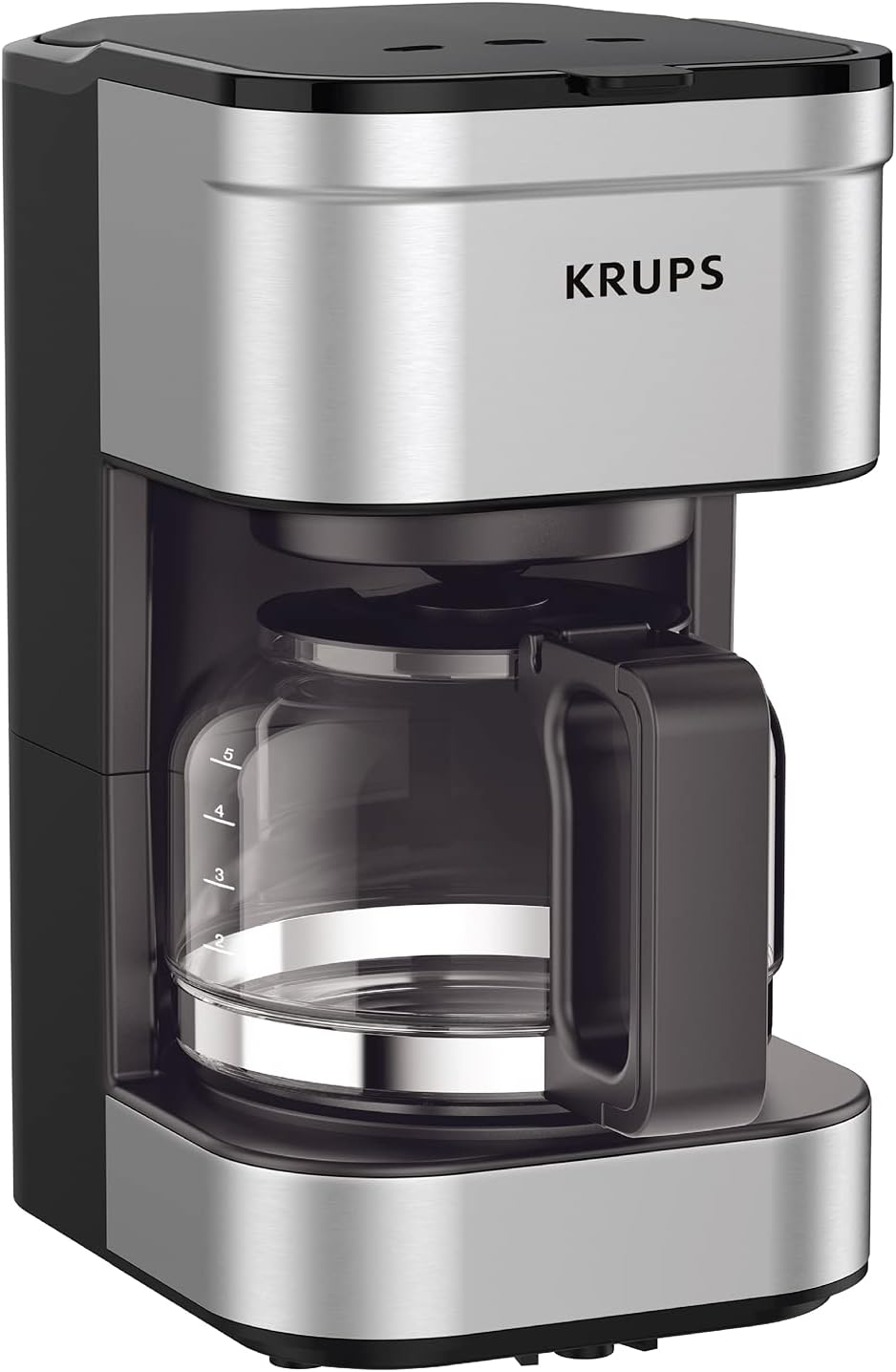
KRUPS Simply Brew Compact 5 Cup Coffee Maker: Stainless Steel Design, Pause & Brew, Keep Warm, Reusable Filter, Drip-Free Carafe
- Compact Design: The coffee machine is great for small kitchens or offices this coffee maker brews just the rig…
- Pause & Brew Function: Enjoy the flexibility to pour a cup mid-brew without a mess with the small drip coffee …
- Keep Warm Feature: Maintain your coffee at the optimal temperature for up to 30 minutes after brewing with thi…
- Easy-to-Use Design: Features a simple on/off button, top-fill water tank, and included measuring spoon. The pe…
- Effortless Cleaning: The small coffee maker's stainless steel exterior is easy to wipe clean while the glass c…
Buy this if you want a trusted name, a glass carafe, and simple drip performance at a modest price step above the budget tier. It’s a solid everyday machine for someone who values reliability over precision.
Skip this if you need SCA-certified brew performance, plastic-free internals, or you’re brewing at very small volumes and need confirmed even water distribution. The OXO Brew 8-Cup addresses both of those needs – at a higher price.
Mr. Coffee 5-Cup Mini Brew Switch Coffee Maker, Black
Before evaluating the machine itself, the cup-label issue needs to be addressed directly, because the Mr. Coffee Mini Brew is the clearest example of why cup counts mislead buyers.
This “5-cup” machine brews 25 ounces. That number comes from the industry-standard 5-ounce cup measurement – a measurement that hasn’t matched how people actually drink coffee since roughly the 1970s. A standard ceramic mug holds 10 to 12 ounces. A travel tumbler holds 16 to 20 ounces. So the “5-cup” Mini Brew fills approximately two standard mugs, or one and a half travel tumblers, or five espresso-adjacent 5-ounce servings that nobody actually drinks from a drip machine.
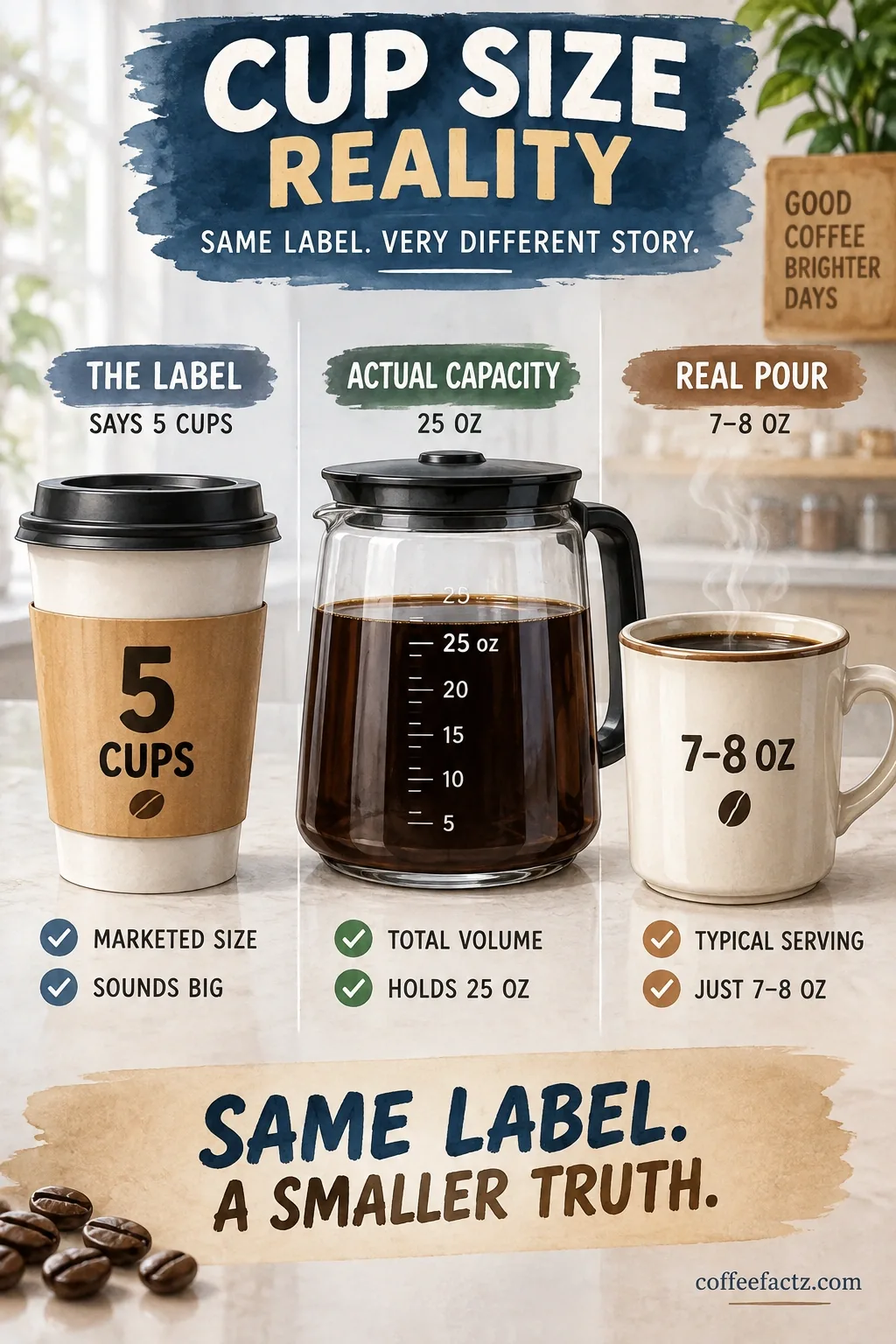
With that established: the Mini Brew is a simple, known quantity at a low price. The switch operation is as reliable as it gets – on, brew, off. No programming, no display, no complexity. For buyers who want a 25-ounce brewer with a recognizable brand name and the simplest possible interface, this machine delivers exactly what it promises.
The plastic construction carries the same caveats as the budget tier above. Daily heat cycling will eventually affect the housing and filter basket. Temperature stability is basic. The extraction quality at partial fills is subject to the same water distribution limitations as any standard drip machine at low volumes.
Real pours to expect: two 12-ounce mugs, or three 8-ounce mugs, or one very large 20-ounce tumbler with a small top-up. Plan your morning around those numbers, not the “5-cup” label.
Hidden costs: paper filters ($5–$10 per year), descaling solution, and eventual plastic fatigue on the carafe and basket.

Mr. Coffee® 5-Cup Mini Brew Switch Coffee Maker, Black
- Please refer to user guide or user manual or user guide (provided below in PDF) before first use
- Grab-a-Cup Auto Pause lets you grab a cup before brewing is finished
- Lift & Clean Filter Basket makes for easy cleanup
- Compact design is great for small spaces; updated ergonomic carafe offers easy pouring and handling, and featu…
Buy this if you want a known 25-ounce brewer at the lowest possible price, with the simplest possible operation, and you’re comfortable with the Mr. Coffee brand. It does what it says.
Skip this if you need true single-cup small-batch performance, premium build quality, or you’re buying based on the assumption that “5 cups” fills five real mugs. It doesn’t.
OXO Brew 8-Cup Coffee Maker
The OXO Brew 8-Cup is the machine on this list most likely to surprise you – not because of what it brews at maximum capacity, but because of what it brews at minimum.
Its minimum brew volume is 10 ounces. That’s one generously filled standard mug, brewed through a machine that carries full SCA certification – meaning it meets the Specialty Coffee Association’s verified standards for brew temperature, water distribution, and extraction consistency.
The Specialty Coffee Association has certified the OXO Brew 8-Cup as meeting its rigorous home brewing standards, specifically citing its BetterBrew™ precision brewing technology for controlling water temperature and brewing time.
What SCA certification actually means in practical terms: this machine has been independently verified to brew within the parameters that produce proper extraction – not just at full capacity, but across its usable range. For small-batch buyers, that certification is more meaningful than for full-carafe buyers, because small-batch performance is exactly where uncertified machines tend to fail.
The Kalita Wave filter compatibility is a specific and useful feature for anyone who brews manually on weekends. Kalita Wave filters are a standard in specialty coffee for their flat-bottom, even-extraction design. The OXO’s compatibility means you can use the same filter style you’d use for a pour-over, which translates to consistent extraction geometry across your brewing methods.
The $140 price point is the honest barrier. It’s five to six times what the budget options cost, and the footprint – approximately 8.5 inches wide, 12 inches deep, 14 inches tall – is larger than the compact machines above. You’re not buying this for a tiny counter; you’re buying it for small-batch quality in a mid-sized footprint.
Hidden costs: Kalita Wave filters (slightly more expensive than standard cone filters), descaling solution, and replacement parts. Budget $20 to $30 per year for consumables.
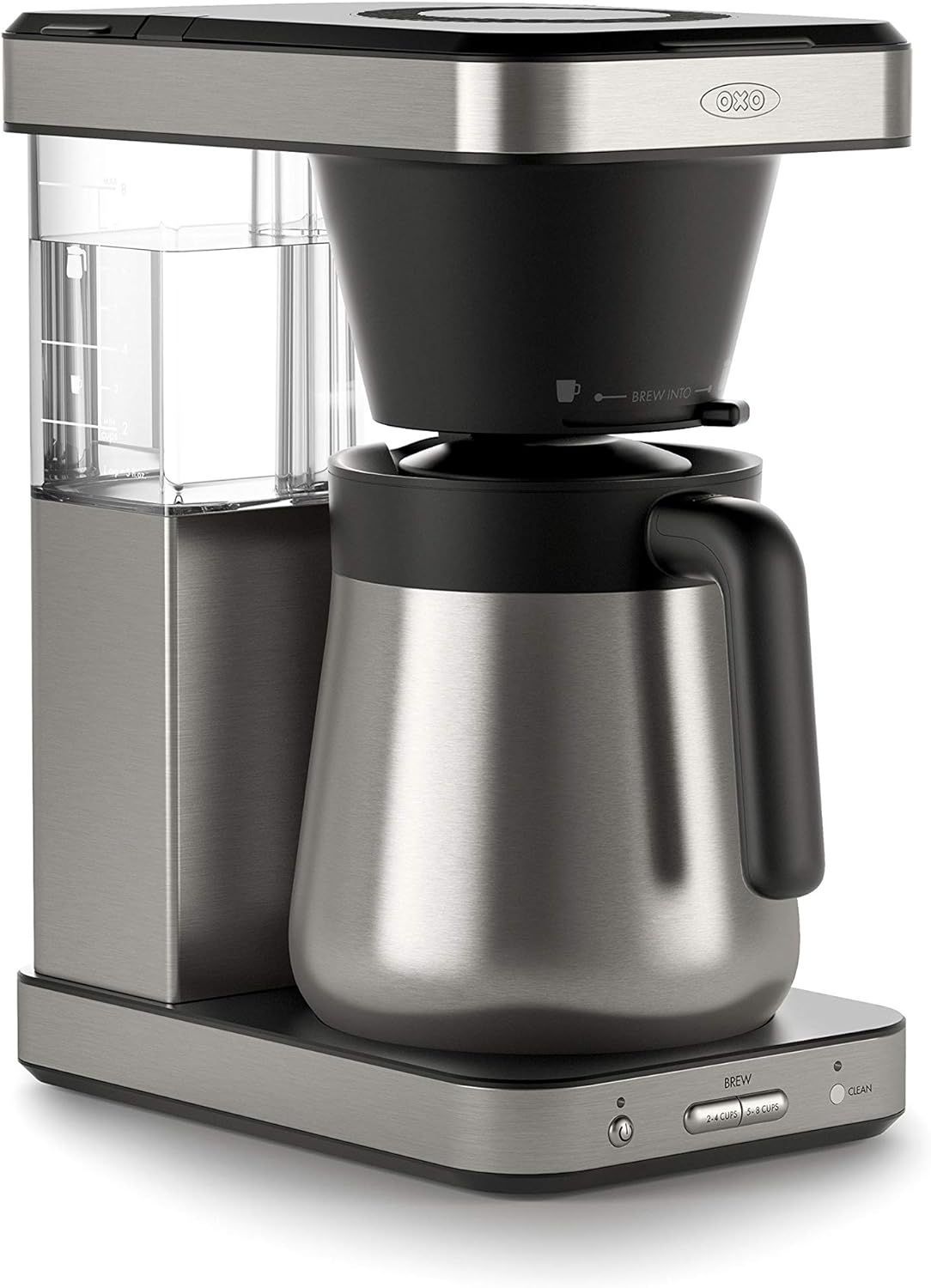
OXO Brew 8-Cup Coffee Maker - Single-Serve, Thermal Carafe, Stainless Steel
- Gold Cup Certified: BetterBrew precision technology ensures water hits the grounds at 194 F – 205 F, meeting t…
- Keep your coffee hot: Double-wall vacuum-insulated thermal carafe locks in heat and flavor for hours.
- Single-serve capability: Use the optional brew basket for quick and easy solo cups.
- Rainmaker showerhead: Delivers even saturation for smoother, better-tasting coffee every time.
- More room for mugs: Removable well fits everything from your smallest espresso cup to your tallest travel mug.
Buy this if you want SCA-certified small-batch drip performance, you brew into tumblers or single mugs regularly, and you’re willing to spend more upfront for verified extraction quality. This is the hidden gem of the list for serious home brewers who don’t want a full manual setup.
Skip this if your budget is tight, you need a true 4-cup footprint, or you’re a casual drinker who just wants hot coffee in the morning without thinking about it. The Amazon Basics or Mr. Coffee options serve that need for a fraction of the price.
Bunn My Cafe MCU
The Bunn My Cafe MCU solves a problem that most small coffee maker buyers don’t know they have until year three: plastic fatigue.
Every budget and mid-tier machine on this list uses plastic in the water pathway – the reservoir, the internal tubing, the shower head. Over daily heat cycling across years of use, that plastic degrades. It can affect flavor. It can crack. It can introduce the kind of subtle off-notes that make you wonder why your coffee tastes slightly different than it did two years ago.
The Bunn MCU uses a stainless steel internal tank and a fresh grounds drawer that keeps water contact with plastic components to a minimum. That design choice isn’t about aesthetics – it’s about durability and flavor neutrality over time.
Community reports from enthusiast forums consistently cite six to seven years of daily use without significant performance degradation. That’s an unusually long lifespan for a single-serve machine in this price range, and it tracks mechanically: stainless steel doesn’t degrade under heat the way plastic does, and fewer plastic joints means fewer failure points.
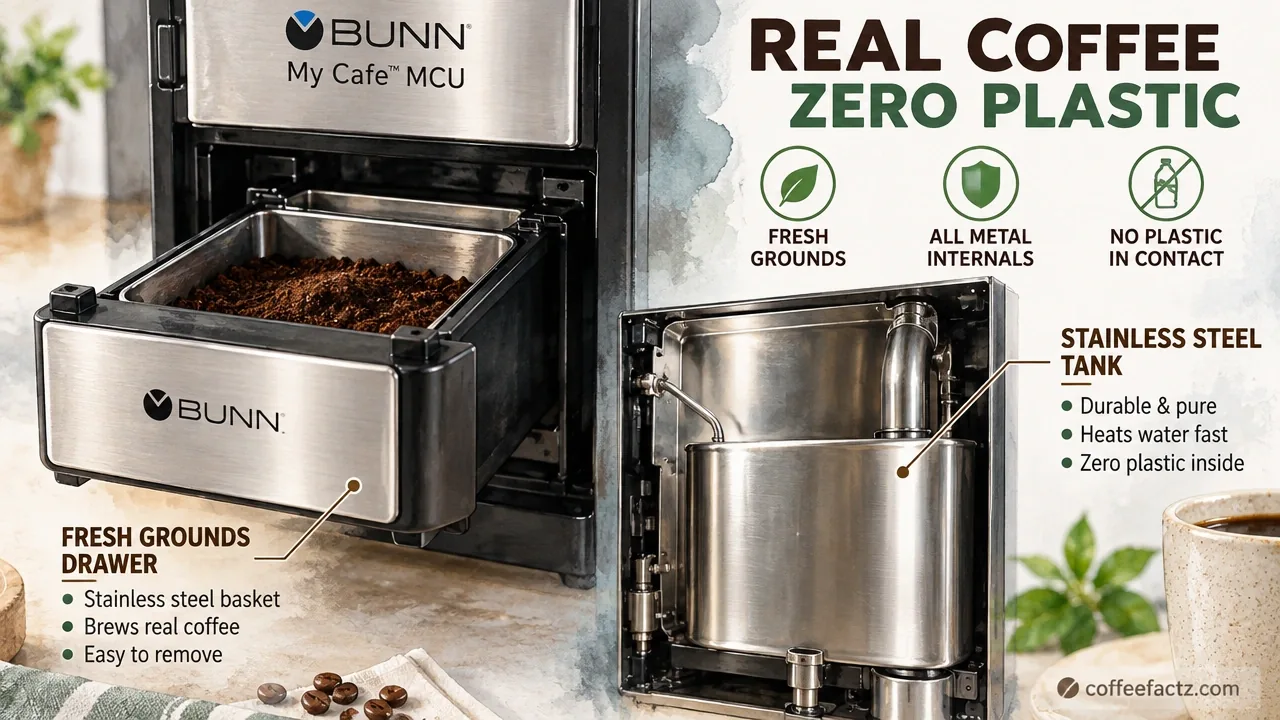
The availability caveat is real. Bunn is a commercial-grade brand that sells primarily through specialty retailers and online. It’s not on the shelf at every big-box store, and replacement parts – particularly proprietary pods or filter drawers – may require direct ordering. Check sourcing before you commit.
Pod and grounds compatibility is worth verifying against your specific workflow. The MCU is designed to work with both fresh grounds and certain pod formats, but not all pod types are compatible. If you’re a grounds-only brewer, this is a non-issue.
Hidden costs: proprietary pods or filter inserts if you use them, descaling solution (Bunn recommends a specific descaling process), and replacement parts. Budget $20 to $40 per year depending on pod usage.

BUNN MCU My Cafe Single Cup Multi Use Coffee Brewer (Black/SST)
- My Café Single Cup Coffee Maker - Brew coffee and tea exactly the way you want. Four different easy-to-use bre…
- BUNN BREWS DIFFERENTLY - Internal stainless steel hot water tank holds water at the optimal temperature for be…
- BREW THE WAY YOU WANT - Brew more than coffee! MCU is compatible with K-Cup* Packs, Ground Coffee, Soft Coffee…
- BREW JUST FOR YOU - Brew as little as 4 ounces to fill a cup or 14 ounces to fill a travel mug.
- CAFÉ TASTE AT HOME - Unique commercial-style jet action sprayhead ensures that pods are first pre-soaked and t…
Buy this if plastic-free internals and genuine long-term durability are your priorities. If you’ve been through two or three budget machines and you’re tired of replacing them, this is the machine that breaks that cycle.
Skip this if you need wide retail availability, a low upfront cost, or you want the simplest possible setup. The Bunn requires more sourcing effort and a higher initial investment than the budget tier.
Melitta Aromaboy
The Melitta Aromaboy is the machine on this list that most US-based buyers have never heard of – and that’s precisely why it belongs here.
At approximately £30 to £45 (roughly $35 to $55 at current exchange rates), it’s an ultra-budget compact drip machine from a brand with genuine coffee heritage. Melitta invented the paper coffee filter in 1908. The Aromaboy is their smallest drip machine, designed for the single-cup European market where counter space is at a premium and the expectation is simple, clean drip coffee without complexity.
The footprint is genuinely compact – approximately 5.5 inches wide and 7.5 inches deep, which puts it among the smallest drip machines available anywhere. It uses standard Melitta cone filters, which are widely available in Europe and increasingly available through online retailers in the US.
The availability friction is the honest challenge. This machine is designed for the UK and European market, which means voltage compatibility (230V vs. 110V in the US) is a non-trivial issue. Running a 230V appliance on a US circuit without a transformer will damage the machine. US buyers need to verify voltage and either source a compatible model or use a step-up transformer – which adds cost and complexity that somewhat undercuts the budget appeal.
Plastic build throughout, consistent with its price point. Temperature stability is basic. For its intended market and use case – a single cup, a small kitchen, a simple morning – it does the job.
Hidden costs: Melitta cone filters (very affordable, widely available in Europe), descaling solution, and for US buyers, potential shipping or import fees and voltage adaptation costs.

Melitta 1015 Aromaboy Filter Coffee Machine, 2 Cups, Glass Pot, Automatic Switch-Off black by Melitta
- Compact and stylish filter coffee machine with transparent water tank and cup level markers, Makes 2 cups of c…
- Optimal brewing temperature for full aroma development and the ideal cup of coffee
- Space-saving design, With its space-saving design, the Aromaboy is guaranteed to fit into even the smallest ki…
- The removable filter holder and glass jug are dishwasher safe to ensure convenient cleaning, Switches off auto…
- Contents: 1 x Melitta Filter Coffee Machine, Aromaboy Model, Stainless Steel, Black, Art.No. 6707286
Buy this if you’re in the UK or Europe, want the smallest possible drip footprint at an ultra-budget price, and trust the Melitta name. It’s a legitimate hidden gem for its intended market.
Skip this if you’re in the US and need plug-and-play compatibility, a US warranty, or premium temperature stability. The sourcing friction may not be worth it compared to domestic options at similar price points.
Technivorm Moccamaster KBGV Select With Half-Pot Function
The Technivorm Moccamaster KBGV Select is what happens when a brand refuses to compromise on build quality and temperature performance, even when the target volume is small.
The half-pot setting brews approximately 20 ounces – the same volume as the Elite Gourmet 4-Cup – but through a machine that uses a copper heating element, aluminum boiler housing, and BPA-free polypropylene for any plastic components. The engineering is Dutch, the assembly is manual, and the five-year warranty is the longest on this list by a significant margin.
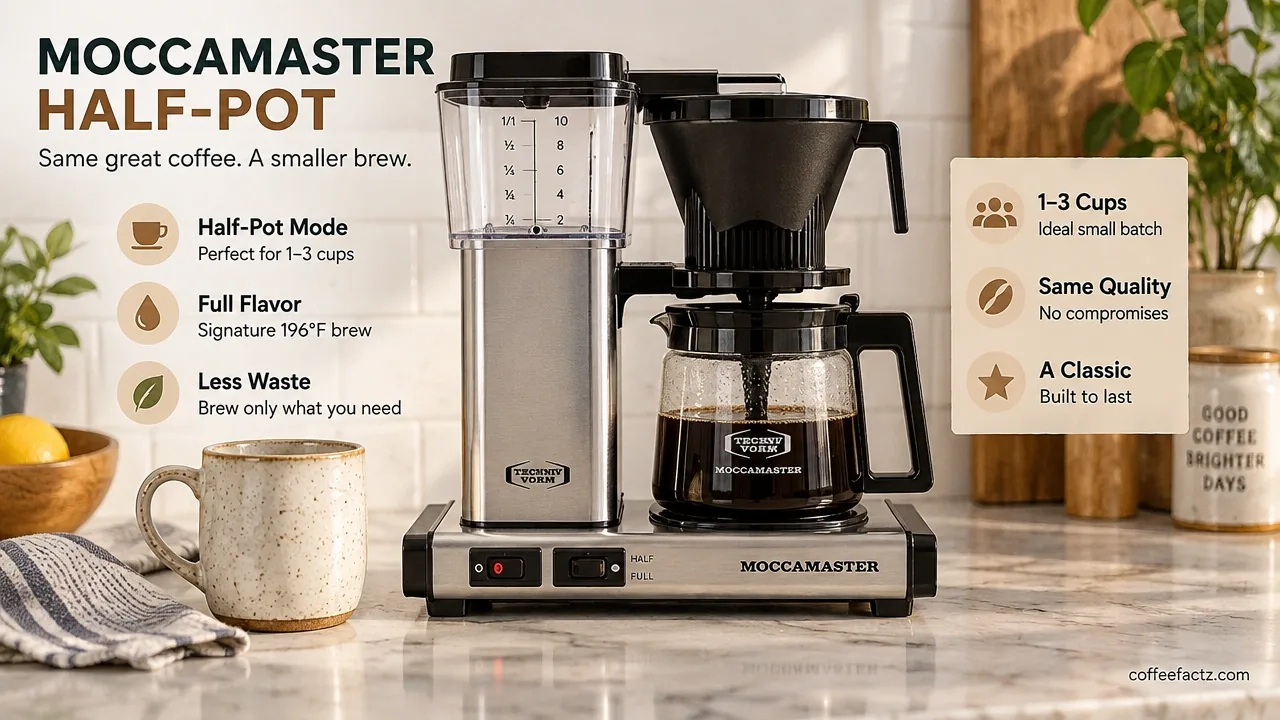
Temperature stability is where the Moccamaster earns its reputation. The copper heating element brings water to brewing temperature rapidly and maintains it consistently throughout the brew cycle. This is the machine’s core design priority, and it delivers on it. The half-pot setting concentrates that performance into a smaller brew volume – which is exactly the use case that most standard drip machines handle poorly.
The honest conversation about this machine is the price: $200 to $250 puts it at five to ten times the cost of the budget options on this list. That’s not a flaw – it’s a deliberate positioning. You’re paying for Dutch manufacturing, a five-year warranty, copper heating components, and a machine that enthusiast communities consistently report using for a decade or more without performance degradation.
What it doesn’t do: it doesn’t have a tiny footprint. At approximately 8 inches wide, 11 inches deep, and 13.5 inches tall, it’s a substantial machine for a small kitchen. The half-pot setting makes it small-batch capable, not compact in the physical sense.
Hidden costs: standard paper filters (widely available, inexpensive), descaling solution, and occasional replacement parts – though the five-year warranty covers most failure scenarios. Budget $15 to $25 per year for consumables.

Technivorm Moccamaster 53937 KBGV 10-Cup Coffee Maker Black, 40 Ounce, 1.25l
- Perfect Coffee Every Time: This pump-free coffee maker heats water to the correct temperature for coffee extra…
- Brew-Volume Selector switch for brewing half or full carafes Easy to Use: The Moccamaster brews a full 40 oz p…
- Easy to Use: The Moccamaster brews a full 40 oz pot of coffee in 4-6 minutes using one switch
- Quiet and Safe: The Moccamaster Select quietly brews your coffee and automatically turns off after 100 minutes
- Delicious Coffee and Peace of Mind: Moccamaster coffee brewers have a 5-year warranty
Buy this if you want the best possible build quality and temperature performance in a small-batch drip machine, you’re planning to use it for a decade, and the price reflects a long-term investment rather than sticker shock. For serious home brewers who drink one to two mugs per morning and refuse to compromise on extraction quality, this is the answer.
Skip this if budget is the priority, your counter genuinely can’t accommodate a mid-sized machine, or you just want reliable hot coffee without thinking about it. There are machines on this list that cost $120 to $200 less and will serve a casual drinker perfectly well.
The Best Small Coffee Maker for Your Counter, Workflow, and Budget
The right small coffee maker isn’t the one with the best reviews – it’s the one that fits your actual mug, your actual counter, and the way you actually use your kitchen in the morning. Here’s how the nine machines on this list break down by the person most likely to be happy with them.
Budget single drinker: The Amazon Basics 5-Cup is the pragmatic call. The reusable filter eliminates one ongoing cost, the switch operation is foolproof, and the 25-ounce capacity fills two standard mugs. If you want the absolute smallest footprint at the lowest price, the Elite Gourmet EHC4128 (4-Cup, ~20 oz) is the alternative – slightly less coffee, significantly less counter space.
Two people, small mugs: The Elite Gourmet EHC-5055 or the Mr. Coffee Mini Brew both hit 25 ounces at budget prices. The Mr. Coffee has slightly better brand recognition and the same simple switch operation. Either works if 25 ounces split between two people is enough – and now that you know the ounce number, you can do that math yourself.
Small-batch quality: The OXO Brew 8-Cup is the strongest value for buyers who care about extraction. SCA certification, a 10-ounce minimum brew, and Kalita Wave compatibility make it the only machine on this list that’s been independently verified to perform at small volumes. The Technivorm Moccamaster Half-Pot is the premium alternative – better build, longer warranty, higher price.
Plastic-free durability: The Bunn My Cafe MCU is the only machine here with a stainless steel internal tank. If you’ve cycled through two or three budget machines and you’re tired of replacing them, this is the long-term investment that breaks that pattern.
Ultra-budget European: The Melitta Aromaboy at £30 to £45 is a legitimate option for UK and European buyers who want the smallest possible footprint at the lowest possible price. US buyers should factor in voltage compatibility before ordering.
Before committing to any of these, revisit the comparative specifications table in the opening section. Width, depth, and height together – not just cup count – tell you whether a machine actually fits. And factor in the annual maintenance costs column: filters, descaling, and replacement carafes are real ongoing expenses that don’t appear in the purchase price.
A few machines worth naming specifically as poor fits for small-volume use: the Breville Precision Brewer is an excellent full-carafe machine but is not optimized for single-cup or very small-batch brewing. Standard full-size drip machines generally share this limitation – they’re engineered for 8 to 12 cups, and their water distribution systems reflect that. And across every machine on this list: “5-cup” labels mean 25 ounces, not five mugs. Build your buying decision around the ounce number in the table, and you’ll avoid the most common mismatch in this category.
Frequently Asked Questions About Best Small Coffee Makers
What does SCA certification actually mean for a home coffee maker?
It means the machine has been independently tested and verified to meet the Specialty Coffee Association’s standards for brew temperature, water distribution, and extraction consistency – not just at full capacity, but across its usable range. For small-batch brewers, it’s the closest thing to a performance guarantee.
Can I brew just one mug in a 5-cup drip machine?
Technically yes, but the result is often weak or uneven. Most 5-cup machines distribute water across the grounds bed assuming a near-full fill; brew one mug’s worth and the water may channel unevenly, producing under-extracted coffee. Machines with a minimum brew volume spec, like the OXO Brew 8-Cup at 10 oz, are specifically designed to handle this.
How often should I descale a small coffee maker?
Most manufacturers recommend every one to three months depending on water hardness. If you use unfiltered tap water in a hard-water area, monthly descaling is realistic. Neglecting it is the leading cause of heating element failure – and it’s the one maintenance task that’s entirely preventable.
Is a built-in grinder worth it in a compact machine?
For most buyers, no. Built-in grinders add mechanical complexity to a machine you’re using daily. When the grinder fails – and they do – it often takes the brewer down with it. A separate burr grinder and a simple brewer outperforms a combined unit in both longevity and grind quality.
What’s the actual difference between a $25 budget machine and a $140 OXO Brew?
Primarily: verified small-batch extraction performance, filter compatibility, and build materials. The $25 machine brews hot coffee. The OXO brews at certified temperatures with even water distribution at volumes as small as 10 ounces, using filters designed for specialty coffee. If you notice the difference between good and great coffee, the gap is real. If you don’t, the budget machine serves you fine.
Does the Melitta Aromaboy work in the United States?
Not directly out of the box. It’s designed for 230V European power standards. US buyers would need a step-up voltage transformer to use it safely, which adds cost and a layer of setup complexity. For most US buyers, that friction outweighs the budget appeal.
Why is the Breville Precision Brewer not on this list?
It’s a well-regarded machine for full-carafe brewing, but it’s not optimized for single-cup or very small-batch use. Its water distribution system is designed for larger volumes. Buyers looking specifically for small-batch performance will get better results from the OXO Brew 8-Cup or the Moccamaster Half-Pot.
How long should a small coffee maker realistically last?
Budget plastic machines typically last two to four years under daily use before flavor quality or mechanical reliability degrades noticeably. Mid-tier machines like the KRUPS often extend that to four to six years with proper descaling. The Bunn My Cafe MCU and Technivorm Moccamaster Half-Pot are the outliers – community data and warranty terms both suggest eight to ten or more years is realistic with basic maintenance.
References
- Best Single-Serve Coffee Maker | nytimes.com/wirecutter
- Elite Gourmet 5-Cup EHC-5055 Review | consumerreports.org
- OXO Brew 8-Cup Coffee Maker SCA Certification | new.sca.coffee
- Brew temperature, at fixed brew strength and extraction, has little impact on the sensory profile of drip brew coffee | nature.com