

The best cappuccino cups are the only variable in your morning routine that demands zero technique – and yet most buyers get them wrong by shopping for aesthetics instead of physics. A cup’s interior curve decides whether your crema survives the pour. Its wall thickness determines whether the second sip tastes like the first.
This guide ranks seven cups – from a championship-proven porcelain egg to a hand-thrown studio find – against four criteria that actually matter: volume fidelity, interior geometry, thermal behavior, and glaze durability. Once you understand the trade-offs, the right pick becomes obvious.
This guide ranks seven cups—from a championship-proven porcelain egg to a hand-thrown studio find—against four criteria that actually matter: volume fidelity, interior geometry, thermal behavior, and glaze durability, much like how Coffee Cupping Defect Detection The protocol helps professionals systematically identify flaws in brewed coffee.
Key Takeaways on Best Cappuccino Cups
- The fondo a uovo interior curve preserves crema and controls the pour – exterior style is irrelevant without it.
- INEI’s 160 ml standard is the only formal cappuccino cup specification; everything else is an uncited range.
- Double-wall construction insulates through air, not mass – it is the only mechanism that works without a cup warmer.
- Heavy-mass cups are heat sinks when cold; preheat longer or they actively cool your drink.
- Brand reputation is not a proxy for thermal performance – the Vero, LINO, and ACME all demonstrate this.
- The 15-20 second hot-water preheat outperforms any cup upgrade attempted without it.
How We Ranked: The Anatomy of a Real Cappuccino Cup
A cup is not just a cup – not when it is the cappuccino cup that determines whether your espresso ratio holds together or collapses into warm milk. The assumption that any 6-ounce vessel will do is the single most expensive mistake a home barista makes, because the geometry, mass, and glaze of a cappuccino cup are doing active work before the first sip.
Every pick in this guide is measured against five criteria, disclosed here so you can override any recommendation for your own situation.
Traditional Volume Envelope
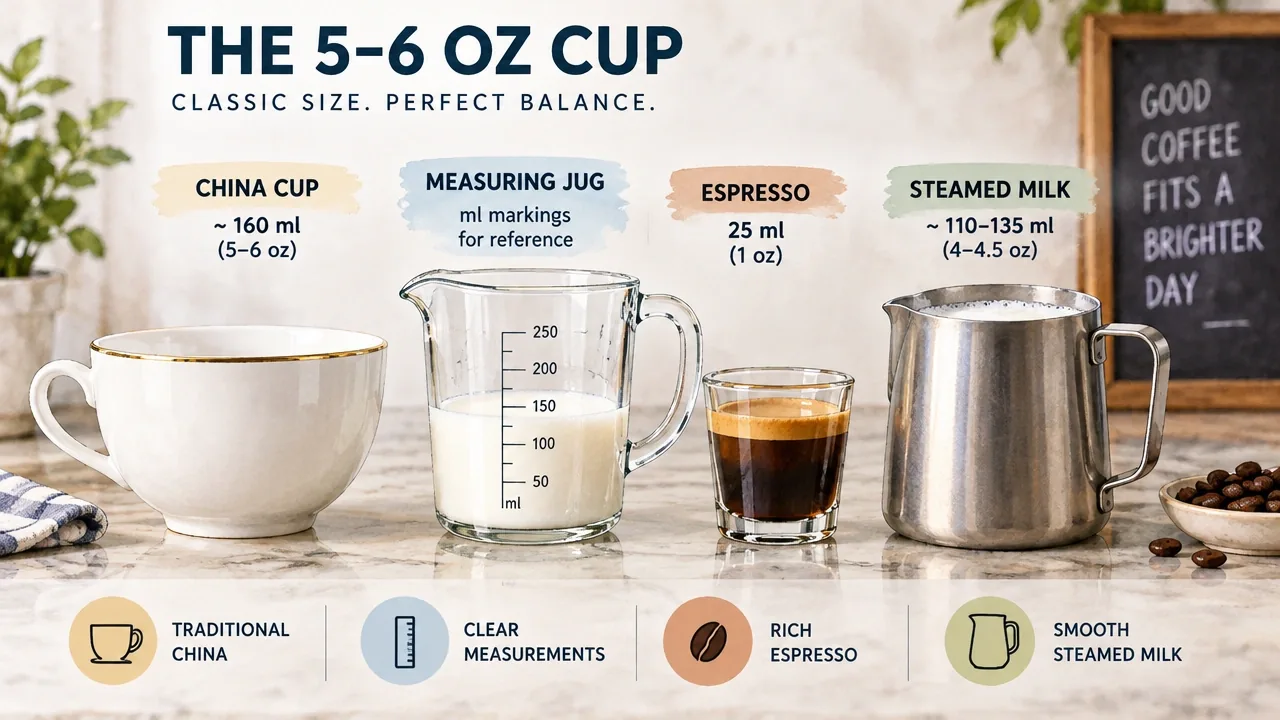
The traditional Italian cappuccino lives in a 5-6 oz (150-180 ml) envelope, built around one-third espresso, one-third steamed milk, and one-third dense foam. That ratio is not arbitrary – it is the architecture that keeps the espresso dominant without being harsh and the milk textured without being flat.
The only formal standard in play is the INEI specification: a white feldspathic china cup of approximately 160 ml, holding 25 ml of espresso and 100 ml of steam-foamed milk. It is worth treating as the traditional anchor of this guide, while flagging it honestly as prescriptive rather than universal – the wider market runs on uncited “5-8 oz” ranges, which is exactly where the trouble starts.
Pour a traditional cappuccino into an 8-12 oz mug and watch what happens: the espresso volume stays fixed while the milk has to travel farther before foam forms, the crema spreads thin across a wider surface, and the result is a small latte wearing a cappuccino’s name. Volume is not a preference – it is the structural container for the ratio.
Interior Curve and Handle Mechanics
You already know a cappuccino is one-third espresso, one-third milk, one-third foam. What almost nobody tells you is that the cappuccino cup is the fourth essential element—and its interior curve decides whether your crema survives the pour.
The fondo a uovo – an egg-shaped, rounded-bottom interior – is not a style choice. The interior curve is functional: espresso concentrates at the base and steamed milk folds upward through it rather than splashing flat, which preserves the layered ratio. A flat-bottomed interior invites the microfoam to crater on impact. A wide rim solves the second problem: it gives the pitcher a generous landing zone so latte art sets rather than sinks, and it broadens the aroma delivery at the lip.
Handle mechanics are less discussed but equally consequential. A handle sized for two fingers keeps the cup balanced during a pour; a pinch-grip handle shifts the center of gravity forward when the cup is full, which forces a tilted delivery and disrupts the pour line. A handle angled too far down means the wrist rotates during drinking – minor in isolation, tiring across a morning.
For a masterclass in how rim geometry translates directly into pour control, this video from two-time Latte Art World Champion Lance Hedrick is worth every minute:
Thermal Mass and Assessment Criteria
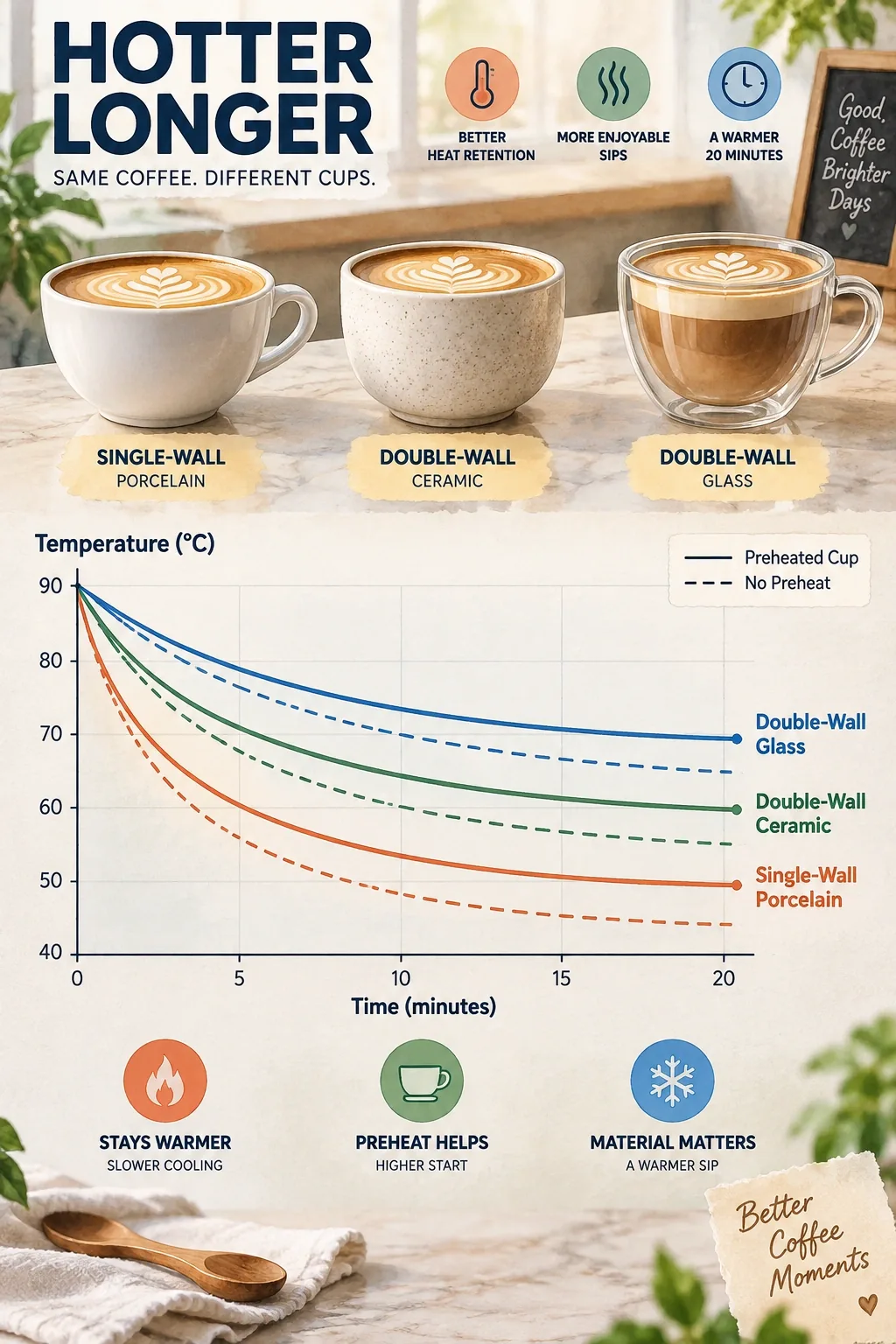
Material choice is where the physics becomes unavoidable. Heavy-weight feldspathic-style porcelain – the closest commercial equivalent to the INEI standard – offers fine walls with enough density to buffer temperature without excessive mass. Stoneware runs thicker and heavier, charging slowly but releasing slowly too. Double-wall construction, whether borosilicate glass or insulated ceramic, insulates by trapping air rather than by mass – a fundamentally different mechanism that performs independently of preheating.
The mechanism matters: wall thickness and beverage mass both slow temperature decay, but mass must first be charged. This is why the universal preheat ritual of 15-20 seconds of hot water before the shot is not optional ceremony – a study published in the International Journal of Heat and Technology modeled the exponential cooling rate of a ceramic mug and validated that wall thickness and liquid mass directly govern how fast temperature decays, confirming that an uncharged heavy cup pulls heat out of the drink until it reaches equilibrium.
A validated analytical cooling model for porcelain mugs confirms that both wall thickness and beverage mass slow the rate of temperature decay – meaning a cold, heavy cup is thermally worse than a warm, thin one. – From the study “Analytical, Experimental and Computational Analysis of Heat Released from a Hot Mug of Tea” – International Journal of Heat and Technology
In practical terms: preheating a heavy cup is not a barista affectation. It is the difference between a cup that holds your drink and one that consumes it.
The five ranking axes used throughout this guide are:
- (a) Volume fidelity – does it hit the traditional 5-6 oz band?
- (b) Interior geometry – does the curve support crema preservation and controlled pours?
- (c) Thermal independence – does it hold heat without a cup warmer?
- (d) Glaze durability – does it survive dishwasher cycles over years?
- (e) Saucer compatibility – does it pair with a proper café-style saucer?
Brand reputation is explicitly not a criterion. That exclusion matters – and it will come up again.
Loveramics Egg: Championship Pour Geometry for Entry-Level Money
A café pour looks effortless for one reason: geometry. And the cup that won on the world stage costs roughly the price of two coffee-shop cappuccinos.
The Loveramics Egg is the entry point into genuinely traditional cup architecture – an egg-derived interior curve matched to a handle that keeps a full cup balanced during a pour. It is also the official cup of the 2018 World Latte Art Championship, chosen by competitors pouring under the highest-pressure conditions the discipline offers. That is not marketing copy – it is direct evidence that the rim geometry supports controlled pours rather than merely looking the part. A “top pick” badge from a blog is a weaker validation signal than the cup a world champion selected for competition.
At home, the egg interior delivers a sensory payoff that a flat-bottomed cup cannot replicate. The espresso pool stays at the base, microfoam folds into it instead of cratering, and the first sip delivers the layered ratio – crema, milk, foam in sequence – rather than a foam-only opening. The wide rim gives your pitcher a landing zone wide enough to run a pour line without the milk sheeting off the edge.
The practical realities are honest and worth stating plainly. The body is high-fired porcelain, dishwasher-tolerant, with a glazed foot that protects both the cup and the saucer beneath it. It stacks cleanly and stores without drama. The aesthetic is minimalist white – the café look without a design-brand markup.
The one expectation to set clearly: at entry-level pricing, thermal mass is entry-level too. The Loveramics Egg responds well to preheating and poorly to neglect. Run hot water through it for 15-20 seconds before pulling the shot, and it behaves like a cup that costs three times as much. Skip that step, and the thin walls will remind you of the price point.
| Spec | Detail |
|---|---|
| Volume | ~5.5 oz / 155 ml |
| Material | High-fired porcelain |
| Interior geometry | Egg-curve (fondo a uovo) |
| Dishwasher safe | Yes |
| Saucer included | Sold separately |
| Provenance | Official cup, 2018 World Latte Art Championship |
At roughly £10, the Loveramics Egg is the cheapest route to a cup whose silhouette was validated under competitive conditions. That is why it anchors this list rather than a $30+ design object.
Affiliate Disclosure
This post contains affiliate links, meaning I may earn a commission if you make a purchase through these links, at no additional cost to you. As an Amazon Associate, I earn from qualifying purchases. I only recommend products I genuinely believe will add value.

Loveramics Cappuccino Cup with Saucer, 8 oz Ceramic Coffee cup with Round Bottom for Cappuccino, Latte, Tea, Espresso, Thick-walled Stoneware Cup Set for Barista - Regular Colours (Red, 8OZ)
- SCA STANDARDS: The preferred coffee cup of the World Latte Art Championship (2015-2023). Embraced by coffee en…
- THICKWALLED PORCELAIN: Crafted from high-fired porcelain at 1300°C, our cappuccino cup are remarkably scratch-…
- EXQUISITE LATTE MOMENTS: Discover our exclusive egg-shaped latte cup, meticulously crafted to enhance your cof…
- DESIGNED FOR LATTE PERFECTION: With a wide-diameter design beautifully showcases latte art and a rounded base …
- PERFECT FOR GIFTING:Surprise the coffee lover in your life with our meticulously crafted ceramic coffee cups f…
NotNeutral LINO: The Café Standard You’ve Already Drunk From
You have almost certainly drunk from this cup in a café without noticing it. The question worth asking is whether the café’s choice is also the right one for a kitchen with no cup warmer.
The NotNeutral LINO is the modern third-wave default for one structural reason: its wide-mouth, low-profile form gives the pitcher the largest possible landing surface and gives the drinker a broad, even lip. The geometry is optimized for service – fast pours, consistent latte art, and a rim wide enough that the coffee’s aroma reaches the nose before the sip reaches the tongue.
Hand feel is part of the appeal and worth describing honestly. The LINO has substantial throw-weight – the kind of cup that feels purposeful rather than fragile. The balance point sits low, and the wide aperture changes aroma delivery in a way a narrow mug cannot: the volatile compounds have more surface area to escape from, which means the first impression of the drink is olfactory before it is gustatory.
The saucer pairing completes the picture. A matched café-style saucer does functional work: it holds warm water against the cup foot during the preheat ritual, stabilizes the cup during a pour, and catches drips. The LINO’s saucer is designed to the same proportions as the cup – which sounds obvious until you try pairing a wide-mouth cup with a saucer sized for a narrow espresso cup.
On sizing: the cappuccino option sits inside the traditional band established in H2-1. The LINO line runs larger for latte service, so confirm the size code before ordering. Aesthetically, it is minimalist café-grade white – designed to disappear into a lineup rather than command attention on a shelf.
The one dissenting voice worth naming: the most structured roundup available names the LINO best overall, but at least one practitioner prefers NotNeutral Fina – the thinner, china-like sibling – specifically for its finer, less ponderous lip. If you love the LINO’s look but find thick café porcelain tiring to drink from over a long morning, Fina is the overlooked alternative inside the same design language.
What this section does not claim: the LINO is a café-ubiquity pick, not a heat-retention pick. Its reputation should not substitute for thermal testing. That tension is resolved in the next section.

notNeutral Lino Porcelain Cup & Saucer Double Cappuccino 6 oz (White, 6 oz, 2)
- Fine porcelain
- Dishwasher-and microwave-safe
- Volume: 6 oz. (180 ml)
- Cup: 2.375" H x 4.75" W - Saucer: 6.25" diameter
- Made in Sri Lanka
Fellow Monty: Best Heat Retention, Built to Behave Without a Cup Warmer
You already preheat, and you’re still drinking warm foam by the last sip. That is a wall-thickness problem, not a technique problem.
The Fellow Monty solves it with double-walled construction: an insulating air gap between the inner and outer walls reduces conduction from the liquid to your hand and to the room simultaneously. The drink loses temperature more slowly than a single-wall cup of the same footprint – not because of mass, but because of physics. Air is a poor conductor of heat. That gap is doing the work your preheat ritual cannot.
The sensory consequence is the point. The second and third sips retain foam structure and aromatic lift instead of collapsing into cold, bitter milk. For a drinker who works at a desk, reads through a morning, or simply doesn’t drink at café speed, the Monty is the only cup in this comparison that answers all four community friction points at once: thermal management, preheating method, wall thickness, and cup-warmer independence. The most structured blog testing named it best heat retention outright.
The design language is a deliberate departure from traditional white porcelain – contemporary, minimalist, available in exterior color options that let it read as decor rather than equipment. That is either a feature or a liability depending on whether you want your cup to look like it belongs in a café or in a kitchen.
Practicalities: confirm the serving size against the traditional cappuccino band before ordering (Fellow offers multiple sizes). Handle ergonomics are clean – the double-wall profile keeps the grip comfortable even when the liquid inside is at full brewing temperature. The saucer situation is worth checking at point of purchase, as matched saucers are not always bundled. Thin double-wall construction generally calls for gentler washing than a heavy single-wall body – treat it more like a wine glass than a café mug.
The runner-up in the heat-retention tier is a double-wall glass option – the Kruve Imagine, offered in three sizes – relevant only if you want to see the layers of your cappuccino through the wall. The lip feel is a departure from porcelain, not a substitute for it, and most porcelain drinkers find it a significant adjustment.

Fellow Monty Double Wall Cappuccino Mug for Latte Art, 6.5 oz, Matte Black
- MONTY THE CAPPUCCINO CUP - A modern 6.5 oz sleek double wall ceramic mug ideal for sipping on beautiful, handc…
- PICASSO YOUR POUR - Where some see a cup, we see a canvas! Monty was created for latte art with the design of …
- REFINED COFFEE MUG - Monty's sleek, subtle polished graphite bottom complements the matte black ceramic finish…
- STACKABLE DESIGN - Monty's stackability makes for efficient storage & can be beautifully displayed in your kit…
- DISHWASHER SAFE - Monty does not need to be hand-washed, just add to the dishwasher; however, you DO NOT micro…
Le Creuset Stoneware: The Buy-Once Cup with a Written Warranty
This is the most durable cup in the entire comparison, and the only one whose durability claim is backed by a manufacturer guarantee rather than forum consensus.
The Le Creuset stoneware cappuccino cup makes a different kind of promise than any other pick on this list: a written lifetime warranty. That is not a marketing distinction – it is a different class of commitment. A review score reflects one person’s experience over weeks. A lifetime warranty reflects the manufacturer’s actuarial confidence in the product’s failure rate over years.
The durability case rests on three structural decisions: a thick stoneware body, a chip-resistant rolled rim, and an enamel-style glaze engineered for repeated dishwasher cycles. What actually dulls a glaze over years is detergent chemistry and rack contact – the abrasive combination of alkaline chemistry and vibration. Heavy stoneware with a rolled rim survives that cycle better than thin-walled porcelain or double-wall construction, both of which expose more vulnerable geometry to the dishwasher environment.
The white glaze versus colored finish decision is more functional than it appears. A bright white interior maximizes contrast against crema and microfoam – you can see foam density, pour definition, and the espresso layer at a glance. Saturated or dark interiors look richer on a shelf but visually flatten the drink and make latte art read poorly. If you care about what the drink looks like as well as tastes like, the white interior is the functional choice.
Stoneware’s thermal identity is the honest trade-off: substantial mass means the cup charges slowly and releases slowly. Preheat longer than you would a porcelain cup – closer to 30 seconds than 15 – and expect the cup to hold the drink rather than simply warming up to it. In a full hand, the weight is noticeable; the handle needs to be sized proportionally for the heavier body, which Le Creuset accounts for. The rim is thicker than fine porcelain, which changes the drinking feel – not unpleasant, but different.
Buy this cup because you want to own one cup for a decade. Do not buy it because the brand implies it keeps coffee hot – thermal performance is the one axis where brand equity is not a reliable proxy.

Le Creuset Stoneware Vancouver Mug, 14 oz., Artichaut
- Premium stoneware ensures excellent heat distribution for uniform browning and even cooking with no hot spots
- Superior heat retention keeps food warm or cold for serving
- Colorful glaze is non-porous, non-reactive, scratch-resistant, and resists stains and flavor absorption
- Virtually nonstick interiors easily release food for quick clean-up, and resist cracking and crazing
- Safe for freezer, oven, microwave, broiler, dishwasher and metal utensils
ACME Evolution Cappuccino (190 ml): The Café Workhorse, Honestly Assessed
The café cup holds more than a traditional cappuccino should. Here is why it still wins with a certain kind of drinker – and why it loses with another.
The ACME Evolution cappuccino sits at 190 ml – slightly above the traditional 150-180 ml band. The drinker who benefits is specific: someone who wants a longer, milkier cappuccino and is willing to trade strict Italian proportion for volume. With the same single espresso dose, the ratio shifts milkier; compensate by up-dosing to a 20-22 g double, or accept a cappuccino-latte hybrid. Neither outcome is wrong – but knowing which one you’re making matters.
The build is unambiguously café-grade: a robust thick-walled body, a chunky handle sized for a full grip, and a sturdiness that survives a busy counter without drama. ACME’s color range is where many buyers first encounter the finish-over-function trap – the palette is genuinely beautiful, and it is worth applying the same white-interior principle from the Le Creuset section before committing to a saturated color. The drink looks different in a cobalt cup than in a white one, and not always better.
The preheat requirement for a thick-walled cup of this mass is non-negotiable. Fill it with hot water, wait 30 seconds, discard, then pull the shot. Skip this step and the stoneware-equivalent mass will pull heat from the drink in the first 60 seconds.
Here is the community’s most useful contradiction: ACME is recommended repeatedly by experienced home baristas, and yet the person actually stress-testing it reported rapid cooling even after pre-warming. This is the cleanest illustration in the category that a well-loved, widely-endorsed cup can still lose temperature faster than a stranger on a forum expects. Endorsement and thermal performance are different things.
Treat the Evolution as a cup you either pair with a cup warmer or drink promptly. If you routinely nurse a cappuccino for twenty minutes, the 190 ml volume and the single-wall construction are both working against you regardless of how good it looks on the shelf.
Decent Tipsy: The Thin-Wall Insider Pick Nobody Roundups
Every cup reviewed so far optimizes for heat retention. The Decent Tipsy optimizes for something different: the sensation of the drink itself.
This is a thin-walled, small-batch cup sold directly by the manufacturer – not stocked in retail, not featured in affiliate-driven roundups, and consequently invisible to most buyers despite real practitioner enthusiasm. It surfaced from community discussion, not from a blog recommendation, which is precisely the signal worth paying attention to.
The thin-wall thesis is a sensory argument: less ceramic between the liquid and your lip means a more immediate, less buffered sip. The cup reads as delicate and precise rather than heavy and warming. If you find thick café porcelain clunky in the mouth – the sensation of drinking around the cup rather than from it – thin walls are the answer, and the Decent Tipsy is the clearest expression of that philosophy in the market.
The two-size architecture is well-matched to this audience: a small espresso size and a larger latte size that lands at the top of the traditional cappuccino band at roughly 180 ml, letting you run one cup family across both drinks without compromise. The trade-off is explicit: thin walls are the opposite philosophy from stoneware thermal mass. They reward preheating and punish idling. A 15-second hot-water charge before the shot is not optional here – it is the difference between a cup that tastes intentional and one that tastes thin.
Practical notes: direct-order fulfillment means slightly longer lead times than retail. Limited runs mean stock is not guaranteed. A larger size was planned but unavailable at the time community discussion surfaced this cup – if the 180 ml is what you want, buy it now rather than waiting on a SKU that may not ship.
This is the pick for the drinker who finds thick café porcelain clunky in the mouth. It is deliberately the opposite of the thermal-mass strategy – and it is the reason a list that only ranks heat retention is structurally incomplete.
Studio-Sale Ceramics: The Best-Kept Secret in Home Cappuccino
No roundup in this category includes it, because there is no affiliate relationship to monetize. Local ceramic studio sales have surfaced hand-thrown cappuccino cups at roughly $0.50 – a price point the entire commercial category ignores.
The case for a hand-thrown studio cup is not nostalgia. It is geometry. A skilled potter can produce a genuinely egg-shaped interior proportioned for a specific hand rather than a mold shared by millions – which means the fondo a uovo that every brand on this list approximates can be executed more precisely by a maker who threw the cup with one drinker’s use in mind. That is not always true, which is why the in-person test protocol matters.

Here is the test to run at a local studio sale or potters’ market:
- Interior curve check: tilt the cup and look at the base. A rounded bowl reads as fondo a uovo. A flat floor does not – and no amount of beautiful glazework changes what happens to your microfoam on impact.
- Volume check: bring a measuring jug. Pour water to the brim and measure. You want 150-180 ml. An oversized studio cup will flatten your espresso ratio the same way a 12 oz mug would, and you will not know until you pour.
- Rim check: run a finger around the lip. Thin enough to drink comfortably, but not knife-edged. A thick rim is a sensory tax on every sip.
- Foot ring check: a flat, unglazed foot ring sits stable on a saucer and holds preheat water against the cup base. A wobbly or fully glazed foot slides – a minor irritation that compounds over thousands of uses.
The honest tradeoffs are real: no warranty, no matched saucer, size variance between pieces, and the need to confirm the glaze is food-safe and dishwasher-suitable if either matters to you. A studio sale is not a returns department. Validate before paying.
But on the one axis that matters most – interior geometry – a hand-thrown cup can beat every brand on this list. That is not a romantic claim. It is a function of what a mold can and cannot do.
NotNeutral Vero: Beautiful Weight, Real-World Thermal Pushback
The NotNeutral Vero is the cup everyone photographs and the cup that generates the most honest community pushback. Both reactions are correct, and neither one alone tells you whether to buy it.
The Vero is the heavier, more sculptural line within the same café-standard family as the LINO – praised specifically for its substantial weight and hand presence. In the hand, it reads as purposeful and premium. On the counter, the physics work against you if the cup is cold.
Here is the mechanism the aesthetic obscures: more ceramic mass requires more energy to charge. A heavy cup that hasn’t been fully preheated pulls heat out of the drink until the ceramic reaches thermal equilibrium with the liquid – which takes longer than the average home barista waits. The result is a cup that feels luxurious in the hand and acts as a heat sink in practice. At least one documented community user returned their Veros specifically because the coffee cooled “SO quickly” without a cup warmer. Heavy is not synonymous with hot – in this case, it is the opposite.
The self-diagnostic is simple: do you own a cup warmer, or do you drink standing up within four minutes of pulling the shot? If either is true, the Vero’s mass is a feature. If neither is true, that mass is working against your drink.
Where the Vero still wins: feel, presence, café-standard compatibility, and a matched saucer that pairs as well as any on this list. If you want the cup that makes the counter look right and you have the ritual to support it, the Vero earns its place.
The decision rule this section resolves: choose mass for feel, choose insulation for temperature. You rarely get both in one cup, and the Vero is the clearest proof that the category forces you to pick.
The general principle, deployed once and not repeated: brand reputation is not a reliable proxy for thermal performance. The Vero is praised for heft. The café-ubiquitous LINO has no thermal guarantee. ACME is widely recommended and reported to cool despite preheating. Each of these can still be the right cup – but buy on the axis you actually care about, not on the shelf it sat on in a café.

notNeutral Vero Glass Cappuccino, 6 oz., Amber (1)
- Please note that notNeutral's Vero line is a hand-pressed glass product, and natural color variations will occ…
- Dishwasher- and microwave-safe
- Volume: 6 oz. (177 ml)
- Size: 3.5" H x 3.5" W
- Made in the USA
The Verdict: Which Cappuccino Cup Should You Actually Buy?
You now know what separates a cup that flatters your cappuccino from one that fights it. Here is the single decision tree to act on.
Match Your Primary Constraint First
| Your #1 Constraint | The Pick |
|---|---|
| No cup warmer, hate lukewarm sips | Fellow Monty (double-wall insulation) |
| Mouthfeel – the cup feels clunky | Decent Tipsy (thin-wall, direct order) |
| Longevity – one cup for a decade | Le Creuset Stoneware (lifetime warranty) |
| Café aesthetics, minimum spend | Loveramics Egg (~£10, championship geometry) |
| Café-standard default + saucer match | NotNeutral LINO (wide-mouth, low-profile) |
| Budget, unique geometry | Studio-sale ceramic ($0.50, validate volume first) |
If you have no specific constraint, the answer is simple: buy a white, egg-interior, wide-rim porcelain cup in the traditional 5-6 oz band with a matching saucer. It serves the classic ratio best, it preheats predictably, and it is the least risky purchase in the category.
What to Avoid and Why
Oversized mugs flatten the ratio before the first sip – the milk volume overwhelms the espresso, and the foam thins across a surface it wasn’t designed to cover. Dark or saturated interiors visually flatten crema and pour definition; if you care about what the drink looks like, the white interior is the functional choice. Heavy-mass cups bought without an intent to preheat are heat sinks, not insulators. Thin walls bought by drinkers who nurse a drink slowly are the wrong philosophy for the wrong habit.
The One Habit That Outperforms Any Cup Choice
The 15-20 second hot-water preheat – filling the cup with hot water before pulling the shot, then discarding it – prevents temperature shock, protects crema, and costs nothing. This single ritual lifts the worst cup on this list more than swapping cups without it. No technique, no equipment, no expense. Just hot water and thirty seconds.
The Tier Map
- Heat retention: insulated double-wall highest (Fellow Monty); double-wall glass second (Kruve Imagine, three sizes, with a caveat on lip feel); standard single-wall porcelain trailing
- Durability: warranted stoneware (Le Creuset) – the only pick backed by a manufacturer guarantee
- Budget: championship-proven porcelain at roughly £10 (Loveramics Egg) and studio-sale ceramics at roughly $0.50
- Mouthfeel / precision: thin-wall single-wall (Decent Tipsy)
“Thanks to the inner double-walled porcelain with an interspace inside, MANIKO is the series of cups designed to keep the inner wall at an optimally high temperature, leaving the outer wall in contact with your hand at a comfortable, lower temperature. The external shape offers a secure, comfortable grip, while the perfectly oval inner shape has a capacity of 70 cc for an espresso cup and 200 cc for a cappuccino cup, which is in line with the well-established standards.” – Club House Srl, manufacturer of the MANIKO porcelain cup series and SCA Best New Product Awards entrant
The MANIKO design principle – thermally separating the inner drinking surface from the outer hand-contact surface – is the engineering logic that makes double-wall construction more than a marketing claim. It is also the clearest illustration that cup geometry and thermal architecture can coexist in a single object, which is the argument this entire guide has been building toward.
The cup cannot fix a bad shot or thin microfoam. But it is the only variable in your cappuccino that requires no technique at all. Buy for your single constraint, preheat every time, and the drink in the cup rises to meet it.
Frequently Asked Questions About Best Cappuccino Cups
What size cup is best for cappuccino?
The traditional Italian range is 5-6 oz (150-180 ml), with INEI’s formal standard sitting at 160 ml. Anything larger shifts the espresso-to-milk ratio milkier – closer to a latte – regardless of how you pour.
What is the Italian rule for cappuccino?
The INEI standard specifies a white feldspathic china cup of approximately 160 ml holding 25 ml of espresso and 100 ml of steam-foamed milk – one-third each of espresso, steamed milk, and foam. It’s prescriptive, not universally followed, but it’s the only formal anchor the category has.
What is the difference between a latte cup and a cappuccino cup?
A cappuccino cup sits in the 5-6 oz band with a rounded, egg-shaped interior that concentrates espresso at the base. A latte cup runs 8-12 oz with a taller, wider profile – the extra volume is designed for more milk, which dilutes the espresso character a cappuccino depends on.
Does preheating a cappuccino cup actually make a difference?
Yes, and it’s the single highest-impact habit on this list. A cold ceramic wall pulls heat from the drink until it reaches equilibrium – a process that can drop the liquid temperature by several degrees in under a minute. Fifteen to twenty seconds of hot water before the shot prevents that entirely.
Why do so many specialty cafés use the same cups?
Wide-mouth, low-profile cups like the NotNeutral LINO became the third-wave default because their geometry supports controlled latte art pours and broad aroma delivery. Cafés also buy in volume from a short list of foodservice suppliers, which concentrates the market around a handful of designs.
Can a double-wall cup replace a cup warmer?
For most home use, yes. Double-wall construction traps air between the inner and outer walls, which insulates independently of whether the cup was preheated. It’s the only mechanism on this list that performs well without an external heat source.
Is a white interior actually better than a colored one?
Functionally, yes – a bright white interior maximizes contrast against crema and microfoam, letting you see foam density and pour definition. Dark or saturated interiors flatten the visual read of the drink. If you care about the aesthetics of what’s in the cup, white is the working choice.
Are hand-thrown studio ceramics a realistic option, or just a novelty?
They’re realistic if you validate them in person. Check the interior curve for a genuine rounded base, measure capacity with a jug against the 150-180 ml band, confirm the glaze is food-safe, and check foot ring stability. A well-thrown studio cup can outperform branded options on interior geometry – the constraint is that you can’t return it if the volume is wrong.
References
- Analytical, Experimental and Computational Analysis of Heat Released from a Hot Mug of Tea Coupled with Convection, Conduction, and Radiation Thermal Energy Modes | iieta.org (International Journal of Heat and Technology)
- Club House Srl – MANIKO Cup Entry | new.sca.coffee