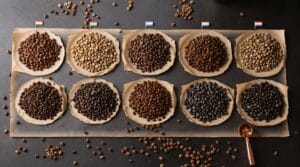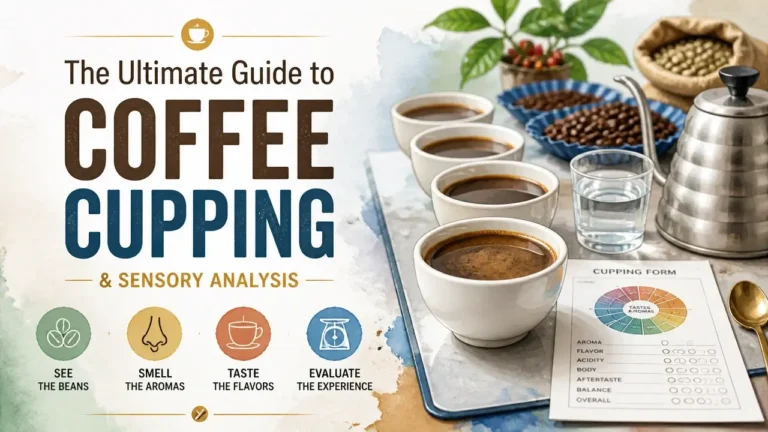

Rigorous coffee cupping separates bean quality from brewing variables – and that distinction drives every purchasing decision in the specialty supply chain. From the SCA protocol’s fixed parameters to the SCAA cupping form’s 10-attribute scoring system, the method is designed to make subjective sensory experience as communicable and reproducible as possible.
Understanding how and why that system works gives you something no checklist can: the judgment to use it well, recognize when it’s failing, and know where it ends and your own trained perception begins.
Key Takeaways on Coffee Cupping Guide
- Cupping locks down every brewing variable so the only thing being evaluated is the coffee itself, not the preparation method.
- The SCAA cupping form scores 10 attributes on a 16-point scale; coffees above 80 total points qualify as specialty grade.
- A one-point increase in cupping score correlates with a 35.80% rise in price per pound, making decimal precision commercially significant.
- Sensory vocabulary is built through calibration and repetition, not memorization; the flavor wheel is a navigation tool, not a terminology test.
- Preparing two unlabeled cups of the same coffee within a flight lets you verify your own perceptual consistency before trusting your scores.
- Water chemistry – mineral content, TDS, pH – affects extraction and flavor perception, but no major cupping protocol specifies water standards.
What Coffee Cupping Actually Is (And Why It Exists)
Coffee cupping is the specialty industry’s standardized sensory evaluation method – a fixed, reproducible protocol designed to assess coffee quality, detect defects, and compare multiple samples on equal terms. It is not a brewing method. It is not a consumer tasting flight. The protocol locks down every variable: grind size, water ratio, temperature, steep time. The only thing left to vary is the coffee itself.
That distinction matters more than it sounds. When you brew for enjoyment, you’re optimizing for a cup you want to drink. When you cup, you’re running an experiment with one independent variable. Changing the brew ratio or steep time to “improve” the result defeats the entire purpose. The controlled conditions are the tool.
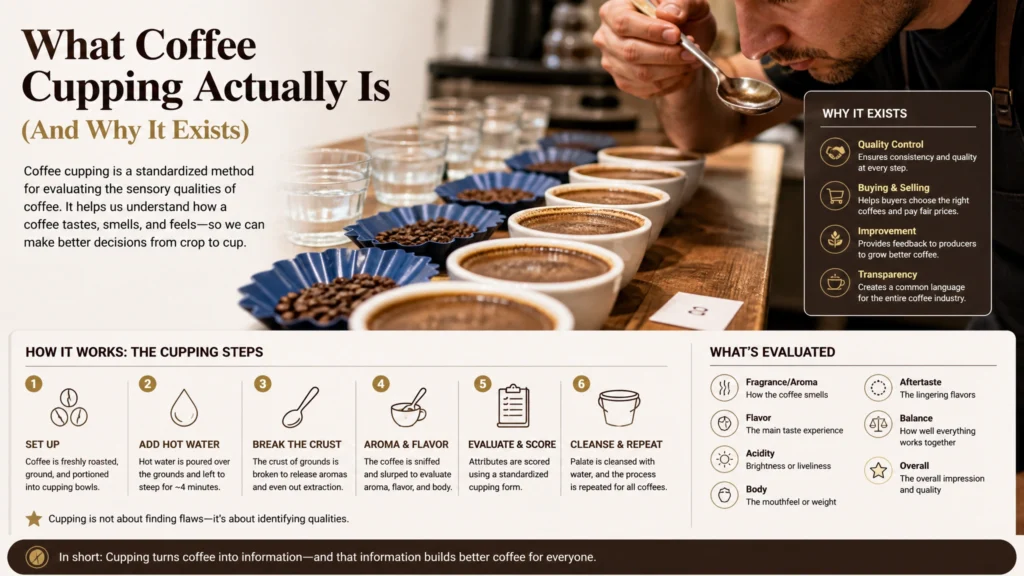
One thing new cuppers consistently confuse: the layer that forms on top of a cupping bowl is a crust, not crema. Crema is the emulsified colloid produced under espresso pressure. The crust is a mat of saturated coffee grounds and trapped CO₂ gases sitting on the surface of a steeped cup. They look similar. They are entirely different phenomena, and breaking them correctly is a step in the protocol – not a stylistic choice.
The professionals who depend on this method span the entire supply chain. Q Graders, certified by the Coffee Quality Institute, use cupping to formally grade lots for market access. Roasters use it to make purchasing decisions and build roast profiles. Green buyers use cupping scores to negotiate contracts and select specific lots. Producers use it to verify their own output before offering it to buyers. Every one of these decisions has a dollar figure attached to it.
Cupping’s origins trace to the late 19th-century coffee trade, when importers needed a fast, reproducible way to assess shipment quality before committing to a purchase. The method formalized over decades and eventually standardized through the Specialty Coffee Association of America – now the SCA – into the global protocol used today. It has been refined continuously since, most recently in 2024 when the SCA adopted new cupping forms and standards that brought the scoring framework in line with modern sensory science.
Mario Fernández, SCA Technical Officer, described the 2024 update as a landmark achievement built on years of collaboration and expert input – one that aligns cupping with contemporary sensory science and produces assessments that are data-rich and multidimensional, giving the industry deeper, more actionable insight into coffee quality.
That shift reflects a broader ambition. The SCA is not simply maintaining a tradition; it is trying to make the human sensory instrument more reliable and more legible across the industry.
In a companion effort, Mario R. Fernández-Alduenda and Peter Giuliano, SCA Technical Officer and SCA Chief Research Officer respectively, framed the goal of their Coffee Sensory and Cupping Handbook plainly: to bring sound sensory practices into everyday professional work, reduce the bias and error that accumulate in daily tasting, and sharpen the conclusions drawn from sensory evaluation – without stripping away the enjoyment that drives the industry in the first place.
That balance between rigor and passion is what makes cupping worth learning. It is an analytical instrument built by people who love coffee enough to want to understand it precisely.
The Standard Cupping Protocol: A Step-by-Step Walkthrough
The standard cupping protocol starts with fixed numbers, and those numbers are non-negotiable. Use 8.25 grams of coffee per 150 mL of water, ground medium-coarse to roughly French press consistency, with water temperature at 93°C (approximately 200°F). These parameters exist because they produce a stable, reproducible extraction. Deviate and you’re no longer comparing coffees – you’re comparing brew conditions.
Before you pour anything, evaluate the dry fragrance. Smell the grounds directly after grinding. Volatile aromatics begin escaping immediately after grinding, so this step has a short window. Note what you perceive – floral, earthy, nutty, fruity – before the chemistry changes.
Pour water directly onto the grounds, filling to the rim. Start timing. Let the coffee steep undisturbed for exactly 4 minutes. Do not stir. Do not agitate. The grounds form a crust on the surface, trapping aromatic compounds underneath.
At 4 minutes, break the crust. Use the back of a spoon, push through the center with three deliberate strokes, and keep your nose close to the bowl. The burst of aroma released at this moment is one of the most information-dense points in the entire session. It is brief. Pay attention.
After breaking, skim the surface completely. Remove the foam, floating oils, and loose grounds. This is not optional – leaving them in changes the sensory experience and muddies your evaluation. Use two spoons if needed to clear the surface cleanly.
Now wait. Begin tasting as the coffee cools, and taste it multiple times at different temperature stages. This is intentional. Acidity becomes more pronounced as the cup drops toward 70°C and below. Body perception shifts. Sweetness may only emerge clearly once the coffee approaches room temperature. A single pass at one temperature gives you a partial picture.
A practical safety note: water at 93°C causes serious burns. Handle bowls carefully. Ensure your cupping surface is stable and level before you pour. If you’re running multiple samples, work systematically to avoid reaching across hot bowls. When tasting multiple coffees in sequence, use the spitting protocol – spit after each sample into a designated cup – to manage caffeine intake and prevent palate saturation across a long session.
The Slurping Technique
The slurping technique looks performative from the outside. It is not. Load a deep cupping spoon, draw the liquid forcefully into the mouth with a sharp intake of air. The goal is to aerosolize the coffee, spraying it across the entire tongue surface and simultaneously driving volatile aromatics up through the retronasal passage to the olfactory epithelium. You taste far more through retronasal olfaction than through the tongue’s taste receptors alone. The slurp is the delivery mechanism for that olfactory data.
Sample Setup and Replication
Standard cupping sets up 5 cups per coffee sample. Five cups of the same coffee, not one. The reason is uniformity testing: you are checking whether the lot is consistent across multiple preparations, not just whether a single cup tastes good. Arrange cups in a triangle or line for systematic evaluation, and move through them in the same order each pass.
If you’re starting out and don’t have professional equipment, accessible approximations work for learning the method. Identical ceramic bowls of the same volume substitute for SCA-standard cupping bowls. A probe thermometer checks water temperature when you don’t have a temperature-controlled kettle. A consistent hand grinder, set to the same position every time, approximates a calibrated burr grinder. The protocol scales down. The discipline doesn’t.
This video walks through the full home cupping process step by step, showing exactly how each phase connects to the next:
Understanding the benefits and limitations of coffee cupping helps you frame what the protocol can and cannot tell you – and how cupping improves quality control shows how that data feeds decisions across the supply chain.
Breaking Down the SCAA Cupping Form and Scoring Categories
The SCAA cupping form translates sensory experience into a number that travels. A roaster in Oslo and a producer in Yirgacheffe can disagree about descriptors in five languages and still read the same score. That’s the form’s core function: it converts subjective perception into communicable data. If you want to learn the definition of coffee cupping at a deeper level, understanding the scoring structure is where the method’s logic becomes fully visible.
The SCAA Cupping Form: Structure, Scoring Scale, and Defect System
The SCAA cupping form evaluates 10 distinct attributes: fragrance/aroma, flavor, aftertaste, acidity, body, balance, uniformity, clean cup, sweetness, and overall impression. Each attribute is scored on a 16-point scale, running from 6 to 10 in quarter-point increments. A coffee that scores above 80 total points qualifies as specialty grade. Below 80, it does not, regardless of how pleasant it may taste to a casual drinker.
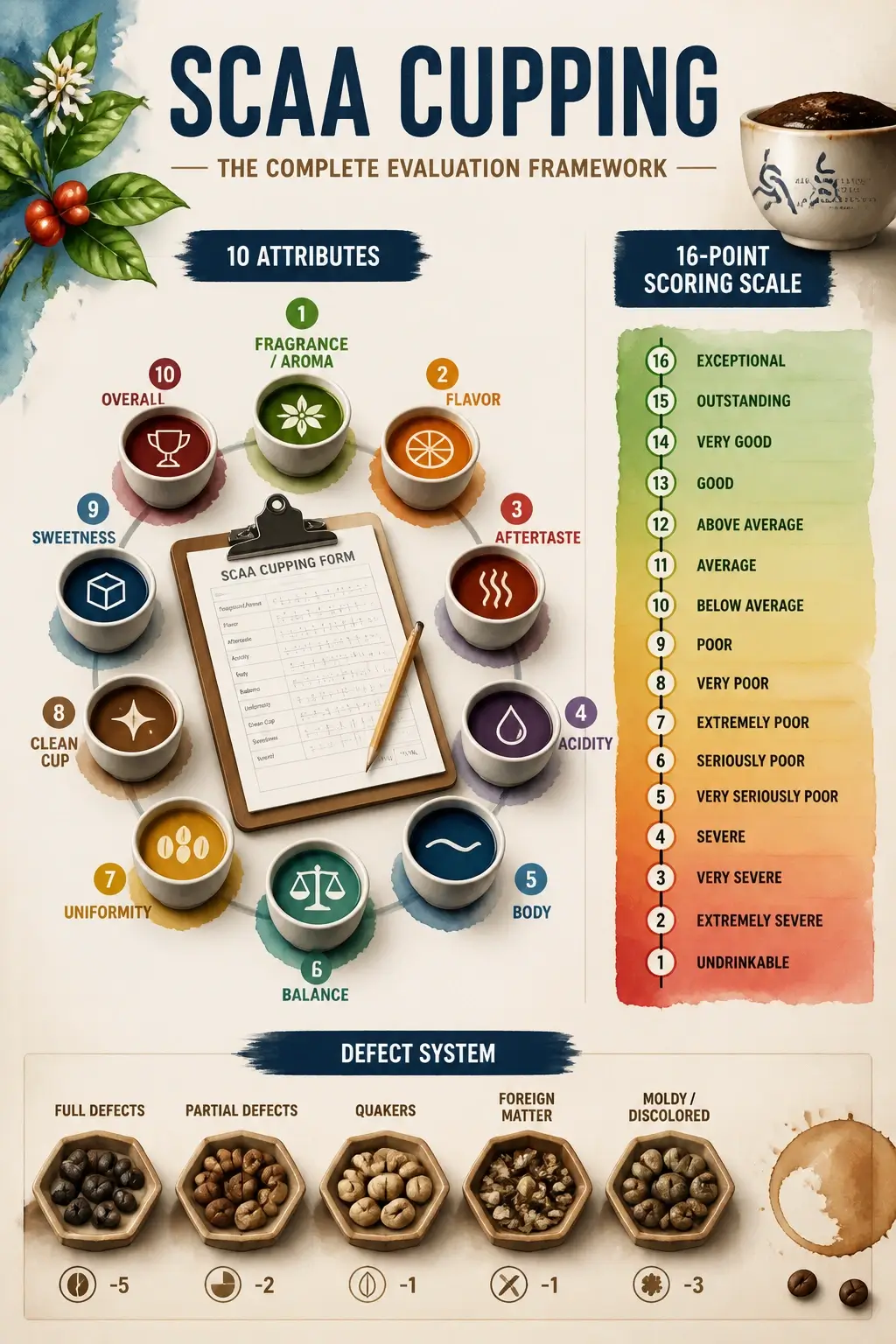
The defect scoring system runs separately and works as a subtraction mechanism. Off-flavors – ferment, phenol, mold – are identified and scored on their own scale, then subtracted from the total. A single cup with a severe defect can disqualify an entire sample. This is not a penalty for imperfection; it is a threshold that protects the integrity of the specialty designation.
One critical point that most protocol guides skip: the form’s value comes from shared reference points, not individual scores. A 7.5 acidity rating means something only when the people in the room have calibrated what 7.5 means to them collectively. Without that shared baseline, the numbers are precise but not accurate.
Attribute Definitions and Professional Calibration Requirements
Each attribute measures something specific, and the distinctions matter in practice.
Fragrance is the smell of dry grounds before water contact. Aroma is the smell after water contact – a chemically different event, because heat releases different volatile compounds than dry air does. Flavor is the combined sensory experience of taste and retronasal aroma while the coffee is in the mouth. Aftertaste is what persists after you spit or swallow: its duration, character, and cleanliness all factor into the score.
Acidity is the bright, lively quality in coffee – phosphoric, malic, citric. It is not sourness, which signals fermentation problems or under-extraction. The distinction is critical and often misread by new cuppers. Body is tactile: the weight and viscosity of the liquid on the tongue. A Sumatran wet-hulled coffee and a washed Ethiopian can score identically on acidity while feeling completely different in the mouth. Balance asks whether all the elements – acidity, body, sweetness, flavor – integrate or compete.
Uniformity, clean cup, and sweetness are scored per cup across your five samples. Each cup in the flight contributes to the score, rewarding consistency across the lot. A coffee that shows defects in two of five cups loses uniformity and clean cup points accordingly.
The practical reality the scorecard doesn’t spell out: a single point difference in total score can determine whether a lot sells at specialty premium pricing or gets redirected to commercial channels. As the green buying firm Nordic Approach has noted in their training materials, decisions are based on cup quality. The scorecard is not an academic exercise. It is a commercial arbitration instrument. Score it as such.
There is also an honest limitation worth naming: no major training resource quantifies the inter-rater variability between individual cuppers evaluating the same sample. That variability is real and documented in sensory science broadly. Calibration sessions reduce it. They do not eliminate it. Anyone using cupping data to make high-stakes purchasing decisions should factor that variance into their confidence levels.
Speaking the Language: Sensory Vocabulary and the Flavor Wheel
Cupping sensory vocabulary is a shared coordinate system. Without it, two cuppers tasting the same coffee can describe completely different experiences and both be right – which makes their observations useless to each other. The goal is not to find the “correct” word. The goal is to find words that map onto the same perception for everyone in the room.
For a deeper look at how scoring categories connect to descriptive language, the SCAA cupping form explained covers the relationship between attribute scores and the vocabulary used to justify them. And if you want to understand how human sensory evaluation compares to instrument-based approaches, cupping vs sensory analysis technology maps the trade-offs directly. The full range of who uses coffee cupping – from Q Graders to producers – also shapes how vocabulary gets used in practice, since different roles prioritize different descriptors.
The SCA Coffee Taster’s Flavor Wheel: Structure and Logic
The SCA Coffee Taster’s Flavor Wheel is the industry’s shared reference lexicon. It is not a random collection of words. The wheel is organized hierarchically: broad categories occupy the inner rings (fruity, nutty, floral, roasted, spicy), and specific descriptors occupy the outer rings (blackberry, almond, jasmine, dark chocolate, cardamom). You move from the center outward as your perception sharpens.
The logic is diagnostic, not decorative. When you taste something you can’t name, start at the center. Is it fruity or is it roasted? Once you’ve committed to fruity, move outward: is it berry-like or citrus-like? Then narrow again. This process of progressive elimination is how the wheel functions as a tool rather than a poster. It gives you a path through the ambiguity instead of leaving you staring at 80 words at once.
Building Practical Sensory Vocabulary Through Calibration and Self-Training
Calibration works like this: a group of cuppers tastes the same coffee, writes descriptors independently and silently, then reads them aloud and discusses the differences. The goal is not consensus for its own sake. It is to understand why two trained people perceived the same compound differently – because of concentration, because of individual sensitivity thresholds, because of context from the previous cup. That discussion builds shared language faster than any chart.
New cuppers hit a consistent wall here. The flavor wheel is available on day one, but the sensory memory to use it fluently takes months of repetition to build. You cannot memorize your way to sensory vocabulary. You have to taste your way there, which means encountering specific flavors repeatedly in different contexts until the word and the perception connect reliably.
A practical starting method for building vocabulary on your own: taste with the wheel open, but pick one category per session. If you’re working on acidity, taste three coffees known for different acid profiles – a Kenyan, a Colombian, a Brazilian – and spend the entire session trying to narrow within the “sour/fermented/citrus/malic/phosphoric” branch of the wheel. Ignore everything else. The focused constraint forces you to distinguish between perceptions you’d otherwise lump together. Repeat this across sessions for different categories, and your descriptive range expands systematically rather than randomly.
The Self-Calibration Trick: Using Dual Cups to Check Your Own Senses
Dual-cup calibration solves a problem most new cuppers don’t know they have: your palate drifts during a session, and you won’t notice unless you build in a mechanism to catch it. Sensory fatigue is real. Attention lapses. Palate adaptation – where repeated exposure to a compound reduces your sensitivity to it – happens even within a single 30-minute flight. Without a self-check, you can unknowingly score the same coffee two different ways in the same session and trust both scores equally.
The method is simple. Prepare two separate, unlabeled cups of the same coffee within your cupping flight. Treat them as if they were different samples. Evaluate both independently. When you finish the flight, pull those two cups and compare your scores and descriptors for them.
If your evaluations align closely, your perception was stable during that session. If they diverge significantly – different scores, different descriptors, different intensity levels – you have a signal that something interfered. Fatigue, palate coating from a previous sample, an ambient temperature shift that changed the cup’s cooling rate. The divergence is diagnostic information, not evidence of incompetence.
A study published in Food Quality and Preference examined the dual-pair test design in sensory discrimination and found that presenting two pairs of samples – one identical, one different – stabilizes the psychological criterion subjects use to judge sameness or difference. This stabilization reduces noise when pooling responses and controls for response bias, making the duplicate-sample design a valid mechanism for improving the reliability of sensory discrimination data.
This is the same principle embedded in formal sensory science laboratory panels: duplicate samples measure panelist reliability, not just product quality. When you embed a duplicate cup in your flight as a blind check, you’re borrowing that laboratory discipline and applying it to your own practice.
Frame the result correctly. If your two cups diverge, the session’s data should be treated cautiously – not because you lack skill, but because the conditions produced unreliable output. Inconsistency is information. It tells you to re-cup that sample under better conditions rather than acting on data you can’t trust.
Who Uses Cupping and What’s at Stake
Q Graders, certified by the Coffee Quality Institute, sit at the formal end of the cupping ecosystem. Their certification requires passing a rigorous series of sensory and written exams, and their scores carry legal and commercial weight in quality certification and market access decisions. A Q Grade is not an opinion – it is a credential that opens or closes market doors for a producer’s entire harvest.
Roasters use cupping to make purchasing decisions and develop roast profiles. A roaster cupping three lots from the same origin is not looking for the best coffee in an abstract sense; they are looking for the coffee that fits their current lineup, their roasting equipment’s behavior, and their customers’ expectations. The score informs the decision. It does not make it.
Green coffee buyers use cupping scores to negotiate prices and select specific lots before committing to contracts. This is where the economic weight becomes most visible. A difference in cupping score translates directly into price:
A one-point increase in cupping score is associated with a 35.80% rise in price per pound – Source: LEIRD 2025
That figure reframes the entire protocol. Every decimal point on the SCAA form is not a stylistic preference – it is a pricing signal. A producer whose lot scores 83 instead of 82 may command meaningfully higher revenue per kilogram across an entire harvest. The stakes are not abstract.
Producers themselves cup to verify quality before offering lots to market. A producer who cups their own harvest before presenting it to buyers is not being precious about their craft. They are doing quality control that protects their price and their reputation.
The collaborative dimension of cupping is often underestimated. Cupping sessions between producers, exporters, importers, and roasters function as a shared language across cultural and linguistic barriers. A producer in Guatemala and a buyer in Tokyo may share no common spoken language. A cupping table with labeled samples and a shared scoring form gives them a communication channel that works. The history of coffee cupping shows how this function shaped the method’s development from its origins in the 19th-century trade.
Standard professional sessions typically involve 6 participants, conducted in silence during the evaluation phase to prevent one person’s verbal reaction from anchoring everyone else’s perception. Discussion follows after independent scoring. Sessions run 30 to 60 minutes depending on sample count, with a step-by-step cupping guide providing the sequencing logic that keeps that time productive. The SCAA cupping protocol sets the official standards that govern every step of that session.
Knowing how to describe coffee aromas and flavors is what allows that post-evaluation discussion to produce actionable feedback rather than a collection of personal impressions.
The Real Limits of Cupping: Blind Spots, Barriers, and What Comes Next
Cupping’s limitations are not reasons to distrust the method. They are reasons to use it with clear eyes. The protocol controls what it can control. What it cannot control, it mostly doesn’t acknowledge – and that silence is where errors accumulate.
Subjectivity Paradox and Environmental Variables
The subjectivity paradox sits at the center of the method. Cupping is a controlled subjective evaluation. The controls are real and meaningful. The subjectivity is also real and meaningful. Individual palate variation – sensitivity thresholds for specific compounds, genetic differences in bitter receptor density, prior flavor exposure – is not eliminated by training. It is reduced and partially aligned. Two certified Q Graders evaluating the same sample will not produce identical scores. Calibration narrows the gap. It does not close it.
Environmental variables compound this. Ambient temperature affects how quickly cups cool, which affects which volatile aromatics are present at each tasting pass. Room odors – cleaning products, food, perfume – compete with the coffee’s own aromatics for olfactory attention. Cup cooling rates vary with ambient humidity and airflow. Standard protocols specify what they can: water temperature, steep time, grind consistency. They cannot specify the room.
Complementary Technologies, Practical Constraints, and Structural Gaps
Instrument-based tools occupy the space where human perception runs out. Electronic noses, gas chromatography-mass spectrometry (GC-MS), and other analytical chemistry instruments identify specific chemical compounds objectively. GC-MS can tell you exactly which volatile compound is producing a given aroma note, at what concentration, in a way no human nose can. These technologies are not replacements for cupping. They are increasingly used alongside it – for defect detection, quality control consistency, and compound identification – because they answer questions cupping cannot.
Timing matters more than most guides acknowledge. Professional protocols recommend cupping in the morning because palate sensitivity declines throughout the day. This is not a theoretical preference. It is a documented physiological reality that limits when cupping produces reliable data. For a single professional, this means one or two productive cupping windows per day. For an organization running high-volume evaluation, it is a genuine scheduling and staffing constraint.
Water chemistry is the most significant structural gap in the standard protocol, and almost no guide addresses it directly. Mineral content – calcium, magnesium, sodium, potassium ion concentrations, total dissolved solids, pH – directly affects extraction yield and the perceived flavor profile of the resulting cup. Two cuppers following the identical SCA protocol in different cities with different municipal water supplies are not, in fact, evaluating under identical conditions. They are evaluating under conditions that appear identical but diverge at the molecular level. This is not a failure of individual cuppers. It is a gap in the standard itself.
The retronasal slurping technique has a plausible physical mechanism: forceful inhalation drives aerosolized coffee through the nasopharyngeal passage to the olfactory epithelium, increasing aromatic compound delivery. The technique also accelerates sample cooling. Faster cooling changes which volatile aromatics are present at the moment of evaluation, since temperature-sensitive compounds evaporate at different rates. The technique is widely used and professionally endorsed, but its effect on temperature-sensitive volatile perception has not been rigorously isolated. Use it. Know what it trades.
Finally, the accessibility gap: no major cupping guide offers a scaled-down protocol for people without professional equipment. The SCA standard presumes SCA-standard equipment. Motivated newcomers face a binary choice – invest heavily upfront or disengage from the practice entirely before developing the skills that would justify the investment. The field recognizes this problem informally, but the solution remains grassroots. A ceramic bowl, a probe thermometer, and a consistent hand grinder are enough to begin building real sensory skill. The method scales. The barrier is perceptual, not physical.
Frequently Asked Questions About Coffee Cupping Guide
How is cupping different from a regular coffee tasting or brew comparison?
Cupping fixes every variable except the coffee – grind size, water ratio, temperature, steep time are all locked to a single standard. A brew comparison changes those variables intentionally, which means you’re evaluating preparation as much as the bean.
Do I need SCA-certified equipment to cup at home, or can I improvise?
You don’t need certified equipment to start. Identical ceramic bowls, a probe thermometer, and a consistent hand grinder get you close enough to build real sensory skill. The protocol scales; the discipline doesn’t.
Why does cupping use 5 cups of the same coffee instead of just one?
Five cups test for uniformity across the lot, not just whether a single cup tastes good. If two of five cups show a defect, the lot fails uniformity scoring even if the other three cups are exceptional.
What actually happens in a professional cupping session between producers and buyers?
Participants evaluate samples independently in silence, record scores and descriptors without discussion, then compare notes openly afterward. Silence during evaluation prevents one person’s reaction from anchoring everyone else’s perception before they’ve formed their own.
Can cupping detect all coffee defects reliably?
Cupping catches sensory defects – ferment, phenol, mold – reliably enough that the SCAA form subtracts them from the total score. But some chemical defects only emerge at specific temperatures or concentrations, and individual sensitivity thresholds vary, so a defect one cupper catches another may miss.
Why does time of day matter for cupping, and how significant is the effect?
Palate sensitivity declines throughout the day as olfactory receptors fatigue from continuous exposure to environmental odors. Professional protocols schedule cupping in the morning for this reason. It’s a real physiological constraint, not a tradition.
How long does it take to develop reliable sensory vocabulary for cupping?
There’s no fixed timeline, but meaningful fluency takes months of regular practice. Focusing one session at a time on a single flavor category – rather than trying to name everything at once – builds vocabulary faster than general tasting without a framework.
What’s the difference between a Q Grader score and a roaster’s internal cupping score?
A Q Grader score is a formal certification issued by the Coffee Quality Institute using a standardized protocol; it carries official weight for market access and contracts. A roaster’s internal cupping score uses the same form but serves purchasing and roast development decisions without formal certification authority.
References
- SCA Officially Adopts New Cupping Forms and Standards | dailycoffeenews.com
- SCA Introduces the Coffee Sensory and Cupping Handbook | dailycoffeenews.com
- Investigation of the effect of within-trial retasting and comparison of the dual-pair, same-different and triangle paradigms | sciencedirect.com
- Cupping Score and Price Per Pound Correlation | doi.org