
Serious barista competition preparation starts long before you step on stage – and most competitors find that out too late. The gap between a skilled working barista and a competition-ready one isn’t talent. It’s structured preparation: a cupping protocol that finds the right coffee, a signature drink built backwards from the bean’s flavor profile, and a recovery script rehearsed for the moment a shot chokes in front of five silent judges.
This guide covers all of it. Not as a checklist, but as a connected system – because every decision you make in the next six to twelve months, from roast profile to psychological drilling, feeds the same fifteen-minute performance window.
Whether you choose to test your skills behind the espresso machine or focus purely on filter extraction, understanding the nuances outlined in this World Barista Championship vs Brewers Cup overview is crucial for shaping your long-term path.
Key Takeaways on How to Prepare for a Barista Competition
- Independent baristas without roaster sponsorship should budget $2,000 to $5,000 before a first serious competition attempt.
- The official rulebook and score sheet from your competition body outrank every other piece of preparation advice, including this guide.
- Flavor calls are auditable claims: five judges will taste whether “dark chocolate and stone fruit” is actually in the cup.
- Competition coffee selection requires finding a coffee other people taste the same way you do – not just one you personally love.
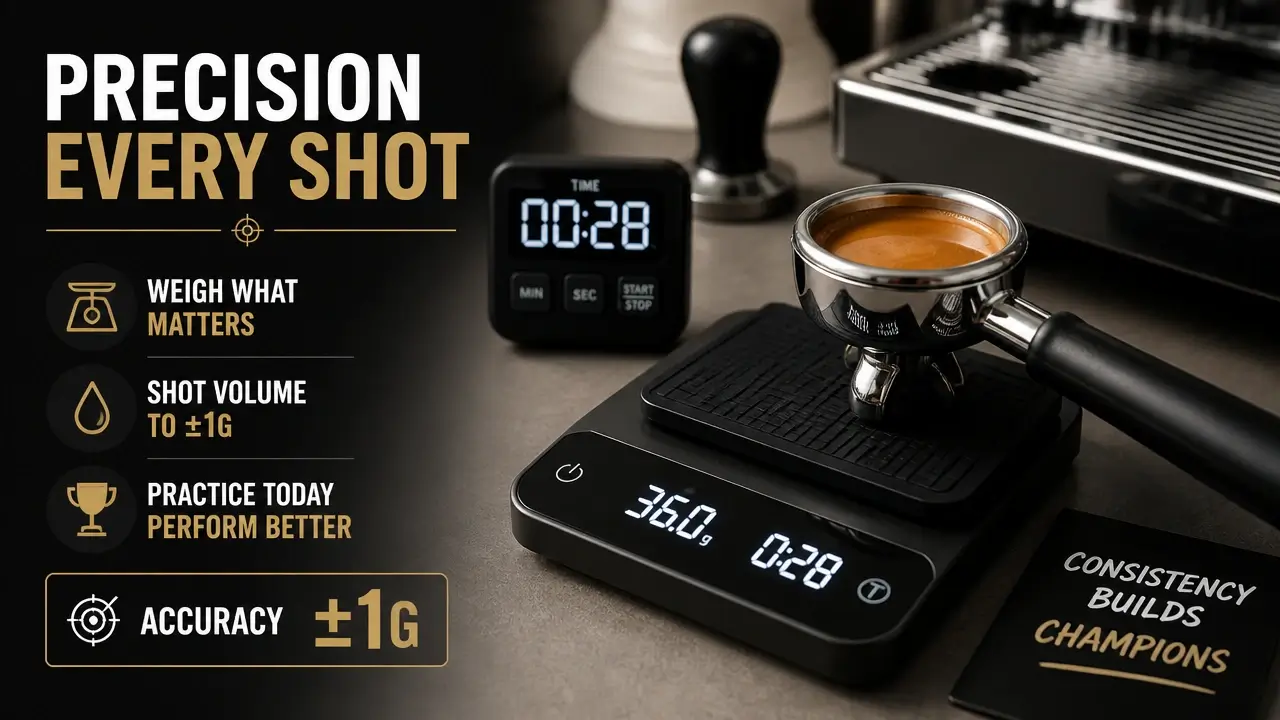
- Consistency is a number, not a feeling: target ±1g shot yield variance, ±1 second shot time, and ±0.5°C brew temperature drift.
- A pre-planned failure recovery script – practiced to the same depth as the main routine – is what separates a complete competitor from a hopeful one.
The True Cost of the Stage: A Prerequisites Checklist
Barista competition preparation is a serious multi-month project, and the first question to answer honestly is whether you’re actually ready to start it. This guide assumes you’re already a proficient working barista. You can dial in espresso, texture milk to a consistent standard, and pour latte art under pressure. If you’re still building those fundamentals, competition prep isn’t the next step – more floor time is.
That baseline matters because competition judges aren’t grading effort. They’re grading execution against a documented standard. Every hour you spend preparing a routine on top of a shaky technical foundation is an hour that reinforces the wrong habits.
Know Why You’re Doing This
Before the timeline, the budget, or the coffee selection, answer one question: why are you competing?
According to Holly Bastin, former Head Judge for U.S. Barista Championships from 2006 to 2010 and a foundational contributor to competition rules and scoring, purpose isn’t motivational fluff – it’s a navigation tool. She explains that “why” informs every decision throughout the preparation process. When you hit the inevitable rabbit trails – and you will – a clear purpose pulls you back to the path before those detours become full-on black holes.
This isn’t about writing a mission statement. It’s about having a decision filter. When you’re three months in, exhausted, and trying to choose between two coffees that both score well, your “why” is what breaks the tie.
Choose the Right First Competition
World Barista Championship is not a first step. Neither is a national preliminary if you’ve never performed in front of judges. Local throwdowns and regional qualifying events exist precisely to build the performance muscle before the stakes get high. Start there. The feedback loop from a smaller event – what the judges noticed, what you didn’t – is worth more than months of solo practice.
As your experience grows, you move up the ladder deliberately. The competition structure rewards competitors who understand the format from the inside, not just from watching YouTube.
Before committing months to preparation, consult this detailed guide to competition types to ensure your initial stage aligns with your current performance experience.
The Realistic Timeline
Budget six to twelve months of dedicated preparation. That’s not six months of “thinking about it while pulling shots at work.” It’s structured phases:
- Months 1–3: Coffee sourcing and cupping. Roast profile refinement. Early recipe ideation for the signature drink.
- Months 3–6: Routine development. Script writing. First full run-throughs with a sensory partner.
- Months 6–12: Repetition, stress inoculation, and locked-in consistency drilling.
Phuong Tran, 2005 U.S. Barista Champion and Director of Coffee Education at Brewed Behavior, frames this as an annual planning problem. She advises setting a full-year goal, building a detailed schedule for the entire lead-up period, then breaking that schedule into smaller time-bound tasks so progress is trackable – not just hoped for.
The key word in her framing is trackable. Vague dedication doesn’t compound. Scheduled milestones do.
Build Your Support Network
You need a coach, or at minimum a trusted sensory partner who will give you honest, objective feedback. Not a friend who’ll tell you the routine was great. Someone who will say “your milk texture was inconsistent on the second cappuccino” and mean it.
Federico Bolanos, a World Barista Champion Coach, identifies sensory skill development as the foundation of the entire coaching relationship. His view is that a barista’s ability to appreciate coffee quality at a granular level directly determines how well they can make the small brewing adjustments that produce a substantially better cup.
A coach who has competed – or judged – at a high level brings something a sensory partner alone can’t: they know exactly what the judges are looking for, and they can watch your routine through that lens.
The Budget Nobody Talks About
Here’s the part most preparation guides skip entirely. Independent baristas – those without roaster sponsorship – should budget realistically between $2,000 and $5,000 for a first serious competition attempt. That number breaks down like this:
| Cost Category | Estimated Range |
|---|---|
| Competition entry fees | $100–$300 |
| Travel and accommodation | $500–$1,500 |
| Competition-grade green coffee (10–20 lbs for sampling and practice) | $400–$900 |
| Specialty glassware and auxiliary equipment | $200–$500 |
| Coaching fees (if applicable) | $500–$1,500 |
| Signature drink ingredients and development | $200–$500 |
Ben Put, three-time Canadian Barista Champion at Monogram Coffee, points to full-environment simulation as the single most important preparation method. He recommends setting up a prep cart under a real time limit, using only the limited equipment available at competition, dialing in within the actual setup window, and running full fifteen-minute sets to music while actively visualizing the competition space.
That kind of simulation requires access to equipment, space, and time – all of which cost money or require a sponsor who can provide them. Know your resource picture before you build your plan.
Decoding the Rulebook and Score Sheet
The official rules and score sheets from your specific competition body – whether that’s the WCC, SCA, or a national organizing body – are the single most important documents in your preparation. Not this guide. Not a YouTube video from a past champion. The rulebook. Read it before you do anything else.
Every piece of advice in this article is downstream of those documents. If the rules change between editions, the advice changes too. Your preparation must serve the current judging standard, not a version from two years ago.
What the Judges Are Actually Scoring
Competition scoring typically falls into three main categories:
Sensory scores carry the most weight. Judges evaluate flavor clarity (can they identify what you described?), tactile qualities (body, texture, mouthfeel), taste balance across the espresso and milk drinks, and the overall sensory experience of each beverage. This is where your coffee selection and signature drink development either pay off or expose gaps.
Technical scores cover the mechanical execution: workflow efficiency, cleanliness, waste management, shot times, and consistency across multiple drinks. A judge watching your workflow is checking whether your movements are purposeful or reactive.
Overall impression captures professionalism, hospitality, and uniformity. Did the presentation feel considered? Did you treat the judges as guests? Were all three espresso shots, three cappuccinos, and the signature drink delivered at the right moment, in the right condition?
Flavor Calls Are Auditable Claims
This is the concept that most first-time competitors underestimate. When you tell the judges “you’ll taste dark chocolate and stone fruit with a lingering citric brightness,” you’ve just made a testable promise. The judges will taste the coffee and score whether your description matches the reality in the cup.
A vague call (“it’s complex and sweet”) scores worse than a precise call that the judges can confirm. A precise call that doesn’t match what’s in the cup scores worse than either. Your flavor descriptions are not poetry. They’re claims that must be verifiable by five independent palates.
This means your cupping process during coffee selection isn’t just about finding something delicious. It’s about finding a coffee whose flavor profile is distinctive enough, and consistent enough, that other people taste the same notes you do.
The 15-Minute Window Is a Hard Rule
The 15-minute performance window is not a guideline. Running over time in most major competition formats triggers disqualification or severe point deductions – not a gentle penalty. This shifts time management from a performance virtue into a technical rule with a pass/fail consequence.
Build your routine to run at 13 minutes in practice. That two-minute buffer absorbs a slow shot, a fumbled glassware placement, or a judge asking you to repeat something. A routine that runs at exactly 15 minutes in an empty cafe will run at 15 minutes and 30 seconds under competition adrenaline. Every time.
Sourcing Your Champion: A Cupping Protocol for Gold
Competition coffee selection is the highest-leverage decision in the entire preparation process. The coffee you choose determines your flavor calls, shapes your signature drink, and sets the ceiling for your sensory scores. Choosing wrong at this stage means months of preparation built on a weak foundation.
The mindset shift required here is specific: you’re not looking for coffee you love. You’re looking for coffee that performs under a judging lens.
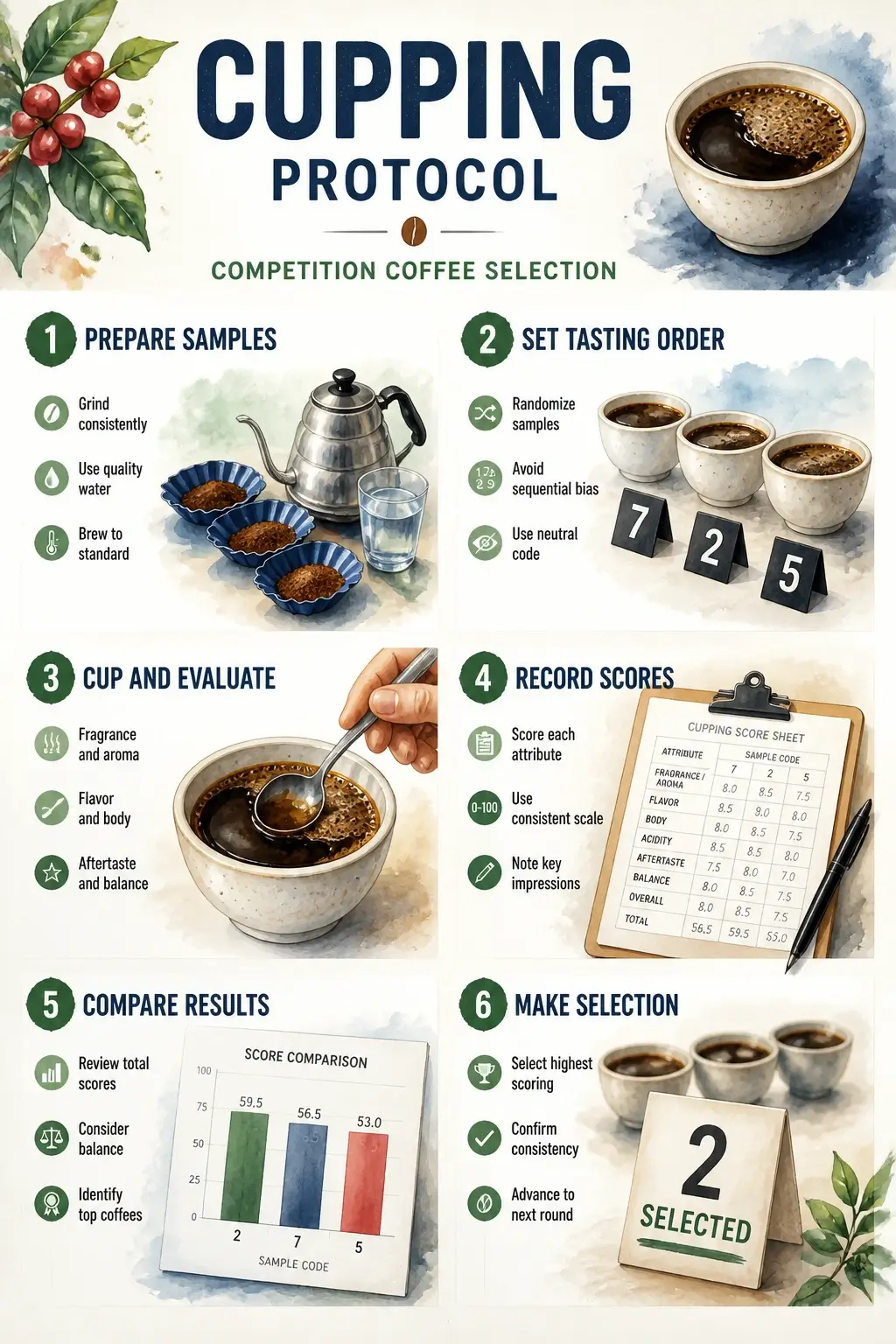
The Systematic Cupping Protocol for Competition Coffee Selection
A systematic cupping protocol for competition selection works differently than a standard quality-control cupping. The goal isn’t to find defects. It’s to identify a coffee with a flavor profile so distinct and consistent that five judges – tasting it blind, for the first time – can confirm your description.
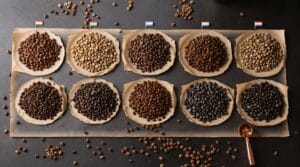
Start by cupping a wide array of samples across processing methods (washed, natural, honey), origins, and varieties. Run these sessions back-to-back over several weeks, not as one-off tastings. You’re looking for a coffee that stands out narratively. Clean acidity that is bright and identifiable. Syrupy body that creates a tactile impression. Sweetness with enough character to anchor a signature drink built around it.
The selection criteria in order of priority:
- Flavor distinctiveness: Can you describe it in three specific, verifiable notes?
- Consistency: Does it taste the same across three separate cuppings on different days?
- Sweetness foundation: Is there enough inherent sweetness to support a signature drink without masking the coffee?
- Clean finish: Does the aftertaste reinforce the flavor call, or does it drift into something muddier?
Keep a cupping log for every session. Record the sample code, the origin and processing method, your flavor descriptors, and a numerical score. This log becomes the raw material for your presentation script. When you’re on stage describing the coffee’s origin story and flavor profile, you’re drawing from documented, tested observations – not improvising.
Below is a visual breakdown of the full competition cupping workflow:
Roast Profile Partnership and Refinement for Competition Coffee
Once you’ve selected your coffee, the work isn’t done. It’s entering a second, equally critical phase: roast profile refinement. The coffee that won you over at cupping was roasted a specific way. That roast may not be the optimal roast for competition.
If you’re not a roaster yourself, this is where the partnership conversation begins. Approach your roaster with a clear brief: you need a profile that amplifies this specific coffee’s sweetness and mouthfeel, without introducing roasty or smoky flavors that would muddy your flavor calls. The retail profile for a single-origin or blend is optimized for a different audience. Your competition profile is optimized for five trained palates scoring against documented criteria.
The practical method is straightforward: cup the same coffee across multiple roast degrees, varying development time as the primary variable while keeping everything else constant. You’re listening for the roast that makes the coffee’s unique character louder – not the roast that makes it taste “good.” There’s a difference. A slightly lighter development might preserve a delicate floral note that disappears at 30 seconds longer. A slightly extended development might push a raw brightness into something more rounded and scoreable.
Cup as many iterations as it takes. The roast profile is not a detail. It’s the translation layer between the raw potential of your green coffee and what the judges actually taste.
Engineering Your Signature Beverage
Signature beverage development is where the competition’s creative ceiling lives, and where most competitors either soar or overcomplicate things into a mess. The brief here is deceptively simple: build a drink that makes your espresso more of what it already is.
For deeper exploration of what champions have actually built and why their approaches worked, the signature drink secrets behind past competition winners reveal patterns that go far beyond clever ingredient combinations.
The Coffee-Forward Edict
The coffee-forward edict is non-negotiable in judging. The espresso must remain the dominant, identifiable element of the signature drink. Not a background note. Not one layer among many. The star.
This means every ingredient you introduce must serve the espresso, not compete with it. A floral tea infusion that amplifies a jasmine note in the coffee is serving the espresso. A sweet caramel syrup that buries the coffee’s natural sweetness is masking it. Judges have tasted enough signature drinks to recognize the difference immediately.
The “Work Backwards” Framework
Start with the espresso’s two or three dominant tasting notes – the ones you’ve confirmed across multiple cuppings with multiple tasters. Then ask: what ingredient either complements that note (amplifies it, adds depth) or contrasts it (creates tension that resolves into something new)?
A coffee with stone fruit and milk chocolate notes might pair with a clarified tart cherry reduction that amplifies the fruit and cuts the chocolate’s heaviness. Or it might contrast beautifully against a cold, lightly salted cream that pushes the chocolate forward. Both are valid starting points. Neither starts with “what drink sounds impressive.”
Techniques worth exploring during development:
- Controlled infusions: Cold brew concentrates, tea infusions, or fruit macerations built specifically from the coffee’s flavor profile.
- Clarified acids: Citric or malic acid solutions in precise concentrations to adjust perceived brightness without adding flavor noise.
- Temperature manipulation: Serving components at different temperatures to control how flavor compounds release sequentially on the palate.
Every component must be fully reproducible on stage from prepared components. If it requires a step you can’t execute reliably in fifteen minutes, it doesn’t belong in the routine.
Federico Bolanos, World Barista Champion Coach, describes his approach to signature drink development as finding perfect synergy between the drink and the coffee itself. In one case, he and his competitor created a signature drink that reincorporated the carbohydrates lost during roasting and revealed polysaccharide sweetness from the espresso puck that had never been extracted before – making the drink not just complementary, but an actual extension of what the coffee was doing chemically.
That level of integration doesn’t come from brainstorming flavor combinations. It comes from understanding the coffee’s chemistry deeply enough to build backward from it.
Advanced Technique: Cold Processing and Its Risks
One advanced method involves chilling milk or liquid ingredients to near-freezing – around 0°C – using a cold-alcohol bath, preserving texture and sweetness without dilution. The result is a mouthfeel that’s distinctly different from standard refrigerated ingredients.
If dry ice enters your development process: stop and read this carefully. Dry ice sits at -78.5°C and causes instant frostbite on unprotected skin contact. As it sublimates, it releases CO₂ gas that displaces oxygen in enclosed spaces, creating a genuine asphyxiation risk in a sealed or crowded competition prep area. If you use it, the protocol requires insulated cryo-gloves and mandatory use in a well-ventilated space only. Never in a sealed prep room.
The equally effective, lower-risk alternative is pre-chilled mixing vessels and calibrated refrigeration to hold ingredients at target temperature. This is the recommended primary method. The cold-alcohol bath is an advanced option for controlled environments, not a shortcut.
The following video demonstrates an ice-extraction method that uses temperature as a flavor tool – the same underlying principle applied to coffee extraction itself:
Record Everything
Treat the signature drink development process with the same rigor as the cupping protocol. Log every iteration: the ingredients, ratios, preparation method, and tasting notes. Have a sensory partner blind-taste the drink alongside a straight espresso and report whether the coffee reads as dominant. If they can’t identify the coffee as the lead element, the recipe needs adjustment – not the espresso.
The Consistency Protocol: Defining “Good Enough”
Measurable consistency targets are the thing almost nobody in the industry actually publishes, which is why “be consistent” remains the most useless piece of competition advice in circulation. Consistency is not a feeling. It’s a number. And you need to know the number before you can practice toward it.
Here’s what an acceptable window of drift looks like during a performance run:
| Parameter | Target | Acceptable Variance |
|---|---|---|
| Shot yield | Dialed target weight | ±1g |
| Shot time | Dialed target time | ±1 second |
| Brew temperature | Programmed set-point | ±0.5°C |
According to Dale Harris, 2017 World Barista Champion and Founder of Ithaka Coffee, pulling consistent espresso shots is genuinely difficult. He notes that the traditional parameters – changing dose and grind size – are often clunky, slow to respond, and inaccurate. The implication is that consistency isn’t just about discipline; it requires understanding which variables in your system actually respond predictably and which ones introduce noise.
Knowing that distinction is what separates a barista who “tries to be consistent” from one who has a calibrated system.
The Daily Calibration Ritual
Every practice session starts the same way: pull a baseline shot, taste it critically, and make the micro-adjustments needed to bring the coffee back to your target flavor profile. Temperature changes overnight. Humidity shifts. The coffee ages. Your grinder’s burrs warm up differently depending on how long the shop has been open.
None of that is an excuse. All of it is a variable you account for before a single routine rep begins.
The calibration ritual takes five minutes. Skipping it means your first three routine reps are built on an undialed foundation, and you’re practicing inconsistency.
The Correction Drill
This drill builds the diagnostic muscle that calibration alone can’t develop. Have your coach or practice partner change your grinder setting by one micro-click – without telling you. Pull a shot. Diagnose what you observe from the flow rate and taste. Verbally state the correction before pulling the next shot.
The point isn’t to catch the sabotage. It’s to train your brain to read a shot and respond with a specific, technical answer – not a shrug. In a real routine, you won’t have a coach to tell you something drifted. You’ll only have the shot in front of you and thirty seconds to decide what to do about it.
The Manual Mode Mandate: Forging Equipment Independence
Equipment independence training is the preparation step that separates competitors who perform well at home from competitors who perform well on stage. The machine you’ve practiced on for six months has quirks you’ve unconsciously adapted to. Auto-volumetrics that stop the shot at your dialed weight. A built-in scale that auto-tares when you place the cup. A shot timer that starts automatically. These features aren’t making you more consistent. They’re making you dependent.
Understanding what judges are actually evaluating during your technical execution – the full picture of the judging criteria at championship level – reveals just how exposed a machine-dependent workflow becomes under scrutiny.
Identify the Competition Machine Early
The exact competition machine model is typically announced months before the event. Find out what it is as early as possible and get hands-on time with it. The pump pressure, the group head geometry, the steam wand angle – all of it feels different from what you know. The earlier you start building familiarity, the less cognitive load you’re carrying on competition day.
Beyond the Machine
Auxiliary gear shapes your workflow in ways that compound across fifteen minutes. The specific tamper weight and diameter affects your tamp consistency. The milk pitcher size and spout shape changes how your pour initiates. The knock box position relative to your dominant hand determines whether your workflow flows or stutters.
None of these are dramatic differences individually. Together, they add up to a routine that either feels natural or fights you the whole way. Test every piece of your auxiliary setup on the competition equipment before you lock in your workflow.
The Manual Mode Practice Protocol
Here’s the specific drill: identify every automated feature on your practice machine – auto-volumetrics, auto-tare scales, built-in shot timers, pre-infusion programs. Then systematically disable them, or cover the displays. Run your full routine using only an external timer and a standalone scale.
Do this for at least five complete, unassisted run-throughs. The goal is to build what you might call a “manual mode trigger” – a brain state where your hands know exactly what to do regardless of what the machine is or isn’t telling them.
The competitor who trained only on a machine with an auto-tare scale will, on competition day, place a cup and wait a half-second for a number that never appears. That half-second is visible. Judges see it.
The Spares Inventory Checklist
Pack backups for every critical component. Not as an afterthought – as a system:
- Extra portafilter baskets (same spec as your dialed recipe)
- Backup tamper (same weight and diameter)
- Replacement group gaskets
- Extra glassware for every drink in the routine
Broken glassware is one of the most common routine-disrupting events in competition, and it’s entirely recoverable if you have a spare positioned and ready. It becomes a catastrophe only when you don’t. The spare isn’t just equipment redundancy. It’s psychological security. Knowing the backup exists changes how you move around the station.
The Inner Game: A Psychological Preparation Protocol
Psychological preparation is the last phase most competitors address and the first one that shows up on stage. Technical execution under pressure is a trained skill, not a personality trait. The barista who looks calm behind the machine in front of five judges practiced being calm – they didn’t arrive that way.
Stress Inoculation via Simulation
The mechanism behind stress inoculation is simple: repeated exposure to the conditions that trigger anxiety reduces the anxiety response over time. You cannot build this resilience by practicing alone in an empty cafe. You build it by performing in front of people who are watching and evaluating.
Invite a mock panel – trusted industry peers, your coach, anyone who will take it seriously – and run a full routine for them. The social pressure of being observed activates the same physiological response as competition. Your heart rate climbs. Your hands move slightly differently. Your script, which you knew perfectly five minutes ago, suddenly requires more effort to retrieve.
Run this simulation repeatedly. The goal is not to eliminate the adrenaline response. The goal is to practice executing through it until the physical response stops disrupting the technical execution.
Record and Review
A video recording of your practice routines is the most honest feedback tool available. Watch the recordings. Not to feel proud or disappointed – to observe what the video shows.
Nervous tics you don’t notice while performing. Hurried transitions between drinks that look rushed to an outside eye. Moments where your eye contact with the judges breaks because you’re retrieving the next line of your script. A slight hunch in your posture during the signature drink preparation.
None of these are visible from inside the performance. All of them are visible on a three-minute review of the footage. This external perspective does what a coach can do when they’re present, and what your own perception can never do.
Script as Anchor, Not a Trap
A fully memorized script serves one function: it removes the cognitive load of word retrieval so your active attention can stay on extraction quality and judge engagement. The script must be internalized deeply enough that the words come out as physical reflex, freeing your mind to think about the extraction or think about the audience rather than what comes next.
That level of internalization takes more repetition than most competitors budget for. It’s not memorized when you can recite it sitting in a chair. It’s memorized when you can deliver it while simultaneously managing a shot that’s running two seconds long.
Environmental Stress-Factor Drills
Two specific drills build the focus resilience that simulation sessions alone don’t fully develop:
The Distraction Drill: Practice your full routine while a partner creates unpredictable interruptions – sudden loud music, a dropped metal pitcher, a fridge door opening and slamming. The goal is to train your brain to register the distraction and return to the current task without losing the thread. Not to ignore it – to process it and continue.
The Cold Start Drill: At a random, unannounced moment, your coach says “Go.” You launch immediately into your full script and workflow from wherever you are. Zero preparation, zero transition time. This drill replicates the adrenal switch that happens when your name is called and you walk to the machine – the sudden shift from waiting to performing. Practice that transition until it stops feeling like a shock.
The 30-Second Plan: A Mid-Routine Failure Recovery Protocol
Failure recovery is the final and most important piece of competition preparation, and it’s the one almost no preparation guide addresses directly. Every competitor prepares to execute a perfect routine. Almost none prepare for the moment the routine breaks.
That asymmetry is a strategic error. The competitor who has a practiced, pre-planned response to failure is not just more resilient – they’re actively more impressive to judges than a competitor who executes perfectly. Because judges know things go wrong. They’re watching how you handle it.
For the broader context of how competitive coffee culture evaluates performance at every level, this coffee competition guide breaks down the full landscape from local throwdowns to world-stage events.
The “Stop, Don’t Flop” Pivot Rule
The core principle of failure recovery is this: a decisive, pre-planned correction is always less damaging than a panicked hesitation. Never freeze. Freezing communicates that you don’t know what to do. A confident, immediate pivot communicates that you do.
The judges are not hoping you fail. They’re watching to see whether you’re a skilled professional who can adapt under pressure, or a rehearsed performer who falls apart when the script breaks. Give them the former.
Common Failure #1: The Choked Shot
A shot choking – running too slow, producing a dense, over-extracted pull – is one of the most common technical failures on stage. The recovery protocol is a verbal pivot:
“I’m seeing the extraction running too slowly, which will mute the sweetness I described. I’ll adjust to a coarser grind and pull again.”
Then immediately: purge the group head, adjust the grinder, redose, and pull. The commentary transforms a technical error into a demonstration of sensory expertise and calibration skill. The judges watched you diagnose a problem in real time and fix it with precision. That’s not a failure. That’s a showcase of mastery.
Rehearse this script until it comes out as naturally as the main routine.
Common Failure #2: Broken Glassware
The physical protocol here is silent and procedural. Do not acknowledge the break verbally to the judges. Step away from the glass. Retrieve the pre-positioned backup from your tray. Resume the exact step in the workflow.
The key word is pre-positioned. The backup glassware must be placed on your tray before the routine begins, in the exact position you’ll reach for it. A backup you have to search for is almost as disruptive as having none. Practice the retrieval motion until it’s automatic.
The Time-Drastic Cascade Script
The most destructive failure pattern isn’t a single mistake. It’s the cascade – one error causes a second, time compresses, and the routine unravels. The time-critical script is the tool that stops the cascade before it starts.
Here’s how it works: during preparation, identify one or two non-essential narrative lines in your script that can be cut without damaging the sensory scoring. Mark them. Then practice your routine in two versions: the full script, and the time-critical script with those lines removed.
If you reach the signature beverage stage more than 45 seconds behind your practice cue, you execute the time-critical version. The cut is pre-decided, pre-practiced, and automatic. It does not require a new decision under pressure. The decision was made in rehearsal.
The Self-Correction Loop
Combine the numeric targets from the consistency protocol with the recovery script, and you have a complete self-correction system. If your shot time drifts outside the ±1-second window, the recovery line is already written:
“That extraction ran just outside my target time, so I’m adjusting the grind flow by one click to bring it back into the balance I described.”
What sounded like a mistake now sounds like real-time calibration by a barista who knows exactly what their coffee needs. That reframe is not spin. It’s accurate. You are calibrating in real time. The difference is that you practiced the language for it, so the judges hear expertise instead of error.
Frequently Asked Questions About How to Prepare for a Barista Competition
How many hours a week should I practice leading up to a competition?
There’s no universal number, but the quality of practice matters more than the volume. Structured sessions with a coach or sensory partner – even three focused hours a week – outperform ten hours of unguided repetition. Prioritize deliberate drilling over accumulating floor time.
What’s the difference between a throwdown and a sanctioned competition?
Throwdowns are informal, usually single-skill events (latte art, speed) with no standardized judging criteria. Sanctioned competitions use official score sheets, certified judges, and a structured format that counts toward national or world qualification. Use throwdowns to build performance comfort; use sanctioned events to actually compete.
Can I compete with a coffee I didn’t select myself?
Yes, and many sponsored competitors do. The key is that you must be able to describe the coffee’s flavor profile with enough precision and accuracy that judges can confirm your calls. Whether you sourced it or your roaster handed it to you is irrelevant to the score sheet.
What happens if I run out of time mid-routine?
In most major competition formats, running over the time limit results in immediate disqualification or a severe point deduction – not a minor penalty. This is why the time-critical script exists: a pre-practiced, shortened version of your routine that you execute if you fall behind your cue by more than 45 seconds.
Do I need to explain the coffee’s origin story in my presentation?
The rules don’t mandate a specific narrative structure, but a compelling origin story strengthens your overall impression score and gives context to your flavor calls. More importantly, it gives the judges a reason to care about what’s in the cup before they taste it.
How early should I identify the competition machine model?
As early as possible – ideally the moment registration opens. Machine models are typically announced well in advance. Every week of practice on the actual competition machine (or a matching model) reduces the cognitive load you’ll carry on stage.
What’s the biggest mistake first-time competitors make?
Treating the signature drink as the centerpiece of the routine rather than the espresso. Judges score the signature drink heavily, but the coffee must remain the dominant element. A technically impressive drink that buries the espresso’s flavor profile will lose to a simpler drink where the coffee shines through.
Should I watch recordings of past champions before building my routine?
Watch them to understand the format and pacing – not to copy the structure. The most successful routines are built backwards from a specific coffee’s story, not forwards from a template. Borrowing another competitor’s framework without a coffee to match it produces a routine that feels generic to experienced judges.
References
- Secrets of Phuong Tran | baristamagazine.com
- Tips from Holly Bastin | baristamagazine.com
- Secrets of Barista Competitor Ben Put | baristamagazine.com
- How to Choose a Coach for Barista Championships | perfectdailygrind.com
- World Barista Champion Coach Federico Bolanos: The Sprudge Interview | sprudge.com
- How to Improve Grinding Consistency for Espresso | perfectdailygrind.com