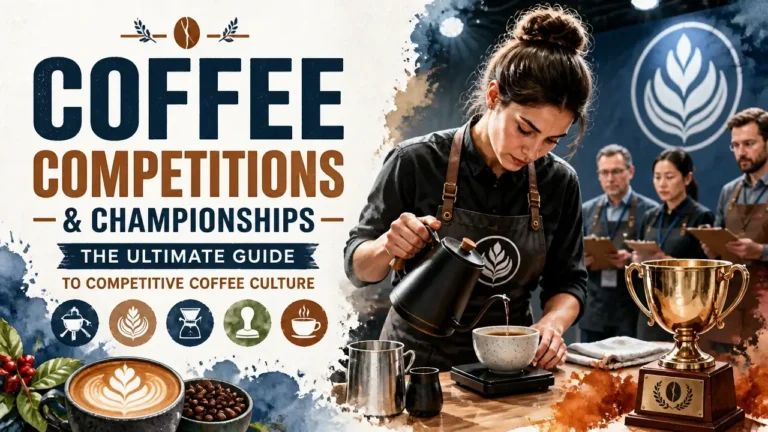

Serious coffee competitions are not trade-show theater. They are structured, rules-driven contests where the world’s most skilled coffee professionals perform under trained judges, with careers, credibility, and industry trends riding on the outcome. The World Coffee Championships alone encompasses seven disciplines, from espresso performance to blind tasting to traditional Cezve preparation.
What happens on those stages doesn’t stay there. Equipment born in competition ends up behind café counters. Processing methods championed by finalists reshape sourcing decisions at origin. If you want to understand where specialty coffee is going, watch where competitors are already pointing.
While modern competitors chase perfection on stage, the industry’s roots run much deeper, as explored in Blood Beans amp Billions The.
Key Takeaways on Coffee Competitions
- Coffee competitions are judged professional events with strict rules, not marketing sideshows – they set real industry standards.
- World Coffee Events runs seven distinct disciplines, each testing a different skill from espresso performance to blind tasting to roasting.
- Judging panels split into sensory and technical judges using detailed scoresheets, but TDS measurements alone don’t guarantee a cup tastes good.
- The qualification path runs from national championships to the World Coffee Championships, with a full competitive season in between.
- The real barrier to entry isn’t skill – it’s funding, with a full competitive season costing between $10,000 and $12,000 before coffee costs.
- Competition innovation consistently filters into everyday café culture, from equipment design to processing methods to brew recipes.
What Coffee Competitions Actually Are
Coffee competitions are not marketing events dressed up as sport. They are organized professional contests where coffee specialists – baristas, roasters, tasters – perform a defined set of tasks and get scored against rigorous criteria by trained judges. The Specialty Coffee Association (SCA), through its competition arm World Coffee Events (WCE), sets the global rulebook.
The dual purpose is worth understanding. On one level, competitions recognize individual craftsmanship. A barista who spends months perfecting a 15-minute routine earns something no résumé line can fully replicate: a public, verified demonstration of skill. On another level, competitions drive the entire specialty coffee industry forward. When hundreds of professionals compete under shared standards, those standards rise. Techniques get refined. Ingredients get scrutinized. The bar moves for everyone, not just the people on stage.
The highest tier is the World Coffee Championships (WCC), and the path to it runs through national qualifiers. A barista in Australia, for instance, must first win or place at the national level to earn a spot representing their country at worlds. The competition circuit is genuinely tiered – local events feed regional ones, which feed nationals, which feed the world stage.
These events also function as career infrastructure. A strong competition performance opens doors that years of quiet café work might not. Titles attract consulting offers, roastery partnerships, and speaking invitations. For many professionals, the competition stage is the single most accelerating move they can make.
Here’s a look at how one of those events actually unfolds:
Watch the 2026 Australian Coffee Championships to see what a real competition floor looks like – the timing pressure, the judge interactions, and the precision required at every step.
The 7 Major Types of Coffee Championships
Coffee competition is not a single event. It is a full menu of disciplines, and each one tests a genuinely different skill set.
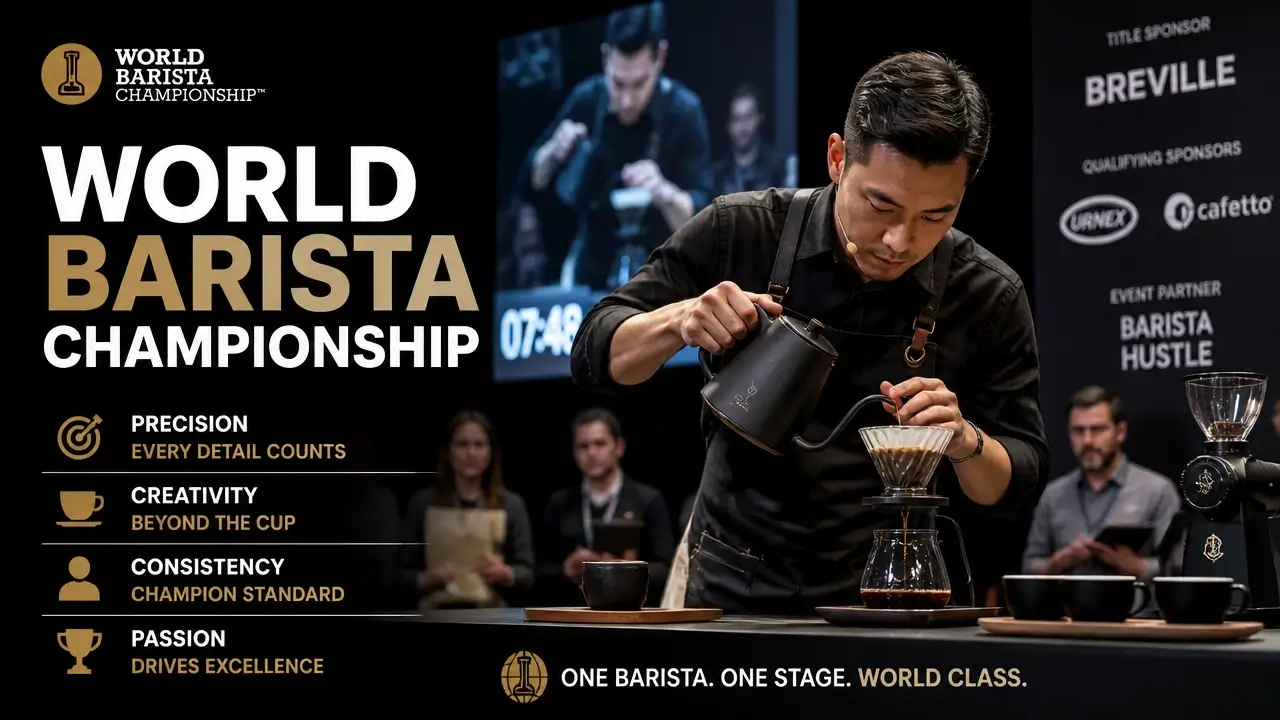
The World Coffee Championships currently runs seven official disciplines under the WCE framework:
1. World Barista Championship (WBC) The flagship event. Competitors deliver a 15-minute performance: four espressos, four milk beverages, and four signature drinks, all served to a judging panel. It tests technical precision, sensory knowledge, and presentation under pressure.
2. World Brewers Cup Manual filter brewing, evaluated on taste quality and the competitor’s technical understanding of their chosen method. No espresso machines. The emphasis is on extraction control and flavor clarity.
3. World Latte Art Championship Competitors pour two pattern-based drinks and one original design. Judges score visual symmetry, contrast, creativity, and execution. It looks theatrical because it is – but the motor control and consistency required are genuinely difficult.
4. World Coffee in Good Spirits Championship Coffee-based cocktails, both hot and cold. This discipline sits at the intersection of barista craft and bartending, and it has its own dedicated following among professionals who work in both worlds.
5. World Cup Tasters Championship Pure sensory skill. Competitors identify the odd cup in a series of triangulated sets – three cups, two identical, one different – as fast and accurately as possible. Speed matters as much as accuracy. The best competitors finish in minutes.
6. World Coffee Roasting Championship Roasters are evaluated on their ability to analyze green coffee, develop a roast profile, and produce finished coffee that scores well on quality. This is the behind-the-scenes discipline most café customers never see, but it determines the flavor potential of everything else.
7. Cezve/Ibrik Championship Preparation of traditional Turkish-style coffee using a cezve. This discipline preserves a specific cultural practice within the global competition structure, honoring a brewing tradition that predates espresso by centuries.
Each of these disciplines has its own community, its own circuit of national qualifiers, and its own coaching culture. The WBC draws the largest mainstream audience. The Cup Tasters Championship draws the most obsessive sensory nerds. The Cezve/Ibrik attracts competitors for whom cultural authenticity is the whole point.
There is a stage here for every professional passion. If you work in coffee at any level, one of these seven disciplines is almost certainly testing something you care about.
Inside the Arena: How Competitions Are Structured and Judged
The judging in coffee competitions is not purely subjective – but it is not purely objective either. That tension is the most interesting thing about how these events actually work.
Competition Flow, Judge Panels, and Scoresheets
Most competitions run through preliminary rounds, semi-finals, and finals, with competitors performing a set routine or completing a defined task within strict time limits. Advance or go home. The format is closer to gymnastics or figure skating than to a typical food festival tasting.
The judging panel is split into two functions. Sensory judges taste the drinks and evaluate flavor, balance, texture, and presentation. Technical judges watch the competitor’s workflow: cleanliness, efficiency, waste, and adherence to the rules. Both sets of judges score independently using detailed scoresheets – structured documents that break performance into specific, weighted criteria. There is no single “overall impression” score. Every element earns its number.
Scoresheets are the backbone of consistency. They force judges to articulate why a cup is good or not, rather than just reporting a gut feeling.
The World Barista Championship Example and Judging Calibration
The World Barista Championship makes the structure concrete. Each competitor gets exactly 15 minutes. In that window, they must serve 12 drinks to the panel: four espressos, four milk beverages, and four signature drinks. Four sensory judges evaluate the drinks. Two technical judges watch the process. Every movement, every cup, every word spoken is on the clock.
Calibration is built into the system. Before competitions begin, judges undergo training sessions and shared tasting exercises to align their palates and interpretations. The goal is to make sure a “7 out of 10” means the same thing to every judge on the panel, not just to the one who happened to be in the right mood that morning.
But here is where it gets complicated. In the Brewers Cup, judges also use a refractometer to measure the extraction yield of the brewed coffee. The device reads Total Dissolved Solids (TDS) – essentially, how much coffee material ended up in the cup. The industry’s widely cited “golden window” of 18–22% extraction yield is a statistical correlation developed from large consumer preference studies. It is not a flavor guarantee.
The same TDS reading can come from a bitter, hollow cup or a beautifully sweet one, depending on grind distribution, water chemistry, and the bean’s own cellular structure. A refractometer tells you how much dissolved. It does not tell you what dissolved or whether those compounds taste good together.
Academic Evidence: A peer-reviewed analysis in the Journal of Food Science found that the classic Coffee Brewing Control Chart’s “ideal” extraction window oversimplifies flavor quality. Sensory attributes and consumer preferences follow far more complex patterns than the chart’s three-region model suggests – the same extraction yield can correspond to a wide range of flavor outcomes. – From the study “A new Coffee Brewing Control Chart relating sensory properties and consumer liking to brew strength, extraction yield, and brew ratio“
What this means in practice: a judge who leans too heavily on the refractometer reading risks rewarding a coffee that hits the correct number but tastes mediocre. The measurement tool removes one kind of subjectivity while introducing a different kind of blind spot. Most spectators watching a Brewers Cup have no idea this tension exists. Now you do.
The Path to the Stage: How to Qualify and Prepare
Understanding what a coffee competition is is the easy part. Getting onto the stage is a different challenge entirely, and the official resources only tell you half the story.
Qualification Ladder: From National Championships to Worlds
The qualification ladder is straightforward in structure. To compete at the World Coffee Championships, you must first win or place highly enough at a recognized national championship in your country. Win the U.S. Barista Championship, and you represent the United States at worlds. Finish second, and you go home and prepare for next season.
Some regions add an additional layer. Preliminary or regional events serve as stepping stones before a national final, meaning the competitive season can span many months before a competitor ever stands on a world stage. This is not a single event you sign up for in October. It is a year-long campaign.
Preparation, Coaching, and the Hidden Cost Barrier
Serious competition preparation is a production. A competitor selects their coffee, designs a full beverage menu, writes and rehearses a scripted 15-minute presentation, and refines their physical technique through hundreds of repetitions. The signature drink alone – the creative centerpiece of a WBC routine – can require months of research and development, involving unusual flavor combinations, non-standard ingredients, and extensive sensory testing.
Most competitive campaigns involve coaches who have competed themselves, roaster partners who supply competition-grade coffee, and practice judges who simulate the real panel before the event. It is a team effort that looks like a solo performance.
For deeper breakdowns of specific preparation strategies and signature drink creation, the discipline-specific guides cover those details directly.
Here is what the official resources never tell you, though. Across all major institutional sources – from the United States Coffee Championships to the World Coffee Championships website – there is essentially no information on entry fees, equipment costs, travel expenses, or the realities of sponsorship. The implicit assumption is that competitors are employer-funded or independently wealthy.
Statistical Data: The total cost of competing in a major coffee competition season, not including coffee itself, runs between $10,000 and $12,000. – Source: The Pour Over
That figure covers entry fees, equipment rentals or purchases, travel, lodging, and coaching time. For an unsponsored barista working café shifts, this is not a minor logistical detail – it is the single largest obstacle between aspiration and the stage. The funding puzzle exists before the signature drink recipe, before the training schedule, before any of the skills work. No official guide will map it for you. That silence is itself a structural barrier worth naming.
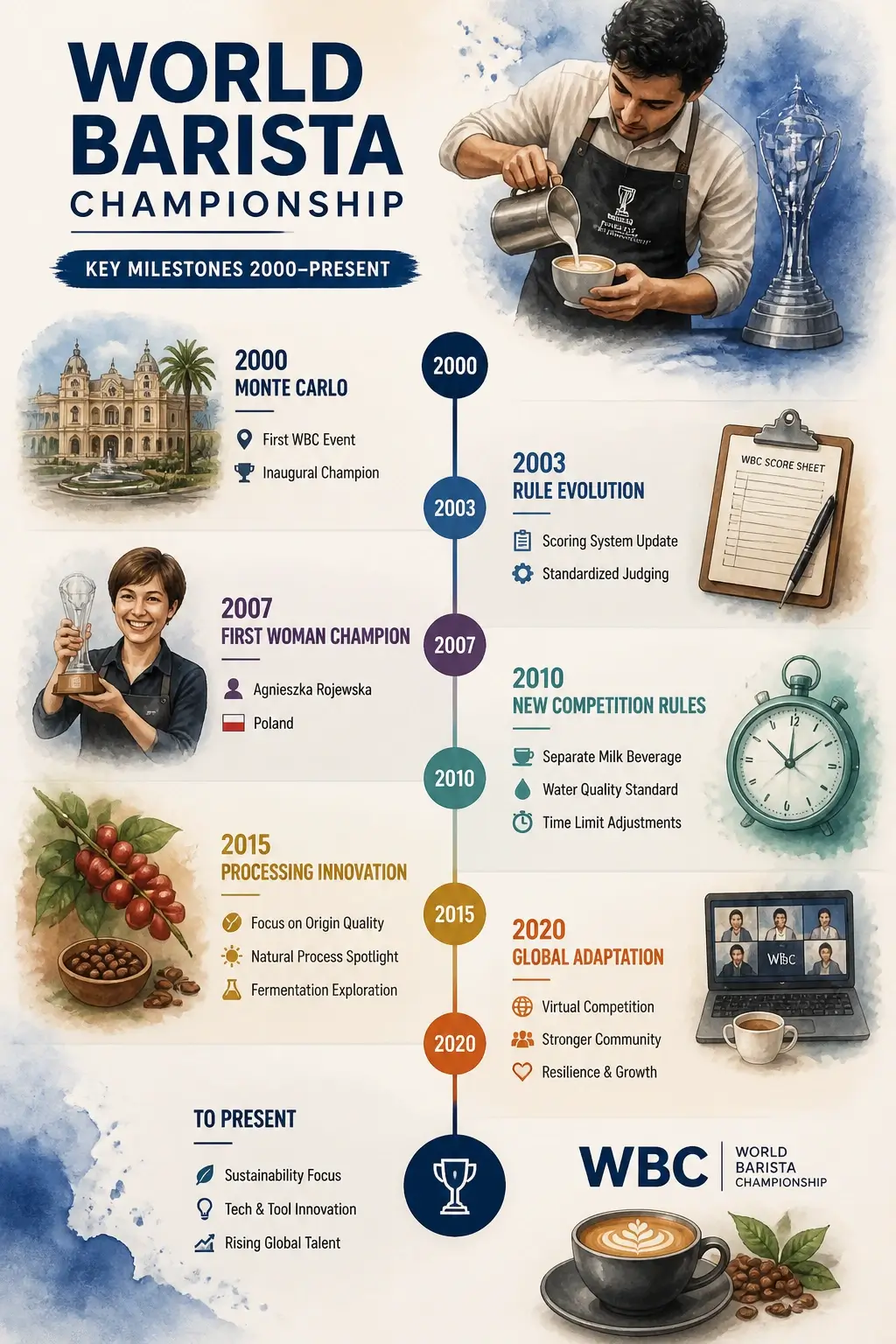
A Timeline of the World Barista Championship
The World Barista Championship began in 2000, held in Monte Carlo, and it set the template for what competitive coffee would become. A single annual event. A defined format. A world champion.
For the first decade and a half, the rules evolved incrementally. Then 2016 brought a significant structural shift: the WBC introduced provided Mahlkönig grinders and new standardized espresso machines for all competitors, leveling the equipment playing field and removing one variable that had previously favored well-funded campaigns. The “cappuccino” category was also broadened to “milk beverage,” giving competitors more latitude in how they expressed that part of their routine.
2018 marked a turning point in the competition’s cultural history. Agnieszka Rojewska of Poland became the first woman to win the World Barista Championship. Her win was not just symbolic – it shifted the conversation about who competes, who wins, and who gets mentored into elite-level preparation. Her subsequent career as a competitor and ambassador made her one of the most recognized figures in the sport.
In 2023, the WBC updated its rules to permit infused and co-fermented coffees in competition. This was a direct response to the specialty coffee industry’s growing interest in processing innovation, where producers manipulate fermentation conditions to develop specific flavor profiles in the green coffee. Allowing these coffees on stage legitimized a trend that had been building at origin for years.
The event now rotates across continents, with national bodies from dozens of countries feeding competitors into a single world final. The scale is genuinely global.
One important note on the historical record, though. At least one published source on the World Barista Championship contains a winner’s table that lists Martin Hildebrandt of Denmark as the champion for every single year from 2000 through 2025. This is a template error – a repeated placeholder that was never corrected before publication – and it directly contradicts the same article’s own text, which names other champions including Rojewska in 2018. Even official-looking institutional data can be corrupted by a production error. When you research competition history, cross-reference at least two independent sources before trusting any single table.
Notable Champions, Judges, and Industry Icons
For the full history of the world barista championship, the names and narratives span 25 years. But a few figures define the culture in ways that go beyond their scorecard.
Agnieszka Rojewska is the clearest example of a champion whose impact extended far past the trophy. As the first woman to win the WBC, she changed the visible face of elite competition. Her preparation approach, her technical precision, and her post-win career as a coach and ambassador made her a reference point for an entire generation of competitors – particularly women entering a circuit where the finalist stage had historically looked very different.
Beyond individual champions, the head judges and sensory judges who operate behind the scenes carry enormous influence. Many are Q-graders, veteran roasters, or former competitors themselves. They shape the scoring criteria, train incoming judges, and set the interpretive standards that determine what “excellent” actually means in a given year. They are, in a real sense, the gatekeepers of quality – and their calibration sessions before each event have as much impact on outcomes as the competitors’ training.
The career arc after a strong competition performance is well-established by now. Champions and high-placing finalists regularly launch consulting practices, found roastery brands, or build educational platforms. The title is a credibility signal that the broader industry recognizes immediately. It opens sourcing relationships at origin, attracts wholesale accounts, and generates speaking invitations at events that have nothing to do with competition.
What often gets overlooked: the long-term volunteer judges, national body organizers, and emcees who have shaped competition culture for decades without ever standing on a winner’s podium. These are the people who kept the circuit running between the headline moments. Within the coffee competition community, they are equally iconic – and the community knows it.
The Ripple Effect: How Competitions Shape Coffee Quality, Trends, and Careers
Coffee competitions are not isolated skill contests. Their influence moves outward in ways that reach every café counter, every roastery, and every sourcing decision in the industry.
Innovation, Equipment, and Market Trends Born on the Stage
The equipment you use at your favorite specialty café has almost certainly been influenced by competition. Grinders with tighter particle distribution, espresso machines with finer pressure profiling, and brew devices optimized for extraction clarity – many of these became industry standards because competitors pushed manufacturers to solve specific problems on stage. The competition floor is a live R&D environment with a global audience.
Technique follows the same path. Brew recipes developed by Brewers Cup competitors get shared, reverse-engineered, and adapted by baristas worldwide. Latte art patterns that debuted in competition end up as training benchmarks in coffee schools. Processing methods – anaerobic fermentation, carbonic maceration, precision drying – gained mainstream attention in specialty coffee partly because competitors used them to create flavors that judges and audiences had never encountered before.
The market trendsetter function is equally real. When a WBC competitor builds a signature drink around a rare variety from a specific micro-lot, demand for that variety spikes. When a finalist’s routine tells a compelling story about a specific origin or producer, café menus start featuring that story. Competitors who understand this dynamic treat their routine not just as a performance but as a product launch.
Career Transformation, Global Community, and Geopolitical Dimensions
A strong competition result changes a barista’s professional trajectory faster than almost anything else. The credibility is immediate and internationally legible. Training roles, consulting contracts, and green coffee sourcing invitations follow. Producers at origin want their coffee on the competition stage because the exposure is unmatched. Importers want relationships with competitors because those relationships signal quality.
The community dimension matters too. Competitors from different countries share training methods, swap feedback, and build professional relationships that cross borders in ways that ordinary café work rarely enables. The global community that has formed around coffee competition is one of the most knowledge-dense networks in the food and beverage industry.
But the influence extends further than coffee itself. In 2026, World Coffee Events announced that Taiwanese competitors would be recorded under “Competition Body of Chinese Taipei,” aligning with IOC and FIFA naming conventions. The statement framed this as a purely administrative alignment. For the affected community, it was anything but administrative. How a competitor is named on the world stage touches identity, recognition, and belonging in ways that no rulebook can fully neutralize. The decision made clear that coffee competitions sit at the intersection of global culture and geopolitics – and that the organizations running them must navigate pressures that have nothing to do with extraction yield or latte art symmetry. The cupping table is never as isolated from the world as it looks.
The Verdict: Pros, Cons, and Is Competing Worth It?
This is the question that matters most if you are standing at the edge of a decision. And the honest answer is: it depends on what you are trying to build.
The benefits are real and specific. A strong competition performance accelerates career advancement in ways that years of quiet excellence often cannot. The credibility is immediately recognized across the industry. The network you build – fellow competitors, coaches, judges, roasters, producers – is dense with knowledge and opportunity. The personal growth is genuine: your palate sharpens, your workflow tightens, and your understanding of coffee deepens in ways that café shifts alone rarely produce. Even without a trophy, the preparation process transforms how you work.
The costs are equally real. The financial investment runs into thousands of dollars before you account for coffee, and as covered earlier, no official guide will help you solve the funding problem. The time commitment is substantial – months of preparation, not weeks. The stress of performing under judges in a timed routine is not for everyone, and burnout among serious competitors is a documented reality in the community. There is no guaranteed return on investment. A competitor can spend $10,000, train for six months, and finish in the middle of the pack.
The intangible is worth naming directly. Many competitors say the journey changed them regardless of placement. The discipline of designing a routine forces clarity of thought about flavor, sourcing, and storytelling. The feedback from judges gives you a calibrated external perspective you cannot replicate in your own café. The community you enter becomes a professional home.
If you are weighing whether to compete versus judge, the considerations are genuinely different. Judges influence the standards that shape the entire industry, they develop deep calibration skills, and they do it without the financial exposure of a full competitive campaign. That path deserves its own evaluation.
For those who want neither the stage nor the panel: watching these events with the context you now have is its own kind of participation. You will see things in a competitor’s routine that most audiences miss. You will understand why the judges pause, why a signature drink choice signals a specific strategy, and why a 15-minute performance can carry the weight of an entire industry’s direction.
The types of coffee competitions span far more disciplines than most people realize. Whether you compete, judge, volunteer, or simply watch with sharper eyes, these events raise the standard for everyone – and that raises the quality of every drink that follows.
Frequently Asked Questions About Coffee Competitions
How long does a typical World Barista Championship routine take?
Competitors get exactly 15 minutes to serve 12 drinks: four espressos, four milk beverages, and four signature drinks. Every second counts – running over time results in score deductions.
Can any barista enter a coffee competition, or do you need an employer to sponsor you?
Anyone can enter a national qualifier, but sponsorship from an employer or equipment brand is the practical reality for most serious competitors. The total cost of a competitive season often exceeds $10,000, which is prohibitive without external support.
How do sensory judges stay consistent across different competitors?
Before each competition, judges undergo calibration sessions where they taste the same coffees together and align their interpretations of the scoresheet criteria. The goal is to make scoring standards consistent across the entire panel.
What happens to competitors who don’t win – is there still a career benefit?
Yes. Even a strong semi-final performance builds credibility, expands a competitor’s professional network, and often attracts coaching or consulting opportunities. The preparation process itself sharpens skills in ways that translate directly to café or roastery work.
Why did the World Coffee Championships allow infused and co-fermented coffees in 2023?
Processing innovation at origin had been advancing rapidly, with producers developing specific flavor profiles through controlled fermentation. Allowing these coffees on stage reflected the competition’s role as a mirror of where the industry is actually moving, not just where it has been.
What’s the difference between a sensory judge and a technical judge?
Sensory judges taste the drinks and score flavor, balance, and presentation. Technical judges watch the competitor’s workflow – cleanliness, efficiency, rule compliance – without tasting. Both score independently, and both scores count toward the final result.
Is the World Cup Tasters Championship actually difficult, or is it just about having a good palate?
It’s both, but speed is the underrated factor. Competitors must identify the odd cup in a triangulated set of three – two identical, one different – across multiple rounds. The best competitors finish in minutes. Raw sensory ability matters, but so does mental stamina under time pressure.
How does a competition win translate into a business opportunity?
A WBC title or even a national championship result functions as an internationally recognized credibility signal. It attracts roastery partnerships, wholesale accounts, training contracts, and sourcing invitations from producers who want their coffee associated with elite competition performance.
References
- A new Coffee Brewing Control Chart relating sensory properties and consumer liking to brew strength, extraction yield, and brew ratio | doi.org
- The Cost of Competing | thepourover.coffee