
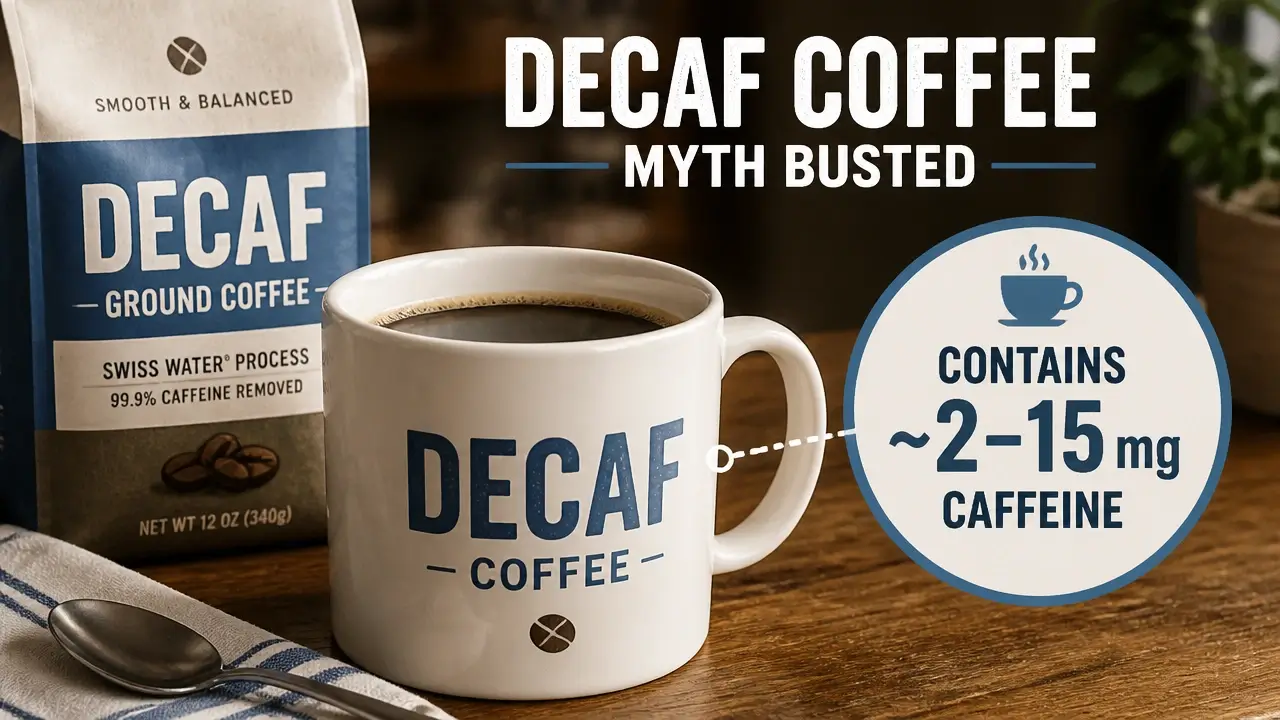
Decaf coffee isn’t caffeine-free — it’s caffeine-reduced. Most cups carry somewhere between 2 and 15 mg of caffeine, depending on the decaffeination method used and who brewed it. The Swiss Water Process pushes removal close to 99.9%, but even that leaves traces behind.
For most people, that’s a non-issue. For pregnant women watching a 200 mg daily limit, or anyone with genuine caffeine sensitivity, those small numbers add up fast. Cumulative intake is the part nobody talks about – until it matters.
The Surprising Truth About Decaf Coffee
Commercially produced decaf coffee retains a small but real caffeine residue because the industry standard only requires removing at least 97 % of caffeine, leaving roughly 3 % behind in every cup. That’s not a rounding error or a labeling loophole. It’s baked into how decaf‑decaffeination works at a process level. The coffee bean itself holds caffeine in its cellular structure, and no current commercial method pulls it all out.
Most people have never heard this. Scroll through any coffee subreddit or wellness forum and you’ll still find “TIL decaf has caffeine” posts racking up thousands of upvotes, which tells you everything about how thoroughly the “caffeine‑free” myth has taken hold. The word decaf has quietly become a synonym for zero caffeine in everyday conversation, even though that’s never been what it meant.
That gap between what people believe and what’s actually in the cup isn’t just a fun trivia point. It’s a structural information failure with real consequences on both ends of the spectrum.
Pregnant women sometimes avoid decaf entirely out of fear, when a single cup would likely fall well within safe limits. On the other side, individuals with caffeine sensitivity-those who get heart palpitations or anxiety from even small amounts-drink multiple cups of decaf assuming zero effect, then wonder why they feel wired at 10 PM.
The caffeine residue left behind after decaf isn’t a trace so small it disappears into background noise. The actual milligram count can vary more than most people expect, and for someone who reacts to caffeine, that variability is exactly where the risk lives.
Caffeine in a Cup of Decaf: The Real Numbers
Decaf coffee’s caffeine content is not the flat “trace amount” the label implies; it’s a moving target, and the range is wider than most people expect. The widely accepted window runs from 2 to 15 mg per 8‑oz cup, compared to 95–165 mg in a standard cup of regular coffee. That gap is enormous, but the number that matters most is where your specific cup lands inside that window.
Here’s why that question is harder to answer than it should be.
To benchmark these figures against single-serve pods, consult our K Cup Caffeine Levels Complete analysis to track how various brewing formats scale in daily consumption.
Decaf vs. Tea: Where the Numbers Actually Sit
Caffeine content in a typical 8‑oz decaf sits well below every caffeinated beverage you’d normally compare it to, but it’s not zero, and that distinction matters once you start stacking cups.
The table below puts decaf in context against the beverages most people reach for as lower‑caffeine alternatives:
| Beverage | Typical Caffeine (mg) | Notes |
|---|---|---|
| Brewed coffee | 95–200 | Highest of the four; a standard 8‑oz cup typically contains far more caffeine than tea. |
| Black tea | 40–70 | Usually about half or less of brewed coffee, but varies with steep time and brewing method. |
| Green tea | 20–45 | Lower than black tea and coffee; still provides measurable caffeine in a typical 8‑oz cup. |
| Herbal tea | 0 | Naturally caffeine‑free in most cases; decaf tea is different and may still contain a small amount of caffeine. |
Decaf lands below all of them-including green tea. If you’re comparing it to black tea at 40–70 mg, even a high‑end decaf cup at 15 mg is still less than a quarter of the caffeine load. Against herbal tea, though, decaf is no longer a tie. That gap matters most to people who’ve switched to decaf specifically because they believed they were drinking something caffeine‑free.
Lab Data Breaks the “~2 mg” Consensus
Branded averages on decaf caffeine variability have a consistency problem: they consistently quote the low end. Most corporate websites anchor on roughly 2 mg per cup. That number isn’t wrong-it just describes the floor, not the ceiling, and it’s nowhere close to what independent lab analysis finds.
A 2006 peer‑reviewed study used gas chromatography with a nitrogen‑phosphorus detector to measure caffeine across ten commercial decaf samples. The results ranged from 0 mg (Folger’s Instant) up to 13.9 mg per 16‑oz serving. Decaf espresso shots from a single Starbucks location in the same study varied between 3.0 and 15.8 mg per 1‑oz shot, and that’s within one chain, one location, on different days.
That’s not a rounding error. That’s a six‑fold swing from the number most consumers believe they’re drinking.
The 16‑oz cup size is where this gets practical. Order a grande or a medium at most coffee shops, and you’re already at 16 oz. If that cup lands at the high end of the documented range, you’re looking at close to 16 mg of caffeine, about 5.4 mg being a reasonable mid‑range estimate for a standard 8‑oz pour, but double that volume and you’ve already moved past what many people expect from a “decaf.”
Brewing method and bean type both pull the number in different directions, but the deeper mechanics of why belong in the next section. What the lab data establishes here is simpler: the gap between the marketed average and the real upper bound isn’t a technicality. For anyone drinking decaf for medical reasons, pregnancy, or caffeine sensitivity, that gap is the ballpark where the risk actually lives.
How the Decaffeination Method Drives Caffeine Levels
The decaffeination method your coffee went through is the single biggest variable controlling how much caffeine ends up in your cup. Not the roast level. Not the brew time. The process used before the beans ever reached your bag. And since most labels don’t tell you which method was used, you’re often flying blind.
Here’s what’s actually happening inside each approach-and why it matters.
Three Ways to Pull Caffeine Out of Coffee
Every decaffeination method shares the same core goal: strip caffeine from green coffee beans while leaving the flavor compounds intact. That’s harder than it sounds, because caffeine doesn’t travel alone-it’s bound up with the same chemical matrix that gives coffee its taste. The three methods just take different routes to the same destination.
- Swiss Water Process: Uses only hot water and a proprietary carbon filter. No added chemicals. The beans soak in a caffeine‑saturated water solution, and the filter continuously pulls caffeine molecules out while the flavor compounds stay behind.
- Direct Solvent Method (Methylene Chloride): A chemical solvent-most commonly methylene chloride-is applied directly to the beans to bind with caffeine molecules, which are then rinsed away. The solvent evaporates during roasting.
- CO₂ Process: Pressurized carbon dioxide acts as a solvent at a specific temperature and pressure where it behaves like both a liquid and a gas. It’s highly selective for caffeine and leaves flavor compounds largely undisturbed.
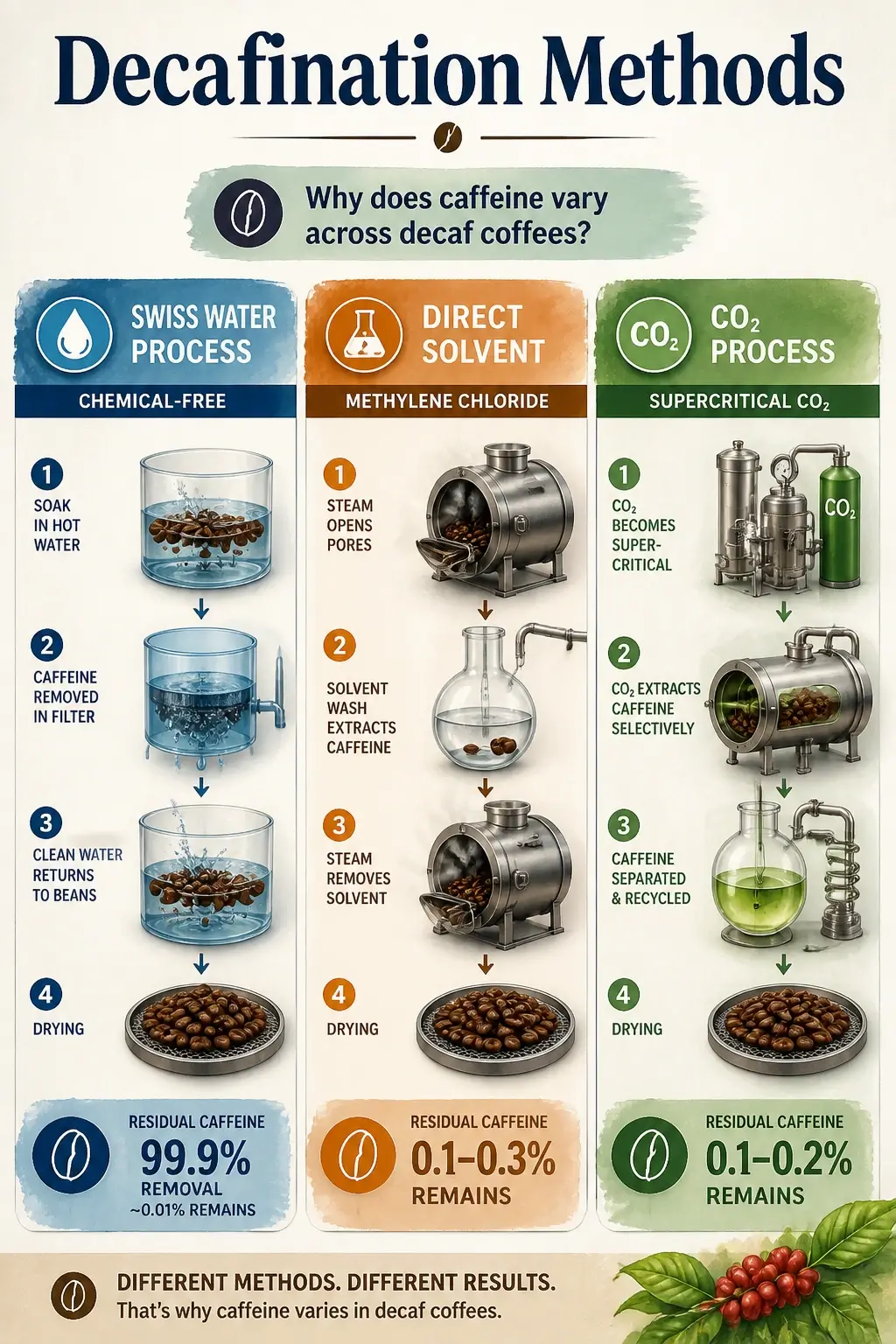
Each route leaves a different amount of caffeine behind, and that gap is where the variability in your cup actually comes from.
Swiss Water Process Removes the Most Caffeine
The Swiss Water Process is the most documented low‑caffeine option available, and the mechanism explains why. Rather than relying on a chemical affinity for caffeine, it uses a continuous filtration loop: the carbon filter keeps pulling caffeine out of the water until the beans reach 99.9 % caffeine removal-typically around 1 to 2 mg per cup.
Solvent‑based methods like methylene chloride are FDA‑approved and considered safe at the residue levels that survive roasting. If you’re not sensitive to trace chemicals, the safety profile is well‑established. But the industry standard for solvent decaf targets roughly 97 % caffeine removal-not 99.9 %. That gap is small in absolute terms, but if you’re someone who reacts to even a few extra milligrams, it’s the difference that matters.
The honest caveat here: direct head‑to‑head trials comparing caffeine residue across methods aren’t publicly available at the brand level. What we have is the mechanistic rationale-and it strongly favors Swiss Water. A water‑only extraction with continuous carbon filtration, running until the beans hit a verified 99.9 % threshold, is structurally built to go lower than a solvent rinse that stops at 97 %.
Stacey Lynden - Cupping Lab Manager for Swiss Water Decaffeinated Coffee Inc., describes the endpoint precisely:
“When the coffee is 99.9% caffeine free (after about 10 hours) it is sent to the dryer, then bagged and shipped.”
That 10‑hour window is the process doing its job-not a shortcut. And for anyone who needs to push their daily caffeine intake as close to zero as possible, Swiss Water Process beans are the most deliberate choice you can make right now. Not because the competition has been proven worse in a controlled trial, but because Swiss Water is the only method with a built‑in, time‑verified removal target that exceeds the industry baseline.
Video: James Hoffmann – The Secretive Decaf Process Using ONLY Water
For comparison, a single shot of espresso contains roughly 65–75 mg of caffeine.
Decaf doesn’t clear that threshold. At 2–7 mg, the adenosine interference is negligible for the overwhelming majority of people. Independent sleep guidelines don’t flag decaf as a sleep disruptor-and the dark chocolate comparison isn’t just rhetorical. A 1‑ounce square of 70 % dark chocolate carries roughly 20–25 mg of caffeine. Nobody’s being told to skip the after‑dinner chocolate for sleep hygiene reasons.
So the practical rule is straightforward: switching to decaf after 2 PM is a sound, evidence‑based move for protecting sleep quality. One or two cups in the evening won’t touch your sleep architecture.
The one exception worth naming-if you have diagnosed insomnia or know you’re genuinely hypersensitive to even trace stimulants, reach for Swiss Water Process decaf specifically, which holds residual caffeine closer to 2 mg per cup, or swap to a caffeine‑free herbal tea entirely. That’s not overcaution; that’s just matching the tool to the sensitivity level.
What decaf is not is regular coffee with the volume turned down. That framing is what keeps people unnecessarily anxious about an evening cup. The dose difference between 95 mg and 5 mg isn’t a matter of degree-it’s the difference between a substance that demonstrably disrupts sleep and one that doesn’t register in the research at all.
Is Decaf Coffee Actually Safe for You?
Decaf coffee safety comes down to three numbers you should carry with you: 2–15 mg of caffeine per cup, 99.9 % removal through the Swiss Water Process, and 200 mg as the daily ceiling that matters most to pregnant drinkers. Those three anchors cover most of what you need to make a confident decision. Everything else is refinement.
If you’re caffeine‑sensitive: Your best move is to look for “Swiss Water Process” or “Water Process” on the label-that’s currently your clearest signal that the caffeine residue is as low as it can get. Cap yourself at two or three cups and pay attention to how your body responds. If you notice jitteriness or a racing pulse after your third cup, the math is telling you something. Track total intake for a few days-coffee, tea, chocolate, medications-and you’ll often find the culprit isn’t any single source but the accumulation of several small ones.
If you’re pregnant: A few cups of Swiss Water decaf fit comfortably within the 200 mg daily budget most health authorities recommend, especially once you account for other sources. The risk isn’t decaf in isolation-it’s treating decaf as a free pass while quietly adding dark chocolate, black tea, and a prenatal vitamin with added caffeine on the same day. Count everything.
If you’re an evening drinker: The trace caffeine in a standard decaf cup is low enough that it won’t meaningfully disrupt your sleep architecture. Switching after 2 PM is a reasonable, evidence‑backed choice, not a compromise.
The bigger problem isn’t the coffee itself-it’s the information void surrounding it.
“Regulation (EU) 1169/2011 and standard food regulations do not mandate specific brand‑level labeling of caffeine content in non‑flavored coffees.” - Dr. Food Safety and Labeling Team, MDPI
That gap is the real issue. No widely available resource currently gives you brand‑specific caffeine numbers. No label tells you whether your particular bag of “decaf” landed at 3 mg per cup or 15 mg. The generic “consult your doctor” advice is legally safe but practically useless for someone who just wants to know if their evening cup is going to keep them up.
So the Swiss Water label becomes your proxy. It’s not a guarantee of an exact milligram count, but it’s the most transparent signal the industry currently offers. When you see it, you know the producer chose a process built around maximum caffeine removal rather than minimum regulatory compliance.
The bottom line: decaf coffee is a safe, practical ritual for the vast majority of caffeine‑sensitive individuals, pregnant women, and evening drinkers-not despite the research, but because of it. What the research also makes clear is that your own vigilance fills the gap the industry hasn’t closed yet. Choose the most transparent process available, track your total daily intake for a few days if you’re unsure, and don’t hesitate to push back on brands that won’t tell you what’s actually in the cup.
Key Takeaways on Decaf Coffee
- Decaf coffee retains 2-15 mg caffeine per cup, not zero, due to the industry’s 97% removal standard.
- The Swiss Water Process removes 99.9% of caffeine, making it the safest choice for sensitivity or pregnancy.
- Drinking multiple decaf cups daily can cumulatively equal a weak regular coffee, triggering symptoms.
- Even decaf from the same shop can vary up to 6-fold in caffeine due to brewing and bean variables.
- For pregnant women, decaf fits easily within the 200 mg daily caffeine limit, leaving room for hidden sources.
- Evening decaf at 2-7 mg won’t disrupt sleep architecture unless you’re extremely sensitive to trace stimulants.
Frequently Asked Questions About Decaf Coffee
Q: Why does decaf coffee sometimes trigger anxiety symptoms even in people without an anxiety disorder?
A: Decaf isn’t caffeine-free. Multiple cups can push your total caffeine intake over 25 mg, which is enough to overstimulate the nervous system in sensitive individuals, mimicking anxiety. It’s the cumulative effect, not just a single cup.
Q: Why does my heart race after a few cups of decaf when I’m supposed to be caffeine-free?
A: Even low-dose caffeine in decaf adds up. Five cups at 5 mg each gives you 25 mg, enough to trigger heart palpitations in people with caffeine sensitivity. Swiss Water decaf, at 1-2 mg per cup, lowers that risk.
Q: How can the same decaf coffee from the same shop have wildly different caffeine levels on different days?
A: Brewing variables like water temperature, grind size, and contact time change how much caffeine extracts from the grounds. A study found Starbucks decaf espresso shots ranged from 3 to 15.8 mg across different days.
Q: Is there such a thing as zero-caffeine decaf coffee?
A: Almost never. One test found Folger’s Instant at 0 mg, but it’s an outlier. Swiss Water Process removes 99.9%, leaving 1-2 mg. True zero-caffeine decaf is not commercially reliable, so always expect traces.
Q: Why does Swiss Water Process decaf cost more than regular decaf?
A: The Swiss Water Process takes roughly 10 hours to remove 99.9% of caffeine using only water and carbon filtration. This extended, chemical-free method demands more resources and monitoring than solvent-based processes, which raises production costs and, ultimately, the retail price.
Q: Can I trust the caffeine content listed on a decaf label?
A: Most decaf labels don’t state actual milligrams. Brands often quote a low average of 2 mg, but independent lab tests show up to 13.9 mg per 16-oz cup. The Swiss Water label is your best indicator of minimal caffeine.
References
- Decaffeinated Coffee Caffeine Content Study – academic.oup.com
- Understanding the Process: Swiss Water Decaffeination – baristamagazine.com
- The Secretive Decaf Process Using ONLY Water – youtube.com
- Everyday Dose Caffeine Sensitivity Survey – finance.yahoo.com
- Caffeine and Health Implications Review – mdpi.com
- ACOG Clinical Guidelines – acog.org
- Maternal Caffeine Consumption Study – mdpi.com
- EU Food Labeling Regulations and Caffeine – mdpi.com