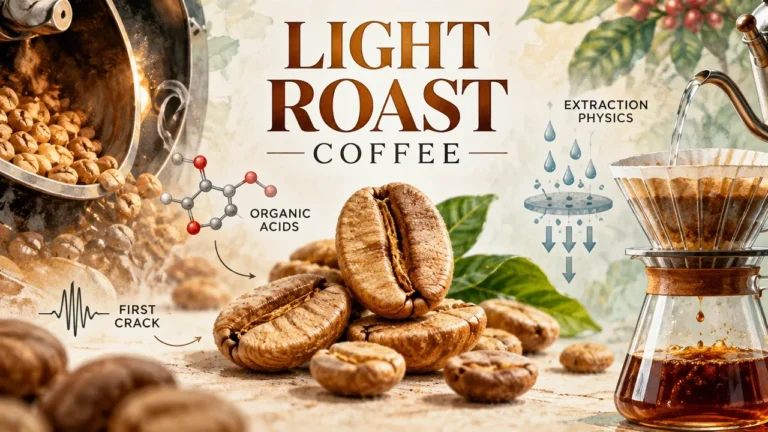

Light roast coffee earns its identity at a single thermodynamic boundary: the moment First Crack completes. Stop the roast there, and you preserve malic acid’s green-apple crispness, chlorogenic acid’s brightness, and floral aromatics that darker heat would destroy. Push past it, and you’re making a different drink entirely.
What most people call “light roast preference” is really a set of physical and chemical trade-offs playing out inside the bean. Understanding those trade-offs, from cellular integrity to extraction physics to caffeine math, is what separates a consistently great cup from a frustrating one.
Key Takeaways on Light Roast Coffee
- Light roast is defined by exiting the roast at or immediately after First Crack, a thermodynamic phase boundary, not a fixed temperature or color target.
- Dry, matte bean surfaces signal intact cell walls and locked lipids, not freshness; judge light roast by roast date and storage, never by surface sheen.
- Brightness and sourness are chemically distinct: brightness comes from preserved malic, citric, and phosphoric acids; sourness signals under-extraction, underdevelopment, or a roast defect.
- Light roast beans are denser and less porous than dark roasts, requiring hotter water (205-208°F), finer grinding, and more agitation to extract evenly.
- Caffeine content depends on your measurement unit: gram-for-gram, dark roast edges ahead; scoop-for-scoop, dense light roast packs more mass and slightly more caffeine.
- Transparent sourcing labels (farm, varietal, processing method, roast date) give you actionable brewing context; a bag without a roast date gives you nothing useful.
What Light Roast Coffee Actually Is: The First Crack Boundary and Roast Color
Light roast coffee is defined by a single exit point in the roast sequence: dropping the batch at or immediately after First Crack completes. Everything downstream, including flavor, density, acidity, and extraction behavior, flows from that one decision. Color is a symptom. The phase boundary is the cause.
Thermodynamic Phase Transition in Bean Development
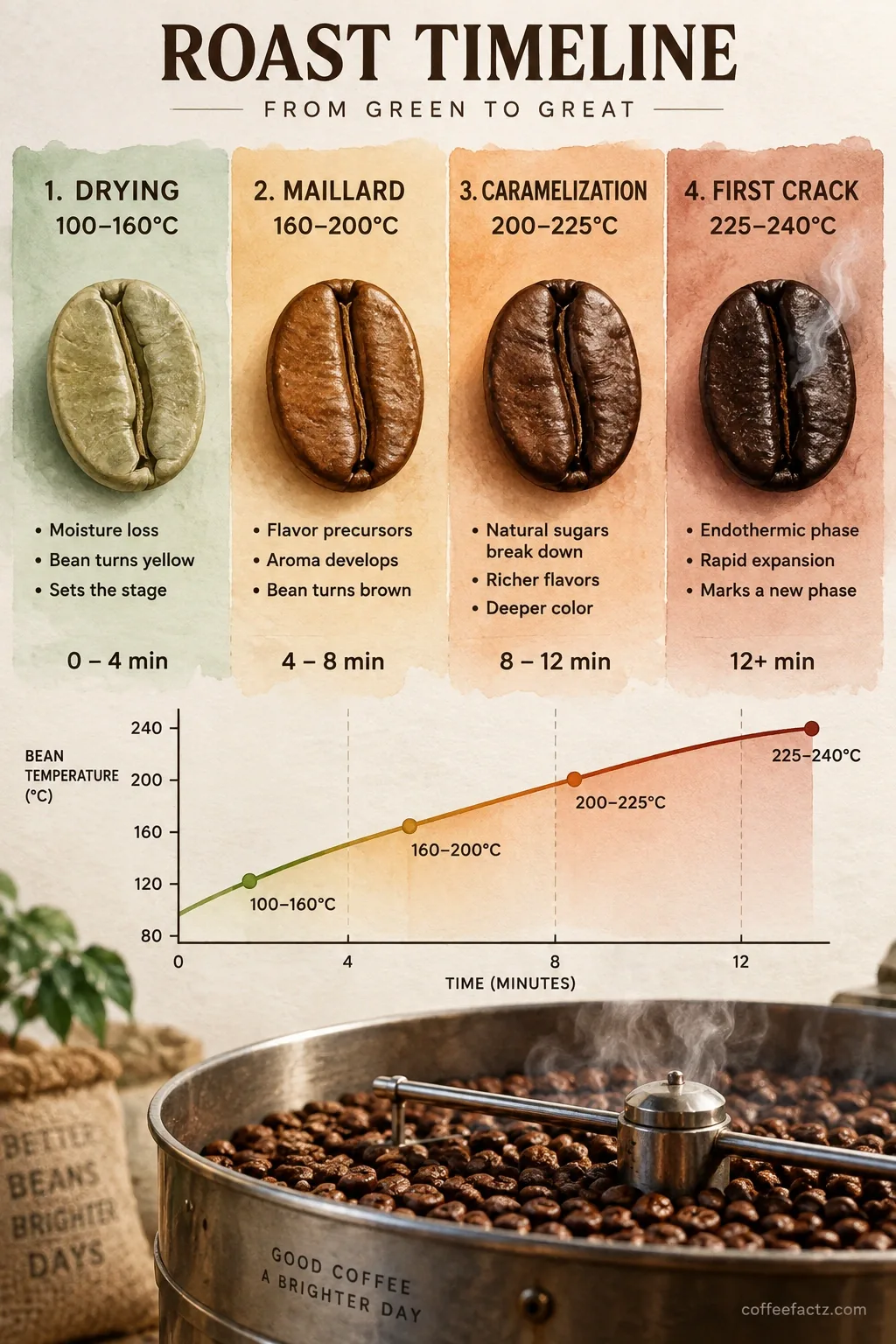
Bean development during roasting isn’t a smooth gradient. It’s a sequence of distinct chemical phases, each one building on the last, and First Crack marks the most critical boundary in that sequence.
Here’s the chain. Green coffee beans carry 8-12% moisture. In the drying stage, the roaster drives that water out. Then, around 140-160°C (302°F), the Maillard reaction begins: amino acids and reducing sugars react to build hundreds of volatile flavor compounds and start browning the bean. Above roughly 180°C (356°F), caramelization begins as sucrose breaks down. Then, somewhere in the range of 175-205°C (347-401°F), internal steam pressure builds until it fractures the bean’s cellular structure. That fracture is First Crack. The audible pop you hear is moisture vaporizing and forcing its way through the bean wall.
This is an endothermic transition: the bean absorbs heat to drive the phase change, the same physics as water boiling in a pot. The roaster must supply energy to push through it. What matters for light roast is that the batch exits here, before the reaction crosses into exothermic territory and before Second Crack’s pyrolytic carbonization begins.
Public sources disagree on the exact onset temperature, with blogs citing drop temperatures anywhere from 196°C to 207°C and internal bean temperatures from 180°C to 205°C. Treat First Crack as a phase range, not a precise number. The roaster’s job is to read the crack as a process, not to hit a single digit on a thermocouple.
Chromatic Assessment and Quality Tiering
Specialty coffee is a quality classification, not a roast style. The Specialty Coffee Association scores green coffee on a 100-point scale; anything above 80 qualifies. Light roast is a roast level that happens to be common in specialty coffee because it preserves the origin character that earned the bean its score in the first place.
The Agtron scale makes this concrete. It measures roast color numerically, and it exposes a gap between marketing and reality. True SCA-defined light roasts land in the 80-90 range, with light-medium roasts around 70-79. But retail “light roast” labels regularly tell a different story.
Light roast on the Agtron scale runs 80-90; light-medium runs 70-79. Starbucks Veranda (labeled “Light”) measures 55.4, Peet’s Luminosa (labeled “Light”) measures 62.7, and Lavazza Super Crema (labeled “Medium”) measures 62.5. – Source: Coffee Bros. Agtron Scale Guide
Those numbers tell you that most mass-market “light roasts” are actually medium roasts by color measurement. The trade-off that defines true light roast, trading sweetness, body, and solubility for clarity, acidity, and origin expression, only applies if the roast actually stopped where it claims to have.
Why Light Roast Beans Stay Dry: Surface Oil Mechanics and Cellular Integrity
Light roast beans look matte, dry, and light cinnamon to light brown because their cell walls never ruptured. That dry surface isn’t cosmetic. It tells you the bean’s internal architecture is still intact, and that has direct consequences for how the bean stores, stales, and brews.
The mechanism is straightforward. Coffee beans are built from cellulose cell walls packed with lipids, sugars, proteins, and acids. During roasting, heat and pressure build inside each cell. At First Crack, the bean expands and fractures audibly, but the roast stops before the cellular matrix fully breaks down. Lipids stay locked inside those cells. No oils reach the surface.
Dark roasts work differently. Extended, hotter roasting carries the bean through Second Crack, where pyrolytic carbonization and an exothermic reaction chain rupture cell structures more completely. Lipids migrate outward. The result is the shiny, oil-slicked surface you see on a French roast or a dark espresso blend. That sheen is the bean’s interior chemistry sweating through its walls.
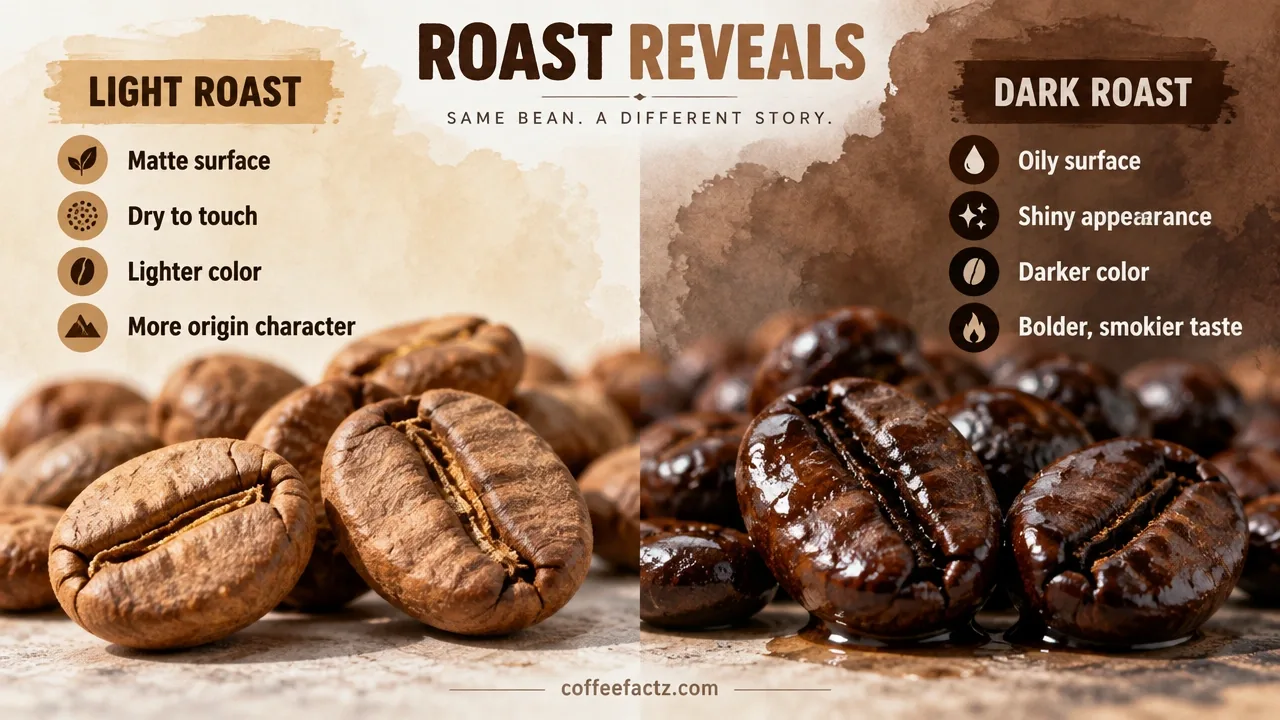
The practical implication most guides skip: surface sheen is not a freshness signal for light roast. You cannot judge a light roast bean by whether it looks oily, because it never will. The oils are intracellular. That said, “locked inside” doesn’t mean “protected indefinitely.” Light roast beans can still oxidize internally. Freshness is a function of roast date and storage conditions, not surface appearance. A matte, dry bean kept in a poorly sealed bag for six weeks is not fresher than a slightly oily dark roast pulled from an airtight container at ten days post-roast.
The Acid Story: Brightness, Sourness, and the Chlorogenic Acid Trade-Off
Light roast acidity isn’t a flaw. It’s a preserved chemical signature. But the line between “bright” and “sour” is real, and understanding where it comes from is the difference between fixing your brew and blaming your beans.
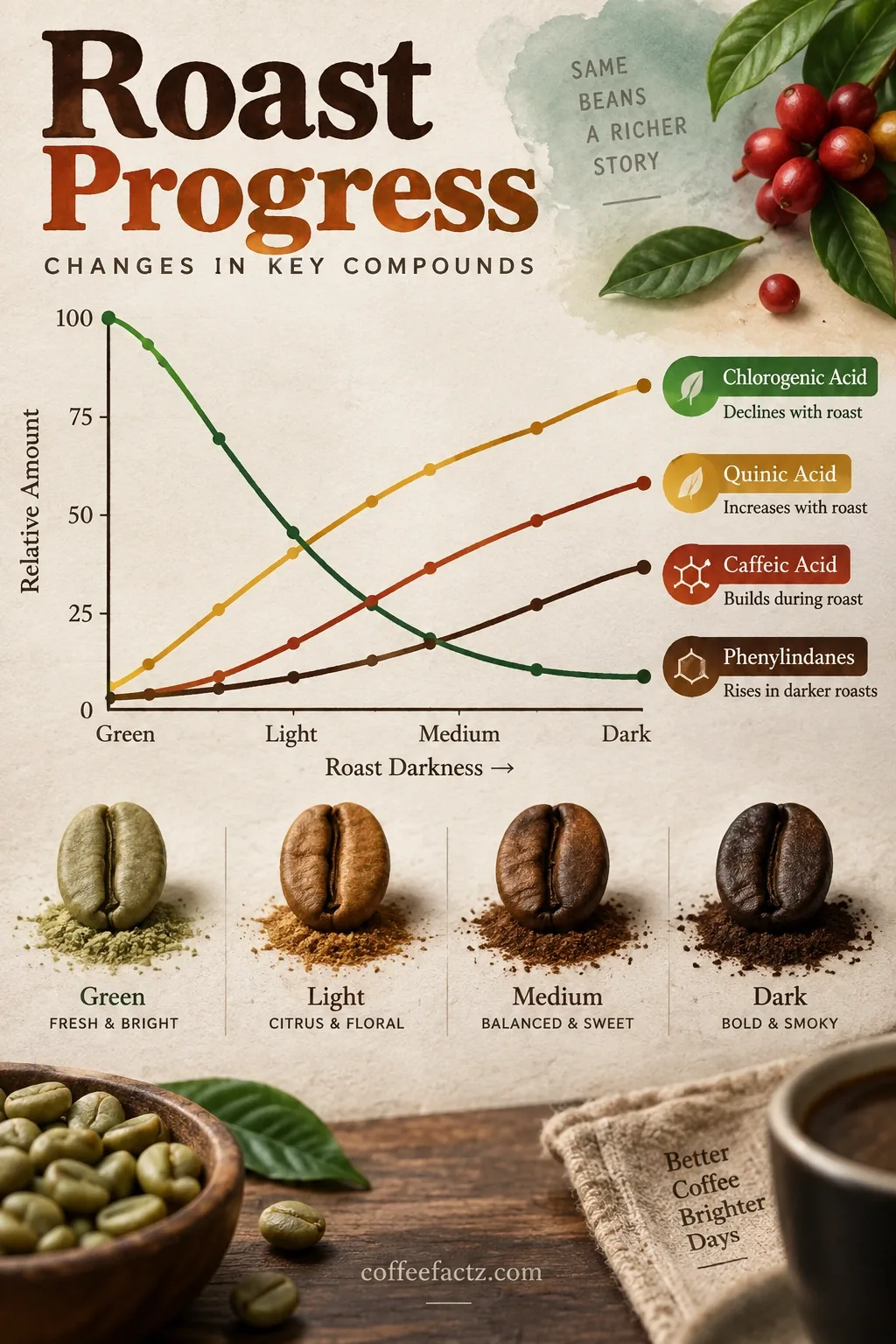
Light roasts retain fragile organic acids that darker heat destroys. Malic acid gives that green-apple crispness. Citric acid delivers citrus brightness. Phosphoric acid creates a sparkling, almost effervescent mouthfeel. These acids exist in the green bean and survive because the roast never got hot enough or long enough to degrade them. Chlorogenic acids (CGAs) are also preserved at meaningful levels.
“Roasting steadily breaks down CGA, with 50% remaining in a light roast and perhaps 20% in a dark roast. CGA decomposes to quinic and caffeic acids, two astringent phenolic compounds that contribute body to coffee. In small amounts, quinic acid and caffeic acid contribute beneficial brightness and acidity to coffee, but larger quantities produce undesirable levels of sourness and astringency.” – Scott Rao, author of The Coffee Roaster’s Companion
That decomposition pathway is the key. Dark roasts don’t eliminate acidity; they transform it. The bright organic acids are replaced by quinic acid and caffeic acid from CGA degradation, and by phenylindanes from extended pyrolysis. Those compounds read as bitter and astringent, not bright and clean.
Here’s the diagnostic that matters: acidity and sourness are not the same thing. If your light roast cup tastes sour, the cause is one of three things: under-extraction, underdevelopment, or a roast defect. Before assuming the roast is broken, adjust your brew variables. Grind finer, raise your water temperature, or extend contact time. If the sourness softens, it was an extraction problem. If it persists alongside a grassy or astringent quality, suspect underdevelopment at the roastery level.
Sugar, Aroma, and the Caramelization Boundary: Floral, Tea-Like, Stone Fruit
Light roast aromatics are defined by what the roast didn’t do. Stopping at First Crack means sucrose pyrolysis is interrupted mid-reaction, before the chemistry that produces heavy molasses, dark chocolate, and roast-derived bitterness has a chance to complete.
Sucrose Pyrolysis and Volatile Retention
Caramelization begins above roughly 180°C (356°F), which is right at the First Crack boundary. Sucrose starts breaking apart into smaller volatile compounds, but in a light roast, this reaction is halted early. The result is an abundance of light, delicate aromatics: floral notes, tea-like qualities, stone fruit, and bright citrus. The heavier compounds, molasses, dark chocolate, smoky phenols, require longer time at higher temperatures to form.
The chemistry underneath this is specific. Research published in the Journal of Agricultural and Food Chemistry traced exactly how roast degree shifts sucrose pyrolysis pathways.
A peer-reviewed kinetic study using labeled and unlabeled sucrose in biomimetic in-bean roasting experiments found that early in roasting, 2,3-butanedione formed mainly from the intact sucrose skeleton, but as roasting advanced, the pathway shifted to fragment recombination. HDMF (a furanone compound associated with caramel-like sweetness) was generated almost exclusively from the intact sucrose skeleton, peaking in early-to-middle roast stages before declining significantly in darker roasts. – From the study “Generation of α-Diketones and 4-Hydroxy-2,5-dimethyl-3(2H)-furanone upon Coffee Roasting”
The implication is mechanical, not just descriptive. Light-to-medium roasts preserve a greater abundance of 2-furfural, 5-hydroxymethylfurfural, chlorogenic acids, and hydroxybenzoic acid. Darker roasts degrade most of these non-volatile compounds. The flavor difference between a light roast and a dark roast isn’t preference; it’s the outcome of which reaction pathways ran to completion and which ones were stopped.
Compound Markers and Operational Monitoring
Not every light roast tastes floral or fruity. Roast degree sets the boundary for which volatile compounds can form, but origin, processing method, and development time after First Crack determine which ones actually do.
A naturally processed Ethiopian coffee and a washed Colombian coffee can both be roasted to the same Agtron number and taste completely different. The Ethiopian may express intense stone fruit and jasmine; the Colombian may lean toward clean citrus and tea-like brightness. The roast level opened the door. The green coffee walked through it.
Volatile compounds like acetone and 3-methyl-butanol shift measurably with roast degree. Diacetyl functions as a roasting-degree marker, and CIELAB color values correlate with roasting intensity closely enough to enable color-based monitoring in production environments. For home roasters, this translates to a practical habit: log your roast color and your development time after First Crack. If you’re chasing floral and tea-like results, a narrow development window before Second Crack is your target. Underdevelopment produces grassy, astringent cups. Baking, where the roast lingers at low heat too long, flattens the aromatics without adding roast character.
The Hard Bean Problem: Density, Porosity, and Extraction Physics
Light roast bean density is the single biggest brewing variable most guides underweight. The bean stopped roasting before its cellular matrix fully broke down, so it’s physically harder, denser, and less porous than a dark roast. That structure fights water at every stage of brewing.
Here’s the causal chain. Water extracting coffee doesn’t just flow through; it must penetrate the cellular matrix and dissolve soluble compounds. In a dark roast, extended heat has broken down cell walls, increased porosity, and made those compounds readily accessible. Water moves in, solubles move out. In a light roast, the tight cellular matrix slows water penetration significantly. Fewer solubles dissolve per unit of time, per unit of water.
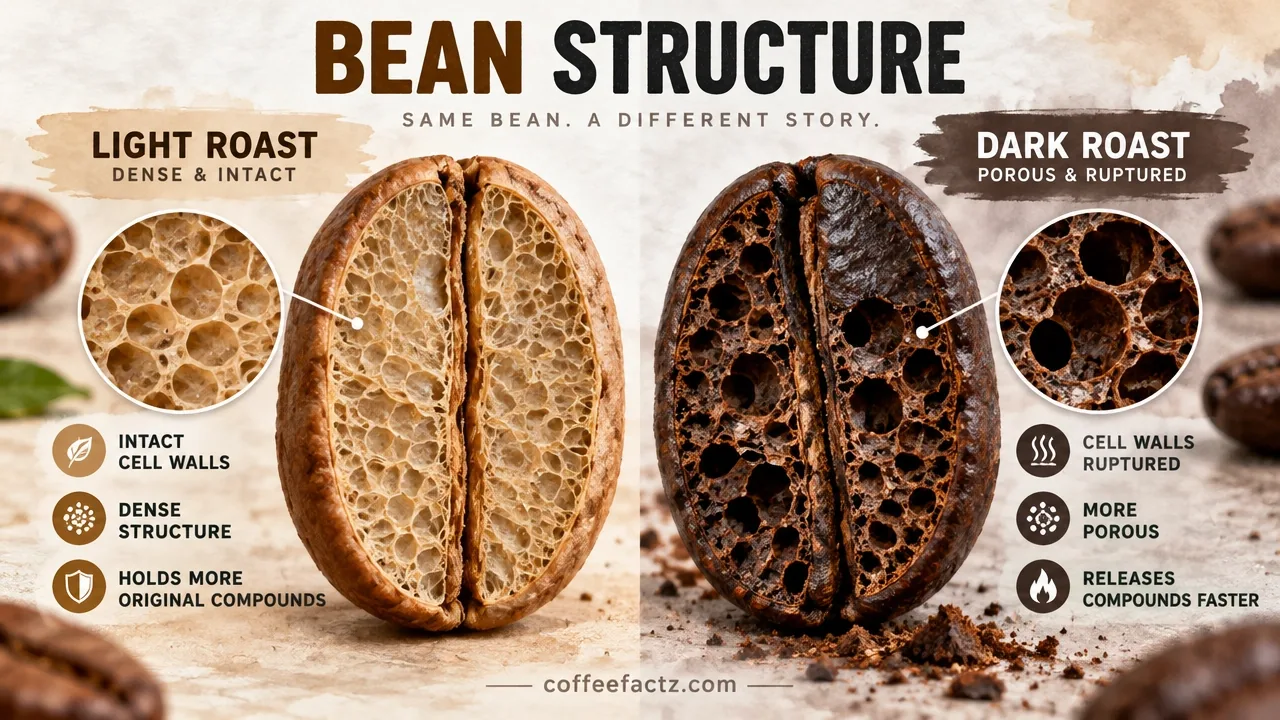
The consequence is low solubility and high extraction resistance. Push water through a light roast puck or bed without compensating, and you get a weak, vegetal, sour cup. That’s under-extraction: water passed through without pulling enough of the right compounds.
“There are two completely different physical processes by which coffee extracts: erosion and diffusion. Erosion happens when a coffee cell is broken and water can very easily wash away all of the dissolvable compounds that it contains… Diffusion is a slower process, where water needs to penetrate inside the coffee particle and slowly extract the compounds by concentration gradient.” – Jonathan Gagné, astrophysicist and author of The Physics of Filter Coffee
For light roast, diffusion dominates in most brew methods. Water must work its way into dense, intact particles and pull solubles out against concentration gradients. This is slower and more uneven than the erosion-dominant extraction you get with fine espresso grinds or with the porous structure of a dark roast. The practical upshot: grind settings, water temperature, and agitation aren’t preferences for light roast. They’re compensations for hard-bean physics.
Dark roast behaves almost inversely. More porous and more soluble, it over-extracts easily. The same grinder setting that produces a balanced dark roast cup will produce an under-extracted light roast cup. This is not a minor adjustment; it’s a different calibration problem entirely.
Brewing the Unyielding Bean: Water, Grind, Agitation, Method Matching, and Drawbacks
Light roast brewing demands specific compensations for the hard-bean physics described above. Every variable adjustment has a direct causal link to bean density and extraction resistance.
Temperature and Particle Size Adjustments
Water temperature is the first lever. Use water near boiling: 205-208°F (96-98°C). Hotter water increases the solubility of the compounds locked inside dense light roast cells and speeds diffusion across concentration gradients. Brewing with water at 185°F because you’ve heard that’s “safer” will reliably under-extract a light roast.
Grind size is the second lever. Grinding slightly finer increases the total surface area exposed to water, which partially compensates for low porosity. More particle surface means more extraction sites per unit of time. Pair finer grinding with increased agitation or extended contact time. Agitation disrupts the saturated layer of water immediately around each particle, exposing fresh water to the surface and accelerating diffusion.
Use filtered water. It makes up 98% of your cup, and mineral content directly affects extraction efficiency and perceived acidity. This isn’t optional; it’s foundational.
Apparatus-Specific Extraction Tactics
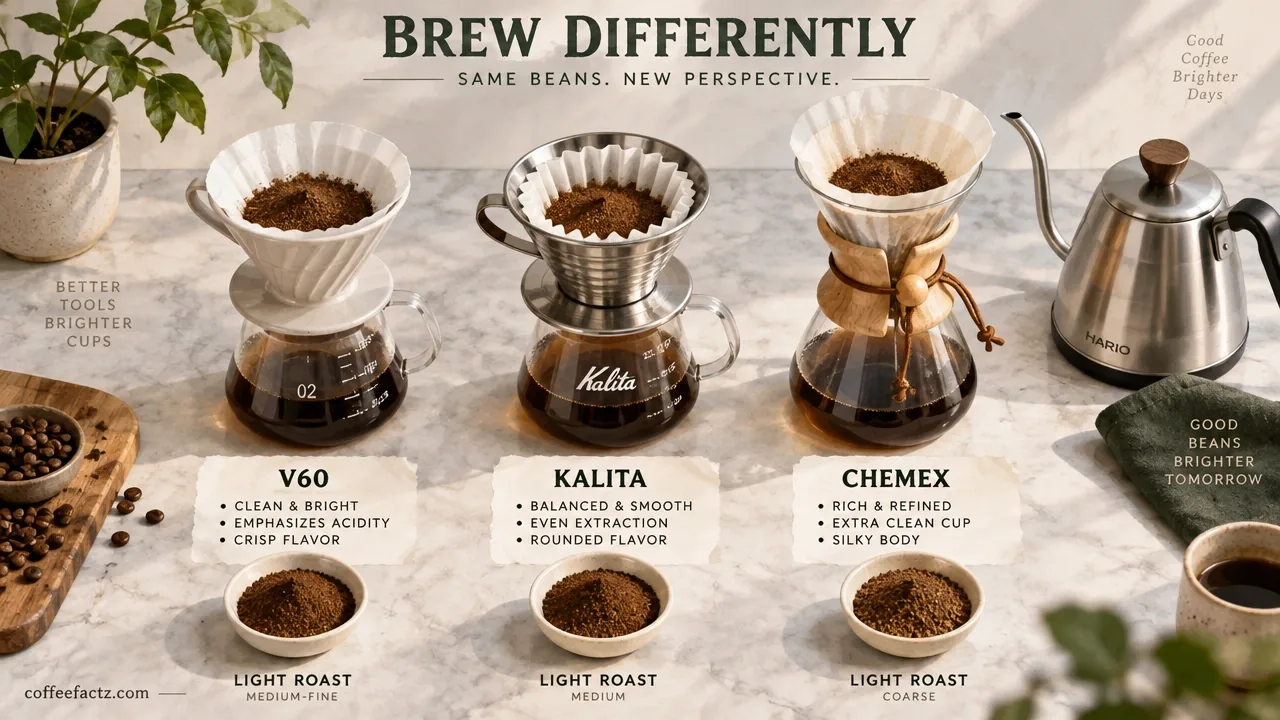
Pour-over methods like the V60, Kalita Wave, and Chemex are well-matched to light roast because they give the brewer direct control over agitation, flow rate, and contact time. The open bed and paper filter produce a clean cup that lets delicate floral and acid-driven notes come through without interference.
Start with a 1:16 coffee-to-water ratio by weight. If the cup tastes sour or weak, grind finer or raise water temperature. If it tastes bitter or harsh, grind coarser or lower temperature slightly. These adjustments are sequential; change one variable at a time.
Espresso with light roast is a different challenge. The dense bean resists even pressure-driven extraction. Channeling, where water finds a weak path through the puck and punches straight through rather than extracting evenly, is a constant risk. Tight puck prep matters more here than with dark roast. If the shot pulls sour and thin, increase extraction before increasing dose: grind finer, extend the ratio, or raise temperature. Adding more coffee to a poorly extracted shot just gives you more of the same problem.
For pour-over, controlled agitation is the practical lever. Enough to increase extraction from dense grounds, but not so much that flow becomes uneven or the bed disturbs unevenly.
Defect Diagnosis and Freshness Logistics
Underdevelopment is the failure mode most specific to light roast. It’s underdevelopment, not a brewing error, and it produces cups that are grassy, astringent, and harshly sour in a way that doesn’t respond to brew adjustments. If adjusting water temperature and grind size doesn’t move the cup toward brightness, the problem is likely at the roastery.
On the freshness side, light roast is best between 4 and 21 days after roast date. Avoid bags labeled only with a best-by date; without the roast date, you have no usable information. Use a burr grinder. Blade grinders produce uneven particle sizes that make extraction unpredictable, and uneven extraction is already the central challenge with light roast.
For pour-over, single-origin beans let origin character come through clearly. For espresso, blends are often more forgiving because they’re designed for extraction consistency across different origins and processing methods. When sourcing, look for transparent labeling: farm name, varietal, and processing method. A bag that tells you “washed Gesha from Yirgacheffe” gives you actionable brewing context. A bag that says “light roast blend” does not.
The Caffeine Myth Dissected: Bean-for-Bean, Scoop-for-Scoop, Gram-for-Gram and the Light-Roast Verdict
Caffeine in light roast is not higher or lower than in dark roast in any simple, universal sense. The answer depends entirely on how you measure. This is a denominator problem, not a chemistry problem.
Thermal Stability and Measurement Denominators
Caffeine is thermally stable at roasting temperatures. The heat that destroys organic acids and drives caramelization does not meaningfully degrade caffeine. So the roast level itself isn’t changing how much caffeine exists in the bean. What roasting does change is mass and density.
Dark roasts lose more water during roasting. Each bean ends up lighter than it started, and lighter than a comparable light roast bean. Here’s where the math splits three ways:
Bean-for-bean: A dark roast bean and a light roast bean contain roughly similar total caffeine. The dark roast bean lost water, not caffeine.
Gram-for-gram: A gram of dark roast contains slightly more beans than a gram of light roast, because dark roast beans are lighter per unit. More beans per gram means slightly more caffeine per gram for dark roast.
Scoop-for-scoop (by volume): A volume scoop of dense light roast packs more mass than the same scoop of porous, lightweight dark roast. More mass per scoop means slightly more caffeine per scoop for light roast.
The common myth that dark roast is “stronger” is answering a different denominator than the person asking the question. Volume measurements favor light roast’s caffeine count. Weight measurements favor dark roast’s. The gap in either direction is small.
Use gram dosing for control. Volume scoops are unreliable for comparing caffeine across roast levels because density differences make the same scoop deliver meaningfully different masses.
Identity Synthesis and Practical Selection Criteria
Light roast’s full identity is a chain of physical and chemical facts, not a marketing category. First Crack boundary exit. Intact cellulose cell walls with lipids locked inside. Preserved organic acids: malic, citric, phosphoric, and chlorogenic. Sucrose pyrolysis halted mid-caramelization, producing floral and stone-fruit aromatics instead of molasses and char. High bean density and low porosity producing extraction resistance at every brew stage.
That identity makes light roast neither stronger nor healthier in any categorical sense. The preserved chlorogenic acids carry antioxidant properties that darker roasting degrades, but the extraction challenge means a poorly brewed light roast may deliver fewer dissolved compounds than a well-brewed dark roast. The cup in your hand is determined by brew variables, not by the label on the bag.
For a repeatable light roast cup: weigh your dose, use water at 205-208°F, adjust grind toward finer until sourness resolves, and choose your roast level for its acid-driven origin character and the brew control it demands. Not for caffeine. Not for health claims. For what it actually does in the cup.
Frequently Asked Questions About Light Roast Coffee
What are the drawbacks of light roast coffee?
Light roast is harder to extract evenly because of its high density and low porosity, making it more prone to under-extraction and sour cups. Underdeveloped light roasts, where the roaster pulled the batch too early, produce grassy, astringent flavors that no brewing adjustment can fix.
Is light roast coffee actually stronger?
It depends on how you measure. By volume scoop, dense light roast packs more mass and delivers slightly more caffeine. By weight, dark roast has slightly more caffeine per gram because moisture loss made each bean lighter. Neither is dramatically stronger; the difference is small and denominator-dependent.
Why does light roast taste sour even when I brew it correctly?
Two causes: under-extraction from insufficient water temperature, grind fineness, or contact time, or genuine underdevelopment from the roastery. Test by adjusting grind finer and raising water to 205-208°F. If sourness softens, it was extraction. If it persists with a grassy or astringent quality, the roast was likely pulled too early.
What is the 15-15-15 coffee rule?
The 15-15-15 rule refers to a pour-over timing guideline: 15 grams of coffee, a 15-second bloom, and a 15-minute brew window, though variations exist across sources. It’s a rough starting template, not a calibrated protocol, and it doesn’t account for roast level, origin, or grind size.
Why is light roast coffee considered healthier?
Light roast preserves more chlorogenic acids (CGAs) than dark roast, roughly 50% remaining in light versus 20% in dark. CGAs carry antioxidant properties. That said, a poorly extracted light roast delivers fewer dissolved compounds overall, so the health advantage is conditional on actually brewing it well.
Can you pull a good espresso shot with light roast beans?
Yes, but it requires tighter puck prep and often a longer ratio than dark roast espresso. Dense light roast beans resist even pressure-driven extraction and are prone to channeling. If the shot pulls sour and thin, increase extraction (finer grind, longer ratio) before increasing dose.
How do I know if my light roast is actually light, or just labeled that way?
The Agtron scale is the honest measure. True SCA light roasts score 80-90; light-medium roasts score 70-79. Many retail “light roast” products measure in the 55-65 range, which puts them closer to medium by any objective color standard. Without a roaster publishing their Agtron or color measurements, the label alone tells you very little.
Does light roast coffee go stale faster than dark roast?
Not necessarily faster, but differently. Light roast lipids are locked inside intact cells rather than coating the surface, so you won’t see visual oxidation cues. The bean can still oxidize internally. Aim to brew within 4-21 days of roast date, store in an airtight container away from light and heat, and rely on roast date rather than appearance.
References
- The Ultimate Guide to Understanding Coffee Roast Levels | coffeebros.com
- Scott Rao – The Coffee Roaster’s Companion (via studfile.net) | studfile.net
- Generation of α-Diketones and 4-Hydroxy-2,5-dimethyl-3(2H)-furanone upon Coffee Roasting | uoregon.edu
- The Dynamics of Coffee Extraction – Coffee Ad Astra | coffeeadastra.com