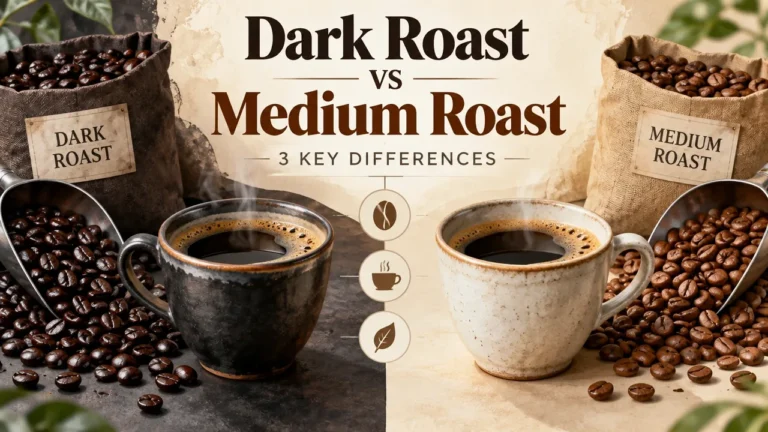

Dark roast vs medium roast coffee differences start at the bean’s cell wall, not the cup. Most comparisons stop at “bold vs balanced,” but the real split happens in a narrow temperature window between first and second crack, where roast chemistry rewrites flavor, density, and compound concentration simultaneously.
Understanding those three changes, flavor, caffeine, and health, gives you a decision framework that works regardless of which roaster labeled the bag. Evan Gilman, Green Coffee Buyer at Royal Coffee, puts it plainly: you pay for nuance in high-quality beans, and darker heat systematically burns it off.
Key Takeaways on Dark Roast vs Medium Roast Coffee Differences
- Roast level sets the flavor profile; caffeine strength is determined by dose and measurement method, not roast darkness.
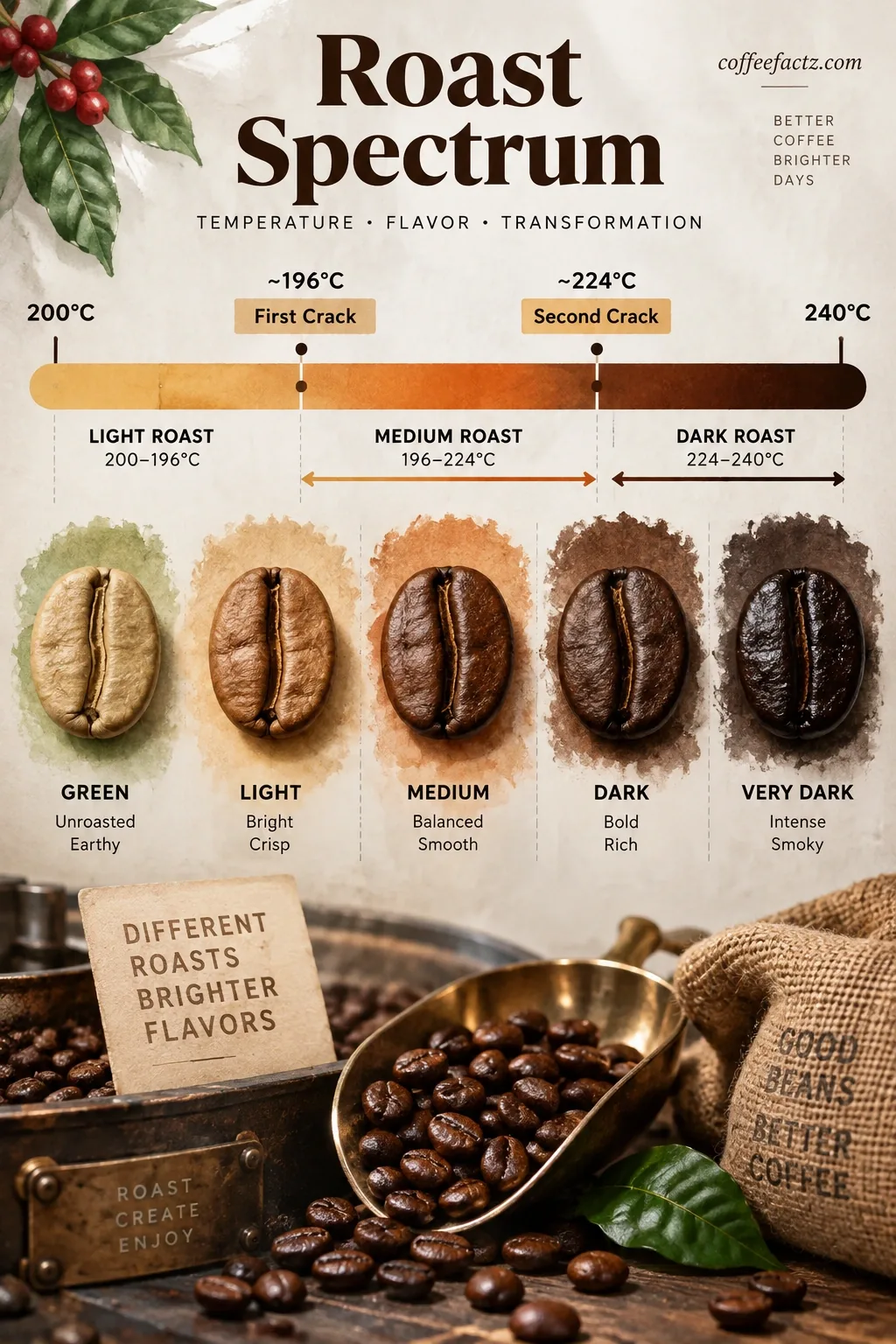
- Medium roast stops between first and second crack (~410–428°F), preserving origin acidity and terroir; dark roast enters second crack (~435–450°F+), converting those compounds into roast-forward flavor.
- By gram weight, medium and dark roast contain roughly equal caffeine; by scoop, dark roast can deliver less because its beans are less dense.
- Dark roast has lower organic acid content; medium roast retains more chlorogenic acids, which are linked to antioxidant activity.
- Roast labels like French, Italian, and City are trade shorthand for roast degree, not bean variety, origin, or caffeine specification.
- Brewing method can override roast-level flavor differences; sour or weak cups are almost always extraction problems, not evidence of a bad roast.
Roast Level, Strength, and the Crack-to-Crack Spectrum
Roast level and coffee strength are not the same thing. That single distinction is the foundation of every comparison that follows. Roast level describes a bean’s flavor profile; coffee strength describes how much caffeine ends up in the final brew. Conflating them is where most coffee confusion starts.
Medium and dark roast are points on a continuous spectrum, not two separate categories. The spectrum runs from the first audible crack to well past the second, and where a roaster stops the drum determines everything downstream.
| Roast Stage | Temperature Range | Physical Marker |
|---|---|---|
| Medium | ~410–428°F / 210–220°C | After first crack, before second crack |
| Medium-Dark | ~428–435°F / 220–224°C | At the onset of second crack |
| Dark | ~435–450°F+ / 224–232°C+ | Into or past second crack |
First crack is the audible pop caused by steam and CO₂ escaping as internal bean pressure builds. The bean’s structure is still largely intact. Second crack is a different event entirely: it’s the sound of cell walls fracturing as the bean’s physical structure collapses under heat. That structural collapse is what produces the oily surface on dark roast beans. Oil isn’t migrating outward because dark beans are “richer.” It’s the bean’s internal lipids escaping through cracks in the cell wall.
Roast labels add another layer of confusion. French, Italian, City, Full City are trade terms describing roast degree. They are not standardized across roasters. One roaster’s “medium” sits at the same temperature as another’s “medium-dark.” The label is a starting point, not a specification.
Three differences actually matter in this comparison: flavor, caffeine, and health-related compounds. The sections below trace each one to its mechanical root.
Why Medium Tastes Balanced and Dark Tastes Roasty
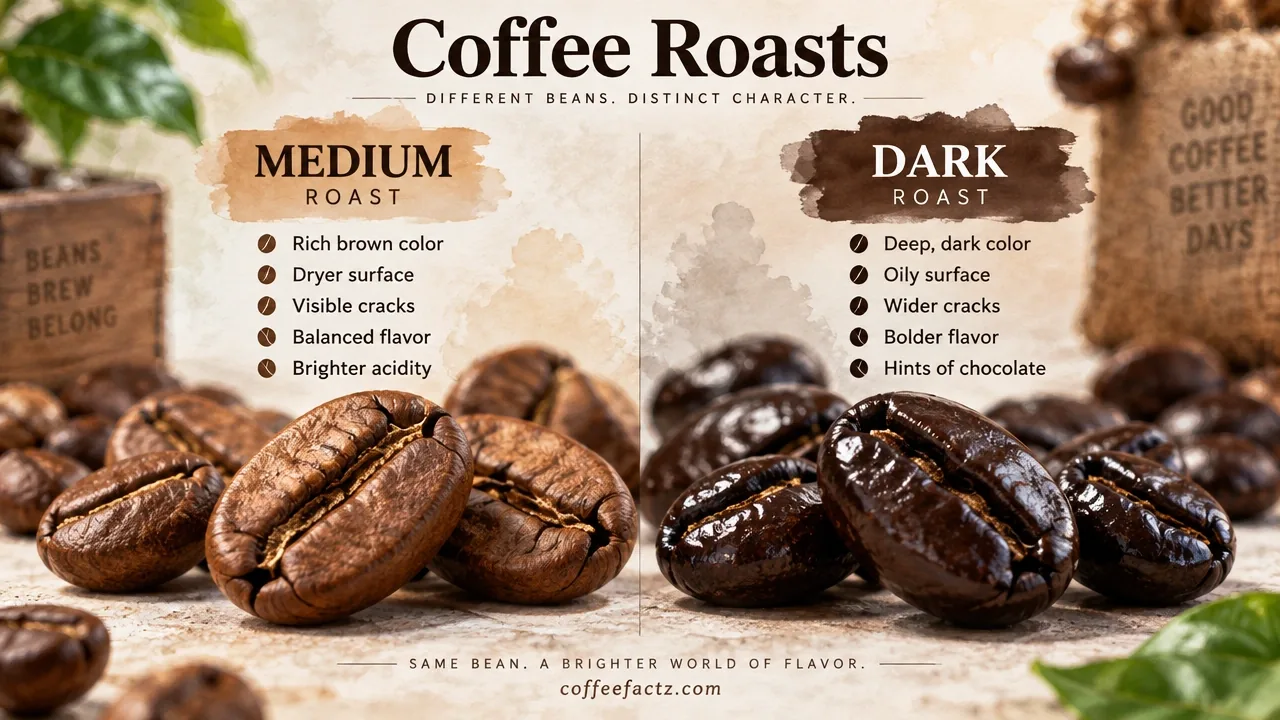
Medium roast flavor is balanced because the bean’s original chemistry is still mostly intact. The sugars have caramelized enough to produce chocolate and caramel notes, but the organic acids that carry fruit, floral, and terroir character haven’t fully degraded. You taste the origin alongside the roast. That’s why a medium-roasted Ethiopian bean still reads as berry and jasmine while a Colombian reads as red apple and walnut.
Dark roast tells a different story. By the time the drum reaches second crack, the roast process has become the dominant flavor variable.
Here’s the causal chain that drives that shift. As roast temperature climbs past the medium window:
- Chlorophyll breaks down, removing grassy/green notes
- Moisture evaporates, concentrating flavor compounds
- Sucrose caramelizes further, then moves toward carbonization
- Amino acids transform through Maillard reactions, producing roasty, nutty, and bitter compounds
- Chlorogenic acids break down into lactones and phenylindanes, which register as roast-driven bitterness rather than bright acidity
- Cellulose in cell walls carbonizes, fracturing structure and releasing oils to the surface
The result is a cup that tastes bold, smoky, and low-acid, sometimes with dried fruit or bittersweet chocolate at the edges, but with very little of the bean’s geographic origin left in the flavor. That oily surface isn’t a quality signal. It’s a sign that second crack opened the cell wall.
Milk changes the perception of dark roast significantly. The fat and protein in milk bind to bitter phenolic compounds, softening the harsh edge. That’s why dark roast performs well in lattes and cappuccinos while medium roast tends to shine in a clean pour-over where nothing interrupts the origin character.
Evan Gilman, Green Coffee Buyer at Royal Coffee, makes the economic case for matching roast level to brew method: premium, high-quality beans carry nuanced acidity, gentle aromatics, and deep sweetness that justify their price. Roasting those beans darker progressively subdues the acidity, strips the inherent aromatics in favor of roast-process flavors, and eventually carbonizes sugars past the caramelization point.
The practical takeaway is that roast level determines which flavor compounds survive into your cup. Darker heat doesn’t add complexity; it substitutes roast character for origin character.
The Weight-vs-Scoop Rule That Ends the “Dark Is Stronger” Myth
Caffeine content in dark roast vs medium roast depends almost entirely on how you measure. The “dark roast is stronger” claim isn’t wrong in every context. It’s just incomplete. Specify the measurement basis and the claim either holds or collapses.
Here’s the mechanism. Roasting doesn’t destroy caffeine. It’s a thermally stable alkaloid that survives the roasting process at essentially the same concentration per unit of mass. What roasting does change is the bean’s physical density and mass.
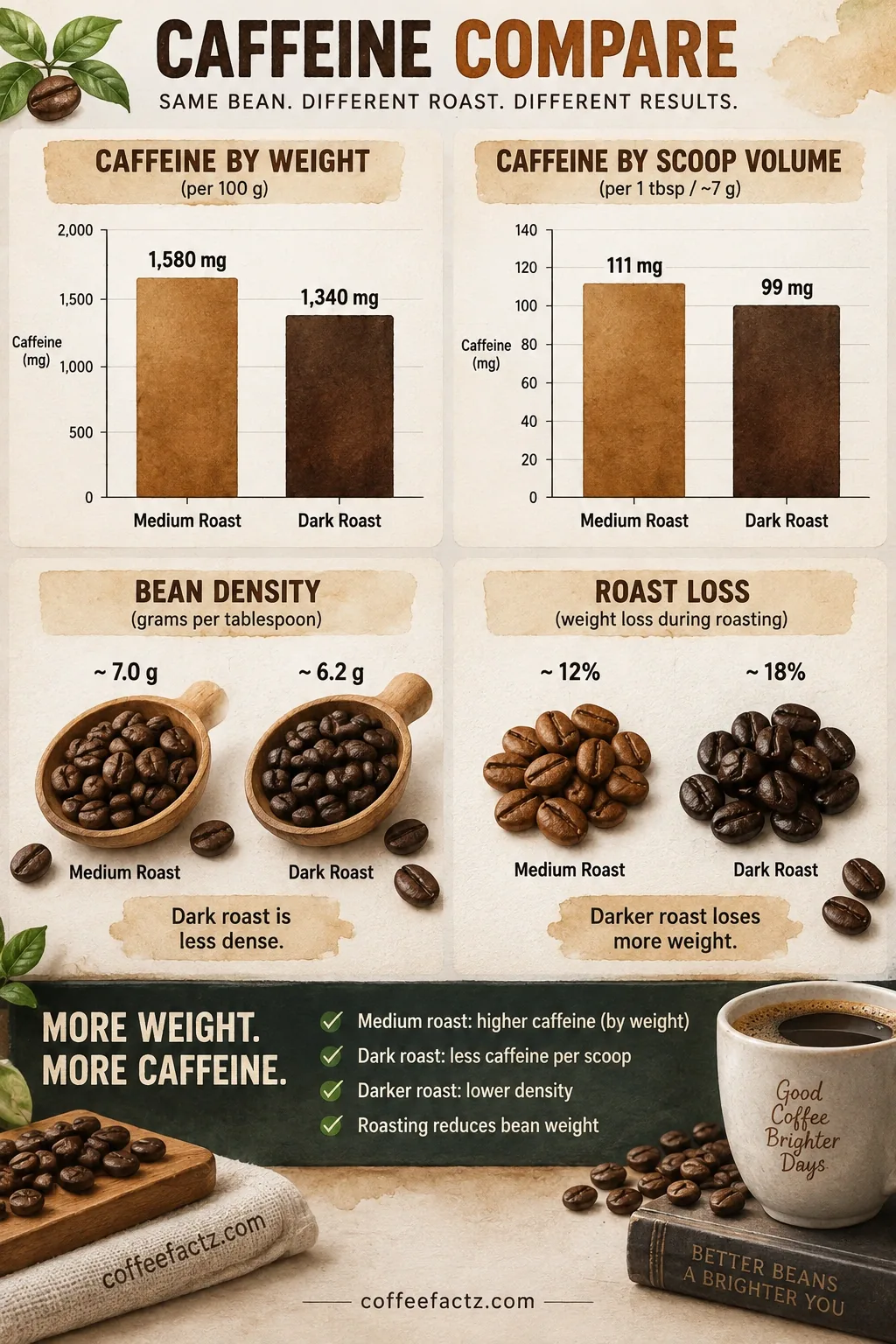
By weight: Medium and dark roast beans contain roughly equal caffeine per gram. If anything, medium roast holds a slight edge because the bean has lost less mass to roasting. Dark roast beans lose more moisture and CO₂ through prolonged heat, so they weigh less. Gram for gram, medium roast delivers equal or marginally more caffeine.
By volume (scoop): Dark roast beans are physically larger and less dense after cell-wall fracturing. A standard scoop of dark roast beans contains fewer grams of bean than the same scoop of medium roast. Fewer grams means less caffeine. By this measure, dark roast can actually deliver less caffeine per scoop.
The measurement basis is the hidden variable. Most home brewers dose by scoop or tablespoon, not by gram weight. That’s where the perception of “dark roast is stronger” enters: the bold, roasty flavor reads as intensity, and intensity gets confused with caffeine.
What actually determines caffeine level in your cup:
- Coffee species: Robusta contains roughly twice the caffeine of Arabica, regardless of roast
- Varietal and elevation: Higher-elevation Arabica tends toward higher caffeine concentration
- Dose: More grams of coffee, more caffeine. This is the most controllable variable
- Brewing method: Espresso is concentrated but small volume; drip coffee is lower concentration but larger volume
Roast level sits near the bottom of that list as a caffeine driver. Strength is a dose and measurement question. Flavor is a roast question. Keep those lanes separate.
Acidity, Chlorogenic Acids, and Why “Healthier” Depends on What You Measure
Health differences between dark and medium roast are compound-specific, not roast-level absolutes. The common claim that dark roast is healthier because it’s less acidic is partly true, mechanically misunderstood, and incomplete as a health statement.
Start with acidity. Perceived acidity is a sensory experience: the brightness or sharpness you taste. Measurable pH is a chemical property. Roast-driven bitterness is a third thing entirely, caused by lactones and phenylindanes produced when chlorogenic acids degrade under heat. These three often get conflated.
Dark roast does have lower measurable organic acid content. Prolonged heat breaks down the citric, malic, and chlorogenic acids that produce brightness in medium roast. That’s why dark roast tastes less sharp and why people with acid sensitivity sometimes tolerate it better. That part of the claim is accurate.
But the health picture shifts when you look at antioxidant compounds. A 2023 analysis published in Antioxidants (Basel) traced the transformation of chlorogenic acids through progressive roasting stages. Early in the roast, chlorogenic acids undergo isomerization and hydrolysis. As roast degree increases, they break down further through decarboxylation into phenylindanes, epimerization, and dehydration into cyclohexenes and lactones. Total chlorogenic acid content generally decreases with darker roasting, with the lowest concentrations found in dark-roasted coffees. Since chlorogenic acids and melanoidin-related compounds are linked to antioxidant activity, darker roasting produces a measurable, roast-degree-dependent drop in antioxidant capacity.
From the study: total chlorogenic acid content generally decreases with darker roasting, with the lowest levels found in most dark-roasted coffees. – From the study “Comprehensive Analysis of Metabolites in Brews Prepared from Naturally and Technologically Treated Coffee Beans“
So the health trade-off looks like this: dark roast is gentler on perceived acidity, but medium roast retains more of the antioxidant compounds that most health-focused coffee research points to. Neither roast is universally healthier. The answer depends on which variable you’re optimizing for: stomach comfort or antioxidant concentration.
What actually determines health outcomes in your cup:
- Dose: How many grams of coffee you brew
- Additions: Milk, sugar, and syrups change the nutritional profile more than roast level does
- Brewing method: Filter paper removes cafestol, a diterpene linked to cholesterol effects; French press and espresso retain it
- Origin and processing: These affect compound concentrations before the roaster touches the bean
Roast level is one variable in a multi-variable system. Treat it as such.
Extraction Mechanics That Override the Roast Label
Brewing method changes what you actually taste more than roast level does in many cases. The extraction variables, grind size, water temperature, contact time, and ratio, determine how much of the roast’s chemistry ends up dissolved in your cup. Get those wrong and the roast label becomes irrelevant.
Here’s how each major method interacts with roast character:
Espresso uses high pressure and a fine grind to extract a concentrated shot in 25–30 seconds. Dark roast performs predictably here because its lower acidity and roast-forward compounds extract evenly under pressure. Medium roast in espresso requires tighter grind and ratio control to avoid sour or thin shots; the higher acid content extracts quickly and can become unbalanced.
Pour-over is where medium roast earns its reputation. Slower extraction at 195–205°F / 90–96°C with a clean filter highlights origin acidity and aromatic complexity. Dark roast in a pour-over can taste flat or harsh because the roast-forward bitterness has no milk or pressure to balance it.
French press produces full-body, unfiltered coffee. The metal mesh retains oils and fine particles, which add texture. Both roasts work here; dark roast produces a rich, heavy cup while medium roast produces a more complex one. Neither is wrong.
Cold brew uses time instead of heat, typically 12–24 hours of steeping at room temperature. The cold extraction process pulls fewer bitter acids, which is why cold brew tastes smooth regardless of roast. Dark roast cold brew reads as chocolate and low-acid. Medium roast cold brew retains more sweetness and subtle fruit notes.
Milk drinks favor dark roast for a simple reason: fat and protein in milk bind to bitter phenolic compounds, smoothing the roast edge. Medium roast in milk drinks can taste thin or get lost behind the dairy.
Under-extraction is the most common misread. A sour, weak cup is almost never evidence that a roast is bad. It means water didn’t dissolve enough soluble compounds. The fix is finer grind, higher temperature, longer contact time, or a higher coffee-to-water ratio. Blaming the roast label delays the actual solution.
The practical rule: choose your roast for flavor goal, then dial extraction to match it. A medium roast brewed poorly will taste worse than a dark roast brewed well. The roast sets the ceiling; extraction determines how close you get to it.
Why French, Italian, and “Medium” Are Not Standardized
Roast labels describe degree of roast, not bean variety, origin, or caffeine content. French roast doesn’t mean French beans. Italian roast doesn’t mean beans from Italy. These names are trade shorthand that evolved to communicate roast degree between roasters and buyers, and they were never standardized across the industry.
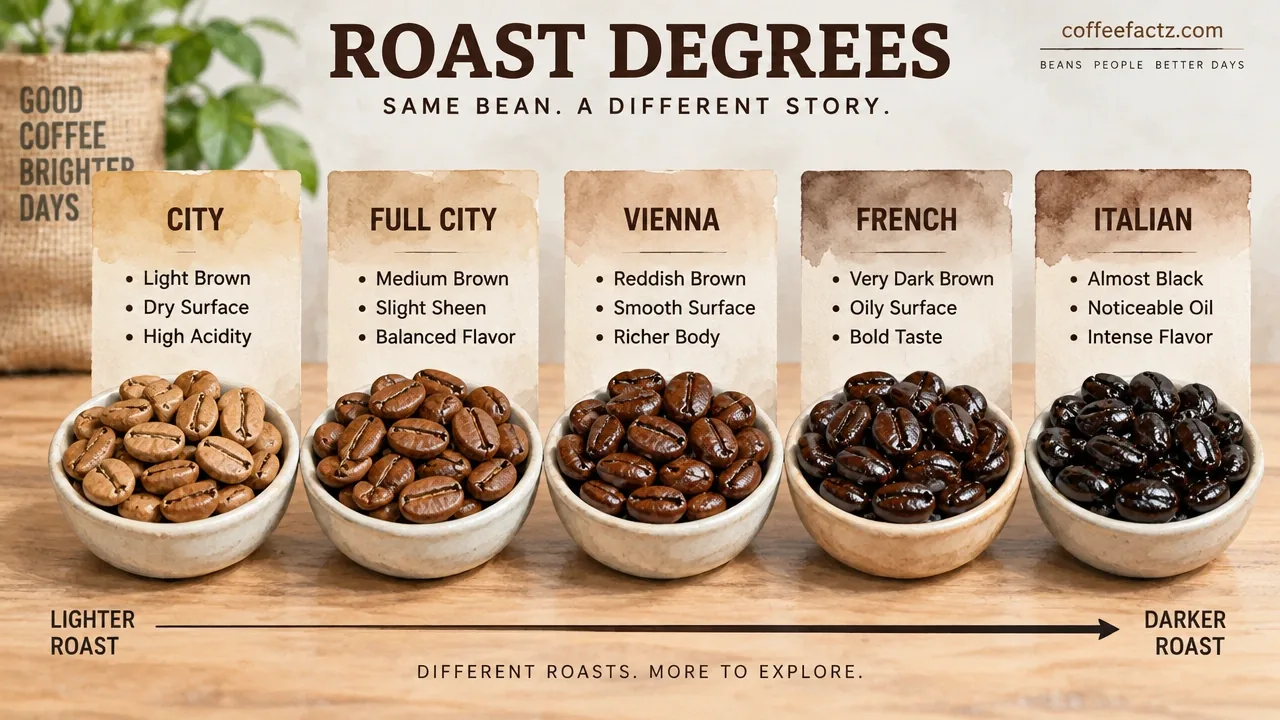
Here’s what the common labels actually describe:
| Label | Roast Degree | General Characteristics |
|---|---|---|
| City | Light-medium | Just past first crack; grain-forward, high acidity |
| Full City | Medium | Between cracks; balanced, caramel, moderate body |
| Vienna | Medium-dark | Early second crack; bittersweet, light oil on surface |
| French | Dark | Deep into second crack; smoky, low acidity, heavy oil |
| Italian | Very dark | Past French; near-carbonized, flat, intensely roasty |
The problem is that “medium” at one roastery sits at the same temperature as “dark” at another. A specialty roaster’s “medium” might be what a commercial roaster calls “light.” Without knowing the roaster’s internal calibration, the label alone tells you very little.
Terroir is the first casualty of dark roasting. Medium roast preserves the chemical fingerprint of where the bean was grown: the soil mineral content, altitude, rainfall patterns, and processing method all leave traces in the bean’s organic acids and aromatic compounds. Dark roast erases most of that signal. A dark-roasted Yirgacheffe and a dark-roasted Sumatra can taste nearly identical because the roast chemistry overwrites the origin chemistry. A medium-roasted version of each would be immediately distinguishable.
The practical guidance is straightforward: read the roast description, not just the label. Look for temperature references, crack stage descriptions, or flavor notes from the roaster. Visual cues also help. Dry, matte surface: medium or lighter. Light sheen: medium-dark. Heavy oil coating: dark or very dark. The label is a starting point. The description and the bean’s surface tell the real story.
Fast Answers to the Most Common Mental Jams
Sensory Preference and Selection Goals
Which coffee tastes better, medium or dark, is a preference question with no universal answer. Taste is subjective, and brewing method changes the equation significantly. The more useful question is: what flavor experience are you building toward?
If you want to taste where the bean came from, medium roast is the better tool. Origin character, moderate acidity, and balanced sweetness all survive the medium roast window. Pour-over and filter methods amplify those qualities.
If you want low acidity, bold body, and roast-forward chocolate or smoke, dark roast is the right roast level. It performs best in espresso and milk drinks where its intensity holds up against dilution or dairy.
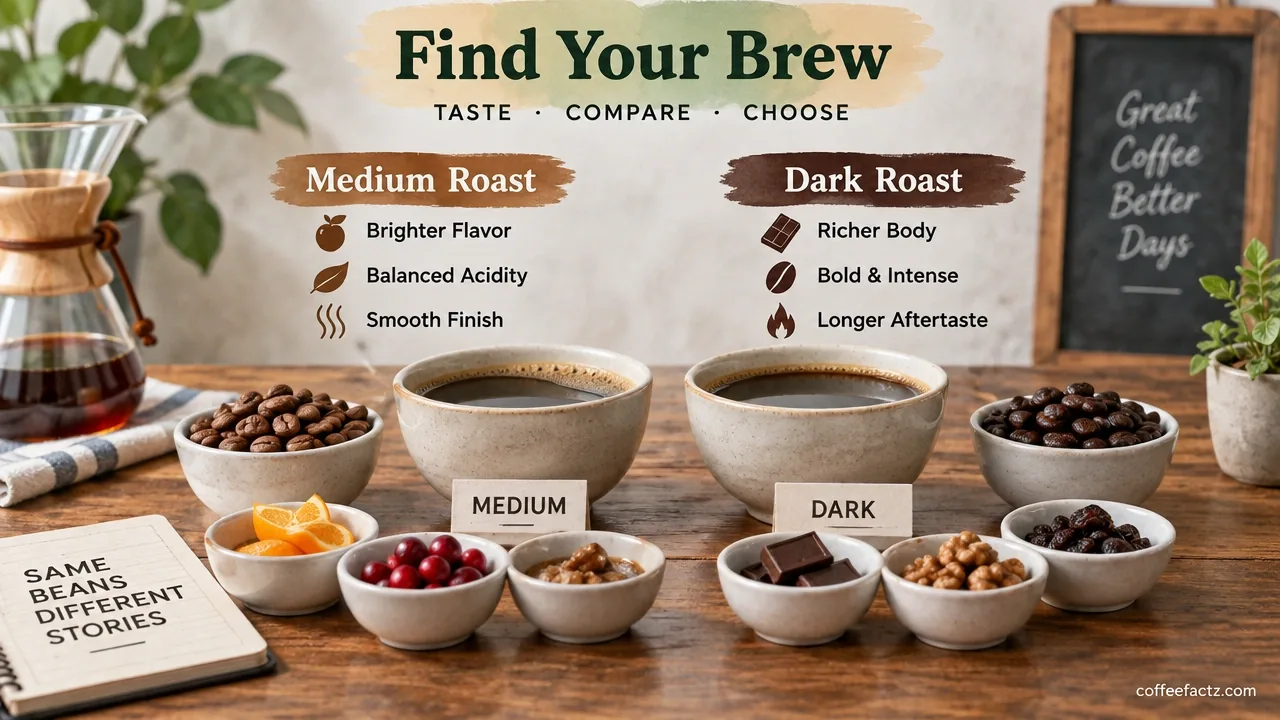
Which roast is best for coffee follows the same logic. Medium roast for filter methods and origin-forward flavor goals. Dark roast for espresso, cold brew, and milk-based drinks where bold body matters more than terroir.
One practical note: if your medium or light roast cups consistently taste sour or weak, the roast isn’t the problem. Sour and weak are extraction symptoms. Try a finer grind, a slightly higher water temperature, or a longer brew time before switching roasts. That sequence fixes most thin, sour cups without changing a single thing about the bean.
Caffeine Dose and Wellness Claims
Dark roast is not categorically stronger than medium roast. As covered in the caffeine section, “stronger” depends on whether you’re measuring by weight or by volume. By gram weight, medium roast holds equal or slightly more caffeine. By scoop, dark roast can deliver less caffeine because the beans are less dense. Flavor boldness is not a proxy for caffeine content.
Dark roast is not universally healthier. The lower acidity is real and relevant for people with acid sensitivity. But antioxidant compounds, specifically chlorogenic acids, decrease with darker roasting. Medium roast retains more of those compounds. Health outcomes also depend on dose, brewing method, and what you add to the cup. Roast level is one variable, not the determining one.
Which Roast to Buy and How to Brew It
Neither medium nor dark roast is universally better. That framing is the wrong starting point. The right starting point is your flavor goal and your brewing method, because those two variables determine which roast will perform well in your specific setup.
Here’s a working decision framework:
Choose medium roast if:
- You want to taste the bean’s origin character: fruit, floral, regional terroir
- You’re brewing with a pour-over, drip machine, or Aeropress
- You prefer moderate acidity and balanced sweetness
- You’re experimenting with single-origin beans where the farm or region matters
Choose dark roast if:
- You want low acidity and roast-forward flavor: chocolate, smoke, bittersweet
- You’re pulling espresso shots or making milk-based drinks
- You prefer a full, heavy body without bright acidity
- You’re brewing cold brew and want a smooth, rich concentrate
Now tie the three differences back to their root causes:
Flavor is driven by roast chemistry. The temperature window and crack stage determine which compounds survive and which get converted or destroyed. Medium roast preserves origin chemistry. Dark roast substitutes roast chemistry.
Caffeine is a measurement and dose question. Roast level barely moves the needle. Species, dose, and brewing method do. If you want more caffeine, add more grams of coffee. That’s the most direct lever.
Health is compound-specific. Dark roast is gentler on perceived acidity. Medium roast retains more antioxidant compounds. Neither roast overrides the impact of dose, brewing method, and what you add to the cup.
The operating rule that covers all three: use roast level to set your flavor direction, use dose and ratio to control strength, and use brewing variables to tune the final cup. Roasting is a spectrum. Your brewing setup is where that spectrum becomes a specific drink.
Frequently Asked Questions About Dark Roast vs Medium Roast Coffee Differences
Which coffee tastes better, medium roast or dark roast?
Neither is objectively better. Medium roast suits people who want origin character and moderate acidity; dark roast suits those who prefer bold, low-acid, roast-forward flavor. Brewing method shapes the result as much as the roast does.
Is a dark roast stronger than a medium roast?
It depends on how you measure. By gram weight, medium and dark roast are roughly equal in caffeine. By scoop, dark roast can actually deliver less because its beans are less dense. Flavor boldness isn’t the same as caffeine strength.
Which type of roast is best for coffee?
Medium roast works best for filter and pour-over methods where origin character and acidity can shine. Dark roast performs better in espresso and milk drinks where bold body and low acidity hold up against dilution or dairy.
Why is dark roast coffee healthier?
The claim rests on lower acidity, which is real and relevant for people with acid sensitivity. But dark roast also has fewer chlorogenic acids, which are the antioxidant compounds most associated with coffee’s health benefits. Medium roast retains more of those. Neither is universally healthier.
Why does my medium roast taste sour?
Sour coffee is almost always an under-extraction problem. Water pulled too few soluble compounds from the grounds. Try a finer grind, slightly higher water temperature, or longer brew time before changing roasts.
Does roasting destroy caffeine?
No. Caffeine is thermally stable and survives the roasting process at essentially the same concentration per unit of mass. What changes is the bean’s density and mass, which affects how much caffeine you get per scoop.
Can I taste the origin in a dark roast bean?
Rarely. Dark roasting past second crack converts most of the organic acids and aromatic compounds that carry terroir character into roast-driven flavors. A dark-roasted Ethiopian and a dark-roasted Colombian can taste nearly identical for this reason.
Why do dark roast beans look oily?
The oil on dark roast beans is lipid migrating outward through fractures in the cell wall caused by second crack. It’s a structural consequence of high-heat roasting, not a sign of quality or richness.
References
- Comprehensive Analysis of Metabolites in Brews Prepared from Naturally and Technologically Treated Coffee Beans | pmc.ncbi.nlm.nih.gov
- Roasting for Filter and Espresso at Home | perfectdailygrind.com