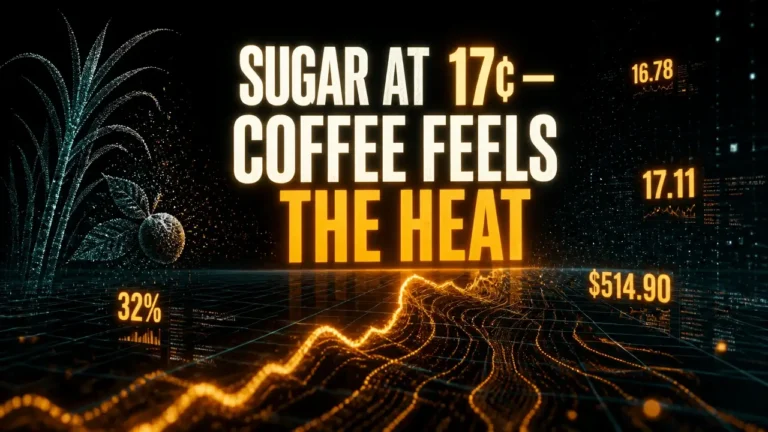

Sugar futures on ICE have surged to a one-year high above 17 cents per pound in mid-August, pulling refined prices higher and coinciding with firmer arabica coffee, as weather disruptions and shifting ethanol policies reshape key soft-commodity markets.
On 12 August, raw sugar rose 0.4% to 16.78 cents per pound at 1456 GMT after touching 17.11 cents, the highest level since June 2025, while white sugar climbed 0.7% to $514.90 per ton after reaching $520.90, its strongest level since April 2025, according to Business Recorder (Reuters). Just two days earlier, raw sugar had already climbed above 16 cents per pound to a 10-month high, TradingView News reported.
The rally followed a short-covering move that lifted the ICE #11 sugar futures curve by 3–5% on 7 August, with the front-month October 2026 contract settling at 16.45 US cents per pound, up 0.88 cents or 5.35%, and trading volume above 200,000 lots, CMB News reported. March 2027 settled at 17.33 US cents per pound, and mid-2027 positions added around 3.5–4.4%, CMB News added.
The same report noted that the sugar forward curve was slightly inverted, with October 2026 trading below March 2027 and prices rising toward March 2029 at 17.54 US cents per pound. CMB News said this structure left 2027–2029 contracts at a mild premium over nearby months, with its three-day outlook describing ICE #11 nearby prices as biased slightly upward to sideways in euro terms.
In the physical market, Brazilian refined sugar (ICUMSA 45) free on board São Paulo has also firmed, with offers around 0.53 euros per kilogram compared with approximately 0.51–0.52 euros per kilogram in October 2024, according to CMB News. MarketScreener reported that the broader S&P GSCI Agriculture Index stood at 392.16 points on 10 August, up 0.49% on the day and 11.31% since the start of the year.
Several supply-side developments in Brazil, the world’s largest sugar exporter, have added to market focus. TradingView News reported that Brazil suspended its biweekly harvest and production reports, while June sugar output fell 15% year-on-year and nearly 58% of Brazilian cane juice was diverted to ethanol. The same report said Brazil raised its mandatory ethanol blend in gasoline to 32% in late July, from 30% a month earlier and 27% a year earlier.
Weather has been another key factor. On 12 August, Business Recorder (Reuters) cited Rabobank as saying that lost harvesting days in Brazil in June and partly July increased the risk that more sugarcane will be left unharvested, while El Nino-related rains were harming sugar content. In India, rainfall remained 11.7% below normal due to the El Nino pattern, Reuters reported, adding another concern for cane production.
Earlier in the month, Reuters reported that the sugar market was supported by an expected drop in European Union production after hot, dry weather, alongside lower Brazilian exports year-on-year. On 10 August, raw sugar was down 0.2% at 16.41 cents per pound at 1040 GMT after equalling a 10-month high of 16.50 cents, while white sugar edged up 0.1% to $504 per ton after peaking at $505.40, its highest since May 2025, Business Recorder (Reuters) reported.
Arabica coffee has moved in parallel, though less dramatically. On 10 August, ICE arabica fell 2.4% to $3.2745 per pound, according to Reuters. Two days later, Business Recorder (Reuters) reported that ICE arabica rose 1.1% to $3.1930 per pound after hitting a three-week peak of $3.2755, supported by fallout from an earthquake in Colombia and dwindling stocks.
Speculative positioning has also shifted in tandem with the price rally. In the week to 4 August, speculators cut their bearish bets in ICE U.S. raw sugar futures, according to Commitments of Traders data cited by Business Recorder (Reuters). CMB News said that, looking at the near term, weather and crush progress in Brazil and other major cane regions remained key swing factors for the balance between sugar and ethanol, with adverse weather having the potential to tighten the nearby market while strong harvest data would limit further upside.