
Kenya’s main tea and coffee auctions generated a combined Ksh1.816 billion in a single reported week, underscoring how the country’s flagship beverage markets are sustaining strong international demand even as new levies and lower tea volumes reshape trading conditions.
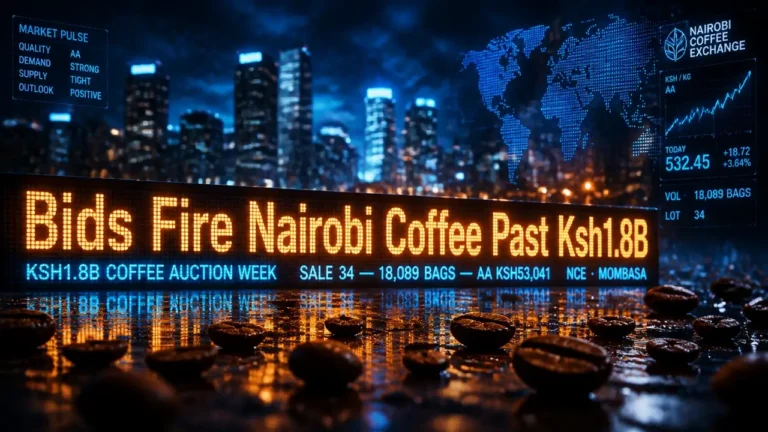
According to Sacco Review, data from the East African Tea Trade Association (EATTA) show that tea sold at the Mombasa Tea Auction earned Ksh822.8 million from 2,452,925kg, while coffee traded at the Nairobi Coffee Exchange (NCE) during Sale 34 grossed roughly Ksh994 million from 18,089 bags. The coffee sale on 4 August 2026, the first after a June recess, moved all 18,089 bags weighing 1,115,430kg of green coffee and raised USD7,682,983, Sacco Review and Kilimo News reported.
At NCE Sale 34, the auction posted an average of Ksh44,503 per 50kg bag, according to Kenya Broadcasting Corporation / Kenya News Agency (KBC/KNA), while Sacco Review and Kilimo News calculated an average of USD344 per 50kg bag, or USD6.89/kg of clean coffee. KBC/KNA described the session as recording strong trading activity, with buyers competing for quality lots from leading coffee regions, and noted that coffee remains one of Kenya’s leading foreign exchange earners.
Premium arabica grades led the coffee results. KBC/KNA reported that Grade AA lots totalled 1,738 bags and fetched Ksh107.8 million, while Grade AB registered 7,761 bags for Ksh461.1 million. Ngugu-ini Factory in Kirinyaga topped the AA category at Ksh53,041 per 50kg bag (about USD410), followed by Muisuni Farmers’ Co-operative Society in Machakos at Ksh52,912, and Kiriaini Factory in Kirinyaga at Ksh52,653, Sacco Review and KBC/KNA stated. Sacco Review and Kilimo News added that clean AA and AB coffees from Kirinyaga, Nyeri, Embu and Meru traded between USD380 and USD410 per 50kg, while mbuni and lower grades sold in the USD100–250 range.
The buyer side of the coffee market was highly concentrated. Sacco Review, Kilimo News and KBC/KNA reported that C. Dorman SEZ Ltd purchased 425,021kg, equivalent to 38% of the auction’s volume and USD3.19 million (Ksh412.5 million), or 42% of total value. Ibero Kenya Ltd followed with 3,790 bags (234,404kg) worth USD1.61 million (Ksh208.5 million), and Kenyacof Ltd bought 2,107 bags (130,602kg) for USD867,256 (Ksh112.1 million). Together with Louis Dreyfus Company, Mumbi Coffee Merchants and Taylor Winch (Coffee) Ltd, the top six buyers absorbed 87% of the sale’s value.
Certified coffee also featured prominently. A Nairobi Coffee Exchange report quoted by Sacco Review stated that the market sold 207,100kg of Rainforest Alliance–certified coffee, 111,989kg under Café Practices, 108,664kg certified by Fairtrade, and 107,234kg meeting European Union Deforestation Regulation (EUDR) criteria. KBC/KNA noted that NCE prices are determined by bean quality, cup profile, global demand and prevailing international market conditions.
On the tea side, Sacco Review reported that the Ksh822.8 million in earnings at Mombasa came in a week when 2,452,925kg were auctioned, compared with 3,097,862kg fetching Ksh1.018 billion the previous week. A separate Sacco Review article cited KTDA-managed factories selling 2,462,925kg for the same Ksh822.8 million figure, a 10,000kg discrepancy that was not reconciled in the reports. Seven factories surpassed Ksh388.08 per kg (about USD3) in that week, led by Mununga at Ksh433.36 (USD3.35) and followed by Imenti, Githongo, Rukuriri, Ngere and Gathuthi.
EATTA Managing Director George Omuga told Sacco Review that, “Since the introduction of the tea levy in May only Mununga, Gathuthi, and Rukuriri had achieved the price above $3 per kg. We plead for the best prices to motivate the growers.” Sacco Review noted that the Ksh2.28 per kg levy, implemented on 1 May, has been a major challenge for buyers, while Enos Njeru, chairman of KTDA Holdings, said in the same outlet that factories east of the Rift Valley “were forced to absorb the levy rather than return the teas to the warehouses.”
These weekly results come against a backdrop of rising tea trade through the Mombasa platform. On its website, EATTA states that sales at the Mombasa Tea Auction increased from 51% to 84% of volumes offered between July and September 2025 compared with the same period in 2024, while Kenyan tea exports grew by 33% on increased demand. Omuga said this followed the removal of a government-set reserve price from the 2021 crop year and “key interventions by value chai players” that improved the quality of tea coming to auction.
The Mombasa Tea Auction, which EATTA describes as the largest black CTC tea auction globally and the central marketplace for East African teas, handles teas from multiple countries and accounts for 32% of world tea exports. EATTA notes that teas are traded in US dollars, with payment due ten working days after sale, and lists Pakistan, Egypt, the United Kingdom, Sudan, Yemen and the United Arab Emirates among its main export destinations.
According to EATTA’s membership page, the Mombasa Tea Auction runs every week throughout the year except during the week of Christmas, while KBC/KNA describes the Nairobi Coffee Exchange as Kenya’s principal coffee marketing platform, emphasizing that coffee continues to rank among the country’s most important foreign exchange earners.