

Starbucks Venti price savings are real for exactly two drink categories, and a priced milk upgrade for most of the rest. The arithmetic is simple once you’re using the right denominator. The problem is that most published guides aren’t.
This breakdown maps the full size system, runs the per-ounce formula with the correct cup volumes, audits the 28% claim against actual division, and tells you what the math says for your specific order, whether you’re pulling a daily brewed coffee, a hot latte, or a customized iced espresso built to redeem stars.
Key Takeaways on Starbucks Venti Price Savings
- A hot Venti is 20 oz and an iced Venti is 24 oz; using the wrong denominator corrupts every per-ounce comparison you run.
- The 28% per-ounce savings claim has no verified source and no published arithmetic behind it – treat it as a slogan, not a finding.
- Venti delivers genuine per-ounce value for brewed coffee and Americanos; for hot lattes, the upgrade buys milk at espresso prices because the shot count doesn’t change.
- Any saving that depends on barista discretion is a bonus, not a budget line – the same star-redemption hack succeeds and fails at different registers for the same order.
- Home espresso only beats Starbucks on per-ounce cost past a break-even volume, and only if you perform the maintenance that keeps the machine extracting at full efficiency.
- Your real Venti price is the app price in your metro, divided by the correct ounce count, with tax and add-ons included – no published national figure applies to your specific order.
What “Venti” Actually Buys You: The Size System Decoded
Venti is not a single volume. That one fact breaks most of the per-ounce math you’ve seen published, and it’s worth getting straight before anything else.
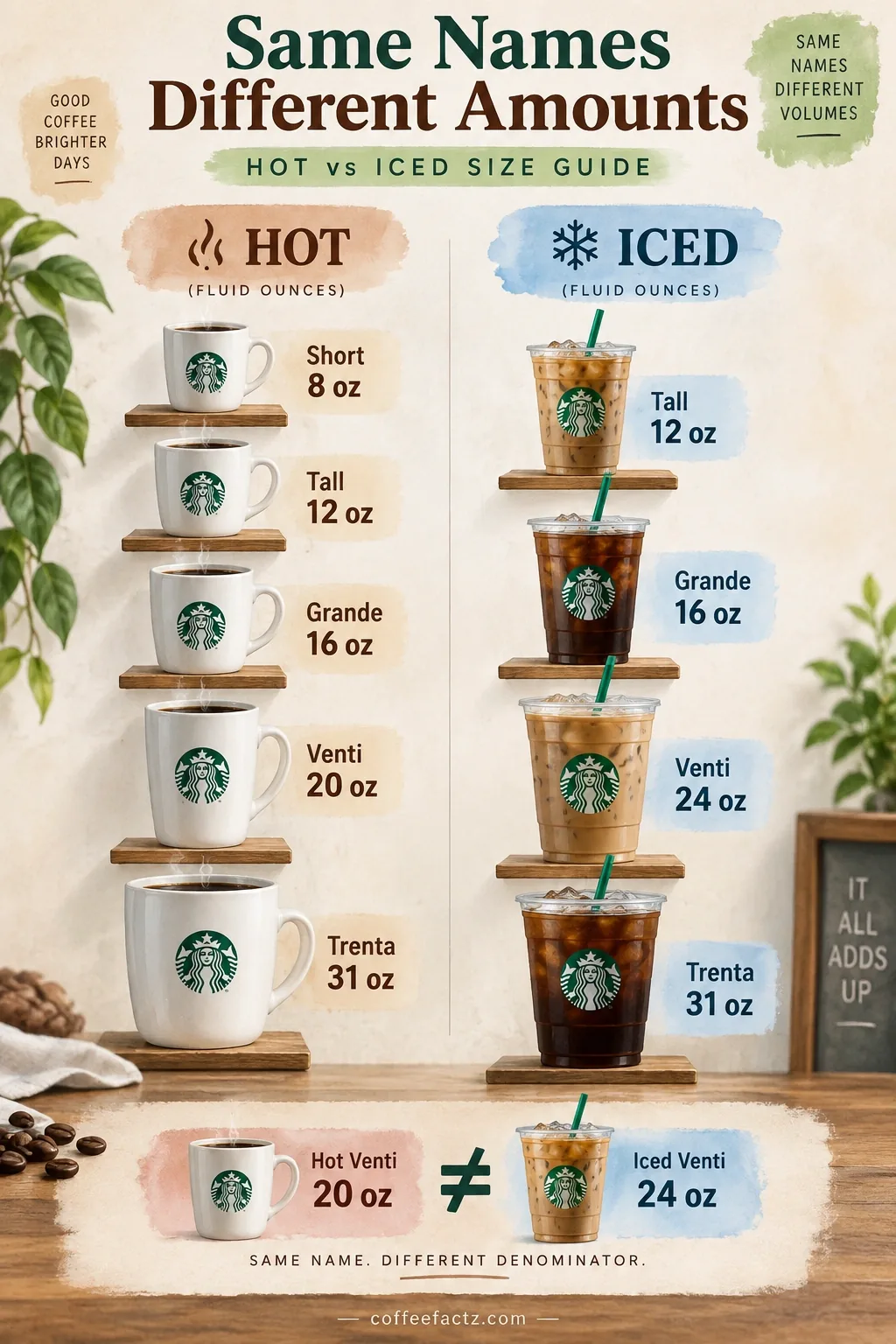
Here’s the full Starbucks size ladder in fluid ounces:
| Size | Hot | Iced |
|---|---|---|
| Short | 8 oz | – |
| Tall | 12 oz | 12 oz |
| Grande | 16 oz | 16 oz |
| Venti | 20 oz | 24 oz |
Short is real, frequently unlisted on the menu board, and only available for hot drinks. Every other size runs the same volume hot and iced, except Venti. A hot Venti gives you 20 oz. An iced Venti gives you 24 oz (591 ml). Same name, different cup, different denominator for every per-ounce calculation you’ll ever run.
The reason the iced cup is larger has nothing to do with generosity. It’s architecture. A standard iced cup is taller and wider than its hot counterpart because it has to hold ice in addition to liquid. The cup was engineered around ice displacement: the physical space that ice cubes occupy reduces the available liquid volume, so the cup itself is scaled up to keep the drink volume competitive. If you ordered a 20 oz iced cup, you’d end up with a noticeably smaller drink than you paid for once the ice went in.
What this means practically: when a barista hears “Venti,” they reach for the cup that matches the temperature of what you ordered. The name triggers the cup. The cup determines the volume. And the volume is the denominator of every value calculation in this article.
Ordering language matters here. Baristas act on names, not ounces. Saying “large” at a Starbucks counter doesn’t guarantee a Venti. Saying “Venti” does, and it changes the cup size, not the recipe. What goes inside that cup, how many shots, how much milk, how the ice ratio works—that’s a separate Starbucks Venti pricing detail we’ll get to in H2-4.
One transition before the price table: any article that cites a single Venti price per ounce without specifying hot or iced is using the wrong denominator for at least half its readers.
Here’s a visual breakdown of exactly how hot and iced Venti volumes compare across the full size ladder:
The 2026 Venti Price Breakdown: What You’re Actually Paying
There is no single national Venti price. That’s not a gap in this guide. That’s the finding. Anyone who gives you one number without specifying region, drink family, and channel is giving you a number that doesn’t apply to your order.
Drink-Family Ranges and Regional Variables
Starbucks pricing moves by drink family, not by size alone. The table below shows approximate 2026 Venti price ranges across the major drink categories. These are ranges, not national averages, because no national average exists:
| Drink Family | Venti Price Range |
|---|---|
| Brewed hot coffee | $3.25 – $4.25 |
| Iced coffee / cold brew | $4.50 – $5.75 |
| Latte / cappuccino (hot) | $5.25 – $6.50 |
| Blended drinks (Frappuccino) | $5.75 – $7.25 |
| Tea (hot or iced) | $3.50 – $4.75 |
Three variables move any given price within these bands:
Metro and regional pricing is the largest variable. A Venti latte in midtown Manhattan or central San Francisco runs materially higher than the same drink in a mid-size Midwest city. Starbucks sets prices by market, not by zip code, but the spread between markets can exceed a dollar on espresso drinks.
Sales tax is the second variable, and it’s invisible until you’re at the register. Most published Venti prices are pre-tax. Depending on your state and municipality, the actual cash outlay can be 8–10% higher than the menu figure.
Seasonal and limited-time menu additions are the third variable. Holiday drinks, regional exclusives, and new platform launches often carry their own price tiers that don’t map cleanly to the standard drink-family ranges above.
Add-On Stacking, Receipts, and Collection Protocols
Base price stops being the real price the moment you customize. Add-ons stack linearly on top of the drink family base, and they can shift your total significantly:
- Syrups (one pump included on some drinks, extra pumps charged): typically $0.50–$0.80 per addition
- Alternative milks (oat, almond, coconut, soy): typically $0.60–$0.80 upcharge
- Extra espresso shots: typically $0.80–$1.10 per shot
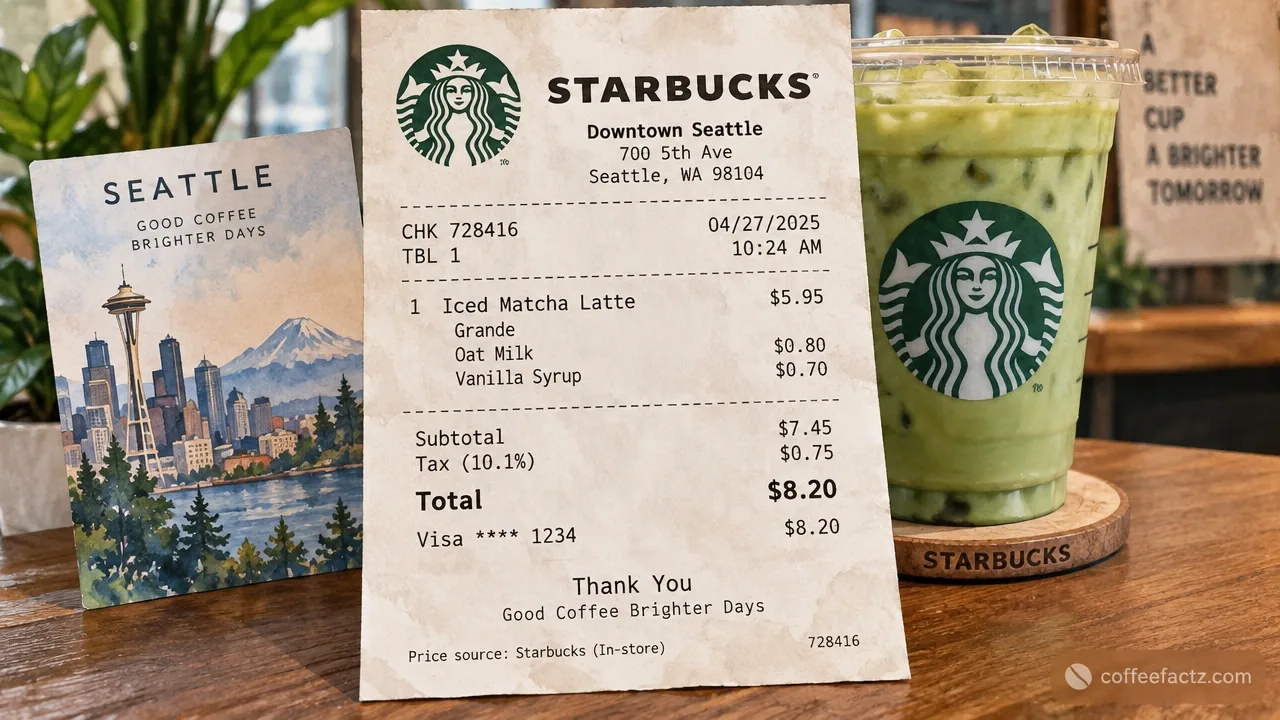
Here’s a fully worked receipt to make this concrete:
Drink: Venti Oat Milk Latte, two extra pumps vanilla syrup City: Chicago, IL Date collected: October 2026 Source: Starbucks in-store pickup price
>
| Line item | Cost | |—|—| | Venti Latte base | $5.95 | | Oat milk upcharge | $0.70 | | Extra vanilla pump (×2) | $1.00 | | Subtotal | $7.65 | | Sales tax (10.25%) | $0.78 | | Total | $8.43 |
That $8.43 is the real price. The base Venti latte price was $5.95. Any guide that cites $5.95 as “the Venti latte price” is describing a cup that most customized orders don’t match.
Here’s where published price guides structurally fail: nearly every “Venti price” circulated by major deal sites and financial outlets omits region, tax, and seasonality. That’s not editorial laziness. It’s a structural impossibility, because there is no verified national price to report. The guides that print one number are reporting their city, their day, and their base order, then presenting it as universal.
The fix is a three-point collection method that produces your number, not a borrowed one:
- App price in your metro: Open the Starbucks app, add your exact drink with your exact customizations to the cart, and read the pre-tax total. This is the most accurate base price for your market.
- In-store price: Ask at the register before you order, or read the digital menu board. In-store and app prices occasionally diverge by $0.10–$0.30.
- Delivery-channel price: If you order through a third-party platform (DoorDash, Uber Eats), add a separate check. Delivery-channel prices are consistently the highest of the three, often $1.00–$2.00 above in-store, before delivery fees and tip. This is the largest single gap between what a Venti “costs” and what you actually pay.
Your verified price is the one from step one or two. The delivery price is a separate budget line, not a Starbucks pricing data point.
Here’s a look at how add-on stacking plays out on a real receipt:
The Golden Formula: Price Per Ounce and the 28% Claim, Tested
Price per ounce is the right metric for comparing Starbucks sizes, but it only produces a useful number if you’re dividing by the right denominator. Most circulated comparisons aren’t.
Arithmetic Mechanics and Denominator Selection
The formula is two steps:
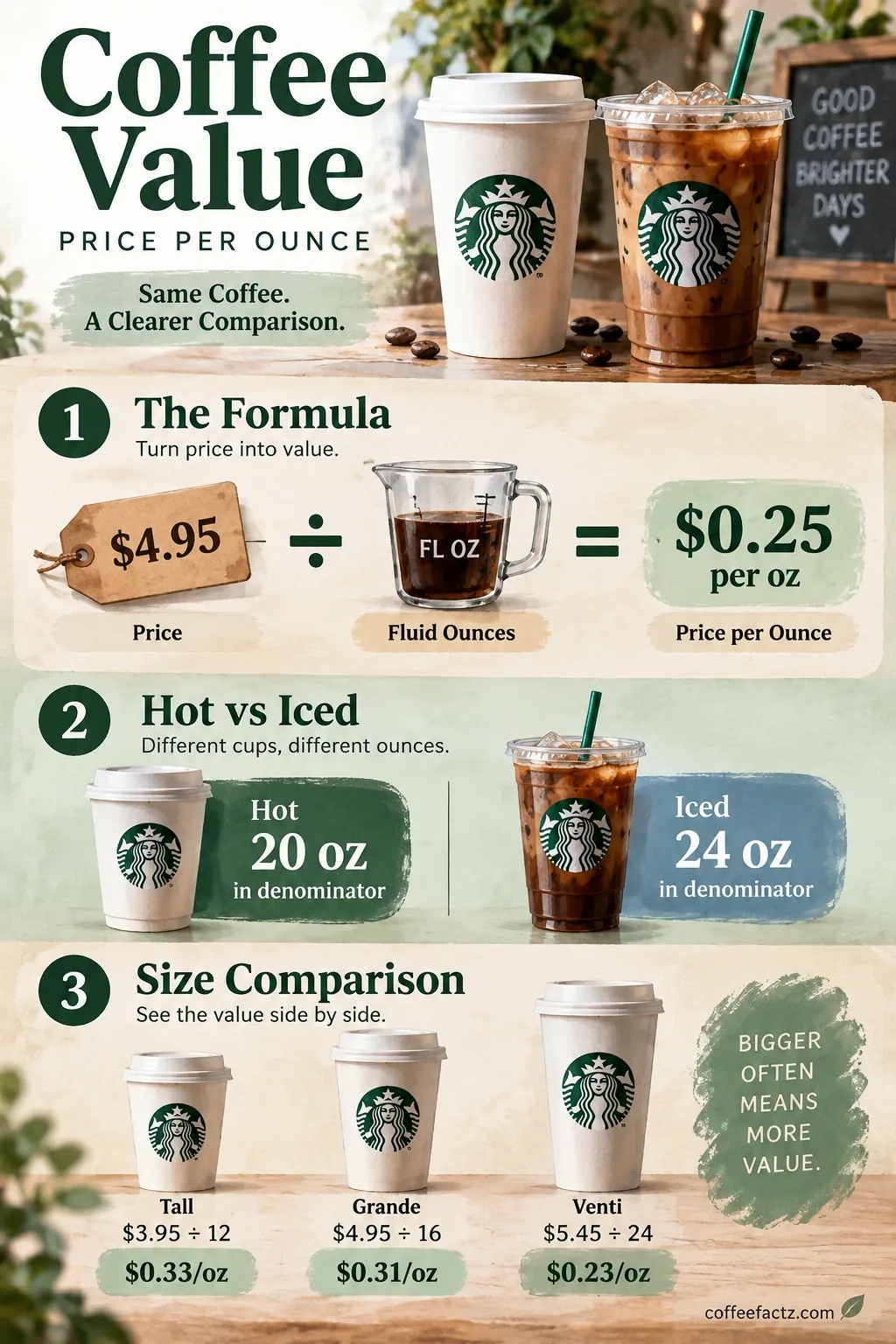
Step 1 – Volume value: Price ÷ fluid ounces. For a hot Venti, divide by 20. For an iced Venti, divide by 24. Using the wrong denominator shifts the result by 17%, which is enough to invert the conclusion.
Step 2 – Caffeine value (for espresso drinks): Price ÷ number of espresso shots. Volume tells you what you’re paying per ounce of liquid. Shot count tells you what you’re paying per unit of caffeine. For milk-heavy espresso drinks, the shot metric is often more honest than the volume metric.
Here’s a side-by-side comparison using brewed coffee prices from a mid-sized U.S. market, October 2026 app prices, pre-tax:
| Size | Price | Volume | Price per oz |
|---|---|---|---|
| Tall | $3.25 | 12 oz | $0.271 |
| Grande | $3.75 | 16 oz | $0.234 |
| Venti (hot) | $4.25 | 20 oz | $0.213 |
The Venti is cheaper per ounce than the Grande in this example. The Grande is cheaper per ounce than the Tall. The savings are real for brewed coffee. The percentage depends entirely on the prices in your market.
Run that same three-column table with the prices from your app. The arithmetic takes thirty seconds. Whatever percentage it produces is your number. Don’t borrow someone else’s.
For espresso drinks, add the shot column:
| Size | Price | Shots | Price per shot |
|---|---|---|---|
| Grande latte | $5.50 | 2 | $2.75 |
| Venti latte (hot) | $6.25 | 2 | $3.13 |
Same shot count, higher price. The Venti hot latte is more expensive per shot of caffeine than the Grande. That’s not a rounding error. That’s the drink.
Here’s a visual breakdown of how denominator selection changes the per-ounce result across cup sizes:
Headline Number Audit and Consumption Boundary
The 28% claim is everywhere. It appears on deal blogs, personal finance roundups, and Reddit threads. Not one of them shows the division. That absence is the tell.
We searched for a source. There isn’t one. No consumer research study, no Starbucks disclosure, no independently verified arithmetic produces a consistent 28% savings figure across drink families and markets. The number has been copied between sites without anyone running the math in public. When social media users have actually tested the claim, reports of it failing outnumber reports of it holding.
Here’s the falsification test: divide the Venti price by 20 oz instead of 24 oz. If you’re holding an iced Venti, the 24 oz denominator is correct. But most circulated percentages appear to use 24 oz for both hot and iced comparisons, or they never specify which cup they measured. Switching to the correct 20 oz hot denominator shrinks the apparent savings enough that the 28% figure becomes uncopyable for hot drinks in most markets.
The boundary condition matters as much as the formula. Upsizing only saves per ounce if you drink the ounces. Every un-drunk ounce converts the theoretical discount into a surcharge. If you consistently finish a Grande but leave two inches of a Venti, you’re not saving 28%. You’re paying more for a cup you didn’t finish.
The per-ounce formula flatters two drink categories:
- Brewed coffee and Americanos: These are primarily water and coffee, so more volume at a modest price increase is genuinely more value. The formula works here.
- Milk-heavy hot espresso drinks (lattes, cappuccinos, mochas): The volume increase is mostly milk. The shot count stays the same. The formula produces a favorable per-ounce number, but the per-shot number tells the opposite story.
Know which category your usual order falls into before you trust the formula’s output.
The Four Ordering Mistakes That Cost You Money
Ordering mistakes at Starbucks rarely happen at the register. They happen before you get there, when you’ve already decided what you want based on habit rather than the drink’s actual composition.
Espresso Shot and Temperature Discrepancies
Mistake 1: Paying for milk, not caffeine.
A hot Venti latte carries two espresso shots. So does a hot Grande latte. The upgrade from Grande to Venti hot adds four ounces of steamed milk and costs roughly $0.50–$0.75 more depending on your market. You are not buying more coffee. You are buying more milk.
The fix: order a Grande with an added shot. You get the same volume as a Grande, three shots of espresso instead of two, and you typically pay less than the Venti total. When is that fix the wrong call? If you genuinely want the larger milk volume for texture or satiety, or if you’re using the Venti cup size for a drink that scales differently with volume (like a cold brew), the Grande-plus-shot swap doesn’t serve you. Know what you’re optimizing for.
Mistake 2: Ordering a temperature out of habit.
An iced Venti latte typically pours three espresso shots into 24 oz. A hot Venti latte pours two shots into 20 oz. Same drink name, same price tier, different caffeine content, different volume, different per-ounce and per-shot value. The temperature you choose by default is making a caffeine and value decision for you without your input.
If you’re ordering hot because you always order hot, check whether the iced version of your drink carries more shots. If it does, you’re leaving caffeine on the table every time you default to warm.
The recommended video below walks through the core differences between iced espresso formats, which is the fastest way to see where temperature and recipe intersect:
Ice Volume and Default-Size Reflexes
Mistake 3: Accepting default ice.
An iced Venti with standard ice fills a meaningful portion of the cup with frozen water. Requesting light ice is a volume-control lever: you get more liquid per cup. But be honest about the trade. Light ice means your drink warms faster and dilutes differently as the remaining ice melts. This is not a free upgrade. It’s a preference swap. If you drink fast, light ice is a net gain. If you nurse your cup for an hour, you may prefer the slower dilution that standard ice provides.

Mistake 4: The default-size reflex.
Buying a Venti because you always buy a Venti is not a sizing decision. It’s a habit. The relevant question is whether you finish the cup. If you consistently leave liquid behind, you’re paying Venti price for Grande consumption. The finish-it test is simple: for one week, order a Grande. If you want more at the end, the Venti is earning its price. If you don’t, you’ve been paying a size premium for nothing.
Run all four of these through the same logic:
The fact is that espresso shot counts don’t scale proportionally with hot Venti size. The reason is that Starbucks recipe standards set shot counts by drink category, not by volume. The impact is that the hot Venti espresso upgrade buys milk at espresso prices. The verdict is to check your drink’s shot count before you upsize, and to use the Grande-plus-shot swap for hot milk drinks unless volume is your actual goal.
The 4-Minute Rule, Birthday Rewards and Barista Discretion: Which Hacks Survive Contact With Reality
Conditional savings hacks at Starbucks share one feature that deal blogs consistently omit: they depend on a human being agreeing to apply them. The policy is half the equation. The person at the register is the other half.
Eligibility and Timing Mechanics
Birthday reward eligibility works as follows. You need an active Starbucks Rewards account, and “active” has a definition: you must have made at least one Star-earning purchase in the 30 days before your birthday. If your account sat dormant, the reward doesn’t appear. The reward loads on your birthday and expires at 11:59 PM that same day in most markets, though some locations honor it through the end of the day based on local system settings. What the reward covers is one free handcrafted beverage, food item, or ready-to-drink bottled product up to the size you select, including a Venti. Size is your choice. Customizations beyond the base drink may or may not be covered depending on how the reward is applied at that specific register.
The “4-minute rule” is a customer-side myth, not a documented Starbucks policy. The name circulates on social media as a claim that you can return or adjust a drink within four minutes of receiving it for any reason. Starbucks does have a “Make It Right” policy that allows customers to request a remake if a drink doesn’t meet their expectations, but there is no published four-minute window attached to it, and application varies by store and staff. Treat it as a goodwill accommodation, not a guaranteed contractual right.
Discount Programs and Promotional Constraints
The reusable-cup discount is $0.10 off per visit when you bring a clean personal cup. It applies at participating company-operated stores. It does not apply to mobile orders in most cases, does not stack with other drink discounts, and does not apply to drinks ordered through third-party delivery. The discount is small by design. At $0.10 per visit, five daily visits over a year saves $18.25 before tax. It’s real, but it’s not a budget line.
The in-store brewed coffee and tea refill policy applies to Rewards members who are sitting in the store with their original visit receipt. You can get a free refill of hot or iced brewed coffee or tea, in any size, during the same store visit. “Same store visit” means you haven’t left and returned. The refill policy does not apply to espresso drinks, cold brew, Frappuccinos, or any customized beverage. It stops the moment you walk out the door.
Promotional structures at Starbucks follow a consistent pattern worth knowing before you plan around them: limited-time offers carry expiration dates that aren’t always prominently displayed, participating-store restrictions mean a promo active at a licensed location (airport, grocery store, Target) may not run at a company-operated store two blocks away, and discounts do not stack. A birthday reward applied to a heavily customized drink may trigger a customization surcharge that reduces or eliminates the reward value.
Before you order on a promo day, run this check:
- Is this a company-operated store or a licensed location?
- Does this promo exclude customizations I plan to make?
- Is today within the offer window (check the app, not memory)?
- Am I trying to stack this with another discount?
If any answer is “I’m not sure,” verify at the register before the order is rung.
Viral Redemption Conditions and Staff Enforcement
Star redemption for a custom Venti is one of the more circulated value plays in Starbucks social communities. The specific build that appears most often: a Venti iced blonde quad espresso, redeemed at the 400-star tier for roughly $3.65 in star value against a drink that would otherwise cost $6.00–$7.00 in a mid-to-high-cost market.
Here’s every condition that build depends on:
- You hold 400 stars in your Rewards account.
- The drink qualifies under the redemption tier’s eligible category (handcrafted beverage).
- The customization (quad shots, blonde roast) is accepted without an upcharge at that location.
- The barista processes the redemption against the full drink rather than the base price.
When all four conditions hold, the saving is real and material. When any one fails, the math collapses. Condition 3 is the most variable: customization surcharges are applied at the discretion of the store, and the identical build has been accepted without charge at one location and repriced at another.

Social documentation of this specific hack shows a consistent pattern: one customer reports the full saving, another reports the same order being repriced or refused. The variable is not the app or the policy. It’s the person at the register. Deal blogs that present star-redemption hacks as reliable savings skip this entirely.
The decision rule that survives this reality: treat any saving that requires staff flexibility as a bonus. Never build it into a regular budget line. If the custom build is refused or repriced, your fallback order is a standard Venti iced blonde espresso with no additional customizations, redeemed at the same star tier. The saving is smaller. The reliability is higher.
The Counter-Cost: What a Home Barista Pays Per Ounce Instead
Home barista costs are not the machine’s sticker price. They are the sticker price plus consumables plus the time cost of maintenance, divided by the number of cups you actually make before the machine needs service. Most home-brewing cost comparisons stop at the sticker price. That’s why they’re wrong.
Comparative Specifications and Hardware Trade-Offs
Here’s the full comparison across the five options a daily coffee drinker actually faces:
| Option | Upfront Cost Band | Cost per Oz | Cost per Shot | Daily Active Minutes | Counter Footprint | Consumable Burden | Best-Fit Drinker |
|---|---|---|---|---|---|---|---|
| Starbucks hot Venti | $0 | $0.21–$0.33 | $2.50–$3.25 | 0 (in-store) | None | None | Convenience-first, occasional buyer |
| Starbucks iced Venti | $0 | $0.19–$0.27 | $1.80–$2.50 | 0 (in-store) | None | None | Higher-caffeine, warm-weather drinker |
| Home batch brew | $25–$200 | $0.03–$0.08 | N/A | 5–8 min | Small | Low (filters, descaler) | Daily volume drinker, brewed coffee |
| Home espresso | $200–$1,500+ | $0.08–$0.20 | $0.40–$1.20 | 10–20 min | Medium–Large | High (tablets, gaskets, filters) | Daily espresso drinker, technique-tolerant |
| Grande + added shot | $0 | $0.28–$0.38 | $1.80–$2.20 | 0 (in-store) | None | None | Hot espresso drinker optimizing caffeine |
Build materials matter more than marketing copy suggests. Entry-level home espresso machines use plastic boilers and single-walled portafilters. Plastic boilers lose heat between shots faster than brass or stainless, which means your second shot of the morning extracts at a lower temperature than your first. That inconsistency is invisible in spec sheets and visible in the cup. Mid-range machines ($400–$700) typically move to stainless boilers and double-walled baskets, which produces more consistent extraction across back-to-back shots.
Maintenance friction is the honest differentiator. A batch brewer needs a descaling cycle every 1–3 months depending on water hardness. An espresso machine needs backflushing with cleaning tablets weekly, descaling monthly to quarterly, and gasket replacement annually on most entry-level housings. Gaskets and baskets on entry-level machines typically show fatigue at 18–24 months of daily use. Factor that into the cost.
Break-Even Volume and Consumable Burden
Break-even volume is not a universal number. It’s a formula you run with your own inputs:
Break-even cups = Machine cost ÷ (Starbucks price per cup − Home cost per cup)
If your Venti habit costs $6.50 per day and your home espresso machine costs $450 with a home cost per cup of $0.85 in beans, milk, and consumables, you break even at approximately 75 cups, or roughly 2.5 months of daily use. But that math only holds if your consumable burden stays at $0.85. It won’t.
The costs most home-brewing guides skip:
- Cleaning tablets: $0.25–$0.50 per backflush, weekly
- Descaler: $8–$15 per bottle, used every 1–3 months
- Water filters (if your machine uses a built-in filter): $15–$25 per replacement, every 2–3 months
- Replacement gaskets: $8–$20 per set, annually
- Replacement baskets: $15–$40, every 18–24 months on entry-level machines
- Time cost of the cleaning cycle: 15–20 minutes per full backflush and rinse
These costs push your true home cost per cup upward as the machine ages. A machine that cost $0.85 per cup in month one typically costs $1.10–$1.40 per cup in month eighteen once you account for consumable accumulation.
There’s also a performance cost to ignoring maintenance. A peer-reviewed study on scale and thermal efficiency found that mineral deposits on heating elements, composed primarily of aragonite, calcite, and dolomite, act as an insulating layer that reduces heat exchange efficiency by 10% to 60% depending on deposit thickness. That means a scaled boiler runs hotter and longer to reach extraction temperature, consuming more electricity, and still delivers inconsistent water temperature to the puck. The espresso you’re pulling from a neglected machine is worse per ounce than the cup you were trying to beat on price.
Buy home espresso if: You drink two or more espresso-based drinks daily, you’re willing to maintain a machine on schedule, and you have the counter space and time budget for a 15-minute morning routine.
Skip home espresso if: Your daily cup count is one or fewer, you travel frequently, or you know from experience that you don’t maintain appliances consistently. An unmaintained espresso machine is more expensive per cup than Starbucks within 18 months.
Buy home batch brew if: Your primary drink is brewed coffee, you consume 16–20 oz daily, and you want the lowest possible per-ounce cost with minimal technique. This is the clearest break-even case in the comparison.
Skip home batch brew if: Espresso drinks are your primary order. A batch brewer doesn’t replicate lattes, cappuccinos, or cold brew in any meaningful way.
The 2026 Verdict: Buy the Venti or Skip It
The Venti is the cheapest cup per ounce in exactly two scenarios: brewed coffee and Americanos, where the volume increase is coffee and water, not milk. For every other drink category, particularly hot espresso drinks where the shot count stays flat between Grande and Venti, the size upgrade is a priced milk addition, not a caffeine or value gain.
The 28% per-ounce savings claim has no verified source. No published analysis shows the division that would produce that figure consistently across drink families, markets, or temperatures. For brewed coffee in a mid-cost U.S. market, the per-ounce savings between Grande and Venti run roughly 8–12% before tax. For hot latte drinks, the per-ounce savings are real but the per-shot math runs negative. The 28% figure should be treated as an unsupported marketing slogan, not a personal finance finding.
Three archetypes, three prescriptions:
- Daily brewed-coffee drinker: Order the Venti. You get the lowest per-ounce cost in the lineup, and the volume increase is all coffee. If you’re drinking daily, home batch brew breaks even within 60–90 cups and drops your per-ounce cost to $0.03–$0.08.
- Daily hot-latte drinker: Order a Grande with an added shot. You pay less than a Venti, get more caffeine than the standard Grande, and stop buying steamed milk at espresso prices. If you’re daily, home espresso becomes cost-competitive past 75 cups, but only if you’ll maintain the machine.
- Occasional espresso-only drinker: Order the iced Venti when you want the extra shot count, and order deliberately by temperature. The iced Venti’s three-shot standard is a genuine value advantage over the hot Venti’s two. For occasional buyers, home gear never breaks even before the machine needs service.
The 30-second verification routine before every order:
- Open the Starbucks app and add your exact drink with your exact customizations. Read the pre-tax total. That’s your real base price.
- Divide by the correct ounce count: 20 for hot Venti, 24 for iced Venti.
- Check the shot count for your drink at your chosen temperature.
- If you’re planning to use a promo or reward, confirm it applies to this drink at this location before the order is placed.
Those four steps take less than a minute and produce a number you can actually defend. Every other Venti price claim you’ve read was built on someone else’s metro, someone else’s order, and someone else’s assumption about which cup you’re holding.
Frequently Asked Questions About Starbucks Venti Price Savings
What is the 4-minute rule at Starbucks?
It’s a customer-side myth, not a documented policy. Starbucks has a “Make It Right” accommodation for drinks that don’t meet expectations, but no published four-minute return window exists – how it’s applied depends on the store and the staff member.
Do you get a free Venti at Starbucks on your birthday?
Yes, if your Rewards account made at least one Star-earning purchase in the 30 days before your birthday. The reward covers one free handcrafted beverage in any size, including Venti, but it loads on your birthday only and expires that same day in most markets.
What is the current price of Starbucks coffee?
There’s no single national price. A Venti brewed coffee runs roughly $3.25–$4.25 depending on market, while a Venti latte ranges from $5.25–$6.50 before tax and add-ons. Check the Starbucks app with your specific customizations for the price in your metro.
How much cheaper is Starbucks when you bring your own cup?
You save $0.10 per visit at participating company-operated stores. That’s $36.50 per year if you visit daily – real, but not a meaningful budget lever on its own.
Does the iced Venti actually give you more coffee than the hot Venti?
More volume, yes – 24 oz versus 20 oz. But the extra volume is partially occupied by ice, and many iced espresso drinks pour three shots versus two in the hot version, so you’re also getting more caffeine. Choose temperature deliberately rather than by habit.
Why does a hot Venti latte cost more per shot than a Grande latte?
Both carry two espresso shots under standard recipes. The Venti adds roughly four ounces of steamed milk and charges $0.50–$0.75 more for it. Per shot, the Venti is the worse deal. A Grande with an added shot gives you three shots for less money.
When does home espresso gear actually beat Starbucks on cost?
Past your personal break-even volume, calculated as machine cost divided by your daily savings per cup, and only if you maintain the machine on schedule. An unscaled boiler loses 10–60% of its heating efficiency, which degrades extraction quality and pushes your real per-cup cost back toward what you were paying at the counter.
Can you stack a birthday reward with the reusable-cup discount?
No. Starbucks discounts and rewards do not stack. The birthday reward covers the drink; the reusable-cup discount applies to a separate, non-discounted purchase.
References
- Influence of Water Scale on Thermal Flow Losses of Domestic Appliances | waslix.com