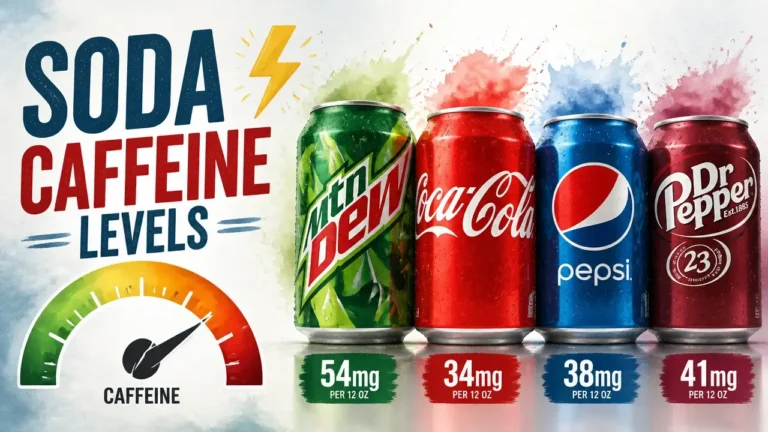

Soda caffeine levels are more spread out than most people expect – and the difference between brands can be bigger than the difference between a soda and a weak cup of coffee. Knowing the actual numbers takes the guesswork out of every can you open.
The four brands covered here – Mountain Dew, Coca-Cola, Pepsi, and Dr Pepper – each land in a different spot on the caffeine scale, and their zero-sugar versions sometimes tell a completely different story. By the end, you’ll know exactly which one fits your energy goal and your sugar budget.
How Much Caffeine Is Really in Soda?
Reliable caffeine safety guidelines give healthy adults a clear ceiling: the FDA considers up to 400 mg of caffeine per day safe. That number sounds big – and it is, once you see where soda actually lands on the scale.
A standard 12 oz can of soda typically holds somewhere between 30 and 55 mg of caffeine. To put that in context, a Starbucks venti hot coffee can blow past 400 mg on its own, and a single Celsius energy drink clocks in at 200 mg. Soda isn’t the heavy hitter of the caffeine world – it’s firmly in the moderate lane.
One thing that makes the four brands in this article easy to compare: national-brand sodas are made to a tightly controlled recipe. The number on the label (or in lab analysis) is what’s actually in your can. No guesswork, no batch variation worth worrying about.
That said, the real health conversation for most casual soda drinkers isn’t just about caffeine. It’s about sugar and calories riding alongside it. A regular Mountain Dew, for instance, carries 46 g of sugar and 170 calories in that same 12 oz. The caffeine might be the headline, but the sugar is often the fine print that matters more day to day.
FDA and NIH researchers, in a joint publication in the Journal of the American Academy of Child and Adolescent Psychiatry, put it plainly:
“Caffeine is recognized by the US Food and Drug Administration as safe for adults in amounts < 400 mg/day... The primary source of caffeine in this population is soda (40 mg/12 oz), followed by coffee... Chronic intake of lower doses of caffeine, such as 35–55mg in a 12-ounce can of soda (e.g., Pepsi™, Coca-Cola™, Mountain Dew™) or a 16–20 ounce bottle of sweet tea... could promote dependence."
That last point is worth sitting with. The doses in soda feel small, but regular daily intake – even at 35–55 mg – can quietly build a dependence pattern over time, especially if you’re reaching for a can every afternoon out of habit rather than choice.
Now here’s the wrinkle the 400 mg rule doesn’t account for: your genetics. More than 95% of caffeine in your body is broken down by a single enzyme called CYP1A2, and how fast that enzyme works is largely determined by a gene variant you were born with. Research published in The Pharmacogenomics Journal – a systematic review and meta-analysis of 3,570 individuals – found that people with the “fast metabolizer” version of this gene have significantly higher enzyme activity than slow metabolizers. The authors noted that this genetic variability can effectively double or halve the safe caffeine limit for a given person.
A companion review in Pharmacological Reviews confirms that CYP1A2 is the dominant driver of caffeine clearance, and a study in Clinical and Translational Science measured this variation across repeated doses, showing that your genotype consistently shapes how your body processes each sip. A broader review in Hereditas integrates both genetic and environmental factors, reinforcing that the spectrum from slow to fast metabolizer is real and clinically meaningful.
A randomized crossover trial in Medicine & Science in Sports & Exercise even showed this plays out in athletic performance – fast metabolizers benefit from caffeine doses of 2–4 mg per kg of body weight, while slow metabolizers actually performed worse after the same dose.
What that means practically: if one soda leaves you restless, wired, or staring at the ceiling at midnight, your personal ceiling may sit well below 400 mg. The guideline is a population average, not a personal prescription. Your own reaction is the most reliable data point you have.
Mountain Dew: The High-Caffeine King of Sodas
Mountain Dew leads the pack with 54 mg of caffeine per 12 oz can, paired with 46 g of sugar and 170 calories – making it the strongest regular soda in this comparison by a clear margin.
That 54 mg is roughly 60% more caffeine than a standard Coca-Cola. It’s also about a third of what you’d get from an average 8 oz cup of brewed coffee, which puts it in “mild-to-moderate stimulant” territory – real enough to feel, not so much that it overwhelms most people.
The flavor profile matches the energy: citrus-forward, intensely sweet, and unapologetically bold. If you’ve never had one, think bright lemon-lime with a sugar punch. It’s not trying to be subtle.
The zero-sugar side of the family is where things get interesting. Diet Mountain Dew keeps the caffeine identical at 54 mg while dropping to zero calories – a clean swap if you want the same lift without the sugar. Mountain Dew Zero Sugar, however, takes a different approach: it bumps the caffeine up to approximately 68 mg while also staying calorie-free. That makes it not just the strongest diet option in this lineup, but the strongest soda overall.
A laboratory analysis published in the Journal of Food Science found that store-brand colas can contain as little as 4.9 mg of caffeine per 12 oz can – which means Mountain Dew’s 54 mg is more than ten times the caffeine of some budget alternatives. If you’re shopping for a lift and reaching for whatever’s cheapest on the shelf, brand genuinely matters here.
The bottom line: if maximum caffeine from a soda is the goal, Mountain Dew – and especially Mountain Dew Zero Sugar – is the top of the chart.
Coca-Cola: The Classic Soda with a Mellow Kick
Coca-Cola delivers 34 mg of caffeine per 12 oz can alongside 39 g of sugar and 140 calories – the mildest caffeine profile of the four brands in this comparison.
That gentleness is actually part of its identity. A single Coke gives you a light alertness boost, the kind you’d want with lunch rather than before a long drive. It’s not going to move the needle the way Mountain Dew does, but that’s the point for a lot of people.
The diet split here is one of the more surprising details in the whole comparison. Diet Coke actually contains more caffeine than regular Coke – 46 mg versus 34 mg. That’s not a typo. Diet Coke uses a slightly different formula, and the caffeine level reflects that. Coke Zero Sugar, on the other hand, matches the regular version exactly at 34 mg, with zero calories. So if you’re switching to a calorie-free version and expecting the same experience, Coke Zero Sugar is the closer match. Diet Coke is its own thing.
The taste is what most people already know: smooth, caramel-toned, with a sweetness that feels familiar rather than aggressive. It’s the benchmark everything else gets compared to.
Here’s a look at how Coca-Cola holds up in a real-world setting:
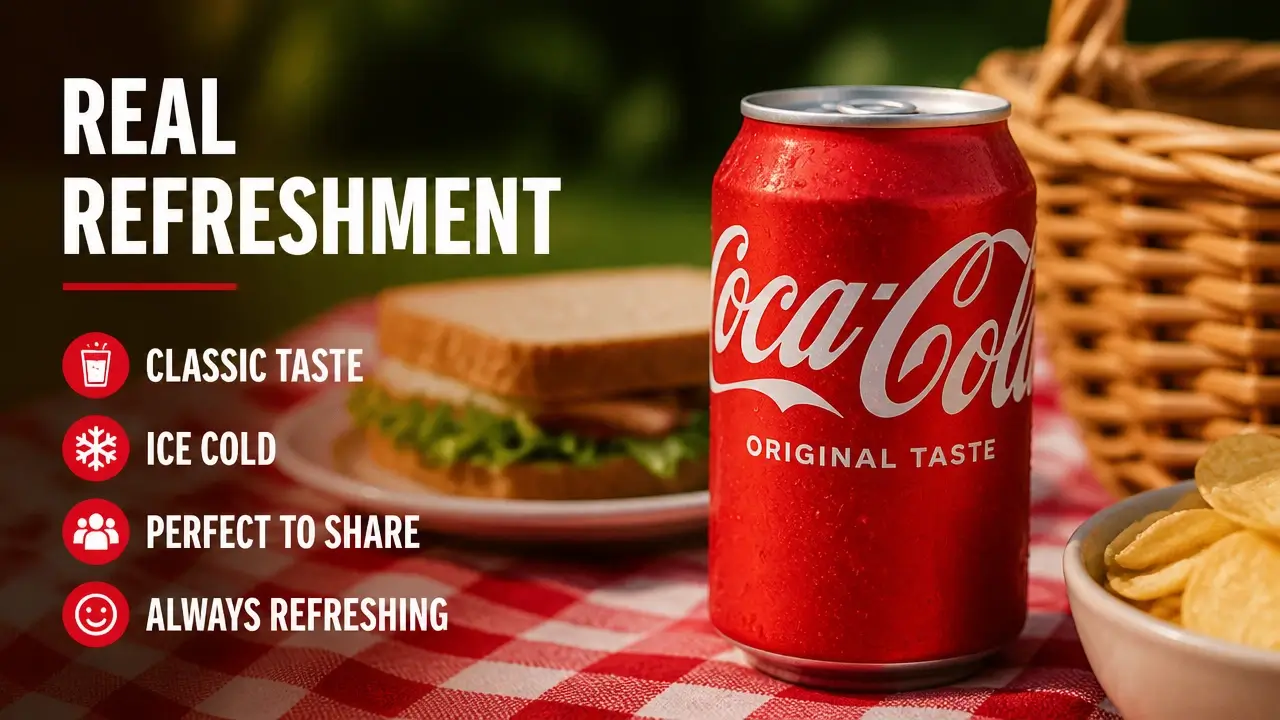
If you want a classic soda experience with a restrained caffeine lift – or you’re managing your intake and want predictability – Coca-Cola is the straightforward choice.
Pepsi: A Touch More Buzz, a Little More Sweet
Pepsi sits just one step above Coke on nearly every number: 38 mg of caffeine, 41 g of sugar, and 150 calories per 12 oz can. Four milligrams more caffeine doesn’t sound like much, but across a few cans a day, it adds up.
The flavor difference is real and consistent. Pepsi tends to taste sweeter than Coke, with a slightly citrusy edge that makes it feel a bit more indulgent. Whether that’s a pro or a con depends entirely on your palate, but it’s the most common reason people land firmly in one camp or the other.
The zero-sugar story for Pepsi has a plot twist. Diet Pepsi actually comes in slightly lower than regular Pepsi at about 35 mg of caffeine – a minor dip, nothing dramatic. Pepsi Zero Sugar, though, is a different beast entirely: it jumps to approximately 69 mg of caffeine with zero calories. That makes it one of the highest-caffeine calorie-free sodas on the mainstream market, edging out even Mountain Dew Zero Sugar by a hair.
Here’s a visual breakdown of how Pepsi’s caffeine content stacks up across its variants:
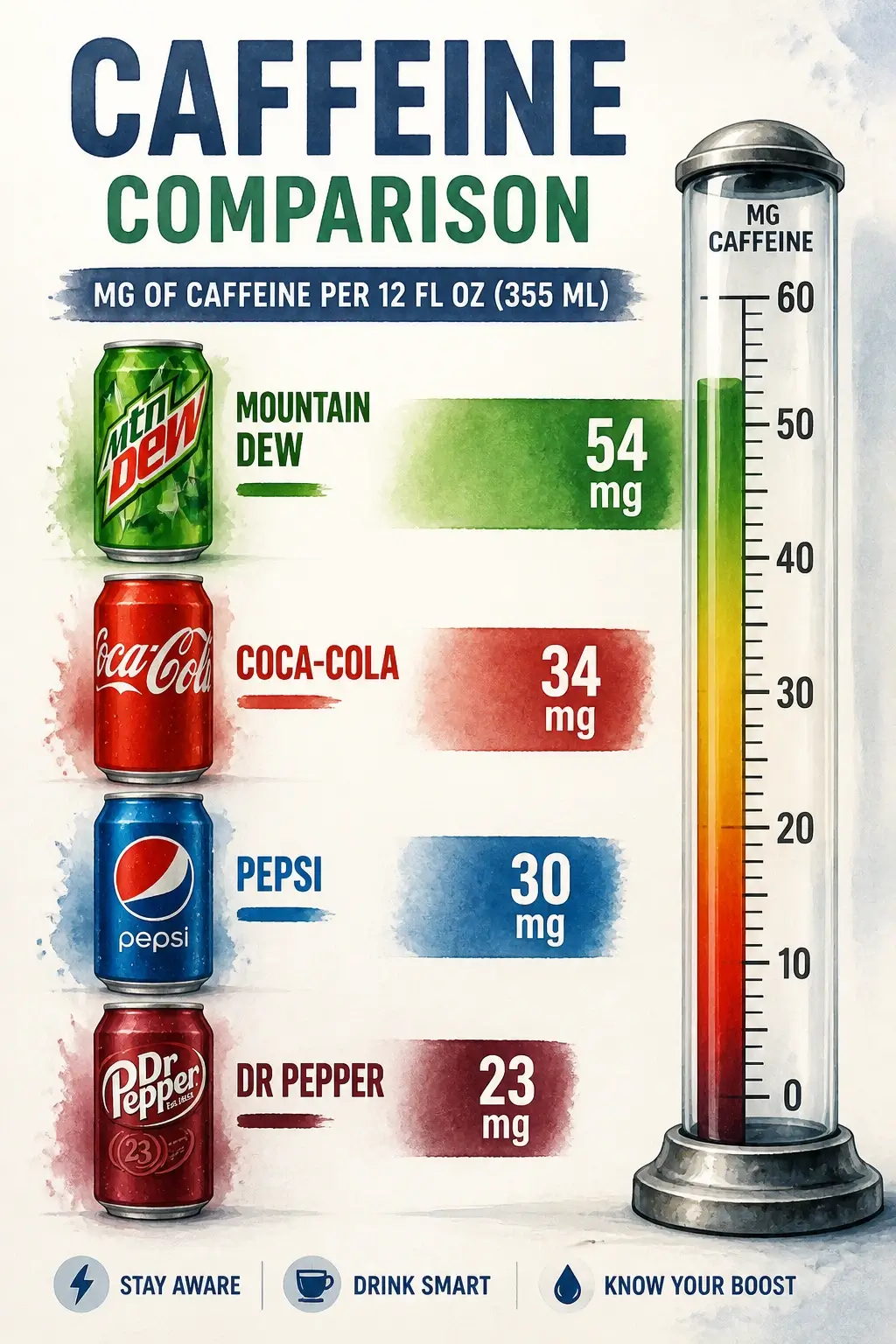
If you already prefer Pepsi’s flavor, you’re also getting a slightly stronger caffeine hit than Coke – and if you go for Pepsi Zero Sugar, that hit becomes genuinely significant for a soda.
Dr Pepper: The Wild Card with a Unique Caffeine Footprint
Dr Pepper lands at 41 mg of caffeine per 12 oz can, with 40 g of sugar and 150 calories – putting it squarely between Mountain Dew and the cola pair, and slightly above Pepsi on the caffeine scale.
What makes Dr Pepper different isn’t primarily the caffeine – it’s the flavor. That famous 23-flavor blend produces something that doesn’t resemble a traditional cola at all. It’s sweet, a little spicy, vaguely cherry-adjacent, and entirely its own category. Most people who drink Dr Pepper are choosing it because nothing else tastes like it, not because they’re optimizing their caffeine intake.
The caffeine story across the Dr Pepper family is unusually consistent. Both Diet Dr Pepper and Dr Pepper Zero Sugar hold steady at 41 mg of caffeine with zero calories. No surprises, no reformulation jumps. What you get in the regular version is exactly what you get in the diet versions, minus the sugar and calories.
USDA and Nutrition Coordinating Center dietary experts, cited in a dietary exposure analysis published in Food and Chemical Toxicology, noted:
“The caffeine content of the beverages was attained from The Food Processor database… assessing dietary exposure to caffeine using representative category-specific values… standard colas represent the lower end, Dr Pepper represents the intermediate range, and citrus-type sodas like Mountain Dew occupy the highest caffeine category among non-energy soft drinks.”
That framing holds up well as a mental model: Dr Pepper is the middle ground – more kick than Coke, less than Dew, and a flavor experience that stands completely apart from both.
For the casual consumer, Dr Pepper is the pick when you want a noticeable buzz and a taste that doesn’t feel like a compromise. The zero-sugar versions make that trade even easier.
The Final Verdict: Which Soda Should You Grab?
Soda caffeine levels don’t have a single winner – they have a right answer for each kind of drinker, and that depends on what you’re actually after.
Here’s a simple cheat sheet:
- Max energy without touching coffee: Mountain Dew at 54 mg is your go-to, or Mountain Dew Zero Sugar at 68 mg if you want the highest caffeine in the lineup with zero calories.
- Classic, easy sip with lower sugar: Coca-Cola at 34 mg is the gentlest option. If you want a slightly stronger calorie-free version, Diet Coke at 46 mg is the quiet overachiever in the Coke family.
- Sweet tooth who still wants a lift: Pepsi at 38 mg gives you that extra sweetness with a small caffeine bump. Pepsi Zero Sugar at 69 mg is the surprise here – one of the highest caffeine counts in any mainstream calorie-free soda.
- Unique flavor with a solid, reliable buzz: Dr Pepper at 41 mg, consistent across every variant, is the pick when taste is the priority and you still want more than Coke delivers.
Every regular version on this list carries significant sugar – up to 46 g in a single Mountain Dew. If sugar is something you’re watching, the zero-sugar variants aren’t a minor convenience; they’re a meaningful difference. The caffeine levels in those versions often change too, sometimes dramatically, so it’s worth checking before you assume the diet version is a straight swap.
Even at the top of this list, two Mountain Dews in a day puts you at about 108 mg of caffeine – well under the FDA’s 400 mg ceiling. But that ceiling is an average, not a guarantee. As the research on CYP1A2 genetics makes clear, your personal metabolism could make the same dose feel twice as strong. If jitters or disrupted sleep follow even a single can, your body is giving you better data than any guideline can.
And if you’re on the other end – genuinely sensitive to caffeine and looking for something even lower – laboratory analysis has found store-brand colas with as little as 4.9 mg per 12 oz can. That’s not a typo. For people who feel every milligram, that’s a real option worth knowing about.
The numbers below let you compare everything side by side before you decide.
| Soda | Caffeine (12 oz) | Sugar | Calories | Diet/Zero Sugar Caffeine | Diet/Zero Calories |
|---|---|---|---|---|---|
| Mountain Dew | 54 mg | 46 g | 170 | Diet: 54 mg / Zero Sugar: 68 mg | 0 cal |
| Coca-Cola | 34 mg | 39 g | 140 | Diet Coke: 46 mg / Coke Zero: 34 mg | 0 cal |
| Pepsi | 38 mg | 41 g | 150 | Diet Pepsi: 35 mg / Pepsi Zero: 69 mg | 0 cal |
| Dr Pepper | 41 mg | 40 g | 150 | Diet & Zero Sugar: 41 mg | 0 cal |
Key Takeaways on Soda Caffeine Levels
- Mountain Dew leads all four brands at 54 mg per can, with Mountain Dew Zero Sugar pushing even higher at 68 mg.
- Coca-Cola is the mildest option at 34 mg, but Diet Coke quietly outpaces regular Coke with 46 mg.
- Pepsi Zero Sugar and Pepsi Zero Sugar top the calorie-free caffeine chart at approximately 69 mg per 12 oz.
- Dr Pepper holds a steady 41 mg across all its variants – regular, diet, and zero sugar – making it the most consistent of the four.
- The FDA’s 400 mg daily limit is a population average; your genetics can make the same dose feel twice as strong or half as strong.
- Sugar, not caffeine, is often the bigger daily health trade-off – regular sodas carry 39–46 g of sugar per can.
Frequently Asked Questions About Soda Caffeine Levels
Is Mountain Dew or Coke worse for you overall?
It depends on what you’re weighing. Mountain Dew has more caffeine (54 mg vs. 34 mg) and significantly more sugar (46 g vs. 39 g) per 12 oz, so if you’re watching either, Coke is the lighter option. Neither is a health food, but Mountain Dew carries a noticeably heavier sugar load.
Which mainstream soda has the highest caffeine of all?
Among the four brands here, Pepsi Zero Sugar edges out the competition at approximately 69 mg per 12 oz, followed closely by Mountain Dew Zero Sugar at 68 mg. In the regular (full-sugar) category, Mountain Dew at 54 mg is the clear leader.
Does Diet Coke really have more caffeine than regular Coke?
Yes – Diet Coke contains about 46 mg of caffeine per 12 oz while regular Coke has 34 mg. They use slightly different formulas, and that difference shows up in the caffeine count. Coke Zero Sugar, by contrast, matches regular Coke at 34 mg.
What soda is safest to drink if I have acid reflux or GERD?
Caffeine and carbonation both relax the lower esophageal sphincter, which can worsen GERD symptoms – so no soda is truly “safe” in that context. If you’re going to have one, a low-caffeine option like Coke (34 mg) or a caffeine-free version of any brand minimizes one trigger, though the carbonation itself remains a factor worth discussing with your doctor.
Can drinking soda every day make you dependent on caffeine?
It can, even at the relatively low doses soda delivers. Research cited in the Journal of the American Academy of Child and Adolescent Psychiatry notes that chronic intake of 35–55 mg per can – the range all four brands fall into – is enough to promote caffeine dependence over time, particularly if the habit is daily and consistent.
Why do zero-sugar sodas sometimes have more caffeine than the regular versions?
It’s a formulation choice, not a rule. Brands like Pepsi Zero Sugar and Mountain Dew Zero Sugar are designed to appeal to consumers who want more energy without calories, so the caffeine level is boosted as part of that positioning. Diet versions, on the other hand, are often reformulated to taste closer to the original, and their caffeine levels vary by brand.
How do soda caffeine levels compare to energy drinks?
Soda sits well below mainstream energy drinks. A Celsius, for example, has 200 mg of caffeine in one can – roughly four times a regular Mountain Dew. Even Pepsi Zero Sugar at 69 mg is less than half of most energy drinks. Soda is a moderate caffeine source; energy drinks are a different category entirely.
Is there a soda option for someone who’s extremely caffeine-sensitive?
Yes. Laboratory analysis has found certain store-brand colas with as little as 4.9 mg of caffeine per 12 oz – a fraction of any national brand. Caffeine-free versions of Coke, Pepsi, and Dr Pepper are also widely available and contain zero caffeine, making them a reliable option for anyone who reacts strongly to even small amounts.
References
- The Impact of Genetic Polymorphisms on CYP1A2 Activity in Humans: A Systematic Review and Meta-Analysis – nature.com
- Interindividual Differences in Caffeine Metabolism and Factors Driving Caffeine Consumption – aspetjournals.org
- Effects of Common CYP1A2 Genotypes and Other Key Factors on Intraindividual Variation in the Caffeine Metabolic Ratio – pmc.ncbi.nlm.nih.gov
- Unraveling the Complexities of Caffeine: Metabolism, Genetics, Evolution, and Health – springer.com
- Caffeine, CYP1A2 Genotype, and Endurance Performance in Athletes – journals.lww.com
- Caffeine and the Child and Adolescent: FDA/NIH Joint Publication Insights – sciencedirect.com
- Caffeine Content of Carbonated Beverages: Laboratory Analysis – ift.onlinelibrary.wiley.com
- Dietary Exposure to Caffeine Using Representative Category-Specific Values – sciencedirect.com