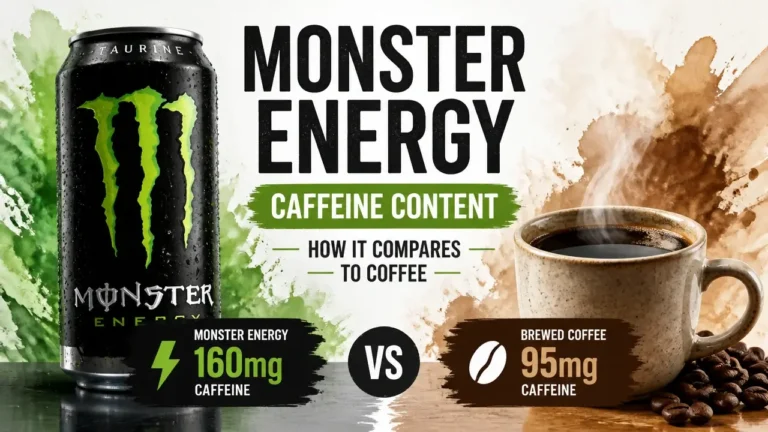

Monster Energy caffeine content is closer to your morning coffee than most people expect – and that single misconception shapes a lot of bad decisions about daily caffeine habits. A 16-oz Monster Original packs 160 mg of caffeine. A Starbucks Grande carries 150–200 mg. The gap is almost nothing.
So why does the buzz feel so different? And which one is actually safer to reach for every day? The answer lives beyond the milligram count – in the sugar, the ingredient stack, and what we still don’t know about long-term use.
Caffeine by the Numbers: Monster vs Your Coffee Cup
Monster Energy caffeine content starts at a flat 160 mg for the standard 16-oz Original can – but that headline number gets complicated fast once you factor in serving size, product variation, and what’s actually in your coffee order. Most people assume energy drinks are loaded with far more caffeine than coffee. The math says otherwise.
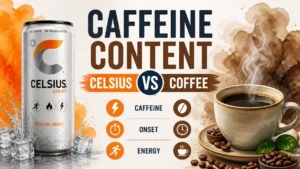
Start with the per-ounce comparison. Monster Original delivers roughly 10 mg of caffeine per ounce. A standard home-brewed drip coffee runs about 12 mg per ounce. Coffee is actually more concentrated – but we drink it in smaller servings. That’s the sleight of hand that makes the comparison misleading at first glance.
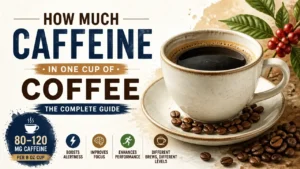
Scale up to real-world serving sizes and the picture shifts again. A 16-oz coffee shop order – a Starbucks Grande, for instance – typically contains 150 to 200 mg of caffeine. Order a large at some chains and you can push past 330 mg in a single cup. Suddenly, that Monster can looks moderate by comparison.
Monster’s own lineup adds more variables. Monster Ultra comes in at around 150 mg per can – slightly less than the Original. Java Monster, the coffee-based hybrid, can reach up to 300 mg per can. And a single 1-oz espresso shot delivers 60 to 75 mg, meaning a double shot is already halfway to a Monster’s total.
Here’s the table that levels the playing field:
| Drink | Serving Size | Total Caffeine | Caffeine per oz |
|---|---|---|---|
| Monster Energy Original | 16 oz | 160 mg | ~10 mg/oz |
| Monster Ultra | 16 oz | ~150 mg | ~9.4 mg/oz |
| Java Monster | 15 oz | ~300 mg | ~20 mg/oz |
| Home-brewed drip coffee | 8 oz | ~95 mg | ~12 mg/oz |
| Starbucks Grande (drip) | 16 oz | ~310 mg | ~19 mg/oz |
| Starbucks Venti (drip) | 20 oz | ~415 mg | ~21 mg/oz |
| Espresso (single shot) | 1 oz | ~63 mg | ~63 mg/oz |
The simple takeaway: a single Monster and a medium coffee are often in the same ballpark for total caffeine. The real story is what rides along with those milligrams.
Dr. Sachin A. Shah, PharmD and Professor of Pharmacy Practice, puts the upper end of the risk in sharp relief:
“a single energy drink [like Monster] may be up to 32 fl oz, implying up to 400 mg of caffeine, the equivalent of more than six 1 oz shots of espresso.”
That’s the version of Monster that crosses from “roughly equivalent to coffee” into genuinely high-dose territory – and it’s sitting on convenience store shelves right next to the standard can.
Beyond Caffeine: What’s Really Inside Monster Energy?
Monster Energy’s proprietary energy blend does more than pad the ingredient label – it changes the time course and subjective character of the buzz in ways that raw caffeine milligrams can’t predict. The can contains a stack of active compounds, each with a distinct biological role, and understanding what they actually do (versus what the marketing implies) is the key to answering why a Monster feels different from a coffee with identical caffeine.
Here’s what’s in the blend and what each ingredient is actually doing:
- Taurine: An amino acid that supports nerve signaling and has shown some protective effects on the cardiovascular system under stress. It doesn’t stimulate – it modulates.
- L-carnitine: Involved in transporting fatty acids into cells for energy production. At the doses in an energy drink, the functional effect on energy metabolism is modest at best.
- Inositol: Plays a role in cell signaling pathways. Its inclusion in energy drinks is largely mechanistic – there’s limited clinical evidence it adds to alertness.
- B vitamins (B3, B6, B12): These help convert food into usable energy, but only if you’re deficient. For most healthy adults eating a normal diet, extra B vitamins don’t produce a noticeable energy boost – they just get excreted.
- Guarana extract: This one matters. Guarana contains caffeine-like compounds (primarily caffeine itself, bound to tannins) that release more slowly than free caffeine. It effectively raises the total stimulant load beyond what the caffeine label alone reports.
- Ginseng: An adaptogen with some evidence for reducing mental fatigue, though effects are highly variable and dose-dependent.
The honest summary: most of these ingredients are associated with energy metabolism in controlled research, but the evidence that they meaningfully amplify caffeine’s effect at the doses found in a Monster can is thin. What we can say is that guarana adds real stimulant load, and taurine appears to modulate – not amplify – caffeine’s cardiovascular impact.
Coffee, by contrast, gets its energy profile almost entirely from caffeine and its natural antioxidants. There’s no engineered stack, no secondary stimulant compounds. What you see on a coffee label is essentially what you get.
The temporal difference is what most comparison articles miss entirely. Guarana’s slower-releasing caffeine compounds, combined with taurine’s modulating effect, can shift the peak and duration of the buzz. That’s why a Monster can feel sharper and more aggressive early on, then sustain longer – even when the total caffeine matches your coffee. It’s not more caffeine; it’s differently timed caffeine riding alongside compounds that alter the experience.
Dr. Aydın Adnan Menderes, a clinical researcher and author in Applied Sciences, found something important when isolating these compounds:
“compared with taurine and the combination of caffeine + taurine, caffeine was found to have the most adverse effects on the cardiovascular system… It was also found that the presence of taurine may have repressed the adverse effects of caffeine”
That finding reframes taurine’s role entirely. It’s not there to make you more wired – it may be there to keep the caffeine from being too hard on your heart. Whether that’s intentional formulation or a fortunate side effect, it’s a more nuanced picture than “energy blend = more stimulants.”
The Sugar Rollercoaster and the Zero-Sugar Trap
Monster Energy’s sugar impact is where the “it’s basically like coffee” comparison breaks down completely – and where the choice between the Original and the Ultra versions gets more complicated than most people realize. The regular can has a sugar problem that’s hard to overstate. The zero-sugar can swaps that problem for a quieter, less-discussed one.
The 54-Gram Sugar Crash Inside Every Original Can
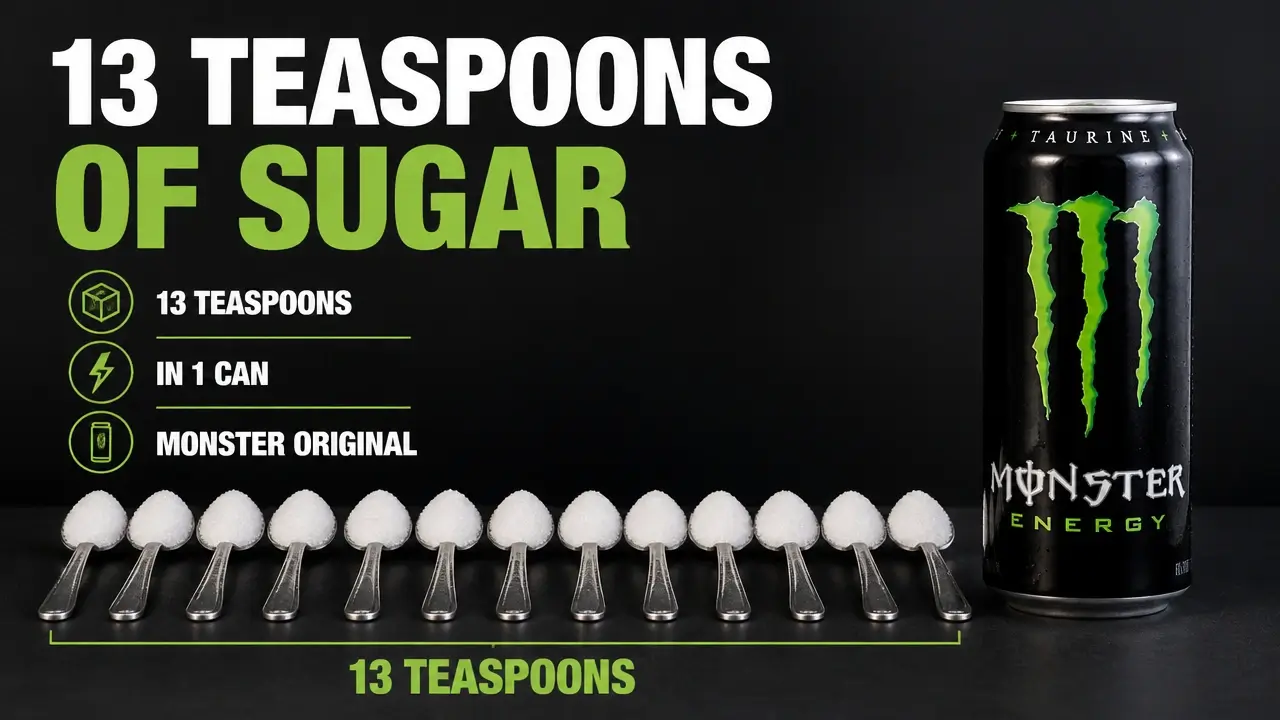
Reactive hypoglycemia from Monster Original starts with a number that should stop you mid-sip: 54 grams of sugar in a single 16-oz can. That’s roughly 13 teaspoons. It also exceeds the World Health Organization’s entire recommended daily limit for added sugar in one drink.
Here’s the physiological sequence that follows. You drink the can. The 54 grams of glucose hit your bloodstream fast – there’s nothing slowing the absorption the way fiber would in whole food. Your pancreas responds with an insulin spike to bring blood sugar back down. It overcorrects. Blood sugar drops below baseline. That’s reactive hypoglycemia – the crash – and it’s the reason you feel worse two hours after a Monster than you did before you opened it.
Caffeine adds a layer to this. It masks the early signs of the crash by keeping you alert through adenosine blockade, so the drop hits you harder when the caffeine also starts to wear off. The two curves – sugar crash and caffeine comedown – often land at the same time.
Here’s a visual to make the sugar load tangible:
The Zero-Sugar Trade-off in Monster Ultra
Monster Ultra’s artificial sweeteners solve the sugar crash problem – and introduce a different set of questions that most “zero-sugar is healthier” framing quietly ignores. The can uses sucralose and acesulfame potassium to deliver sweetness without the calorie load or the acute blood-sugar spike. For the immediate crash cycle, this is a genuine improvement.
But artificial sweeteners are not metabolically inert.
Sucralose, in particular, has shown up in multiple trials as a compound that influences insulin dynamics even without raising blood glucose. In a randomized crossover trial published in Nutrition & Metabolism, 30 healthy adults consuming diet sodas containing sucralose and acesulfame potassium showed a modest but statistically significant increase in active GLP-1 – an incretin hormone that stimulates insulin release – compared to seltzer water. A separate trial published in Nutrients found that ingesting sucralose (not just tasting it) increased insulin response in normal-weight participants, pointing to a cephalic-phase-like effect – your body anticipating sugar that never arrives and releasing insulin anyway.
The chronic picture adds another layer. A 10-week randomized controlled trial in the Nutrition Journal found that daily sucralose consumption at 48 mg and 96 mg doses increased fasting and post-glucose-challenge insulin concentrations and reduced insulin sensitivity over time.
To be fair, the gut microbiota story is less settled. The Nutrition & Metabolism trial explicitly noted that “alterations of the gut microbiome have only been reported in one small human study,” and a 14-day sucralose trial in Nutrients found no meaningful change in dominant bacterial taxa or short-chain fatty acid production.
The honest summary: zero-sugar Monster eliminates the acute blood-sugar spike and the crash that follows. What it doesn’t eliminate is the possibility of cumulative effects on insulin sensitivity from chronic sucralose intake. For someone drinking Monster Ultra every day, that’s a trade-off worth knowing about – because almost no one is talking about it.
The Real Health Risks: What the Studies Show (and What They Don’t)
Health risks from chronic Monster consumption sit on a spectrum that most people either dismiss entirely or catastrophize – and neither response is useful. The data supports a clear-eyed middle ground: there are real, documented acute risks, some credible long-term concerns, and a significant evidence gap that deserves more respect than it gets.
Acute Caffeine Overconsumption: Limits, Jitters, and Cardiac Risks
Caffeine toxicity thresholds give us the clearest numbers we have. The FDA and EFSA both place the safe daily ceiling for healthy adults at 400 mg of caffeine. Pregnant individuals get a tighter limit – 200 mg per day – and the consensus across pediatric health bodies is that children and adolescents should avoid energy drinks entirely, not because of a single ingredient but because of the combined stimulant load.
Cross that 400 mg ceiling and the acute side effects become predictable: jitteriness, anxiety, heart palpitations, nausea, and disrupted sleep. Push into extreme territory – around 1,200 mg of caffeine, which would require multiple large energy drinks or concentrated caffeine supplements – and the risks escalate to seizures and cardiac events.
Two standard Monster Original cans already put a 130-pound person near the upper edge of their safe daily limit. A large Java Monster gets there in one can. These aren’t hypothetical scenarios.
The emergency department data makes the stakes concrete. According to data published by the NIH’s Office of Dietary Supplements, energy drink-related ED visits in the U.S. more than doubled between 2007 and 2011, rising from approximately 10,000 to over 20,000 annual cases – with the majority involving young adults aged 18 to 25.
Long-Term Health Concerns: Triglycerides, Kidney Strain, and Medication Interactions
Chronic health effects from regular Monster intake are where the conversation gets more nuanced – and where the evidence has more gaps than most sources admit.
Triglycerides: The 54 grams of sugar in a regular Monster is the mechanism here, not the caffeine. High added-sugar intake drives elevated triglyceride levels, which is an independent risk factor for cardiovascular disease. Daily or near-daily Original consumption adds up to a meaningful sugar burden over weeks and months.
Creatinine and kidney strain: High-dose caffeine can transiently raise creatinine levels, which shows up on blood panels as a flag for kidney stress. For healthy people with normal kidney function, moderate caffeine intake is unlikely to cause structural damage. The concern shifts for people with pre-existing kidney conditions, where chronic dehydration compounded by caffeine’s mild diuretic effect creates a more meaningful risk.
Medication interactions: This is the area most energy drink articles skip entirely. Combining a Monster with stimulant medications like Vyvanse (lisdexamfetamine) stacks two cardiovascular loads – caffeine’s vasoconstrictive and heart-rate-elevating effects on top of amphetamine’s similar profile. The combination amplifies cardiovascular strain beyond what either alone would produce. Separately, caffeine’s adenosine-blocking mechanism can partially counteract the calming, cortisol-regulating effects of supplements like ashwagandha. If you’re taking either, that’s a conversation to have with a healthcare provider, not a risk to guess at.
Clinical researchers writing in Nutrients documented that:
“habitual intake was linked to acute blood-pressure rises, arrhythmias, endothelial dysfunction, and metabolic disturbances, sometimes within 24 h of a single can”
That “within 24 hours” detail matters. These aren’t effects that only emerge after years of use – they can show up fast in susceptible individuals.
Contrast this with what we know about moderate coffee consumption. Large observational studies consistently associate regular coffee drinking with reduced risk of type 2 diabetes, Parkinson’s disease, and liver disease. The mechanism is largely attributed to coffee’s polyphenol antioxidants – compounds that Monster simply doesn’t contain. This isn’t a minor footnote. It means that for daily caffeine users, the choice between coffee and Monster isn’t just about equivalent milligrams – it’s about whether your caffeine vehicle is working for your long-term health or just delivering stimulation.
The bigger honest caveat: no long-term epidemiological studies exist that track daily Monster consumption over multiple years. Everything we know about chronic risk is extrapolated from short-term trials and single-dose tolerance data. For someone who drinks one every day and assumes “I’m under 400 mg, so I’m fine,” that evidence gap is the most important thing in this article – and it’s the piece that almost no comparison article bothers to mention.
The 2-4-1 Rule: A Simple Strategy to Dial In Your Caffeine Intake
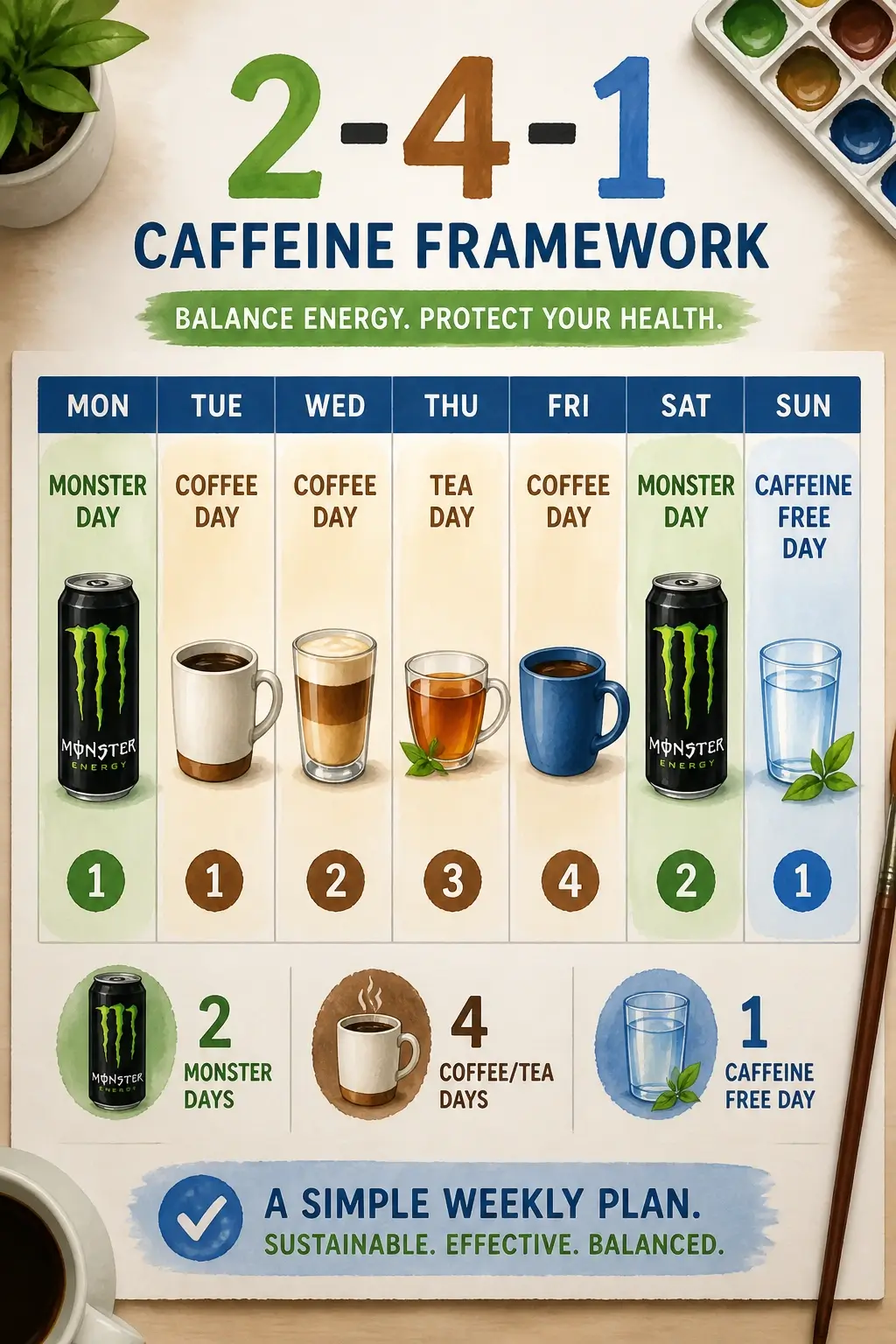
The 2-4-1 caffeine management framework isn’t about quitting anything – it’s about shifting the balance so Monster goes from your default to your exception, and coffee fills the rest of the week with a steadier, cleaner energy profile. It’s simple enough to remember without writing it down, and it works with your existing habits rather than against them.
Here’s how it breaks down:
- 2 Monster Energy drinks per week – maximum. Not two per day, not two before Thursday. Two total, for the whole week.
- 4 days where your caffeine comes from coffee or tea instead. These are your baseline days – steadier energy, no sugar spike, and the antioxidant benefits that come with the territory.
- 1 fully caffeine-free day. One day where you reset tolerance, let your adenosine receptors recover, and find out what your natural energy level actually feels like without chemical support.
Why does this pattern hold up? The math is automatic. Two Monsters per week means your weekly sugar exposure from energy drinks stays manageable. Four coffee days means you’re spending most of your week on a beverage with a well-documented long-term health profile. One caffeine-free day prevents the creeping tolerance that turns “I need this to function” from a joke into a real problem.
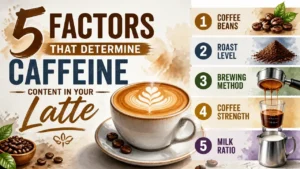
For anyone who currently drinks Monster daily and finds coffee too bitter or too plain, the transition doesn’t have to be cold turkey. Start with lightly sweetened coffee – a splash of simple syrup, a flavored creamer. Try milk-based drinks like a latte or flat white, where the espresso is softened by steamed milk and the sweetness comes naturally from the lactose. Some single-origin beans – particularly those from Ethiopia or Colombia – carry natural fruit sweetness that makes unsweetened coffee far more approachable than the diner-coffee reference point most people are working from.
The goal isn’t to become a specialty coffee person. The goal is to stop treating Monster as a daily necessity.
Dr. Cristiana Casula, lead author of The Dark Side of Energy Drinks published in Nutrients, lands on a similar place from the clinical side:
“We suggest that the intake of energy drinks should not only not exceed the safety limits for caffeine established by European and American regulatory authorities, but should be even lower. If consuming both, a practical rule is: no more than one [energy drink] at a time and two cans per day to remain within an acceptable safety limit”
Two per day is her ceiling for safety. Two per week is a more comfortable margin – and it leaves room for the occasional third without panic.
The Final Verdict: Monster or Coffee for Your Daily Life?
Monster vs coffee comes down to one honest question: are you using caffeine as a daily tool for sustained function, or as an occasional boost for specific situations? The answer to that question should determine which one you’re reaching for most mornings.
For daily use, coffee wins – and it’s not particularly close. The natural antioxidant profile in coffee carries documented associations with lower risk of type 2 diabetes, liver disease, and neurological decline over time. When you drink it without added sugar, there’s no spike-and-crash cycle. The ingredient list is one item long. For someone who wants caffeine to be a long-term part of a healthy life, coffee is the vehicle that earns its keep.
Monster has legitimate use cases. Long drives at 2 a.m. Night shifts. A week where your coffee maker broke and you’re in a convenience store. Situations where you genuinely dislike coffee’s taste and need a one-off boost. In those moments, a single can – ideally a zero-sugar variant like Monster Ultra, with full awareness of the artificial sweetener picture – is a manageable choice, especially if you’re working within the 2-4-1 framework.
The real problem was never a single Monster. It’s the pattern. If it’s your daily go-to, you’re carrying an unnecessary sugar load (or a chronic sucralose exposure), a less predictable stimulant stack, and an unknown long-term risk profile – all for a caffeine hit you could get more cleanly from a cup of coffee.
Dr. Josiemer Mattei, Assistant Professor of Nutrition at the Harvard T.H. Chan School of Public Health, puts it plainly:
“the negative health consequences of drinking energy drinks outweigh any potential short-term benefits”
That’s not a verdict against caffeine. It’s a verdict against the delivery system – the sugar, the artificial sweeteners, the secondary stimulant stack, and the marketing-driven serving sizes that push consumption past what the body handles cleanly.
You don’t have to pick a team. You’re not a “coffee person” or an “energy drink person” – you’re someone who uses caffeine as a tool. Use the data to mix wisely. Keep Monster as the exception. Let coffee be the baseline. And treat the one caffeine-free day per week not as deprivation, but as the clearest signal you’ll ever get about how well you’re actually sleeping.
Key Takeaways on Monster Energy Caffeine Content
- Monster Original’s 160 mg of caffeine is comparable to a Starbucks Grande – the gap between energy drinks and coffee is far smaller than most people assume.
- Coffee is more caffeine-concentrated per ounce than Monster; serving size, not formula strength, is what drives Monster’s higher total intake.
- Guarana in Monster’s blend adds additional slow-releasing caffeine compounds, making the actual stimulant load higher than the label suggests.
- Monster Original’s 54 grams of sugar exceeds the WHO’s entire daily added-sugar recommendation in a single can.
- Zero-sugar Monster avoids the blood-sugar crash but introduces sucralose and acesulfame potassium, which may affect insulin sensitivity with chronic use.
- No long-term epidemiological data exists on daily Monster consumption – the “under 400 mg is safe” assumption rests entirely on short-term tolerance studies.
Frequently Asked Questions About Monster Energy Caffeine Content
Are energy drinks bad for triglycerides?
Regular Monster Energy can raise triglycerides over time, but sugar is the mechanism – not caffeine. The 54 grams of added sugar per can drives the triglyceride elevation, so zero-sugar variants sidestep this specific risk.
Do energy drinks affect Vyvanse?
Yes, and the combination deserves real caution. Both caffeine and lisdexamfetamine (Vyvanse) elevate heart rate and blood pressure, so drinking a Monster while on Vyvanse stacks two cardiovascular loads – amplifying the strain beyond what either produces alone. Talk to your prescriber before combining them.
Does caffeine cancel out ashwagandha?
They work against each other to a degree. Caffeine raises cortisol and blocks adenosine, while ashwagandha is taken specifically to lower cortisol and reduce stress response – drinking a Monster within a few hours of your ashwagandha dose blunts some of its intended effect.
Can energy drinks cause high creatinine levels?
High-dose caffeine can transiently spike creatinine on a blood panel, but for healthy adults with normal kidney function, it’s usually not clinically significant. The bigger concern is chronic dehydration from daily high-caffeine intake, especially for anyone with pre-existing kidney issues.
How does Monster caffeine content compare to a Red Bull?
A standard 8.4-oz Red Bull contains 80 mg of caffeine – exactly half of Monster Original’s 160 mg in a 16-oz can. Per ounce they’re nearly identical at around 9.5–10 mg/oz; Monster just comes in a bigger container.
Is it safe to drink Monster every day?
The FDA’s 400 mg daily caffeine limit isn’t the only variable. Daily Monster Original adds up to 54 grams of sugar per day from one can alone, and no long-term studies track what habitual daily consumption does over years. One can occasionally is a very different risk profile from one can every morning.
Why does Monster feel stronger than coffee with the same caffeine?
Guarana in Monster releases caffeine-like compounds more slowly than free caffeine, and taurine alters how caffeine interacts with the cardiovascular system. The result is a buzz that can feel sharper at onset and longer-lasting – not because of more caffeine, but because of differently timed caffeine delivery.
At what caffeine dose do serious side effects start?
Most healthy adults start experiencing jitteriness, anxiety, and heart palpitations somewhere between 400 and 600 mg. Seizures and serious cardiac events are associated with doses around 1,200 mg – a level reachable through concentrated caffeine supplements or multiple large energy drinks consumed quickly.
References
- Emergency Department Visits Associated with Energy Drinks (2005–2011) – ods.od.nih.gov
- Cardiovascular Effects of Caffeine and Energy Drink Ingredients – ncbi.nlm.nih.gov
- The Dark Side of Energy Drinks: A Comprehensive Review – mdpi.com (Nutrients)
- Hormonal Responses to Non-Nutritive Sweeteners in Water and Diet Soda – nutritionandmetabolism.biomedcentral.com
- Effects of Sucralose Ingestion on Metabolic Responses to an Oral Glucose Tolerance Test – mdpi-res.com (Nutrients)
- Chronic Sucralose Consumption Induces Elevation of Serum Insulin in Young Healthy Adults – link.springer.com (Nutrition Journal)
- Taurine and Caffeine Cardiovascular Interaction Study – mdpi.com (Applied Sciences)
- Harvard T.H. Chan School of Public Health – Energy Drinks and Health Risks – hsph.harvard.edu