

Pre-workout caffeine is the single most studied performance ingredient in sports nutrition — and also the easiest to accidentally overdose. One scoop of your pre-workout, a morning coffee, and a fat-burner pill can stack your daily total past 600 mg before you’ve even started your warm-up.
Getting the dose right isn’t about picking a number off a label. It’s about knowing your bodyweight, your product’s actual caffeine content, and every other source you’re pulling from that day. That’s what this guide is for.
Why Pre-Workout and Diet Pills Rely on Caffeine
Pre-workout caffeine earned its place as the default active ingredient because it’s the most thoroughly investigated performance-enhancing substance in sports science – not by a small margin, but by decades of accumulated, peer-reviewed evidence. The Journal of the International Society of Sports Nutrition position stand on caffeine and exercise performance reviewed that body of research and concluded caffeine has “dominated the ergogenic aids and sport supplement research domain” – a statement backed by hundreds of controlled trials across endurance, strength, and cognitive performance.
That dominance is why you’ll find it in virtually every pre-workout powder and a large share of over-the-counter weight-loss pills. Brands use it because it works, and it works consistently across different training styles and populations.
The problem isn’t the ingredient. It’s the variance in how much you’re actually getting.
A single scoop of pre-workout can deliver anywhere from 150 mg on the mild end to over 400 mg in high-stim formulas. Diet pills and fat burners often add another 100–200 mg per serving on top of that. Most people take these products alongside a morning coffee without doing any math, which means total daily intake can climb past safe territory without a single warning sign on the label.
That’s the area this guide closes. Knowing caffeine works is table stakes. Knowing how much your body can handle – and how much you’re already consuming from all sources – is where safe, effective use actually begins.
Eric S. Trexler, PhD, CSCS and co-author of a peer-reviewed review in Nutrients, puts the consumer responsibility clearly:
“It may be in the best interest of the consumer to select a MIPS product that discloses all ingredient amounts and contains appropriate dosages of each ingredient.”
That advice applies whether you’re buying a pre-workout for performance or a diet pill for weight management. If the label doesn’t tell you exactly what’s in it and how much, you can’t make an informed decision about your total daily load.
Dosing Breakdown: How Much Caffeine Should You Take?
Effective caffeine dosage isn’t a single number – it’s a range anchored to your bodyweight, with a hard ceiling that applies to everyone regardless of size. The sports science consensus gives us two frameworks that work together: an absolute fixed-dose window of 150–400 mg per serving, and an evidence-based formula of 3–6 mg per kilogram of bodyweight.
The bodyweight formula is the more precise tool. At 3 mg/kg, you’re at the low end of the performance window – enough to get a measurable benefit without overwhelming your system. At 6 mg/kg, you’re at the upper bound of what research supports. Beyond that, you’re not getting more performance. You’re getting more side effects.
The International Society of Sports Nutrition is direct on this point:
“The International Society of Sports Nutrition’s position on caffeine… summarizes that caffeine is effective at enhancing performance at dosages considered to be moderate (∼3–6 mg/kg), consumed ∼60 min before performance.”
Here’s where it gets important for larger individuals: if you weigh more than 67 kg, the upper end of the 6 mg/kg formula starts pushing against – or past – the 400 mg absolute daily ceiling. A 90 kg person at 6 mg/kg would theoretically need 540 mg. That’s not a target. That’s a danger zone.
The practical guardrail is this: start at 3 mg/kg, and cap your total daily caffeine at whichever is lower – 6 mg/kg or 400 mg absolute. That single rule keeps you inside both the performance window and the FDA-recognized safety band simultaneously.
Here’s what that looks like across common bodyweights:
| Body Weight | 3 mg/kg (Start) | 6 mg/kg (Upper) | Absolute Cap | Recommended User Tier |
|---|---|---|---|---|
| 60 kg | 180 mg | 360 mg | 360 mg | Beginner–Intermediate |
| 70 kg | 210 mg | 420 mg → cap at 400 mg | 400 mg | Intermediate |
| 80 kg | 240 mg | 480 mg → cap at 400 mg | 400 mg | Intermediate–Advanced |
| 90 kg | 270 mg | 540 mg → cap at 400 mg | 400 mg | Advanced |
User Tiers in Practice
If you’re curious how caffeine in chocolate shows up in everyday foods, consider its content in cacao products.
Most commercial pre-workouts cluster around three product profiles: beginner formulas at 150–200 mg per scoop, intermediate products at 200–250 mg, and high-stim products at 300–420 mg. Diet pills typically contribute 100–200 mg per serving on top of whatever you’ve already taken.
- Beginners (under 150 mg): Use this range if you’re new to stimulants, sensitive to caffeine, or just restarting after a long break. Even 100 mg is enough to feel a real effect if your tolerance is low.
- Intermediate (200–250 mg): The sweet spot for most regular gym-goers. Delivers measurable performance benefits without the anxiety spike that high-stim products can cause.
- Advanced (300–400 mg): Reserved for experienced users with established tolerance. At this range, you need to be meticulous about counting every other caffeine source in your day.
Doses above 6 mg/kg or the 400 mg daily cap do not provide additional performance benefit. That’s not a conservative opinion – it’s what the dose-response data consistently shows. Past that threshold, you’re trading performance for jitters, GI distress, and the kind of crash that wrecks the rest of your day.
The Hidden Danger of Caffeine Stacking
Caffeine stacking is the pattern most supplement guides quietly ignore – and it’s one of the most common ways people end up in trouble. You start with a morning latte (55–100 mg). You take a pre-workout scoop before your afternoon session (250–400 mg). Maybe there’s a fat-burner or caffeine pill in the mix (100–200 mg). By the time you add it up, you’re sitting at 600 mg or more – well past the 400 mg daily limit – without having done anything that looked reckless in the moment.
According to a peer-reviewed survey published in the National Library of Medicine, 14% of pre-workout users reported taking two or more servings at a time, a practice that routinely pushes total daily caffeine intake to 600 mg and beyond. That figure almost certainly understates the real number, since it doesn’t account for coffee and diet pills consumed alongside those servings.
The consequences of consistently exceeding 400 mg aren’t subtle. A peer-reviewed safety review on caffeine toxicology is unambiguous:
“Excessive amounts of caffeine (>200 mg) can give rise to significant… nausea, vomiting, tachycardia, severe hypertension, arrhythmia, seizures, and even death.”
The threshold for serious cardiovascular effects is lower than most people assume. You don’t need to be at 1,000 mg. For some individuals, consistently running at 600–700 mg is enough to elevate cardiac workload and trigger arrhythmia – even if you feel fine subjectively.
Tolerance Masks the Signal, Not the Stress
This is the part that trips up experienced supplement users most. High tolerance means you don’t feel jittery at doses that would floor a beginner. It does not mean your heart rate, blood pressure, and nervous system aren’t under strain. The physiological load is still there. You’ve just lost the warning signal that would otherwise tell you to back off.
Online fitness communities have normalized stacking to a degree that’s genuinely concerning. Forum threads asking “how much pre-workout should I take?” routinely receive top-voted replies of “all of it” – often from users who are combining a 300–420 mg scoop with a 200 mg caffeine pill and morning coffee, treating the resulting 700 mg day as a flex rather than a risk. That culture is worth naming directly: it’s not optimization, it’s desensitization to a real health hazard.
The Dry Scoop Problem
Dry scooping – swallowing pre-workout powder without mixing it in water – deserves its own callout. Beyond the obvious choking risk, it delivers a concentrated caffeine bolus that hits your bloodstream faster and harder than intended. There is no performance advantage to dry scooping. The absorption rate doesn’t improve your workout. It just spikes your blood pressure violently and removes the buffer that water provides for your gut. Skip it entirely.
The Fasted Training Multiplier
If you’re training fasted and combining high-dose caffeine (650 mg range) with BCAAs but no real food or electrolytes, you’re compounding the cardiovascular stress. Dehydration, electrolyte imbalance, and stimulant load interact – the risk of arrhythmia and syncope climbs meaningfully in that combination. Stacking isn’t just a numbers problem. It’s a whole-protocol problem.
Caffeine Timing for Peak Performance and Better Sleep
The standard rule – take your pre-workout 30–60 minutes before training – exists because of caffeine’s pharmacokinetics, not convention. Caffeine reaches peak plasma concentration roughly 45–90 minutes after ingestion. The goal is to align that peak with the most demanding part of your session, which means the clock starts when you swallow, not when you walk into the gym.
Chad M. Kerksick, PhD, FACSM, CSCSD, puts it plainly from a randomized timing trial in Frontiers in Nutrition*:
“Based on the results of this study, it appears that caffeine consumed 1 h prior to exercise exerts the most consistent ergogenic benefits.”
That one-hour mark is the sweet spot for most people. Take it earlier and the peak fades before you hit your hardest sets. Take it too close to training and you’re still on the way up when the session ends.
How Your Last Meal Changes the Equation
Here’s the nuance that most timing guides skip entirely: your fed or fasted state significantly shifts caffeine’s absorption rate. Gastric emptying determines how quickly caffeine reaches your small intestine, where it’s absorbed. A large meal slows that process considerably.
- Fasted training: Take caffeine 30–40 minutes beforehand. Absorption is fast, and the peak arrives right on schedule.
- Fed training (large meal): Push that window out to 60–90 minutes. If you take it at the standard 30 minutes after eating a full meal, you’ll likely still be absorbing it when your warm-up ends and hit the peak mid-session or after.
This connection between meal timing and caffeine onset is almost entirely absent from mainstream pre-workout guides. Most give you a single number. Adjusting for your actual feeding pattern is the difference between a protocol that works and one that works inconsistently.
The Sleep Math You Need to Do
Caffeine has a half-life of roughly 3–5 hours, and that number has real consequences for recovery. A 300 mg dose taken at 4 PM still leaves approximately 150 mg circulating in your system at 9 PM. That residual load doesn’t just keep you from falling asleep – it suppresses slow-wave sleep, which is where the majority of physical recovery and muscle repair happens.
The practical cutoff: avoid any stimulant-containing pre-workout after 2–3 PM. If you train in the evening, this isn’t a minor inconvenience – it’s a genuine tradeoff between today’s workout quality and tonight’s recovery quality. For late-day trainers, a stim-free pre-workout (citrulline, beta-alanine, creatine, without caffeine) is the better call. You keep the pump and the endurance support without wrecking your sleep architecture.
Here’s a video that breaks down the full pharmacokinetics of caffeine absorption, including how the 30–60 minute window works mechanically and why meal timing shifts the curve:
Optimizing Your Pre-Workout: Smooth Energy and Maximum Pumps
Synergistic ingredients don’t replace pre-workout caffeine – they shape how it feels and what it delivers. The right additions can smooth out the jittery edge, extend endurance, and drive better muscle pumps. The wrong approach is buying a product loaded with undisclosed blends and hoping for the best.
Here’s what the label reading process looks like in practice:
A well-formulated label will show you exactly what you’re working with – caffeine dose, L-theanine amount, citrulline malate grams, and beta-alanine quantity. If those numbers aren’t disclosed, you’re flying blind on dose.
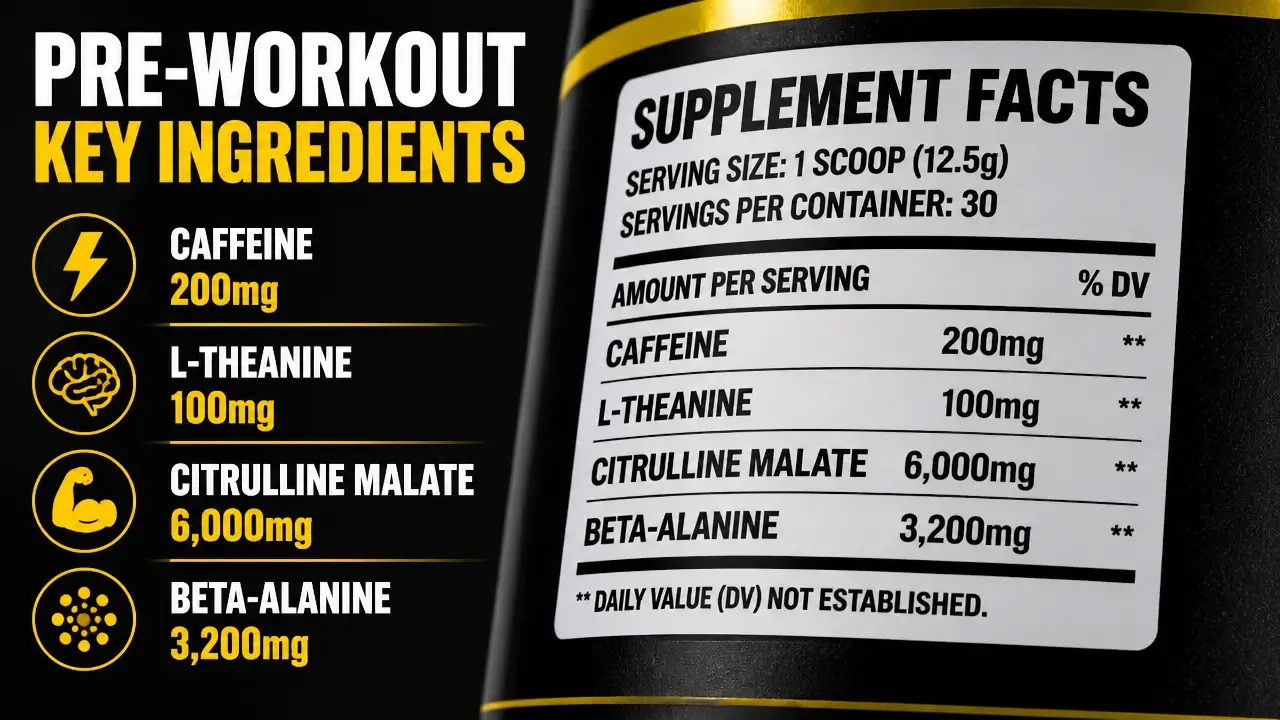
L-Theanine: The Caffeine Smoother
L-theanine is an amino acid found naturally in tea that promotes calm, focused alertness without sedation. At 200 mg paired with your caffeine dose, it takes the sharp edge off the stimulant response – the kind that manifests as racing thoughts, hand tremors, or a general sense of being wired rather than focused. The mechanism is real: L-theanine modulates alpha brain wave activity and blunts some of caffeine’s more aggressive excitatory effects.
That said, the research picture on the combination is more nuanced than the marketing suggests. A randomized, double-blind, placebo-controlled crossover study in competitive athletes found that:
“the combined ingestion of CAF and TEA would differentially affect physical and cognitive performance” but “the caffeine and L-theanine combination did not demonstrate any superiority over placebo. Additionally, taking caffeine and L-theanine together did not provide any additional or synergistic benefits.”
The honest takeaway: L-theanine may improve the subjective feel of your caffeine dose – less edge, more focus – but it’s not a performance multiplier in the measurable sense. If you find caffeine alone leaves you anxious or scattered, 200 mg L-theanine is worth trying. If caffeine already works cleanly for you, it’s optional.
Citrulline Malate: The Pump Driver
Citrulline malate works through a different mechanism entirely. It fuels nitric oxide production, which dilates blood vessels and drives the muscle pump sensation – but more importantly, it supports endurance by clearing ammonia from working muscles and recycling arginine. Look for 6–8 grams on the label. Anything under 4 grams is an underdosed token inclusion, not a therapeutic dose.
Beta-Alanine: Performance With a Side Effect
Beta-alanine raises muscle carnosine levels, which buffers acid buildup during high-intensity efforts and extends your capacity for repeated hard sets. The performance case is solid. The user experience can be jarring: a harmless but distracting skin-tingling sensation called paresthesia, usually felt in the face, ears, and hands.
For new users, the tingling can feel alarming enough to pull focus mid-session. The fix is dose splitting. Research on beta-alanine’s dose-response shows that dividing your daily 4-gram target into smaller 1.6-gram portions significantly reduces paresthesia while still delivering the full carnosine-loading effect over time. Most pre-workouts give you the full dose in one scoop. If the tingles bother you, consider a separate beta-alanine supplement you can spread across the day, rather than a single pre-workout hit.
These ingredients work best when your caffeine dose and timing are already dialed in. They’re the refinement layer, not the foundation.
Your Smart Pre-Workout Routine: Putting It All Together
A complete pre-workout routine isn’t complicated once you have the right pieces – but it does require doing the math each day, not just once. Here’s how it flows in practice, and where most people cut corners.
Follow this infographic as a reference for the full daily protocol before we walk through each step:
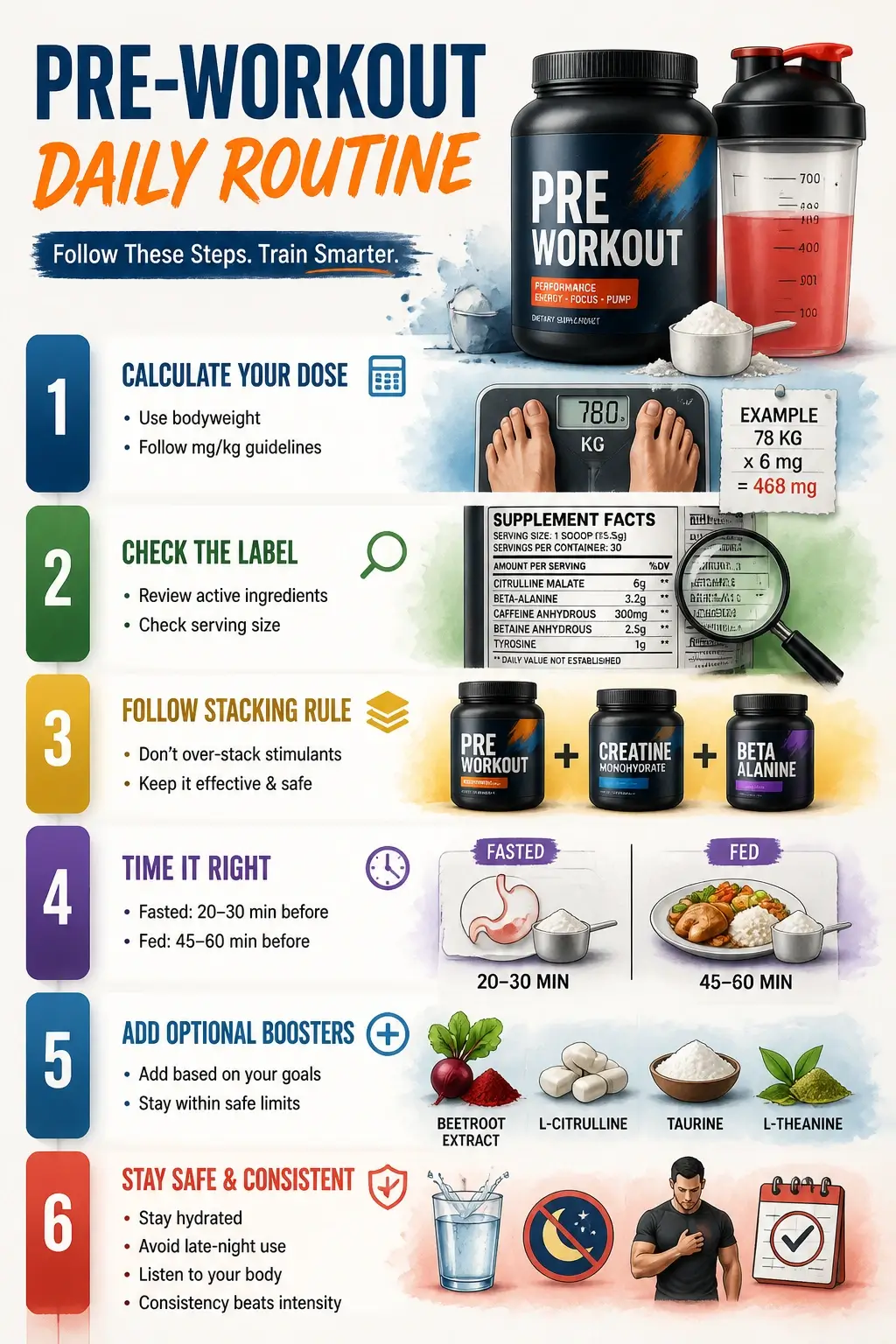
Step 1: Calculate Your Starting Dose
Weigh yourself. Multiply your bodyweight in kilograms by 3. That’s your starting dose in milligrams. A 75 kg person starts at 225 mg. Check your product label for the exact caffeine content per scoop, then match the serving size to your calculated dose – not the other way around.
Step 2: Apply the Stacking Rule
Count every caffeine source you’ve consumed or plan to consume that day: coffee, tea, energy drinks, diet pills, and the pre-workout itself. Add them up. Your total cannot exceed 400 mg. If your morning coffee already put 150 mg in your system, your pre-workout ceiling for the day is 250 mg, regardless of what the scoop size says.
On days when you’ve already had a large caffeine load, skip the stimulant pre-workout entirely or use a stim-free formula. This isn’t being overly cautious – it’s basic dose management.
Step 3: Time It to Your Session and Meal Status
- Fasted? Take it 30–40 minutes before training.
- Fed? Push to 60–90 minutes.
- Training after 2–3 PM? Switch to a stim-free product and protect your sleep.
Step 4: Add the Optional Performance Layer
If you want to refine the experience:
- Add 200 mg L-theanine for cleaner focus if caffeine alone makes you anxious.
- Confirm 6–8 g citrulline malate is in the formula for pumps and endurance support.
- Split beta-alanine into 1.6 g portions across the day if you want the carnosine benefit without the tingling.
None of these are mandatory. They’re upgrades to a foundation that’s already working.
The Part Most Supplement Guides Won’t Tell You
Frontiers in Sports and Active Living researchers make a point worth anchoring the whole protocol on:
“the use of moderate or higher doses would only be justified through peripheral effects of caffeine on performance tests… increasing the caffeine dose should be used based on the individual’s tolerance to the substance and the type of physical exercise.”
Pre-workout caffeine is an accelerant. It sharpens what’s already there. But it cannot compensate for poor sleep, inadequate calories, or chronic dehydration. In online fitness communities, high-stim intake often becomes a substitute for the fundamentals – people use more caffeine to push through fatigue that should be addressed with rest. That path leads to tolerance escalation, diminishing returns, and eventually a dependency that makes normal training feel impossible without stimulants.
Sleep and nutrition are the engine. Pre-workout caffeine is the fuel additive. Keep that hierarchy in place, and the protocol works long-term.
Key Takeaways on Pre-Workout Caffeine
- Pre-workout caffeine is the most researched ergogenic aid in sports nutrition, making precise dosing more important than brand selection.
- Start at 3 mg per kg of bodyweight and never exceed 6 mg/kg or 400 mg total daily — whichever limit is lower.
- Count every caffeine source across the day; stacking a pre-workout with coffee and diet pills routinely pushes intake past 600 mg.
- Take your pre-workout 30–40 minutes before training if fasted, or 60–90 minutes if you’ve eaten a full meal.
- Avoid stimulant pre-workouts after 2–3 PM — caffeine’s 3–5 hour half-life directly fragments deep recovery sleep.
- L-theanine, citrulline malate, and beta-alanine can refine your session, but only after your caffeine dose and timing are already dialed in.
Frequently Asked Questions About Pre-Workout Caffeine
Can you build a tolerance to pre-workout caffeine, and how do you reset it?
Yes, regular high-dose caffeine use downregulates adenosine receptors over time, which means the same dose produces a weaker effect. A 1–2 week caffeine break — or a significant dose reduction — is usually enough to restore baseline sensitivity.
Is pre-workout caffeine safe to use every day?
Daily use isn’t inherently dangerous if you stay within the 400 mg daily cap and account for all sources, but cycling off periodically helps prevent tolerance buildup and keeps the ergogenic effect strong.
What’s the difference between caffeine anhydrous in pre-workouts and natural caffeine in coffee?
Caffeine anhydrous is a dehydrated, concentrated form of caffeine that absorbs slightly faster than caffeine in coffee, which comes bound to other compounds that slow gastric emptying — the performance effect is essentially the same, but the onset can feel sharper with anhydrous.
Can pre-workout caffeine affect blood pressure, even at normal doses?
Caffeine causes a temporary, dose-dependent rise in blood pressure in most people — typically 5–10 mmHg systolic. If you have hypertension or a known cardiovascular condition, you should discuss stimulant use with a physician before starting any pre-workout.
Should you take pre-workout caffeine on rest days?
There’s no performance reason to take a stimulant pre-workout on a rest day, and doing so unnecessarily increases your daily caffeine load and tolerance without any training benefit.
Why does pre-workout sometimes cause stomach upset or nausea?
High-dose caffeine on an empty stomach stimulates gastric acid production and accelerates gut motility — both of which can cause nausea or cramping. Taking your pre-workout with a small amount of food, or switching to a lower-dose formula, usually resolves it.
Does caffeine dehydrate you during training?
At moderate doses, caffeine’s diuretic effect is mild and largely offset by the fluid in your pre-workout drink. Dehydration becomes a real concern when you’re combining high-dose caffeine with fasted training and inadequate electrolyte intake — not from caffeine alone at normal doses.
What’s the safest way to reduce pre-workout caffeine if you want to cut back?
Taper gradually — reduce your dose by 25–50 mg every 1–2 weeks rather than stopping abruptly. Cold-turkey caffeine cessation commonly causes headaches, fatigue, and irritability for 2–5 days as adenosine receptor sensitivity normalizes.
References
- International Society of Sports Nutrition Position Stand: Caffeine and Exercise Performance — pmc.ncbi.nlm.nih.gov
- Multi-Ingredient Pre-Workout Supplements, Safety Implications, and Performance Outcomes (Trexler et al., Nutrients) — mdpi.com
- Caffeine and Exercise Performance — ISSN Position Stand (ScienceDirect) — sciencedirect.com
- Prevalence of Dietary Supplement Use by Athletes (PMC Survey) — pmc.ncbi.nlm.nih.gov
- Caffeine Toxicology Safety Review — sciencedirect.com
- Caffeine Timing and Ergogenic Benefits: Randomized Trial (Kerksick, Frontiers in Nutrition) — frontiersin.org
- Caffeine and L-Theanine in Competitive Athletes: Crossover Study (Frontiers in Nutrition) — frontiersin.org
- Caffeine Dosing in Sports and Active Living (Frontiers in Sports and Active Living) — frontiersin.org