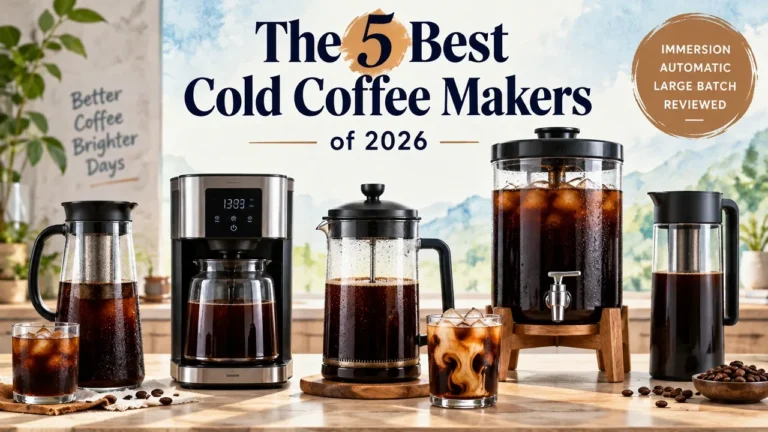

The best cold brew coffee maker is one of the most contested titles in home brewing – every list names a different winner because every list tests a different use-case. OXO, Takeya, Toddy, Hario, and Cuisinart each dominate a specific axis: clarity, value, volume, material purity, or speed.
Once you know which axis matters to your kitchen, the decision makes itself. This guide scores all five across filtration, yield, cleanup, footprint, and steep mechanics – and tells you upfront when a mason jar beats every one of them.
Key Takeaways on Best Cold Brew Coffee Maker
- “Best overall” is meaningless without a use-case label – batch size and consumption pattern determine the right pick more than any feature.
- Midpoint agitation during a 12–24 hour steep measurably increases extraction evenness and costs nothing beyond remembering to stir.
- Metal mesh alone doesn’t control fines; every brewer worth owning should accept a paper or felt finishing stage.
- “BPA-free” plastic is not inert – cold brew’s long contact time makes material verification across the entire brew path worth doing.
- The Toddy’s felt-and-paper system produces the cleanest cup at scale, but its operational overhead disqualifies it for anyone who wants low-friction daily brewing.
- A mason jar and a coffee sock is a legitimate baseline every dedicated brewer must justify itself against – most can’t on taste alone.
How We Ranked the 5 Best Cold Brew Coffee Makers of 2026
Every published “best cold brew maker” list crowns a different winner. One test names a Rainmaker carafe the top pick. Another blind-tastes a dispenser as best flavor. A third crowns a mason-jar brewer, and a scored showdown flips the entire order. That’s not inconsistency – that’s each reviewer accidentally revealing which use-case they tested. The word “best” is meaningless until you attach a criteria label to it.
This ranking doesn’t pick a single winner. It maps five brewers to five use-cases, scores each on the same six axes, and tells you which one belongs in your kitchen – including the scenario where none of them do.
Scored Evaluation Criteria and Steep Baseline
Six axes determine every pick on this list, and they’re stated up front so you can weight them for your own situation.
(a) Filtration and sediment control. The target is a 100–150 micron fine-mesh as the primary stage. Then we assess whether the system accepts a paper or felt finishing pass – because mesh alone is not a complete filtration answer.
(b) Concentrate yield versus ready-to-drink volume. How much concentrate a batch actually produces, and how far it stretches when diluted. A system that looks large can yield surprisingly little drinkable coffee.
(c) Steep duration and agitation method. The standard immersion window is 12–24 hours, and most guides treat it as fixed. It isn’t. Agitation is the free variable almost every brewer ignores. A UC Davis dissertation on full-immersion extraction dynamics found that occasional manual stirring can be as effective as continuous mechanical agitation for increasing extraction rate – and that a single midpoint stir produces an immediate TDS increase that approaches the equilibrium of interval spoon agitation. That costs nothing. It just requires knowing when to open the fridge.
(d) Material contact path and part availability. What your coffee actually touches, and whether those parts are orderable when they wear out.
(e) Cleanup labor. Dishwasher-safe components, removable silicone gaskets, mesh rinsing versus disposable media – this axis separates a brewer you’ll use weekly from one that collects dust.
(f) Footprint, spigot or dispenser design, and refrigerator shelf clearance. A brewer that doesn’t fit your fridge is a countertop paperweight.
Every published best cold brew maker list crowns a different winner.
Evaluating extraction efficiency and filtration baselines requires the same rigorous scrutiny one applies when auditing best coffee makers for longevity and daily performance.
Capacity Alignment, Archetypes, and What We Refused to Crown
Before the picks, one structural reality: capacity must match consumption frequency. A 24 oz carafe cannot serve a two-drinker iced-coffee household through a week without constant re-brewing. A 56 oz system is wasted on a single daily drinker who brews once and forgets about it for five days. Getting the volume wrong makes every other axis irrelevant.
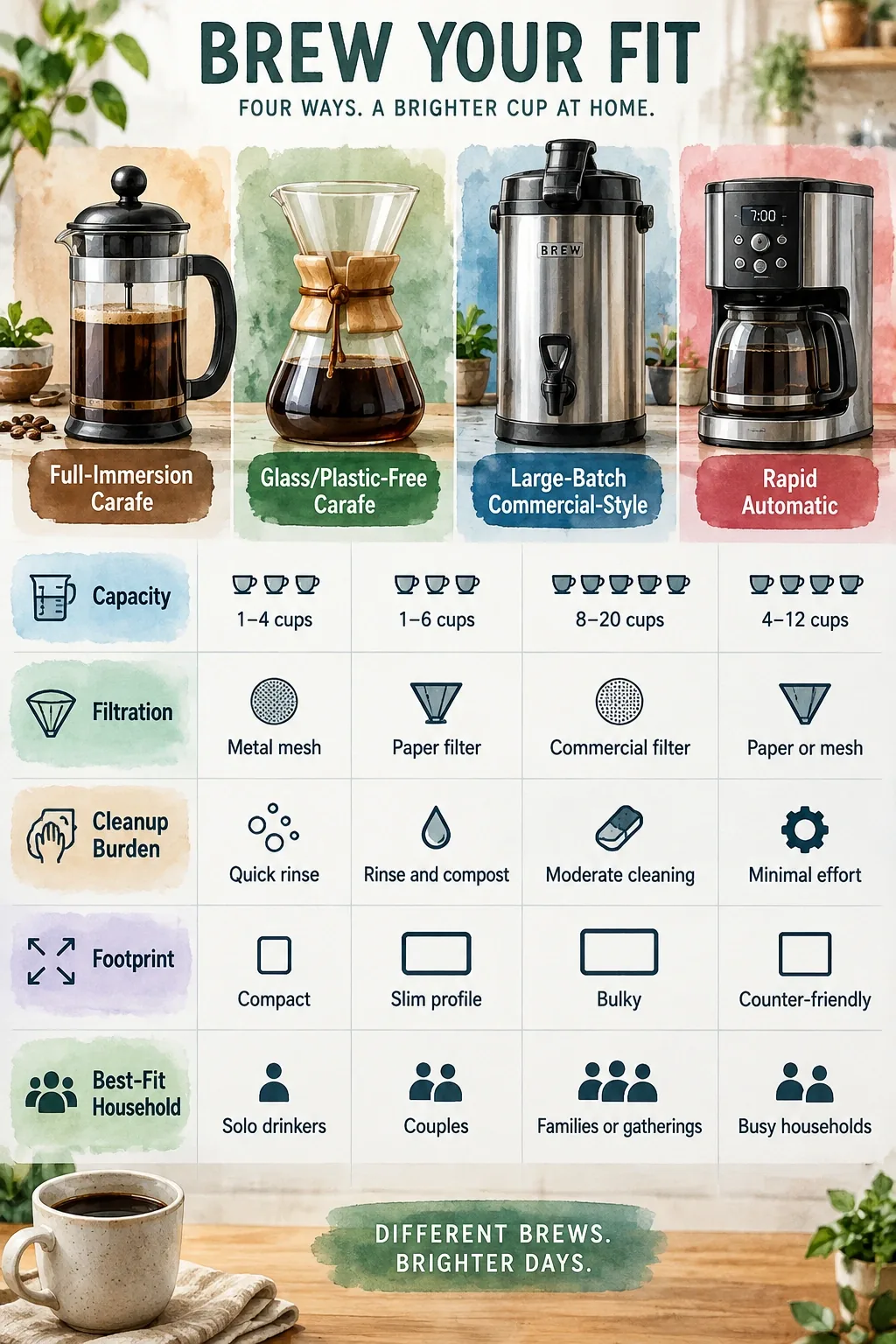
The five picks here fall into four archetypes. Full-immersion carafes optimize for clarity and control. Glass or plastic-free carafes optimize for material purity and footprint. Large-batch commercial-style systems optimize for volume and sediment-free output. Rapid automatics optimize for speed at the cost of extraction depth.
A number of units were evaluated and not crowned – Mueller, Ovalware, and several hybrid hot/cold drip machines among them. The one universal disqualifier that ended every conversation: any system that leaves grit or sludge in the cup loses, regardless of how elegant its archetype is.
One more thing worth saying plainly before the picks begin. The most-recommended “brewers” in community threads are not machines at all. A mason jar plus a coffee sock, a nut milk bag dropped into a gallon pitcher, an approximately $18 mason-jar setup, a plain pitcher lined with a #6 Melitta filter – these regularly outperform dedicated equipment in blind taste comparisons. This list ranks methods and use-cases, not brands. Every pick must justify itself against that near-zero-cost baseline. If it can’t, we say so.
OXO Good Grips Cold Brew Maker: Best Overall Full-Immersion Brewer
The OXO Good Grips Cold Brew Maker is the immersion benchmark because it solves the two problems that make other carafes frustrating: uneven saturation on the way in, and a messy disassembly on the way out. Every other full-immersion carafe is essentially measured against what OXO does here.
The question most people ask – “Is the Rainmaker showerhead actually better, or is it marketing shorthand for a regular carafe?” – has a concrete answer. It’s a real mechanism with a measurable effect, not a name badge.
Affiliate Disclosure
This post contains affiliate links, meaning I may earn a commission if you make a purchase through these links, at no additional cost to you. As an Amazon Associate, I earn from qualifying purchases. I only recommend products I genuinely believe will add value.

OXO Brew Cold Brew Coffee Maker
- Smooth, cold brew maker: Brews low-acid coffee concentrate for up to 14 coffee drinks – just add water or milk…
- Even extraction for better flavor: Rainmaker top evenly distributes water over coarse coffee grounds to ensure…
- Brew with control: Iced coffee maker uses easy-access brew-release switch to start and stop filtration on dema…
- Borosilicate glass carafe included: Durable borosilicate glass carafe holds up to 32 oz of cold brew concentr…
- Reusable mesh filter: Ultra-fine stainless steel mesh filter is reusable and dishwasher safe, eliminating the …
Rainmaker Distribution and Concentrate Yield
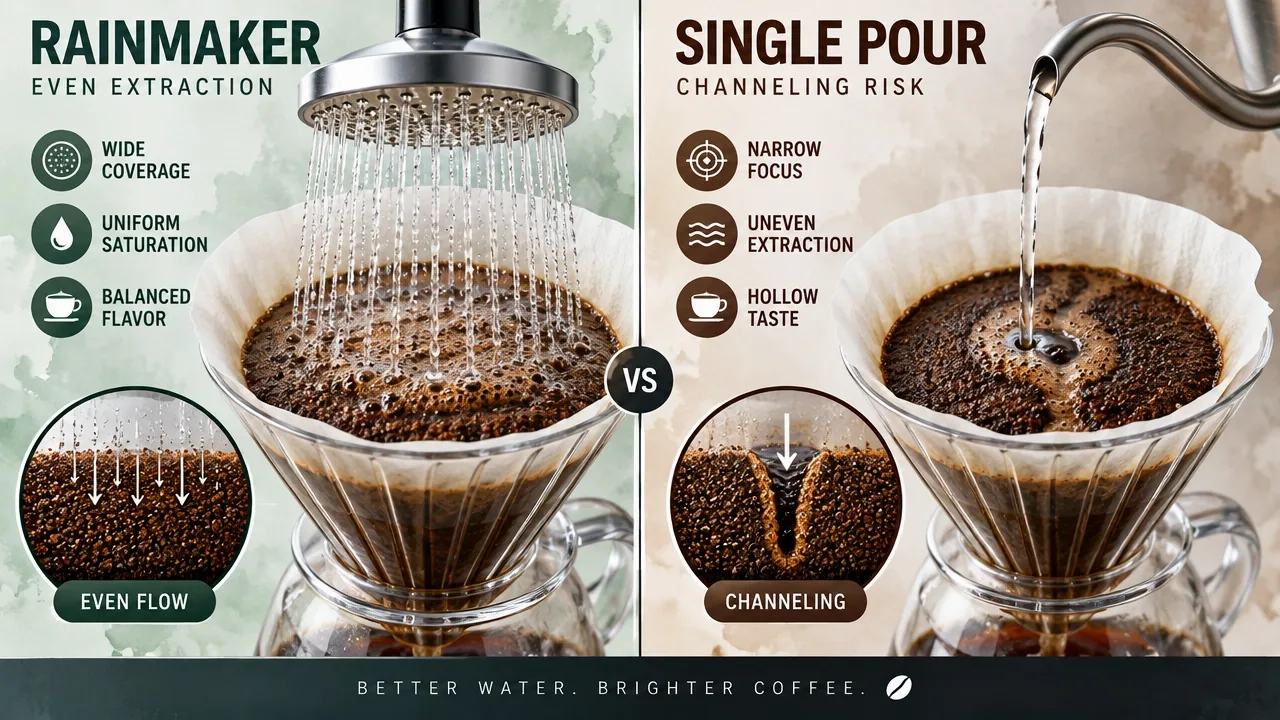
The Rainmaker dispersion head distributes water across the entire perimeter of the coffee bed rather than pouring from a single central point. That distinction matters more than it sounds. A single-point pour saturates the center of the bed first and forces water to migrate outward through already-dense grounds, creating channeling – fast lanes where water moves without extracting – and weak, under-extracted pockets at the edges.
Perimeter showerhead distribution hits the bed uniformly from the start, which means every gram of ground coffee begins steeping at roughly the same moment. The result is a more even extraction across the entire load without any additional technique required.
In tested loads, the ratio runs roughly 10 oz of ground coffee to 40 oz of water, producing approximately 3 cups of concentrate. At a standard 1:1 dilution with water or milk, that yields 6 servings per batch – enough for two drinkers over two to three days without re-brewing mid-week.
Even saturation is only half the clarity equation: what passes through the mesh matters as much as how evenly water hits the bed.
Stop Valve Operation, Cleaning Protocol, and Refrigerator Fit
The stop valve is the operational detail that separates the OXO from a standard carafe more than the showerhead does. When the steep is complete, you position the brewing vessel over the serving carafe and open the valve – concentrate drains through the filter bed by gravity without any disassembly. The saturated grounds stay contained in the upper vessel. You never have to lift, tilt, or wrestle a soaked filter basket over a sink.
A midpoint stir is easy to integrate here: at the 12-hour mark, lift the lid, give the bed a slow pass with a long spoon, and reseal. Based on the extraction dynamics research cited above, that single stir measurably increases TDS and reduces uneven extraction – no additional equipment needed.
Cleanup follows a logical sequence. Rinse the mesh filter under running water immediately after draining – don’t let it dry with grounds in it. Remove the silicone gasket, rinse separately, and inspect the seat for residue. The brewing vessel and serving carafe are both dishwasher-safe; the mesh filter and gasket are hand-wash only. Between batches, the two-piece assembly stores compactly because the carafe nests under the brewing vessel. Assembled height fits most standard refrigerator shelves without removing a shelf bracket.
One community-tested finish worth adopting: pre-sift your grounds before loading, then run the finished concentrate through a Chemex filter before storing. The reported result is near-zero residue and noticeably smoother cup texture. Metal mesh alone is not sufficient for fines control – fines are the single most overlooked cause of bitterness and sludge, which is why paper or felt compatibility is scored on every system in this guide, not just noted as a bonus feature.
Takeya Deluxe Cold Brew Maker: Best Value and Best for Small Kitchens
The Takeya Deluxe Cold Brew Maker answers a specific question: what is the minimum viable cold brew setup that still handles the fundamentals correctly? The answer turns out to be a reusable stainless mesh filter, a genuine airtight seal, and a footprint that fits where you already have room. No consumables. No decanting. No learning curve.

Takeya Deluxe Cold Brew Coffee Maker - BPA-Free Tritan Pitcher with Airtight Leakproof Lid, Silicone Grip Handle, Fine-Mesh Filter - Shatter-Proof, Dishwasher Safe, Made in USA - 2 Quart/Black
- Effortless Café-Quality Brews: The Takeya Deluxe Cold Brew Coffee Maker delivers smooth, less acidic coffee at…
- Lock-in Freshness & Aroma: The Takeya Deluxe Cold Brew Coffee Maker’s patented airtight, leak-proof lid preser…
- Durable & Stylish Tritan Design: Crafted from shatter-proof, stain and odor-resistant Tritan, this cold brew c…
- Easy Cleaning & Versatile Use: Dishwasher safe or simple to hand wash, the Takeya Deluxe Cold Brew Coffee Make…
- Perfect Size & Portability: The Takeya Deluxe Cold Brew Coffee Maker fits most refrigerator doors. Its compact…
Reusable Mesh Filter and Airtight Seal
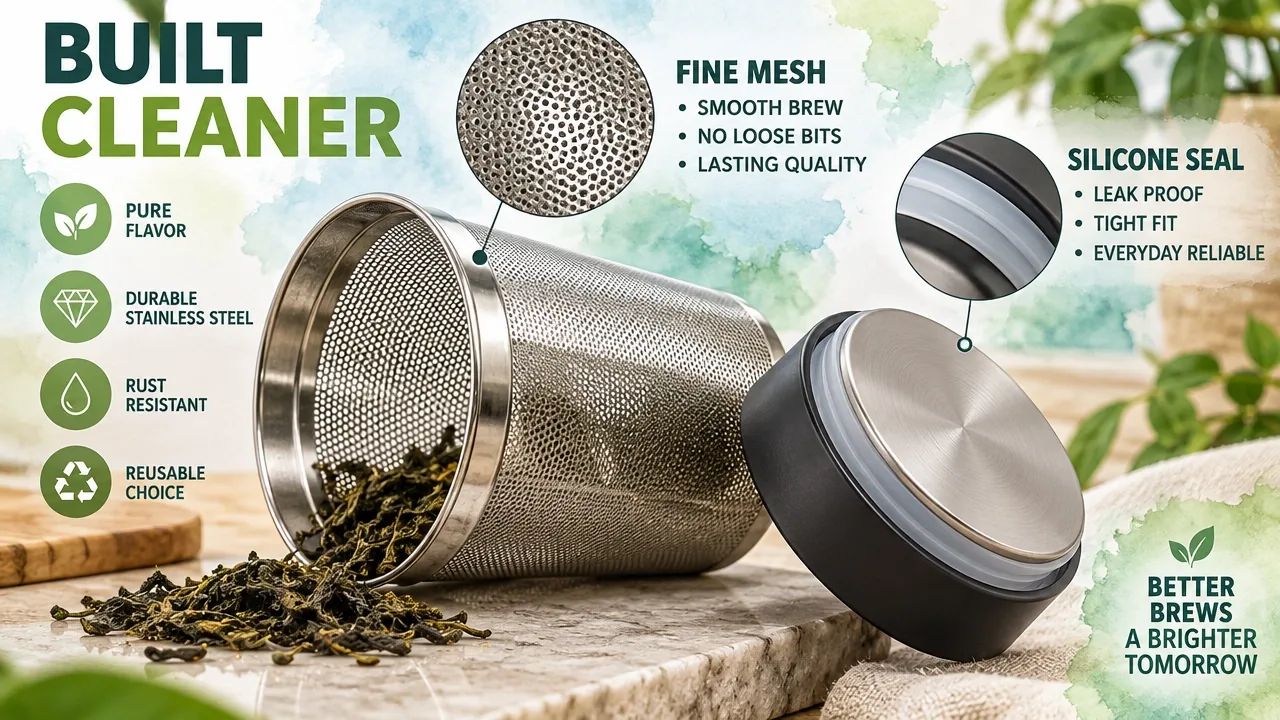
The fine-mesh reusable stainless filter sits inside the carafe on a collar that holds it centered during steeping. It catches most coarse and medium-ground particles reliably. What it lets through depends almost entirely on grind consistency – if you’re pulling from a burr grinder set to medium-coarse, sediment is minimal. Blade-ground coffee will push fines through any mesh filter, including this one, and no brewer on this list fixes that problem at the machine level.
Rinsing matters more than most users realize. Mesh pores clog progressively if grounds are allowed to dry inside the basket. The fix is simple: rinse immediately under running water after each batch, then hold the basket up to light and check for blocked sections. A soft brush clears stubborn deposits without damaging the weave.
The silicone-sealed lid creates a genuine airtight closure, which enables the Takeya’s most practical feature: brew-and-store in one vessel. You steep in the carafe, seal it, and slide it into the fridge. When the steep is done, you pour directly from the same container. No second vessel to wash, no transfer step where sediment gets disturbed.
Footprint Efficiency, Durability Checks, and Trade-Off Verdict
The Takeya’s slim profile fits refrigerator door bins – a real advantage in compact kitchens where shelf real estate is allocated by the inch. The fill-drain workflow is intuitive enough that first-machine buyers rarely need instructions: fill the filter with grounds, lower it into the carafe, add cold water, seal, refrigerate, pour. That’s the entire process.
All components are dishwasher-safe except the gasket, which should be hand-washed and inspected after every few cycles. The two failure points to monitor over time are seal deformation – the silicone compresses with repeated dishwasher heat and may eventually lose its airtight closure – and mesh deformation from aggressive scrubbing or being dropped. Neither failure is catastrophic, but both are worth catching early because replacement parts availability varies by retailer.
The honest trade-offs versus a flagship immersion carafe: thinner wall construction that feels less substantial under daily use, and a smaller concentrate volume that becomes limiting if your household drinks more than two cups of cold brew daily. For one or two daily drinkers, those trade-offs are genuinely irrelevant. The Takeya does what it needs to do, costs a fraction of the OXO, and eliminates consumables entirely. That’s the value case, and it holds.
Toddy Cold Brew System: Best for Large Batches and Sediment-Free Clarity
The Toddy Cold Brew System is the oldest design on this list and also the one with the clearest functional logic. Two-stage filtration at large batch scale is what it does, and it does it better than anything else in this price tier. The question isn’t whether the felt-and-paper approach is outdated – it’s whether you’re a daily drinker who benefits from what that approach actually produces.
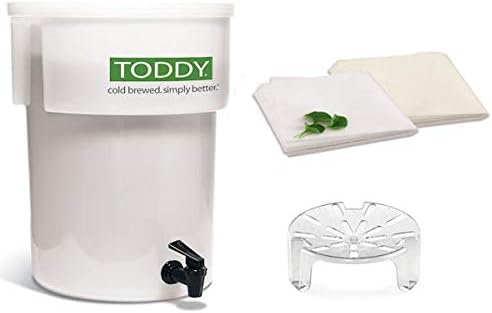
TODDY Cold Brew Coffee Set White
- Set consisting of 1 9.5L infusion container with tap, 1 lid, 2 natural paper filters and 2 PLA filters (thermo…
- Capacity: approx. 9.5 liters of extract
- NFS & BPA Free Certified
- Can be used to brew coffee or tea
- This model is suitable for preparation of large quantities of extract
Two-Stage Filtration and Volume Output
The Toddy’s filtration stack works in sequence. The felt pad at the drain acts as the primary stage, catching the bulk of grounds and coarser particles. The paper disc clarifier sits above it and handles fines – the sub-100-micron particles that mesh filters pass and that cause the chalky mouthfeel and bitterness common in high-volume brews. The result is near-zero sediment in the cup, which is measurably cleaner output than any mesh-only system at this batch scale.
The maintenance reality of the felt pad is worth stating plainly: it must be kept wet and refrigerated between batches. A felt pad that dries out becomes stiff, clogs unevenly, and compromises the filtration on the next batch. Paper discs are replaced per batch – they’re inexpensive and widely available, but they are a consumable, and that’s a real operational difference from a sealed carafe.
Tested load runs approximately 12 oz of ground coffee to 56 oz of water, producing a concentrate volume that dilutes to roughly 12–14 servings of iced coffee, or proportionally fewer when used in milk-heavy drinks where the concentrate is more heavily diluted.
Drain Mechanics, Scaling Path, and Operational Trade-Offs
When a full batch is ready, you’re lifting a container that holds 56 oz of cold liquid plus saturated grounds – that’s meaningful weight. The handle and lid design are adequate for the task, but the drain plug mechanics require attention: the plug must seat fully before you add water, and removing it over the serving container requires a steady hand to avoid splashing. The spigot pour control on commercial-scale Toddy systems handles this more cleanly, but the home version uses a drain plug rather than a spigot, which introduces a brief drip after removal.
For high-volume entertaining or weekly batch brewing, the scaling path goes to 2-to-5 gallon commercial-style systems with heavy-duty lift handles and sanitary drain spigots. The trigger point where a home brewer should step up rather than brew twice: when you’re running two Toddy batches per week consistently, the commercial unit pays for itself in time and felt-pad savings within a few months.
The trade-offs are concrete and non-negotiable: bulkier storage than any carafe on this list, wet felt upkeep that requires refrigerator space between batches, disposable paper discs that add a recurring cost, and more hands-on labor than a sealed carafe from loading to draining. Who should accept all of that? Anyone who drinks cold brew in volume, hosts regularly, or prioritizes cup clarity above all other variables. For everyone else, the OXO or Takeya will serve them better with less friction.
Hario Mizudashi Cold Brew Pot: Best Glass, Plastic-Free Carafe
The Hario Mizudashi Cold Brew Pot earns its place on this list by solving a problem the other picks don’t fully address: material purity across the entire contact path. “Glass carafe” is a marketing claim until you verify what else your coffee touches – and that verification is where most buyers stop asking questions too early.

Hario "Mizudashi" Cold Brew Coffee Maker, 1000ml, Black
- Mizudashi Coffee Maker: The simplest way to make and enjoy cold brew coffee at home. Simply add ground coffee …
- Cold Brew at Home: Grind coffee coarse for a lighter more delicate coffee, or finer for a brew with more body …
- Daily Use: Featuring a slender spout for slow, steady and controlled pouring. Brew and serve directly from gla…
- Japanese Design: Made with high-quality Hario heatproof glass. Made in Japan
- Product Details: 5-cup capacity, brewed volume 1000mL; W138×D94×H294mm
Material Composition and Contact-Path Audit
Borosilicate glass offers two genuine advantages over acrylic and plastic alternatives. First, it handles thermal shock – moving from refrigerator temperature to a warmer surface – without stress fracturing under normal use. Second, and more importantly, it does not leach.
The “BPA-free” label on plastic carafes is not the safety guarantee most buyers assume it to be. A study published in Environmental Health Perspectives tested commercially available plastic resins and products – including items marketed as BPA-free – and found that nearly all sampled plastics leached chemicals with detectable estrogenic activity. In some cases, BPA-free products released more estrogenic activity than BPA-containing products, and leaching increased after common-use stresses including UV radiation and temperature cycling. For cold brew, which steeps in contact with the container for 12–24 hours, that contact duration matters.
The trade-off glass introduces is structural fragility under daily kitchen handling. Borosilicate is more resistant to thermal shock than standard glass, but it is not impact-resistant. A hard counter edge or a drop onto tile ends the carafe’s useful life immediately.
The honest contact-path audit: the Hario Mizudashi’s body is borosilicate glass, but the lid, filter basket collar, and seal contain plastic or resin components. A true plastic-free standard means glass, metal, and silicone only throughout the entire brew path. The Mizudashi comes close but doesn’t fully clear that bar – buyers who require zero plastic contact should note where the collar and lid material sits relative to the water line during steeping.
Glass solves leaching concerns at the body level, but it doesn’t solve the second and more easily ignored question: what happens when a proprietary gasket, lid, or filter basket is discontinued? Parts availability is a longevity question, not a performance question, and it’s one most material-focused reviews never raise.
Filtration Mechanics, Cleaning Protocol, and Footprint Suitability
The mesh basket filters at approximately 100–150 microns, which is adequate for medium-coarse grinds with consistent particle distribution. Sediment expectations at this micron range are low but not zero – expect light cloudiness at the bottom of the last pour, particularly if the carafe is disturbed before pouring is complete. The design accepts a secondary paper pass if you want to chase clarity further: pour finished concentrate through a paper filter into a storage vessel before refrigerating.
Cleaning requires a careful touch. Rinse the mesh basket immediately after use. The drip-free pour spout is well-designed and doesn’t leave residue on the carafe body, which keeps the exterior cleaner than wide-mouth alternatives. Hand-wash only – the dishwasher’s heat cycling accelerates gasket wear and risks micro-fractures in the glass over time. Inspect the gasket after every few washes; a deformed gasket loses its seal and allows slow dripping.
The slim carafe profile fits refrigerator door bins and shallow shelves comfortably. Stated capacity handles two-person households through a standard 12–18 hour steep without needing to re-brew mid-week. For single-person households, it’s slightly oversized; for three or more drinkers, it’s undersized.
The community’s durability benchmark for glass carafes is a 64 oz mason jar: no plastic parts, nothing proprietary to replace, no consumable to reorder. Apply that parts-availability test to any glass carafe before buying. If the seal is unique to the model and not independently orderable, the carafe has an expiration date tied to the manufacturer’s production schedule – not to your actual use.
Achieving precise drawdown and sediment management shares much with the technique required when operating a dedicated pour over coffee maker.
Cuisinart Automatic Cold Brew Coffeemaker: Best Rapid Automatic Brewer
The Cuisinart Automatic Cold Brew Coffeemaker is the only pick on this list that doesn’t ask you to wait overnight. It’s also the only pick that requires you to accept a fundamentally different extraction mechanism – and understand what that mechanism costs you before you decide it’s worth the speed.

Cuisinart DCB-10P1 Automatic Cold Brew Coffeemaker with 7-Cup Glass Carafe, Silver and Black
- 7-cup glass carafe with removable stainless steel filter lid makes ready-to-drink cold brew Coffee in as littl…
- Strength Selector for mild (25 min), medium(35 min) and bold(45 min)
- Clear brewing chamber; removable water tank and Coffee filter basket for easy filling and cleaning
- Coffee release lever with indicator light. MC Cubic Feet: 1.569
- Glass carafe can be used to store Coffee in refrigerator for up to 2 weeks
Vacuum-Pressure Cycling and Extraction Depth
The machine works through two simultaneous mechanisms: vacuum-pressure cycling that alternately pressurizes and depressurizes the brew chamber, and a spinning agitation chamber that continuously resaturates the coffee bed. Together, these replace the passive diffusion of traditional immersion brewing with active forced contact between water and grounds.
That’s a genuine engineering solution to the time problem, not a marketing reframe. The bed is never sitting still waiting for diffusion gradients to equalize – it’s being actively cycled throughout the extraction window.
A pressurized microwave-assisted extraction study at 40–45°C and 10 bar for 30 minutes yielded 91–139.2% of 24-hour room-temperature maceration yields across 16 of 18 plant samples. – Source: Wiley Online Library
That finding establishes that pressurized short-duration extraction can match or exceed extended passive maceration for total yield – but yield and flavor complexity are not the same variable. The 15-to-45-minute extraction window pulls a narrower band of soluble compounds than a 12-to-24-hour immersion steep. Shorter contact time means fewer of the slower-dissolving aromatic compounds make it into the cup. The result reads as leaner and less layered at matched strength, even when TDS is comparable. That gap matters more when you drink black, less when you’re diluting heavily into milk.
Strength Selection and Competitive Positioning
The Cuisinart offers strength selection and batch sizing controls that let you dial between lighter and bolder outputs. The important operational distinction from every other pick on this list: the output is ready-to-drink, not a concentrate you dilute over the course of a week. That changes your milk-drink math significantly – you’re adding milk or cream to a full-strength brew rather than to a 2x or 4x concentrate, so the ratios and the resulting sweetness balance are different.
Against other rapid approaches – Dash-style rapid brewers and hybrid hot/cold drip machines – the Cuisinart holds its position through the vacuum-pressure mechanism, which is more sophisticated than simple rapid immersion. Hybrid hot/cold drip machines brew hot and chill immediately, which is a different process entirely and produces a different flavor profile. The Cuisinart is the closest thing to genuine compressed cold brew in the rapid category.
Who should choose rapid over traditional immersion? Anyone whose cold brew consumption is spontaneous rather than planned, who doesn’t want to manage a 12-hour scheduling window, or whose household drinks cold brew infrequently enough that a week-old concentrate is a waste problem rather than a convenience.
Internal Maintenance and the Skeptic Rebuttal
The cleaning reality of an automatic brewer is more demanding than the marketing suggests. The internal reservoir and plumbing cannot go in the dishwasher. Maintenance involves a wipe-down of accessible surfaces, periodic descaling of the internal water path, and attention to the brew chamber gaskets that the cycling mechanism stresses over time. Automatic units demand more preventive care than a mesh basket and a glass carafe – the more moving parts, the more failure points, and the more maintenance discipline required to keep extraction quality consistent.
The skeptic argument – that rapid machines produce iced coffee rather than cold brew – deserves a direct response. Iced coffee is hot-brewed and chilled. The Cuisinart never applies heat to the water; extraction happens at ambient or near-ambient temperature throughout the cycle. The mechanism is cold extraction under pressure and agitation, not hot extraction followed by chilling. Whether the resulting cup tastes identical to a 20-hour immersion steep is a separate question, and the honest answer is no – it doesn’t. But what it produces is cold-extracted coffee, not iced coffee. The distinction is real. The flavor gap between it and a traditional steep is also real. Both things are true simultaneously.
The Cold Brewer Decision Matrix: Which of the 5 Should You Buy?
Every pick on this list was built around a different problem. The final question is which problem matches yours.
Persona Mapping and the Speed Trade-Off
| Brewer | Best For | Use-Case | Key Trade-Off |
|---|---|---|---|
| OXO Good Grips | Best Overall Immersion | Two-drinker household, daily cold brew, wants clarity and control | Highest price in the immersion tier |
| Takeya Deluxe | Best Value / Small Kitchen | One to two drinkers, first machine, no consumables budget | Smaller volume, thinner construction |
| Toddy Cold Brew System | Best Large Batch and Clarity | High-volume household, entertaining, sediment-free priority | Bulky storage, wet felt upkeep, disposable discs |
| Hario Mizudashi | Best Glass / Plastic-Free | Material-conscious buyers, two-person household, compact fridge | Fragile, proprietary parts, limited plastic-free path |
| Cuisinart Automatic | Best Rapid Automatic | Spontaneous drinkers, no overnight planning, milk-drink focus | Leaner cup, internal maintenance, ready-to-drink only |
The speed question has a direct answer. Rapid automatic wins on time and loses on depth and control. If your cold brew exists primarily to be diluted into milk drinks – lattes, iced oat milk coffees, sweetened blends – speed matters more than extraction nuance, and the flavor gap between a 30-minute auto-brew and a 20-hour steep is largely masked by the milk. If you drink cold brew black or lightly diluted, that gap is front and center in every sip, and immersion wins without argument.
One caveat worth stating plainly: no single automatic brewer has established itself as the 2026 consensus pick. Evaluate automatics on mechanism transparency and cleaning burden, not on crowd-voted rankings. The category is still maturing.
Exclusion Triggers, Material Standards, and Final Rankings
Skip triggers are as useful as buy triggers, so here they are explicitly.
Skip the 56 oz Toddy if you brew for one person. You’ll either under-fill the system and compromise extraction evenness, or you’ll waste concentrate before it’s consumed. Skip a compact 24 oz carafe if two people drink cold brew daily – you’ll be re-brewing every two days, which eliminates the convenience argument. Skip the Cuisinart automatic if your primary use case is a weekly concentrate you dilute over seven days – the machine produces ready-to-drink output, not a shelf-stable concentrate, and the economics don’t work for that consumption pattern.
The material and filtration standard every pick on this list should be held to: a verified contact path (know what your coffee actually touches), paper or felt-compatible filtration as a finishing option, and orderable non-proprietary replacement parts. If a gasket or filter basket is only available through the manufacturer and the manufacturer stops stocking it, you have a carafe with an expiration date.
The ranked short answer: OXO for most households. Takeya if budget or counter space is the constraint. Toddy if volume and clarity are both non-negotiable. Hario if material purity is the priority and you accept the fragility trade-off. Cuisinart if waiting overnight is genuinely not an option.
The pick hardest to justify against the mason-jar baseline is the Hario Mizudashi. A 64 oz mason jar with a coffee sock achieves a similar plastic-minimized contact path, similar sediment performance, and similar footprint – at roughly $18. The Mizudashi wins on pour ergonomics and aesthetics. Whether that’s worth the price differential is a personal call, but you should make it knowingly.
If none of the five maps cleanly to your counter, the adjacent tiers are worth noting: a compact 24 oz immersion carafe for single-person small-batch brewing, a 28 oz brew-and-serve dispenser with a pour spout that scored 4.8/5 on convenience (despite a trickier cleaning routine), the 56 oz large-batch system that scored 4.3/5 on taste, and a high-budget rapid machine at approximately $695 positioned as the fastest option currently in the field.
Frequently Asked Questions About Best Cold Brew Coffee Maker
Does grind size matter more than the brewer itself?
Yes, significantly. A high-quality burr grind at medium-coarse will outperform a fine or inconsistent blade grind in any brewer on this list – fines cause bitterness and sludge that no mesh filter fully corrects.
Can I use the same grounds ratio across all five brewers?
Not reliably. The OXO and Takeya target a roughly 1:4 coffee-to-water ratio for concentrate; the Toddy runs slightly higher coffee mass to water volume for a similar output. The Cuisinart uses its own internal ratio calibrated to ready-to-drink strength, not concentrate.
How long does cold brew concentrate actually keep in the fridge?
A properly sealed concentrate typically holds well for 7–10 days. Ready-to-drink output from the Cuisinart is best within 3–4 days. Oxidation and microbial activity both accelerate once the seal is broken repeatedly.
Is there a meaningful taste difference between glass and plastic carafes?
Under controlled conditions with new plastic, the difference is minimal. Over repeated use and thermal cycling, plastic carafes can impart off-flavors – particularly if stored warm between uses. Glass doesn’t change flavor over time.
What’s the actual risk of skipping the paper filter finishing step?
You’ll likely get a slightly cloudier brew with more dissolved fines, which reads as a rougher, more bitter mouthfeel – particularly noticeable when drinking black. For milk-heavy drinks, the difference is harder to detect.
How do I know when my silicone gasket needs replacing?
Press the sealed lid against your palm and squeeze – if air escapes, the gasket has deformed. Visible cracking, permanent compression set, or a lid that no longer clicks firmly are all replacement signals.
Why do some brewers recommend cold water specifically rather than filtered water?
Tap water chlorine and mineral content affect extraction flavor at the margin. Filtered or low-mineral water produces a cleaner baseline; the cold temperature is required for the immersion method itself, not just a preference.
Does the Cuisinart’s rapid brew qualify as true cold brew by any formal definition?
There’s no regulated definition of “cold brew,” but the accepted industry distinction is extraction temperature – cold brew uses cold or room-temperature water throughout. The Cuisinart extracts without heat, so it qualifies mechanically. Whether the flavor profile matches a 20-hour steep is a separate question, and honestly, it doesn’t – but it’s not iced coffee either.
References
- The Extraction Dynamics and Sensory Quality of Full Immersion Brewed Coffee | escholarship.org
- Most Plastic Products Release Estrogenic Chemicals: A Potential Health Problem That Can Be Solved | ehp.niehs.nih.gov
- Pressurized Microwave-Assisted Extraction Study | onlinelibrary.wiley.com