
A properly made black eye coffee is not just a strong cup – it is a precisely layered drink where a full-bodied drip base and a fresh double espresso pull in the same direction instead of fighting each other. Get the ratio wrong, skip the pour order, or use stale beans, and you get muddy, bitter coffee with none of the crema-topped intensity the drink is known for.
The good news is the mechanics are straightforward once you understand what each component is actually doing. This guide walks you through every step, from bean selection to troubleshooting, so you can dial in a barista-level result on the first try.
Key Takeaways on How to Make Black Eye Coffee
- Black eye coffee is drip coffee topped with a double espresso – two shots is what separates it from a red eye.
- The default ratio is 8 to 10 oz of drip coffee to 2 oz of espresso; adjust by cup size and desired intensity.
- Always brew the drip first, preheat the cup, and pull the espresso immediately before combining to keep both components hot.
- Pour the espresso on top of the drip – never the reverse – and avoid stirring if you want the crema to survive.
- A black eye delivers roughly 215 to 280 mg of caffeine, below the 400 mg daily safe threshold but above the 200 mg single-dose benchmark.
- Bitterness, weak body, lost crema, and cold temperature all trace back to extraction timing and pour order – not the recipe itself.
What a Black Eye Is and What You Need Before You Brew
Black eye coffee is 8 to 12 oz of freshly brewed drip or filter coffee topped with a double espresso – roughly 2 oz of extracted shot – for a total volume of about 10 to 14 oz depending on your cup size. That double shot is the entire point. It is what separates a black eye from a red eye (one shot) and what makes this drink a caffeine-delivery system disguised as a coffee.
One thing worth clearing up immediately: this is not the Black Eye cocktail, which is an entirely different alcoholic drink. Black eye coffee contains no alcohol – just brewed coffee, espresso, and the crema that floats between them.
Before you start, gather what you actually need. On the brewing side, you need a drip brewer or pour-over setup for the base and an espresso machine for the shots. If you do not have an espresso machine, a moka pot or AeroPress can produce a concentrated, espresso-style shot – but this is where an important distinction matters. True espresso requires pressure, typically 9 bars, which only a pump espresso machine delivers. A moka pot brews at roughly 1 to 2 bars; an AeroPress can get close to 3 bars manually. Both produce a strong, concentrated coffee, but neither generates the emulsified crema and full body that define authentic espresso. This strong drip coffee is still a high-caffeine drink worth making, but it is technically drip-on-drip rather than a true Black Eye.
On the ingredients side, you need fresh coffee beans suitable for both drip and espresso brewing. Bean selection and grind are the very next step, so hold that thought.
Most guides anchor the ratio at a vague “drip plus two shots,” but the actual numbers vary widely across sources – from 8 oz brewed coffee to 250 ml to 230 ml, all paired with two shots. For a practical default, use 8 to 10 oz of drip coffee and a 2 oz double espresso (a 4:1 to 5:1 ratio). Scale up to 12 oz if you want a longer, slightly less intense drink. The ratio is the lever you pull to control intensity, so knowing it matters more than memorizing a single fixed number.
Here is the setup you need at a glance:
| Component | Equipment | Notes |
|---|---|---|
| Drip base | Drip brewer, pour-over, or filter cone | Brew 8–12 oz |
| Espresso shots | Pump espresso machine | Required for authentic crema and body |
| Espresso alternative | Moka pot or AeroPress | Produces concentrated coffee, not true espresso |
| Cup | Preheated mug, 12–16 oz capacity | Prevents thermal shock |
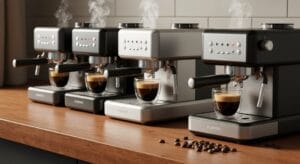
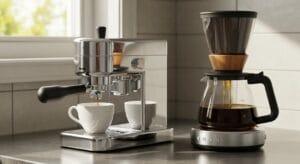
This is the photo of a complete black eye coffee setup – drip base brewed, double espresso ready to layer.

Step 1: Dial In Drip and Espresso Beans for Synergy
The biggest flavor mistake in a black eye is treating the drip base and the espresso as two separate coffees that happen to share a cup. They are not. Your drip coffee and espresso need to complement each other, or one will overwhelm the other.
For the drip base, a medium-roast washed bean is the safest starting point. It brews clean and bright without adding another layer of roasty bitterness on top of what the espresso will bring. For the espresso, a chocolate or nut-forward roast – typically a medium-dark – adds depth and viscosity without turning the combined drink into an ashtray. If you want contrast, pair a clean, high-acid drip (think Ethiopian washed or Kenyan) with a chocolatey Brazilian or Colombian espresso roast. The brightness cuts through the espresso’s weight and makes the drink feel more dynamic.
What you want to avoid is pairing two very dark, heavily roasted beans. When both components are already bitter and smoky, the black eye amplifies that in the worst way – you end up with a cup that tastes like burnt rubber doubled.
For grind, the rule is simple: medium grind for the drip brewer, fine grind for the espresso. Do not try to use the same grind setting for both; the extraction mechanisms are completely different, and a grind optimized for drip will produce a weak, under-extracted espresso shot.
Here is the practical shortcut that simplifies everything: if you only have one grinder and do not want to dial in two separate settings, use the same medium-dark bean for both and grind separately at the correct coarseness for each. A medium-dark bean sits at a roast level that works reasonably well in both a drip and an espresso context. It reduces clashing roast notes and means you are working with one flavor profile instead of two. For home baristas without two grinders, this is the most reliable path to a coherent cup.
Step 2: Brew the Drip Coffee First and Keep It Hot
Timing is the part most home recipes skip entirely, and it is the reason a lot of black eyes arrive at the cup lukewarm with a cold espresso shot sinking through tepid drip.
Start the drip brew first. Drip coffee takes longer – typically 4 to 6 minutes for a standard brewer, longer for a manual pour-over – so it needs a head start. If you pull the espresso first and let it sit while the drip finishes, the shot oxidizes, loses crema, and drops in temperature. By the time you pour, you have wasted the best part of the espresso.
Brew 8 to 12 oz of drip coffee depending on your preferred intensity. The smaller the drip volume, the more concentrated and espresso-forward the final drink will taste. The larger the volume, the more it resembles a very strong coffee with an espresso accent.
Before you pour anything, preheat your cup. Run hot water through it for 30 seconds and dump it out. This prevents thermal shock – the sudden temperature drop that happens when hot liquid hits a cold ceramic surface and immediately loses 10 to 15 degrees. A preheated cup keeps the combined drink hot from the first sip to the last. If you are brewing into a carafe, keep it on a thermal pad or wrap it in a towel; the drip base needs to stay hot and ready when the espresso shot finishes pulling.
Step 3: Pull a Fresh Double Espresso Shot
With the drip coffee brewed and hot in a preheated cup or carafe, now you pull the shot – and you pull it immediately before combining.
Dose for a double shot: typically 18 to 20 grams of finely ground coffee into the portafilter, targeting a 2 oz (60 ml) yield extracted over 25 to 30 seconds. If the shot pulls faster than 25 seconds, the grind is too coarse – tighten it. If it stalls past 30 seconds or barely drips, the grind is too fine – open it up slightly. Extraction time is your real-time feedback loop for whether the grind is dialed in correctly.
Use fresh beans. Espresso is the most unforgiving brewing method for stale coffee – the crema, which is CO₂ released from freshly roasted beans during extraction, disappears almost entirely when beans are more than three to four weeks off roast. No crema means no aromatic blanket floating on top of your black eye, which is both a visual and a flavor loss.
If you are using a moka pot, fill the basket to the brim without tamping, brew over medium heat, and pull it off the stove the moment you hear the gurgling sound. This produces a concentrated, bold shot with some body – but expect minimal crema and a slightly different flavor profile than pump espresso. An AeroPress on the inverted method with a fine grind and a short steep time gets closer to espresso character than a moka pot, but the result is still an approximation. Both are valid for a high-caffeine drip drink; neither produces a textbook black eye.
This video walks through pulling a double shot correctly, including grind adjustment and yield timing:
Step 4: Pour Espresso Over Drip and Preserve the Crema
Pour order is not a stylistic preference – it determines whether you have a black eye or just a strong coffee.
The drip coffee goes into the cup first. Then the fresh double espresso goes on top, poured slowly and gently over the back of a spoon if you want maximum layering, or poured in a thin stream directly over the surface if you are confident in your pour control. The espresso, being denser and hotter than the drip base in the moment of contact, will naturally want to sink – your gentle pour slows that process and lets the crema settle as a visible amber-brown layer on the surface.
According to Acquired Coffee, a coffee retailer and brewing guide publisher, the espresso shots in a black eye are traditionally placed on top of the brewed coffee, with no fixed ratio – the shots can be added to a small, medium, large, or any other cup size depending on preference.
That traditional pour-on-top approach exists for a reason beyond aesthetics. The crema – the emulsified layer of CO₂ bubbles, coffee oils, and melanoidins – acts as an aromatic cap that you smell before you taste. When you drink through it, the crema lipids coat your palate and deliver the espresso’s concentrated roast notes ahead of the cleaner, higher-volume drip body underneath. That sequence – intense up front, clean and full-bodied behind it – is the defining sensory experience of a correctly made black eye.
Do not stir if you want that experience preserved. Stirring immediately collapses the crema and homogenizes the drink into a uniform strong coffee. That is not necessarily bad – it just means you are drinking something different. Stir gently only if you prefer a consistent flavor from the first sip to the last rather than a layered progression.
The visual cue that tells you the pour was successful: a dark circle at the heart of the crema where the concentrated espresso made contact with the drip surface. If you see that ring, your ratio, temperature, and pour order are all working correctly.

Step 5: The Spiked Coffee Spectrum by Shot Count
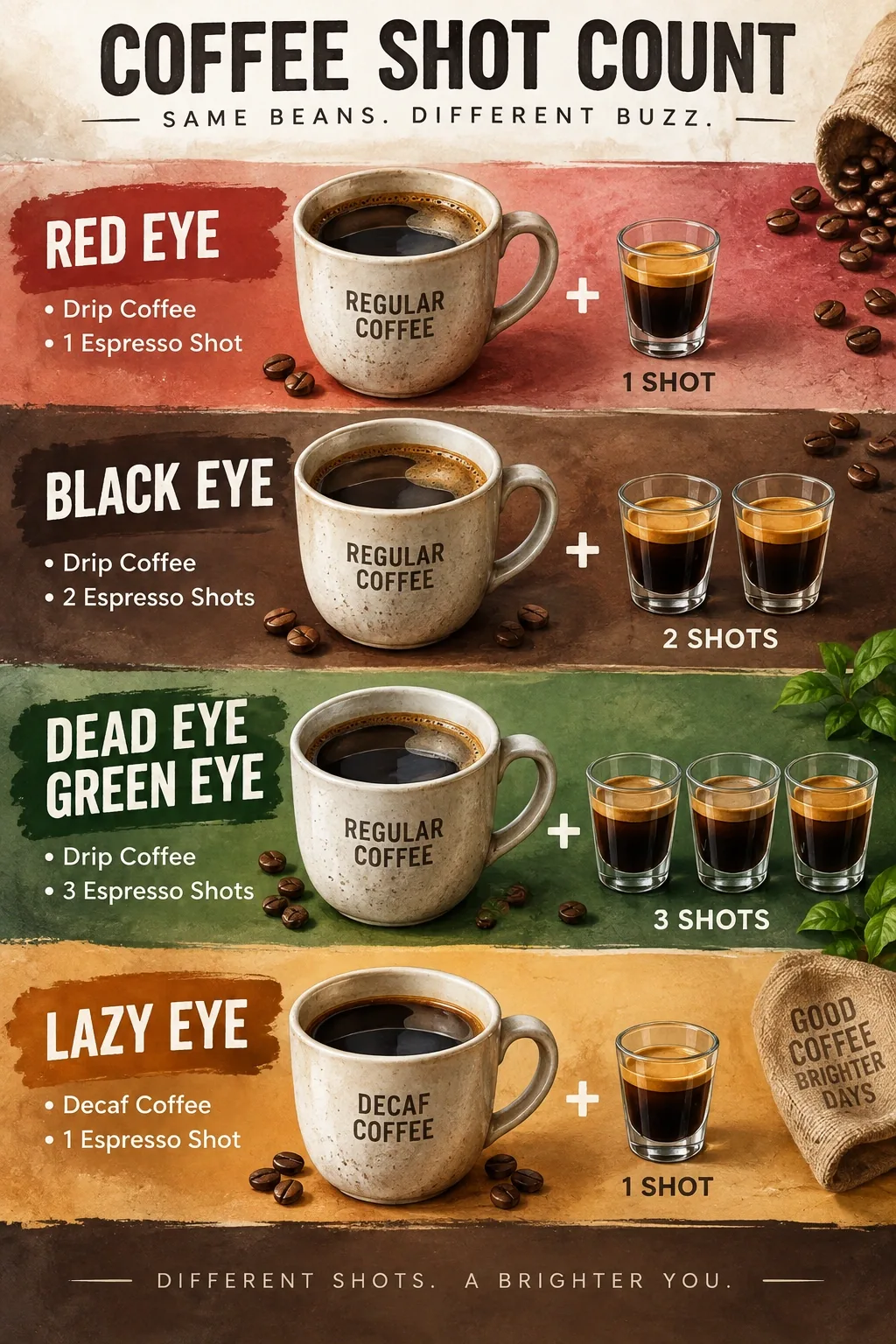
The black eye does not exist in isolation – it sits in the middle of a shot-count ladder of drip-plus-espresso drinks, each with a distinct name and caffeine load. Understanding the full spectrum lets you order confidently at any café and adjust the recipe to exactly the intensity you want.
| Drink | Drip Base | Espresso Shots | Relative Intensity |
|---|---|---|---|
| Lazy Eye | Decaf drip | 1–2 regular shots | Low overall caffeine |
| Red Eye | Regular drip | 1 shot | Moderate boost |
| Black Eye | Regular drip | 2 shots | Strong |
| Dead Eye / Green Eye | Regular drip | 3 shots | Very high |
The Red Eye is the entry point – one shot of espresso over drip coffee, enough to push a standard cup into serious caffeine territory. The Black Eye doubles that to two shots, making it the balanced middle ground: meaningfully stronger than a red eye, but not the all-out assault of a Dead Eye (also called a Green Eye in some regions), which adds a third shot. The Lazy Eye is the opposite direction – decaf drip with regular espresso shots, for people who want the espresso flavor and a controlled caffeine dose without the drip coffee’s contribution.
One important caveat: these names are not standardized across menus. Some cafés use “Red Eye” and “Black Eye” interchangeably, some use regional names like “Shot in the Dark” for any espresso-spiked drip, and others do not carry these drinks by name at all. When ordering, always specify the shot count explicitly – “drip coffee with two shots of espresso” – rather than relying on the name alone.
Placing the black eye alongside red eyes and dead eyes illuminates how terminology shifts with every added shot, a hierarchy mapped comprehensively in every coffee drink explained.
Step 6: Audit Caffeine, Order at Chains, and Manage the Sensory Hit
How Much Caffeine Is Actually in a Black Eye
The honest answer is: it depends on your drip volume, your espresso machine, your beans, and your roast level. Any source that gives you a single fixed number for black eye caffeine content is oversimplifying.
Here is the component math that lets you build your own estimate:
| Component | Caffeine Range |
|---|---|
| 8–10 oz drip coffee | ~95–150 mg |
| Double espresso (2 oz) | ~120–130 mg |
| Black Eye total | ~215–280 mg |
Across sources, estimates for a black eye range from roughly 200 mg on the low end (lighter roasts, smaller drip volume) to around 280 to 300 mg on the higher end (full 10 oz drip, strong double shot). Some calculations reach even higher depending on espresso concentration. The practical takeaway is to treat 250 mg as a reasonable midpoint and adjust based on your specific setup.
For context, a scientific opinion published in the EFSA Journal found that single caffeine doses up to 200 mg do not raise safety concerns for healthy adults, while habitual intake up to 400 mg per day remains within safe limits for non-pregnant adults. A black eye in the 250 to 280 mg range sits comfortably below the 400 mg daily benchmark but does exceed the 200 mg single-dose threshold – which means it matters how much coffee you have already had earlier in the day. If a black eye is your first drink of the morning, you have plenty of headroom. If it is your third coffee, you are likely pushing against that daily ceiling.
Ordering at Chains and Managing the Physical Hit
At Starbucks, a black eye does not appear on the menu by name, but the order is simple: ask for a drip coffee (or Pike Place if you want something specific) with two shots of espresso added. Specify your cup size, because the barista will add the shots to whatever volume you order, and a grande versus a venti changes the ratio significantly.
At Peet’s and Dunkin, the same logic applies – order a brewed coffee and request two espresso shots added. The terminology varies by location, but the request is straightforward. At third-wave independent cafés, you may encounter “Shot in the Dark” on the menu (typically one shot over drip), in which case you ask for a double. Some specialty cafés will require you to order the drip and the shots separately at the register, then combine them yourself.
The sensory onset of a black eye is faster than a standard drip coffee because free liquid caffeine in a hot drink absorbs quickly – expect to feel it within 30 to 60 minutes. The combination of concentrated espresso dissolved solids and a full volume of drip coffee also hits the digestive system harder than either drink alone, particularly on an empty stomach. The practical fix: sip slowly, pair it with food, or drop to a red eye (one shot) if your stomach is sensitive to high-acid, high-caffeine combinations.
Customizing a double-shot addition at the register involves navigating sizing costs, financial optimization strategies detailed thoroughly within the Starbucks venti price guide.
Troubleshooting: Fix Bitter, Weak, Cold, No-Crema, and Equipment Failures
Extraction Balance Corrections
Bitter is the most common complaint, and it almost always traces back to one of two sources: over-extracted espresso or a roast that is simply too dark for this application. If the shot ran longer than 30 seconds, the grind is too fine – coarsen it slightly and repull. If the shot timed correctly but still tastes harsh, the roast level is the problem; switch from a dark roast to a medium or medium-dark espresso bean. Over-extraction and dark roast bitterness compound each other in a black eye because the drip base has no milk, sugar, or dilution to soften them.
Weak is the opposite problem: too much drip coffee relative to the espresso dose, stale beans that produced a thin shot, or an underdosed portafilter. Start by reducing your drip volume by 2 oz and tasting the result. If the shot itself tasted watery during extraction, the beans are likely stale – fresh beans make a measurable difference in espresso body and intensity. If beans are fresh and the shot still feels thin, increase your dose by 1 gram and re-extract.
Temperature and Texture Preservation
Cold is a timing failure, not a recipe failure. If the combined drink is lukewarm, one of three things happened: the cup was not preheated, the drip sat too long before the shot was pulled, or the espresso was pulled too early and cooled while waiting. Fix the sequence – preheat the cup, brew drip, pull espresso immediately, combine within 30 seconds.
No crema points to stale beans, incorrect grind, insufficient machine pressure, or stirring after the pour. Crema requires CO₂ still present in freshly roasted beans, fine enough grinding to create resistance during extraction, and adequate pressure to emulsify. If your espresso machine is older and pressure has dropped, a portafilter pressure gauge can confirm whether it is still hitting the 9-bar target. If you are using fresh beans with a correct fine grind and still getting no crema, try pouring more gently – aggressive pouring physically breaks the crema on contact with the drip surface.
Hardware Limitations and Grind Adjustments
Wrong grind causing overflow – the espresso basket overflowing or channeling during extraction – means the grind is too coarse and water is finding the path of least resistance rather than extracting evenly. Tighten the grind in small increments. Conversely, if the machine strains and barely produces output, the grind is too fine – open it up.
If you are working with a moka pot or AeroPress and finding the result unsatisfying compared to what you expected from a black eye, that is not a calibration problem – it is a hardware limitation. These devices cannot replicate the pressure-emulsified body and crema of pump espresso. The drink you are making is closer to a strong drip-on-drip, which is still a valid high-caffeine coffee but a different experience. If that result works for you, lean into it. If you want an authentic black eye, an entry-level pump espresso machine is the only path there.
For anyone who lacks espresso equipment entirely: the closest honest alternative is a red eye made with strong moka pot coffee – one concentrated pour over drip – which delivers elevated caffeine without the expectation of espresso crema or body. You can also customize the base with milk, flavored syrup, or a different roast to make the strong coffee more palatable rather than chasing an espresso result the equipment cannot produce.
Frequently Asked Questions About How to Make Black Eye Coffee
What is the difference between a black eye and a dead eye?
Shot count. A black eye uses two espresso shots over drip coffee; a dead eye (also called a green eye) uses three. The dead eye is significantly more intense and pushes most people close to or past the 400 mg daily caffeine ceiling in a single drink.
Can I make a black eye without an espresso machine?
You can make a high-caffeine drip drink using a moka pot or AeroPress, but it won’t be a true black eye. Without the pressure of a pump espresso machine, you won’t get authentic crema or the emulsified body that defines the drink.
What happens if I pour the drip over the espresso instead of the other way around?
The crema collapses immediately under the weight of the drip, and you lose the layered flavor progression. You also get a more uniform – and usually more bitter – result because the espresso has no surface to float on.
Does the roast level matter for a black eye?
It matters more here than in almost any other coffee drink because there’s nothing to soften harsh roast notes. Two very dark roasts combined produce compounded bitterness. A medium-roast drip base paired with a medium-dark espresso is the most forgiving combination.
How do I order a black eye at Starbucks?
Ask for a drip coffee – Pike Place or any available brewed coffee – with two shots of espresso added. Specify your cup size and tell the barista you want the shots on top if you want the layered experience rather than having it stirred in.
Is a black eye stronger than a cold brew?
It depends on the cold brew concentration, but a standard black eye at 250 mg of caffeine is comparable to or stronger than most 12 oz cold brews, which typically range from 150 to 260 mg. Nitro cold brew and concentrate-based cold brews can exceed that.
Why does my black eye taste different every time?
Drip coffee and espresso are both variable – drip changes with water temperature, brew time, and grind consistency; espresso changes with dose, grind, and machine pressure. Locking in a consistent grind setting for each component and measuring your drip volume will tighten up the results significantly.
Can I make a black eye with decaf espresso?
Yes – decaf espresso over regular drip gives you most of the espresso flavor and body with less total caffeine. It’s an inversion of the lazy eye, which uses decaf drip and regular espresso. Neither is wrong; they just shift where the caffeine is coming from.
References
- Scientific Opinion on the Safety of Caffeine | backend.orbit.dtu.dk
- Red Eye, Black Eye, Dead Eye Coffee Guide | acquiredcoffee.com