
A standard latte runs on espresso, not cup size, and that single fact rewrites everything most people assume. One shot delivers roughly 63–75 mg of caffeine whether it’s swimming in a small or drowning in a venti.
Size doesn’t scale caffeine. Shot count does. Starbucks quietly bumps shots as sizes grow, but the logic isn’t automatic or universal. Know your shot count, and you know your dose, every time, every order.
What’s Actually Inside a Latte
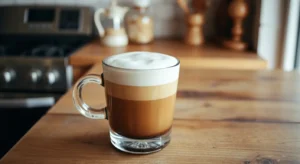
Latte caffeine comes entirely from espresso (the milk is just the vehicle). A caffè latte is two things: one or more shots of concentrated espresso, and a generous pour of steamed milk on top. That’s the whole drink.
The espresso shot is small (roughly one ounce) but it’s doing all the heavy lifting. Hot water gets forced through finely ground coffee under high pressure, pulling out a dense, concentrated liquid that carries essentially all the caffeine in your cup.
The steamed milk? It adds volume, creaminess, and that smooth texture people love. But it brings exactly zero caffeine to the equation.
Here’s the easiest way to think about it: imagine dropping a caffeinated tea bag into a small cup, then pouring that tea into a much bigger mug and filling the rest with hot water. The water changes the taste and the size, but every milligram of caffeine was already in that original small cup. Same principle here. When a barista pulls a shot and pours eight ounces of steamed milk over it, the milk dilutes the flavor and softens the intensity, but the caffeine count doesn’t budge. It was set the moment that shot finished pulling.
So when you’re trying to figure out how much caffeine is in your latte, the milk is irrelevant. The only number that matters is how many espresso shots went into the cup.
This short video shows exactly what that two-step process looks like in real time:
Video: Pulling a Perfect Espresso Shot & Steaming Milk – Latte Basics
The Number That Matters: Caffeine Per Espresso Shot
A single concentrated espresso shot delivers roughly 63–75 mg of caffeine, making it the only source of latte caffeine, every milligram in your cup traces back to those shots, not the milk. That range isn’t a rounding error. It’s a real spread caused by bean type, roast level, and where you buy your coffee. For a casual café-goer, water temperature and grind pressure cause minor fluctuations, but the bean blend your café uses and the chain’s own extraction standards move the needle far more.
The math feels simple at first: one shot at 63 mg, two shots at 126 mg, done. A standard double-shot latte should land between 126 and 150 mg of caffeine, and that’s roughly correct. But here’s where the mental model needs one more layer.
Why Shot Count Alone Doesn’t Tell the Full Story
The linear-shot fallacy is the assumption that every espresso shot is the same size unit, like adding 63 mg blocks, one at a time. In practice, that block changes depending on who pulled the shot.
Independent specialty cafés using pure Arabica beans tend to produce shots in the 63–70 mg range, with tighter consistency across pulls. Chain cafés using Robusta-heavy blends push closer to 75 mg per shot, sometimes well past it. A consumer-group study by Which? measured espresso shots across major high-street chains and found the variance is striking: a single shot at Costa clocked around 100 mg, while Pret shots reached approximately 180 mg, nearly three times what a standard independent café shot delivers. Starbucks, by contrast, measured closer to 33 mg per shot in that same data set.
That’s not a small rounding difference. A double-shot latte at an independent café might give you 126 mg of latte caffeine. Order the same drink at a chain using a higher-caffeine blend, and you could be looking at 150 mg or more, a 19% swing based purely on where you’re standing when you order.
Federal nutrition researchers from the USDA Agricultural Research Service put a tighter frame on the specialty end of that range. In a study published in the Journal of Food and Chemical Toxicology, “Assessing dietary exposure to caffeine,” the NHANES research team noted:
“Specialty coffee, espresso [contains] 46.7–62.8 [mg per fluid ounce].”
That per-ounce framing matters because a standard 1 oz espresso shot sits at the lower end of the published range, consistent with what independent shops pull. Once you move to chain-style extraction with different bean ratios, you’re measuring a different product even if the menu calls it the same thing.
So the number that actually matters for your latte isn’t just how many shots, it’s whose shots. That distinction is what makes shot count the right question to ask, and café choice the variable that determines whether your answer is accurate.
Why a Bigger Cup Doesn’t Mean More Caffeine
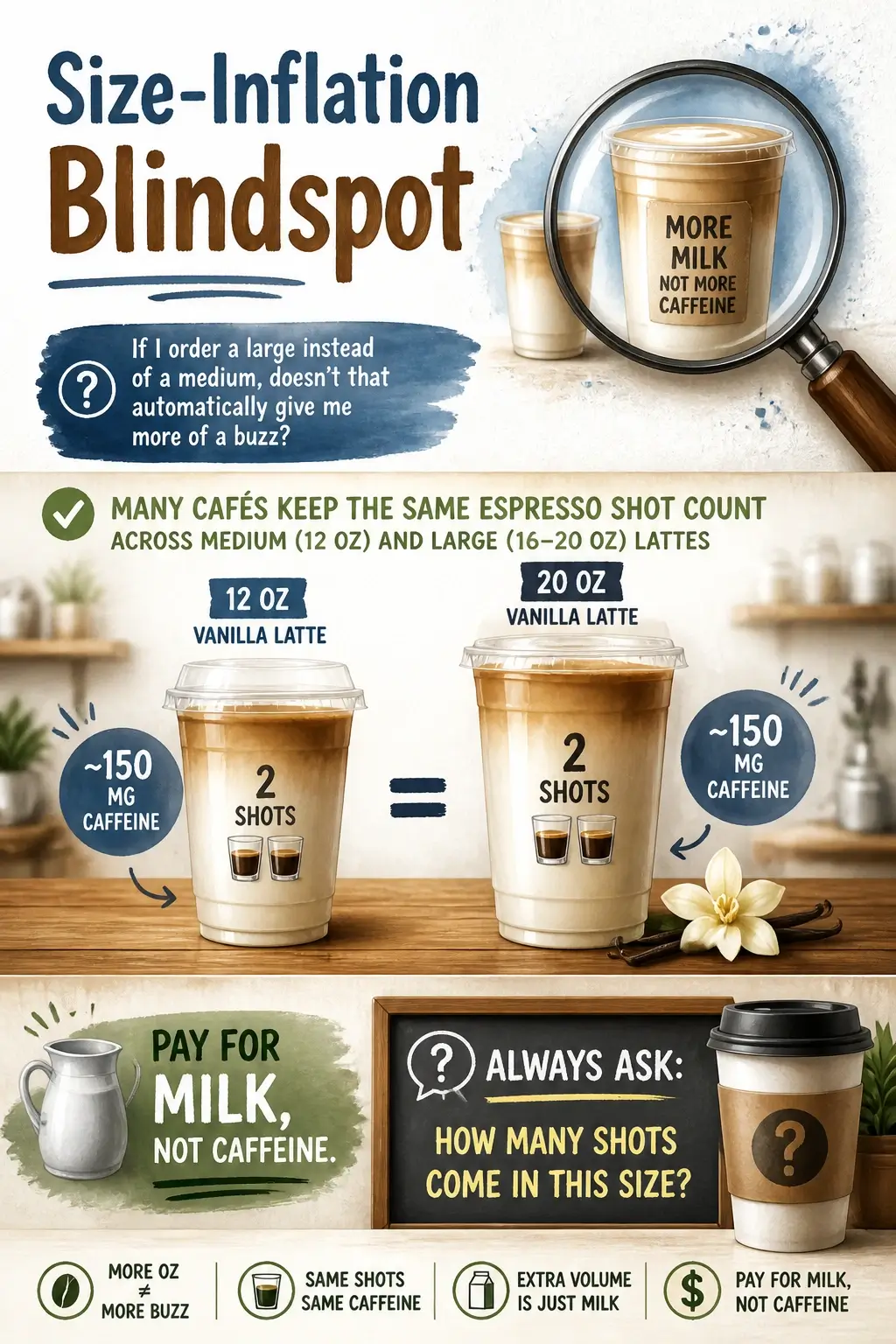
Latte caffeine doesn’t scale with cup size, it scales with shot count, and those two things often move independently of each other. In most café chains, the medium and large versions of the same drink are built on identical espresso recipes. The only thing that grows when you upsize is the milk.
Here’s the concrete version of that: your 12 oz vanilla latte and your friend’s 20 oz vanilla latte may both contain exactly 150 mg of caffeine. You’re not getting a stronger drink, you’re getting a longer sip. That extra volume is steamed milk filling the gap, not more espresso pulling its weight.
This happens because chains standardize their shot recipes across sizes. It keeps training simple, keeps flavor consistent, and (let’s be honest) it keeps costs predictable. The result is that upsizing is mostly a milk purchase, not a caffeine purchase.
To see how these principles apply to oversized specialty drinks, examine the breakdown of venti latte variations across different milk-to-espresso ratios.
The Size-Inflation Blindspot
The reason this surprises so many people is that their mental model of “a cup of coffee” was built in a different era. Most caffeine guides floating around online still do their math based on an 8 oz cup, a size that barely exists at commercial cafés anymore. Meanwhile, the drinks people are actually ordering run 16 to 20 oz.
That gap between the imagined cup and the real one is what the Center for Science in the Public Interest calls out in their caffeine data: a Starbucks venti brewed coffee (20 oz) can deliver 390–490 mg of caffeine, enough to hit the FDA’s entire daily ceiling in one drink. Lattes don’t reach those extremes because espresso is the only caffeine source, but the same psychological effect is at work. People are estimating based on an 8 oz world while living in a 16 oz reality.
There’s also a flavor argument hiding inside this logic. Ken Nye, owner of Ninth Street Espresso in New York, put it plainly:
“If you wanted to be espresso-focused, you had to go smaller… Simply put, to serve espresso with milk in a larger cup took away from the flavor of the espresso. What would be the point of being espresso-focused if you couldn’t even taste it?”
That’s the trade-off nobody advertises at the register. More milk doesn’t just dilute the caffeine picture, it dilutes the espresso itself. A larger cup with the same shot count doesn’t give you a stronger latte; it gives you a milder one with more volume.
The single most reliable fix is also the simplest one: ask your barista “how many shots come in this size?” before you order. That one question cuts through every size label, every ounce count, and every menu description. Shot count is the only number that actually tells you what your latte caffeine will be.
Shot Count by Latte Size
Standard shot count by size gives you the fastest shortcut for estimating latte caffeine before you even reach the counter. The general rule follows a simple ladder (more milk, more shots) but the jump isn’t always as clean as it sounds.
Here’s the baseline most independent cafés work from:
| Cup Size | Typical Shot Count | Caffeine Range | Shop-Dependent Notes | | :— | :—: | :—: | :— | | Small (8–10 oz) | 1 shot | ~60–75 mg | Most shops pull a single shot here. Some regional formats or smaller specialty cups sit closer to 5–8 oz with the same one-shot build. | | Medium (12 oz) | 1–2 shots | ~60–150 mg | The most variable size on the menu. Many chains default to 2 shots; some smaller shops stay at 1. This is where assumptions cost you the most. | | Large (16–20 oz) | 2–3 shots | ~120–225 mg | Usually built on 2 shots. A third shot shows up when the shop wants a stronger drink or the cup runs very large, not a given. |
| Cup Size | Typical Shot Count | Caffeine Range | Shop-Dependent Notes |
|---|---|---|---|
| Small (8–10 oz) | 1 shot | ~60–75 mg | Most shops pull a single shot here. Some regional formats or smaller specialty cups sit closer to 5–8 oz with the same one-shot build. |
| Medium (12 oz) | 1–2 shots | ~60–150 mg | The most variable size on the menu. Many chains default to 2 shots; some smaller shops stay at 1. This is where assumptions cost you the most. |
| Large (16–20 oz) | 2–3 shots | ~120–225 mg | Usually built on 2 shots. A third shot shows up when the shop wants a stronger drink or the cup runs very large, not a given. |
That middle row is the one worth watching. A medium latte is where the gap between what you expect and what you get is widest (some shops treat it as a single-shot drink stretched with milk, others treat it as a proper double).
The large size is where the “bigger cup = more caffeine” assumption quietly breaks down, which is exactly what we mapped in the previous section. Two shots might be the ceiling whether you’re holding 14 ounces or 20. The extra volume is milk, not espresso.
The Sprudge editorial team ran into this same gap when comparing Starbucks drinks directly:
“A tall latte at Starbucks has one shot, while a tall Starbucks Flat White has two shots. Drage even confirmed for us that were guests to order a Grande or Venti Starbucks Flat White, they would receive a third shot, so this in fact an upping of strength across the board.”
That’s not an edge case, it’s the rule. Two drinks sitting in the same size cup, built by the same chain, can carry completely different shot counts depending on the drink name. Latte caffeine doesn’t track cup size. It tracks shot count, and shot count tracks the shop’s own recipe.
The table above is a reliable starting point, not a guarantee. The only way to know exactly what’s in your cup is to ask. Most baristas will tell you in five seconds flat.
Bean Types and Café Chains: The Hidden Variables
Two medium lattes, two shots each, yet meaningfully different caffeine. The variable isn’t the shot count; it’s what’s inside the shot, which comes down to coffee bean type, the brand’s proprietary blend, and to a lesser degree, roast level.
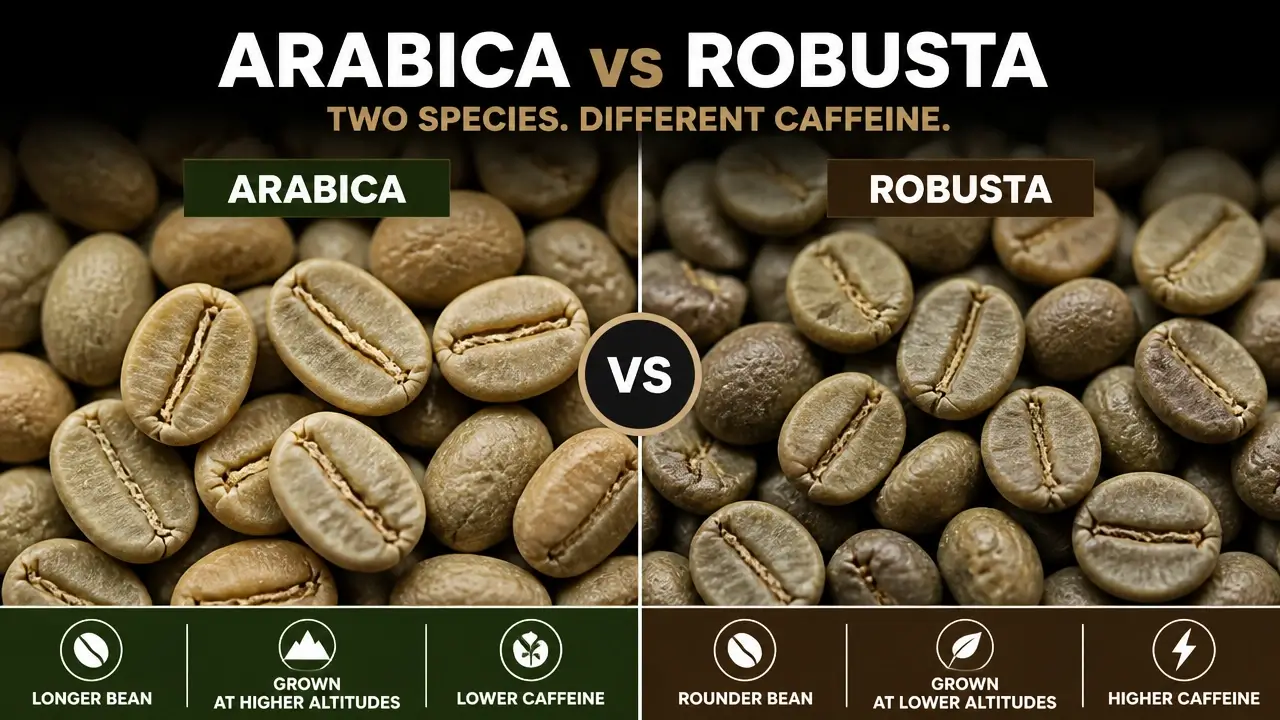
Start with the bean. There are two species behind nearly every cup you’ll ever order.
Arabica is what most specialty and premium cafés pull their espresso from. It’s smoother, more complex in flavor, and delivers roughly 63–70 mg of caffeine per shot. Robusta, on the other hand, carries nearly double the caffeine of Arabica per bean. It’s harsher on its own, which is why you rarely see it featured solo, but it shows up regularly in commercial blends and instant coffee, quietly pushing the caffeine number up.
This is where chain cafés enter the picture. Starbucks and similar large-format chains use proprietary blends (often Robusta-forward or high-density Arabica roasts) that tend to push a single shot toward the higher end of the range, around 75 mg. Order a two-shot medium latte there versus a two-shot medium at a local specialty café using single-origin Arabica, and you could be looking at a 20–25 mg difference before you’ve even touched your cup.
Roast level adds one more wrinkle, though it’s a smaller one. Jon Frech, co-founder of Black Oak Coffee Roasters and a coffee roasting expert, explains the mechanism clearly:
“Why? Caffeine is super stable during the roasting process. As coffee is roasted darker, it is losing organic matter but keeping roughly the same amount of caffeine. In other words, a dark-roasted bean weighs less than a lightly roasted bean, but they may contain the same amount of caffeine. This means that a 25-gram coffee (1 ounce) made with dark roast is going to have more beans than a light roasted coffee using 25 grams of coffee. And because each coffee bean has about the same amount of caffeine, this means the 25 grams of dark roast will contain slightly more caffeine.”
So a light roast isn’t the low-caffeine option most people assume it is, it’s actually marginally lower in caffeine by weight than a dark roast, because each bean retains more mass and you need fewer of them to hit the same gram count. The difference is real, but it’s secondary to what species is in the bag.
The most useful mental shift here: think of latte caffeine the way you think about sugar content in soda. A 12-ounce can isn’t just “a 12-ounce can” (a Coke and a store-brand cola carry different numbers on the label). Same logic applies. The shot count gives you the frame, but the bean type and the brand’s blend fill in the actual number. When you’re at a new café or ordering from a chain you haven’t tracked before, the safest assumption is that their espresso sits somewhere in the 63–75 mg range per shot, and if they’re leaning on a Robusta blend, it could push past that.
Understanding how roasting profiles influence extraction is essential, especially when exploring whether Does Dark Roast Coffee Have an impact on the final cup’s stimulant profile.
The Truth About Decaf Lattes
Decaf lattes still carry measurable latte caffeine (the decaf espresso shot inside them isn’t caffeine-free, just caffeine-reduced). A single decaf shot holds somewhere between 3 and 12 mg of caffeine, which for most people on a single cup is genuinely no big deal. But “no big deal” is a context-dependent statement, and that context matters more than the coffee industry usually admits.
The science is straightforward here. McCusker, Goldberger, and Griffiths measured caffeine in decaffeinated espresso shots pulled from multiple retail outlets and found concentrations ranging from 3.0 mg to 15.8 mg per shot, with the variation coming from differences in bean sourcing, decaffeination method, and brewing. Commercial decaffeination removes roughly 97% of caffeine, but that last 3% doesn’t disappear. It stays in the cup.
When “Negligible” Becomes a Misleading Label
For a healthy adult drinking one decaf latte in the afternoon, 3–12 mg of caffeine is genuinely negligible. The problem is that word gets stretched to cover situations where it no longer applies.
Consider someone (a pregnant individual, or a person managing an anxiety disorder) who drinks three or four decaf lattes across a day. That 3–12 mg per shot starts stacking: two-shot lattes at the low end of the range add up to 18–24 mg per cup, and four cups puts you at 72–96 mg total. That’s approaching the caffeine load of a full regular espresso shot, consumed gradually and invisibly.
Dr. Adriana Farah, Professor of Food Science and Nutrition and a leading researcher in coffee bioactive compounds, put it plainly in Molecules:
“According to various national and international rules and regulations, decaffeination processes should lower the methylxanthine concentration by 97–98% in ground coffee… caffeine content reached 18 mg/473 mL serving… for a heavy coffee drinker, the ingestion of multiple servings of decaffeinated beverages could result in caffeine doses equivalent to a caffeinated beverage.”
That last line is the one worth sitting with. The per-cup number looks harmless. The daily total is where the math quietly turns on you.
The Real Takeaway for Zero-Caffeine Needs
Decaf is a genuinely good option if your goal is cutting back, it does remove the overwhelming majority of caffeine, and for most people it’s more than enough of a reduction. But if your healthcare provider has told you to eliminate caffeine entirely for medical reasons, a decaf latte is not a safe assumption. There’s no such thing as a zero-caffeine espresso-based drink from a café.
If that boundary matters for you, the honest move is to ask your provider directly before treating decaf as a free pass.
Your Daily Latte Limit: Planning Without Guessing
Latte caffeine adds up by shot count, not cup size, and once you know that, the 400 mg FDA guideline for healthy adults becomes a simple equation you can run in your head before you order.
Here’s the quick math. A standard medium latte runs two shots, each delivering roughly 70–75 mg of caffeine. That puts one medium latte at 140–150 mg. Two of them lands you around 280–300 mg, comfortably inside the daily limit with room to spare. Push to three, and you’re at 420–450 mg, which nudges past the line for most people.
Starbucks tightens that ceiling slightly. Their shots clock in closer to 75 mg each, so two medium lattes there puts you at roughly 300 mg. A third one crosses 400 mg on its own. For regular Starbucks drinkers, 2 to 2.5 lattes is the more honest daily ceiling.
The good news is that the café counter gives you real control over all of this.
- Single shot in a medium: You get the full latte experience (same volume, same warmth) at about half the caffeine. A smart move for an afternoon order when you’re already at 200 mg for the day.
- Double shot in a small: Maximum caffeine, minimum milk. If you want the kick without the 16-ounce cup, this is the order.
- Flavored syrups (vanilla, caramel, hazelnut): Zero caffeine, every time. Adjust your drink’s taste as aggressively as you want. It won’t move the needle on your daily total by a single milligram.
You don’t need to guess at this anymore. Count the shots, know your shop’s shot size, and the math takes about five seconds. That’s the whole system, and it works whether you’re on your first latte of the morning or deciding if a second one at 3 p.m. is actually a good idea.
Key Takeaways on Latte Caffeine
- Latte caffeine depends solely on the number of espresso shots, not cup size or milk added.
- Chain cafés often use Robusta-heavy blends, producing shots with higher caffeine than indie shops.
- Upsizing a latte usually just adds more steamed milk, not more caffeine.
- Decaf lattes still contain 3–12 mg per shot, which adds up across a day.
- Flavored syrups add flavor but zero caffeine — your dose stays the same.
- The simplest way to know your latte’s caffeine is to ask, “How many shots come in this size?”
Latte Caffeine FAQs: What You’re Actually Asking
Q: Does a latte from a chain like Starbucks automatically have more caffeine than an independent cafe?
A: Not automatically, but often yes. Chains frequently blend Robusta beans, pushing shots toward 75mg. Independent specialty cafes using pure Arabica pull shots closer to 63–70mg. The difference can be 20% or more, so your latte’s kick depends heavily on who’s pulling the shot.
Q: Why might a medium latte keep you awake longer than a large one?
A: Because many shops put the same two shots in both sizes, only adding more milk to the large. Caffeine is identical, so the larger drink just spreads the same dose through more volume. You’re not more wired — you’re just sipping longer.
Q: What’s the one question you should always ask a barista to know exactly how much caffeine is in your latte?
A: “How many shots come in this size?” That cuts through all the menu confusion. Most baristas can answer instantly, and it gives you the only number that actually matters for calculating your caffeine intake.
Q: Can a latte made with blonde espresso actually have less caffeine?
A: Surprisingly, yes. Blonde roasts are denser, so a shot uses fewer beans to hit the same weight, resulting in marginally less caffeine than a dark roast. It’s a small difference, but it flips the “lighter equals stronger” myth.
Q: If I’m sensitive to caffeine, is ordering a decaf latte a foolproof solution?
A: Not foolproof. Decaf espresso still holds 3–12 mg of caffeine per shot. A couple of decaf lattes across a day can sneakily stack up to the equivalent of a regular espresso shot for someone who’s sensitive.
Q: How do flavored lattes compare in caffeine to plain ones?
A: Exactly the same. Vanilla, caramel, hazelnut — those syrups add flavor, not caffeine. Your caffeine count stays locked to the espresso shots, so go wild with syrups without altering your dose a single milligram.
References
- Caffeine levels in high-street coffees vary significantly – which.co.uk
- Assessing dietary exposure to caffeine from beverages in the U.S. population using brand-specific versus category-specific caffeine values – sciencedirect.com
- Coffee Cup Sizes: The Case for Smaller Cups – baristamagazine.com
- Starbucks Flat White vs. Latte: What’s The Difference? – sprudge.com
- Caffeine and Coffee: How to Get More of a Good Thing – dailycoffeenews.com
- Caffeine content of decaffeinated coffee – academic.oup.com
- Caffeine content in decaffeinated beverages – mdpi.com