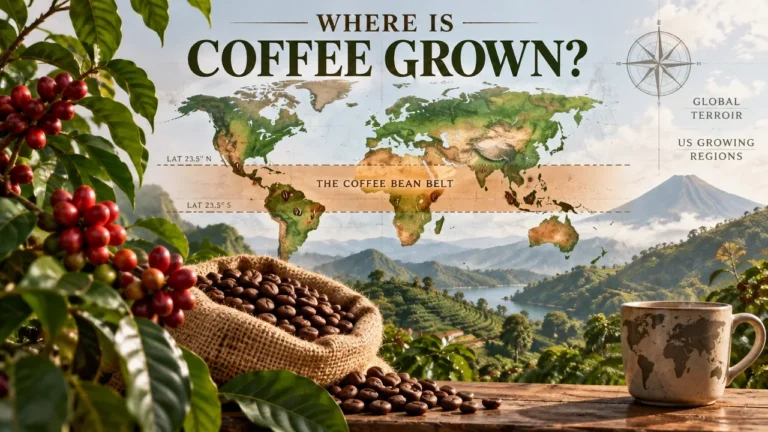

The Coffee Bean Belt is not a marketing label. It’s a climate verdict – a narrow equatorial strip where the atmosphere, soil, and elevation happen to line up in the precise combination that coffee plants need to survive and produce fruit worth drinking.
Every major coffee origin on earth sits inside this band, from Ethiopian highlands to Colombian volcanoes to Indonesian rainforests. The reasons are physical, not political. And once you understand the mechanics behind the belt, the flavor differences between continents stop feeling mysterious and start feeling inevitable.
Key Takeaways on the Coffee Bean Belt
- The Coffee Bean Belt is defined by frost physics first: coffee cannot survive hard freezes, and the tropics are the only broad zone that guarantees frost-free growing conditions year-round.
- The Hadley cell’s seasonal ITCZ migration creates the wet-dry rhythm that triggers coffee flowering and ripening – without it, the tropics would either be too wet or too dry for commercial cultivation.
- Elevation lapse rates (6.5°C per 1,000 m) allow Arabica to grow at equatorial latitudes by keeping highland temperatures in the 18–22°C range that the plant needs.
- Latin America, Africa & Arabia, and Asia-Pacific each produce distinct flavor profiles because of soil geology, genetics, altitude, and processing method – latitude alone explains almost nothing about cup character.
- Climate change is physically contracting the belt by pushing viable Arabica zones upward; models project up to 50% of current coffee land could become unsuitable by 2050.
- Hawaii and Puerto Rico are inside the tropical belt; California’s coastal coffee farms are a microclimatic exception outside it – and Europe and Canada cannot commercially cultivate coffee outdoors due to photoperiod, frost, and insolation constraints.
The Bean Belt: Mapping Coffee’s Equatorial Frontier
The Coffee Bean Belt is the equatorial band bracketed by the Tropic of Cancer to the north and the Tropic of Capricorn to the south – roughly 23.5 degrees in each direction from the Equator. Every country that produces coffee at commercial scale sits inside or very close to this band. That’s not coincidence. It’s frost physics.
Coffee is a tropical evergreen. Its cells cannot survive a hard freeze. When temperatures drop below 0°C for even a few days, ice crystals form inside the plant’s vascular tissue and destroy it from the inside out. The tropics provide the one thing coffee cannot do without: year-round freedom from killing frost.
Researchers at the International Center for Tropical Agriculture (CIAT) found that Arabica coffee requires an annual mean temperature of around 20°C and over 1,200 mm of rainfall per year to be economically viable. Temperatures above 30°C sustained over time reduce yields, while even a few days of frost can damage or kill the plant outright.
That temperature window is tight. Too cold and the plant dies. Too hot and yields collapse. The tropics are the only broad geographic zone on earth where that window holds consistently across a full growing year.
Tropical Latitude Limits
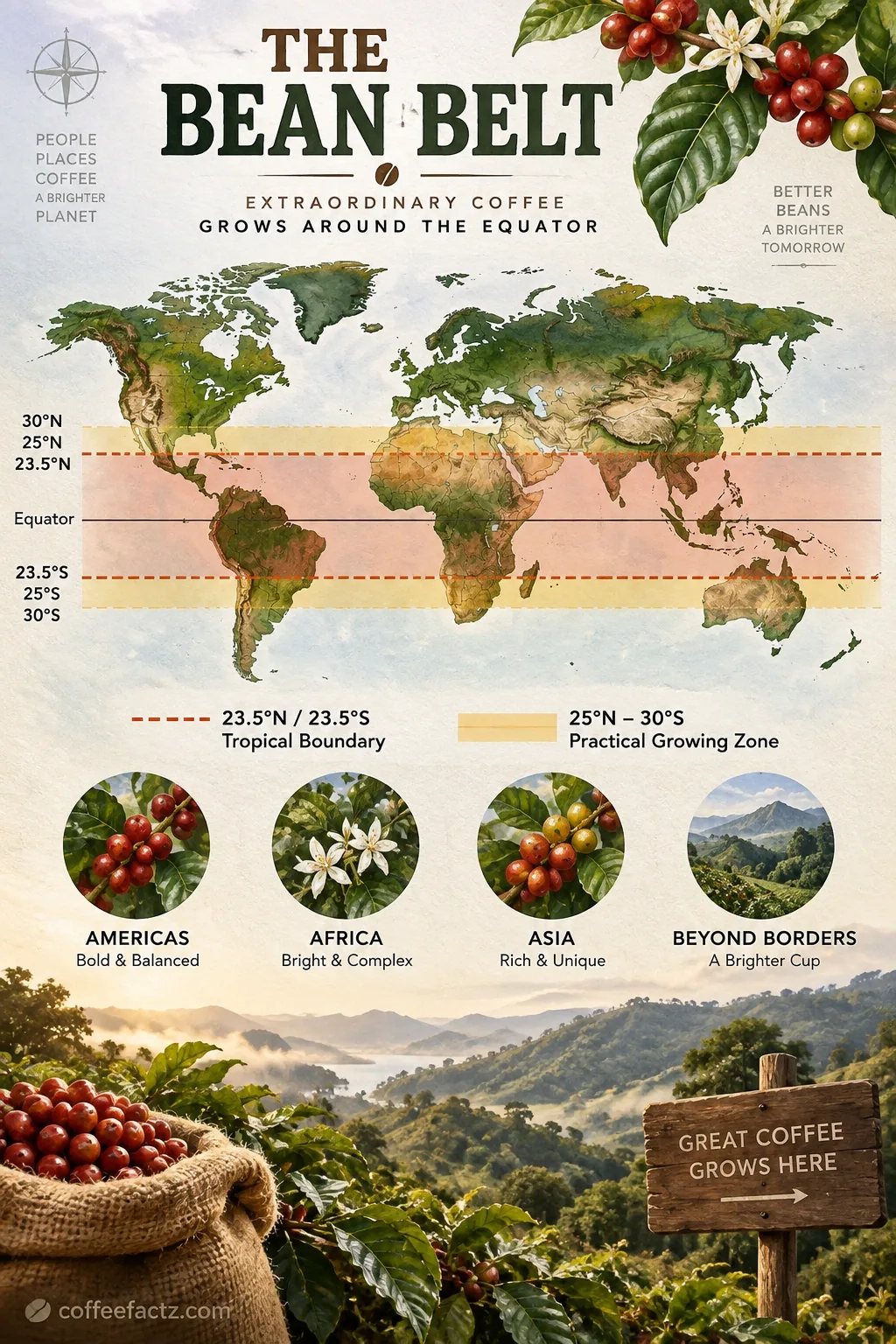
The Coffee Bean Belt is formally defined by the Tropic of Cancer at 23.5°N and the Tropic of Capricorn at 23.5°S. You’ll find some sources stretching those limits to 25°N–30°S to account for microclimates – coastal California is the clearest example – but the core belt lives between the Tropics. The extension to 25°N–30°S is a practical envelope, not a redefinition. It describes the edge cases where local geography overrides regional climate, not a new climate zone.
Arabica and Robusta respond to this latitude constraint differently. Arabica, the more delicate species, needs mild temperatures and typically grows at higher elevations within the belt. Robusta tolerates more heat, lower altitudes, and harder conditions – which is why Vietnam, a lower and warmer growing environment, is built almost entirely on Robusta. Latitude sets the outer wall. Elevation and variety determine where inside that wall each crop actually thrives.
One natural transition sentence to introduce the infographic: the map below shows how the Tropic boundaries carve the belt out of the global landmass, with the core tropical zone and the extended microclimatic envelope both visible.
Global Origin Distribution
Every top coffee-producing country on earth – Brazil, Vietnam, Colombia, Ethiopia, Honduras, Indonesia, Uganda, Mexico, Guatemala, and India – sits inside the Coffee Bean Belt. That’s not a partial overlap. That’s a complete set.
The three major producing regions divide the belt geographically. Latin America holds the western half, running from Mexico through Central America and down the Andes into Brazil and Peru. Africa and Arabia anchor the belt’s eastern African corridor, with Ethiopia, Kenya, Rwanda, Burundi, and Tanzania as the highland spine, plus Yemen as the historic commercial bridge. Asia-Pacific fills the eastern arc: Indonesia, Vietnam, Papua New Guinea, India, and Thailand.
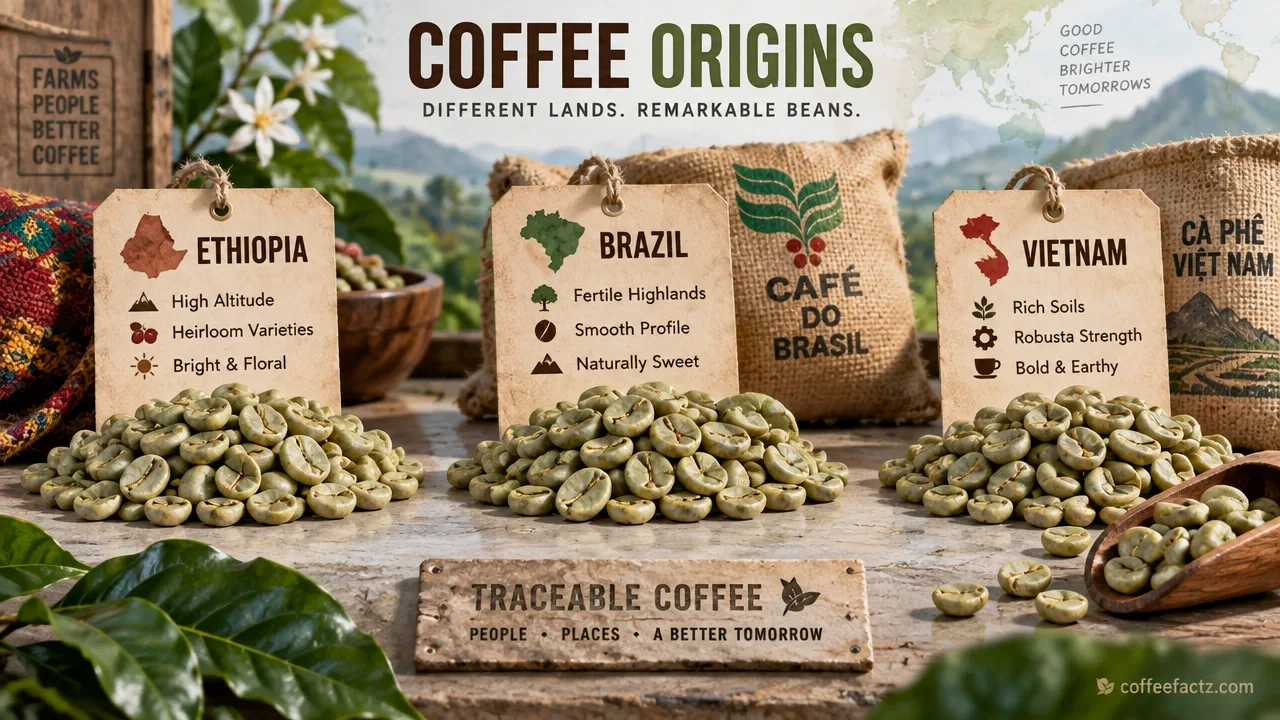
Specialty coffee roasters and importers use real-time origin maps as transparency tools – layering not just country of origin but specific regions, processing methods, farm elevation, and harvest dates. The Bean Belt provides the outer boundary, but latitude alone tells you almost nothing about what’s in the cup. The flavor differences between an Ethiopian natural and a Colombian washed come from soil chemistry, altitude, genetics, and processing – not from how far each farm sits from the Equator.
The Atmospheric Engine: Why the Bean Belt Exists
The Coffee Bean Belt sits where it does because of a planetary-scale air circulation system that delivers the exact rainfall pattern coffee needs – wet enough to grow, dry enough to ripen. That system is the Hadley cell, and understanding it explains why the equatorial tropics got coffee and the temperate zones didn’t.
Hadley Cell Circulation
At the Equator, solar energy heats the surface intensely. That warm air rises, cools as it climbs, and dumps its moisture as the heavy rainfall that defines tropical wet seasons. The air then spreads north and south at altitude, cools further, and descends around 30°N and 30°S as dry, stable, high-pressure air – the same descending air that creates the Sahara and the Australian Outback.
The Intertropical Convergence Zone (ITCZ) is the surface boundary where the northern and southern trade winds collide and force that rising column of air upward. It doesn’t sit still. It migrates north and south with the seasons, following the sun. That seasonal shift is what gives coffee-growing regions their alternating wet and dry seasons – the wet season triggers flowering, and the dry season concentrates sugars and triggers the cherry-ripening cycle that makes harvest possible.
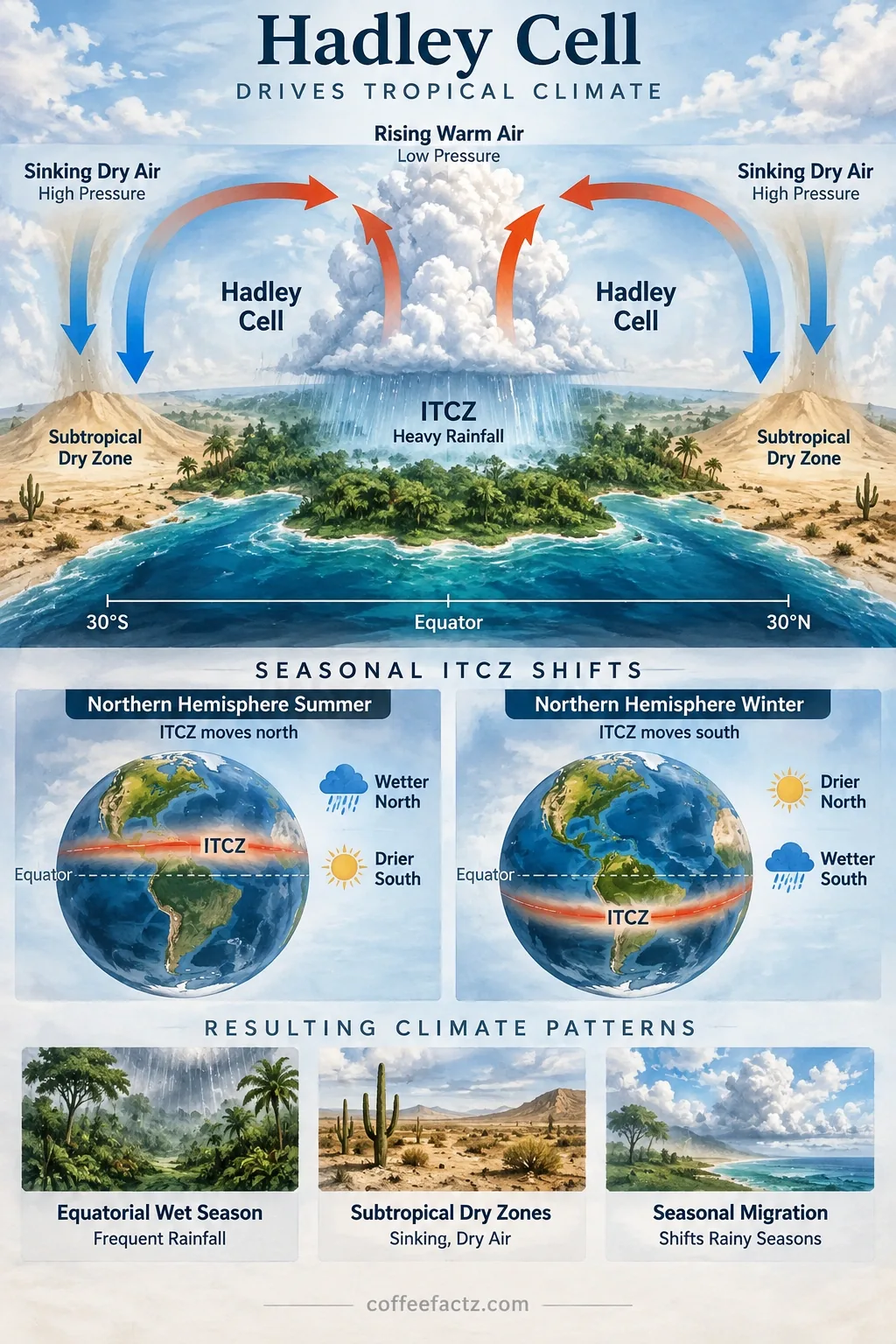
Without the Hadley cell, the tropics would either be uniformly wet year-round (no dry season for ripening) or arid (not enough rain for growth). The ITCZ migration creates the rhythmic wet-dry pulse that coffee plants evolved alongside.
Elevation Lapse Rates
Here’s the mechanism that makes highland tropical coffee possible. Temperature drops roughly 6.5°C for every 1,000 meters of elevation gained. That rate – the environmental lapse rate – means a farm sitting at 1,800 meters near the Equator experiences temperatures more similar to a temperate spring than a tropical lowland, despite being geographically equatorial.
Arabica needs that coolness. At low elevations near the Equator, temperatures can breach 30°C regularly, stressing the plant and reducing yields. But climb to 1,500–2,200 meters and the same latitude becomes a viable Arabica environment. Altitude doesn’t just prevent heat stress. It also modulates moisture through cloud cover and orographic rainfall – mountains intercept moisture-laden air and force it upward, creating the persistent cloud cover that buffers against temperature extremes.
The flavor consequence of this is direct and mechanistic. A peer-reviewed altitudinal study of coffee grown on Gorongosa Mountain in Mozambique found that increasing elevation from 650 to 935 meters was associated with lower temperatures, greater water availability, and a four-week extension of fruit maturation time. At the highest elevation, green bean mass and apparent density increased, and the beans showed higher concentrations of trigonelline and key chlorogenic acids, along with elevated soluble sugars including glucose and fructose. The authors concluded that altitude – primarily through cooler temperatures and extended maturation – was a major driver of improved physical and chemical bean traits.
The causal chain works like this: higher altitude slows ripening, slower ripening builds denser beans, denser beans accumulate more sugars and organic acids, and those compounds translate into the floral, stone-fruit, and berry flavors that specialty buyers pay premiums for. Lower altitude runs the same chain in reverse – faster ripening, less density, simpler and earthier cup profiles.
Researchers at the University of California, Davis reviewing coffee terroir found that high-altitude coffee above 1,000 meters, grown under lower rainfall conditions, consistently produced more aromatic, acidic cups with perceived body. Coffee grown below 850 meters under higher rainfall was rated less favorably – more bitter, grassy, astringent, and lower in aroma.
That’s not a flavor preference. That’s a physiological outcome of how the plant matures under different temperature and water regimes.
Latin America: Volcanic Soils, Washed Clarity, Balanced Sweetness
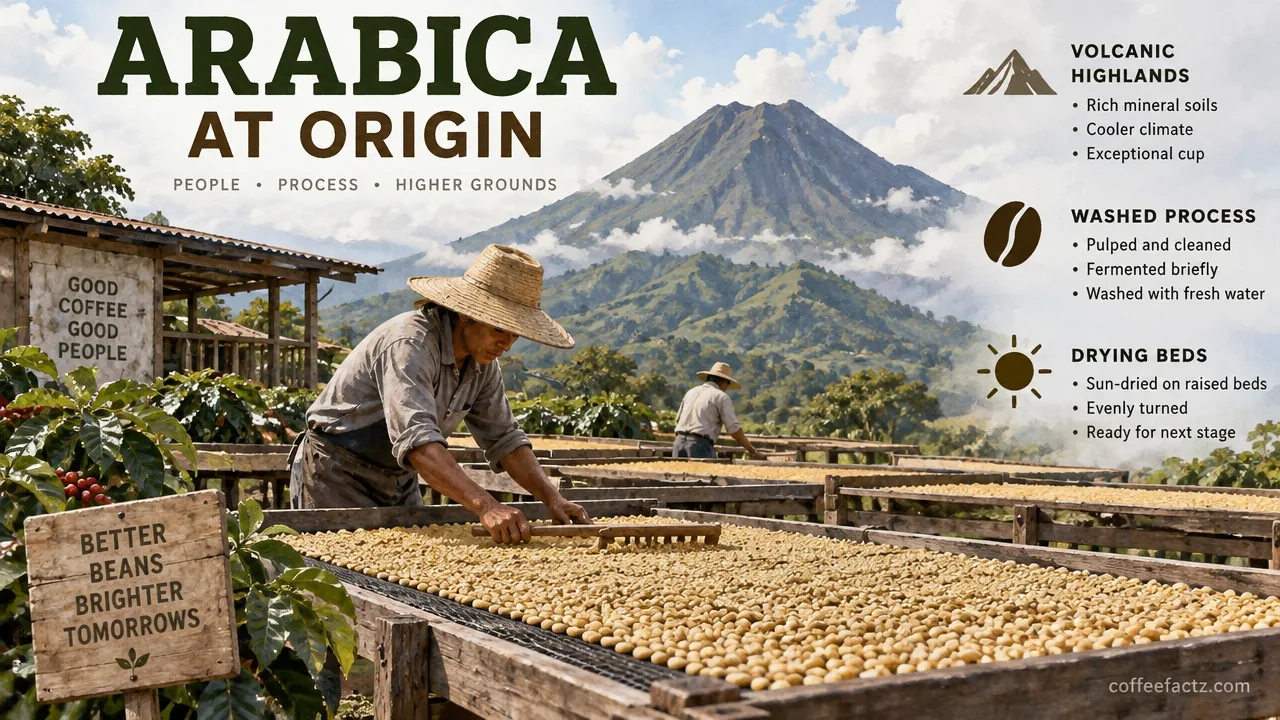
Latin American coffee terroir is built on a specific geological and geographic combination: young volcanic mountain ranges, high-altitude tropical plateaus, and the wet-processing tradition that came to dominate the region. The result is a flavor profile that most coffee drinkers encounter first – and often use as their unconscious baseline for what coffee is supposed to taste like.
The geography runs from Mexico’s southern highlands through Guatemala, Honduras, El Salvador, Nicaragua, Costa Rica, and Panama in Central America, then down the Andes through Colombia, Ecuador, and Peru, with Brazil occupying a separate lowland plateau in the south. Volcanic soils across Mexico and Central America are mineral-rich, well-draining, and high in phosphorus and potassium – nutrients that support vigorous plant growth and contribute to cup brightness. Colombia’s Andean farms benefit from similar volcanic geology, plus the unique double-harvest advantage of two distinct flowering seasons per year due to its equatorial position.
The flavor baseline across the region is recognizable: balanced sweetness, bright citric and malic acidity (think lemon, apple, and stone fruit), and chocolate-to-nut finish notes that anchor the cup without overpowering it. That profile is not accidental. It’s the product of washed processing – the dominant method across most of Latin America – which strips the coffee cherry’s fruit layer away before drying, leaving the bean’s intrinsic flavors to speak without the fermentation-forward sweetness of natural processing. Washed coffees from volcanic highlands are clean, transparent, and consistent.
Brazil is the regional outlier. Lower elevations, flatter terrain, and natural or pulped-natural processing give Brazilian coffee a heavier body, lower acidity, and pronounced chocolate-and-nut profile that makes it the backbone of countless espresso blends worldwide.
Some origin taxonomies label this region “Latin America,” others “America,” and a few split it further by subregion. For clarity across this guide, the three-pillar taxonomy – Latin America / Africa & Arabia / Asia-Pacific – keeps geography, genetics, and processing directly comparable.
Africa & Arabia: Heirloom Genetics and Rift Valley Terroir
African coffee terroir tastes the way it does for one foundational reason: genetics. Ethiopia is where Coffea arabica originated as a wild plant, which means Ethiopian coffees carry a genetic diversity that no other origin can replicate. Thousands of distinct heirloom landrace varieties grow across the Ethiopian highlands – many still unnamed and uncharacterized – and that genetic richness is the single biggest driver of the floral, jasmine-forward, tea-like complexity that defines East African cups.
The geography anchors this: Ethiopia’s highlands sit between 1,500 and 2,200 meters, with the Great Rift Valley running through the heart of the continent and creating the soil structure and drainage conditions that East African coffees depend on. Kenya, Rwanda, Burundi, and Tanzania share this Rift Valley geology – volcanic and nutrient-dense, with high phosphorus content that contributes to the vibrant phosphoric acidity characteristic of Kenyan AA lots. That bright, almost wine-like acidity is distinct from the citric acidity of Colombian coffee; it’s sharper and more electric on the palate.
Processing variation across Africa adds another layer. Ethiopia produces both natural-processed coffees (berry-forward, deeply fruited, often wine-like) and washed coffees (jasmine-floral, clean, delicate). Kenya is almost exclusively washed, using a double-fermentation method that intensifies acidity and clarity. Rwanda and Burundi have developed strong washed-coffee programs with a focus on traceability through smallholder cooperatives – farms of 1–2 hectares that collectively deliver to centralized washing stations.
Yemen sits on the Arabian Peninsula rather than the African continent, but its place in coffee history is inseparable from Africa’s. Commercial coffee cultivation likely spread from Ethiopia to Yemen by the 15th century, where it was first traded as a commodity and exported through the port of Mocha. Some historians argue that Arabica’s agricultural lineage may trace back further into Sudan before Ethiopia, which complicates the single-origin-birthplace narrative. What’s clear is that Arabia was the commercial bridge – the point where wild Ethiopian forest coffee became a global trade commodity. That historical channel is why “Africa & Arabia” is the accurate regional label, not just a geographic convenience.
Asia-Pacific: Monsoon Minerals, Wet-Hulling, and Robusta Scale
Asia-Pacific coffee terroir is the most internally diverse of the three pillars – and the most misunderstood. The region spans vastly different climates, species, and processing traditions, from the high-altitude washed coffees of Papua New Guinea to the monsoon-exposed beans of India’s Malabar coast to the commodity-scale Robusta plantations of Vietnam’s Central Highlands.
The geographic spine runs through Indonesia first. Sumatra, Java, and Sulawesi sit on the Pacific Ring of Fire, with young volcanic soils that deliver intense mineral character – heavy, loamy, and saturated with iron and magnesium. The monsoon climate means high humidity and significant rainfall, which creates both the growing conditions and the processing constraints that define Sumatran coffee.
That processing method is Giling Basah, or wet-hulling – and it’s the key to understanding why Sumatran coffee tastes the way it does. In most origins, parchment coffee is dried to around 11% moisture before the outer hull is removed. In wet-hulling, the hull is stripped much earlier, when the bean is still at 30–50% moisture. The exposed, swollen bean then continues drying under open air. That process leaves the bean’s cellular structure porous and irregular, which allows more oxygen contact during drying and creates the deep, earthy, cedar, and dark-chocolate flavors that Sumatran coffee is known for – alongside a characteristic low acidity and heavy body that works exceptionally well in espresso blends.
Vietnam operates on a completely different model. The country is the world’s second-largest coffee producer by volume, but the vast majority of that production is Robusta – grown at lower altitudes in the Central Highlands, where temperatures are warmer and rainfall heavier than Arabica prefers. Robusta produces roughly twice the caffeine of Arabica, tolerates more heat and drought, and yields more cherries per plant. The tradeoff is cup complexity: Robusta carries a rubbery, bitter baseline that makes it unsuitable as a standalone specialty coffee but essential as the backbone of Italian-style espresso blends and instant coffee globally.
India, Thailand, and Papua New Guinea round out the region with smaller but growing specialty sectors – India’s Monsoon Malabar process mimics the flavor effects of historical sea-voyage aging, while Papua New Guinea’s highland washed coffees offer a flavor bridge between East African brightness and Indonesian body.
Climate Change and the Moving Bean Belt
The Coffee Bean Belt is not a fixed line. Climate change is physically relocating it – pushing viable growing zones upward in elevation and contracting the total land area where commercial Arabica cultivation makes economic sense. The question isn’t whether the belt is moving. It’s how fast, and whether the industry can adapt.
Warming Elevation Envelopes
Arabica cultivation is being squeezed upward. As average temperatures rise, the lower-elevation portions of existing growing zones breach the heat threshold where Arabica yields collapse. Farmers who once grew successfully at 1,200 meters are finding that 1,500 or 1,800 meters now provides the temperature conditions their grandparents had at lower altitudes.
The problem is that mountains have a ceiling. Once you’ve pushed cultivation to the highest viable slope, there’s no higher ground to move to. And the land area available at extreme elevations is a fraction of what exists at lower altitudes – steeper, harder to farm, and more susceptible to erosion.
The model estimates a reduction in the global area currently used for coffee production by 50% by 2050 across all three emission scenarios – Source: International Coffee Organization review of academic climate studies
A 50% reduction in viable coffee land by mid-century is not a gradual inconvenience. It’s a structural reorganization of where the world’s coffee comes from, who grows it, and what it costs. The countries with the highest-altitude mountain ranges – Ethiopia, Colombia, Kenya – have more buffer than low-lying producers, but no origin is immune.
Adaptation and Pest Pressure
The industry’s adaptation toolkit includes shade management – using tree canopy to buffer microclimate temperatures – migration uphill where terrain allows, varietal development focused on heat-tolerant Arabica hybrids and improved Robusta lines, and water management to handle increasingly erratic rainfall patterns.
Robusta gains relative advantage in some scenarios. Its heat and drought tolerance means that areas where Arabica cultivation becomes unviable may still support Robusta production, shifting the regional species balance further toward commodity-grade coffee.
The biological pest risk compounds the land loss. Coffee leaf rust (Hemileia vastatrix) and the coffee borer beetle (Hypothenemus hampei) both thrive in warmer, more humid conditions – exactly the conditions that rising temperatures create at elevations that were previously too cool for these pests. Rust devastated Central American production in the 2012–2013 outbreak and cost the region an estimated $1 billion in losses. Warmer temperatures extend the elevation range where both pests can survive and reproduce, meaning farms that migrate uphill to escape heat stress may find they’ve also migrated into new pest pressure zones they didn’t face before.
American Coffee Frontiers: Hawaii, California, and Puerto Rico
United States coffee production is real, commercially significant in specific zones, and almost entirely absent from mainstream coffee geography discussions. Three distinct American growing regions sit inside or adjacent to the Coffee Bean Belt: Hawaii, California’s coastal microclimates, and Puerto Rico’s mountain highlands.
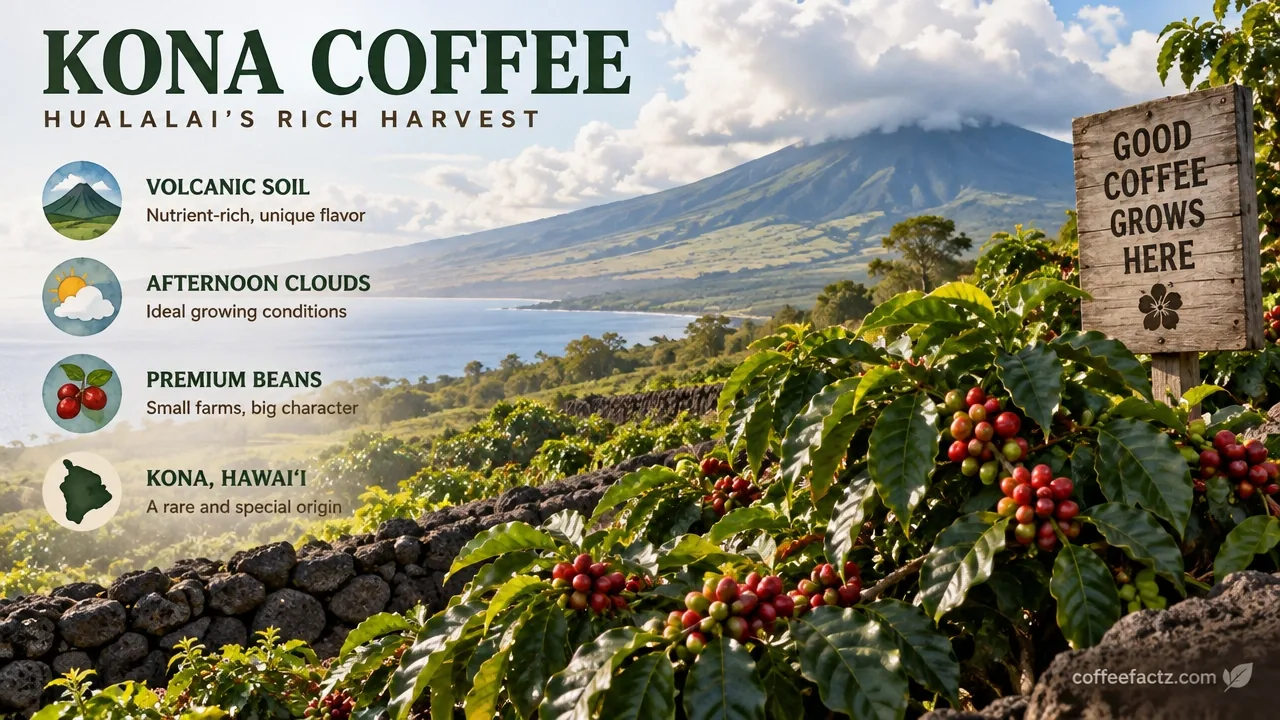
Hawaii is the clearest case. The Hawaiian islands sit between 19°N and 22°N – well inside the tropical zone – and the volcanic geology of the Big Island produces some of the most recognizable microclimates in American agriculture. The Kona district, on the western slopes of Hualalai and Mauna Loa, benefits from a specific daily weather pattern: clear mornings with intense sunlight, afternoon cloud cover that moderates heat and provides diffuse light, and rich basaltic soil with excellent drainage. That combination produces the Kona profile – medium body, bright but gentle acidity, and a clean, slightly nutty sweetness. Maui and Kauai support larger-scale, more mechanized coffee farms that produce reliable commercial volumes outside the Kona premium tier.
California is the outlier that tests the belt’s definition. The state sits between 32°N and 42°N – outside the Tropic of Cancer entirely. But coastal Santa Barbara County, Goleta, and San Diego benefit from a Mediterranean microclimate buffered by the Pacific, with mild winters that rarely produce killing frost and summer temperatures moderated by marine influence. Farmers in these zones have intercropped coffee with avocado orchards, using the avocado canopy as a thermal buffer against the temperature swings that would otherwise stress coffee plants.
Climate suitability modeling published on ResearchGate found over 230 km² of California agricultural land – much of it currently used for avocado cultivation – is thermally suitable for coffee with appropriate management.
The coffees coming out of California’s niche farms – including ultra-premium Geisha lots from Santa Barbara – have achieved some of the highest farmgate prices recorded anywhere in the world. The production volumes are tiny. But the proof of concept is real.
Puerto Rico rounds out the American picture. The island’s Cordillera Central mountain range provides the altitude, rainfall, and volcanic soil that shade-grown Arabica needs. Historically, Puerto Rican coffee was prized in European royal courts – Yauco Selecto from the southwestern highlands was among the most sought-after coffees in the late 19th century. Hurricane Maria in 2017 devastated the island’s coffee infrastructure. Recovery has been slow but active, with younger producers rebuilding shade-grown mountain farms with specialty market positioning.
Hawaii and Puerto Rico are tropical US territories – inside the core Coffee Bean Belt by latitude and climate. California is a microclimatic exception: commercially real, geographically outside the belt, and dependent on specific coastal conditions that don’t scale to the broader state.
The Temperate Boundary and Final Verdict: Can Coffee Grow Outside the Bean Belt?
Temperate climates cannot support commercial outdoor coffee cultivation, and the reasons go deeper than average temperature. Three distinct physical mechanisms work together to make Europe and Canada structurally incompatible with outdoor Arabica farming – and understanding them clarifies exactly what the Coffee Bean Belt is actually protecting.
The first mechanism is photoperiod. Coffee evolved near the Equator, where day length stays close to 12 hours year-round. The plant’s flowering cycle is triggered by the transition from wet to dry season – a temperature and moisture cue, not a light cue – but its overall physiology is calibrated to consistent day length. In temperate latitudes, summer days run 16–18 hours and winter days drop to 8 hours or fewer. That extreme swing disrupts the plant’s growth rhythm in ways that cannot be corrected by irrigation or fertilizer.
The second mechanism is winter frost cellular destruction. Below 0°C, water inside the plant’s xylem vessels freezes and expands. On thawing, the ice crystals that formed inside the vessel walls cause xylem cavitation – essentially, tiny air bubbles that block the plant’s water transport system. A single hard freeze can kill mature coffee trees. Temperate winters guarantee repeated freeze-thaw cycles across months, making outdoor commercial cultivation categorically non-viable in continental Europe, Canada, or any climate with a true winter.
The third mechanism is insolation quality. Equatorial highland coffee farms receive intense, relatively consistent solar radiation year-round, modulated by cloud cover at altitude. That combination – high light intensity, cloud diffusion, and consistent photoperiod – drives the photosynthesis rates and fruit development timelines that produce specialty Arabica. Temperate regions receive weaker, more oblique solar radiation in winter, further reduced by low sun angles and shorter days. Even if a temperate greenhouse could control temperature, it cannot replicate the light environment of a Colombian mountain farm.
The final answer: coffee can grow outside the Coffee Bean Belt only in protected microclimates or tropical territories. California’s coastal farms, Hawaii’s volcanic slopes, and Puerto Rico’s mountain highlands are the documented exceptions – real, commercially active, and geographically bounded. They work because local geography mimics the belt’s core conditions, not because they’ve escaped the belt’s physical logic.
Europe and Canada have neither the frost-free winters, the consistent photoperiod, nor the insolation patterns that coffee requires outdoors at scale. The Bean Belt endures as the global engine of coffee production because it delivers all five variables simultaneously: tropical atmospheric stability, elevation-driven temperature modulation, volcanic mineral soils, seasonal rainfall rhythm, and year-round frost-free growing conditions. No other broad geographic zone on earth does that for coffee.
Frequently Asked Questions About the Coffee Bean Belt
Why is it called the coffee belt?
The name comes from the band-like shape of the growing zone – a continuous strip wrapping around the planet’s midsection between the two Tropics. It’s called a “belt” because it circles the globe at equatorial latitudes rather than clustering in one region.
Which countries are in the coffee belt?
Every major coffee producer sits inside the belt: Brazil, Colombia, Ethiopia, Vietnam, Honduras, Guatemala, Indonesia, India, Uganda, and Mexico, among others. The full list covers roughly 70 countries across Latin America, Africa & Arabia, and Asia-Pacific.
What does “coffee belt” mean?
It’s the geographic zone between the Tropic of Cancer (23.5°N) and Tropic of Capricorn (23.5°S) where climate conditions – frost-free temperatures, seasonal rainfall, and adequate altitude – allow coffee plants to grow and produce fruit economically.
Can coffee grow outside the coffee belt?
In limited microclimates, yes. Hawaii, Puerto Rico, and coastal California all produce commercial coffee outside or at the edge of the strict belt boundary. But broad outdoor commercial cultivation in temperate regions like Europe or Canada is not viable due to winter frost, photoperiod extremes, and insufficient solar intensity.
Does altitude matter more than latitude for coffee flavor?
Altitude is often the stronger flavor driver within the belt. The elevation lapse rate cools highland farms enough for slow cherry ripening, which builds bean density, sugar concentration, and the acids responsible for floral and fruit-forward flavors – regardless of how close to the Equator the farm sits.
Why do African coffees taste so different from Latin American coffees?
Genetics is the primary reason. Ethiopia is the origin of wild Arabica, and the heirloom landrace varieties grown across East Africa carry a genetic diversity that produces floral, tea-like, and jasmine aromatics that cultivated Latin American varieties simply don’t express at the same intensity.
How does climate change threaten the coffee belt?
Rising temperatures push the lower bound of viable Arabica cultivation upward in elevation, while simultaneously expanding the range of pests like coffee leaf rust and the coffee borer beetle. The net effect is a shrinking viable growing zone – projected to lose up to 50% of current suitable land by 2050 under existing emissions trajectories.
What makes Sumatran coffee taste so earthy compared to other origins?
Wet-hulling (Giling Basah) is the direct cause. The hull is removed at high moisture content, leaving the bean exposed and porous during the remainder of drying. That open cellular structure allows heavy oxygen contact, which drives the earthy, cedar, and dark-chocolate character that defines Sumatran profiles.
References
- Multiclass Classification of Agro-Ecological Zones for Arabica Coffee – PLOS ONE | journals.plos.org
- Does Coffee Have Terroir and How Should It Be Assessed? – PMC / UC Davis | pmc.ncbi.nlm.nih.gov
- Classifying Climate-Suitable Lands in California for Coffee Cultivation | researchgate.net
- Shade and Altitude Implications on the Physical and Chemical Attributes of Green Coffee Beans from Gorongosa Mountain, Mozambique – Agronomy | doi.org
- ICO Review of Academic Studies on Climate Change and Coffee Production | ico.org