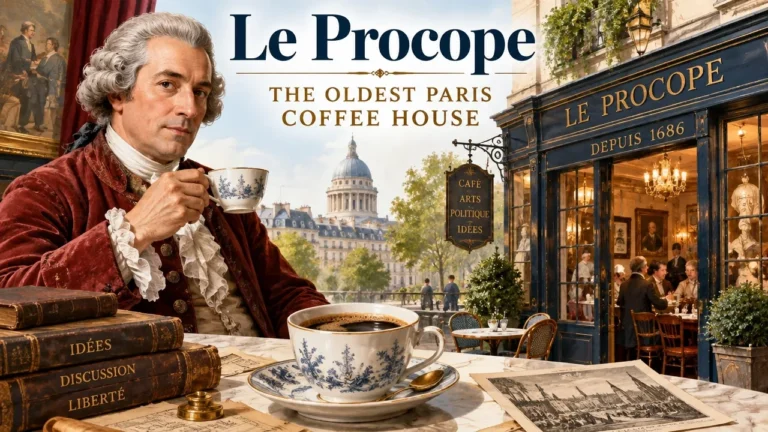

Le Procope, Paris’s most storied coffeehouse, didn’t become famous because it served good coffee. It became famous because of where it sat, who walked through its door, and what those people argued about over small cups of a beverage that Europe was still learning to trust.
Julia Landweber, Associate Professor of History and specialist in early French coffee culture, captures the speed of that transformation: in just sixty years, a drink initially mistrusted for its bitterness, its health risks, and its Ottoman associations became a beloved fixture of Parisian life, gave its name to the café as a new kind of public space, and pulled a whole culture of consumers hungry for exotic novelties into the street. Le Procope was the room where that shift happened at its sharpest.
Key Takeaways on Le Procope
- Le Procope opened in 1686, not as Paris’s first coffee vendor but as its first purpose-built café room designed for extended intellectual life.
- Francesco Procopio dei Coltelli’s biography is genuinely disputed; his name, regional origins, and even his specific inventions exist in competing versions with no single authoritative source.
- The café’s Enlightenment reputation was built on geography as much as genius: the Comédie-Française opened across the street in 1689 and delivered a recurring clientele of France’s sharpest minds.
- The “oldest café in the world” claim is factually contested; Queen’s Lane Coffee House in Oxford has operated since 1654, and Le Procope itself closed in the 19th century before multiple revivals.
- The coffee served at Le Procope during the Enlightenment came primarily from Saint-Domingue, where by 1789 enslaved workers produced 60% of the world’s coffee supply.
- Today’s Le Procope is worth visiting for the room and the history, not the food; recurring visitor consensus recommends the desserts and the upstairs atmosphere over the main menu.
Coffee Before the Café: From Yemeni Sufi Ritual to the Parisian Coffee Frontier
Coffeehouse culture didn’t start in Paris. It started in the highlands of Ethiopia, moved to 15th-century Yemen, and arrived in Paris carrying three centuries of social infrastructure before a single cup was poured on the Left Bank.
The trail begins with Yemeni Sufi monks, who brewed coffee as a ritual aid to night prayer. The plant’s stimulating properties made long devotional sessions manageable, and the practice spread. By the 16th century, the Ottoman coffeehouse had turned that ritual into a civic institution. These were not taverns. They were places where men gathered to argue, read aloud, play chess, and conduct business. The Ottoman coffeehouse was, in practical terms, the first public room in the world where you could sit for hours without drinking alcohol. That distinction mattered enormously when the model traveled west.
European coffeehouses followed the same logic. England got its first in Oxford in 1650. Paris came later and more reluctantly. The city’s first documented coffee vendor was Armenian Pascal, who set up a stall at the Saint-Germain fair in 1672. He sold coffee from a booth, not a room, and the operation didn’t last. But it seeded a market.
Parisian coffeehouses grew from 380 in 1720 to over 600 by the end of the 18th century, while the city’s population rose from approximately 510,000 to 660,000 inhabitants. – Source: Project Manifest
Those numbers tell a specific story. Paris’s population grew by roughly 29% over that period. Its coffeehouse count grew by more than 58%. Demand wasn’t just tracking population; it was outrunning it. The city wasn’t filling a gap. It was building an appetite. By the time Le Procope opened in 1686, Paris wasn’t a city being introduced to coffee. It was a city already hooked, waiting for someone to give the habit a proper room.
Francesco Procopio dei Coltelli: Sicilian Origins, Ice-Cream Mechanics, and the 1686 Opening
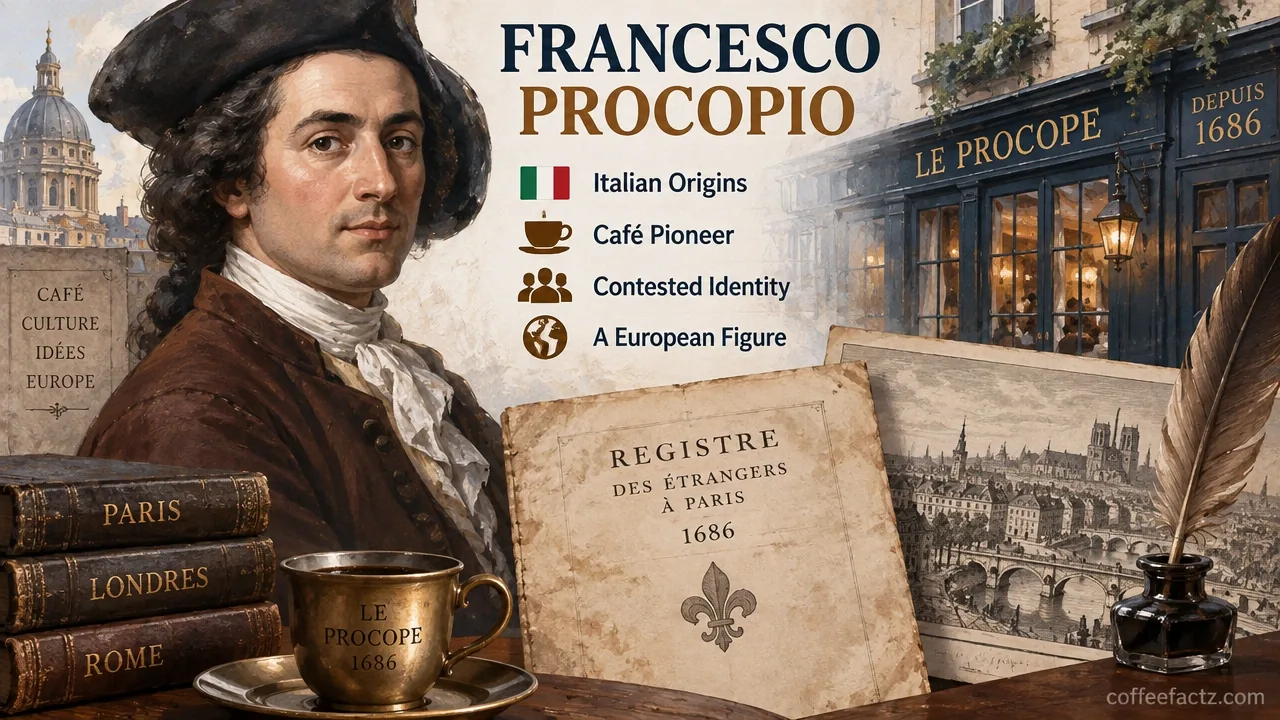
Francesco Procopio dei Coltelli is the founder of Le Procope, but almost everything else about him is a matter of record gaps, name variants, and competing traditions. That ambiguity is worth sitting with, because it tells you something about how early modern biography works: the less famous a person was before they became famous, the thinner the paper trail.
Contested Biographical Record
The founder’s identity is genuinely disputed. His name appears in historical sources as Procopio Cutò, suggesting Sicilian roots, and as François Procope, the Frenchified version he likely adopted after settling in Paris. Some accounts place his origins in Palermo; others describe him as Florentine. No single authoritative document resolves this cleanly. What the record does confirm is that he arrived in Paris with knowledge of both coffee preparation and frozen dessert production, and that he turned those two skills into one of the most consequential addresses in French cultural history.
Business Chronology and Culinary Transfer
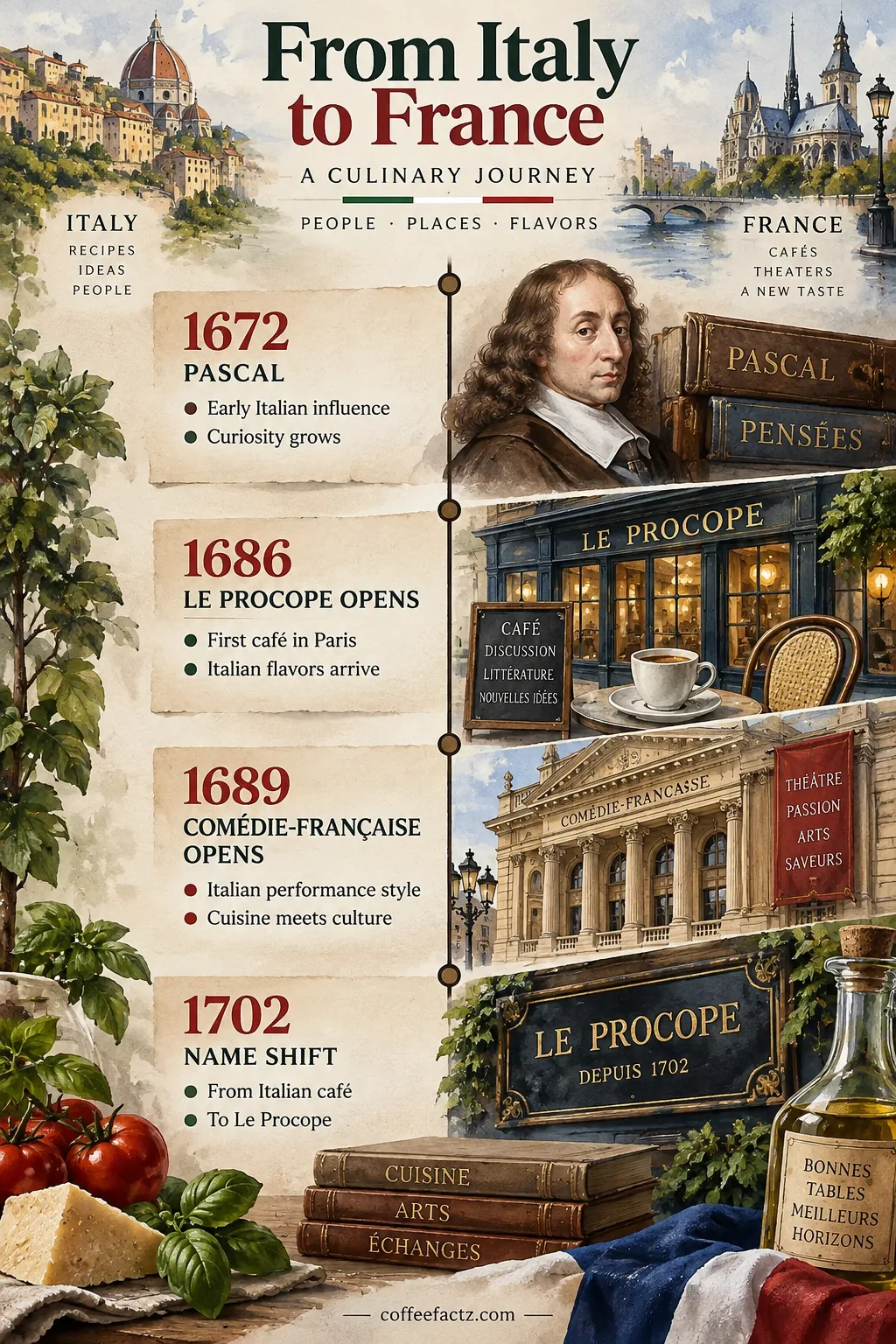
The sequence of events around the café’s founding matters because it shows Le Procope wasn’t born in a vacuum. Armenian Pascal’s 1672 Saint-Germain stall had already introduced Parisians to coffee as a street commodity. Procopio opened his café in 1686, not as a novelty but as an upgrade: a permanent, decorated room rather than a fair booth. Three years later, in 1689, the Comédie-Française opened directly across the street, and the café’s fate was set. Theater crowds needed somewhere to go before and after performances. Le Procope was there.
By 1702, the business had shifted enough that the name itself changed, reflecting either a change in ownership structure, a rebranding, or both. The sources don’t fully agree on the mechanics of that transition.
The broader culinary context matters here. Audiger, a French confectioner who had traveled in Italy, published recipes for ice cream and sorbet in 1692. His cookbook shows that the culinary transfer from Italy to France wasn’t a single event tied to one café; it was a sustained process. The popular legend that Catherine de’ Medici introduced sorbet to France when she married Henri II in 1533 is almost certainly false. More careful historical scholarship places the arrival of frozen desserts in France at least 50 years after that date.
Frozen Dessert Production Logistics
The combination of coffee and frozen desserts under one roof wasn’t arbitrary. It was a calculated offer, and the logistics behind it were genuinely difficult before the mid-19th century.
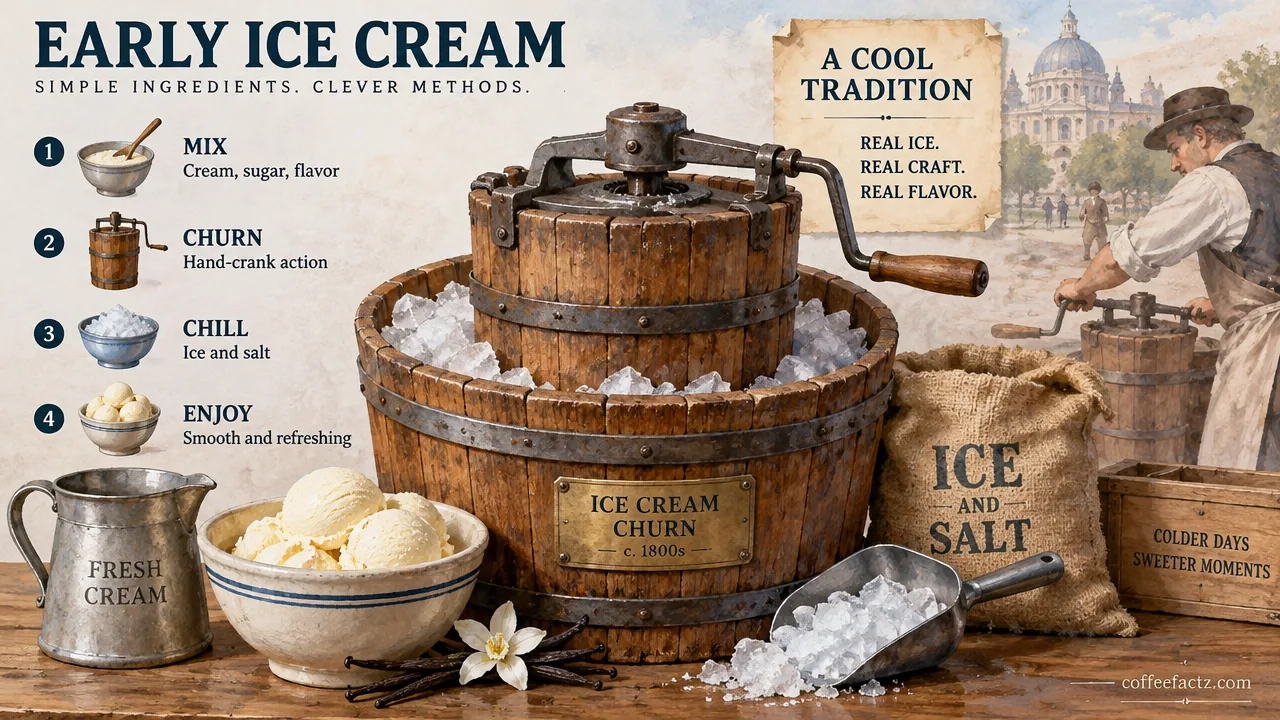
Commercial ice-making machines didn’t exist yet. Ice had to be harvested in winter, stored in insulated underground chambers called glacières, and distributed before it melted. The cold chain was expensive and unreliable. Running a café that offered sorbet and ice cream year-round required either a reliable supplier relationship or your own ice storage, which was a real operational advantage. Procopio had perfected an ice-cream machine that allowed him to produce frozen desserts consistently, and that consistency was part of what distinguished Le Procope from competitors who could only offer coffee.
The café’s combined offer made it a destination. You came for the coffee, stayed for the cold dessert, and lingered because the room was designed to make you want to stay.
Rue des Fossés-Saint-Germain-des-Prés: Comédie-Française, Enlightenment Networks, and the Birth of the Philosophical Café
Le Procope’s transformation into the café of Voltaire and Diderot wasn’t an accident of genius. It was a function of geography and foot traffic. The street made the room.
Theater Traffic and Notable Associates
The Comédie-Française opened in 1689, directly across from Le Procope on the Rue des Fossés-Saint-Germain-des-Prés. That proximity created a self-reinforcing loop. Actors, playwrights, critics, and the educated audiences who followed them needed a place to gather before curtain and argue after it. Le Procope was the obvious choice: it was close, it was permanent, and it served both coffee and something cold.
Over the following decades, the clientele that came with the theater traffic included some of the most consequential minds of the 18th century. Voltaire was a regular. Rousseau came. Diderot and d’Alembert, the architects of the Encyclopédie, used the café as a working environment. The Revolutionaries who followed a generation later, Robespierre, Danton, and Marat, are also associated with the address. Whether every famous meeting actually happened at Le Procope or in the general neighborhood is a question the documentary record doesn’t always resolve. But the café’s location at the center of Left Bank intellectual life is not in dispute.
The theater connection is worth watching in this short documentary on the Comédie-Française’s history and its role in shaping Parisian cultural life:
Documentary Caution and Legendary Claims
The famous names are real. The specific claims built on top of them require more care.
Two claims in particular circulate widely and deserve honest treatment. The first is that Le Procope was the birthplace of the Encyclopédie, the great Enlightenment project that Diderot and d’Alembert produced between 1751 and 1772. Diderot did frequent the café. Whether the Encyclopédie was conceived, outlined, or substantially planned there is a tradition, not a documented fact.
The second claim involves Benjamin Franklin. A window plate at the café asserts that Franklin drafted his treaty there. The hospitality site Relais du Louvre phrases it carefully: “We want to believe it.” The tourism platform cometoparis says Franklin “is said to have written elements of the future U.S. Constitution there.” No archival citation supports either claim. Franklin was in Paris during the treaty negotiations of 1778 and 1783, and he certainly moved in the same intellectual circles as Le Procope’s clientele. But “moved in the same circles” and “drafted a founding document at this specific table” are very different claims.
This is worth naming directly: the café’s documented history is genuinely remarkable. It doesn’t need the unverifiable additions. When a tourism site says “we want to believe it,” that’s an honest admission that belief is doing the work a citation should be doing.
Napoleon’s Hat, the French Revolution, and the Café’s Transformation into a Political Stage
The French Revolution didn’t just pass through Le Procope. It used the café the way revolutionaries have always used cafés: as a room where ideas could be spoken aloud before they became actions.
Insurgent Networks and Imperial Anecdotes
Robespierre, Danton, and Marat are all associated with Le Procope during the Revolutionary period. The café’s location on the Left Bank, its established reputation as a place for serious conversation, and its existing clientele of politically engaged intellectuals made it a natural gathering point. The Revolutionary associations are historically plausible and broadly accepted.
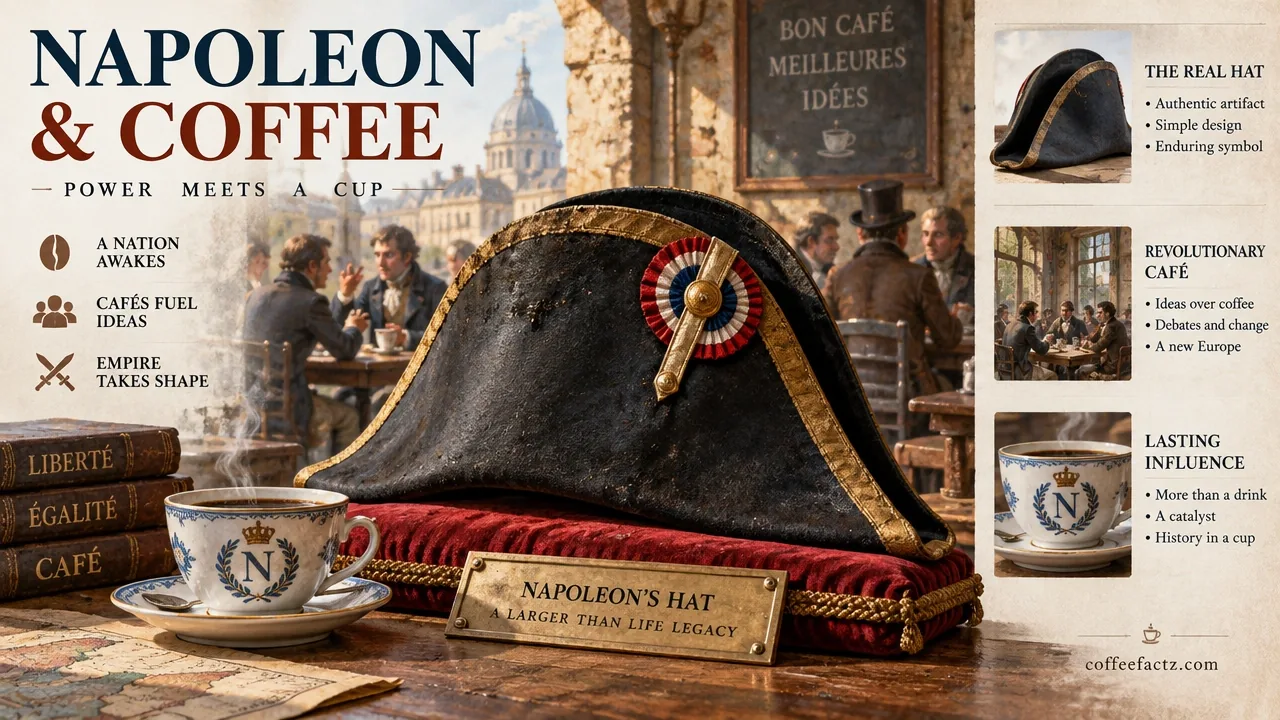
The Napoleon story is different. The most famous anecdote holds that a young Napoleon Bonaparte, short on cash, left his hat as collateral for an unpaid bill at Le Procope. The hat is reportedly still on display. It’s a good story. Whether it’s a true story is another matter. No primary source has been identified that documents the incident. It exists in the category of visitor lore: plausible, entertaining, and impossible to verify. Treat it as such.
Closure Chronology and Contested Longevity
The café’s history after the Revolution is messier than the tourism narrative suggests, and the sources don’t agree on the details.
Le Procope closed at some point in the 19th century. Wikipedia places the closure in 1872. The Project Manifest source places it in 1890. That’s an 18-year discrepancy, and neither source provides a primary citation that resolves it. After closure, the address went through several identities: an artist’s club, a restaurant called Restaurant Procope, then Au Grand Soleil, and eventually Café Procope again. The current establishment was refurbished in 1988-89.
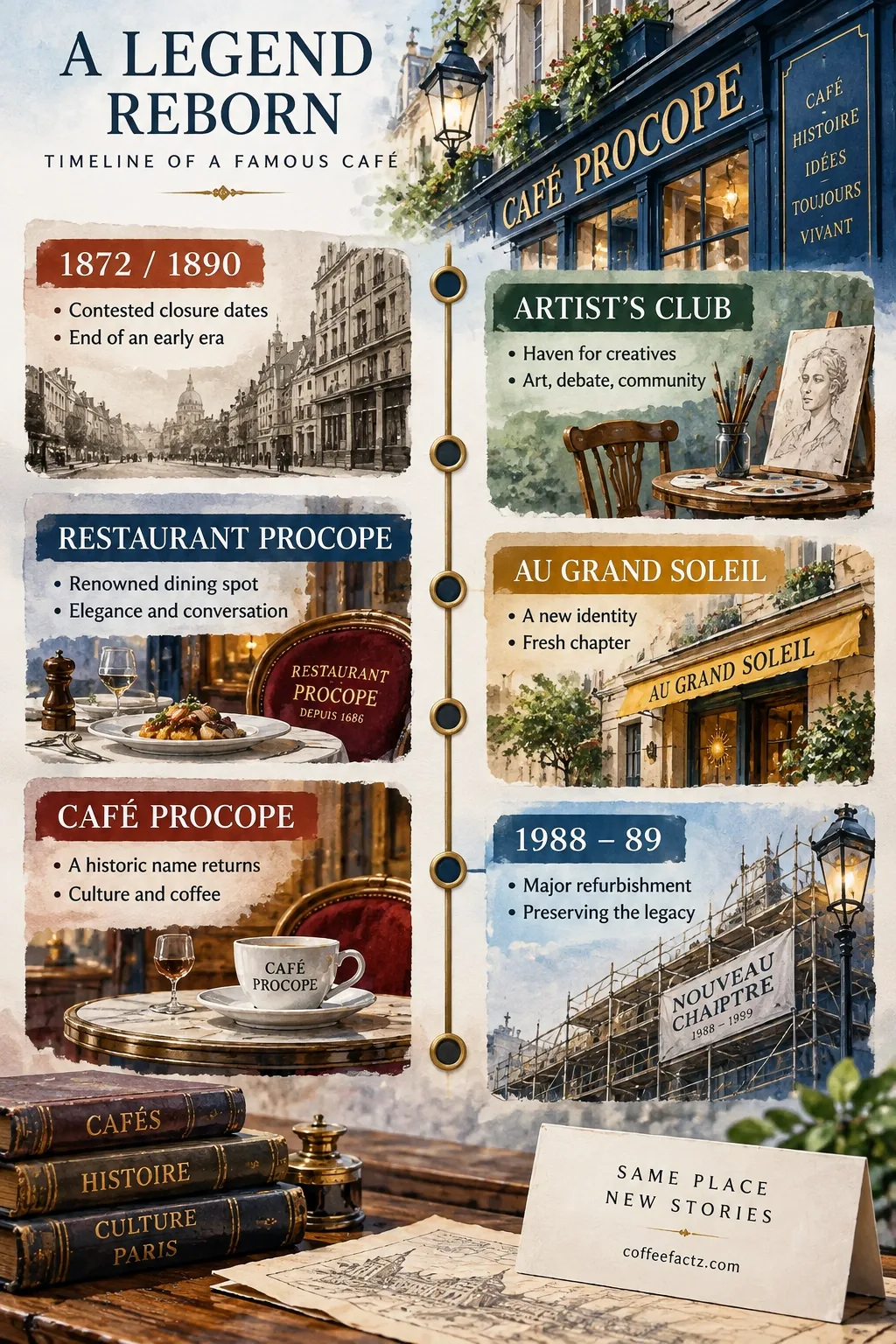
What that timeline actually shows is not uninterrupted operation but cultural memory strong enough to keep pulling the address back to its original identity. Each revival chose the Procope name deliberately, because the name carried weight. That’s a meaningful form of historical continuity, but it’s not the same as continuous operation, and conflating the two is how the “oldest café” claim gets inflated beyond what the record supports.
Why Le Procope Mattered: Enlightenment Infrastructure, Colonial Coffee, and the Contested “Oldest” Claim
Le Procope’s significance isn’t really about whether it was the oldest. It’s about what it did for the idea of the café as a civic institution.
Civic Legacy and Modern Café Template
Before Le Procope, the coffeehouse existed in Paris as a stall, a booth, or a modest room. Procopio built something different: a permanent, decorated space with mirrors, chandeliers, and marble tables, designed to signal that you could stay, think, and talk. That design decision had consequences. It established the physical template for what a café should be and what it should do socially. The modern café, as a place where a person can sit for two hours over one drink and nobody asks them to leave, descends directly from that model.
The Encyclopédie, the Revolution, the literary salons, the political arguments: all of those things needed a room. Le Procope provided one. That’s the real legacy.
Counterexamples and Continuous-Operation Standards
The “oldest café” claim requires a definition before it can be evaluated.
Oldest in Paris? Probably, given the 1686 opening date, though the closure and revivals complicate “continuous” operation. Oldest coffeehouse in the world? No. Queen’s Lane Coffee House in Oxford has been operating since 1654, predating Le Procope by 32 years. Wikipedia notes directly that Le Procope is “erroneously called the oldest café in the world in continuous operation,” with Queen’s Lane as the explicit counterexample. The Relais du Louvre, which manages the property, admits: “there is no document to evidence it… we can believe it.”
“We can believe it” is not a historical standard. It’s a hope. The honest framing is this: Le Procope is among the oldest surviving addresses associated with café culture in continental Europe, and it has the richest documented intellectual history of any café in Paris. That’s a substantial claim. It doesn’t need the superlative to hold up.
Atlantic Commodity Trade and Cultural Narrative
There’s a layer beneath the Enlightenment story that rarely gets named: the coffee in those cups came from enslaved labor.
A 2020 study published in Slavery & Abolition found that by 1789, the French colony of Saint-Domingue supplied 60% of all coffee in the world. In the 1780s alone, Saint-Domingue’s coffee production increased by 45%. The same decade saw almost 240,000 enslaved Africans forcibly transported to the colony. The study also notes that, unlike sugar, coffee demanded more enslaved workers per unit of output in the years before 1791.
That production scale is what made coffee cheap enough for Parisian cafés to serve it at volume. The philosophical conversations at Le Procope, the arguments about liberty and reason that fed directly into the Declaration of the Rights of Man, happened over a commodity whose production depended on the systematic denial of those same liberties to hundreds of thousands of people in the Caribbean. That contradiction doesn’t erase the intellectual history. It complicates it, and it deserves to be part of the story.
Visiting Le Procope Today: Menu, Coffee Lounge, and the Living Memory of a Parisian Icon
Le Procope today operates as a classified historic monument and full-service restaurant, not a museum with tables. That distinction matters for managing expectations before you walk in.
Present-Day Visitor Experience
The current establishment serves traditional French cuisine: onion soup, duck confit, boeuf bourguignon, the canon. An English menu is available, which is a practical detail worth knowing if you’re navigating the room without French. The café also runs a coffee lounge Monday through Friday, 3pm to 6pm, for visitors who want the experience without a full meal.
The physical space earns its reputation. The room is layered with portraits, period objects, and the accumulated atmosphere of three centuries of reinvention. Sitting upstairs, where the rooms are smaller and warmer, tends to produce a more intimate experience than the main floor.
Visitor feedback collected from social media and travel reviews clusters around a consistent theme. As one Facebook commenter put it: “doesn’t matter that the food is just ok. Go for dessert.” Another noted: “Ate upstairs. It was warm but a very memorable night.” A third was direct about the calculus: “service fine for a very busy night… primarily for the historical value.” The food, by recurring consensus, is competent rather than exceptional. The desserts get better reviews. The room itself is the main event.
That’s not a flaw. It’s an honest description of what Le Procope is selling. The café’s value is experiential. You’re paying for the address, the atmosphere, and the right to sit where Voltaire argued and Revolutionaries plotted. If that’s worth something to you, it’s worth the price of a meal.
FAQ Myth Management and Final Legacy
Why is Le Procope famous? Because of its location, its timing, and its clientele. It opened at the moment Paris was ready to institutionalize the coffeehouse, positioned itself next to the city’s most important theater, and attracted the exact social network that produced the Enlightenment and the Revolution. The café didn’t make those events happen. It gave them a room.
Is it a tourist trap? It depends on what you bring to it. If you arrive expecting a great meal at a reasonable price, you’ll probably leave disappointed. If you arrive understanding that you’re visiting a site of genuine historical significance, the experience pays off. It can be both a tourist destination and a meaningful historical pilgrimage. Those aren’t mutually exclusive.
Did Napoleon eat there? The hat story is visitor lore. No primary source documents a specific meal or visit. The story is plausible given the timeline, but plausible and documented are not the same thing.
What was Hemingway’s favorite café in Paris? Not Le Procope. That question belongs to a different Paris entirely: the 1920s expatriate circuit of Montparnasse, where Hemingway, Fitzgerald, and their circle favored places like the Closerie des Lilas, the Dôme, and the Rotonde. Le Procope’s fame is rooted in the 18th century. Connecting it to Hemingway conflates two completely separate eras of Parisian café culture.
Le Procope matters less as an unbroken institution than as a surviving stage. Coffee, ice, Enlightenment argument, Revolutionary conspiracy, Napoleon lore, and modern tourism all share the same address. That accumulation, contested and complicated as it is, is the point.
Frequently Asked Questions About Le Procope
Why is Café Procope famous?
Le Procope became famous because it opened in 1686 next to the Comédie-Française, pulling in the Enlightenment intellectuals, philosophers, and Revolutionary figures who defined 18th-century Paris. The room, the location, and the clientele made it the city’s most consequential café address.
Is Le Procope a tourist trap?
It depends on your expectations. The food is competent but unremarkable; the room and the history are genuinely impressive. If you go for the ambiance and the desserts rather than a standout meal, the visit pays off on its own terms.
Did Napoleon eat at Procope?
The famous hat-as-collateral story is visitor lore with no primary source behind it. Napoleon’s association with the café is plausible given the timeline, but no documented meal or visit has been confirmed by archival evidence.
What was Hemingway’s favorite café in Paris?
Hemingway’s Paris was Montparnasse in the 1920s, not the Left Bank of the Enlightenment. His regular haunts included the Closerie des Lilas and the Dôme. Le Procope has no documented connection to him, and attributing his favorite café status to it conflates two entirely separate eras of Parisian life.
Was Le Procope really the first café in Paris?
No. Armenian Pascal operated a coffee stall at the Saint-Germain fair in 1672, fourteen years before Procopio opened. Le Procope was the first permanent, architecturally designed café room in Paris, which is a different and more historically significant claim.
How did ice cream end up on the menu of a Parisian café in 1686?
Procopio had perfected an ice-cream machine and knew the production logistics for sorbet before he opened. Ice storage before commercial refrigeration was genuinely difficult and expensive, so offering consistent frozen desserts was a real operational advantage that set Le Procope apart from competitors who could only serve coffee.
Is Le Procope actually the oldest continuously operating café in the world?
No. Wikipedia explicitly labels that claim erroneous and cites Queen’s Lane Coffee House in Oxford, open since 1654, as a counterexample. Le Procope also closed in the 19th century and was revived multiple times under different names before returning to its current identity after a 1988-89 refurbishment.
What role did colonial slavery play in Le Procope’s coffee supply?
By 1789, the French colony of Saint-Domingue supplied 60% of the world’s coffee, and that production depended on enslaved African labor. The coffee poured during Enlightenment debates about liberty and reason at Le Procope came directly from that system, a contradiction that belongs in any honest account of the café’s history.
References
- A Parisian Café: Le Procope | projectmanifest.eu
- Slave-based coffee in the eighteenth century and the role of the Dutch in global commodity chains | tandfonline.com
- French Historical Studies: Julia Landweber on early French coffee culture | read.dukeupress.edu