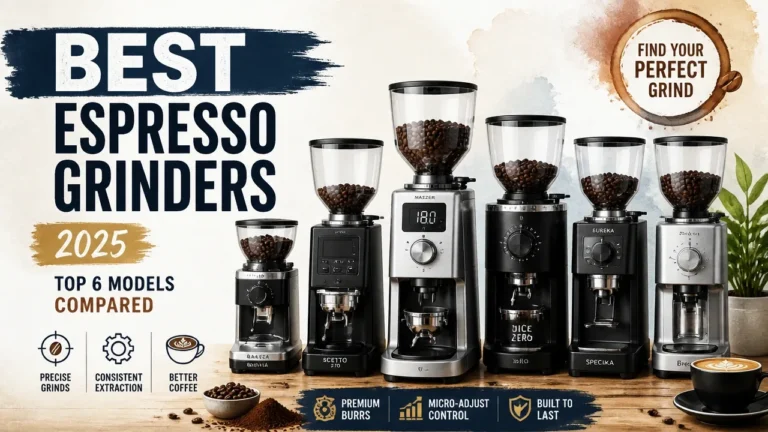

The best espresso grinders share one quality that no spec sheet advertises: they make dialing in feel predictable rather than lucky. Whether you’re chasing a 27-second shot on a Baratza Sette 270 or hand-grinding your way through a travel trip with a 1Zpresso J-Ultra, the grinder is where espresso extraction is won or lost – long before the machine gets involved.
What most rankings miss is the layer underneath the specs: why a flat burr pulls flavor differently than a conical one, why retention matters more than motor wattage, and why “buy the Niche Zero” is useless advice if you live outside the UK. This guide cuts through that noise.
Key Takeaways on Best Espresso Grinders
- Burr geometry shapes the cup before the machine does: conical burrs produce body and crema; flat burrs produce flavor clarity and brightness.
- Retention under 1 gram is the single-dose standard; hopper-fed grinders typically hold 2–10 grams between shots.
- The Baratza Encore ESP is the safest first electric espresso grinder for North American buyers who value support and spare parts.
- The DF54 is the most honest sub-$300 flat-burr recommendation for home baristas who also brew filter coffee.
- Manual grinders like the 1Zpresso J-Ultra offer finer adjustment resolution than many electrics at the same price – travel and precision are their real use cases.
- No universal best exists: match your grinder to your workflow, your support reality, and your flavor priority, not someone else’s top-ten list.
Ranking Criteria: How We Chose the Top 6 Espresso Grinders for 2025
Not every grinder that claims “espresso-capable” on its Amazon listing can actually dial in a 9-bar shot. The six models in this guide survived a filtering process built around five criteria: grind precision, burr mechanics, retention, workflow, and support. Popularity didn’t factor in. Neither did price alone.
Grind Precision and Burr Mechanics
Espresso is unforgiving. The brew window is narrow – a few microns of grind size separate a sour under-extraction from a bitter over-extraction – which means your grinder needs two things above everything else: the ability to reach espresso-fine grind sizes, and the ability to repeat that setting reliably. This immediately eliminates blade grinders (which chop randomly, not grind) and the standard Baratza Encore, which is a genuinely excellent filter grinder that simply doesn’t reach espresso-fine territory.
Beyond grind size, how you adjust matters. Stepped grinders click between fixed positions; stepless grinders move continuously. For espresso, the practical question is whether the adjustment system gives you enough resolution – small enough increments – to actually chase a shot into the right extraction window. That’s where micro-steps become decisive: the finer the step, the more surgical your dial-in.
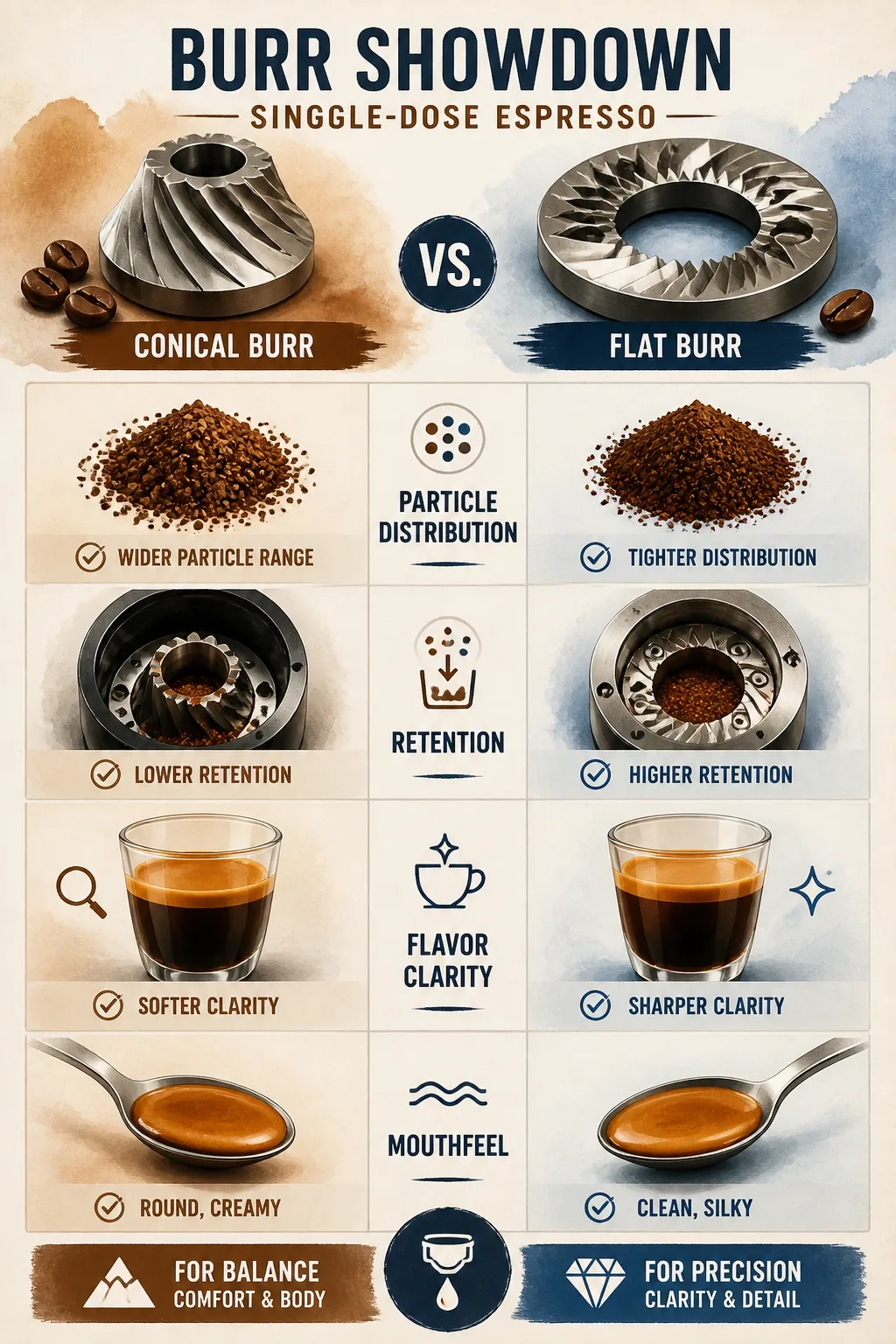
The burr geometry underneath all of this shapes the cup in a different way entirely. Conical burrs produce what researchers call a bimodal particle distribution – two distinct size clusters, one fine and one coarser – which tends to translate into body, mouthfeel, and crema. Flat burrs lean toward a unimodal distribution, with particles clustering more tightly around a single size, which produces greater flavor clarity and brightness. A study published in the Philippine EJournals examining the effect of grinder type on particle size distribution confirmed this directly, finding that flat burrs produced fewer fines than conical burrs – a difference that materially changes how aggressively a grind extracts and how consistent the cup tastes across multiple shots.
A study comparing grinder types found that flat burrs generate a lower fines fraction than conical burrs, which directly affects extraction intensity and cup-to-cup consistency. – From the study “Effect of Embryo Surface Morphology and Grinder Type on the Particle Size Distribution of Coffee“
This isn’t a “flat burrs are better” argument. It’s a trade-off: conical burrs give you a richer, more textured espresso; flat burrs give you a cleaner, more analytically precise one. Knowing which you want is half the buying decision. One grinder worth mentioning here is the Shardor 64 – the cheapest 64mm flat-burr platform on the market and a genuine tinkerer’s machine – but support uncertainty kept it off this list. The six models that made it have verified, ongoing support channels.
Retention, Workflow, and Support Benchmarks
Retention is the weight of coffee that stays inside the grinder after each dose. For espresso, this matters acutely: stale grinds mixing with fresh ones corrupt shot-to-shot consistency. Hopper-fed grinders hold a reservoir of beans and typically retain 2–10 grams in the grinding path. Single-dose grinders are loaded one dose at a time and engineered to expel nearly everything – the best designs, like the DF64 Gen 2 with its dual-action bellows, push retention down to roughly 0.2–0.3 grams.
The DF64 Gen2’s dual-action bellows and anti-popcorn spring reduces retention to approximately 0.2–0.3 grams, verified across 50 consecutive 18-gram test grinds; hopper-based grinders typically retain 2–10 grams depending on design. – Source: Qika Coffee
Features like anti-static chutes, bellows attachments, and low dead-space grinding paths all serve the same purpose: getting your coffee into the portafilter, not stuck to the walls of the grinder. On the usability side, a portafilter fork (or cradle) that holds your portafilter directly under the chute is a small feature with a large daily impact. Motor RPM affects heat generation – high-RPM motors can warm the grounds and accelerate off-gassing – and noise is a real differentiator for anyone grinding at 6am in a shared space.
Most expert blog rankings stop at specs. Real practitioners add dealer trust, local support, and spare-parts availability – factors that become decisive the moment something breaks. The Eureka Mignon Specialita is a well-regarded stepless hopper-fed reference point, but several entry models didn’t survive this filter: the OXO Brew Conical Burr and Breville Smart Grinder Pro both lack espresso-specific micro-adjustment resolution, and the SHARDOR Electric lacks support confidence for long-term ownership. Regional support and import reliability don’t appear in any web ranking framework, yet they’re often the deciding factor for buyers outside the US and EU.
#1 Baratza Encore ESP: Best Overall Entry-to-Mid Electric Conical for First Espresso Dial-In
For a first electric espresso grinder, the Baratza Encore ESP is still the safest choice in 2025 – not because it’s flashy, but because it removes the variables that trip up new home baristas. It ships factory-calibrated for espresso, grinds across a 1–20 stepped range with espresso-specific micro-steps built in, and accepts most standard portafilters directly via its cradle. You don’t have to figure out if it can do espresso. It was designed specifically to.
The key distinction from the standard Baratza Encore is the stepped micro-adjust system. The standard Encore is a filter grinder masquerading as espresso-capable in some reviews. The ESP adds the fine-end range that espresso actually requires. The conical burr geometry produces the bimodal distribution discussed above – expect body, crema, and a rounded mouthfeel that suits milk-based drinks particularly well.
Workflow-wise, the Encore ESP is a hopper-fed machine, which means you’re loading beans in advance rather than weighing individual doses. Retention runs in the 1–2 gram range – acceptable for home use if you’re pulling multiple shots, less ideal if you’re switching beans frequently. The portafilter cradle eliminates the messy step of transferring grinds, and the motor noise sits at a moderate level: not library-quiet, but not the kind of sound that wakes a household.
The comparison that most rankings skip entirely is the HiBREW G5 head-to-head. Both use 48mm conical burrs, but the HiBREW adds a bellow single-dose workflow and lower retention at a lower price. Where the Encore ESP wins decisively is North American support and spare parts: Baratza’s repair program, replacement burr availability, and community knowledge base are unmatched at this price tier. If you’re outside North America and cannot verify local dealer support, the calculus shifts. For everyone else, the Encore ESP’s community familiarity and serviceability make it the lower-risk entry.
Here’s a practical dialing-in tip directly from Baratza themselves:
Baratza, the specialty coffee grinder manufacturer, advises starting with the micro adjustment in the center position when using the Sette 270 or 270Wi, then dialing in as close as possible with the macro adjustment (the upper numbered ring) before using the micro adjustment to fine-tune – a method that works because low retention makes each adjustment’s effect visible in the very next shot.
That same logic applies to the Encore ESP’s stepped system: because retention is predictable and the steps are calibrated, each adjustment produces a readable result. That’s what “dialing in” actually feels like when your grinder is working with you instead of against you.
The Encore ESP is for the home barista who wants a reliable, community-supported electric conical with enough adjustment range to pull real espresso – and who values knowing that a replacement part is one online order away.
Affiliate Disclosure
This post contains affiliate links, meaning I may earn a commission if you make a purchase through these links, at no additional cost to you. As an Amazon Associate, I earn from qualifying purchases. I only recommend products I genuinely believe will add value.

Baratza Encore ESP Coffee Grinder ZCG495BLK, Black
- SPECIALTY COFFEE ASSOCIATION AWARD-WINNING GRINDERS - Baratza grinders are preferred by coffee professionals a…
- DUAL-RANGE ADJUSTMENT SYSTEM - This innovative multi-purpose adjustment mechanism features micro-steps from #1…
- USER FRIENDLY - Fresh coffee is as simple as a single-handed hopper twist for grind size adjustment, then a pu…
- QUICK-RELEASE BURR - The burr mounting system has been redesigned to allow for quick removal without taking th…
- WARRANTY/QUALITY PARTS - Engineered with 40mm hardened alloy steel burrs manufactured in Liechtenstein, Europe…
#2 HiBREW G5: Best Budget Single-Dose Conical with Bellow Workflow
The HiBREW G5 answers a specific question: what if you want single-dose workflow and low retention, but you don’t want to spend Niche Zero money? At its price point, nothing else gives you a bellow-equipped single-dose conical out of the box.
The G5’s 48mm conical burrs sit inside a design built around low dead space. The anti-popcorn hopper – a small spring mechanism that prevents beans from bouncing unpredictably during grinding – combined with the integrated bellows makes the workflow straightforward: weigh your dose, drop it in, grind, give the bellows a squeeze, and the grinds land in your portafilter rather than clinging to the chute walls. Retention stays low enough that shot-to-shot consistency doesn’t require purging between doses.
The bellow single-dosing routine is the G5’s core differentiator from the Encore ESP. Where the Encore asks you to load a hopper and accept 1–2 grams of retention, the G5 treats each shot as a fresh start. That matters most when you’re rotating between different coffees or when you’re pulling a small number of shots daily and don’t want yesterday’s grounds in today’s cup.
Flavor-wise, the conical burr geometry produces the same bimodal distribution pattern covered earlier: body-forward espresso with good crema and a rounded profile. If you’re pulling milk drinks or want a rich, textured shot, this suits you well. If you want the analytical clarity of flat-burr espresso, the G5 isn’t your machine – that’s a different design philosophy, not a flaw.
The honest caveat is import risk. The HiBREW G5 is a Chinese-market grinder with limited Western dealer infrastructure. If you can verify a local dealer or are comfortable with direct import and community-sourced support, the risk is manageable. If you’re in a region where returns and warranty claims are complicated, the Encore ESP’s support network becomes worth the extra cost. The G5 is not a compromise – it’s a genuine value play for buyers who understand what they’re accepting.
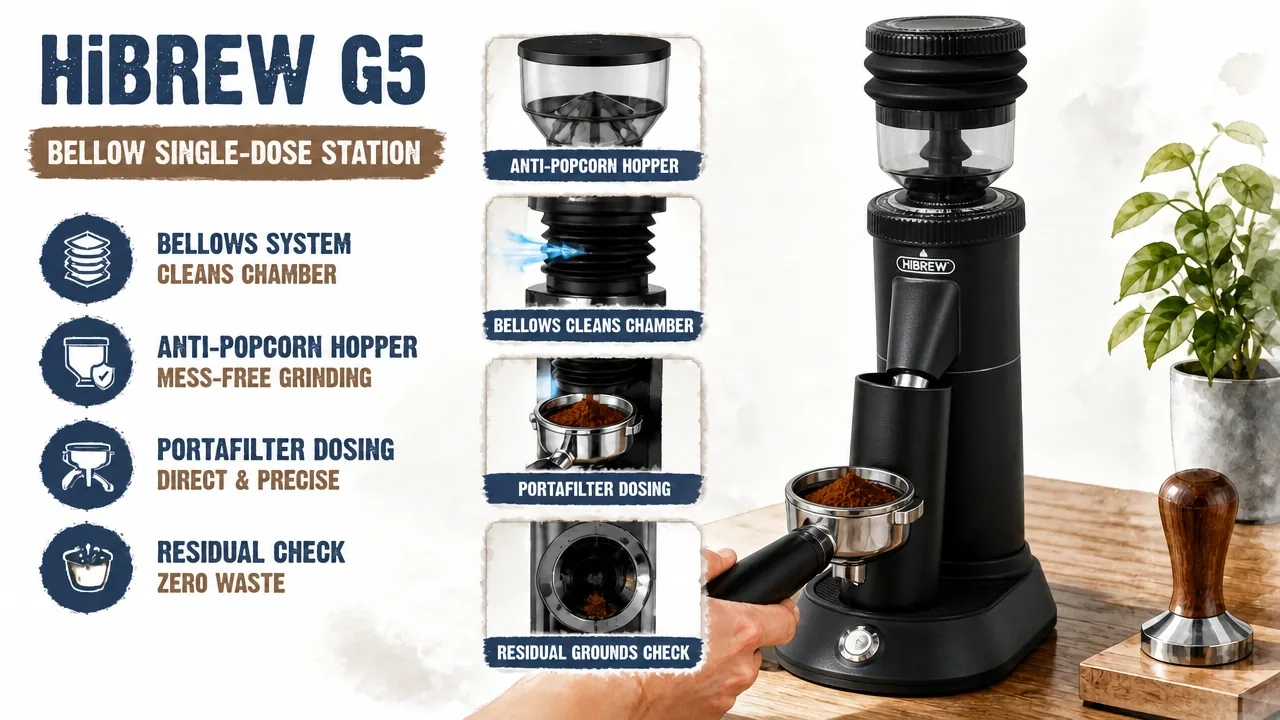
Community consensus has already flagged the Niche Zero as impractical in many regions due to shipping constraints, and the Breville BCG820BSSXL for questionable Amazon India ratings and weak after-sale support. Against that backdrop, a budget single-dose conical with verified bellows and low retention starts to look less like a compromise and more like the honest choice for the buyer who’s done their homework.
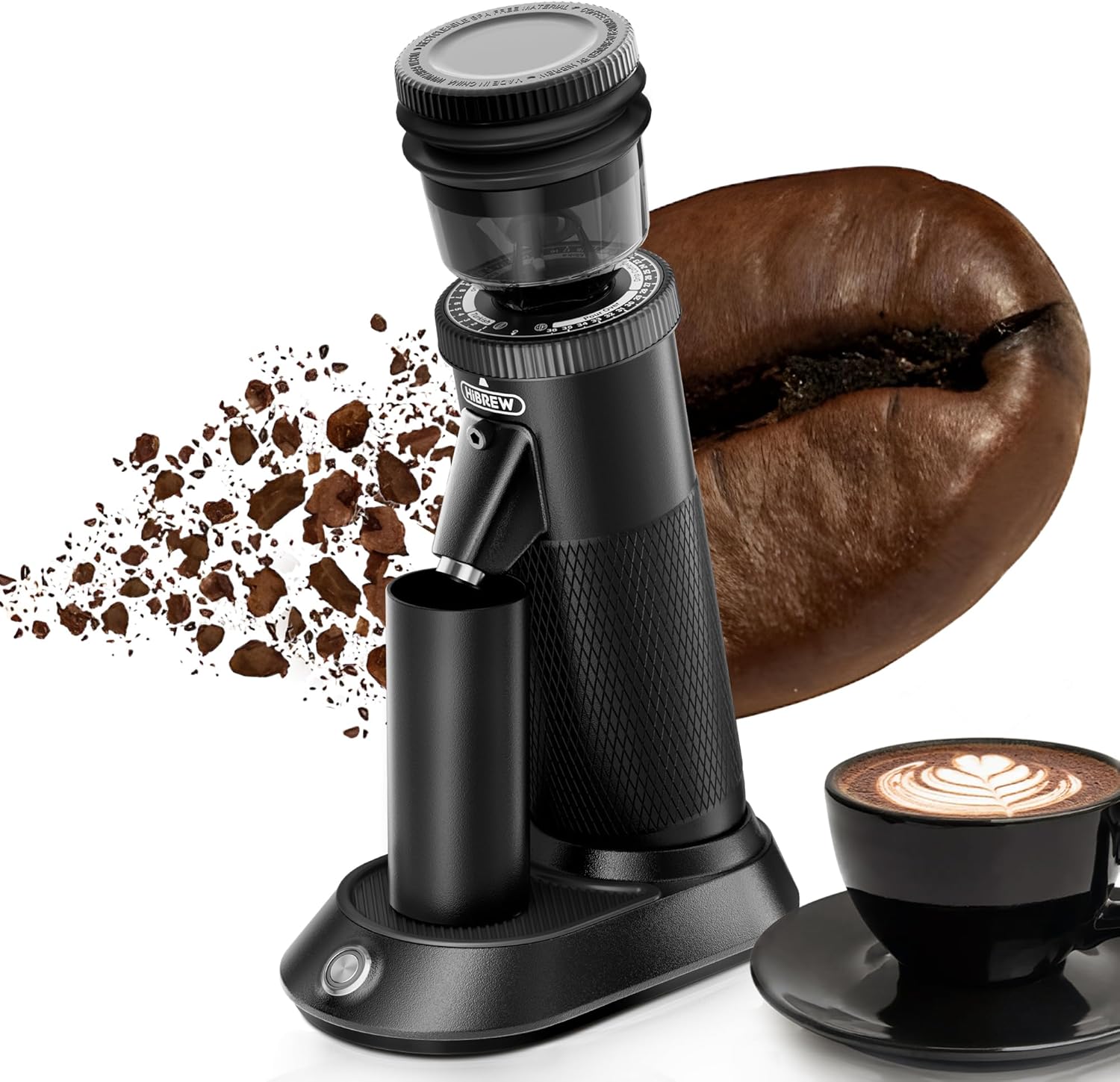
HiBREW G5 Electric Burr Coffee Grinder, Aluminum Body, Single Dose, Black
- Robust aluminum alloy: The electric coffee grinder has a robust aluminum alloy housing and a non-slip, texture…
- 36 Grind Settings: This coffee bean grinder uses a 48mm conical CNC grinding disk with high hardness, which of…
- Fast or slow grinding: This espresso grinder’ fast grinding speed is 500r/min, slow grinding speed is 400r/min…
- Powder discharger and anti-static: Our coffee grinder electric features a powder discharger and an anti-static…
- Compact and artistic design.Our HIBREW G5 burr coffee grinder compact housing reduces space requirements in th…
#3 DF54: Best Affordable Flat-Burr Single-Dose for Flavor Clarity and Low Retention
The DF54 is the grinder that makes flat-burr espresso accessible without a four-figure investment, and it does it without cutting the corners that matter. Single-dose loading, stepless micrometric adjustment, and a 54mm flat burr – this is a purpose-built machine for people who want to taste the coffee, not just feel it.
Flat burrs produce the unimodal particle distribution discussed in the criteria section: particles cluster tightly around a single size rather than splitting into a fine-and-coarse bimodal pattern. In the cup, that translates to flavor clarity – the brightness of a well-sourced single origin, the distinct fruit or floral notes that a conical burr’s body-forward profile tends to soften. If you’re pulling light roasts on a lever or a pressure-profiling machine and want to actually hear what the coffee is saying, flat burrs are the right tool.
The stepless micrometric adjustment means there are no click-steps between you and your target grind size. You turn, you listen to the shot, you adjust – continuously, without being locked to a fixed increment. For espresso dialing, this is a meaningful advantage: you can chase a 1-second change in shot time without overshooting to the next step.
The infographic below maps out how conical and flat burr single-dose grinders compare across the key espresso variables:
The DF54’s single-dose design keeps retention minimal. You load what you need, grind it, and the low dead-space path means most of it lands where you want it. Anti-static performance is solid for the price tier.
The natural comparison here is the Eureka Mignon Specialita – a stepless hopper-fed grinder with excellent build quality and near-silent motor. The Specialita is the right pick if you pull high volume, prefer a timed workflow, and want near-silence in the kitchen. The DF54 is the right pick if you rotate beans, value zero-retention precision, and want flat-burr clarity at a fraction of the Specialita’s price. They’re not competing for the same buyer.
For the tinkerer or the home barista who’s already moved past “just espresso” and wants one grinder that handles both espresso and filter with genuine flat-burr performance, the DF54 is the most honest sub-$300 recommendation on this list. The DF64 Gen 2 is its bigger sibling – 64mm burrs, slightly more retention control – and worth considering once your budget stretches past $300.

MiiCoffee DF54 Single Dose Coffee Grinder (Black)
- 【New Version 1.5】This version comes with anti-popcorn disc having a slightly larger diameter so that the bello…
- 【54mm Flat Burrs】Custom made 54mm stainless steel flat burrs.
- 【Plasma Generator AKA Ionizer】Plasma Generator wrapping around the exit chute reduces static.
- 【Single Dose & Zero Retention】True Zero Retention <0.1 gram. Even without bellow this grinder reaches almost z…
- 【Stepless Adjustment】Redesigned dial is wrapped with chrome. The included metal indicator makes grind size so …
#4 Baratza Sette 270: Best Zero-Retention Straight-Through Electric for Fast Dialing
The Baratza Sette 270 is built around a single architectural idea: the coffee should never change direction between the burrs and the portafilter. Its horizontal straight-through chute drops grinds directly down into the portafilter fork below, which means there’s almost no surface area for grounds to cling to. Retention approaches zero in practical use.
That design choice ripples through everything else. You don’t purge. You don’t tap the machine. You don’t lose a gram of coffee to dead space. What goes in comes out, in sequence, in your portafilter. For home baristas who dial in frequently – switching coffees, chasing roast curves, experimenting with recipes – this makes the feedback loop faster and cleaner.
The adjustment system is the other reason the Sette 270 earns its place here. The macro/micro dual collar gives you 270 distinct settings: the upper numbered ring makes coarse jumps, the lower lettered ring fine-tunes within each macro step. This is the system Baratza describes directly in their dialing-in guidance – start centered on the micro, dial in with the macro, then nudge the micro. With low retention, each adjustment’s effect appears in the very next shot. No guessing, no waiting for stale grinds to clear.
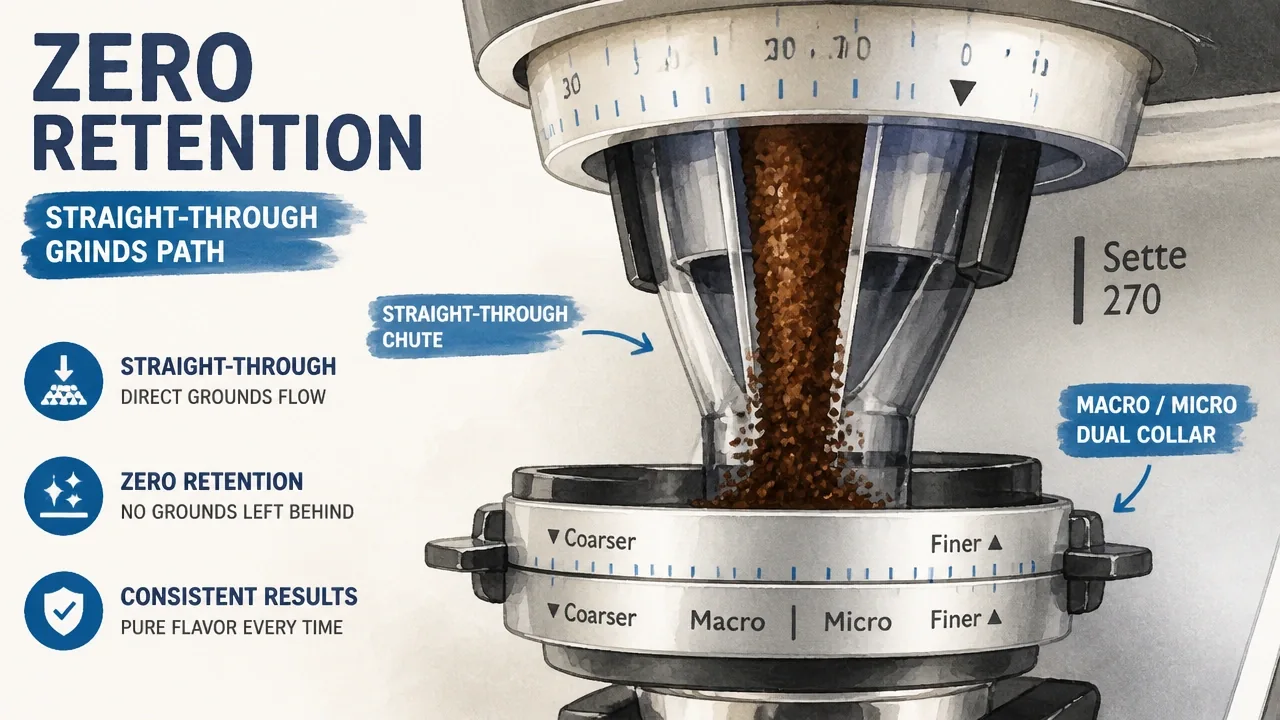
The comparison to the Sette 30 is worth stating plainly: both share the straight-through low-retention architecture, which is the Sette’s core advantage. The Sette 30 has fewer settings and no micro-adjustment. If you’re serious about espresso dialing – pulling shots at different pressure profiles, working through multiple coffees – the 270 settings plus the dual collar justify the step up. If you’re pulling the same bean on the same machine every morning, the Sette 30 does the job for less.
The honest tax on the Sette 270 is noise. It runs louder than the Eureka Mignon Specialita or the Eureka Mignon Zero, both of which are specifically engineered for quiet operation. If your kitchen setup demands silence – early mornings, thin walls, sleeping partners – the Sette 270’s motor is a real consideration. It’s not unusually loud for a grinder, but it’s noticeably louder than the quietest alternatives at this price point.
The Sette 270 is for the home barista who wants the fastest, most responsive electric dialing experience and can trade some noise headroom to get it.

Baratza Sette 270 Conical Burr Coffee Grinder
- SPECIALTY COFFEE ASSOCIATION AWARD WINNING GRINDERS - Baratza grinders are preferred by coffee professionals a…
- DOSING - 3 programmable dosing buttons for accurate, consistent dosing to within a 10th of a second. This allo…
- EXCEPTIONAL ESPRESSO GRINDER - The Sette delivers beautiful espresso and is also capable of grinding for manua…
- 270 GRIND SETTINGS - Macro/Micro adjustment for the most precise dial-in capabilities. A built-in convertible …
- HIGH SPEED GRINDING - Up to 5g/second and minimal retention in the innovative straight-thru grind mechanism.
#5 1Zpresso J-Ultra: Best Manual Espresso Precision with 8-Micron Micro-Steps
Manual espresso grinders don’t appear in most ranking articles. That’s a blind spot, not a verdict. The 1Zpresso J-Ultra is a purpose-built manual espresso grinder with 8-micron micro-steps – finer adjustment resolution than many electric grinders at twice the price. If your priority is dialing in 9-bar espresso with surgical precision, the J-Ultra competes on merit, not on the novelty of being hand-powered.
The 8-micron step size means that a single click of the J-Ultra’s adjustment ring moves the burr gap by 8 microns. To put that in context: the difference between a 25-second and a 28-second espresso shot often lives in a 20–30 micron grind size change. Three or four clicks gets you there. That’s the kind of resolution that lets you actually track what you’re doing rather than guessing which direction to turn next.
The manual workflow requires honest acknowledgment. Grinding for espresso by hand takes effort and roughly 45–90 seconds depending on dose and roast. There’s no motor heat, no electrical noise, and no retention to speak of – the grinds fall directly from the burrs. For travel, this is a genuine advantage: no power requirement, no checked-luggage motor concerns, and a form factor that fits in a bag. For a daily home setup where you’re pulling multiple shots, the physical demand is the real question only you can answer.
The natural comparison is the Comandante C40 MK4 with Red Clix. The J-Ultra is the more espresso-dedicated of the two: its adjustment system was designed specifically for fine-grind dialing, and its burr geometry produces consistent particle distribution at espresso fineness. The Comandante with Red Clix can reach espresso-relevant grind sizes and offers broader filter-to-espresso versatility, but it’s a filter grinder that travels into espresso territory rather than an espresso grinder that also handles filter.
Both use conical burrs and produce the body-forward, mouthfeel-rich espresso characteristic of that geometry. If you’re chasing the analytical clarity of flat-burr espresso, neither manual option delivers that – you’d need a flat-burr electric for that profile.
The J-Ultra is for the traveler, the small-kitchen barista, or the precision-focused enthusiast who wants maximum adjustment resolution without a motor. It’s also for the buyer who’s skeptical that an electric grinder at this price tier is actually better – in adjustment precision, the J-Ultra makes a legitimate case.

1Zpresso J-Ultra Manual Coffee Grinder Iron Gray, Conical Burr, Foldable Handle, Magnet Catch Cup Capacity 40g, Numerical Adjustable Finely Setting, Faster Grinding Efficiency Ideal for Espresso
- [ Precision Coated Burr for Sweeter, Finer Espresso ] - Specially crafted for espresso, this manual coffee gri…
- [ External Grind Adjustment ] - Each click shifts by only 8 microns, giving you exceptional control from fine …
- [ Fast Workflow with Magnetic Catch Cup ] - Enhance your brewing routine with a catch cup that snaps securely …
- [ Compact Foldable Handle ] - Just push, twist, and it tucks away in seconds to prevent tipping. Perfect for t…
- [ Easy to Clean for Better Flavor ] - Tool-free dismantling makes cleaning simple and fast, helping you mainta…
#6 Comandante C40 MK4 with Red Clix: Best Manual Travel and Filter-to-Espresso Companion
The Comandante C40 MK4 is a filter grinder first. That sentence is not a criticism – it’s the most useful thing you can know before buying it for espresso. With the standard click system, the C40 MK4 is one of the finest hand grinders available for pour-over, Chemex, and AeroPress. Add the Red Clix upgrade, and you halve the step size, pushing the adjustment resolution into territory where espresso dialing becomes genuinely feasible.
“Feasible” and “dedicated” are different things. The J-Ultra was engineered from the ground up for espresso micro-adjustment. The C40 MK4 with Red Clix is a versatile travel companion that reaches espresso – and for a traveler who brews both filter and espresso depending on what’s available at the destination, that versatility is the entire point. Carrying one grinder that handles both brew methods is a meaningful practical advantage over carrying two.
The manual workflow is the same as the J-Ultra: load your dose, grind by hand, roughly 45–90 seconds, no power required, no retention. The C40 MK4’s build quality is exceptional – German-engineered, reputable for longevity, with a parts ecosystem that supports long-term ownership. In a category where Chinese-market grinders are common, the Comandante’s repairability is a genuine differentiator.
Flavor profile follows the same conical burr logic: bimodal distribution, body-forward espresso, good crema, rounded mouthfeel. If you’re pulling espresso through a travel machine and want a rich, textured shot rather than analytical clarity, the C40 MK4 with Red Clix delivers that.
The explicit call between these two manual options: if espresso is your primary use case and you want the finest possible adjustment resolution, buy the J-Ultra. If you travel between brew methods and value one capable, repairable grinder over two specialized ones, buy the C40 MK4 with Red Clix. Blog listicles rarely make this call directly. This one does.

Comandante C40 Hand Grinder MK4 - Black
- The MK4’s come with one brown glass jar and one clear polymer-glass jar! Both of which hold around 40g of bean…
Verdict: Which of the Top 6 Best Espresso Grinders Should You Buy in 2025?
There is no universal best espresso grinder. There is a best grinder for your workflow, your budget, your kitchen, and your support reality. Here’s how the six break down.
| Grinder | Best For | Key Trade-Off |
|---|---|---|
| Baratza Encore ESP | First espresso setup, North American buyers | Hopper-fed retention; unmatched support |
| HiBREW G5 | Budget single-dosing with bellows | Import/support risk; no Western dealer network |
| DF54 | Flat-burr clarity, filter + espresso versatility | Stepless learning curve; no hopper option |
| Baratza Sette 270 | Zero-retention fast dialing | Louder than alternatives; hopper-fed |
| 1Zpresso J-Ultra | Manual espresso precision, travel | Physical effort; no motor convenience |
| Comandante C40 MK4 + Red Clix | Travel, filter-to-espresso versatility | Less espresso-dedicated than J-Ultra |
For your first espresso setup: The Encore ESP is the safest entry. Factory-calibrated, community-supported, and forgiving of early dialing mistakes. The support network alone justifies the price over cheaper alternatives if you’re in North America.
For budget single-dosing: The HiBREW G5 is the honest pick if you can verify dealer support and accept import risk. The bellow workflow and low retention are real, not marketing.
For flat-burr clarity on a mid-range budget: The DF54 is the sub-$300 answer. Stepless adjustment, single-dose workflow, and genuine flat-burr flavor separation – nothing at this price does it better.
For zero-retention electric speed: The Sette 270’s straight-through chute and macro/micro dual collar make it the fastest dialing experience on this list. Pay the noise tax willingly or look at the Eureka Mignon Zero for a quieter alternative.
For manual espresso precision: The J-Ultra’s 8-micron steps are the finest adjustment resolution here, electric or manual. If the physical effort is acceptable, it’s a legitimate precision tool.
For travel and filter-to-espresso versatility: The Comandante C40 MK4 with Red Clix. One grinder, two brew methods, no power required, built to last.
The trade-offs that actually matter – stepped vs stepless, conical vs flat, hopper vs single-dose, manual vs electric, support vs price – all reduce to the same root question: what does your daily brewing routine actually look like? A $1,500 grinder is excellent but unnecessary for most home setups. Prioritize burr quality, adjustment repeatability, and low retention at whatever budget tier you’re working in, and you’ll extract better espresso than most cafés serve.
Two things that don’t belong in any espresso setup: blade grinders (they chop, they don’t grind, and the particle distribution is uncontrollable) and the standard Baratza Encore (a great filter grinder that simply doesn’t reach espresso-fine territory). Start there, eliminate those, and any of the six grinders above will reward the effort you put into learning them.
Frequently Asked Questions About Best Espresso Grinders
Why can’t I use the standard Baratza Encore for espresso?
The standard Encore’s grind range doesn’t reach espresso-fine territory – it was designed for filter brewing. The Encore ESP is a different product with espresso-specific micro-steps built in; don’t assume they’re interchangeable.
What’s the practical difference between stepped and stepless adjustment for home espresso?
Stepped grinders click between fixed positions, which limits how precisely you can chase a shot. Stepless grinders adjust continuously, giving you finer control – but they also require more patience to find your setting and repeat it reliably.
How much retention is actually acceptable for home espresso?
For single-bean households pulling multiple shots daily, 1–2 grams of retention is workable. If you rotate beans or pull only one or two shots, anything above 0.5 grams starts corrupting your shot-to-shot consistency with stale grinds.
Is the HiBREW G5 a genuine alternative to the Niche Zero, or just a cheap substitute?
It’s a genuine alternative for buyers who prioritize low retention and bellow workflow on a budget – not a feature-for-feature Niche Zero replacement. The Niche Zero has better build longevity and Western support; the G5 wins on price and single-dose convenience if you can verify dealer access.
Do I need a portafilter fork or cradle on my grinder?
You don’t need one, but it eliminates a messy transfer step and reduces static clinging during dosing. For daily use, it’s a quality-of-life feature that earns its keep fast.
Why does the Comandante C40 MK4 need the Red Clix for espresso?
The standard C40 MK4 has click steps sized for filter brewing – too coarse for espresso dialing. The Red Clix halves the step size, giving you the adjustment resolution needed to actually dial in a 9-bar shot.
Is grinder noise worth factoring into a buying decision?
Yes, especially if you grind early in the morning or live in a shared space. The Eureka Mignon Specialita and Mignon Zero are meaningfully quieter than the Baratza Sette 270 at similar price points – that’s a real differentiator, not a minor footnote.
At what budget does upgrading your grinder stop mattering?
Diminishing returns set in hard above $500–600 for home use. Beyond that point, you’re paying for build materials, longevity, and marginal grind uniformity improvements that most home setups can’t translate into a noticeably better shot.
References
- Effect of Embryo Surface Morphology and Grinder Type on the Particle Size Distribution of Coffee | ejournals.ph
- Why More Coffee Shops Are Switching to Single-Dose Grinders in 2026 | qikacoffee.com
- Dialing In Espresso | baratza.com