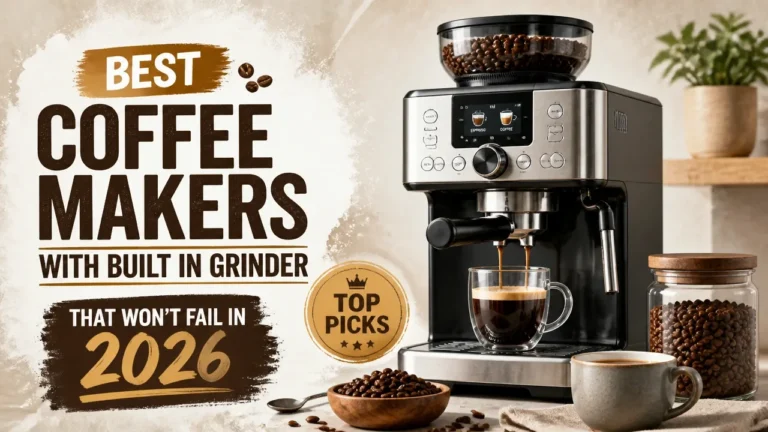

The best coffee maker with a built-in grinder solves a real problem – grinding and brewing in one footprint, one workflow, one button. Breville, Jura, Cuisinart, Ninja, xBloom, and Philips each take a different swing at that promise, and the differences between them are not marketing copy. They are engineering trade-offs with real consequences for your counter, your wallet, and your morning.
What the award badges don’t tell you is that every integrated grinder eventually fails, and when it does, it doesn’t just fail quietly. It can take the brewer with it. Understanding that single mechanical reality – and how each machine on this list handles it – is the only framework you need to buy right the first time.
Key Takeaways on Best Coffee Maker With Built-In Grinder
- Burr grinders beat blade grinders because uniform particle size produces balanced extraction – blade-equipped machines are disqualified before the ranking starts.
- Steam migration from the brew chamber into the grinder chute is the root cause of most integrated machine failures, not manufacturing defects.
- Bypass mode is the most underrated spec on any integrated machine – it determines whether a grinder failure kills your brewer or just inconveniences it.
- The Breville Grind Control is the strongest drip performer, but community practitioners consistently challenge the all-in-one value proposition against separates.
- All-in-one machines average a 2–3 year replacement cycle; a quality separate grinder and brewer, maintained properly, can last a decade.
- If absolute cup quality matters more than counter-space savings, a standalone burr grinder paired with a certified drip brewer outperforms every integrated machine on this list.
How We Ranked: The Reliability-First Criteria for Built-In Grinder Coffee Makers
The question behind every buying decision for a built-in grinder coffee maker isn’t “which one has the best specs?” – it’s “which one holds up when the novelty wears off?” That distinction changes everything about how you should read a ranked list.
The first filter is burr type. Burr grinders – whether flat or conical – shear coffee beans between two abrasive surfaces, producing particles of relatively uniform size. Blade grinders chop randomly, creating a distribution of powder and chunks that extracts unevenly: the fine particles over-extract into bitterness, the coarse ones under-extract into sourness, and you taste both at once. Any integrated machine using a blade grinder is disqualified from a reliability-first ranking before the conversation starts.
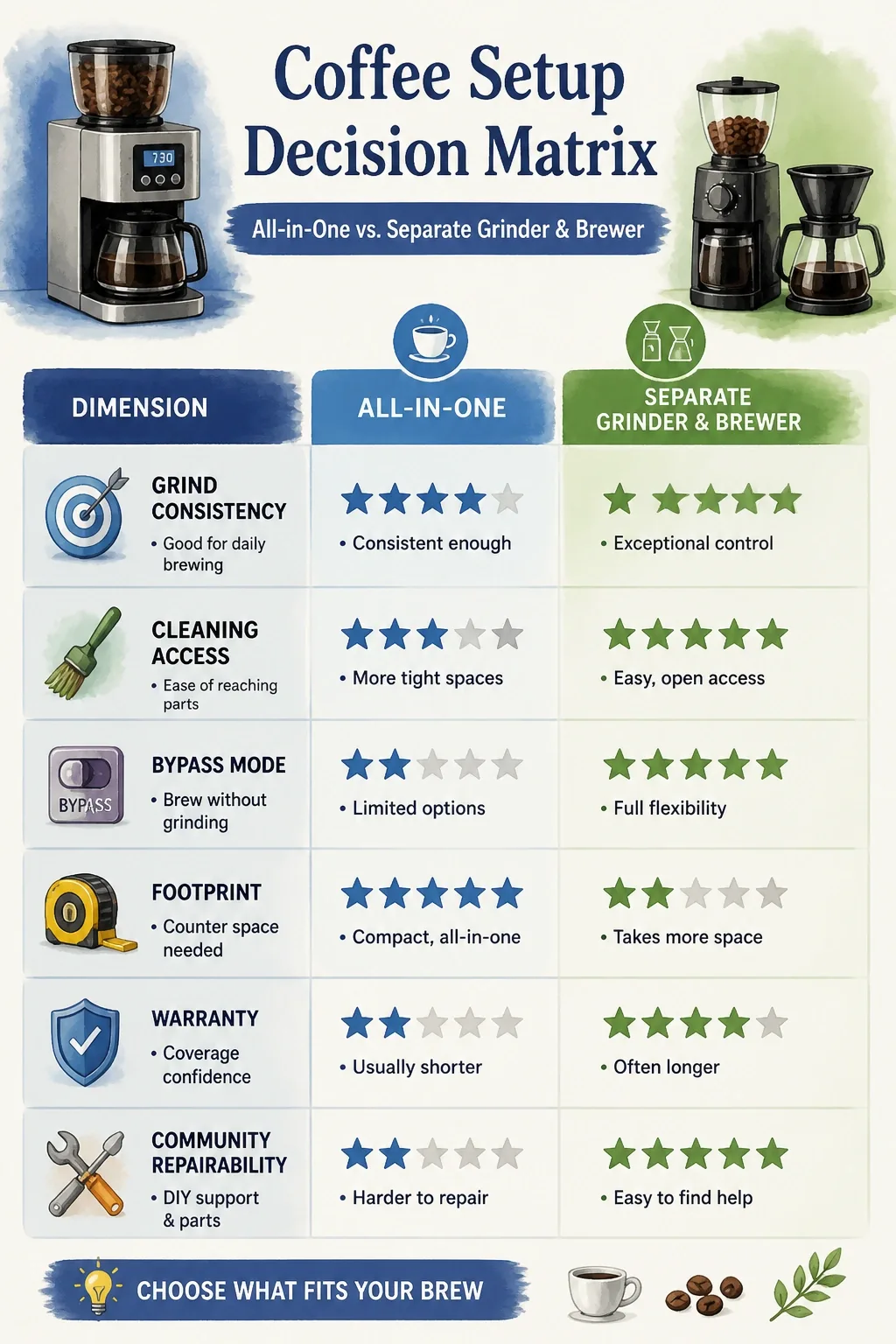
Beyond burr type, the ranking dimensions used here are: grind consistency, brew-method fit, cleaning access to the chute and burrs, presence of a bypass mode for pre-ground coffee, footprint, and warranty coverage. Each of those criteria has a practical reason for existing.
Cleaning access matters because integrated machines share airspace between a dry grinder and a hot, humid brew chamber. That proximity is the root cause of the most common failure pathway: steam migration carries moisture into the burr chute, coffee dust accumulates, and the combination creates mold risk and, eventually, motor burnout. The maintenance baseline for any integrated machine is weekly cleaning of the chute, hopper, and burrs to prevent oily buildup and rancid flavors from contaminating your next brew. Bypass mode matters because it determines whether a grinder failure turns your $300 machine into a $300 paperweight or merely into a slightly less convenient brewer.
One more lens runs through every entry on this list: community reality. Blog award lists optimize for category labels and spec checklists. Practitioners – the people who have owned these machines for two years and posted about it – optimize for separability, repairability, dial-in burden, footprint, and value versus buying a separate grinder and brewer. Both perspectives live here, because the spec sheet and the two-year owner are telling you different things, and you need to hear both.
Breville Grind Control: Best Overall Drip With a Built-In Burr Grinder – If You Accept the Chute Tax
The Breville Grind Control earns its “best overall” label in the drip category, and the reasons are straightforward: adjustable burr settings that let you dial grind size to taste, a thermal carafe that keeps coffee hot without a warming plate that scorches the bottom of your pot, and a smart reservoir that measures water precisely by cup count rather than making you eyeball a fill line. For a home brewer who wants a single machine that grinds, brews, and stays out of the way, this is the most capable all-in-one drip performer on the market.
What the editorial “best overall” label omits is the failure pathway that lives inside every integrated grinder-brewer, and the Breville Grind Control is not immune to it. The brew chamber generates steam; the grinder chute is directly above and adjacent to it; and over time, that steam migration carries moisture into a space designed to stay dry. Coffee dust accumulates on damp surfaces, creating the conditions for mold. The motor driving the burrs runs in that same environment. The failure sequence – moisture, dust, mold, motor burnout – is not a Breville-specific defect. It is the physics of putting a grinder and a brewer in the same housing.
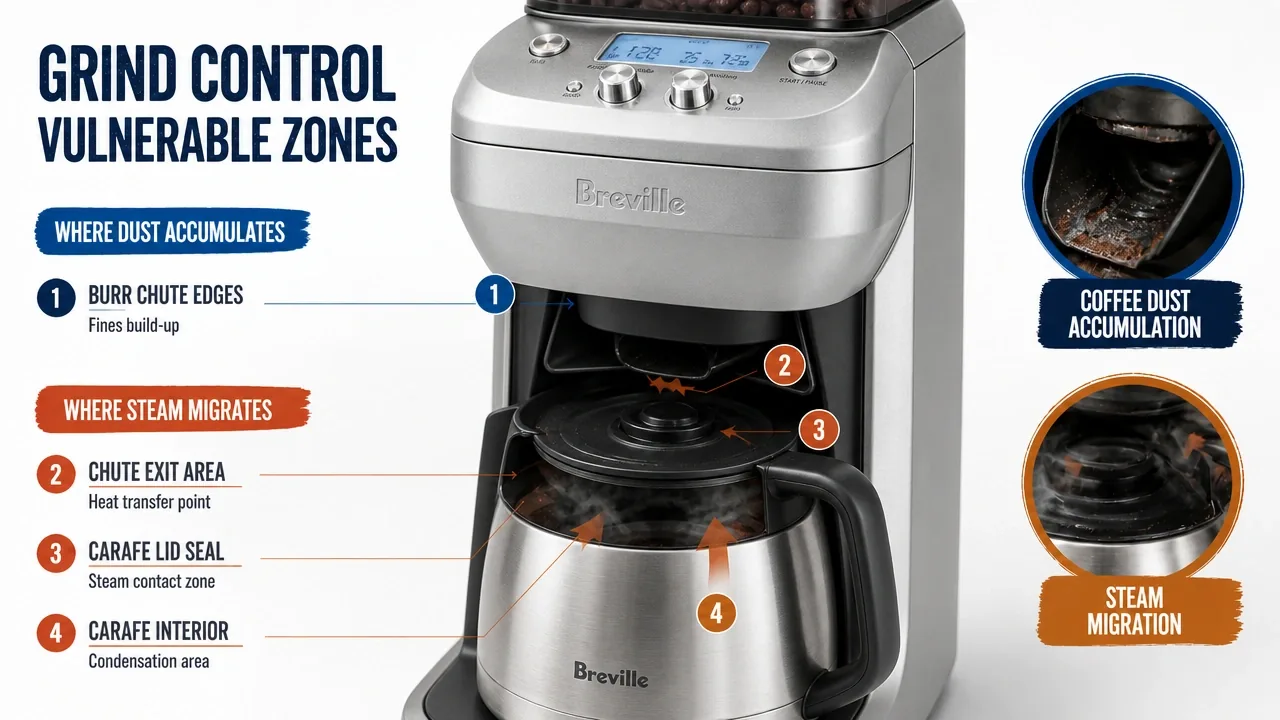
The practical question is what happens when the grinder fails. If the machine has a bypass mode that accepts pre-ground coffee, you lose the grinder but keep the brewer – a meaningful difference in a machine that costs $300 or more. The Breville Grind Control does include bypass functionality, which is why it stays on this list despite the failure risk.
The community’s pushback on integrated machines in general is worth stating plainly: a bad integrated grinder cannot be surgically removed and replaced. When Reddit practitioners weigh in on the all-in-one value proposition, the consistent counter-argument is that a separate grinder and brewer almost always deliver better quality and better repairability for similar or lower total spend. The Breville Grind Control is a strong convenience performer. It is not a community-endorsed reliability consensus – and those are different things.
Affiliate Disclosure
This post contains affiliate links, meaning I may earn a commission if you make a purchase through these links, at no additional cost to you. As an Amazon Associate, I earn from qualifying purchases. I only recommend products I genuinely believe will add value.

Breville BDC650BSS Grind Control Thermal Carafe, Brushed Stainless Steel
- The Breville Grind Control coffee maker creates third wave specialty coffee by capturing freshness and essenti…
- INTEGRATED AND ADJUSTABLE GRINDER: Adjust the coffee grinder output to suit any bean from anywhere and customi…
- Receive 2 free bags of specialty coffee when you purchase and register any Breville coffee machine; T and Cs a…
- STEEP AND RELEASE TECHNOLOGY: Brew your coffee directly into a large carafe, tall cup or travel mug with equal…
- INCLUDED ACCESSORIES: Gold Tone Filter, 12 Cup Dual Wall Stainless Steel Thermal Carafe and Cleaning Brush
xBloom Studio: Best Automatic Pour-Over Hidden Gem – If It Fits Your Cabinet
The xBloom Studio is the machine that coffee practitioners keep recommending in practitioner threads while major blog listicles keep ignoring it. It is an automatic pour-over system with integrated grinding and recipe automation built in – meaning it selects grind size, water temperature, flow rate, and pour pattern based on the specific coffee you’re brewing, without you touching a variable. For the home brewer who wants the cup quality of a manual V60 technique without the learning curve or the ritual, it is the most direct answer available.
The use case is specific and worth stating clearly. The xBloom Studio is not for someone who wants to dial in extraction manually or experiment with parameters. It is for the person who has read enough about pour-over to know they want it, but has no interest in becoming a barista to get there. One-touch pour-over, repeatable results, integrated grinding – that is the pitch, and the community signal says it delivers.
Two real-world constraints apply before you buy. First, height clearance: the xBloom Studio is tall, and it will not fit under standard low cabinets. Measure your clearance before ordering, not after. Second, long-term reliability data is thinner than it is for machines with years of owner reviews behind them. Major blogs haven’t stress-tested it at scale, which means you are relying more on early adopter experience than on a deep track record.
The video below gives you an engineer’s perspective on what’s actually happening inside the machine – worth watching before you commit.
One more name worth flagging: Meraki is emerging as another automatic pour-over contender in the same hidden-gem category. Early signals are interesting, but it is genuinely too soon to say anything reliable about long-term durability. File it under “watch this space.”

xBloom Studio Coffee Machine, Drip Coffee Maker, Grinder&Scale, AppControl
- 1. Three Levels of Automation for Any Skill Level: Choose from Autopilot, Copilot, or Free Solo mode. Autopilo…
- 2. Intuitive User Interface with Tactile Knobs and LED Matrix: The Studio features physical control knobs and …
- 3. Full Customization via the xBloom App: Use the xBloom app to create, adjust, save, and share your favorite …
- 4. xPod System for Effortless Brewing: Each xPod contains carefully selected whole beans and a built-in filter…
- 5. What Is Included in the Box: The package includes the xBloom Studio, Omni Dripper 2 with Hyperflow Bottom, …
Jura E6: Best Superautomatic for One-Touch Convenience – If You Can Stomach the TCO
The Jura E6 sits in a different product category than the drip machines above. It is a superautomatic espresso machine – which means the integrated grinder doesn’t just grind your beans before brewing; it grinds them, doses them, tamps them, extracts the shot, and ejects the puck, all without you touching anything between pressing a button and picking up your cup. For a home brewer who wants genuine bean-to-cup automation for espresso-based drinks, the Jura E6 is a premium and well-regarded entry point.
“There was no hesitation in his reply. He said the Jura Z10 Bean to Cup machine is the model that is setting the new standard in bean to cup machines. He also pointed out it introduced a whole new category to super automatics: the ability to do cold brew, right in the machine.” – As recounted by James Smith, owner of 1st in Coffee with nearly 25 years selling superautomatic machines, speaking about the Jura Z10
Smith’s point about the Z10 matters here because it illustrates where the Jura E6 sits in the lineup: it is a proven, capable machine in a brand that is actively pushing the category forward. The E6 handles the daily workflow reliably; the Z10 is where Jura’s engineering ambition is currently focused. That context helps you understand what you’re buying at each price point.
What the one-touch promise does not eliminate is the need to dial in. Grind size, dose, and brew strength still require adjustment when you change beans, and practitioners treat dial-in burden as a real variable even on automatic machines. The Jura E6 simplifies the process compared to a manual espresso setup, but it does not remove it.
The deeper financial consideration is total cost of ownership. The Jura E6 requires regular cleaning and descaling – Jura’s proprietary cleaning tablets and descaler are not optional, and skipping them degrades both cup quality and machine longevity. More critically, the integrated grinder is a single point of failure. If the grinder mechanism fails outside the warranty window, you are not replacing a $150 standalone grinder – you are evaluating whether to repair or replace a $700-plus machine. Check the warranty terms and the availability of a Jura service network in your area before committing.

Jura E6 Platinum 15465
- VERSATILITY: Automatic coffee machine grinds, tamps, brews, froths and self-cleans in less than 60 seconds
- OPERATION: Intuitive, user-friendly color display, integrated maintenance programs and optional preground chut…
- CUSTOMIZATION: Programmable coffee strength, volume, temperature, amount of milk foam and hot water on demand
- GRINDER: Professional Aroma Grinder grinds 12.2% more aroma in the cup using fresh, whole beans; eco-friendly
- TECHNOLOGY: Pulse Extraction Process for professional-quality espresso, eighth-generation brew unit with 3D br…
Cuisinart Burr Grind & Brew DGB-800/850: Best Budget Mess-Free Combo – With a Bypass Mode
The Cuisinart Burr Grind & Brew DGB-800/850 earns its place on this list through a single design decision that most integrated drip machines get wrong: the grinder deposits grounds directly into the filter basket rather than through an exposed chute that coffee dust colonizes between uses. That over-the-basket grinding mechanism reduces the mess, reduces the surface area for stale grounds to accumulate, and makes the daily workflow cleaner than most competitors at this price point.
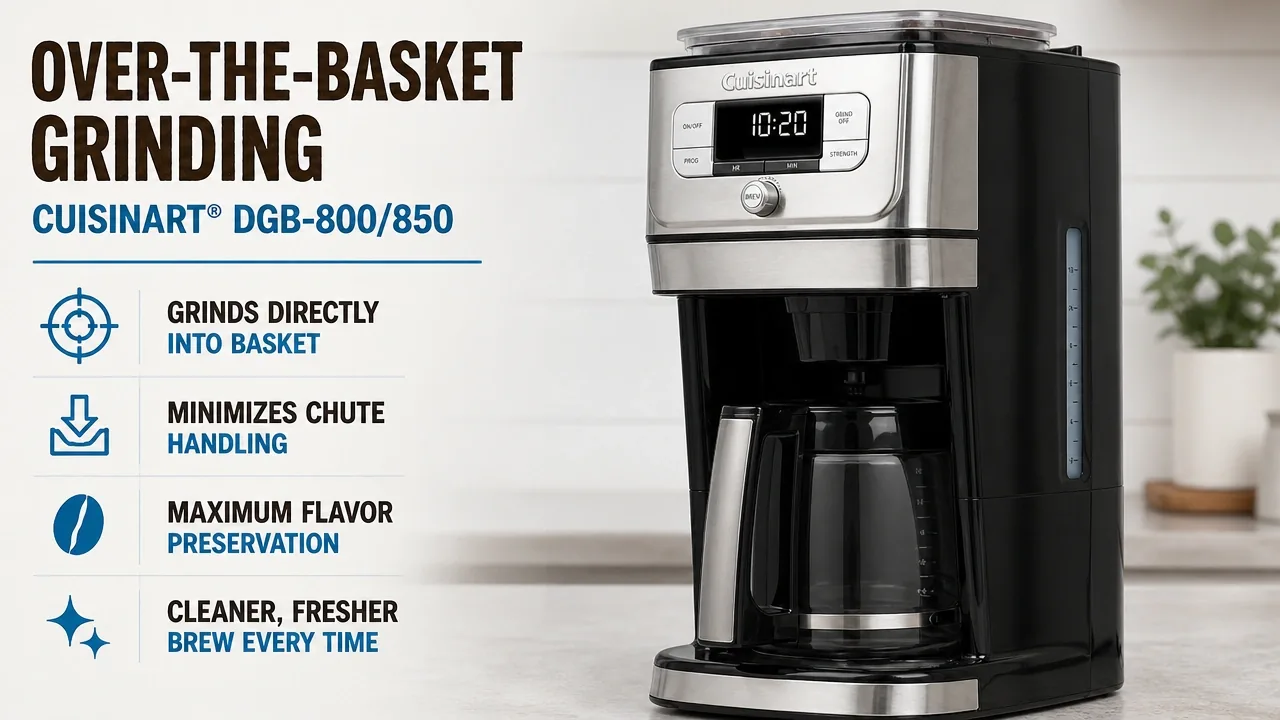
At a budget price point, the Cuisinart DGB-800/850 is a genuinely capable starter combo. You get a burr grinder – not a blade – integrated with a drip brewer, at a price that doesn’t require a long internal debate. For a home brewer entering the fresh-grind world for the first time, it is a reasonable on-ramp.
The bypass mode is the machine’s most important feature, and not for the reason the marketing materials emphasize. It matters because integrated grinders fail, and when they do, bypass mode is the difference between a brewer that still works and a machine you’re throwing away. If the Cuisinart’s grinder gives out, you can continue using the brewer with pre-ground coffee – which is exactly the escape hatch you want in a budget machine where the repair economics rarely make sense.
What the spec sheet doesn’t tell you is that the community doesn’t endorse the Cuisinart Burr Grind & Brew as a reliability champion. The praise is real but narrow: it is a budget convenience machine with a smart grinding design, not a long-life modular investment. Treat it as a starter combo with a two-to-three-year horizon, not as the last drip machine you’ll ever buy.

Cuisinart DGB-800C Fully Automatic 12-Cup Burr Grind & BrewTM Coffeemaker, Black/Silver, 1 Count, Silver
- The coffee maker features an integrated burr mill grinder that automatically grinds whole beans just before co…
- With a strength control feature, you can customize your coffee by choosing strong, medium, or mild brew to sui…
- This coffee maker makes it a cinch to brew up to 12 cups of coffee.
Ninja Luxe Café Premier: Best Versatile All-in-One for Espresso, Drip, and Cold Brew
The Ninja Luxe Café Premier answers a specific question that the other machines on this list don’t: what if you want espresso, drip coffee, and cold brew from one machine, with a burr grinder built in? For a home brewer who wants to cover multiple brew formats without multiple machines, it is the most capable all-in-one available at its price point.
The burr grinder integration across multiple brew modes is the machine’s core engineering achievement. Switching between espresso-style extraction, standard drip, and cold brew requires different grind sizes and different water-to-coffee ratios – and the Ninja Luxe Café Premier manages those transitions with dedicated brew settings rather than leaving you to figure out the adjustments manually. For a versatile home setup, that matters.
The maintenance reality of a multi-mode machine is more demanding than a single-purpose brewer, and it’s worth understanding before you buy. Coffee oils from espresso-style extraction behave differently than the lighter oils from drip brewing. Milk residue from milk-based drinks adds another cleaning layer entirely. The brew basket, the grinder chute, and each brew path carry different residues and require different cleaning frequencies. Neglecting any one of them affects the others – cross-contamination of flavors is the most common complaint from owners who underestimate the cleaning burden.
Versatility also does not eliminate the single-point-of-failure risk that runs through every integrated machine. The Ninja Luxe Café Premier is one machine doing the work of three. When something fails – and eventually something will – the failure affects your entire coffee routine simultaneously. Dial-in still applies: switching beans or brew modes may require adjusting grind size and dose. The convenience is real; so is the complexity.

Ninja Luxe Café Premier Espresso, Drip Coffee & Cold Brew, Green, ES601GY
- 3 MACHINES IN 1: Brew without limits with no guesswork espresso, well-balanced drip coffee, and rapid cold bre…
- BARISTA ASSIST TECHNOLOGY: Unlock a premium guided experience with customized grind size recommendations, weig…
- GRIND-SIZE RECOMMENDATIONS: Barista Assist Technology monitors each brew and gives you a grind size recommenda…
- INTEGRATED GRINDER: The conical burr grinder has 25 grind settings to deliver a fresh, precise grind for versa…
- WEIGHT-BASED DOSING: Different drinks require different amounts of grounds. Our built-in scale does the work f…
Philips Baristina: Best Overlooked Simple All-in-One – Postcard Instructions, Minimal Dial-In
The Philips Baristina is the machine that keeps appearing in practitioner threads as a recommendation and keeps getting omitted from major blog listicles. Its value proposition is not grind quality or brew versatility – it is simplicity executed at a level that most integrated machines don’t bother to achieve. The instructions are genuinely postcard-simple. The one-touch workflow requires almost no technique burden. You put beans in, press a button, and get coffee.
That sounds like faint praise, but it isn’t. Most integrated machines – even the ones marketed as “automatic” – still require meaningful user input: choosing grind settings, managing dosing, interpreting cleaning alerts, and troubleshooting when the output drifts. The Philips Baristina minimizes that cognitive overhead in a way that makes it genuinely different from the rest of this list. For a home brewer who wants fresh-ground coffee every morning without becoming a coffee hobbyist to get there, it is the most honest match.
The trade-off is granular control. If you want to experiment with extraction variables, adjust grind size for different beans, or push the machine toward a specific flavor profile, the Philips Baristina is not your machine. It is optimized for consistency and ease, not customization.
Two things that simplicity does not eliminate: cleaning and descaling. Every automatic machine with an integrated grinder accumulates coffee oils and mineral scale, and the Philips Baristina is not exempt. The cleaning cycle is straightforward – consistent with the machine’s overall design philosophy – but skipping it degrades both the flavor and the machine’s longevity. Simplicity removes the learning curve; it does not remove the maintenance.

PHILIPS Baristina Latte Espresso Machine, Integrated Milk Frother, 16 Bar
- Fresh beans are best — The fresh coffee beans and deliciously frothed milk from this coffee machine with grind…
- Choose your favourite foam — With this espresso machine, you can create lusciously thick froth, perfectly dens…
- Automatic grinding, tamping & brewing — The Baristina coffee machine with grinder automatically grinds, tamps,…
- Easy to clean — This compact coffee machine is simple to maintain: remove the portafilter, take apart the wand…
- Your stylish little barista at home — With ideal grind size, precise pressure, accurate dosing, and delicious …
Verdict: All-in-One vs. the Two-Unit Alternative – How to Avoid a $500–$2,000 Brick
Every machine on this list is a trade-off between convenience and resilience. The verdict section is where that trade-off gets resolved – not with a blanket recommendation, but with a clear framework for your specific situation.
Counter-Space Automation and Modular Longevity
An all-in-one built-in grinder coffee maker makes sense under three conditions: your counter space is genuinely limited, you want a single-button morning workflow, and you are willing to clean the grinder chute, hopper, and burrs on a weekly schedule. If all three are true, the machines on this list are legitimate answers. If any one of them is false, the math changes.
The separates case – a dedicated automatic grinder paired with a certified drip brewer – is not a hobbyist preference. It is a structural advantage. A standalone grinder can be repaired or replaced independently. A standalone brewer can be upgraded without touching the grinder. The two components fail on separate timelines, which means a problem with one doesn’t strand the other. The community verdict on this point is consistent: a separate grinder and brewer is usually superior in quality and value, and the all-in-one value proposition is genuinely contested among experienced home brewers.
Total Cost of Ownership and Lifecycle Risk
The number that most buying guides omit is the replacement cycle. Separates – a quality standalone grinder and a quality drip brewer – can last ten years with modular repair, because you are replacing components, not systems. All-in-one integrated machines average a two-to-three-year replacement cycle in real-world use, because the failure modes compound: steam migration into the burr chute creates moisture; moisture combines with coffee dust to create mold; mold and heat degrade the motor; and when the motor goes, the entire unit goes with it.
The single-point-of-failure risk is not a hypothetical. It is the predictable endpoint of putting a grinder and a brewer in the same housing, sharing the same thermal environment. Blog reviews that rank these machines by flavor and convenience without ranking lifecycle risk are telling you half the story. The other half is what happens at month 26.
Standalone Grinder Pairings and Extraction Quality
If you decide separates are the right call, the grinder choice matters more than the brewer choice – because grind uniformity is where extraction quality is won or lost.
The top standalone options for filter coffee are:
| Grinder | Burr Type | Best For |
|---|---|---|
| Fellow Ode Gen 2 | 64mm flat burrs | Filter-forward precision |
| Baratza Encore | Conical burrs | Entry-level reliability |
| Technivorm Moccamaster KM5 | Conical burrs | Matched to Moccamaster brewers |
| Capresso Infinity Plus | Conical burrs | Budget-conscious step up |
The reason burr geometry matters is measurable. Research comparing grinder types and particle size distribution found that flat burrs produce fewer fine particles than conical burrs – and that an excessive share of fines reduces coffee bed permeability, slows flow, and causes partial clogging and uneven, bitter over-extraction. The Fellow Ode Gen 2’s 64mm flat burrs are the direct application of that finding: fewer micro-fines, cleaner extraction, less bitterness from over-extracted powder clogging your filter.
Research comparing grinder types and particle size distribution found that flat burrs produce fewer fine particles than conical burrs – and that an excessive share of fines reduces coffee bed permeability, slows flow, and causes partial clogging and uneven, bitter over-extraction. – From the study “Effect of Embryo Surface Morphology and Grinder Type on the Particle Size Distribution of Coffee“
That finding doesn’t disqualify conical burrs – the Baratza Encore is a genuinely excellent entry-level grinder – but it does explain why the Fellow Ode Gen 2 produces a noticeably cleaner cup at the filter-coffee level.
A few overlooked setups worth naming for completeness: the Oracle Dual Boiler for espresso-focused households, the Cafelat Robot paired with a Eureka Mignon for manual espresso without an integrated system, and the Hario V60 Neo with a Sibarist filter for pour-over precision. The Aeropress and Clever Dripper both eliminate the integrated-grinder-failure risk entirely by removing the integrated grinder from the equation. They are not for everyone, but they are the ultimate answer to the question of what to do when you want no mechanical failure points in your brew path.
The final call: if absolute coffee quality is the priority, a standalone burr grinder paired with a high-quality drip machine is the superior setup. If convenience and quality need to coexist and your budget is in the $150–$400 range, a burr-based combo from this list is a meaningful upgrade over pre-ground – just go in with clear eyes about the replacement timeline.
Achieving the ultimate extraction profile at home often starts with upgrading your equipment beyond built-in mechanisms by exploring standalone options like quiet coffee grinders that protect both your morning peace and your grind consistency.
Frequently Asked Questions About Best Coffee Maker With Built-In Grinder
Are coffee makers with built-in grinders worth it?
They’re worth it if counter space is tight and you genuinely want a one-button morning workflow – but they carry a 2–3 year replacement cycle risk that separate grinder-and-brewer setups don’t. Go in knowing the trade-off, not assuming the convenience is free.
What is the best coffee machine with a grinder for home use?
The Breville Grind Control leads the drip category for most home brewers, while the Jura E6 leads for superautomatic espresso. The right answer depends on which brew style you actually drink daily, not which machine has the longer spec sheet.
What happens if the built-in grinder breaks on a combo machine?
If the machine has a bypass mode, you can keep brewing with pre-ground coffee. If it doesn’t, the brewer is effectively dead – which is why bypass mode is one of the first specs to check before buying any integrated machine.
How often do you actually need to clean a built-in grinder coffee maker?
Weekly is the maintenance baseline – chute, hopper, and burrs. Skipping it allows coffee oils to go rancid and moisture from the brew chamber to accumulate, which leads to mold and eventual motor failure. Monthly descaling applies on top of that.
Why do coffee practitioners prefer separate grinders over built-in ones?
Because separates fail independently. When the grinder wears out after five years, you replace the grinder. When the brewer develops a fault, you replace the brewer. With an integrated machine, one failure can strand both functions simultaneously.
Is the xBloom Studio reliable enough for daily use?
Early community signals are positive, but long-term reliability data is thinner than for machines with multi-year owner track records. It’s a strong choice for automatic pour-over quality, but you’re relying more on early-adopter experience than on a deep failure-rate history.
What is the best budget combo coffee maker with a grinder?
The Cuisinart Burr Grind & Brew DGB-800/850 is the strongest budget option – its over-the-basket grinding design reduces mess and chute accumulation. Treat it as a 2–3 year starter machine with bypass mode as your safety net, not as a long-term investment.
Do superautomatic machines like the Jura E6 really require dialing in?
Yes – grind size, dose, and brew strength all need adjustment when you change beans. The Jura E6 simplifies the process compared to a manual espresso setup, but it doesn’t eliminate dial-in. Practitioners rank dial-in burden as a real variable even on fully automatic machines.
References
- The Jura Z10 – Eighth Generation of Bean to Cup Machines | coffeegeek.com
- Effect of Embryo Surface Morphology and Grinder Type on the Particle Size Distribution of Coffee | ejournals.ph