
Dunkin’ Iced Coffee, specifically the large 32 oz version, sits right at the edge of the FDA’s recommended daily caffeine limit – and most people have no idea they’re that close. One cup, one limit, one decision.
What makes this number interesting isn’t just the size. The light roast bean, the hot-brew-rapid-chill method, and the ice in your cup all interact in ways that push the caffeine up or pull it down depending on how you order. Knowing the mechanics gives you real control over your morning ritual.
How Much Caffeine Is in a Large Dunkin’ Iced Coffee
Dunkin’ Iced Coffee in a large 32 oz size contains approximately 396–400 mg of caffeine, based on current nutritional data – and that single number tells a more interesting story once you see it next to the other sizes. A small (16 oz) comes in at roughly 198 mg, and a medium (24 oz) lands at about 297 mg. The large doesn’t just inch ahead – it pulls significantly harder than either.
Here’s the part that surprises most people: a large Dunkin’ Iced Coffee has more caffeine than a large Dunkin’ Cold Brew, which clocks in around 347 mg. If you’ve been ordering cold brew because you assumed it was the stronger option, you’ve actually been leaving caffeine on the table.
Some sources report the large reaching as high as 469 mg, and that range is real. It’s not a data error – it reflects genuine preparation differences we’ll get into. But the 396–400 mg figure is the reliable baseline.
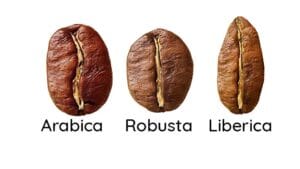
There’s also a reason the number is this high that has nothing to do with cup size. Dunkin’s Original Blend is a light roast, and light-roasted beans are physically denser than dark-roasted ones. When you measure by weight or scoop, you’re packing more coffee grounds into the brew – and more grounds means more caffeine. Research comparing Starbucks roast profiles found that medium roast delivered roughly 310 mg versus 260 mg for dark roast in the same cup size, a 15–20% caffeine advantage. The same principle applies here. So the large iced coffee’s caffeine count isn’t just a product of volume – it starts with the bean.
Here’s a quick look at how the sizes stack up:
| Size | Volume | Caffeine |
|---|---|---|
| Small Iced Coffee | 16 oz | ~198 mg |
| Medium Iced Coffee | 24 oz | ~297 mg |
| Large Iced Coffee | 32 oz | ~396–400 mg |
| Large Cold Brew | 32 oz | ~347 mg |
The Brewing Method That Locks In the Caffeine
Dunkin’ Iced Coffee gets its caffeine count locked in before a single ice cube touches the cup. Dunkin’ brews its iced coffee using hot water – which extracts caffeine quickly and efficiently – then rapidly cools it to stop extraction and preserve freshness. That process is fundamentally different from cold brew, which steeps grounds in cold water for 12–24 hours and yields a slower, milder caffeine extraction per ounce of grounds.
Hot water is simply better at pulling caffeine out of coffee. The heat breaks down the cell walls in the grounds faster, releasing more of the caffeine compounds in a fraction of the time. Cold brew compensates by using a higher ratio of grounds to water, but Dunkin’s hot-brew approach extracts more caffeine per ounce of grounds upfront. The rapid cooling that follows isn’t just about convenience – it halts the extraction process at the right moment, preventing the over-extraction of bitter compounds while keeping the caffeine yield intact.
The brew is also intentionally concentrated. Because it’s designed to sit on ice, the starting liquid is stronger than your typical drip cup. That strength has to survive dilution, so the caffeine is built in from the beginning.
David Dussault, founder of Snapchill – a company specializing in patented rapid-chilling beverage technology – explains how this process works at the flavor level:
“Preparing hot coffee and then quickly cooling it down was something that we were interested in… As the coffee is brewed hot, its full range of flavours, aromas, oils, acids, and sugars are extracted. This is similar to the flash brew process, which involves brewing hot coffee over ice to quickly cool it down.”
What Dussault is describing isn’t just a flavor decision – it’s a caffeine retention decision. Hot extraction pulls out the full chemical profile of the bean, caffeine included, and the rapid chill locks that profile in place before anything can dissipate or break down. The result is a drink that carries the caffeine punch of hot coffee in a cold format.
Here’s a look at how Dunkin’ executes this process in practice:
Why Your Caffeine Hit Can Vary: Ice, Turbo Shots, and Real Math
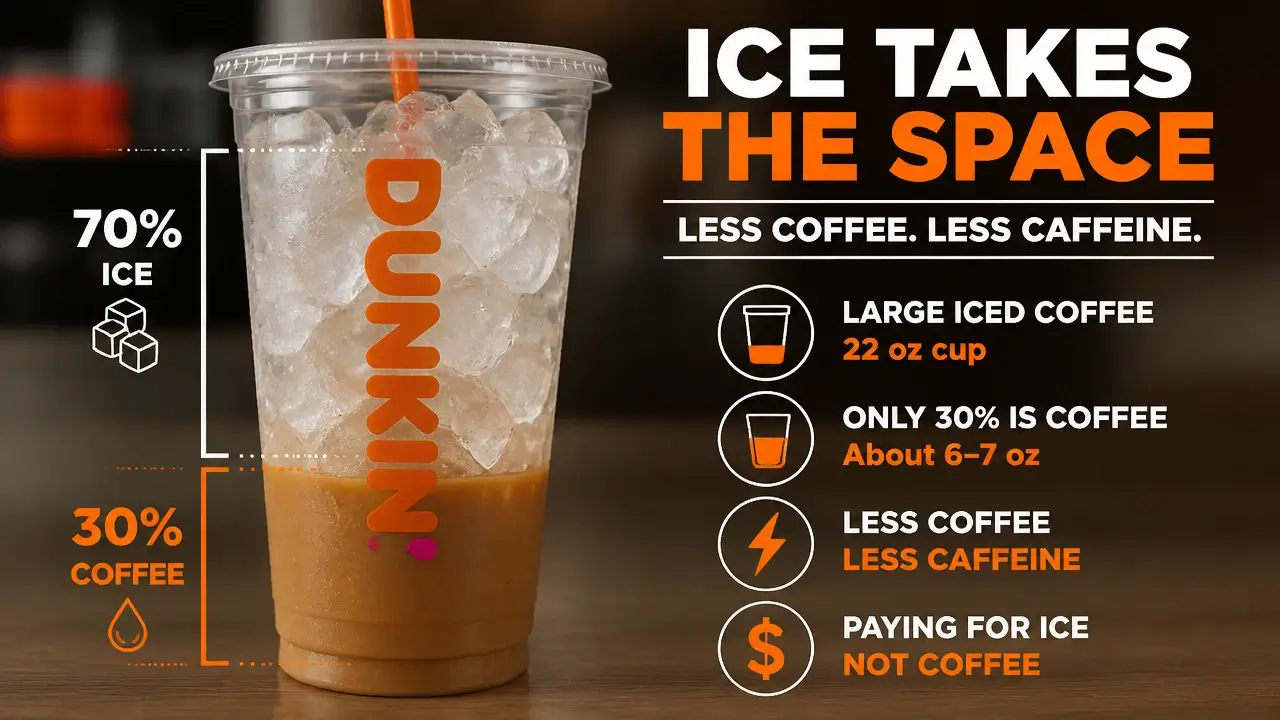
Ice displacement is the hidden variable that makes your large Dunkin’ Iced Coffee feel stronger some days and lighter on others – and it’s the one thing no menu board explains. Your 32 oz cup is not 32 oz of coffee. Ice takes up real space, and depending on how much the barista packs in, it can displace 30–40% of the cup’s total volume. That means your actual liquid coffee might be anywhere from 19 to 22 oz, which brings the real caffeine delivered to your system down to roughly 350–390 mg rather than the full 396–400 mg baseline.
It’s not a flaw in the system – it’s just physics. But it’s worth knowing, especially if you’re tracking your intake carefully.
Here’s a look at what ice volume actually does to your cup:
On the other end of the spectrum, Turbo Shots push the number up fast. Adding a single espresso shot to your large iced coffee adds roughly 118 mg of caffeine, which means a large with one Turbo Shot can easily land above 500 mg – well past the FDA’s daily ceiling before you’ve touched any other food or drink.
A useful internal rule sourced from employee knowledge: treat one ounce of Dunkin’s espresso as approximately 70 mg of caffeine. It’s consistent with Dunkin’s own published figures for espresso-based drinks (four ounces of espresso ≈ 280 mg, which aligns with the medium iced coffee’s 297 mg when you account for the brewed coffee base). With that rule in hand, you can estimate any customized drink on the fly.
Flavor syrups and dairy don’t move the caffeine needle at all – those are purely taste additions. But the ice-to-coffee ratio is the silent variable that most loyal consumers never think to adjust. Knowing it exists is the first step to controlling it.
The FDA Limit: One Large Iced Coffee = Your Whole Day
The FDA caffeine limit for healthy adults sits at 400 mg per day – and a single large Dunkin’ Iced Coffee delivers 396–400 mg in one cup. That’s not a near-miss. That’s essentially your entire daily allowance before 9 a.m.
The FDA’s official guidance is clear on this:
“For healthy adults, the FDA has cited 400 milligrams per day of caffeine as an amount not generally associated with dangerous, negative effects.”
The word “not generally associated” matters. It’s not a hard biological ceiling – it’s the threshold above which risks like jitters, anxiety, elevated heart rate, and disrupted sleep become meaningfully more likely. Regularly exceeding it isn’t catastrophic, but the effects accumulate.
What makes the large iced coffee particularly worth paying attention to is the math after the cup. Add a Turbo Shot and you’re past 500 mg. Grab an afternoon soda or a piece of chocolate, and you’ve stacked on top of an already-full day. The large doesn’t leave room for anything else.
For pregnant individuals, the margin disappears entirely. The recommended limit during pregnancy drops to 200 mg per day – and a large Dunkin’ Iced Coffee is five times that in a single serving. A small is already at the limit. This is the gap that most caffeine guides skip over, and it’s the one that matters most for the people searching hardest for the answer.
There’s also the timing dimension. Caffeine’s half-life is roughly five hours, meaning half of what you drink at 8 a.m. is still active in your system at 1 p.m. A large iced coffee ordered in the afternoon doesn’t just affect your afternoon – it’s still working at bedtime, even if you feel completely fine by then. That’s not a reason to avoid the drink. It’s a reason to know when you’re drinking it.
Enjoying Your Large Iced Coffee Without Crossing the Line
The simplest lever you have is asking for less ice. It costs nothing, takes two seconds at the counter, and immediately increases the actual coffee volume in your cup – which gives you a more predictable, consistent caffeine dose every time. If you’re someone who tracks intake, this one ask eliminates the biggest variable in your drink.
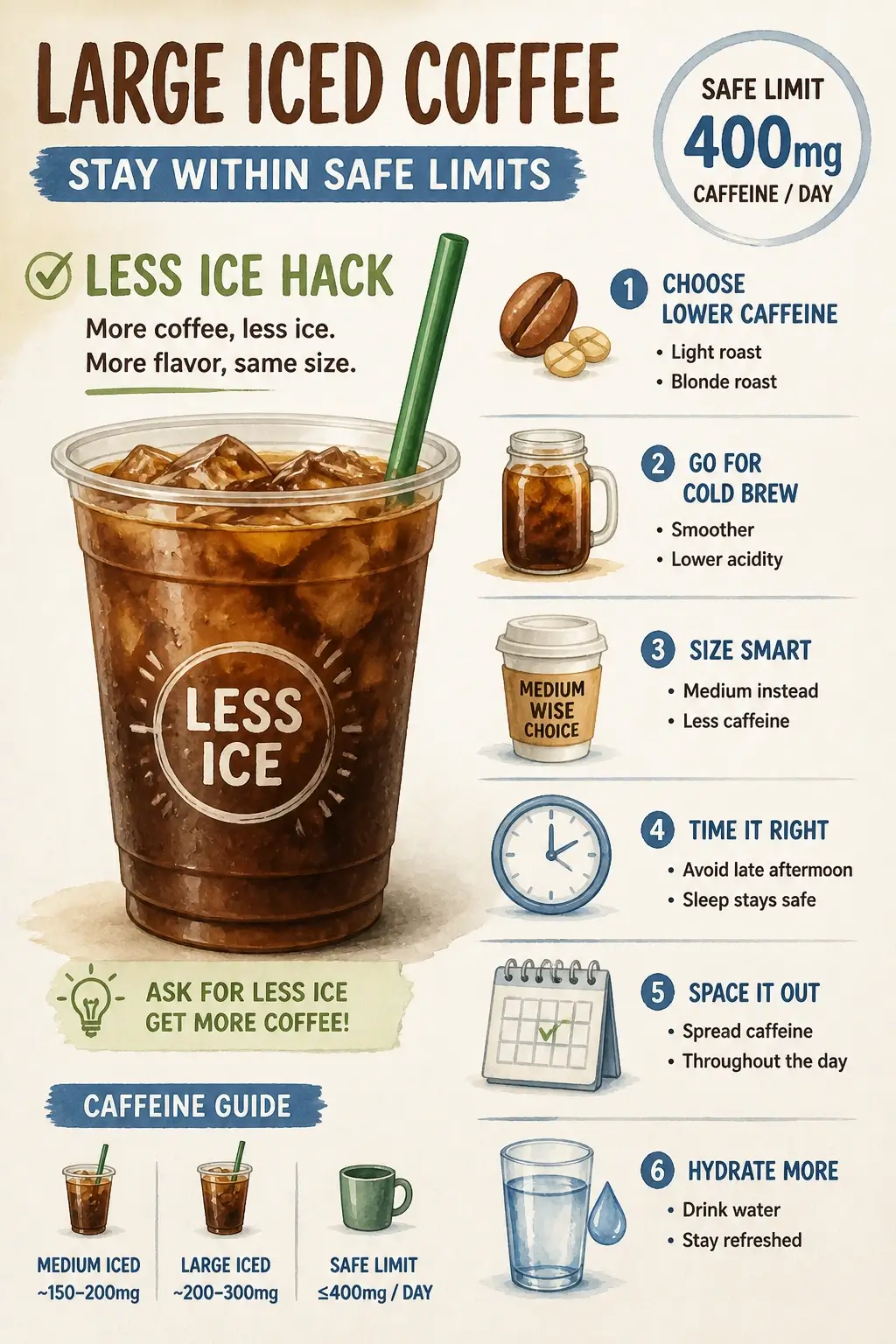
Beyond that, skip the Turbo Shot on days when you know you’ll have other caffeine sources. A straight large is already sitting at your daily ceiling – adding a shot doesn’t enhance the drink, it just pushes you past the limit before lunch. Save the Turbo for days when the large is your only coffee.
Pace matters more than most people expect. Sipping your large over 45 minutes to an hour softens the peak caffeine hit compared to drinking it in 10 minutes. Your body processes caffeine at a fixed rate – spreading out the intake keeps the experience smoother and reduces the likelihood of the jittery overshoot that sometimes follows a fast, large dose.
If sleep has been rough lately, try swapping to a medium on a few days and see what changes. The drop from large to medium is about 100 mg – that’s a meaningful reduction that still gives you a real caffeine lift without consuming your entire daily budget in one cup.
A note on the extreme end: the 48 oz Bucket size carries estimates ranging from 550 mg to nearly 600 mg, with zero official confirmation from Dunkin’. If you’re ever drawn to it, understand that you’re operating in completely unverified territory – not just over the FDA limit, but over it with no reliable number to anchor to.
And if you’re a fan of the specialty lattes – birthday cake, seasonal flavors – there’s no published caffeine data for any of them, from Dunkin’ or any third-party lab. If you’re counting milligrams, stick with plain iced coffee where the math is available and the numbers hold.
You now know exactly how your drink works. That’s not a reason to worry about it – it’s a reason to order it with confidence.
Key Takeaways on Dunkin’ Iced Coffee
- A large 32 oz Dunkin’ Iced Coffee contains 396–400 mg of caffeine, essentially consuming your entire FDA daily limit in one drink.
- Dunkin’s light roast bean is denser than dark roast, delivering 15–20% more caffeine per scoop before brewing even starts.
- The hot-brew-rapid-chill method extracts more caffeine per ounce of grounds than cold brew does, which is why large iced coffee outpaces large cold brew.
- Ice displacement reduces actual coffee volume by 30–40%, meaning your real caffeine dose is often closer to 350–390 mg depending on how much ice is packed in.
- Adding a single Turbo Shot pushes a large iced coffee past 500 mg – well beyond the FDA ceiling before any other caffeine source.
- Asking for less ice, skipping add-on shots, and sipping slowly are the three most effective ways to manage your intake without changing your order.
Frequently Asked Questions About Dunkin’ Iced Coffee
How much caffeine is in a 32 oz Dunkin’ Iced Coffee?
A 32 oz large Dunkin’ Iced Coffee contains approximately 396–400 mg of caffeine based on current nutritional data, though preparation variables like ice volume can bring the effective dose slightly lower on any given cup.
Why does Dunkin’ Iced Coffee have more caffeine than cold brew?
Dunkin’ brews its iced coffee with hot water, which extracts caffeine faster and more completely than the cold-steep method used for cold brew – so even though cold brew has a reputation for being stronger, the hot-brew process wins on total caffeine yield at the same cup size.
Is 200 mg of caffeine a lot?
200 mg is a moderate dose for most healthy adults, sitting at exactly half the FDA’s 400 mg daily ceiling – it’s roughly what you’d get from a medium Dunkin’ Iced Coffee, and it’s the maximum recommended for pregnant individuals for the entire day.
Can I drink a large Dunkin’ Iced Coffee if I’m pregnant?
A large is five times the 200 mg daily limit recommended during pregnancy, so it’s not a safe choice for that group. Even a small (198 mg) sits right at the pregnancy ceiling, so most healthcare providers would recommend switching to a different option entirely.
Does asking for less ice actually change my caffeine intake?
Yes – less ice means more actual coffee in your cup, which gives you a higher and more consistent caffeine dose rather than a diluted one. It’s the single most effective customization for anyone who wants a predictable number.
Is iced coffee worse for GERD than hot coffee?
Iced coffee isn’t necessarily better or worse for GERD than hot coffee – caffeine itself is the primary trigger because it relaxes the lower esophageal sphincter, and the temperature of the drink doesn’t change that mechanism. The high caffeine content in a large Dunkin’ Iced Coffee makes it a significant GERD risk regardless of how cold it is.
What happens if I add a Turbo Shot to my large iced coffee?
One Turbo Shot adds roughly 118 mg of caffeine to your large, pushing the total past 500 mg in a single drink – that’s 25% over the FDA’s daily limit before you’ve had anything else.
Does the flavor syrup I add change the caffeine in my iced coffee?
No – flavor syrups, dairy, and sweeteners are purely taste additions and contribute zero caffeine to your drink. The only customizations that move the caffeine number are espresso shots, the type of coffee base you choose, and how much ice is in the cup.
References
- How Snapchill Works: Flash Chilling and Hot Brew Technology – Perfectdailygrind.com
- FDA Caffeine Guidance for Healthy Adults – FDA.gov
- Dunkin’ Adding Caffeine Boost Coverage – Dailycoffeenews.com
200 mg caffeine is a moderate dose for most healthy adults, sitting at exactly half the FDA’s 400 mg daily ceiling – it’s roughly what you’d get from a medium Dunkin’ Iced Coffee, and it’s the maximum recommended for pregnant individuals for the entire day.