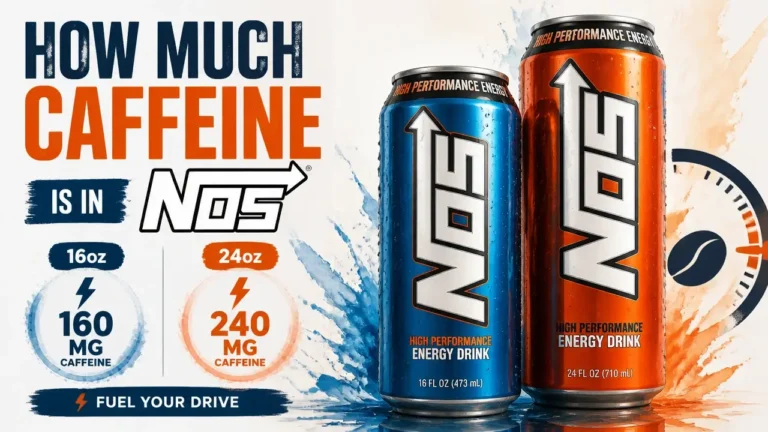

NOS Energy Drink caffeine clocks in at 160 mg for the 16oz can and 240 mg for the 24oz – but the raw number alone tells you almost nothing useful. The FDA sets a 400 mg daily ceiling for healthy adults, and a single NOS stays comfortably under it.
The real story is what surrounds that caffeine: taurine, guarana, B-vitamins, and 27–54 grams of sugar working together to shape how alert you feel – and how hard you crash when it wears off. Knowing the full picture is the difference between a tool and a trap.
What “A Lot” of Caffeine Actually Means
The FDA’s recommended daily caffeine ceiling is 400 mg for healthy adults – that’s the hard line. Below it, most people operate fine. Above it, the risk of palpitations, anxiety, and disrupted sleep climbs fast. That number is your anchor for everything that follows.
For a familiar benchmark: a standard 8oz cup of coffee contains roughly 95 mg of caffeine. That’s the reference point most people carry in their heads, even if they’ve never thought about it consciously.
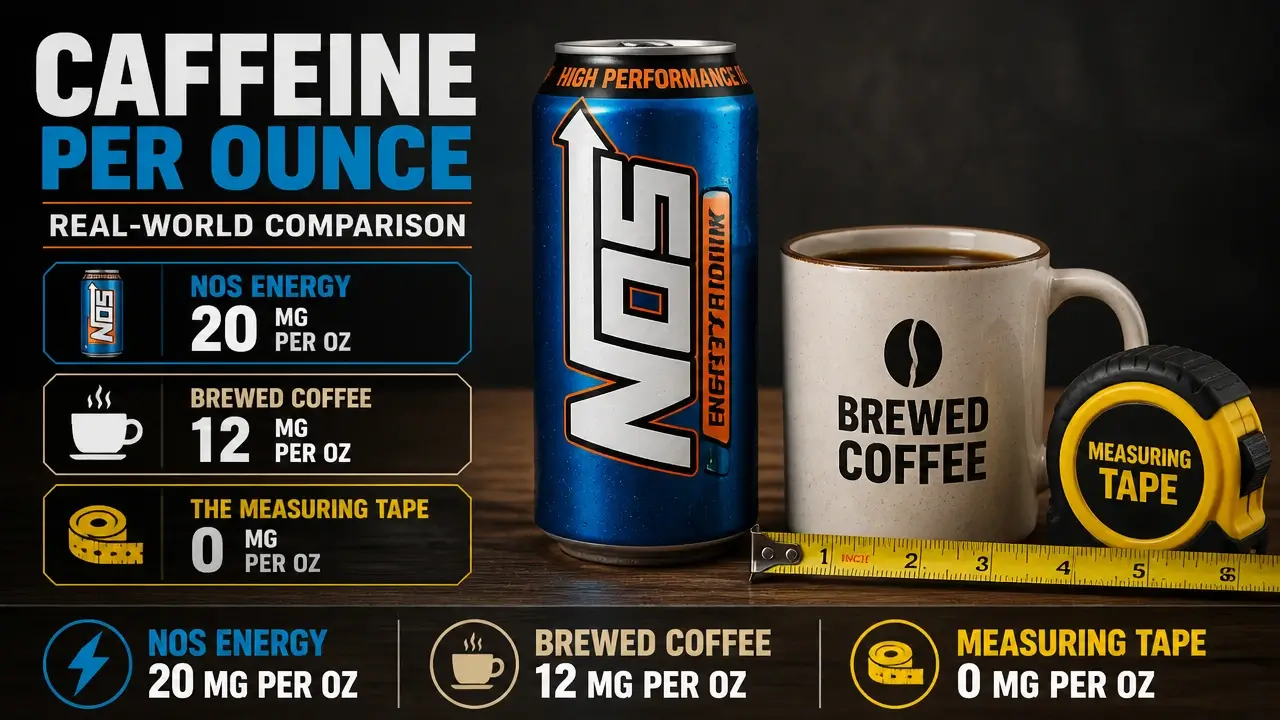
Here’s where the math gets interesting. You’d assume any energy drink crushes coffee’s intensity – but a simple normalization trick often tells a different story. Raw milligrams are misleading when can sizes vary wildly. The fairer comparison is milligrams per ounce.
Run the numbers: coffee delivers about 95 mg ÷ 8 fl oz = ~11.9 mg/oz. A 16oz NOS delivers 160 mg ÷ 16 fl oz = 10 mg/oz. NOS actually comes in below coffee on a per-sip basis. Most articles skip this step entirely, which leaves readers either overestimating the risk or walking away with false reassurance about stacking cans.
That last part matters. A single NOS won’t push you past the 400 mg daily limit. But pair it with a pre-workout, a morning coffee, or a second can during a marathon session, and the math shifts quickly. The can isn’t the problem – the context is.
Here’s a look at how NOS stacks up visually against other common caffeine sources before we get into the exact numbers.
The Numbers: Caffeine in NOS 16oz and 24oz
NOS Energy Drink caffeine comes in two doses depending on which can you grab: the standard 16oz can delivers 160 mg, and the 24oz can delivers 240 mg. Those are the numbers printed on the label, and they’re consistent across the classic original formula.
To make those figures land, translate them into coffee equivalents. A 16oz NOS is roughly 1.7 cups of coffee. The 24oz version is closer to 2.5 cups. That’s a meaningful stimulant load – but it’s not the eye-watering outlier the branding might suggest.
Now position both against the 400 mg FDA daily limit. The 16oz leaves you a 240 mg buffer for the rest of the day. Even the 24oz still gives you a 160 mg cushion – enough headroom for a morning coffee without crossing the line, as long as you’re not stacking other stimulants on top.
One variant worth flagging: the NOS Active Sports Drink runs higher, around 221 mg per 16oz, which tightens that daily margin considerably. But the classic gamer go-to – the original formula – stays at 160 mg for the 16oz.
The number is real. It’s significant. It’s just not the full picture.
Not Just Caffeine: The Ingredient Stack That Amplifies the Kick
Most gamers obsess over the caffeine number on the can, but the real performance variable is the supporting cast built around it.
NOS’s active ingredient stack includes taurine, guarana, B-vitamins (B3, B6, and B12), and L-Theanine. Each one plays a specific role in how the drink actually feels inside a gaming session.
Taurine is the stabilizer. It’s an amino acid that modulates neurotransmitter activity and blunts the jittery, over-wired edge that pure caffeine can produce. Think of it as a governor on the stimulant engine – it keeps your focus steady rather than scattershot. When taurine and caffeine are working together, the result is sharper concentration without the physical restlessness that tanks fine motor control.
Guarana is the second wave. It contains naturally occurring caffeine bound inside a fibrous matrix, which slows its release into the bloodstream. So while the synthetic caffeine in NOS hits fast and creates the initial alertness spike, guarana extends the tail end of that stimulation – giving you a longer plateau before the drop. For extended gaming sessions, that second-wave effect is genuinely useful.
B-vitamins operate at the metabolic level. B3 (niacin), B6, and B12 support the cellular machinery that converts food into usable energy and maintain the neurotransmitter pathways that keep your thinking sharp. They’re not stimulants themselves – they’re more like the fuel injectors that help the engine run cleanly.
L-Theanine is the calm-focus compound. It promotes alpha brainwave activity – the mental state associated with relaxed alertness, the zone gamers often describe as “flow.” Paired with caffeine, L-Theanine is well-documented for smoothing out the stimulant curve and reducing anxiety without blunting the cognitive lift.
The reason NOS feels qualitatively different from a plain cup of coffee – even when the per-ounce caffeine is nearly identical – is this synergy. It’s not one compound hitting your nervous system. It’s a coordinated sequence of fast-acting stimulation, extended release, metabolic support, and anxiety modulation. When it’s calibrated right for your body weight and caffeine tolerance, it can lock in focus for 2–3 hours in a way that a straight coffee rarely replicates. When it’s misjudged, it can tip into overstimulation faster than the caffeine number alone would predict.
The Sugar Factor: How 27–54g Compounds the Caffeine Crash
The caffeine guides stop at the stimulant number. Gamers live and die by what happens 90 minutes after they drink – and sugar writes the script for that second act.
A 16oz NOS delivers roughly 27 grams of sugar. The 24oz version doubles that to approximately 54 grams. Translate those into teaspoons and the visual hits differently: 27g is about 6.5 teaspoons of sugar; 54g is closer to 13 teaspoons in a single can.
Here’s the metabolic chain that follows. The sugar absorbs fast, spiking blood glucose rapidly. Your pancreas responds with an insulin surge to clear it. That clearance often overshoots, pulling blood glucose below baseline – a state called reactive hypoglycemia. The result is mental fog, low energy, and physical lethargy. And here’s the timing problem: that drop tends to arrive right around the same window that your caffeine is tapering off.
That’s the compound crash. The caffeine comedown already threatens your focus and reaction time. The sugar drop doubles the intensity of that decline, often hitting during a critical late-game moment – a final round, a ranked match decision point, a tournament bracket push – when you need to be sharpest.
Dr. David Benton, Professor of Psychology at Swansea University and a published expert in glycemic responses and cognitive performance, puts it plainly:
“The consumption of high-sugar beverages leads to rapid glycaemic and insulin responses… Sustained delivery of energy [using slow-digesting carbs] may help in preventing the ‘sugar crash’ that can occur after consumption of a product high in sugar.”
The implication for gamers is direct. The caffeine in NOS can sharpen your early rounds. The sugar load can undermine your late ones – unless you actively manage the metabolic sequence with food timing and hydration, which is exactly what H2-6 covers.
Synthetic vs. Natural Caffeine: Does the Source Change Anything?
NOS relies primarily on synthetic caffeine – the industry standard, synthesized in controlled conditions for consistency and cost-efficiency. But the guarana in the formula adds a second, naturally occurring caffeine source on top of it. So you’re actually getting two caffeine delivery mechanisms in one can.
The difference that matters isn’t the molecule – it’s the absorption profile. Synthetic caffeine is water-soluble and hits the bloodstream fast, typically within 15–45 minutes of consumption. That creates a sharp alertness spike: quick on-ramp, clear cognitive lift, fast reaction-time improvement. Guarana’s caffeine is embedded in a fibrous, tannin-rich matrix that slows gastric breakdown. The release is more gradual, extending stimulation well past the point where synthetic caffeine alone would begin tapering.
For gaming, that combination can be genuinely useful. The synthetic caffeine handles the fast on-ramp you need at the start of a session. The guarana extends the plateau, reducing the severity of the drop during long queues. Provided the sugar doesn’t cut across that plateau – which, as H2-4 showed, it will if you’re not managing it – the dual-source structure is one of NOS’s real functional advantages over a plain coffee.
Now, the “natural is healthier” claim deserves a direct answer: it’s mostly marketing. The caffeine molecule is chemically identical regardless of whether it came from a lab or a guarana berry. The difference is delivery speed and co-occurring compounds. Guarana does bring theobromine and tannins alongside its caffeine – theobromine offers mild, longer-lasting vasodilation and a gentler stimulant effect compared to caffeine – but the quantities in a typical energy drink formula are small enough that the practical performance difference is subtle at best.
The source doesn’t change the safety math. The 400 mg daily ceiling applies to all caffeine, regardless of origin.
Smart Consumption: How to Ride the Energy Wave Without Crashing
Generic caffeine guides give you numbers. They don’t give you the gamer-specific playbook that Reddit threads demand and most articles refuse to write. Here’s what smart NOS use actually looks like in practice.
Timing: 30 minutes before the match. Caffeine reaches peak blood concentration roughly 30–60 minutes after ingestion. Crack the can 30 minutes before your queue pops so the alertness spike aligns with your critical early rounds, not your warm-up.
Dosing discipline: 16oz is enough for most. For the majority of gamers, 160 mg of synergized stimulation – with guarana extending the tail – is sufficient for a 2–3 hour session. The 24oz should be a late-night exception, not a default. If you crack a 24oz, consider pouring half and saving the rest for a second-half top-up rather than front-loading 240 mg at once.
Hydration: water alongside, not after. Energy drinks carry an osmotic load that pulls water out of cells to dilute the sugar and electrolyte concentration in your gut. Drink a full glass of water with your NOS to stay mentally crisp and counteract the dehydrating effect before it compounds mid-session.
Food buffer: never drink on an empty stomach. A small protein-rich snack before or alongside NOS – a handful of nuts, a boiled egg, Greek yogurt – slows gastric emptying. That flattens both the caffeine curve and the sugar spike, giving you a smoother, more sustained energy arc instead of a sharp peak and early crash.
Cycling: NOS is a tournament tool, not a daily driver. Daily use builds caffeine tolerance fast, meaning you’ll need more to get the same effect within weeks. Reserve NOS for competition days or extended sessions. On off days, drop to lower-caffeine options – green tea, a light coffee – to keep your baseline sensitivity intact.
Know your exit signs. If jitters, chest tightness, or heart palpitations appear, stop sipping immediately. Stand up, move around – physical activity speeds caffeine metabolism – and use slow, deep-belly breathing to bring your arousal level back into the optimal performance zone. One practical flag specific to NOS: the B3 (niacin) content can cause a harmless but startling skin flushing sensation in some people. It’s not dangerous, but if you’ve never experienced a niacin flush before, knowing it’s possible prevents a mid-match panic.
Dr. Margaret C. Craig, an Esports Performance Clinician who has published on elite gaming performance protocols and cognitive testing in esports athletes, documented the timing standard in practice:
“Beverages were consumed after all PRE testing was completed and 30 min prior to the first game… in order to mimic what is commonly done in practice.”
That 30-minute window isn’t arbitrary – it’s the calibrated gap between ingestion and peak cognitive readiness. Build your pre-game routine around it.
The following video walks through energy drink timing and performance in competitive gaming if you want to see the protocol applied in real time.
The NOS Verdict: Should You Crack One Before Your Next Game?
NOS Energy Drink caffeine is not the problem. The full package – 160–240 mg of synergized stimulation layered on top of 27–54 grams of sugar – is what demands a clear-eyed decision before you pull the tab.
The core trade-off is straightforward: effective, multi-source stimulation that can sharpen focus and extend your alertness plateau, paired with a sugar load that will produce a compound crash if you don’t actively manage it. The per-ounce math from H2-1 showed NOS isn’t the caffeine bomb its branding implies. The ingredient synergy from H2-3 showed it delivers more than a plain coffee would at the same mg count. And the sugar-crash mechanics from H2-4 showed exactly where the risk lives.
Which side of that trade-off dominates depends entirely on who you are as a gamer.
Here’s how that breaks down across three real player profiles:
One natural transition before the breakdown: the right call isn’t universal – it’s situational. The table below maps each gamer type to a practical verdict.
| Gamer Persona | NOS Fit | Recommended Dose | Key Mitigation |
|---|---|---|---|
| Tournament Grinder (2–3 hour focused sessions, defined end time) | ✅ Strong fit | 16oz, 30 min pre-match | Protein snack + full glass of water; time the crash after the final match |
| Casual All-Nighter (long, unpredictable sessions, 4+ hours) | ⚠️ Use with caution | Half a 16oz as a first-hour kick | Switch to sugar-free caffeine source after; don’t stack a second can |
| Caffeine-Sensitive Player (prone to jitters, anxiety, or palpitations) | ❌ High risk as-is | Half-can maximum, or skip entirely | Consider a lower-caffeine, L-Theanine-forward alternative; monitor for niacin flush |
The World Health Organization and European Food Safety Authority flagged a pattern worth internalizing here:
“The odds of exceeding caffeine recommendations… were significantly higher by 4% per hour of gaming.”
That’s the real risk vector – not a single can, but the accumulation that happens when a session runs long and the instinct is to reach for another. The half-can strategy and cycling discipline from H2-6 exist precisely to interrupt that pattern before it compounds.
No single verdict works for every gamer. But for most players who respect the full formula – timing it right, buffering the sugar load, and treating it as a competition tool rather than a daily habit – NOS is a legitimate performance ally. The mistake is treating it like a simple soda. The caffeine number on the label is just the entry point. The total package is what you’re actually drinking.
Key Takeaways on NOS Energy Drink Caffeine
- NOS Energy Drink caffeine delivers 160 mg in a 16oz can and 240 mg in a 24oz can, both under the FDA’s 400 mg daily ceiling.
- Per-ounce, NOS (10 mg/oz) actually delivers slightly less caffeine than a standard cup of coffee (11.9 mg/oz).
- Guarana in the NOS formula adds a slower-releasing second wave of natural caffeine on top of the primary synthetic dose.
- The 27–54 grams of sugar in NOS creates a compound crash that hits hardest when caffeine is already tapering – usually 60–90 minutes in.
- Drinking NOS 30 minutes before a match, with water and a small protein snack, significantly smooths the stimulant curve and delays the sugar drop.
- Daily NOS use builds caffeine tolerance quickly; reserving it for competition days keeps your sensitivity – and the performance edge – intact.
Understanding how these energy-focused formulas stack up against traditional brews requires examining alternative stimulants, much like exploring Celsius versus coffee content to evaluate performance differences across beverages.
Frequently Asked Questions About NOS Energy Drink Caffeine
Does NOS have more caffeine than other energy drinks?
NOS sits in the mid-to-high range at 160 mg per 16oz, which is more than Red Bull (80 mg per 8.4oz) but comparable to Monster (160 mg per 16oz) and well below ultra-high-caffeine drinks like Bang or Reign at 300 mg. Per ounce, it’s actually similar to a standard cup of coffee.
Can you drink two NOS cans in a day without going over the limit?
Two 16oz cans would put you at 320 mg – still under the 400 mg FDA ceiling – but only if you’ve had no other caffeine sources that day. Add a morning coffee or a pre-workout and you can cross the line without realizing it.
Why does NOS make some people feel jittery even at low doses?
The ingredient synergy amplifies the stimulant effect beyond what the caffeine number alone predicts. Taurine, guarana’s co-occurring compounds, and B-vitamins all interact with your nervous system, and people with lower caffeine tolerance or anxiety sensitivity will feel that amplification more acutely than the label suggests.
Is the NOS energy crash inevitable, or can you actually prevent it?
You can’t fully eliminate it, but you can blunt it significantly. A small protein-rich snack before drinking slows gastric absorption, and staying hydrated keeps blood volume stable – both of which flatten the blood sugar spike and reduce the severity of the reactive drop.
Does NOS Energy Drink affect sleep if you drink it in the afternoon?
Caffeine has a half-life of roughly 5–6 hours, meaning half of a 16oz NOS is still active in your system 5–6 hours after you drink it. A 3 PM can could still be contributing 80 mg of active caffeine at 9 PM – enough to delay sleep onset and reduce deep sleep quality.
Is the NOS Active Sports variant meaningfully different from the original?
Yes – the NOS Active Sports Drink runs around 221 mg per 16oz, which is a 38% increase over the original 160 mg. That tightens your daily margin considerably and makes stacking with other stimulants riskier. The ingredient co-profile may also differ, so don’t assume the same consumption rules apply.
What’s the safest way to stop mid-can if you feel overstimulated?
Stop drinking immediately, stand up, and do light physical movement – walking or jumping jacks help your body metabolize caffeine faster. Slow, deep-belly breathing activates the parasympathetic nervous system and counteracts the adrenaline response. Drinking water helps dilute the remaining sugar load still in your gut.
Does NOS Energy Drink caffeine hit differently on an empty stomach?
Significantly. Without food in your stomach, both the caffeine and the sugar absorb faster, creating a sharper spike and a more pronounced crash. The stimulant effects feel more intense but also wear off sooner, which is the opposite of what you want for a sustained gaming session.
References
- Glycemic Response and Cognitive Performance Study – MDPI Nutrients (Dr. David Benton, Swansea University)
- Esports Performance Beverage Protocol Study – MDPI Sports (Dr. Margaret C. Craig)
- Scientific Opinion on the Safety of Caffeine – European Food Safety Authority (EFSA)