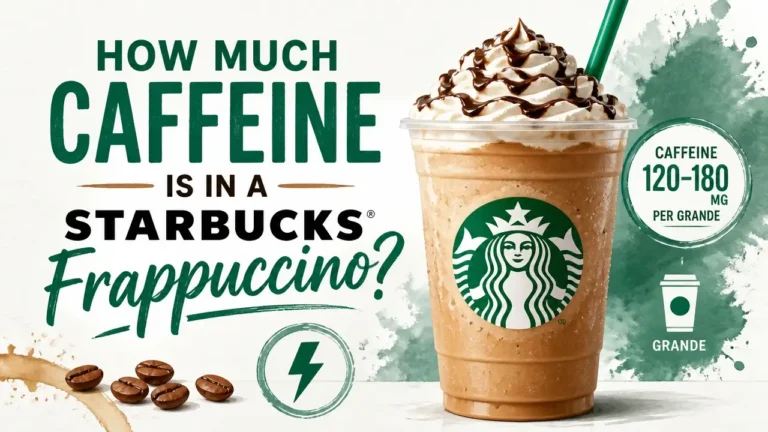

Starbucks Frappuccinos look like a single category of drink, but they split into three completely different worlds the moment you factor in caffeine. Coffee-based, crème-based, and bottled versions all follow their own rules – and the gap between the highest and lowest can be over 100 mg.
Pick the wrong one before a late-night drive or a noon nap, and you’ll feel the difference. Here’s exactly what’s in each type, by size and flavor, so you can order with your eyes open.
What’s Actually in a Frappuccino?
The Starbucks Frappuccino family splits into three distinct types, and knowing which one you’re holding is the first step to understanding your caffeine intake. The blended-ice, creamy texture is the same across all three – that’s the “dessert drink” appeal – but what’s underneath that texture is completely different depending on the type.
Here’s how the three families break down in plain terms:
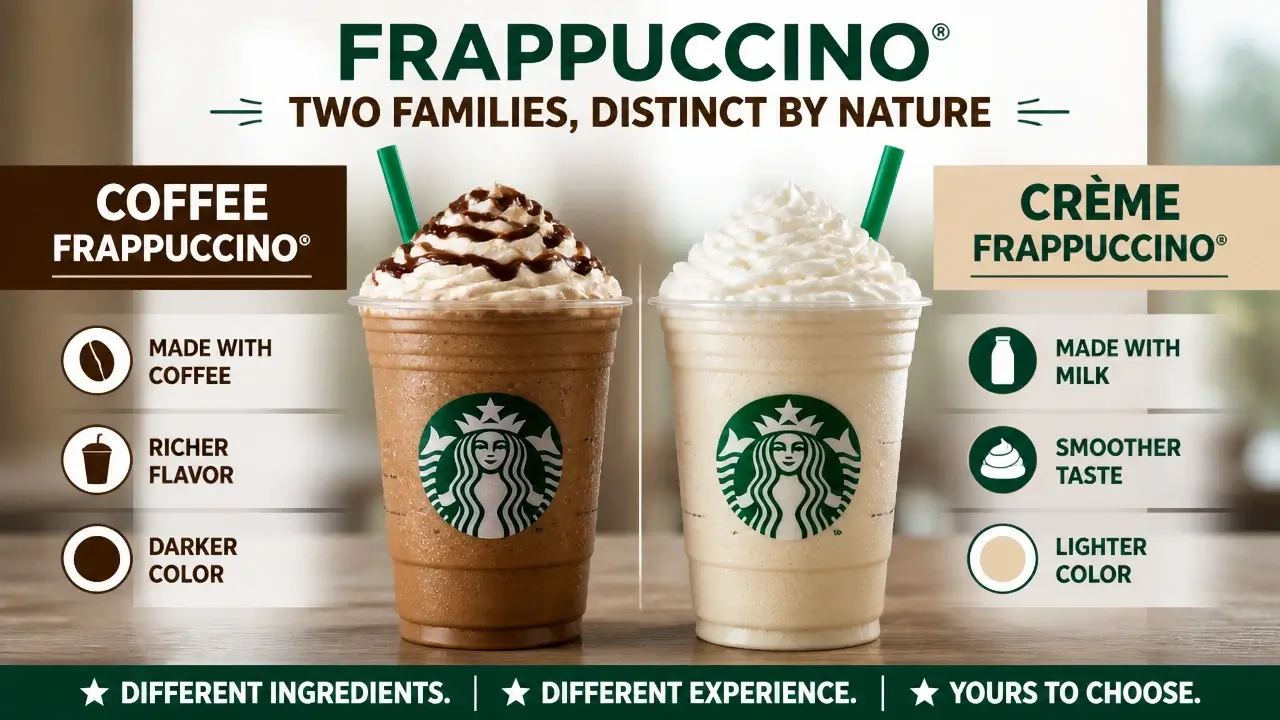
- Coffee-based Frappuccinos: These are built on a cold-extracted coffee concentrate called Frappuccino Roast – not drip coffee, not espresso by default. Think of it as a chilled coffee shot specifically designed to blend well with ice and milk. This is your Classic Coffee Frappuccino, Mocha Frappuccino, Caramel Frappuccino, and similar drinks.
- Crème-based Frappuccinos: No coffee in the base. These are built on milk, ice, sugar, and flavored syrups or powders – things like vanilla, strawberry, or matcha. The name “crème” signals the coffee-free construction, but as we’ll get into shortly, “crème” doesn’t automatically mean zero caffeine.
- Bottled Frappuccinos: The pre-made glass bottles you grab from a grocery store or gas station cooler. Same brand, very different product – a separate formulation with its own caffeine numbers that don’t always match their in-store cousins.
Starbucks serves blended Frappuccinos in three sizes: Tall (12 oz), Grande (16 oz), and Venti (24 oz). Caffeine does scale with size, but not in a perfectly straight line – the relationship depends on how many pumps of Frappuccino Roast the recipe calls for at each size.
One thing worth planting in your mind now: “crème” doesn’t guarantee a caffeine-free drink. Ingredients like matcha powder, chocolate sauce, mocha drizzle, and chai syrup all bring their own caffeine to the party, even when there’s no coffee in sight. We’ll put exact numbers on that in the next section.
Here’s a side-by-side look at the two in-store types to make the distinction concrete:
Coffee vs. Crème: The Caffeine Showdown
Caffeine content in a Starbucks Frappuccino swings from zero to nearly 185 mg depending entirely on which type you order and what’s in it. The coffee-based side delivers a predictable, moderate buzz. The crème-based side is mostly quiet – but a handful of flavors carry a hidden dose that catches people off guard.
Coffee Frappuccinos by Size
The Coffee Frappuccino’s caffeine comes from Frappuccino Roast pumps – a cold-extracted concentrate added in increasing quantities as the cup size grows. Larger sizes get more pumps, which is why the jump from Tall to Venti isn’t just about more ice and milk.
Here’s how the numbers look across the standard size lineup:
| Size | Frappuccino Roast Pumps | Caffeine Range |
|---|---|---|
| Tall (12 oz) | 2 pumps | ~65–75 mg |
| Grande (16 oz) | 3 pumps | ~85–110 mg |
| Venti (24 oz) | 4 pumps | ~115–185 mg |
The higher end of the Venti range belongs to variations like the Espresso Frappuccino, which swaps or supplements the Frappuccino Roast with actual espresso shots. A standard Coffee Frappuccino Venti lands closer to 115–130 mg, while espresso-forward versions push toward the 185 mg ceiling.
Dr. Ian van Altena, a research chemist and lead HPLC investigator at the University of Newcastle, puts a precise number on the retail formulation:
“Scientific chemical analysis reveals that a standard ‘Starbucks Frappuccino, coffee flavored’ contains significant amounts of caffeine (typically around 90 mg to 100 mg per serving in standard retail formulations, climbing higher in larger sizes), while ‘Starbucks Caffe Mocha… contains 125 mg’ of caffeine, partially driven by cocoa components.”
That mocha number is the first hint that chocolate isn’t just a flavor choice – it’s a caffeine contributor. Which brings us directly to the crème side.
Hidden Caffeine in Crème Frappuccinos
Most plain crème-based Frappuccinos are genuinely caffeine-free. Vanilla Bean and Strawberries & Crème are real zeros – no coffee, no chocolate, no hidden stimulants. If you want zero caffeine, those two are your safe harbor.
The trouble starts when you move into flavors that include matcha, chocolate, or chai. Those ingredients carry their own caffeine, and it adds up faster than most people expect.
Matcha Crème Frappuccino: Matcha is powdered whole green tea leaf, not an extract – and that matters. Research published in Current Research in Food Science* confirms that matcha’s caffeine content is higher than standard green tea because “the buds and young leaves of tea plants contain more caffeine than mature leaves,” with caffeine making up 30–40% of matcha’s soluble fraction. In practice, a Venti Matcha Crème Frappuccino delivers roughly 70–85 mg of caffeine – comparable to a Tall coffee-based version.
- Chocolate-based crèmes (Mocha, Double Chocolaty Chip, Cookie Crumble): Cocoa and chocolate sauce both contain caffeine. A University of Wisconsin-Stout thesis analyzing methylxanthines in chocolate via HPLC found an average caffeine content of roughly 30 mg per 40 g of dark chocolate, with theobromine levels running even higher. In a Frappuccino, you’re not getting 40 g of chocolate, but even a moderate mocha sauce or chocolate drizzle contributes 10–20 mg.
- Chai Crème Frappuccino: Chai concentrate contains black tea, which means caffeine. Expect 25–45 mg depending on the size.
The practical rule is simple: if the flavor name includes chocolate, matcha, or chai – even on the crème menu – you’re getting some caffeine. If your goal is a true zero, stick with Vanilla Bean or Strawberries & Crème and skip the chocolate drizzle on top.
How Frappuccinos Stack Up Against Other Drinks
Positioned against other Starbucks staples at Grande size, the Coffee Frappuccino lands squarely in the middle of the caffeine league table – not a lightweight, but nowhere near the top.
Using publicly available Starbucks nutrition data, here’s how a Grande Coffee Frappuccino (~85–110 mg) compares to other Grande drinks you might already know:
- Grande Latte (2 espresso shots): ~150 mg
- Grande Iced Coffee: ~165 mg
- Grande Cold Brew: ~200 mg
- Grande Coffee Frappuccino: ~85–110 mg
According to Starbucks beverage nutritional data, the Cold Brew nearly doubles the caffeine of a standard Coffee Frappuccino at the same size. A Latte comes in about 40–65 mg higher. So if you’ve been treating your Frappuccino like a dessert with a “little” caffeine, that’s mostly accurate – but it’s not negligible either.
One honest footnote: Frappuccinos also carry significantly more sugar and calories than any of those comparison drinks. A Grande Coffee Frappuccino typically runs 230–370 calories depending on customizations, versus roughly 190 calories for a Grande Latte with 2% milk. This isn’t a health lecture – it’s just context for what “dessert beverage” actually means on a nutrition label.
For a casual drinker trying to gauge whether a Frappuccino fits their afternoon, the short answer is: it’s a moderate caffeine drink dressed in a milkshake. Not a red-eye, not a decaf.
Bottled Frappuccinos and Their Caffeine Surprise
Bottled Frappuccinos – the 13.7 oz glass bottles in the cooler – are a separate product from the blended in-store version, and their caffeine numbers follow their own logic. Most people grab them the same way they’d grab a soda, without checking the label. That habit can backfire depending on which flavor you picked up.
The typical bottled Frappuccino range runs 75–130 mg per bottle, with the standard Coffee flavor generally landing around 110 mg. That puts a single bottle roughly in line with a Grande in-store Coffee Frappuccino – a meaningful energy lift, not a casual sip.
The flavor on the label is doing more work than most people realize:
- Vanilla and Pumpkin Spice bottles: As low as 45 mg – the lightest end of the bottled lineup.
- Coffee and Mocha bottles: 75–110 mg – nearly double the buzz of the lighter flavors from the same-looking bottle.
One honest caution worth flagging: different sources report the bottled Coffee Frappuccino’s caffeine as either 110 mg or 130 mg, and the discrepancy doesn’t have a clean official resolution. As Dr. Desbrow et al., writing in the Journal of Food Composition and Analysis, put it:
“It is recognised that beverages with caffeine as a natural component will have a wide range of caffeine levels. These variances are probably the result of many factors which include… effects of commercial processing and storage along with variances at the retail level…”
That’s not a dodge – it’s the real reason third-party caffeine databases sometimes disagree. Processing batches vary, storage conditions shift concentrations, and retailers don’t always carry the same production run. When you need a precise number, flip the bottle and read the label directly. Third-party data is a useful estimate, not a guarantee.
The practical bottom line: reach for Vanilla or Pumpkin Spice when you want a lighter option, grab Coffee or Mocha when you want the full lift, and always glance at the label when it actually matters.
Ordering a Frappuccino That Works for You
Frappuccino customization options give you more control over your caffeine than most people use. Whether you want zero buzz, a gentle lift, or a real kick, the levers are already built into the menu – you just need to know which ones to pull.
For zero caffeine: Go crème-based and stay away from chocolate, matcha, and chai. The Vanilla Bean Crème Frappuccino and Strawberries & Crème Frappuccino are genuinely caffeine-free – no hidden sources, no surprises. Skip any toppings that include mocha drizzle or chocolate chips, and you stay at zero.
For a mild buzz: A Tall coffee-based Frappuccino lands around 65–75 mg – a light lift comparable to a single espresso shot. It’s enough to feel something without committing to an afternoon of extra energy.
For a bigger kick from a crème base: Ask for an added espresso shot. Every extra shot adds roughly 75 mg of caffeine, which lets you take a crème-based flavor you love and turn it into a coffee-boosted drink. You keep the flavor profile, you control the caffeine level.
For a small boost without the espresso flavor: Ask for an extra pump of Frappuccino Roast. One additional pump adds approximately 30 mg – useful when you want slightly more energy without the distinct espresso taste that a full shot brings.
The simplest move of all: Downsize. Going from Venti to Grande, or Grande to Tall, cuts caffeine significantly without changing a single ingredient in your order. No special requests, no barista explanations needed.
Here’s a quick visual summary of your ordering options by caffeine goal:
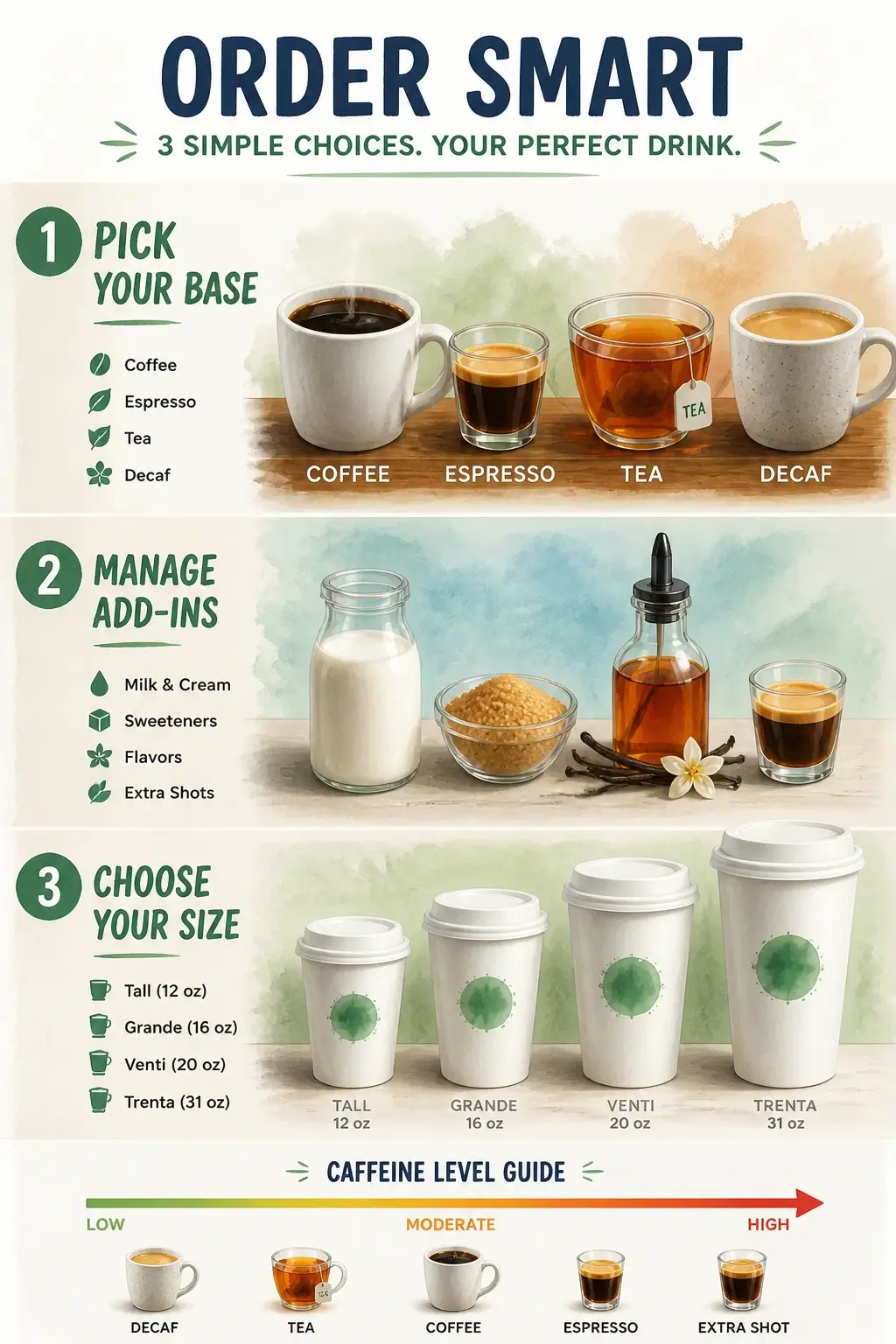
You now know where the caffeine hides in every version of this drink – the blended base, the crème add-ins, and the bottles in the cooler. Three moves cover almost any scenario: pick your base wisely, watch what goes into it, and size down when in doubt.
Key Takeaways on Starbucks Frappuccino
- Coffee-based Frappuccinos range from about 65 mg (Tall) to 185 mg (Venti espresso variations), driven by Frappuccino Roast pumps per size.
- Most crème-based Frappuccinos are genuinely caffeine-free, but matcha, chocolate, and chai versions deliver 10–85 mg depending on the flavor and size.
- A Grande Coffee Frappuccino (~85–110 mg) sits below a Grande Latte (150 mg) and well below a Grande Cold Brew (200 mg).
- Bottled Frappuccinos are a separate product; Coffee and Mocha bottles reach 75–110 mg, while Vanilla and Pumpkin Spice can be as low as 45 mg.
- Adding one espresso shot to any Frappuccino adds roughly 75 mg; one extra Frappuccino Roast pump adds about 30 mg.
- Vanilla Bean Crème and Strawberries & Crème are the only reliably zero-caffeine Frappuccino options, as long as you skip chocolate toppings.
Frequently Asked Questions About Starbucks Frappuccino
How much caffeine is in a 13.7 oz bottled Starbucks Frappuccino?
The standard Coffee-flavored bottle typically contains 110–130 mg of caffeine per 13.7 oz bottle, though the exact number varies by production batch and flavor. Lighter flavors like Vanilla or Pumpkin Spice can be as low as 45 mg, so the label on the specific bottle you’re holding is always the most reliable source.
Can I order a Frappuccino with no caffeine at all?
Yes – but you have to be specific. Vanilla Bean Crème and Strawberries & Crème are genuinely caffeine-free, provided you don’t add chocolate drizzle, mocha sauce, or any topping that contains cocoa. Any crème Frappuccino that includes chocolate, matcha, or chai will carry some caffeine even without a coffee base.
Does the Caramel Frappuccino have caffeine?
Yes, it does – the caramel flavor itself doesn’t contribute caffeine, but a Caramel Frappuccino is coffee-based by default, built on Frappuccino Roast. A Grande lands in the 90–110 mg range, same as a standard Coffee Frappuccino at that size.
What happens to caffeine if I ask for “light” or “skinny” modifications?
Ordering a Frappuccino “light” swaps in nonfat milk and sugar-free syrup, which reduces calories and sugar – but it doesn’t change the number of Frappuccino Roast pumps. Your caffeine level stays the same as the standard version at that size.
Is a Frappuccino strong enough to actually keep me awake?
A Grande Coffee Frappuccino at 85–110 mg is in the same range as a moderate cup of coffee, so yes, it can keep most people alert for a few hours. It’s not a high-caffeine drink compared to Cold Brew, but it’s not a sleepy-time beverage either – ordering one after 3 PM can affect sleep for caffeine-sensitive people.
Why do different websites list different caffeine numbers for the same Frappuccino?
Caffeine in coffee-based beverages isn’t perfectly uniform – it varies with bean lots, extraction batches, and how long a product has been in storage. Third-party databases often pull from different testing dates or production runs, which is why you’ll see a 10–20 mg spread on the same drink across different sources. Starbucks’s own published nutrition data is the closest thing to an official number.
Can I reduce caffeine in an in-store Frappuccino without switching to crème?
Yes. Ask for fewer pumps of Frappuccino Roast – one less pump on a Grande takes off roughly 25–30 mg. You can also downsize from Grande to Tall, which removes one full pump and cuts caffeine by about 20–35 mg without changing the flavor profile.
Does a Frappuccino have more caffeine than a can of Coke?
A 12 oz can of Coke contains about 34 mg of caffeine, so even a Tall Coffee Frappuccino at 65–75 mg has roughly double that. A Grande or Venti version significantly outpaces a soda – the Frappuccino is in a different caffeine category despite looking like a dessert drink.
References
- The Therapeutic Potential of Matcha Tea: A Critical Review on Human and Animal Studies – pmc.ncbi.nlm.nih.gov
- Identification and Quantification of Flavanols and Methylxanthines in Chocolates with Different Percentages of Chocolate Liquor – uwstout.edu
- Starbucks Beverage Nutritional Facts – starbuckspr.com
- Journal of Food Composition and Analysis – sciencedirect.com
high caffeine drinks like the Cold Brew nearly doubles the caffeine of a standard Coffee Frappuccino at the same size. A Latte comes in about 40–65 mg higher. So if you’ve been treating your Frappuccino like a dessert with a “little” caffeine, that’s mostly accurate – but it’s not negligible either.