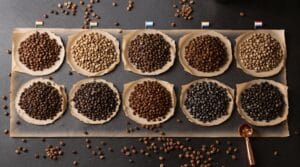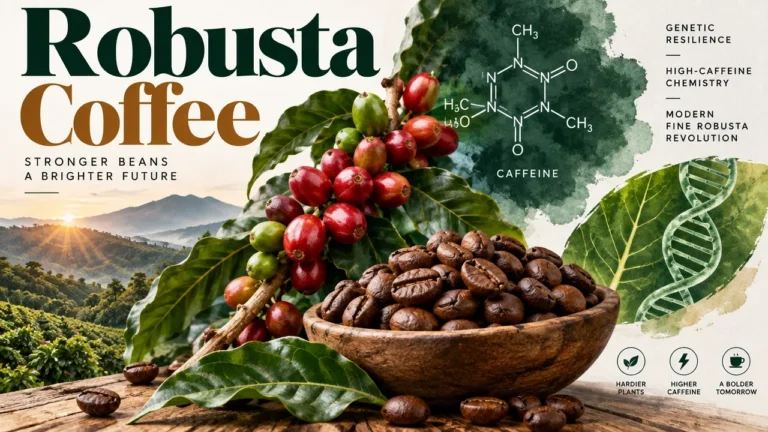

Misread Robusta coffee gets dismissed as cheap commodity filler – a species fit for instant blends and nothing more. That verdict was always based on the worst examples of a category defined by poor post-harvest handling, not by the plant’s actual chemistry or potential.
The real picture is more interesting. Coffea canephora carries molecular armor that Arabica cannot match, drives the crema in your espresso, and – when processed correctly – produces cups that cup-trained palates score above 90. Understanding why starts with the plant itself.
Key Takeaways on Robusta Coffee
- Robusta is Coffea canephora, a diploid species with 22 chromosomes native to lowland equatorial Africa – not a quality grade or a commodity category.
- Caffeine at 2.2%–2.7% functions as a neurotoxic alkaloid deterrent, but gut microbiota in coffee berry borer can degrade it, meaning caffeine concentration alone does not guarantee pest resistance.
- Robusta’s lower sucrose (3%–5% vs. Arabica’s 6%–9%) and lower lipid content (10% vs. 15%–17%) are measurable composition differences that directly explain its boldness, viscous mouthfeel, and superior espresso crema stability.
- Climate models project up to 50% loss of highly suitable Arabica growing environments by 2050, making C. canephora‘s heat tolerance and lowland adaptability a structural necessity for global coffee supply.
- Bad Robusta was a post-harvest failure: strip-picking, dirt-road drying, and high defect tolerances – not species biology – created the stigma.
- Fine Robusta processed with anaerobic fermentation, honey methods, and selective picking has scored above 90 points under CQI standards, with descriptors including honey, lemon, cocoa, and jackfruit.
Coffea canephora’s Lowland Evolutionary Strategy
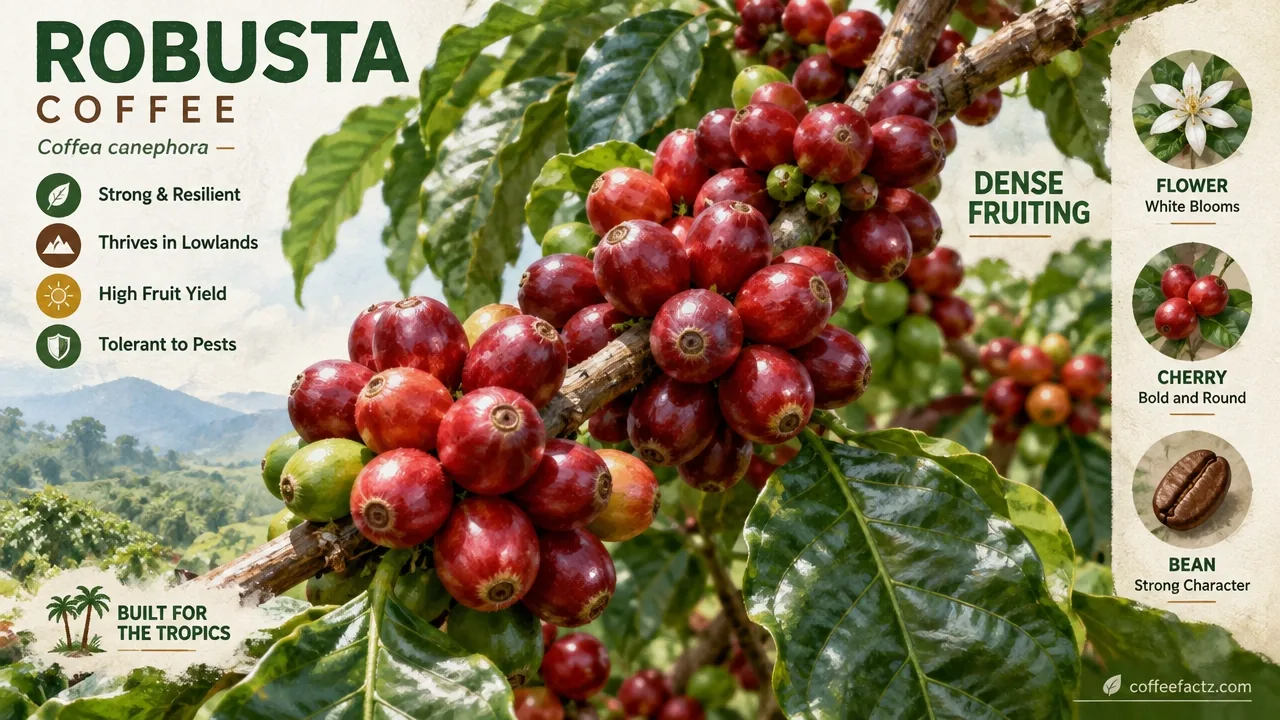
Robusta coffee is not a marketing grade or a quality tier. It is Coffea canephora: a diploid plant carrying 22 chromosomes, built by evolution for the lowland equatorial river basins of Western and Central Africa. That chromosome count matters immediately when you set it against Arabica’s 44-chromosome tetraploid genome. Arabica is a genetic hybrid, a natural cross between C. canephora and C. eugenioides that happened somewhere on the Ethiopian plateau. Robusta is older, simpler at the genomic level, and far more ecologically aggressive.
Its native range runs through the Congo Basin and into Uganda, in environments that would kill a healthy Arabica plant within a season. Where Arabica needs altitude, cool nights, and precise rainfall distribution at 1,000 to 2,000 meters, C. canephora occupies the zone from sea level to roughly 800 meters, in temperatures between 24°C and 30°C. The root system runs deep and wide. The canopy is dense. The plant is not fragile.
That ecological positioning is not accidental. It reflects a species-level survival strategy built around a specific set of chemical and structural defenses – the same defenses that shape every sensory property roasters and buyers deal with downstream.
Pest and Disease Resistance as a Chemical Strategy
The resistance of C. canephora to coffee berry borer (Hypothenemus hampei) and coffee leaf rust (Hemileia vastatrix) is routinely cited as a resilience asset. What gets skipped is the mechanism. This resistance is not a passive structural trait. It is the downstream expression of a chemical architecture the plant evolved to deter herbivory and fungal pressure – the same chemistry that makes Robusta taste the way it does in the cup. The next section traces exactly how that works.
One agronomic lever worth noting here: grafting Arabica scions onto C. canephora rootstock is standard practice in Indonesia, using Robusta’s root system as a biological shield for more commercially valuable Arabica canopy. Outside Indonesia, this technique remains severely underused. Most Robusta-producing origins have not scaled it, which means they are leaving a proven rootstock resilience tool on the table.
Chemical Armor and Molecular Flavor in Robusta
The boldness of Robusta in the cup and its resistance to pests in the field come from the same molecules. This is not a coincidence. The plant synthesizes these compounds as a survival mechanism, and roasters inherit the sensory consequences of that strategy every time they charge a drum.
Alkaloid and Phenolic Defenses
Caffeine is the primary weapon. C. canephora carries 2.2% to 2.7% caffeine by dry weight, compared to 1.2% to 1.5% in Arabica. At the molecular level, caffeine inhibits phosphodiesterase and interferes with DNA repair in insects that consume it, functioning as a neurotoxic alkaloid. The working hypothesis has long been that this concentration deters herbivory, including pressure from the coffee berry borer.
A 2015 study published in Nature Communications added a critical complication to that story. Researchers found that H. hampei gut microbiota actively degrade caffeine, and that antibiotic-treated insects – stripped of those microbiota – lost the ability to detoxify it. Reintroducing Pseudomonas fulva restored caffeine degradation. The study also found no statistically clean correlation between bean caffeine concentration across Coffea species and actual H. hampei resistance, with C. canephora caffeine content recorded at 1.7%–2.4% in their measurements. The honest read: caffeine concentration alone does not lock in borer resistance. It is a significant deterrent, not an impenetrable wall.
Chlorogenic acids (CGAs) work alongside caffeine. These phenolic compounds are present at higher concentrations in Robusta than in Arabica, and they contribute to both the plant’s phenolic defense layer and the cup’s characteristic boldness and dry finish. The relationship between CGA concentration and resistance to coffee leaf rust is less direct than often presented – available data suggest increased leaf CGA did not reliably reduce rust severity in controlled conditions. Treat CGA as a key flavor molecule and a component of the chemical defense system, but not as a single-variable resistance guarantee.
“Despite the significant genetic-environment (GE) effects, the caffeine and chlorogenic acid content primarily exhibited genetic control. In comparison to caffeine content, chlorogenic acid content showed a stronger environmental influence, resulting in more variations in genotype performance across different environments.” – From research by Embrapa, Brazil’s Agricultural Research Corporation
This finding has direct implications for buyers and roasters. Caffeine levels across lots from the same origin will be relatively stable – that is genetics holding firm. But CGA concentrations, and therefore the phenolic boldness and dry astringency in the cup, will shift with altitude, soil, rainfall, and processing environment. When you taste variation in Robusta’s bitterness profile across origins, you are tasting CGA’s environmental sensitivity, not random inconsistency.
Sugar, Aromatics, and Mouthfeel
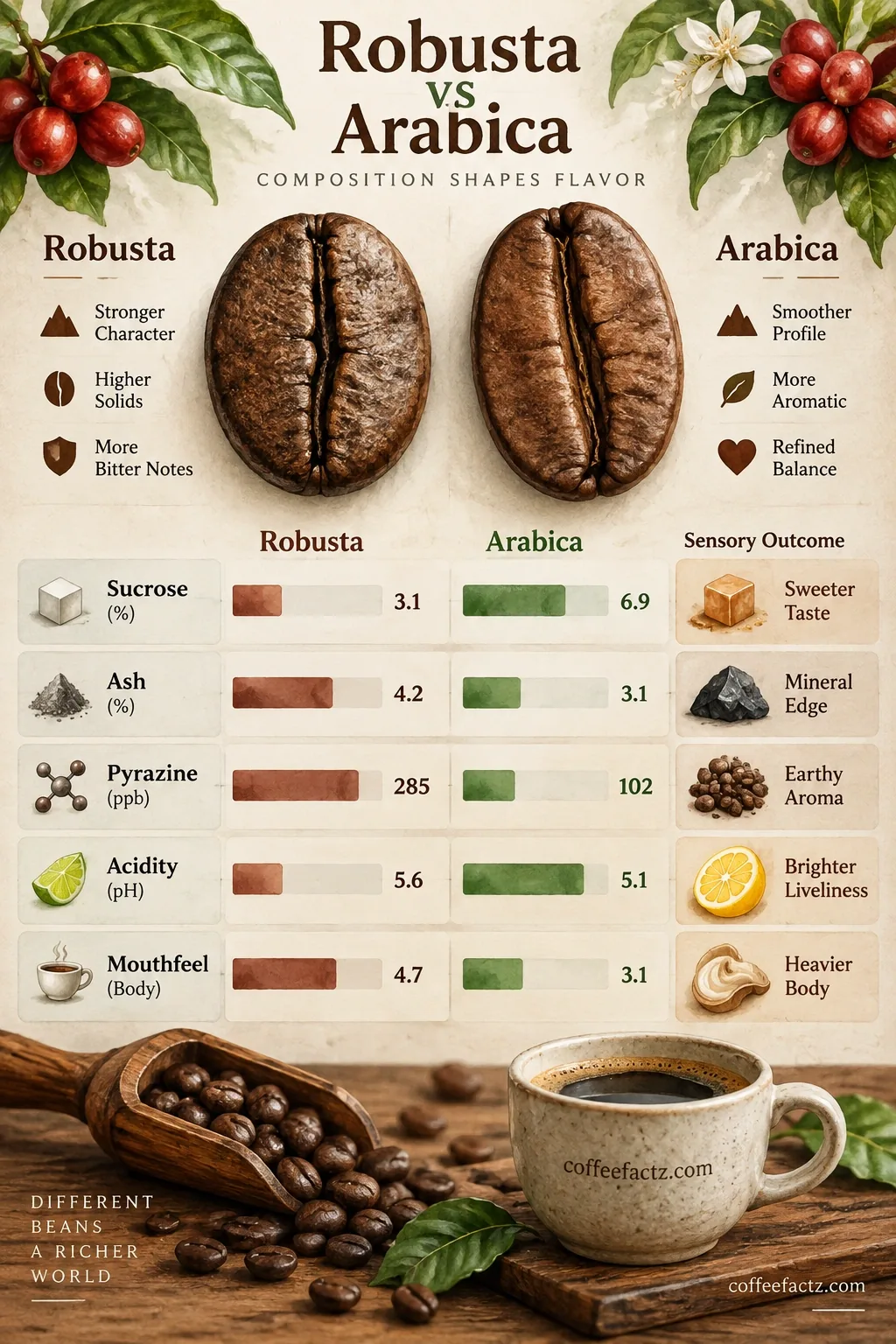
The flavor gap between Robusta and Arabica is not a matter of quality destiny. It is a measurable composition difference that starts with sucrose. Arabica carries 6%–9% sucrose by dry weight. Robusta carries 3%–5%. That gap means roughly 60% more sugar available for caramelization in Arabica during roasting – more Maillard reaction products, more sweetness, more of the fruit-adjacent brightness that specialty coffee consumers recognize.
Robusta compensates with a different aromatic architecture. High ash content and elevated pyrazine concentrations produce the signature notes most experienced tasters associate with the species: dark chocolate, toasted hazelnut, earth, and wood. These are not defect descriptors. They are the predictable aromatic output of a low-sugar, high-alkaloid bean moving through thermal development.
Acidity is structurally absent in a way that Arabica cannot replicate downward. Robusta carries virtually none of the citric or malic acid brightness that defines washed Ethiopian or Colombian cups. What fills that space instead is a heavy, viscous mouthfeel – a physical weight in the cup driven by the bean’s density and molecular composition. For espresso, this is a functional asset. In filter applications, it requires deliberate processing and roast design to read as body rather than flatness.
Why Robusta Builds Better Espresso Crema
Espresso crema from Robusta is denser, more persistent, and more structurally stable than Arabica crema – and the reason is not roast level or grind setting. It is physical chemistry.
Robusta carries roughly 10% lipids by dry weight. Arabica runs 15%–17%. Lower lipid content means less oily material coating the surface of the emulsion. What you get instead is a tighter, more stable foam matrix – crema that holds its structure in the cup rather than collapsing into an oily sheen within 30 seconds. That persistence is the functional signature roasters and baristas working in traditional Italian espresso have relied on for decades.
The bean density of C. canephora adds another layer. The cellular structure is rigid, behaving like denser grains even when apparent density measurements do not always reflect this. In the espresso basket, this translates to more consistent resistance to water flow, which supports even extraction and contributes to the heavy, coating mouthfeel that defines a southern Italian-style shot. Roasters predicting heat transfer and development during roasting need to account for this cellular rigidity – Robusta does not respond to heat the same way Arabica does, and profiling it identically is a common mistake.
The historic role of Robusta in traditional Italian espresso blends – particularly in Naples and the broader southern Italian tradition – was never accidental. Blenders chose it because crema performance, body, and caffeine delivery met the functional demands of that brewing context. That functional advantage remains real. It does not, by itself, indicate cup score or sensory complexity. Crema is a structural outcome, not a quality verdict.
Agronomic Economics and Robusta’s Climate Position
Robusta coffee is not the industry’s climate backup plan because of branding. It is the backup plan because the arithmetic of where coffee can be grown is changing, and C. canephora is the species that fits the zones Arabica is losing.
Temperature Pressure and Suitable Zones
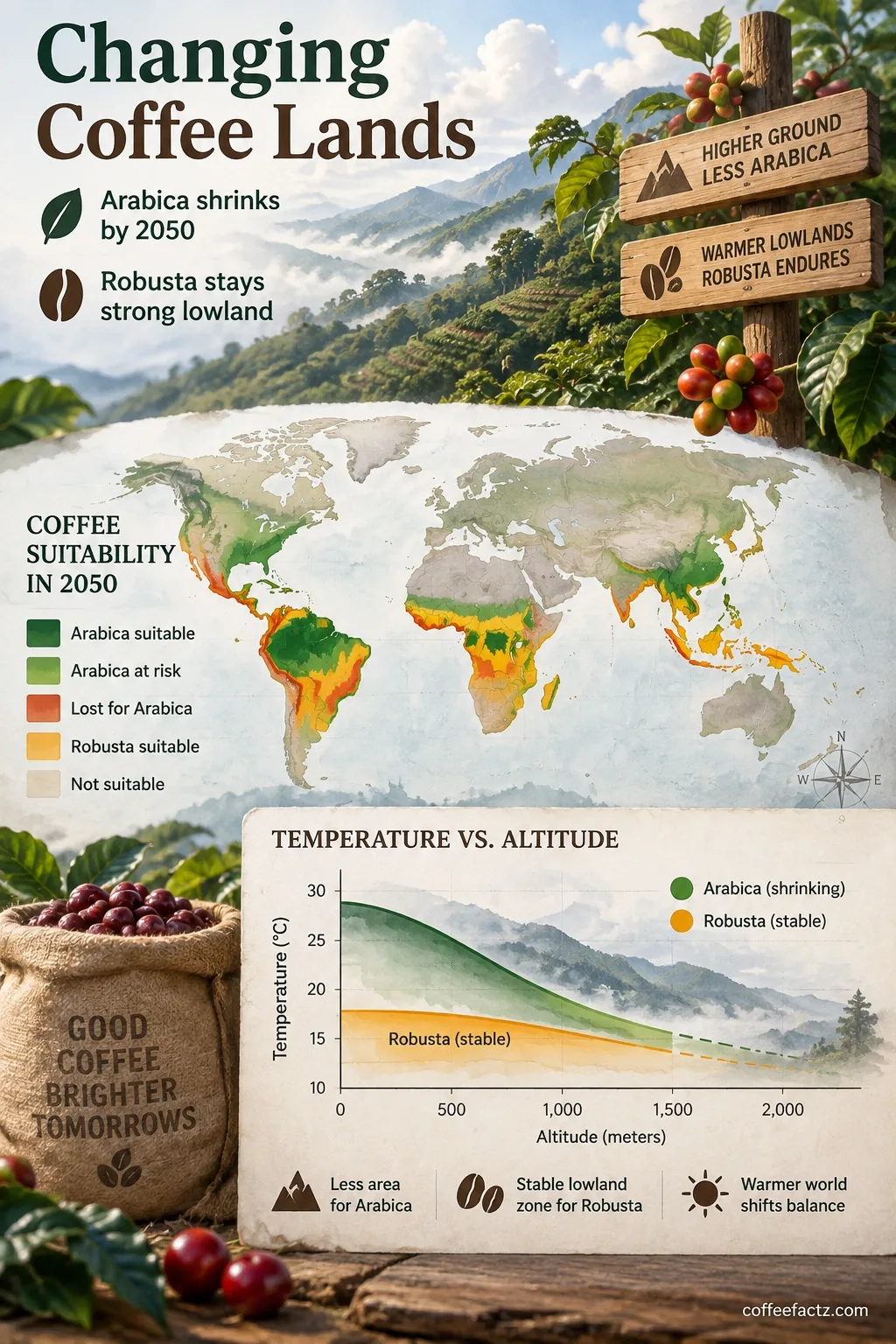
Rising global temperatures and increasingly erratic rainfall are compressing the altitude bands and temperature windows where Arabica grows well. C. canephora occupies the zone those climate shifts are expanding: sea level to 800 meters, sustained temperatures of 24°C–30°C, and tolerance for the kind of heat events that damage Arabica flowering and fruit development.
The strategic gap is quantifiable. Climate projections suggest that highly suitable Arabica growing environments could shrink by as much as 50% by 2050, across major producing regions in Latin America, East Africa, and Southeast Asia. Robusta does not face an equivalent contraction in the same timeframe. Its ecological range aligns with the lowland tropical zones that climate models show expanding, not shrinking.
“In the medium and long term, our strategy is to pursue the introgression of traits from C. canephora into Arabica. That work has begun.” – Dr. Lucile Toniutti, WCR Molecular Breeder, CIRAD
That introgression strategy – moving Robusta’s heat tolerance and pest resistance genes into Arabica’s genetic background – is the long-horizon play for the industry. It is not a short-term solution. In the near term, the species itself carries the climate resilience the industry needs at scale.
Cultivation Requirements and Market Tradeoffs
C. canephora requires 1,500–3,000 mm of annual rainfall, soil pH between 5.5 and 7.0, and post-harvest fermentation windows of 12–48 hours depending on method and ambient temperature. Moisture at export should sit around 11% – tight enough to prevent mold during transit, not so low that the bean becomes brittle. Yields reach 2,000–3,000 kg per hectare under good management, compared to Arabica’s typical 600–1,200 kg/ha range. That yield differential is a major driver of farm-level economics across producing regions.
Vietnam’s Robusta coffee has accounted for approximately 40% of global Robusta production, sometimes reaching 60–70%, with average productivity of 2.8 tonnes per hectare. – Source: VietnamNet
Vietnam is not a marginal Robusta producer that punches above its weight. It is the structural center of global Robusta supply. The economics of that position are built on vigorous root systems, high per-hectare productivity, and a lowland climate that matches C. canephora‘s ecological requirements almost exactly. Lower cost per kilogram is a function of those biological realities, not evidence of lower potential quality.
The expansion of Robusta cultivation carries real tradeoffs that the climate-resilience narrative tends to smooth over. Labor requirements, land-use change, soil health under intensive monoculture, and the social economics of smallholder farming in major producing regions are all legitimate variables. Treating Robusta expansion as a simple substitution for shrinking Arabica land ignores the complexity of that transition at the farm and community level.
The Fine Robusta Revolution and CQI Standards
Fine Robusta as a category exists because the “bad Robusta” problem was never a species problem. It was a post-harvest problem. Understanding that distinction is the single most important mental shift for anyone buying or roasting Robusta in a specialty context.
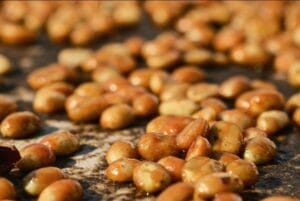
The commercial Robusta that built the species’ reputation for harshness and defects was produced under conditions that would ruin any coffee. Strip-picking of unripe and overripe cherries together. Drying on bare dirt roads with no moisture monitoring. Defect tolerances that would fail a commodity Arabica lot. The cup quality that came out of that system was a direct output of those inputs – not evidence of what C. canephora is capable of producing under controlled conditions.
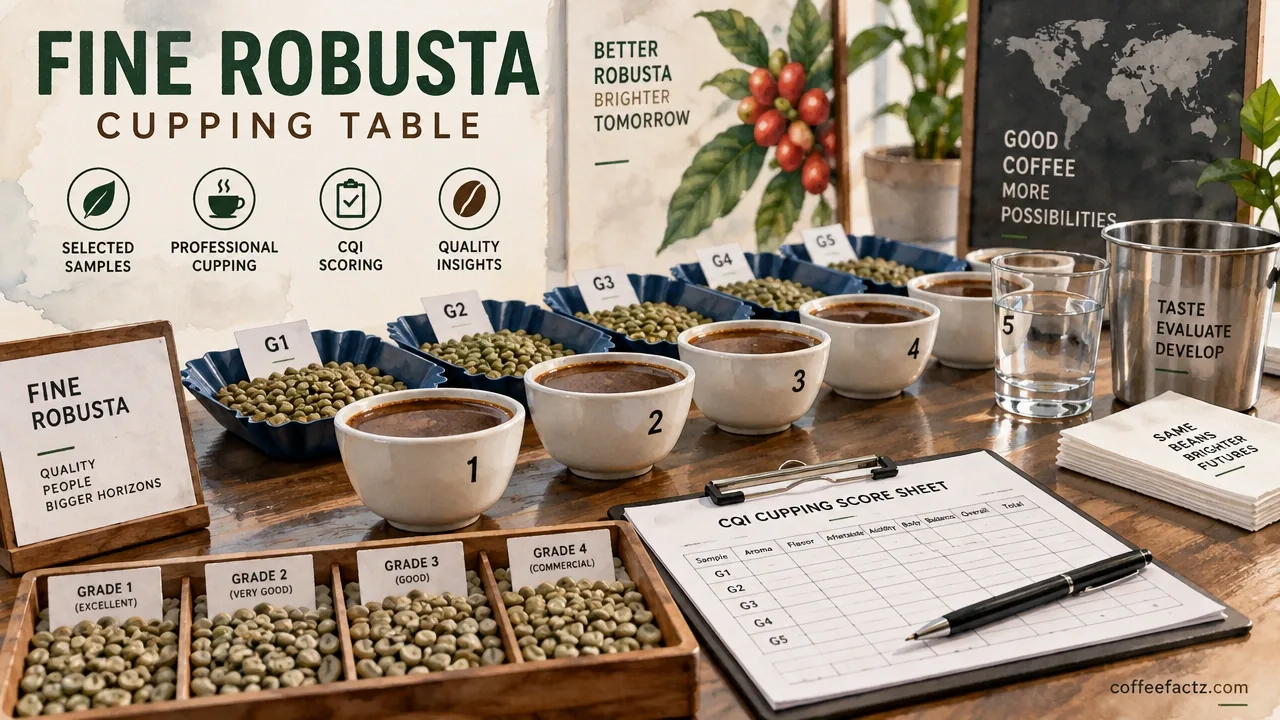
The Coffee Quality Institute (CQI) Fine Robusta grading system changed the evaluative framework. It assesses clean cup, sweetness, and the integrity of processing protocols across the seed-to-cup chain. Moisture at export is held to 10.5%–11.5%. Defect counts are graded rigorously. Storage and transport discipline are part of the quality audit. The system gives buyers and roasters a shared language for evaluating Robusta on its own sensory terms – not as a failed Arabica, but as a distinct species with its own quality ceiling.
That ceiling is higher than most of the industry has acknowledged. Fine Robusta lots evaluated under CQI protocols have scored above 90 points, with tasting notes that include tea, lemon, honey, caramel, cocoa, banana, and jackfruit. These descriptors are not marketing language. They are the sensory output of genetically diverse C. canephora material processed with precision. They are also not yet the industry consensus – Fine Robusta at that quality level remains a relatively small portion of total Robusta production, and the claim that Robusta can be “sweet, complex, and challenging to the inherently inferior” narrative should be positioned as the article’s differentiated claim, not a settled market reality.
Modern Processing and Roast Architecture for Fine Robusta
Processing is where Fine Robusta potential is either realized or lost. The species has the genetic raw material for clean complexity. Getting it into the cup requires deliberate protocol design, not a scaled-up version of what works for washed Arabica.
Fermentation Innovations and Hand-Sorting Protocols
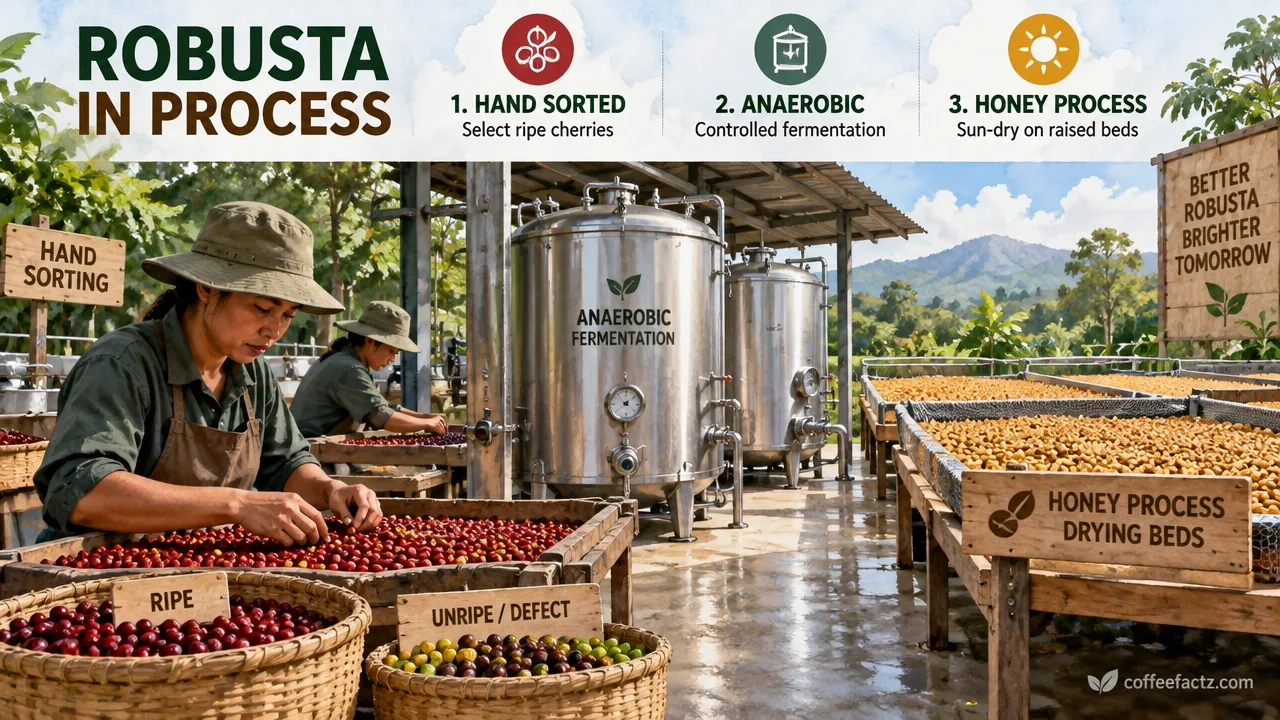
The processing methods driving the best Fine Robusta results right now are anaerobic fermentation, honey processing, and selective hand-picking – applied in Vietnam, Uganda, and India by producers who treat lot-level documentation as a core part of their quality system.
Anaerobic fermentation, when applied to Robusta, creates conditions where lactic acid bacteria and other microorganisms work on the mucilage without oxygen, generating flavor precursors that translate into cacao, spice, and molasses clarity in the roasted cup. Honey processing – leaving varying amounts of mucilage on the parchment during drying – adds body and sweetness that Robusta’s low sucrose content would otherwise limit. Selective hand-picking, the most labor-intensive variable, eliminates the unripe-cherry defect problem at the source.
“The new trends in processing robusta are using fermentation as a crucial step to improve quality. Fermented robustas are often cited as cleaner and show a wider spectrum of descriptors – mostly winey, whiskey, and some positive herbal notes.” – Dr. Veronica Belchior, WCR Research Scientist for Coffee Quality Evaluation, Specialty Coffee Association
These are emerging tools, not universal guarantees. A fermentation log from a Vietnam producer running 36-hour anaerobic tanks does not automatically produce a 90-point lot. Microbial environment, ambient temperature, cherry quality at intake, and drying conditions all interact. The discipline is in demanding lot-level fermentation logs – specific time windows, temperature records, and pre-fermentation cherry sorting data – so you can connect protocol to cup outcome before committing to volume.
Thermal Development and Lot Documentation
Roasting Robusta on an Arabica profile is the fastest way to underextract it or burn it. The cellular structure of C. canephora is more rigid, which changes how heat transfers through the bean during development. Roasters working with Fine Robusta lots consistently report that the approach requires a higher charge temperature, a slightly longer development phase, and a final temperature roughly 5–7°C higher than their Arabica baseline for equivalent roast degree.
First crack in Robusta is less audible than in Arabica – the rigid cell walls do not release pressure with the same dramatic pop. Roasters who rely on first crack as their primary development cue will miss it or misread it. Build your profile around time-temperature curves and rate-of-rise data, not sound.
The documentation requirement connects directly to the fermentation discipline discussed above. Before you finalize a roast profile for a new Fine Robusta lot, you need the producer’s fermentation log: the window length, the method, the moisture at parchment and at green, and the storage conditions between processing and export. A 12-hour natural fermentation lot and a 48-hour anaerobic lot from the same farm in the same harvest season will behave differently in the drum and produce different sensory outcomes. Profile them separately. Treat the documentation as part of the technical specification, not background paperwork.
Sourcing Fine Robusta Without Getting Burned
Traceability is the non-negotiable entry point for Fine Robusta buying. A cupping score and a price sheet are not a sourcing strategy. They are the beginning of a verification process.
Start with the physical attributes before you cup. Screen size consistency, defect counts per 300g sample, and moisture at delivery should align with CQI Fine Robusta parameters before the coffee goes into your grinder. A lot that cups reasonably well but arrives at 13% moisture has a storage problem that will degrade quality on your timeline, not the producer’s. Defect counts above Fine Robusta thresholds mean the picking and sorting protocol broke down somewhere – and that breakdown will show in the cup as inconsistency across the bag.
Establish contracts using standard Incoterms – FOB is the most common point of transfer for green coffee from producing origins, and it defines clearly where producer responsibility ends and buyer responsibility begins. Always sample before committing to volume. A single cupping session on a 200g sample from a 20-bag lot is not sufficient verification. Request multiple samples across the lot, cup them on separate days, and look for consistency rather than peak performance.
For US importers: FDA registration of your supplier and importer of record is a compliance requirement, not a quality signal. Verify it, but do not conflate regulatory compliance with lot-level quality assurance. They address different risks.
The climate-resilience narrative around Robusta is accurate at the species level. C. canephora will survive in zones where Arabica cannot. But species-level resilience does not transfer automatically to farm-level invulnerability. Smallholder Robusta farms in Vietnam, Uganda, and India face their own climate pressures: shifting rainfall timing, pest pressure evolution, and soil health under intensive cultivation. Require lot-specific disclosures – not just origin claims – that cover climate risk, processing protocol, and quality audit data. The species is resilient. The farm still needs to be verified.
For roasters entering Fine Robusta for the first time: approach it as a distinct specialty category with its own agronomy, chemistry, processing logic, and roast architecture. For green buyers: the verification tools are the same ones you use for specialty Arabica, applied with Robusta-specific parameters. For agronomists advising producing regions: the yield and climate economics are compelling, but the quality premium only materializes when post-harvest infrastructure matches the biological potential of the plant. For specialty adventurers: the 90-point Robusta cup exists. It tastes like nothing the commercial category prepared you for. Find a CQI-graded Fine Robusta lot from a producer with documented fermentation protocols, and cup it blind before you read the label.
Frequently Asked Questions About Robusta Coffee
Why does Robusta have more caffeine than Arabica?
Caffeine synthesis in C. canephora is primarily under genetic control, meaning the species is hardwired to produce higher concentrations – roughly 2.2%–2.7% versus Arabica’s 1.2%–1.5%. This is an evolved defense mechanism against herbivory, not a processing or roasting variable.
Can Robusta be used in specialty single-origin filter coffee, or is it only suited to espresso?
It can be used in filter, but it requires deliberate processing and roast design to read as body rather than flatness. Fine Robusta lots from Uganda and India processed with anaerobic or honey methods have produced filter cups with genuine complexity – the key is matching the brewing method to the lot’s specific sensory profile, not to a generic Robusta assumption.
What makes Fine Robusta different from commercial-grade Robusta?
The difference is almost entirely post-harvest. Fine Robusta requires selective picking of ripe cherries, controlled fermentation with documented time windows, moisture management to 10.5%–11.5%, and rigorous defect sorting. Commercial Robusta historically skipped most of those steps.
How does chlorogenic acid concentration change across different Robusta origins?
Embrapa’s research shows that CGA content has stronger environmental sensitivity than caffeine – the same genotype will produce different CGA levels depending on altitude, soil, and rainfall. This means the phenolic boldness and dry finish you taste in a Vietnamese Robusta will differ meaningfully from an equivalent genetic lot grown in Uganda.
Why is Robusta’s first crack less audible during roasting?
The cellular structure of C. canephora is more rigid than Arabica’s, so internal pressure releases more gradually during thermal development. Roasters relying on first crack as a primary development cue will either miss it or misinterpret the timing – rate-of-rise curves and time-temperature data are more reliable guides for Robusta profiles.
Is Vietnam’s dominance in Robusta production a quality ceiling or just a volume story?
Both, for now. Vietnam produces at extraordinary scale – around 40% of global Robusta supply at roughly 2.8 tonnes per hectare – but the quality infrastructure for Fine Robusta is still scaling. Producers running documented fermentation protocols are producing exceptional lots, but they represent a fraction of total national output.
What should I ask a Robusta supplier before committing to a container?
Request the fermentation log (method, time window, ambient temperature), moisture at green, screen size distribution, defect count per 300g, and storage conditions since processing. Verify FDA registration for US imports. Cup multiple samples from across the lot, not just the top-of-bag selection.
Will Robusta genetics eventually be bred into Arabica varieties to improve climate resilience?
This is already underway. WCR’s Dr. Lucile Toniutti confirmed that introgression of C. canephora traits – specifically heat tolerance and pest resistance – into Arabica is an active long-term breeding strategy. Commercial varieties from that work are years away, but the genetic pathway is established.
References
- Gut microbiota mediate caffeine detoxification in the primary insect pest of coffee | nature.com
- Caffeine and chlorogenic acid content in Coffea canephora – genetic and environmental control | alice.cnptia.embrapa.br
- Arabica coffee super-individual and limited genetic diversity | cirad.fr
- Roots of Robusta – Fermentation and Quality Evaluation | sca.coffee
- Vietnam’s Robusta coffee honoured with world record productivity | vietnamnet.vn