

The best pour over kettle debate has a dirty secret: most rankings are built around a single variable – temperature control – while quietly ignoring the criteria that determine whether you’ll still love the kettle eighteen months from now. Flow rate, spout geometry, voltage compatibility, and repairability rarely make the headline, but they’re exactly where expensive purchases go wrong.
This guide covers the Fellow Stagg EKG, Bonavita Variable Temp, Brewista Artisan, Cosori Electric Gooseneck, and Hario V60 Buono – ranked against an honest evaluation matrix that includes the hidden dealbreakers. One pick is overrated for more than half of the people who buy it. One is systematically ignored. Both are worth knowing before you spend a dollar.
Once you have selected the right kettle for your daily routine, you can complete your setup by exploring The 9 Best Coffee Bar equipment picks to elevate your overall home brewing station.
Key Takeaways on the Best Pour Over Kettle
- Flow rate is the most underrated spec: slow (~10 ml/s) means coffee-only, fast (~25–48 ml/s) means genuine dual-use.
- PID temperature control matters most for light roasts; 5°F increment presets are adequate for most everyday pour-over brewing.
- The Fellow Stagg EKG is the precision benchmark for coffee – and genuinely overrated for tea, dual-use, and long-term repairability.
- Repairability and warranty length belong in every evaluation; tamper-proof screws and no parts availability are documented risks in the premium tier.
- The sub-$50 electric gooseneck tier is systematically underrepresented in rankings and legitimately performs for daily casual brewing.
- Voltage compatibility is a hidden cost for international buyers; Hario electric kettles require a step-down transformer in North America, adding ~$74 to the price.
The Ownership Factors Most Rankings Don’t Show You
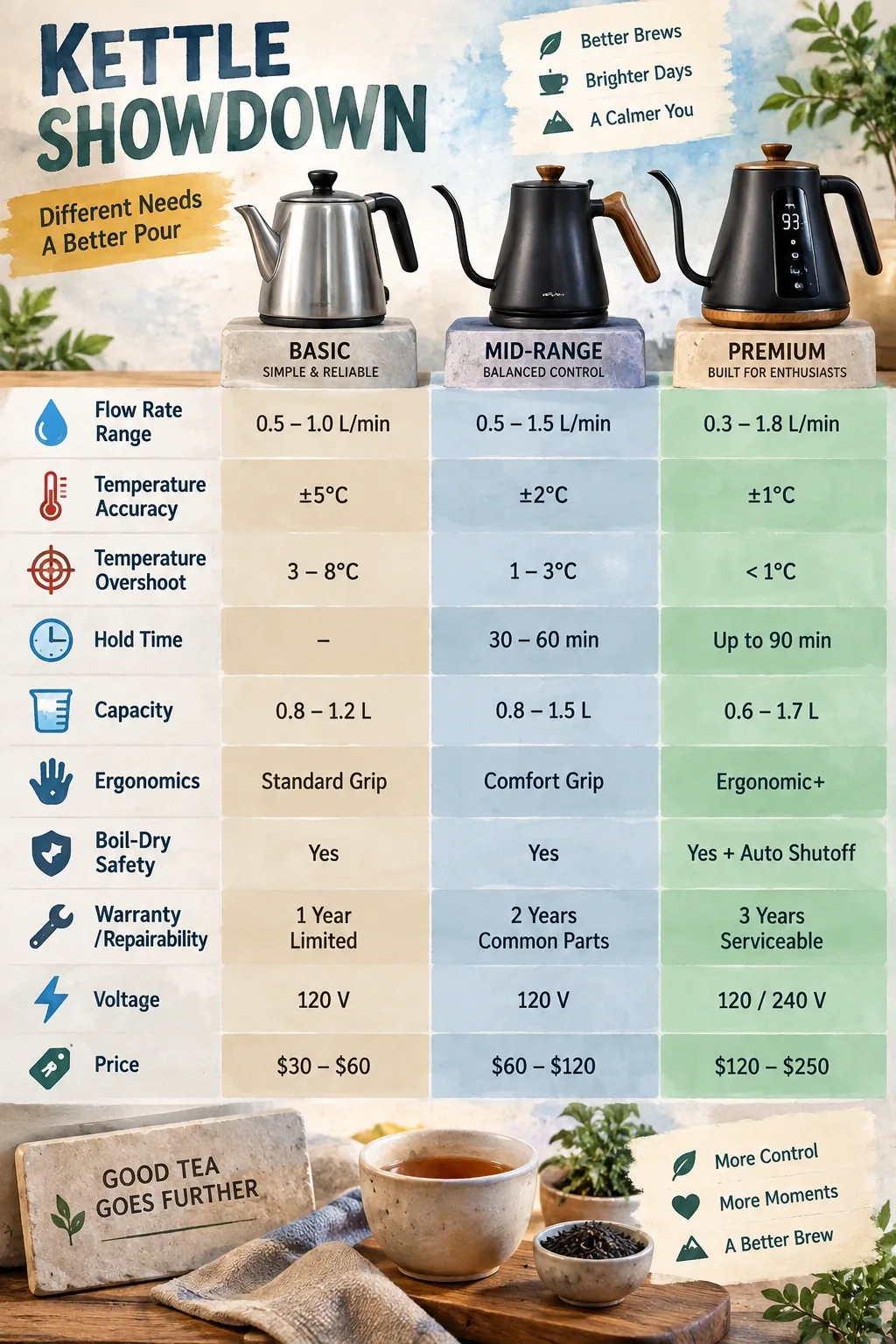
What actually separates a great pour over kettle from an expensive disappointment comes down to five baseline factors and four hidden ones. The baseline factors – gooseneck geometry, temperature control, capacity, materials, and safety – are what most review sites cover. The hidden ones are where pour-over kettle users get burned.
The hidden criteria are repairability and warranty, voltage compatibility for international buyers, dual-use flow range, and whether the sub-$50 tier can actually compete. Once you understand why each of these matters, you can evaluate any kettle on the market without needing another review.
Spout Geometry and Heating Systems
The gooseneck spout isn’t a stylistic choice – it’s a flow engineering decision. A properly designed gooseneck creates a laminar, non-turbulent stream that lets you direct the flow exactly where you want it in the coffee bed, with the volume and speed you intend. Standard kettles pour too fast, flood the bed unevenly, and produce extraction inconsistency that no grind adjustment can fully fix. The key hardware elements are the flow restrictor at the spout’s base, the curvature angle that controls stream direction, and whether the tip is fluted or plain – fluted tips break surface tension and prevent dribble at ultra-slow pour speeds.
The physics behind this matters more than most buyers realize. A 2023 study published in Physics of Fluids used a gooseneck kettle, transparent silica gel particles, a laser sheet, and a high-speed camera to observe exactly what happens when water meets a coffee bed. The findings were precise: laminar gooseneck flow controls the pour’s agitation level, while water poured from too great a height breaks into droplets, carries air into the cone, and measurably decreases extraction efficiency. Crucially, the study found that slower pours using what the researchers called “avalanche dynamics” – where water gently tumbles the coffee particles – can actually tune extraction consistency. The mechanism is direct: the stream’s behavior at the point of contact governs how uniformly the bed saturates.
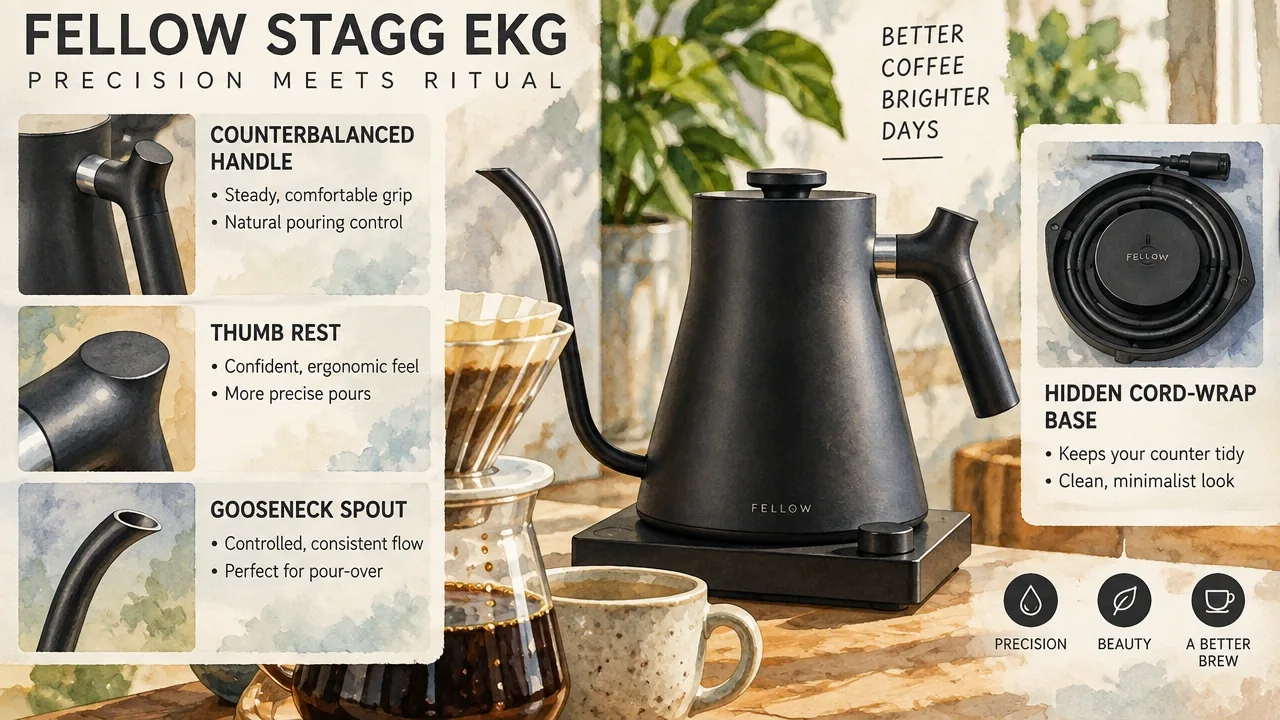
“When it comes to pouring, the Stagg has the best spout design I’ve ever brewed with. The elongated point of its tip means that water won’t dribble when pouring at slower speeds, and the thin, kinked neck provides some resistance to flow, giving the user more control over the pouring speed than traditional curved gooseneck kettles. It also has a weighted handle to offset the water in the kettle itself, providing more balance for precision pouring.” – Jesse Raub, coffee industry veteran and former product reviewer for Bon Appétit
Raub’s observation points to something the spec sheet won’t tell you: the neck kink acts as a passive flow restrictor, and the weighted handle counterbalances the water mass during the deliberate, multi-minute pours that pour-over demands. These aren’t comfort features – they’re precision instruments.
On the heating side, the divide is electric versus stovetop. Electric kettles with PID control maintain temperature within ±1°F (0.5°C), prevent overshoot, and hold that temperature for extended periods. Stovetop kettles require a separate thermometer and manual timing, but offer induction compatibility and zero electronics to fail. Wattage determines how fast you get to temperature – higher wattage means shorter wait times, which matters more than it sounds at 6 a.m. Material science defaults to food-grade 304 stainless steel across most of the field; interior scaling is managed through regular descaling cycles with citric acid or white vinegar, and is more of a maintenance discipline than a design differentiator.
One hidden friction point: voltage compatibility. Most electric kettles are built for either 100–120V or 220–240V grids. Buyers in markets where voltage doesn’t match the kettle’s spec need step-down transformers – an added cost and inconvenience that no “best of” list addresses, but which can add $74 or more to the effective purchase price.
The Buyer Evaluation Matrix
Here’s the framework this ranking uses – and why each criterion earned its slot.
| Criterion | Why It Matters |
|---|---|
| Flow Rate Range | Determines dual-use viability; slow precision vs. fast agitation |
| Temperature Accuracy | ±1°F PID vs. 5°F increments changes extraction repeatability |
| Hold Time | Bloom + drawdown takes 3–5 minutes; hold stability matters |
| Capacity | Match to batch size; 600ml vs. 1L changes workflow |
| Ergonomics / Counterbalance | Handle fatigue during long pours is real |
| Boil-Dry Safety | Automatic shutoff is a non-negotiable for daily use |
| Warranty / Repairability | Community reports thermal fuse failure at ~1.5 years; tamper-proof screws mean no DIY fix |
| Voltage Compatibility | Critical for international buyers; step-down transformers add cost |
| Price | Sub-$50 tier is legitimate and systematically underrated |
The repairability row deserves emphasis. Community reports across multiple forums document tamper-proof screws, zero parts availability, thermal fuse failures around the 18-month mark, and warranty refusals on units that failed just outside the coverage window. This isn’t a fringe complaint – it’s a structural design choice by several premium brands, and it belongs in any honest evaluation.
Fellow Stagg EKG and EKG Pro: The Coffee-Only Precision Benchmark
The Fellow Stagg EKG earns its reputation as the industry standard for pour-over precision – and earns its overrated label for everything else. Understanding both sides of that verdict is the difference between buying the right tool and buying the most-reviewed one.
Affiliate Disclosure
This post contains affiliate links, meaning I may earn a commission if you make a purchase through these links, at no additional cost to you. As an Amazon Associate, I earn from qualifying purchases. I only recommend products I genuinely believe will add value.
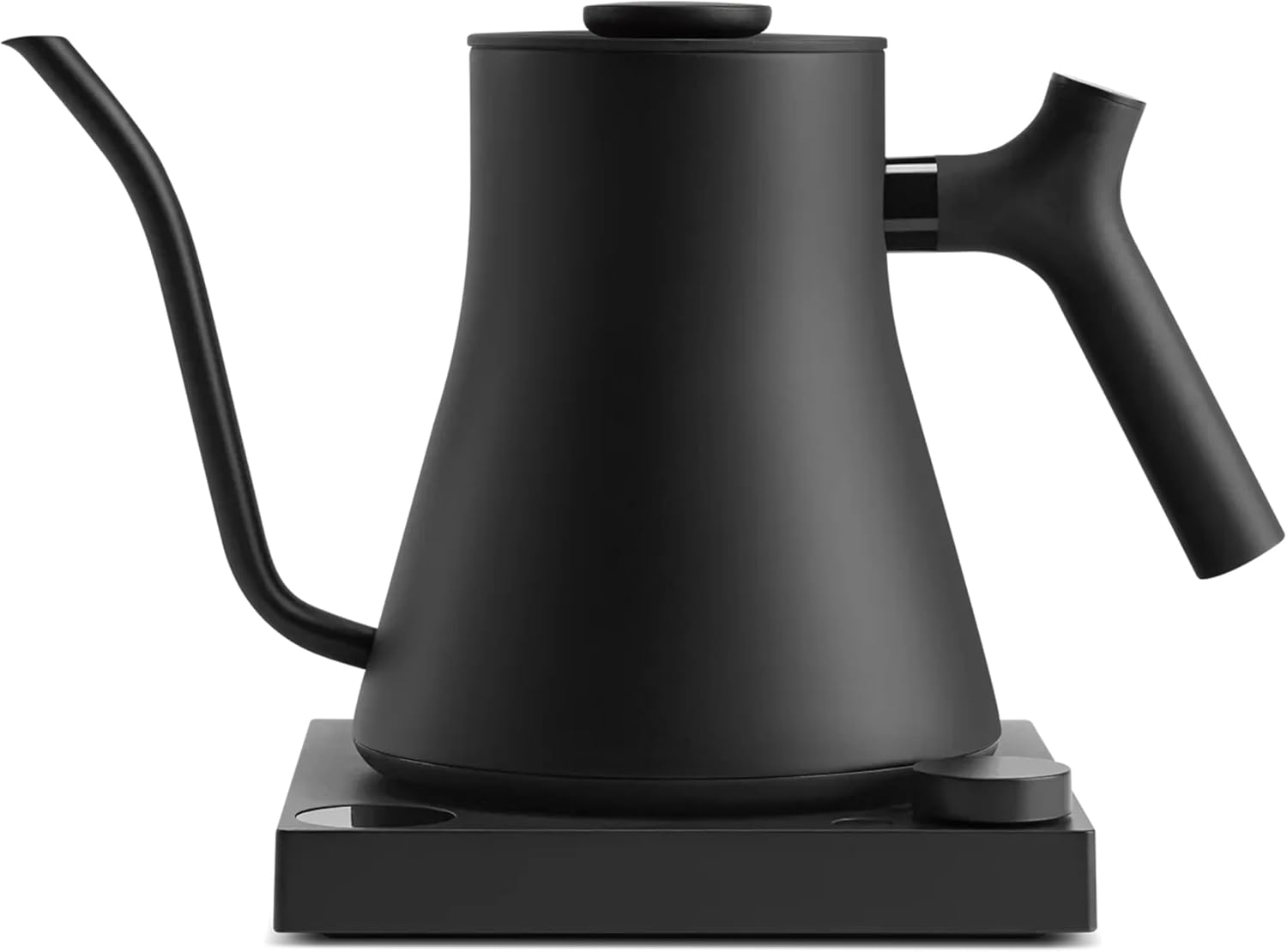
Fellow Stagg EKG Pro Gooseneck Electric Kettle, Brew Timer, 0.9 Liter
- THE ULTIMATE POUR-OVER KETTLE: Designed for pour-over perfection, the precision spout ensures a smooth, steady…
How the Stagg’s Thermal System Actually Works
The Stagg EKG’s temperature control is built around a PID (Proportional-Integral-Derivative) controller that monitors and adjusts heating in real time. The result is ±1°F (0.5°C) accuracy with no meaningful overshoot – the kettle reaches your target and stays there, not a few degrees above it while it “settles.” The 60-minute keep-warm function maintains that temperature through bloom, multiple pours, and drawdown without requiring you to reheat between stages. The digital base interface is clean and tactile; the EKG Pro adds Bluetooth app connectivity and scheduling for users who want to wake up to a kettle already at 205°F.
For coffee-only precision brewing – especially light roasts that demand narrow temperature windows – this level of control is genuinely useful, not marketing. A 3°F difference at the bloom stage affects CO₂ release rate, which affects how evenly the bed saturates before your first pour.
Gooseneck Flow, Ownership Costs, and the Tea Problem
The Stagg’s flow rate sits around ~10 ml/s, which is intentionally restrictive. For single-cup V60 or Chemex brewing with a slow, deliberate pour, that’s a feature. For filling a teapot, it’s a 90-second exercise in patience – and the spout geometry, optimized for vertical precision, produces a pour angle that can hit the dripper rim when you try to increase speed. Community reports are consistent: the Stagg pours messy for tea unless you tip it sideways, which defeats the counterbalance design.
The 304 stainless steel body, boil-dry shutoff, integrated brew stopwatch, and hidden cord-wrap base are all well-executed. The ergonomics – counterbalanced handle, thumb rest – hold up during 3-minute multi-pour sessions in a way cheaper kettles don’t.
Then there’s the ownership picture. The Stagg uses tamper-proof screws, no replacement parts are available through retail channels, and thermal fuse failures around the 18-month mark are documented across Reddit, Home-Barista, and other enthusiast communities. Fellow’s warranty response to out-of-window failures has been inconsistent at best. This isn’t a dealbreaker for everyone, but it’s a known risk that “best overall” verdicts rarely disclose.
One genuinely useful hidden option: Fellow’s Corvo body uses the same base as the Stagg EKG. If you already own the EKG and need better tea flow, the Corvo swap gives you a higher-flow kettle on the same heating platform without buying a second base unit.
Bonavita Variable Temp: The High-Flow Mid-Tier All-Rounder
The Bonavita Variable Temp kettle doesn’t try to out-precision the Stagg. It doesn’t need to. Its value proposition is a different kind of competence: a fast-flow gooseneck at a mid-tier price that handles both coffee and tea without compromise.

Bonavita 1L Digital Variable Temperature Gooseneck Electric Kettle for Coffee Brew and Tea Precise Pour Control, 6 Preset Temps, Café or Home Use, 1200 Watt, LED Panel, Stainless Steel
- Precision Temperature - Fine-tune your brew with 1-degree accuracy (140˚F–208˚F / 60˚C–98˚C), or simply use th…
- Precision Flow - The gooseneck spout delivers a controlled, steady stream, while the ergonomic handle ensures …
- Precision Quality - Crafted from 304 stainless steel and BPA-free virgin plastics, this kettle is built for sa…
- Precision Timing - With 1200 watts of power, your water reaches a boil in just 5 minutes. When inspiration str…
- Precision Heat Hold - Enjoy up to 60 minutes of temperature hold. Brewing becomes a calm and mindful ritual, n…
Why the Spout Agitation Profile Changes Everything
Bonavita’s spout geometry produces a flow rate around ~25 ml/s – roughly two and a half times the Stagg’s output. That difference isn’t just speed; it’s a fundamentally different agitation dynamic at the coffee bed. Where the Stagg’s slow stream creates the laminar, low-agitation pour that light-roast pour-over demands, the Bonavita’s faster flow can generate the bed turbulence that darker roasts and larger batches often benefit from. The gooseneck curve still maintains directional control, so you’re not sacrificing pour-over precision – you’re adding range.
For shared-household use where the kettle serves both a pour-over brewer and a tea drinker, this flow ceiling matters enormously. The Bonavita fills a teapot in a reasonable time and still handles a controlled bloom pour on a Kalita Wave. Eater named it their all-around winner at around $60, and the community consensus on fast-flow goosenecks as the best single-kettle coffee-and-tea compromise consistently includes the Bonavita by name.
Temperature Control and Build Quality
The Bonavita operates on variable temperature presets rather than degree-by-degree control. Its increments are 5°F steps, not the ±1°F precision of PID-controlled competitors. For most pour-over brewing – where the practical target range is 195°F–205°F – a 5°F increment is workable. For light-roast specialists who want 201°F precisely, it’s a meaningful limitation. The keep-warm function maintains your selected temperature through multi-pour sessions, and the base interface is simple enough to operate half-asleep.
The build uses 304 stainless steel throughout, with boil-dry protection and a balanced handle with thumb rest that holds up during extended pours. Scaling management follows the same citric acid descaling protocol as other stainless interiors. It’s not a luxury object – the finish and controls read mid-tier – but the functional durability is solid for the price.
Brewista Artisan: Variable Flow Calibration for Coffee and Tea
The Brewista Artisan solves a problem the Stagg and Bonavita can’t: it lets you change the flow rate itself, not just the temperature. That’s a different category of control, and it’s underappreciated in most rankings.

Brewista Artisan Electric Gooseneck Kettle, Water Boiler with LCD Panel, Precise Temperature Control, Fast Boiling and Keep Warm Settings for Pour-Over Coffee & Tea, Café, 1 Liter (Matte Black)
- STYLE MEETS QUALITY: This gooseneck kettle blends sleek design with precise performance. Crafted from durable …
- PRECISION IN EVERY POUR: Designed for precision, the gooseneck spout ensures a controlled, even flow of water,…
- ACCURACY AT YOUR FINGERTIPS: Achieve pinpoint accuracy with 1-degree adjustments. The LCD console helps you un…
- FLASH BOIL SETTING: Reduce wait time with Brewista's fast-boiling kettle, streamlining your coffee routine. Th…
- WARMTH ON DEMAND: The keep-warm setting preserves the ideal water temperature, so your coffee remains perfectl…
How the Adjustable Restrictor Mechanism Works
The Artisan’s adjustable flow restrictor lets you dial between ultra-slow precision and fast agitation within a single kettle. The practical ceiling is approximately ~48 ml/s – among the highest in the electric gooseneck category – which means it can fill a teapot quickly, agitate a larger batch, or slow down to a deliberate bloom pour without a hardware swap. You’re not buying a compromise; you’re buying a range.
The use case is specific: if you brew both pour-over coffee and loose-leaf tea, or you regularly switch between single-cup and larger batch sizes, the Artisan eliminates the “second kettle” conversation. It’s also the right answer for brewers experimenting with different agitation levels – the ability to reproduce a specific flow rate across sessions is a form of recipe control that matters once you start dialing in variables systematically.
Here’s a practical walkthrough of the Artisan’s tips and tricks that demonstrates how to use that flow range effectively:
Temperature Presets, Smart Features, and Ergonomics
The Artisan’s thermal system uses PID control with user-programmable presets, a hold mode, and an integrated brew stopwatch – the same smart-feature stack as the Stagg EKG, delivered on the Brewista platform. The digital base displays temperature in real time, and the safety shutoff handles both boil-dry and extended-idle scenarios. Preset memory is a practical time-saver for brewers who rotate between coffee and tea at fixed temperatures.
The gooseneck geometry balances a moderate curve angle with a spout diameter sized for controlled flow even at higher restrictor settings. The handle is ergonomically positioned with a thumb rest, and the balance holds well during longer pours – important at the Artisan’s price point, where a 3-minute session shouldn’t feel like a workout. The body is stainless steel throughout, with the same standard scaling management protocol as the rest of the field.
Cosori Electric Gooseneck: The Budget Value Pick That Covers the Basics
The Cosori Electric Gooseneck exists to answer a specific question: do you actually need to spend $150 or more to brew good pour-over coffee? The answer is no – with caveats that are worth understanding precisely.

Cosori Gooseneck Electric Kettle with Temperature Control, 0.8L, Black
- 5 𝑶𝑵𝑬-𝑻𝑶𝑼𝑪𝑯 𝑷𝑹𝑬𝑺𝑬𝑻𝑺: Your Gooseneck Electric Kettle features 5 precise temperature presets. These accurate pre…
- 1-𝑯𝑶𝑼𝑹 𝑲𝑬𝑬𝑷 𝑾𝑨𝑹𝑴: Use the HOLD TEMP function to keep the contents of your kettle warm for up to 1 hour so that…
- 𝑬𝑹𝑮𝑶𝑵𝑶𝑴𝑰𝑪 𝑫𝑬𝑺𝑰𝑮𝑵: Refined ergonomic design allows for precise water flow control for perfect pour-over brewing
- 𝑻𝑯𝑬 𝑷𝑼𝑹𝑬𝑺𝑻 𝑻𝑨𝑺𝑻𝑬: The electric kettle's durable interior, lid, and spout are made with food-grade 304 stainles…
- 𝑷𝑹𝑬𝑪𝑰𝑺𝑬 𝑷𝑶𝑼𝑹𝑰𝑵𝑮: An essential choice for making pour-over coffee, the precise spout and counter-balanced handl…
The Cosori delivers variable temperature presets, a keep-warm function, boil-dry automatic shutoff, and a gooseneck spout that provides real pour-over control. Capacity suits standard single-to-double cup pour-over batches. The body is food-grade stainless steel with reasonable rust resistance and a manageable scaling profile for daily use. These are not compromised versions of premium features – they’re the same functional categories, executed at a lower price point.
What you don’t get is PID-level temperature accuracy, app connectivity, a brew stopwatch, or the ergonomic refinement of counterbalanced handles. The flow rate and spout geometry are adequate for pour-over but not optimized for ultra-slow precision. The materials feel and look mid-tier.
The honest context here comes from the enthusiast community, not the spec sheet. Community members have documented a $35 Amazon-brand gooseneck and the Greater Goods kettle (priced at roughly half the Stagg) working without issue for daily multi-use brewing across more than a year of ownership. That’s a legitimate data point. The sub-$50 tier is systematically underrepresented in pour-over kettle rankings because it doesn’t generate affiliate revenue or brand partnership interest – not because the products don’t perform for casual and budget-conscious brewers.
If your brewing is daily, your palate isn’t yet chasing ±1°F precision windows, and your budget is real, the Cosori is a rational starting point, not a consolation prize.
Hario V60 Buono: The Stovetop Classic for Minimalists and Induction Users
The Hario V60 Buono is the oldest pick in this ranking and the one most likely to outlast every electric kettle on the list. It’s also the one with the most important hidden friction for international buyers.

HARIO V60 Buono Stovetop Gooseneck Kettle, 1.2L Silver
- Buono Coffee Drip Kettle: Stunning stainless steel stovetop kettle that’s easy to use and offers a thin spout …
- Controlled Pour: Slender gooseneck spout allows for a slow, steady, and controlled pour. Great for pour over, …
- Kitchen Essential: Easily boil water for manual coffee brewing, tea or cooking. Perfect for daily kitchen use,…
- Japanese Design: Stainless steel kettle with an ergonomic design for easy, safe pouring. Designed and made in …
- Product Details: Capacity 1.2L, 1200mL. Best when filled to about 800mL. Ideal for IH ranges, gas and electric…
Manual Heating and the Voltage Trap
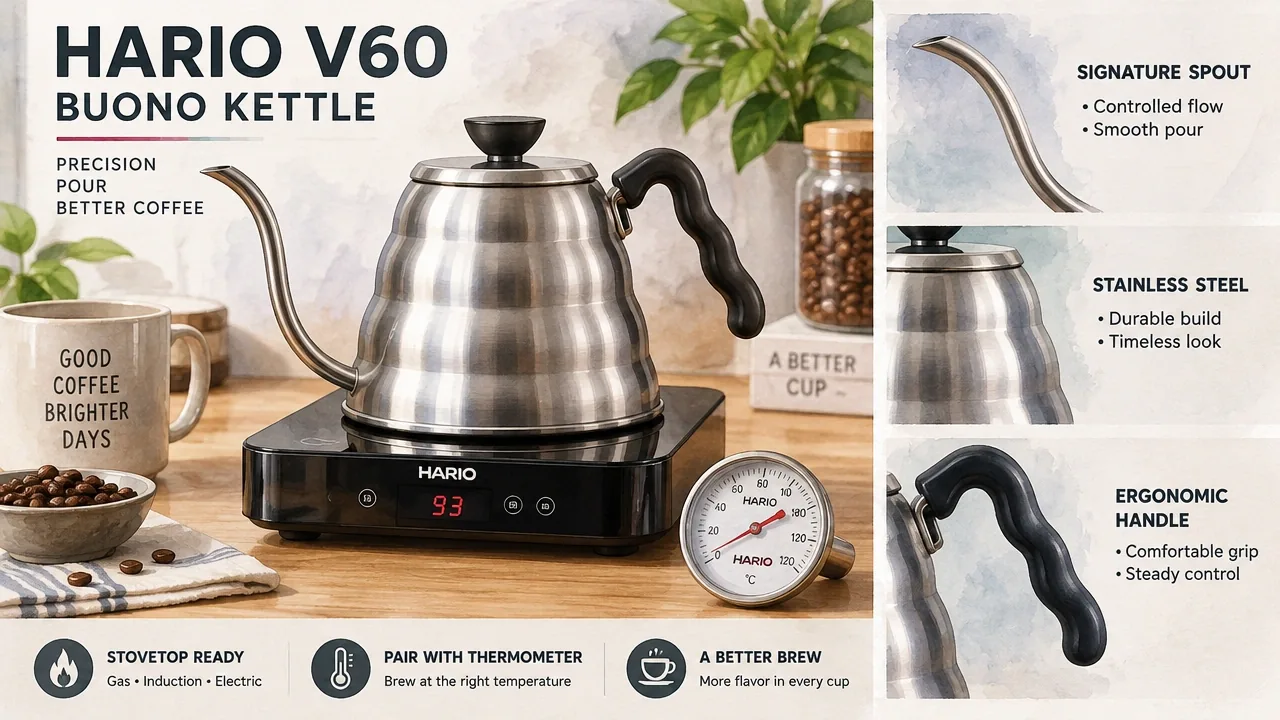
The Buono operates entirely without electronics: heat it on a gas, electric, or induction burner, use a separate thermometer to hit your target temperature, and pour. That’s the whole system. For minimalists, induction users, and anyone who prefers a tool with no circuit board to fail, this is a genuine advantage – not a compromise.
The hidden friction is Hario’s electric kettle lineup, which trips up buyers who discover the Buono’s stovetop-only limitation and look at Hario’s electric options as an upgrade path. Hario electric kettles ship in 100V or 240V only – no 120V version exists for the North American grid. US buyers who want a Hario electric need a 120V→100V step-down transformer, which costs approximately $74, pushing the effective total to roughly $200 for what should be a $130 purchase. This is a ranking criterion, not a footnote.
One genuinely useful non-electric option from Hario: the Hario Air Kettle, a vacuum-insulated stovetop vessel that retains temperatures above 95°C for extended periods. It’s worth knowing about for travel setups or any context where you want to carry hot water without a heat source.

Hario V60 "Air" Drip Kettle, 350ml, Clear Black
- Transparent Black Resin
- 350ml capacity
- 50ml measurement marks, 100ml - 350ml
- The design makes pouring easy, with a surprisingly lightweight feel and transparent material that allows you t…
- Compact size for easy storage.
Gooseneck Flow, Handle Geometry, and Dual-Use Reality
The Buono’s classic gooseneck curve produces a flow rate faster than ultra-restrictive electric spouts – it sits in the same fast-flow category as the Bonavita, making it a legitimate community-recommended option for dual-use coffee and tea brewing. The spout curvature provides directional control for pour-over without the tight restriction of the Stagg’s kinked neck, which means you get more flow range without sacrificing the laminar stream quality that pour-over demands.
The stainless steel body is straightforward to descale, rust-resistant, and built without electronics that can fail. The handle geometry and weight distribution are designed for the weight range of a full kettle, and the balance holds during extended pours. At approximately $40 (per Eater’s pricing), the Buono competes on a value-per-year-of-service basis that no electric kettle in this ranking can match.
The Verdict: Best Pour Over Kettle by Brewer Profile
Every kettle in this ranking is the right answer for someone and the wrong answer for someone else. The decision matrix below resolves that by matching brewer profile to the criteria that actually govern satisfaction.
Buyer Segment Recommendations
| Brewer Profile | Best Pick | Why |
|---|---|---|
| Coffee-only precision | Fellow Stagg EKG Pro | ±1°F PID, 60-min hold, best-in-class spout geometry |
| Coffee + tea dual-use | Bonavita Variable Temp or Brewista Artisan | ~25–48 ml/s flow ceiling, gooseneck control retained |
| Budget daily brewing | Cosori Electric Gooseneck | Presets, keep-warm, boil-dry shutoff under $50 |
| Stovetop / induction | Hario V60 Buono | No electronics, induction-ready, ~$40, lasts indefinitely |
| Repair-conscious buyer | OXO | 4-year no-questions warranty; community’s repairability pick |
| Hidden gem / ultra-precision | Timemore Fish Smart | Flow adjustable down to ~2 ml/s; underrated in rankings |
| International voltage buyer | Hario V60 Buono (stovetop) | Eliminates voltage compatibility problem entirely |
| Fast-flow dual-use alternative | Cocinare | ~33 ml/s; overlooked mid-tier option for coffee + tea |
The Timemore Fish Smart deserves more attention than it gets. Its flow rate can drop to approximately 2 ml/s – the slowest in the category – which opens a level of bloom control that even the Stagg can’t match. It’s the pick for brewers who want to experiment with ultra-slow saturation techniques and aren’t satisfied with “slow” as a fixed setting.
The OXO earns the repair-conscious slot on a single criterion: a 4-year no-questions warranty that the community consistently cites as the best post-purchase ownership experience in the category. If the 18-month thermal fuse failure pattern documented on other premium kettles concerns you, OXO is the structural solution.
Correcting the “Best Overall” Verdict
The Fellow Stagg EKG appears as “best overall” across a significant portion of the ranking landscape, and that verdict deserves direct pushback. One widely cited blog awards it the top position while documenting a 53-second pour time for 900 ml – a data point that contradicts the “overall” framing for any household that brews tea, fills a French press, or values time. Community consensus is clear: the Stagg’s slow flow and spout geometry make it genuinely awkward for tea unless you pour sideways, which undermines the counterbalanced handle design.
The repairability picture compounds this. A “best overall” kettle that has a documented thermal fuse failure pattern, tamper-proof screws, and no available replacement parts isn’t best overall – it’s best for coffee-only brewers who accept the ownership risk and can absorb a replacement purchase in 18–24 months.
The fast-flow gooseneck – Bonavita, Brewista Artisan, Hario Buono, or Cocinare – is the community’s actual best single-kettle compromise for dual-use households. If budget and counter space allow, the two-kettle setup (Stagg for coffee, high-flow for everything else) is the enthusiast’s ideal. But that’s a $250+ solution, and it’s only worth naming once you’ve ruled out the kettles that handle both jobs adequately on their own.
Frequently Asked Questions About the Best Pour Over Kettle
Does temperature accuracy actually change how coffee tastes?
Yes, but the effect is most pronounced with light roasts. A 3–5°F difference at bloom changes CO₂ release rate and bed saturation consistency – which is why PID control matters more for single-origin filter coffee than for darker roasts with wider extraction windows.
Can I use a pour-over kettle for tea without buying a second kettle?
You can, but the right kettle matters. Ultra-slow spouts like the Stagg EKG make tea pouring awkward; fast-flow goosenecks like the Bonavita, Brewista Artisan, or Hario Buono handle both jobs without compromise.
How long should a quality pour-over kettle last?
A stovetop model like the Hario Buono can last a decade or more with basic descaling. Electric kettles with PID systems have more failure points; community reports document thermal fuse failures around 18 months on some premium models, which makes warranty length a meaningful purchase criterion.
Is the Fellow Stagg EKG Pro worth the premium over the standard EKG?
Only if you’ll actually use the app scheduling and Bluetooth connectivity. The core thermal precision and spout geometry are identical between the two; the Pro adds convenience features, not brewing capability.
What’s the best kettle for someone who travels internationally?
The Hario V60 Buono stovetop eliminates voltage compatibility problems entirely – it heats on any burner, anywhere. If you need electric, verify voltage compatibility before purchase and budget for a step-down transformer if the grid doesn’t match.
Why do some reviewers call a 53-second pour for 900ml a positive feature?
They’re optimizing for pour-over precision, where slow flow is a feature. For dual-use households, that same pour time is a practical inconvenience. It’s not a wrong assessment – it’s an assessment made for the wrong audience profile.
What does “repairability” actually mean in practice for a kettle?
It means whether you can replace a failed component – typically the thermal fuse or heating element – without replacing the entire unit. Tamper-proof screws and no retail parts availability mean a failed component equals a dead kettle. Brands like OXO address this with extended warranty coverage instead of DIY repairability.
Is the Timemore Fish Smart available in North America?
It’s available through import-friendly retailers and directly, though it’s less widely stocked than Fellow or Bonavita. Its ~2 ml/s minimum flow rate makes it worth the extra sourcing effort for brewers focused on ultra-slow precision techniques.
References
- Physics of Fluids Pour-over coffee: Mixing by a water jet impinging on a granular bed with avalanche dynamics | pubs.aip.org
- Fellow Stagg EKG Pro Review | bonappetit.com