
Authentic mocha coffee is not a chocolate recipe someone invented – it is a place name that traveled 600 years and picked up a flavor along the way. The word started on a Yemeni quay, moved into European trade ledgers as a quality signal for Arabian coffee, and only became associated with chocolate after supply chains collapsed and café culture filled the vacuum.
That four-way semantic split – port, trade grade, stovetop brewer, and chocolate espresso drink – is the source of nearly every confusion the word generates. Once you see the lineage, the confusion resolves itself.
Key Takeaways on Mocha Coffee
- Mocha coffee traces to Mokha, a Yemeni Red Sea port, not to a chocolate recipe invented by a café.
- The spelling split – “Mocha” for the bean and drink, “Moka” for the brewer – is an etymological artifact from the same toponym, not a marketing distinction.
- Chocolate must dissolve into hot espresso before milk is added; skipping that step produces the chalky, gritty mocha most people blame on the chocolate.
- Caffeine in a mocha varies with species, dose, extraction yield, and volume – the word “mocha” specifies none of those variables.
- Theobromine from the chocolate adds a slower, milder methylxanthine on top of espresso’s caffeine, which is why a mocha’s stimulant effect feels different from plain espresso at the same caffeine load.
- Specialty coffee is quietly reconnecting the word to its origin by selling Yemeni single-origin “Mokha” lots – the same geography the drink was named after, centuries before anyone added chocolate.
Mocha: One Word, Four Meanings (and Why All of Them Are Real)
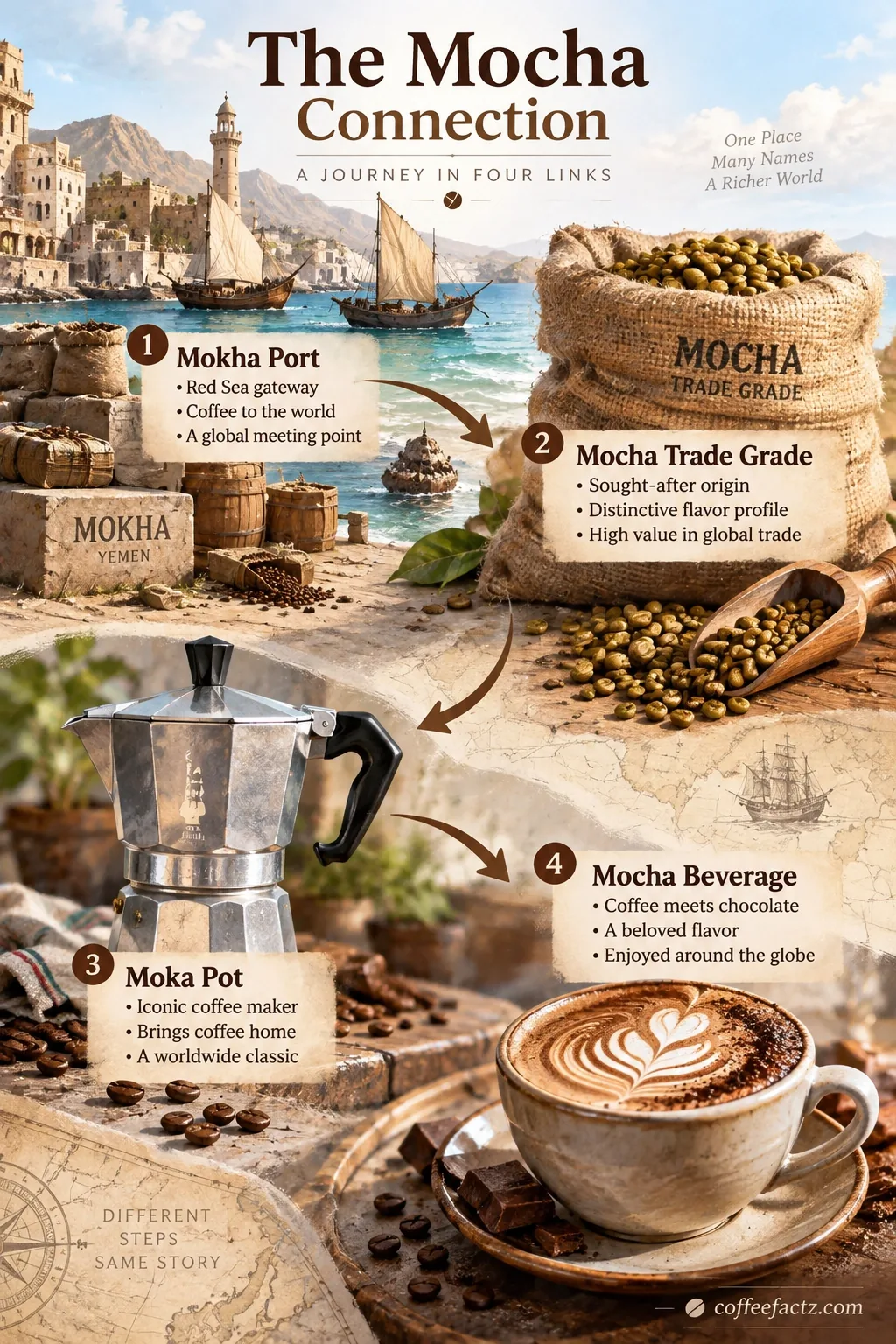
Mocha coffee generates confusion at a structural level, not a reading-comprehension level. The word points at four genuinely different things depending on who is using it and when: Mokha, the Yemeni Red Sea port; “Mocha,” the historical trade-grade designation for Arabian coffee exported through that port; Moka, the stovetop pressure brewer; and mocha, the chocolate-flavored espresso drink you ordered last Tuesday. These are not four competing definitions. They are four stages of one lineage.
For this article, the working definition is the consensus one: caffè mocha is a chocolate-flavored variant of caffè latte – espresso combined with chocolate (powder, syrup, or ganache) and steamed milk or cream, conventionally served hot in a glass. That definition holds through every section that follows.
The spelling fork is a historical artifact, not a marketing decision. “Mocha” attaches to the port, the bean, and the beverage. “Moka” attaches to the stovetop brewer – a divergence that happened because the brewer’s Italian patent used the Italianized spelling of the same Yemeni toponym. Neither camp is wrong. They just froze at different moments in the same word’s drift.
What no single competing source does is hold all four referents simultaneously and show how they connect. Most historical and cultural archives treat “Mocha” purely as a place or a book-title variant. Encyclopedic and brand sources define only the beverage. The bifurcation is real, and it is the highest-value gap in this topic. Each meaning below will be traced to a physical or documentary origin – none of them treated as coincidence.
Here is the four-referent map before we pull it apart:
Mokha the Port: Where the Word Actually Comes From
The word “mocha” begins not in a café but on a coastline. Understanding what the port was – and what it did – is the only way to understand why the word carries the authority it still does, centuries after the port itself faded from global trade.
Geographic Origin and Cultivation Timeline
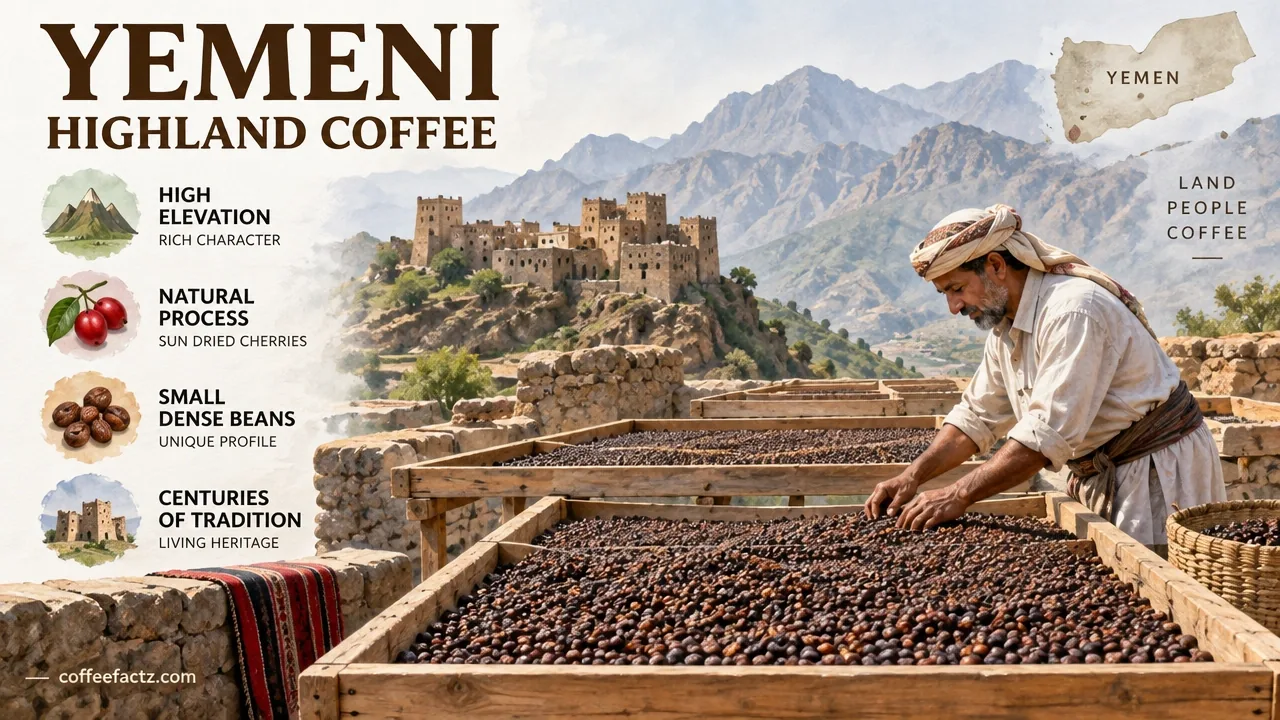
Mokha (variously spelled Al Mokha or Al-Makkha) sits on Yemen’s Red Sea coast, roughly midway up the western shore of the Arabian Peninsula. Coffee is botanically Ethiopian – the Coffea arabica plant is indigenous to the highland forests of Kaffa – but the cultivated, brewed beverage is first reliably documented in 15th-century Yemen. Sufi mystics there used it to sustain alertness through night prayers, a use-case that required a stable supply chain: cultivation, processing, and distribution at scale.
The export corridor built from that foundation follows a clear chronological arc. Yemeni coffee moved first into the wider Ottoman world, where coffeehouses became dense social and political institutions in Istanbul by roughly 1554. Venetian traders adopted the bean around 1645, opening the European corridor. The 17th-century English coffeehouse boom followed – hundreds of establishments in London alone by the 1660s – and Mokha was the named source on nearly every import ledger.
One archival question remains genuinely open and worth naming honestly: no surveyed source resolves who first hulled, roasted, ground, and brewed coffee, or whether a fruit-based infusion preceded roasted-bean brewing. Competing hypotheses exist. The documentary record begins with the brewed beverage, not with the processing method that produced it. Presenting that gap as settled would be a credibility error.
Trade Naming Mechanism and Provenance Authority
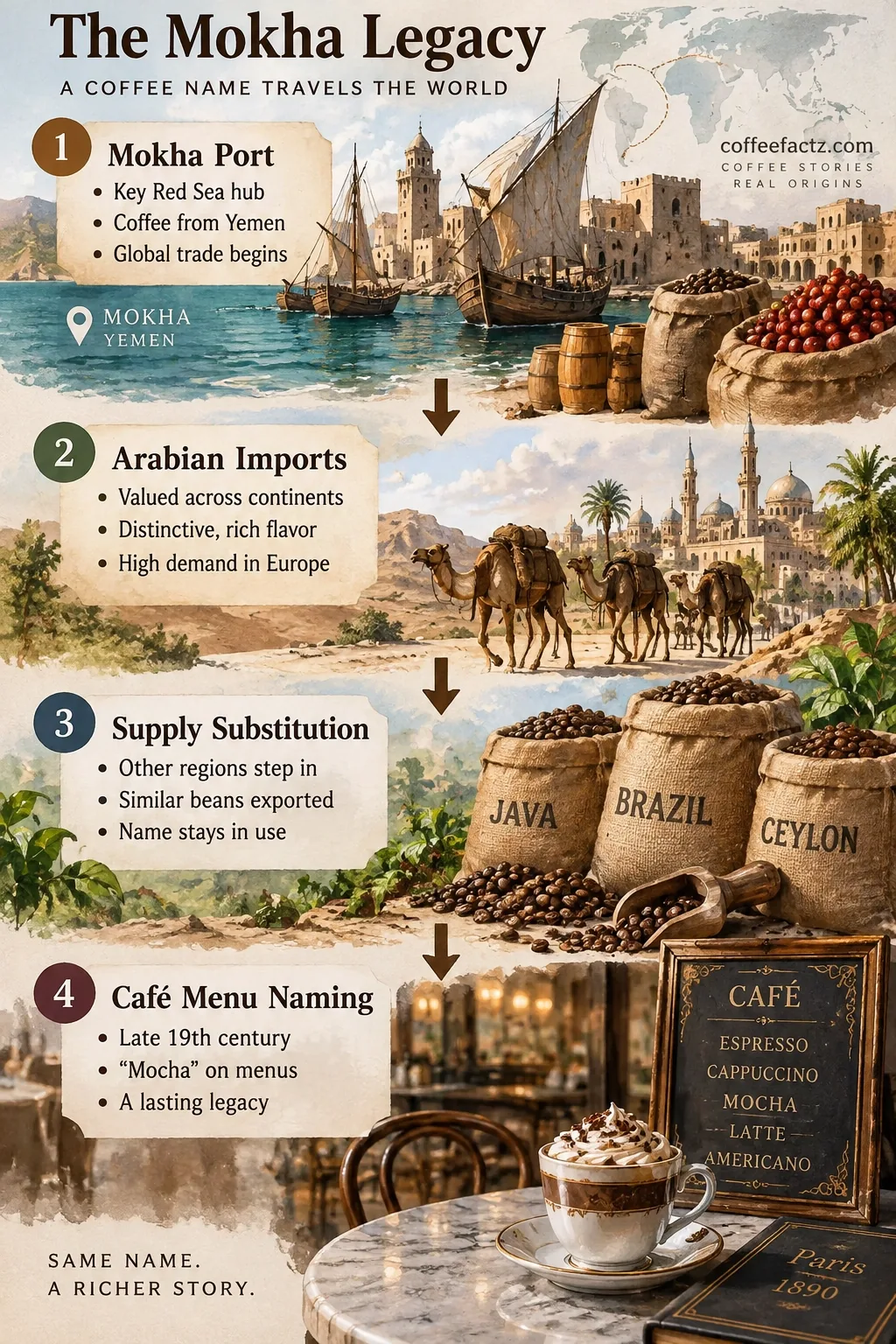
“Mocha” functioned, for its first two centuries in European markets, as a port-of-origin designation and quality signal – the same mechanism that later made “Java” shorthand for Indonesian provenance. The word was a geolocation stamp, not a taste descriptor. Shippers did not call the coffee “Mocha” because it tasted a particular way; they called it “Mocha” because that was where the ship had been.
To answer the PAA question directly: the port, the bean name, and the historical trade term are Yemeni. The chocolate beverage is a much later European construction with no direct geographic claim on the word.
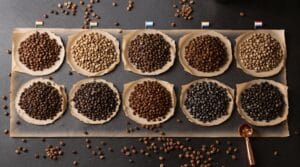
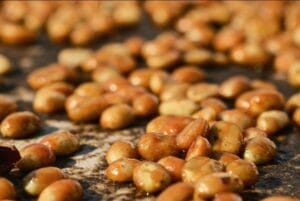
The physical reason “Mocha” carried prestige is worth pinning down. Yemeni highland coffees are grown at elevation and dry-processed – the whole cherry dries in the sun before the bean is extracted – yielding small, dense, irregular beans with unusually high aromatic complexity. That physical distinction was something port inspectors could verify by hand and record in documentation long before anyone wrote a tasting note. The term’s authority came from trade records and auction listings, not from flavor description. That is precisely why the name survived the coffee’s eventual disappearance from the European market: it was a documentary fact, not a sensory one, and documentary facts outlast supply chains.
From Bean Grade to Chocolate Drink: The 200-Year Semantic Shift
The word “mocha” did not become associated with chocolate overnight. The mechanism that produced the shift took roughly two centuries and involved two colliding forces: the collapse of Yemeni coffee’s market dominance and the simultaneous rise of European chocolate culture. Neither force alone would have been sufficient.
European Cocoa Culture and Café Lineage
After roughly 1700, “Mocha” migrated from naming a bean’s origin to naming a drink’s flavor – and the engine was European chocolate-drinking culture, not coffee culture. Chocolate beverages reached Italy in the 17th century via Spanish trade routes. By the 18th century, northern Italian cafés were already serving layered coffee-and-chocolate combinations that directly prefigure the modern mocha.
The concrete historical anchors matter here. Turin’s bavareisa – a layered mixture of coffee, chocolate, and cream – evolved into the bicerin during the 18th century, a drink still served in the same café where it was first documented. The earliest English-language artifact showing the term “mocha” firmly attached to a chocolate beverage is a documented 1920 “Chilled Mocha” recipe combining milk, coffee, and cocoa. That date is significant. It places the semantic migration at roughly the turn of the 20th century in English-language café culture, two full centuries after the Italian lineage began.
Supply Substitution and Naming Disambiguation
The mechanism that emptied the word of its geographic meaning is supply substitution. As cheaper coffee from Java, Brazil, and other origins displaced Yemeni supply in European ports through the 18th and 19th centuries, “Mocha” ceased to function as a verifiable provenance claim. Shippers could no longer guarantee the bean came from Mokha. The word lost its anchor.
That is the moment the café trade could refill it. A word with residual prestige but no enforceable geographic referent is available for reassignment – and the Italian café lineage, already combining coffee and chocolate under various names, provided the new content.
The naming question – “Why is it called mocha and not chocolate?” – has a clean answer: mocha names a place, not a flavor. The chocolate drink borrowed the word because the word once meant the finest coffee available. The blend is a descendant of the name’s prestige, not its definition.
The time gap makes this argument concrete. Mokha port’s commercial peak ran from the 15th through the 17th century. The drink’s naming in English solidified around the late 19th to early 20th century. That is a span of two centuries or more between the port’s dominance and the drink’s naming – which is the strongest available evidence that the drink is named after the bean’s reputation rather than any flavor the bean itself carried.
What Makes a Coffee a Mocha: Ratio, Build Order, and Temperature
Caffè mocha has a standard architecture, but “standard” here means café convention rather than fixed specification. The drink is consistent enough to be recognizable and variable enough that two shops using the same ingredients can produce noticeably different results. The reason is build order and chocolate format – not the espresso.
Standard Architecture and Integration Mechanics
A mocha is a latte variant, not a distinct extraction method. The build sequence is: espresso, then chocolate, then steamed milk or cream, served hot, conventionally in a glass. The widely cited ratio convention is approximately 1/3 espresso to 2/3 steamed milk, with chocolate dosed to taste – call it a starting point, not a rule.
Compared to a cappuccino, the architecture is nearly identical: same espresso-and-milk foundation. The differentiating variables are the chocolate addition and the milk-texture target. Cappuccino is traditionally foam-forward. Mocha is typically built on texturized microfoam with less surface foam, because the chocolate needs contact with liquid milk to stay integrated.
Build order is the controlling mechanism, and it is where most bad mochas are made. Chocolate must be dissolved into the hot espresso before milk is introduced. Cocoa solids and cocoa butter stratify out of the milk emulsion when added after – producing the chalky, gritty mocha that drinkers describe as “too bitter” or “grainy.” The espresso’s heat and acidity do the dissolution work. Skip that step and you have chocolate floating in coffee-flavored milk.
The chocolate format compounds this. Powder, syrup, and melted ganache differ in fat phase, sugar load, and dispersion behavior. Powder requires more mechanical energy to dissolve. Syrup is already water-soluble but adds sugar volume. Ganache emulsifies smoothly but requires temperature management. Identical ratios with different chocolate formats produce visibly different textures – which is why “same recipe” does not mean the same drink across shops.
Here is a step-by-step look at the build in practice:
Thermal Targets and Qualifier Boundaries
Temperature is not optional. Espresso brewing water should run at 90.5–96°C / 195–205°F – the industry-standard extraction window. Drop below that and you under-extract; exceed it and you scorch. Steamed milk targets 55–65°C / 130–150°F. Above 65°C, milk proteins denature in ways that flatten perceived sweetness and produce a cooked-milk flavor that no chocolate addition can fully mask.
The single-rule answer to “what makes a coffee a mocha” is this: chocolate is the qualifier. Caffeine content does not define it. Brewing method does not define it. The presence of chocolate – in whatever format – is the one variable that separates a mocha from every other espresso-and-milk drink on the menu.
The Variant Family: White, Marble, Tuxedo, and the Undefined Mochaccino
The named variants in the mocha family look like marketing taxonomy from the outside. From the inside, each one reflects a specific change in chocolate chemistry or pour order. The names are real. The mechanisms behind them are just rarely explained.
Named Taxonomy and Cocoa Butter System
The core variant set and the single variable that distinguishes each:
| Variant | Chocolate Type | Key Differentiator |
|---|---|---|
| Caffè mocha | Dark chocolate | Standard build |
| White caffè mocha | White chocolate | Cocoa butter, no cocoa solids |
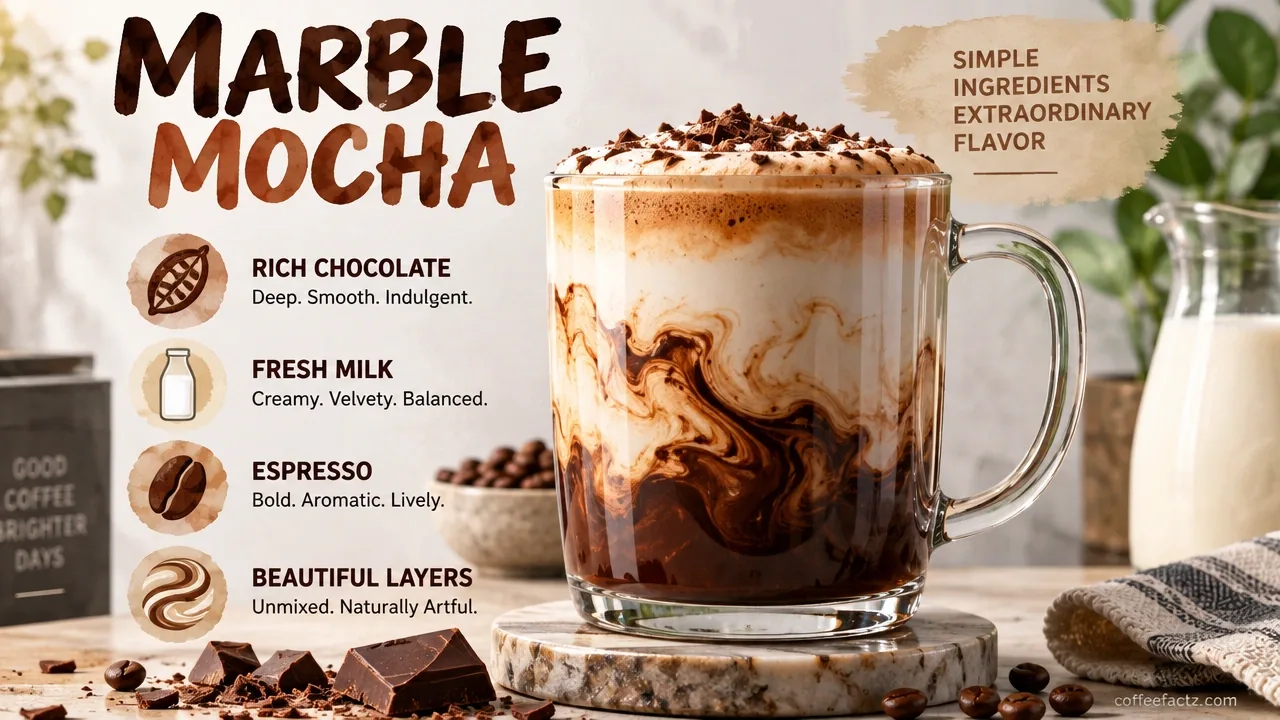
| Black-and-white / Marble / Zebra mocha | Both | Layered pour order |
| Tan mocha | Both, blended | Mixed, no visible layering |
| Tuxedo mocha | Both | Equal parts, distinct layers |
| French white mocha | White chocolate + hazelnut | Flavored syrup addition |
| Mochaccino | Dark chocolate | Foam-forward or blended; no settled definition |
White chocolate deserves a mechanical explanation, because it is the most misunderstood entry. White chocolate contains cocoa butter but no cocoa solids. It contributes fat and sweetness without cocoa’s bitterness or color. Milk is what emulsifies cocoa butter into the drink – without it, the fat separates. This is also why white mocha in syrup form is typically sweeter than dark mocha: there are no cocoa solids present to offset the sugar load with bitterness. White mocha is not a “lighter” mocha. It is a different fat-and-sugar system.
The definitional vacuum across the rest of the list is the real story. Reference sources name these variants without explaining what changes between them. The mechanism – chocolate chemistry and pour order – is what every competitor page omits.
Layering Physics and Naming Ambiguity
Marble, zebra, and tuxedo mochas are pour-order and density effects, not ingredient changes. Both dark and white chocolates are present in each. The visual gradient – the layered appearance in the glass – results from introducing the two chocolate types at different points in the build, exploiting the density difference between the fat-heavy white chocolate layer and the denser dark chocolate syrup. Stir the drink and the gradient collapses immediately. The coffee underneath is identical to a tan mocha.
The mochaccino is the one variant with a genuine naming ambiguity. Some shops define it as a mocha with a cappuccino-style foam cap – more surface foam, less integrated texture. Others treat it as a blended or iced preparation. No industry body has settled the definition. The constant across every version is the chocolate. The coffee preparation varies by house.
Moka vs. Mocha: The Terminology Collision Nobody Explains
Moka and mocha are not the same word with a typo. They are the same word at different points in its history – one frozen in 1933 Italian patent language, the other still drifting through café menus. Every source in this space ignores the collision entirely, which is why it keeps generating reader confusion.
Referent Comparison and Brewer Mechanics
The four referents, side by side:
| Term | Referent | Origin |
|---|---|---|
| Mokha | Yemeni Red Sea port | Geographic toponym, 15th century |
| Mocha (bean) | Arabian coffee trade grade | Port-of-origin designation, 15th–18th century |
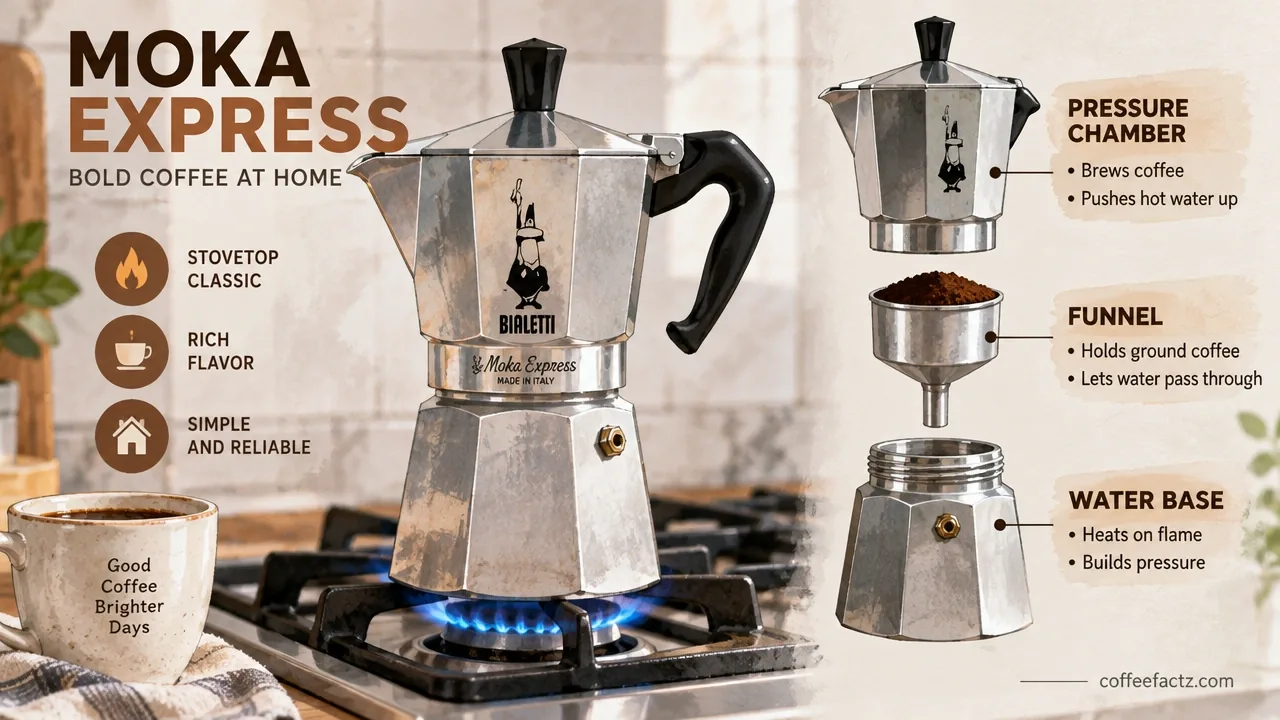
| Moka (brewer) | Stovetop pressure brewer | Italian patent, Alfonso Bialetti, 1933 |
| mocha (beverage) | Chocolate espresso drink | European café lineage, late 19th–early 20th century |
The Moka pot’s technical profile matters here because the distinction is mechanical, not semantic. The stovetop brewer operates at roughly 1–2 bar of pressure. Espresso machines pull at approximately 9 bar. Both produce concentrated coffee, but the extraction kinetics differ: lower pressure means longer contact time with coarser grounds, a different soluble profile, and less emulsified crema. Alfonso Bialetti patented the Moka Express in 1933, naming it after the same Yemeni coffee term that was already embedded in European coffee vocabulary.
Etymological Kinship and Resolution Rule
The Moka pot’s name descends from the same Yemeni toponym as the beverage. These words are relatives, not homonyms – the collision is etymological rather than accidental. Bialetti did not choose an arbitrary word. He chose the word that European consumers already associated with quality coffee, and spelled it the Italian way.
The resolution rule is simple enough to carry away from this article: bean and provenance are “Mocha”; the stovetop brewer is “Moka”; the chocolate drink is “mocha.”
One practical consequence follows from the pressure differential. A Moka pot cannot substitute for espresso in a mocha recipe without adjusting the ratio. At 1–2 bar versus 9 bar, the Moka brew is concentrated but less dense – it lacks the emulsified fat that espresso contributes to the chocolate integration. Use a Moka shot in place of espresso and you will need more coffee volume or less milk to achieve comparable intensity. The pressure differential changes the concentration and therefore the ratio, not merely the flavor.
The Caffeine Reality Check: Why Your Numbers Never Match
Mocha caffeine content generates conflicting figures across every source because no source publishes a mocha specification. The word “mocha” communicates nothing about dose, species, volume, or extraction yield – which means every number you have seen is a different shop’s actual drink, not a property of the category.
Baseline Estimates and Variance Drivers
The commonly cited baseline: approximately 430 mg/L, or about 12.7 mg per US fluid ounce, translating to roughly 152 mg in a 350 mL / 12 fl oz serving. That figure is shop-dependent and approximate by definition. Treat it as an order-of-magnitude anchor, not a specification.
The real drivers of variance are four, and none of them appear in the word “mocha”:
- Coffee species: Coffea robusta carries roughly twice the caffeine by dry mass compared to Coffea arabica. A shop using a robusta-heavy espresso blend will produce a measurably different drink than one using 100% arabica, with identical ratios.
- Dose: Grams of dry coffee ground per shot. A 14-gram double differs from an 18-gram double. Both are “a double espresso” on a menu.
- Extraction yield: The percentage of soluble mass extracted from the dry coffee. Under-extracted shots carry less caffeine in the cup than fully extracted ones at the same dose.
- Total drink volume: A 12 fl oz mocha and a 16 fl oz mocha with the same espresso shot have different caffeine concentrations per ounce, not different total caffeine – unless the larger drink gets an additional shot, which varies by house.
Three more variables shift the dietary outcome without changing the coffee: chocolate format and darkness (darker chocolate carries more caffeine per gram), milk versus milk alternative (no caffeine difference, but caloric and fat profiles shift), and serving size. Readers arriving with three conflicting milligram counts are not reading contradictory facts – they are reading three different drinks.
Roast Myths and Methylxanthine Profiles
The dark-roast myth is persistent and wrong. Dark roasting removes negligible caffeine by mass. The Maillard reactions and pyrolysis that produce darker color and bolder flavor do degrade some caffeine, but the loss is small enough that “dark roast equals more caffeine” and “dark roast equals less caffeine” are both defensible in the rounding errors. “Dark roast equals stronger” is a flavor claim. It is not a stimulant claim.
Theobromine is the more interesting molecule in a mocha, and it comes from the chocolate. A peer-reviewed review published in Nutrients examined the methylxanthine profiles of cacao and chocolate in detail. Its findings clarify why a mocha can feel smoother than its caffeine load would predict:
Theobromine is the dominant methylxanthine in cacao, present at substantially higher levels than caffeine. It carries a plasma half-life of approximately 7.2 hours compared to caffeine’s 4.1 hours, and it is considerably less potent at adenosine A2A receptors – the receptors responsible for caffeine’s alerting effect. The combined profile produces a less intense psychostimulant effect and is not generally associated with anxiety or insomnia. – From the study “Health Benefits of Methylxanthines in Cacao and Chocolate” published in Nutrients
What that means in practice: the chocolate in your mocha is not inert. It adds a slow-burning, mild methylxanthine on top of the espresso’s faster, sharper caffeine hit. The result is a blended stimulant profile – not stronger than plain espresso, but differently shaped across the two to three hours after you drink it.
Modern Twists and Today: Frappuccino Culture, the Specialty Reset, and What to Order
Modern mocha culture has fractured the word into at least three simultaneous identities: a hot café drink with Italian roots, a blended cold format built on syrups and stabilizers, and a flavor platform printed on packaged goods that may contain no espresso at all.
The Moka Cookie Crumble Frappuccino represents the furthest point of drift from the Yemeni port. Cold, blended, finished with whipped cream and a cookie-crumb garnish, it shares a name with the caffè mocha and almost nothing else mechanically. The physical reason is straightforward: cold fat emulsions do not suspend chocolate the way hot milk does. Hot espresso dissolves cocoa solids and cocoa butter into a stable emulsion. Cold blending cannot replicate that chemistry. Blended mochas compensate with syrups and stabilizers – pre-dissolved, shelf-stable formats that disperse evenly in cold liquid without the heat-driven emulsification that a hot build depends on. The drink is engineered around the constraint, not despite it.
Beyond the café, mocha now operates as a flavor platform. Syrups, ready-to-drink cans, desserts, instant coffee sachets, and packaged baked goods all carry the word – often with no espresso in the formulation and no geographic claim attached. The word has fully detached from its origin and functions as a flavor signal the way “vanilla” or “caramel” does: a consumer shorthand for “chocolate plus coffee,” with no further specification.
The specialty-coffee tension is real and worth naming honestly. Third-wave roasters often position added chocolate as a mask over origin character – something you reach for when the coffee itself isn’t interesting enough. From that perspective, mocha is a beginner’s drink, a training-wheel format. Simultaneously, those same roasters sell Yemeni single-origin lots at the top of their price lists, marketing the beans’ natural fruit-forward complexity as an analogue to chocolate without the chocolate. The word “Mokha” appears on specialty menus as a named provenance, sometimes alongside tasting notes of dried fruit and dark cocoa – a flavor profile the bean produces without any addition.
That is the loop closing. The word began as a provenance claim on a Yemeni quay. It drifted into a flavor label as supply chains shifted and café culture filled the vacuum. Now, as origin-focused coffee culture returns Yemeni “Mokha” to the menu as a named single origin, the word is partially reconverging on its starting point – a place, not a recipe.
Mocha was never a recipe. It was a place. Every version you have ever ordered – the hot caffè mocha, the blended frappuccino, the white-chocolate variant, the Moka pot concentrate – is a descendant of one Yemeni quay whose ledgers predate the drink by centuries.
Frequently Asked Questions About Mocha Coffee
What does mocha literally mean?
Mocha is a toponym – it derives from Mokha, a port city on Yemen’s Red Sea coast that was the dominant coffee export hub from the 15th through the 17th century. The word originally meant “coffee from that port,” not “chocolate-flavored.”
What country is mocha from?
The port, the historical bean grade, and the trade term are all Yemeni. The chocolate espresso beverage is a European construction, with its clearest lineage running through northern Italian café culture from the 18th century onward.
Why is it called mocha and not chocolate?
Because the name attached to the bean’s prestige, not its flavor. “Mocha” was already the highest-status coffee word in European markets when cafés began combining coffee with chocolate; borrowing the name was a quality signal, not a flavor description.
Can a Moka pot make a true mocha?
Not as a direct espresso substitute. The Moka pot operates at 1–2 bar versus espresso’s 9 bar, producing a less emulsified brew. You can use it to make a chocolate coffee drink, but the lower concentration means you’ll need to adjust the ratio – more coffee volume or less milk – to get comparable intensity.
Is white mocha just a lighter version of regular mocha?
No. White mocha uses white chocolate, which contains cocoa butter but no cocoa solids. It’s a different fat-and-sugar system – typically sweeter than dark mocha in syrup form because there’s nothing to offset the sugar with bitterness. “Lighter” in color, yes; lighter in sweetness, the opposite.
Does dark roast coffee make a stronger mocha?
In flavor, yes. In caffeine, not meaningfully. Dark roasting degrades a small amount of caffeine, but the loss is minor enough that roast level is not a reliable predictor of caffeine content. Species, dose, and extraction yield matter far more.
What’s the actual difference between a mocha and a mochaccino?
There is no settled industry definition for mochaccino. Some shops treat it as a mocha with a cappuccino-style foam cap; others serve it blended or iced. The one constant across every version is the chocolate. If a shop uses the term, it’s worth asking what they mean by it.
Why do blended mochas taste so different from hot ones?
The emulsification mechanism is different. Hot espresso dissolves cocoa solids and cocoa butter into a stable emulsion. Cold blending can’t replicate that chemistry, so blended mochas rely on pre-dissolved syrups and stabilizers to keep the chocolate integrated. Same name, different physics.
References
- Health Benefits of Methylxanthines in Cacao and Chocolate | mdpi-res.com