


The best double wall espresso cups earn their place on your counter through physics, not aesthetics. The air gap between two walls of borosilicate glass does real thermal work-keeping your shot warmer longer, your exterior cool-touch, and your base condensation-free-but the margin between a great glass and a mediocre one is narrower than most buyers expect.
What actually separates the field is seal integrity, portafilter clearance, capacity discipline, and how the glass holds up after six months of daily use. Get those four right, and the floating crema is just a bonus.
Once you have mastered the vessel holding your shot, identifying underlying problems in the bean’s processing or roast profile is the next logical step, which you can learn in our guide on Coffee Cupping Defect Detection The complete step-by-step protocol.
Key Takeaways on Best Double Wall Espresso Cups
- The air gap in double-wall borosilicate glass reduces heat transfer and prevents condensation, but the thermal edge over ceramic is modest-around 4–6°C at the 4-minute mark.
- Capacity matters more than most buyers realize: stay in the 2–3 oz range or your crema thins out and the thermal advantage disappears faster.
- The base seal is the glass’s most vulnerable point-hand-washing protects it; dishwasher cycles accelerate its failure.
- Bodum Pavina is the reliability baseline; any premium glass should prove it beats the Pavina on a specific axis before justifying the price difference.
- Price does not predict durability or ergonomics-check handles, hold comfort, seal design, and replacement cost before spending premium.
- Double-wall stainless (like Frabosk) is the honest answer for commuters and slow sippers; glass wins on ritual and optics, not portability.
How We Ranked the Best Double-Wall Espresso Glasses
Beyond the signature floating-shot effect, double-wall espresso glasses earn or lose their ranking on seven axes: thermal retention, capacity fit, borosilicate safety, optical clarity, machine clearance, care requirements, and daily workflow. Most reviews collapse all of these into a single “it looks great” verdict. That’s not useful when you’re trying to decide whether to spend $12 or $60 on a two-ounce cup.
The honest framing is this: double-wall glass is not universally superior. Its thermal advantage is real but modest, its optical payoff depends heavily on wall thickness and seal quality, and its durability is entirely contingent on how well the base seal holds over time. Rank by those criteria and the field sorts itself quickly.
Food & Wine editors explain the mechanism clearly: double-walled glass retains heat better than single-wall glass while staying cool to the touch, because the air space between the walls provides insulation. The liquid stays contained inside, which allows the outer wall to maintain a more moderate temperature.
That air gap is the entire value proposition. Everything else in this ranking flows from how well each glass protects it.
Insulation Mechanics and Capacity Discipline
Dual-wall borosilicate glass works by trapping a layer of air between two walls, reducing the rate of heat transfer from the liquid to the environment. The result: a cooler exterior, no condensation pooling on your counter, and crystal-clear walls that let you watch crema separation and tiger striping develop in real time. Those optical benefits are not incidental-they’re structurally linked to the same air gap that provides insulation.
Capacity is where most buyers make their first mistake. A 2–3 oz (60–90 ml) glass is the correct range for a standard single or double espresso shot. Go to 4 oz or above and you’re spreading a 30 ml shot across a much larger footprint: the crema thins out, the thermal mass advantage disappears faster, and the visual drama collapses. Single-wall transparent espresso glasses offer a similar optical experience at lower cost, but they sacrifice the cool-touch exterior and condensation resistance that make double-wall glass genuinely practical at a busy home bar.
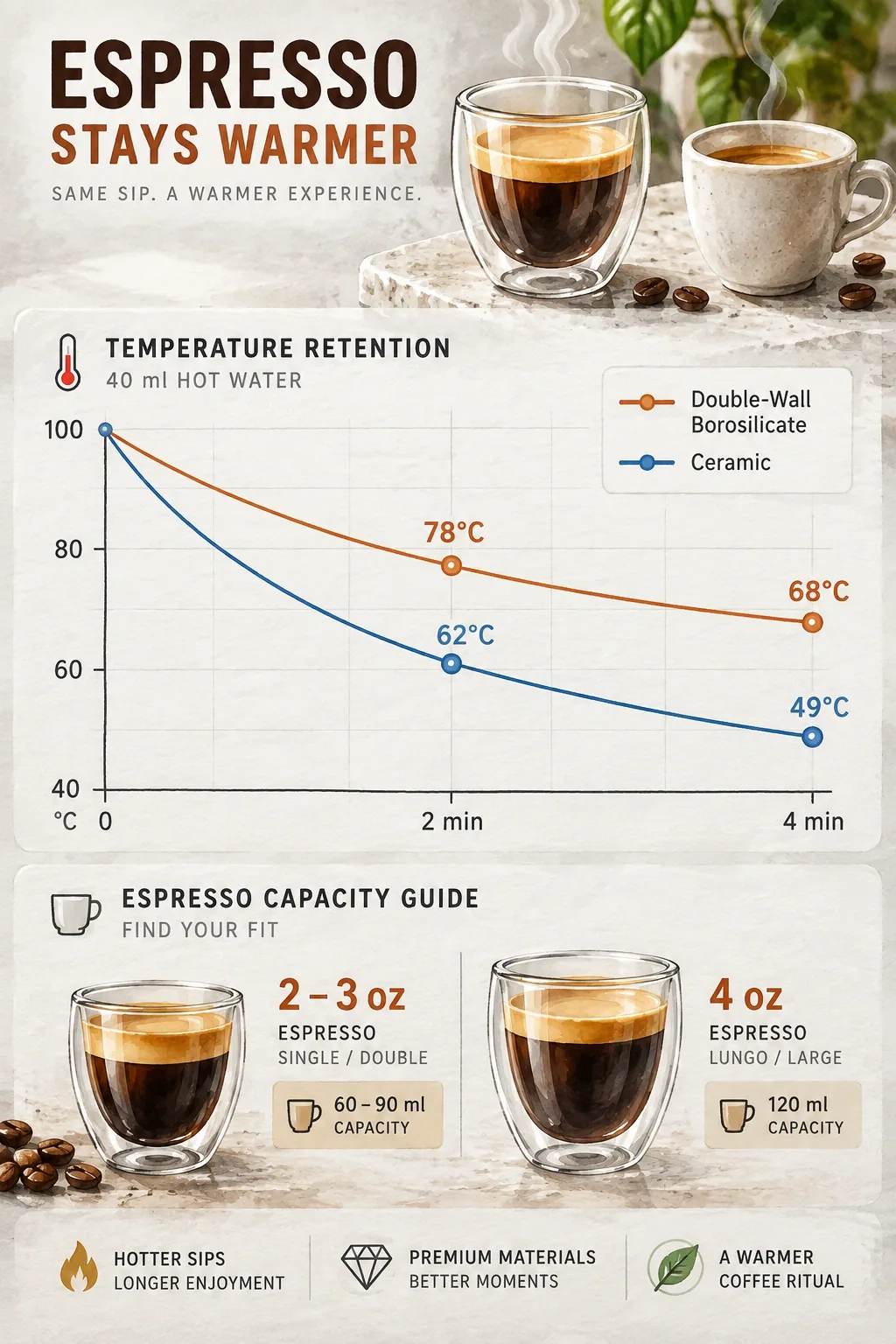
The thermal edge, while real, is worth calibrating. A quick 40 ml hot-water comparison tells the story without a lab: at the 2-minute mark, a double-wall glass holds around 75°C while a ceramic mug sits at roughly 71°C. At 4 minutes, that gap widens slightly-69°C versus 63°C. Not a dramatic difference, but meaningful if you’re a slow sipper or you’re pulling shots while still assembling your morning.
Here’s a visual breakdown of how double-wall glass compares to ceramic across those first critical minutes:
Bench Testing and Seal Integrity
Every glass in this ranking went through the same protocol. First, preheat with hot water for 30 seconds before pulling a shot-this closes the thermal gap between the glass and your espresso and prevents the first few milliliters from flash-cooling on contact. Then pull the same shot into each glass and check three things immediately: does the glass sit flush and stable under the portafilter without scraping the group head? Does it fit on the warming tray without tipping? And does looking through the base and walls at a straight line or grid reveal any optical warping?
The silicone pressure valve at the base of each glass deserves close inspection. It’s the only thing standing between the air gap and the outside world. Check for bubbles, cracks, or discoloration around the seal-any of those signals are early warnings of water ingress. Most manufacturers claim dishwasher safety, but the repeated pressure and heat cycles of a dishwasher accelerate seal degradation. Hand-washing is the correct protocol for extending glass life.
The stakes of a failed seal are higher than they appear. Research published in the ECS Journal of Solid State Science and Technology on water stress corrosion at directly bonded borofloat glass interfaces shows that humid air and mechanical stress stored at the interface increase the reaction rate of bond degradation-dissolving alkali ions, breaking covalent bonds, and driving sub-critical crack growth that progressively destroys bonding energy. In plain terms: once moisture finds its way into a compromised borosilicate seal, the degradation isn’t reversible. The glass clouds permanently, and no amount of drying will fix it.
That’s not a reason to fear your espresso glass. It’s a reason to hand-wash it.
Bodum Pavina: The Proven Double-Wall Borosilicate Benchmark
The Bodum Pavina has been in production long enough to qualify as the reliability baseline for this entire category. If you’re evaluating any newer or more expensive double-wall espresso glass, the honest question isn’t “is it better than nothing?”-it’s “is it meaningfully better than the Pavina?”
At 2.5 oz, the Pavina sits precisely in the correct capacity window for a standard double espresso. Its borosilicate construction delivers the expected cool-touch exterior and condensation-free base, and its optical clarity is strong enough to show crema separation and tiger striping without distortion. There’s nothing revolutionary about the design, and that’s the point. The Pavina’s value is not in leading any single metric-it’s in being a known quantity with a long track record and widely available replacement sets.
Real-world machine fit is worth verifying before you assume. Check the glass height against your portafilter clearance with the basket locked in, and confirm it sits flat and stable on your warming tray. Most home espresso machines accommodate the Pavina without issue, but taller machines or unusually deep portafilter baskets can create a tight fit.
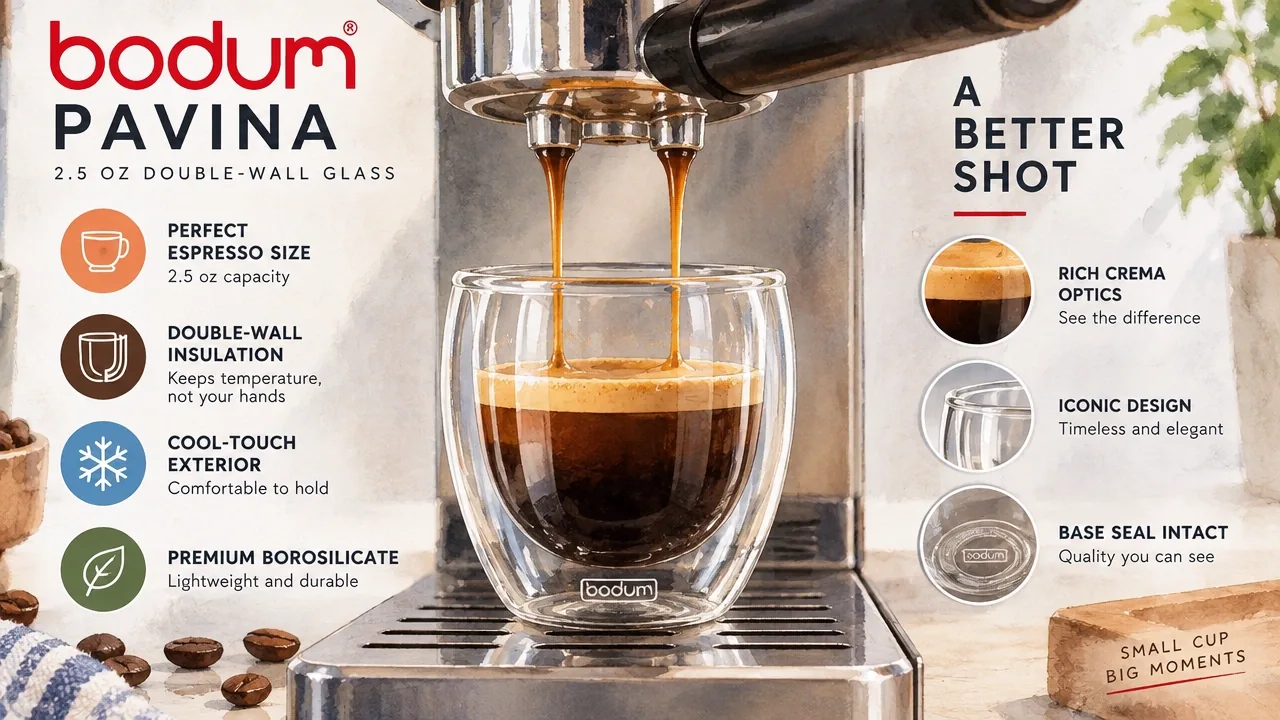
On care: inspect the base seal regularly for bubbles or any sign of water ingress. Hand-wash with warm soapy water rather than running it through a dishwasher cycle. The Pavina’s seal is not fragile, but it’s also not indestructible-and once water enters the air gap, the glass is finished. The good news is that replacement sets are inexpensive enough that this isn’t a catastrophic loss. That replaceability is itself a feature that premium alternatives often can’t match.
Affiliate Disclosure
This post contains affiliate links, meaning I may earn a commission if you make a purchase through these links, at no additional cost to you. As an Amazon Associate, I earn from qualifying purchases. I only recommend products I genuinely believe will add value.

Bodum 2.5oz Pavina Double Wall High-Heat Borosilicate Glass, Set of 2, Clear
- Insulated: a set of Two double-wall pavina glasses, 2. 5 ounces each; perfect for Coffee, espresso, or a multi…
- Heat resistant: Bodum glass is made of mouth-blown, lab-quality borosilicate-glass construction for a durable …
- 2-Layer design: insulated glass has a sleek 2-layer design that creates a dramatic optical illusion and preven…
- Microwave safe: quickly reheat your Coffee in the microwave and toss in the dishwasher when you need a clean; …
- Award winning: Bodum double wall glasses are the winners of the prestigious European if design award; 1 year L…
De’Longhi Double-Wall Espresso Glasses: Machine Clearance & Cafe-Style Value
De’Longhi’s double-wall espresso glasses are designed with machine compatibility in mind, which makes sense given the brand’s core identity as an espresso machine manufacturer. The glasses occupy the 2–3 oz range, hit the right capacity window for straight espresso, and present the shot with the kind of cafe-style visual clarity that makes a home setup feel intentional rather than improvised.
The first thing to verify is clearance. Measure the glass height against your specific machine’s portafilter-to-drip-tray distance before assuming it fits. Some De’Longhi glass models run slightly taller than the Pavina, which creates friction with machines that have tighter clearance-particularly compact home espresso machines where the drip tray sits high. Also check warming tray stability: a glass that rocks even slightly is a liability in a morning routine.
Once clearance is confirmed, the optical performance holds up well. The clear borosilicate-style walls show crema separation and tiger striping cleanly, and the cool-touch exterior and condensation-free base are consistent with what you’d expect from a properly constructed double-wall glass. The base seal follows the same care logic as every other glass in this category: hand-wash, inspect regularly, and avoid thermal shock. De’Longhi’s ecosystem advantage is real if you already own one of their machines-the glasses are sized and proportioned with that pairing in mind-but that advantage disappears the moment clearance doesn’t fit your setup.

DeLonghi 3oz Espresso Double Wall Thermal Glasses, Set of 2
- FROM DE'LONGHI. The world-leader in espresso machines.
- ENHANCED DRINKING EXPERIENCE. These tulip-shaped DeLonghi glasses are designed to enhance the sensorial experi…
- VERSATILE & BEAUTIFUL. Set of two 3oz borosilicate glass thermal espresso glasses that can be used for espress…
- KEEPS DRINKS HOT. The double walled borosilicate allows you to hold the glass comfortably in your hand, and si…
- GIFT PERFECT. These hand-made glasses are the perfect gift for the espresso connoisseur
Kinto Kronos: Design-Forward Optics for Crema & Tiger Striping
The Kinto Kronos is the choice for buyers who treat the espresso ritual as an aesthetic experience and want their glassware to reflect that. Its minimal design strips away visual noise so the shot itself becomes the focal point-and the optical clarity of the double-wall borosilicate construction delivers on that promise. Crema separation and tiger striping read clearly through the walls without the slight murkiness that cheaper glass can introduce.
Capacity discipline still applies. Keep the Kronos in the 2–3 oz range for espresso; the larger sizes in the Kinto lineup look beautiful but dilute the crema concentration that makes the visual payoff worthwhile. Rim thickness is worth evaluating in person if possible-Kinto’s minimal design philosophy produces a thinner rim than utilitarian alternatives, which changes mouthfeel in a way some drinkers love and others find too delicate for daily handling.
Run an optical distortion test before committing: hold the empty glass up and look through the base and walls at a straight line or grid. Any warping in the glass-however subtle-will show up as a bend in that line, and it will distort the crema view every time you pull a shot. The Kronos generally passes this test cleanly, but it’s worth doing on any glass at this price point. Also confirm it clears your portafilter with the basket locked in; Kinto’s slim profile fits most home machines, but verify before you’re committed.

Kinto Set of 2 Double-Walled KRONOS 80 ml Espresso Cups - Maintain Temperature - Prevent Condensation
- The double walls insulate and maintain the hotness or coldness of the drink for longer and keeps the outside w…
- Inner wall has an angle that is ideal for drinking all the liquid and double wall makes it look like the drink…
- Ring supports your fingers and makes the cup easier to hold while the round form provides stability
- Heat resistant glass, microwave and dishwasher safe
- Diameter 55 mm, Height 70 mm (2.16 x 2.75 inches), Weight 70 grams (2.5 ounces)
Gencywe Double-Wall Espresso Cups: Thicker Glass for Daily Durability
Gencywe’s double-wall borosilicate espresso cups make a straightforward argument: thicker glass construction, daily-use durability, and a price point that makes replacement a non-event. For buyers who pull two shots before 7 a.m. and don’t want to treat their glassware like a museum piece, that argument lands.
The 2–3 oz capacity keeps Gencywe in the correct espresso range, and machine clearance is worth checking the same way as every other glass here-measure height against your portafilter and confirm warming tray stability. The thicker walls add a small amount of weight and change the balance in hand compared to the Kinto Kronos; some drinkers find this more reassuring, others find it clunky. Neither is wrong-it’s a preference call.
The durability story is real but not unconditional. Gencywe markets dishwasher safety, and the thicker glass construction does reduce the risk of thermal shock cracking. That said, the same seal-protection logic applies: hand-washing is the right call if you want the air gap to stay clean and the base seal to last. Inspect the seal periodically for bubbles or water ingress, and avoid running the cups through rapid temperature changes-from freezer to boiling water, for instance-regardless of what the marketing says. Replacement cost is low enough that losing one to a mishap doesn’t sting, and that’s a genuine advantage over premium alternatives that charge three times the price for a glass that breaks just as easily.

Gencywe Double Walled Espresso Cups Set of 4 (50% Thicker), 3 Ounce Clear Expresso Coffee Mugs, Espresso Shot Glasses, Double Wall Insulated Espresso Cups Suit for Espresso Machine, Microwave Safe
- 【A BEAUTIFUL WAY TO ENJOY ESPRESSO】 - Set of 4 double-wall espresso mugs, each mug boasting a unique curvature…
- 【UNIQUE DOUBLE WALL DESIGN】 - As you pick up your new double walled espresso mugs, indulge in the elegant way …
- 【DURABLE AND EASY TO CLEAN】 - The crystal clear double-wall espresso mugs made of mouth-blown, lead-free heat …
- 【PERFECT GIFT】 - Makes a wonderful choice for the coffee, espresso or tea lover in your life no matter the occ…
- 【OUR PLEDGE】 - All our products check the highest quality standards, so you can be sure that the double-wall e…
Frabosk Double-Wall Stainless: The Overlooked Commuter Alternative
Glass is the right material for espresso ritual. It is not always the right material for espresso consumption. If your shot travels ten minutes in a bag before you drink it, or if you’re pulling espresso at 6 a.m. and not drinking it until you’re parked, double-wall stainless solves problems that no borosilicate glass can touch.
Frabosk’s double-wall stainless cup gives up one thing-crema optics-and gains everything else: zero breakage risk, stronger insulation for longer holds, and genuine portability. For straight espresso consumed immediately at a desk or counter, the glass ritual wins. For a commute, a slow sip at a standing desk, or any situation where the cup might get knocked over, stainless is the honest answer.
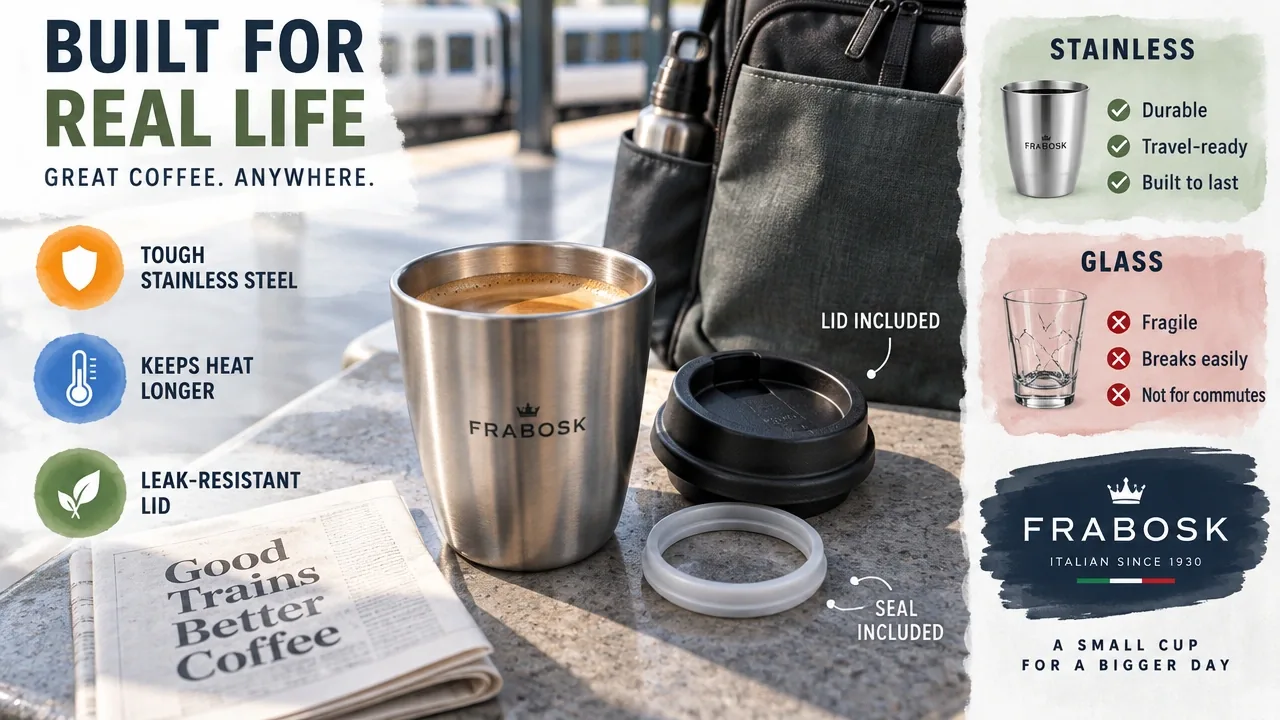
The use-case map is clean: straight espresso for ritual and optics → preheated double-wall glass; commute or extended sipping → Frabosk stainless or an active heated mug like an Ember; milk drinks, americanos, and iced drinks → either double-wall glass or stainless, where the insulation advantage of both materials is more pronounced than it is for a 30 ml shot. The stainless thermal story is actually stronger for larger, longer-held drinks than for espresso specifically.
Care is simpler than glass: most stainless double-wall cups are dishwasher-safe, but check the lid and seal on your specific model before assuming. The lid seal on commuter cups is the component most likely to degrade first-inspect it after the first few months of daily use. Glass still needs hand-washing to protect the base seal; that rule doesn’t change just because stainless doesn’t.
Verdict: Match the Double-Wall Glass to Your Ritual
The price-durability myth is the first thing to put down. Paying more for a double-wall espresso glass does not automatically buy you a better seal, stronger glass, or more ergonomic design. It often buys you a better-looking glass with identical failure modes. Before spending premium, check: does it have a handle or a comfortable hold? What’s the replacement cost when one breaks? Is the seal design actually inspectable, or is it buried under a design element? Is it genuinely dishwasher-safe or just marketed that way?
Here’s where each glass earns its place by use-case:
| Use Case | Best Match | Why |
|---|---|---|
| Daily straight espresso, home ritual | Bodum Pavina | Known reliability, correct capacity, replaceable |
| Machine ecosystem fit | De’Longhi Double-Wall | Sized for De’Longhi machines, cafe-style optics |
| Design & crema optics priority | Kinto Kronos | Minimal design, clearest optical performance |
| Budget daily driver | Gencywe | Thicker glass, low replacement cost |
| Commuter or slow sipper | Frabosk Stainless | Portable, durable, no breakage risk |
| Active heated slow sipping | Ember or equivalent | Maintains temperature actively, not passively |
The double-wall thermal advantage is also not universal. For a 30 ml straight espresso consumed in under two minutes, the insulation edge over ceramic is real but modest. For milk drinks, americanos, and iced drinks-larger volumes held longer-the gap widens meaningfully. If you’re primarily pulling milk-based drinks, double-wall glass or stainless earns its keep more convincingly than it does for a quick ristretto.
On the premium end, a word of caution: Zwilling’s handles have drawn consistent criticism as ergonomically ineffective-present in design but not in function-and breakage reports after roughly a year of use undercut the premium pricing. The Kruve espresso glass is a beautiful object that many users find genuinely difficult to hold during daily use. Design ambition and practical ergonomics are not the same thing, and at the prices these glasses command, they should be.
Final care rules apply regardless of which glass you choose: preheat with hot water before pulling a shot, hand-wash to protect the base seal, inspect the silicone pressure valve every few weeks, avoid rapid temperature changes, and match your cup size to your actual drink. A 2.5 oz glass for a double espresso. A 3 oz glass for a lungo. Nothing larger if you want the crema to survive the pour.
Frequently Asked Questions About Best Double Wall Espresso Cups
How long does a double-wall espresso glass actually keep a shot warm?
In a 2–3 oz glass, a double-wall design holds espresso around 4–6°C warmer than ceramic at the 4-minute mark. That’s meaningful for slow sippers but irrelevant if you drink your shot in under 90 seconds.
Do I need to preheat a double-wall espresso glass?
Yes. Even with the insulation, a cold glass will flash-cool the first milliliters of your shot on contact. A 30-second hot water rinse before pulling closes that gap and gives you a more accurate first sip.
What causes a double-wall glass to go cloudy inside?
Clouding happens when water enters the air gap through a compromised base seal. Once moisture is inside, it can’t be removed-the cloudiness is permanent. This is why hand-washing and regular seal inspection matter.
Are double-wall espresso glasses dishwasher safe?
Many are marketed as dishwasher-safe, but repeated dishwasher cycles accelerate seal degradation through heat and pressure. Hand-washing is the correct long-term practice regardless of what the label says.
What cups do Italians traditionally use for espresso?
Traditional Italian espresso is served in a small, thick-walled ceramic demitasse cup-typically 2–3 oz-preheated on the machine’s warming tray. Double-wall glass is a modern aesthetic variation, not a traditional Italian format.
Is Kinto Kronos worth the premium over Bodum Pavina?
If optical clarity and minimal design are your priorities, yes. If you want a reliable daily driver with easy replacements, the Pavina delivers most of the same functional performance at a lower cost.
When does double-wall glass actually outperform ceramic?
Double-wall glass earns its advantage most clearly with larger drinks-milk drinks, americanos, and iced drinks-held for longer periods. For a 30 ml straight espresso consumed quickly, the thermal gap over ceramic is real but not dramatic.
How do I test a double-wall glass for optical distortion before buying?
Hold the empty glass up and look through the base and walls at a straight line or grid-a tile edge or window frame works well. Any bending or warping in that line will appear the same way when you’re looking at crema through the glass.
References
- Glass Coffee Mugs Review – Food & Wine | foodandwine.com
- Water Stress Corrosion in a Directly Bonded Borofloat Glass Interface – ECS Journal of Solid State Science and Technology | iopscience.iop.org

