

Caffeine in black tea is genuinely misunderstood – not because the science is complicated, but because most published comparisons measure different things and call it a fair fight. One number comes from dry leaf. The other comes from a brewed cup. They are not the same measurement, and stacking them produces a contradiction that has confused drinkers for decades.
Once you put every figure on the same unit – milligrams per brewed 8 oz serving – the confusion dissolves. Black tea and coffee stop being a mystery and become a ratio. What follows is that ratio, the variables that move it, and the personal ceiling that turns it into a usable daily plan.
Key Takeaways on Caffeine in Black Tea
- Brewed black tea delivers roughly 28–46 mg of caffeine per 8 oz cup; brewed coffee delivers 107–151 mg – the two ranges don’t overlap at typical preparation.
- Dry tea leaves can contain more caffeine by weight than coffee beans, but that is a leaf measurement, not a drink measurement; the brewed cup tells the only number that matters.
- Oxidation does not add caffeine; the black tea label tells you how the leaf was processed, not how much caffeine it holds.
- Caffeine in tea and coffee is the same molecule – the smoother feel of tea comes from a lower dose per cup, slower sipping speed, and possibly L-theanine, not a different compound.
- Decaf tea is not caffeine-free; residuals of 2–10 mg per cup are typical, and herbal blends that contain any true tea leaf carry caffeine regardless of the product name.
- Your personal daily ceiling is body-weight-based (roughly 3 mg/kg), and preparation method plus total cup count – not category label – determines whether you stay under it.
Caffeine Is One Molecule: Why the Tea-vs-Coffee Numbers Never Agree
Caffeine in black tea starts with a definition problem, and it runs deeper than most guides acknowledge. True tea – the kind that contains caffeine – comes from one plant: Camellia sinensis. Every black tea, green tea, white tea, and oolong on the market is a leaf from that plant, processed differently. Herbal infusions and tisanes – chamomile, peppermint, rooibos – are not tea in this sense. They are botanical brews, and most contain no caffeine at all. That distinction matters before a single number appears, because the caffeine question only applies to Camellia sinensis.
Now the molecule itself. Caffeine is one compound with one chemical formula, one set of adenosine receptors it blocks, and one pharmacological effect per milligram – regardless of whether it arrived in a ceramic teacup or a paper coffee cup. The felt difference between a cup of tea and a cup of coffee is not a difference in the drug. It is a difference in dose, delivery speed, and what else is in the cup. The compound-level explanation is identical.
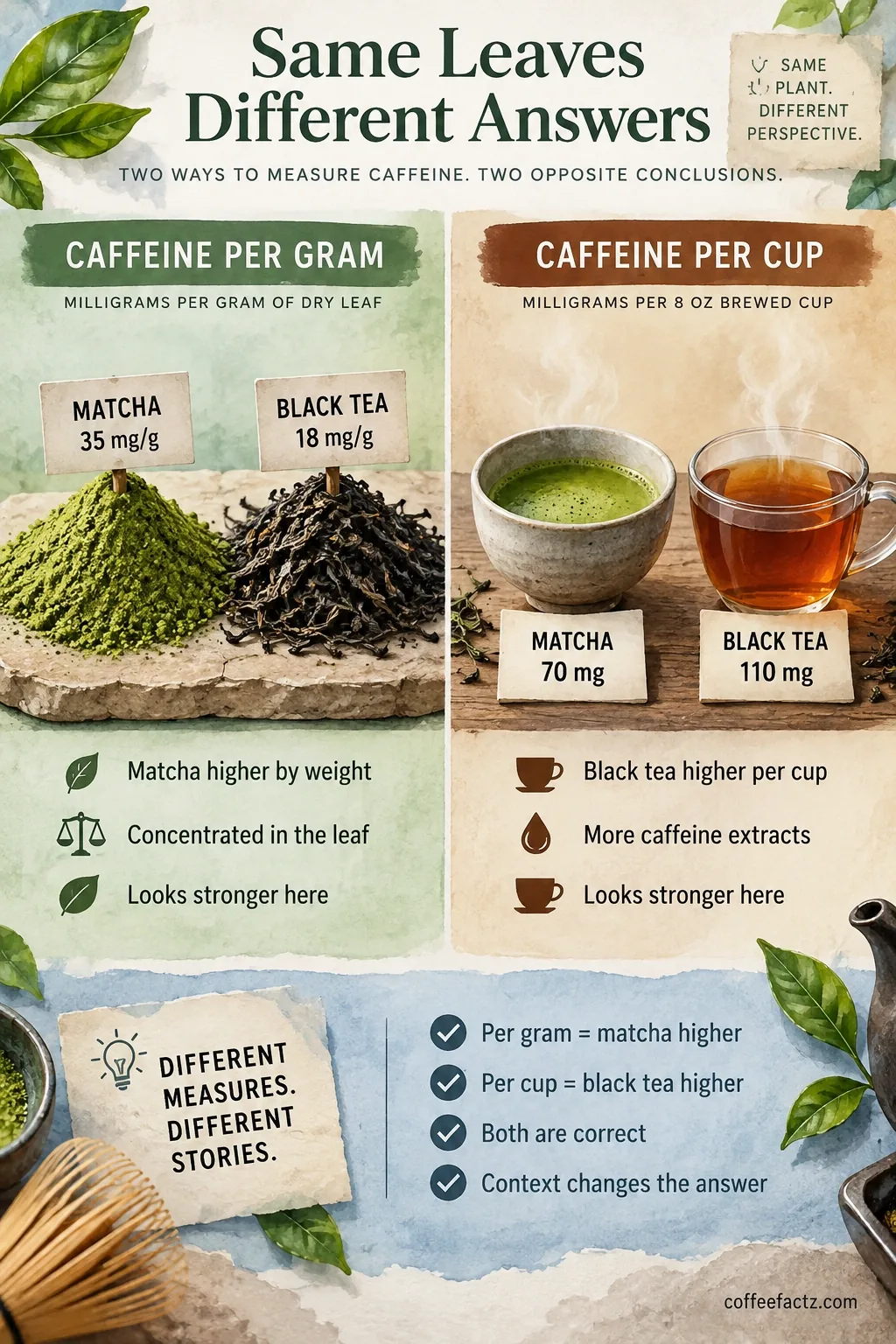
So where does the long-running claim that “tea is stronger than coffee” come from? It comes from a measurement mismatch. Dry tea leaves, by weight, can contain more caffeine per gram than roasted coffee beans. That is a true statement about dry plant material. A brewed cup of tea, by volume, contains meaningfully less caffeine than a brewed cup of coffee. That is also a true statement – about a drink. Both claims are accurate. Only one of them describes something you actually swallow.
Concentration (milligrams per fluid ounce of brewed beverage) and content (milligrams per gram of dry leaf) are two different measurements. Comparing them produces opposite conclusions about which drink is “stronger,” and most of the internet’s conflicting caffeine tables are doing exactly that without flagging it.
One more definitional caveat worth placing here: decaffeinated does not mean caffeine-free. The process reduces. It does not eliminate. The exact residuals will be quantified later, but the category assumption – that switching to decaf takes you to zero – is wrong and worth retiring now.
The Real Numbers in Your Cup: Black Tea vs Coffee, Milligram for Milligram
Black tea caffeine, expressed per brewed serving, is lower than brewed coffee caffeine. That directional answer is reliable. The exact figures are ranges, and the ranges are wide for structural reasons – brewing method, steep time, leaf dose, and water temperature all move the number. Here is what those ranges actually look like, standardized to one unit.
Standardized Brewed Measures
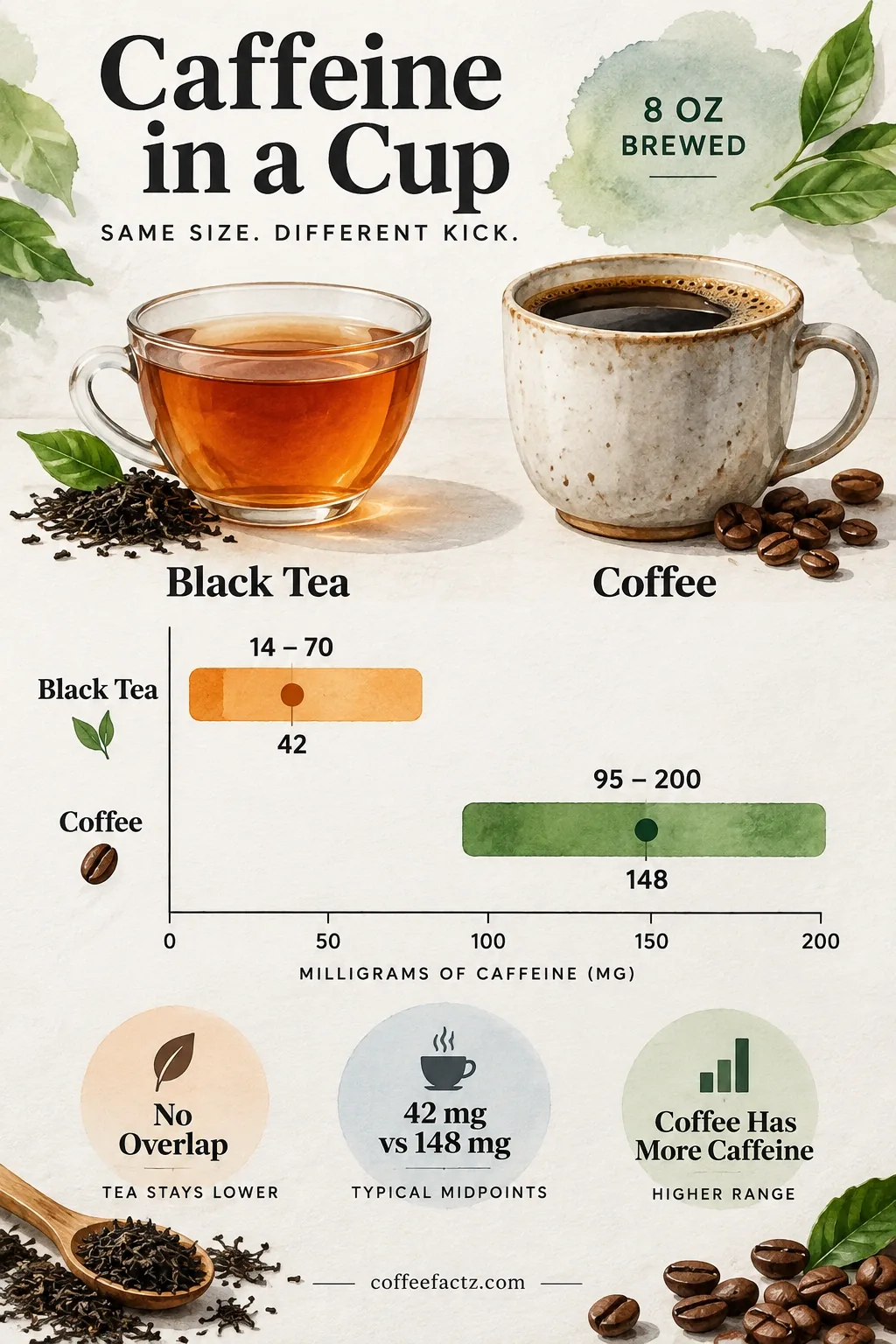
Brewed black tea lands at roughly 28–46 mg per 8 oz (240 ml) cup, with a typical midpoint around 40 mg. Brewed coffee lands at roughly 107–151 mg per 8 oz cup, depending on preparation method. Those two ranges do not overlap at typical preparation. That non-overlap is why the directional answer – tea has less caffeine than coffee – holds even when the precise figure doesn’t.
The coffee range is wide because preparation method moves the number substantially. Drip coffee tends toward the lower end of that band. French press extracts more aggressively and pushes higher. Espresso, measured per 1 oz shot, concentrates at roughly 60–65 mg per ounce – higher than any brewed tea by concentration – but a standard double shot served as espresso delivers roughly 120–130 mg total, which lands within the brewed coffee range. Instant coffee sits lower, often around 60–80 mg per 8 oz, because the manufacturing process pre-extracts and then dries the coffee, leaving less soluble caffeine available in the cup.
The tea range is wide because steep time is the primary variable, and most home brewers don’t measure it consistently. A 1-minute steep and a 5-minute steep of the same leaf at the same temperature can differ by 15–20 mg in a single cup.
Serving-Size Comparisons and Milk Effects
The full comparison the audience is actually searching for looks like this, per standard serving:
| Beverage | Serving Size | Caffeine Range | Typical Midpoint |
|---|---|---|---|
| Brewed black tea | 8 oz | 28–46 mg | ~40 mg |
| Instant coffee | 8 oz | 60–80 mg | ~70 mg |
| Brewed drip coffee | 8 oz | 95–120 mg | ~107 mg |
| Brewed French press | 8 oz | 107–151 mg | ~130 mg |
| Espresso (per shot) | 1 oz | 60–65 mg | ~63 mg |
| Latte (double shot) | 12 oz | 120–130 mg | ~125 mg |
| Milk tea (standard) | 12 oz | 50–90 mg | ~70 mg |
| Cola (standard can) | 12 oz | 34–46 mg | ~40 mg |
The convergence finding is counterintuitive: a well-steeped cup of black tea, a cup of instant coffee, and a cola can each land within the same 40–70 mg band depending on preparation. Beverage category predicts very little once you account for serving volume and preparation method. Milk added to tea or coffee changes the concentration per ounce but does not change the total milligrams in the cup – the caffeine is already there.
Conversion Ratios and Daily Intake Budgets
The conversion question – how many cups of black tea approximate one brewed coffee – depends on the specific preparation of both beverages, so the honest answer is a ratio range, not a single number. At typical preparation (black tea at 40 mg, drip coffee at 107 mg), the ratio is roughly 2.5 to 3.5 cups of black tea per one mug of brewed coffee. At a long steep and a strong leaf, you might close that to 2:1. At a quick bag dip and a strong French press, you might need 4:1 or more.
“Is two cups of tea a day too much?” cannot be answered in category terms. Two cups of black tea at 40 mg each is 80 mg total – well within the general adult daily ceiling. Two cups of a strongly brewed, high-caffeine leaf at 5-minute steeps could approach 100 mg or more. The ceiling itself, and how to calculate your personal version of it, is defined in the section on daily limits below.
Oxidation Doesn’t Add Caffeine: What Actually Sets the Number in the Leaf
Oxidation is the process that turns a green leaf black, and it is the most misunderstood variable in tea caffeine discussions. A dark, brisk, tannic cup of black tea is evidence of one thing: the leaf’s enzymes converted catechins into theaflavins and thearubigins during processing. That is a polyphenol transformation. It is the reason black tea looks dark and tastes bold. It has no effect on caffeine.
Caffeine is synthesized inside the tea plant and stored in the leaf tissue. It is neither created nor destroyed by the oxidation process. The same milligrams that were in the fresh leaf are in the finished black tea. Processing is a polyphenol story, not a caffeine story.
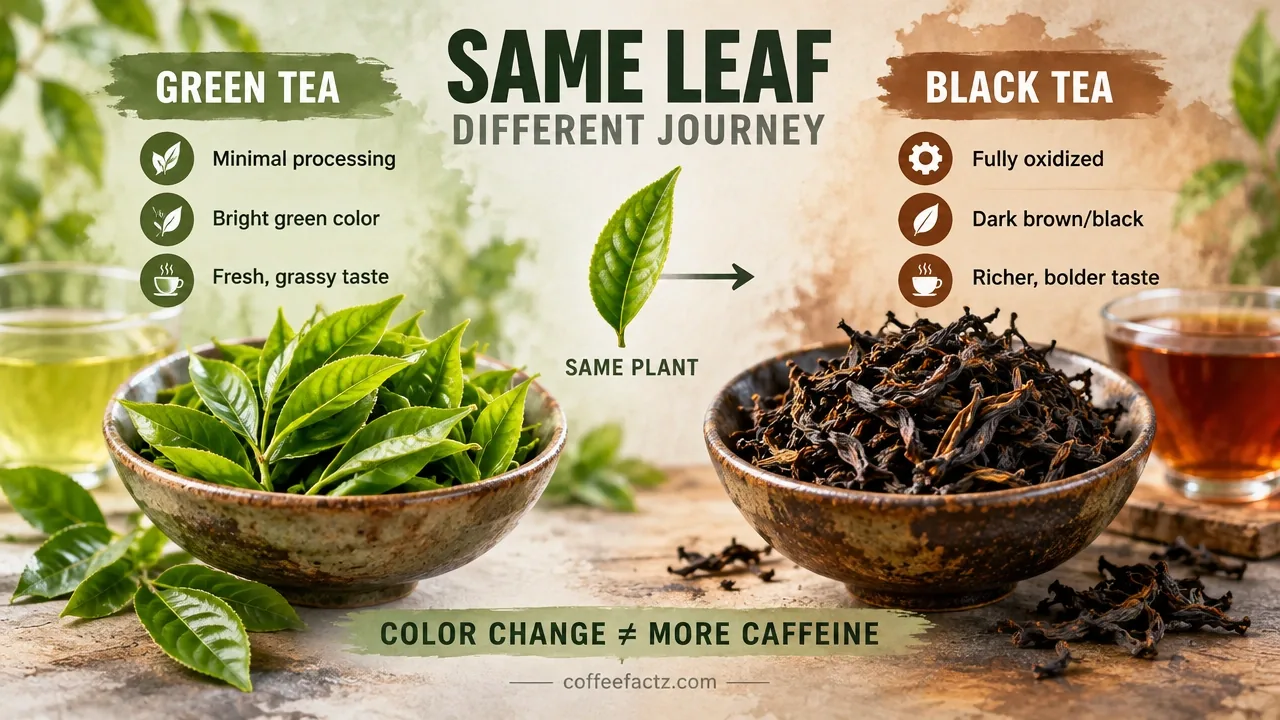
The label on a tea tin tells you how the leaf was processed. It does not tell you how much caffeine the leaf holds. Two teas labeled “black tea” can brew to materially different caffeine levels because three factors – not the processing category – set the actual number:
Cultivar is the first. Different genetic varieties of Camellia sinensis synthesize different amounts of caffeine. Assamica cultivars, common in Indian and Sri Lankan teas, tend to run higher than Sinensis cultivars used in Chinese teas, though this is a tendency, not a rule.
Plant part is the second. Buds and young leaves concentrate more caffeine than mature leaves lower on the stem. A tea made from the bud and first two leaves will run higher than one made from more mature harvests, regardless of how either is processed.
Dose is the third. The grams of dry leaf per cup you use is the single most controllable variable available to a home brewer. Two leaves of identical weight from different cultivars can brew to meaningfully different strengths – but the same leaf at double the dose will always outperform itself at half the dose.
The extraction frame follows from this: every milligram in your cup is the result of a physical extraction event. The leaf sets the ceiling. Brewing determines how much of that ceiling you actually reach.
Brewing for Strength: How to Build a Black Tea That Rivals Coffee
Black tea brewing strong enough to approach coffee territory is achievable, but it requires deliberate control of specific variables in a specific order. Most home brews under-deliver not because the leaf is weak, but because the water side of the equation is sloppy.
Dose, Temperature, and Steep Parameters
Start with dose. A standard recommendation is 2–3 grams of dry leaf per 8 oz of water for a moderate cup. To push toward the upper end of the black tea caffeine range, start at 3 grams and scale up to 4–5 grams. Weigh it. Volumetric scoops – teaspoons, tablespoons – vary significantly with leaf grade and cut. A teaspoon of broken-grade CTC (cut-tear-curl) tea packs far more leaf by weight than a teaspoon of long-twisted whole-leaf tea. This is the single most common reason home brews under-deliver: the scoop is not a reliable dosing tool.
Water temperature for black tea sits in the 90–100°C (195–212°F) range. Unlike green or white tea, black tea is fully oxidized and tolerates full boiling water without the harsh bitterness that damages more delicate leaves. Hotter water extracts caffeine faster and more completely.
Steep time for a standard black tea cup runs 3–5 minutes. Extending to 6–7 minutes extracts more caffeine, but bitterness and astringency accumulate faster than caffeine does past the 5-minute mark. If you want more caffeine without the harshness, reach for more leaf before you reach for more time.
The controlled levers are temperature, steep time, leaf-to-water ratio, particle size, and agitation. Particle size and agitation are the two most commonly ignored. A tea bag contains finely broken leaf particles with a much higher surface-area-to-volume ratio than whole-leaf tea – which is why a tea bag at 3 minutes can extract as much caffeine as a whole-leaf tea at 5 minutes, even at the same dry weight. Agitation (stirring or dunking the bag) increases the rate of extraction by moving saturated water away from the leaf surface and replacing it with fresh solvent.
Escalation Order and Multi-Infusion Accounting
When a single cup isn’t delivering what you want, escalate in this order: leaf dose first, then temperature, then steep time. Doubling the leaf adds caffeine linearly and introduces almost no additional harshness. Doubling the steep time adds caffeine but adds bitterness faster. Temperature is already near its ceiling for black tea, so there is less room to move there.
Multi-infusion brewing changes the accounting. The same leaf re-steeped for a second or third infusion still releases caffeine – the extraction rate drops with each successive steep, but the cumulative total across all infusions is higher than a single steep of the same leaf. If you drink three steeps from one dose of leaf, all three count toward your daily total. Most drinkers skip this math entirely and undercount their intake.

Extraction is a rate process, not a switch. Brewing time and preparation method produce the most significant differences in caffeine levels between otherwise identical cups. The leaf doesn’t release all its caffeine at once – it releases it progressively, which is why the first steep is always the strongest and why each successive infusion contributes a diminishing but non-zero amount.
Substitution Targets and Gap Closure
An honest substitution target: a well-built cup of black tea – 4–5 grams of leaf, full boiling water, 5-minute steep – lands at the upper end of the black tea range, around 55–65 mg. A standard mug of brewed drip coffee sits at 107–140 mg. That gap does not close with one cup. Closing it requires two to three cups of strongly brewed black tea, or accepting that you are replacing coffee’s dose with roughly half of it per cup and adjusting your cup count accordingly.
The ratio is honest. Strength is won on the water side of the equation – same leaf, different cup – but the ceiling of that leaf still limits how far you can push a single serving.
Calm Energy: How L-Theanine Actually Changes the Game
Caffeine in black tea delivers the same pharmacological hit per milligram as caffeine in coffee. The molecule doesn’t change. But the subjective experience often does, and there is a structural reason for that – though the evidence around it is more nuanced than most tea content acknowledges.
Amino Acid Smoothing Hypothesis
L-theanine is an amino acid found in true tea (Camellia sinensis) and not in coffee. It is the most commonly cited explanation for why tea drinkers report a slower-onset, less jittery stimulation compared to coffee drinkers consuming a similar caffeine dose. The proposed mechanism is that L-theanine modifies how caffeine affects the central nervous system – not by blocking caffeine’s action, but by altering the accompanying physiological response.
The evidence for this effect exists, but the dose-response relationship and precise mechanism are not fully settled. The smoothing effect is a proposed explanation supported by controlled research, not a guaranteed outcome at every cup.
A double-blind, placebo-controlled crossover study published in Psychopharmacology tested co-administration of 75 mg caffeine and 50 mg L-theanine – ratios equivalent to one to two cups of tea – while measuring cerebral blood flow, cognition, and mood. Caffeine alone reduced oxygenated haemoglobin and improved attention tasks, but combining it with L-theanine eliminated the vasoconstrictive effect and eradicated caffeine’s influence on oxygenated haemoglobin, cognition, and mood at those doses. – From the study “A double-blind, placebo-controlled study evaluating the effects of caffeine and L-theanine both alone and in combination on cerebral blood flow, cognition and mood“
What this study shows is important to read carefully. At tea-representative doses, the caffeine-L-theanine combination did not produce a stronger positive cognitive effect than caffeine alone – it produced a different physiological profile. The vasoconstrictive effect was blunted. But the combination also didn’t clearly outperform caffeine alone on attention or mood at those doses. This supports the smoothing mechanism while simultaneously illustrating why the evidence tier remains unsettled. The numbers explain the dose. They do not fully explain the feel.
Competing Explanations and Intake Underestimation
L-theanine is one explanation for the smooth feel. There are several others that require no amino acid at all. A lower caffeine dose per cup means the absolute stimulant load is smaller. Slower sipping across a longer window – a cup of tea often takes 20–30 minutes to drink, while espresso is consumed in two minutes – spreads the caffeine absorption across time. Lower acidity compared to coffee may reduce gastric irritation that some people conflate with caffeine jitteriness. Individual sensitivity varies enough that two people drinking the same cup have genuinely different experiences.
The practical danger of a smooth-feeling drink is systematic underestimation. Because tea can feel gentle, drinkers regularly fail to account for total intake across the day. Strong black tea, matcha, and repeated steepings can disrupt sleep even when no individual cup felt sharp or intense. The subjective experience of gentleness and the physiological caffeine load are separate channels. Only one of them is a reliable dosage meter – and it isn’t the one you feel.
Most habitual drinkers underestimate total caffeine by 30–40%, especially with drinks that combine concentrate, espresso, or larger 16–20 oz servings. – Source: Flight Wine Bar
Caffeine is absorbed readily and produces measurable pharmacological effects regardless of how gentle the delivery mechanism feels. Tracking total milligrams per day – not perceived intensity – is the only reliable control available.
Edge Cases: Decaf, Herbal, White Tea, and the “Gentle” Cup That Keeps You Awake
Decaf tea is the most common source of accidental overconsumption among careful drinkers. The category name implies zero. The actual residual is not zero, and the gap between assumption and reality is where sleep disruption hides.
Residual Compound Variability in Caffeine-Free Claims
Decaffeination reduces caffeine – it does not eliminate it. Residual caffeine in commercially decaffeinated tea varies by the original leaf’s caffeine content and the decaffeination method used. Published figures place residuals at roughly 0.03% caffeine by weight, approximately 2–2.5% of the original caffeine content, or 2–10 mg per cup depending on the product and process. Even the most thorough commercial decaffeination processes cannot remove every milligram. A heavy daily drinker of decaf tea is still consuming caffeine – just less of it, and in an amount they are probably not tracking.
Herbal infusions – chamomile, peppermint, rooibos, hibiscus – are tisanes, not true tea, and are generally caffeine-free. That is a reliable category assumption for pure herbal products. It breaks down for blended teas that mix Camellia sinensis leaves with botanical ingredients. A “chamomile blend” that contains any true tea leaf contains caffeine. Check the ingredient list, not the name.

Mild Taste Misperception with Intake Risk
A mild-tasting cup is not evidence of a low caffeine dose. This matters most with high-caffeine products that happen to taste smooth – certain black tea blends, lightly sweetened energy teas, and cold-brew concentrates can carry significant caffeine loads while presenting as gentle. The careful drinker who avoids anything that feels sharp is most likely to be caught off guard by a product that is high in caffeine and low in perceived intensity.
The quick-steep workaround – steeping briefly and discarding the first infusion to reduce caffeine – fails mathematically. Only about 20–30% of caffeine is extracted in the first 30 seconds. Pouring off that first infusion removes a small fraction of the total available caffeine, not the majority of it. The same problem applies to cold-brewing a tea and discarding the liquid: the cold-brew process extracts caffeine, and discarding it doesn’t meaningfully decaffeinate the remaining leaf for subsequent steeps.
Leaf-Type Reporting Conflicts in Proprietary Blends
White tea is the clearest demonstration of why per-type caffeine tables are unreliable. Published figures for white tea range from very high (because it uses young buds, which are caffeine-dense) to very low (because it is minimally processed and often lightly steeped) to “highly variable” (because both of those things are true simultaneously, depending on the specific product). Any single white tea caffeine figure should be treated as a rough estimate, not a reliable input.
“Loaded” tea products and energy-tea blends occupy a separate category entirely. These vary widely, often fall outside standard brewed-leaf ranges, and cannot be estimated from brewing logic or leaf-type tables. For these products, the label is the only number available – and even label figures for proprietary blends deserve scrutiny, since caffeine content from multiple botanical sources can be difficult to measure precisely. Treat label figures as directional, not exact.
The Comfortable Switch: Your Personal Dose, Timing, and Taper
Personal dose is where general caffeine guidance becomes useful, and where most published tea content stops short. A population-level ceiling is a starting point, not a destination. Your actual number is body-weight-scaled, clearance-scaled, and condition-dependent.
Daily Limits with Clinical Exceptions
The general adult daily caffeine ceiling recognized by major health authorities sits at 400 mg per day. A single-dose ceiling of roughly 200 mg is the commonly cited threshold above which acute effects become more likely for most adults. Translated into black tea at a typical 40 mg per cup, 400 mg is approximately 10 cups per day – a number that makes black tea look benign. At a strong 60 mg brew, that same ceiling is 6–7 cups. The cup count is only as reliable as the milligrams-per-cup estimate, which is why preparation matters.
The underlying thresholds are body-weight-based: approximately 3 mg per kilogram, or about 1.4 mg per pound of body weight per day. A 130 lb (59 kg) person has a different ceiling than a 200 lb (91 kg) person, and consumer tea packaging almost never surfaces this calculation. A flat 400 mg daily limit is generous for some readers and potentially too high for others, depending on body weight alone – before any medical factors enter the picture.
Clinical exceptions require a clinician, not a self-calculation. Pregnant and breastfeeding individuals face a much lower recommended ceiling, commonly cited at 200 mg per day or less. Children and adolescents should not be using adult daily limits at all. Cardiac conditions, anxiety disorders, and certain medications – particularly some antibiotics, antidepressants, and thyroid medications – interact with caffeine in ways that change the effective ceiling. If you fall into any of these categories, route the dosing question to a doctor, not a brewing guide.
Clearance, Withdrawal, Preparation Quality
Two people can drink identical cups of black tea and have genuinely different experiences because caffeine clearance varies substantially by individual. Fast metabolizers clear caffeine in roughly 3–4 hours. Slow metabolizers may take 7–10 hours or more – and the slow end of that range means an afternoon cup at 3 PM can still be pharmacologically active at midnight. This is why a universal stop time (“stop drinking caffeine by 2 PM”) works for some people and fails for others. A personal stop time of 8–10 hours before your target bedtime is a reasonable starting point, adjusted based on how your sleep actually responds.
For anyone reducing intake, a gradual taper outperforms abrupt cessation. Caffeine withdrawal – headaches, fatigue, irritability – is a real and documented response to sudden removal after habitual use. A practical protocol: reduce total daily intake by 10–25% per week over successive weeks. This pace blunts withdrawal symptoms while allowing your adenosine receptor sensitivity to recalibrate. All-or-nothing cuts work for some people; most find the stepped approach more sustainable.
A few quality notes for health-conscious drinkers. The benefits associated with both tea and coffee in the research literature are consistently tied to unsweetened preparation. Added sugars, flavored syrups, and sweetened concentrates change the metabolic picture of the beverage substantially. Separately, consuming any beverage above roughly 65°C (149°F) carries a risk of thermal esophageal injury – a caution that applies to freshly poured black tea as much as to any hot drink.
Caffeine pills offer precise milligram dosing for anyone tapering by specific amounts, but they carry a meaningful overdose risk when used without attention to total daily intake. The same 200 mg that feels like a strong coffee in pill form is easy to stack accidentally with dietary caffeine, and cardiac risk increases at high acute doses. If you are using pills as part of a taper, track every source.
Green tea can inhibit non-heme iron absorption when consumed alongside iron-rich meals, because tea polyphenols bind to iron in the digestive tract. This is a practical consideration for anyone managing iron status – spacing tea consumption away from iron-rich meals by at least an hour is a simple adjustment that most retail tea content never surfaces.
The Verdict: Choosing Your Daily Cup Without Regret
Black tea delivers meaningfully less caffeine per brewed cup than brewed coffee – roughly 40 mg versus 107–130 mg at typical preparation – and every deviation from that baseline comes from dose, leaf, and process, all three of which you now control.
Here is how that plays out for three different drinkers.
The coffee replacement drinker needs two to three strongly brewed cups of black tea to approximate one mug of drip coffee. The protocol: 4–5 grams of leaf per 8 oz, full boiling water, 5-minute steep, and at least two cups in the morning window. Count re-steeps toward the total. Expect to land around 100–130 mg across that sequence – in the same zone as a single large coffee, but spread across more volume and time.
The sleep-sensitive drinker needs a stop time more than a cup count. Calculate 8–10 hours before your target sleep time and cut off all caffeine there. Decaf is a reduction, not a zero – so if you are sensitive enough to be managing sleep by the cup, switch to a confirmed caffeine-free tisane in the evening, not a decaf blend. One or two standard cups of black tea in the morning window is unlikely to be the culprit; the afternoon habit is.
The volume drinker – four, five, six cups across the day – needs to do the multi-cup math. At 40 mg per cup, six cups is 240 mg. At 55 mg per cup from a strong steep, six cups is 330 mg. Both are under the 400 mg ceiling, but the second number is closer to it than most volume drinkers realize. Re-steeps add to the total. Strong bagged teas add to the total. An afternoon matcha adds to the total. Track the milligrams, not the cups.
Now the specific questions this guide opened with:
Is black tea stronger than coffee? Per brewed cup, no. Per gram of dry leaf, sometimes. The drink is weaker; the dry leaf can be stronger. Only one of those describes what you consume.
Is two cups of tea a day too much? At 40 mg per cup, two cups is 80 mg – well within any adult ceiling. At a strong brew, two cups might reach 110–130 mg. Still moderate. “Too much” is a function of your body weight, clearance rate, and any clinical exceptions – not the category.
How many cups of black tea equal one coffee? Two to four, depending on how both are prepared. The ratio is honest; a one-for-one swap is not.
What drink in this comparison is highest in caffeine? Within the beverages covered here – brewed black tea, brewed coffee, espresso, latte, milk tea, instant coffee, and cola – brewed French press coffee and double-shot lattes sit at the top of the range. Naming a global maximum across all caffeinated products is beyond the scope of what this guide can do reliably.
The decision sequence that puts all of this to work:
- Establish your daily ceiling – use 400 mg as the adult starting point, then scale it down by body weight (3 mg/kg) and any clinical factors.
- Convert it to cups – divide your ceiling by your actual milligrams per cup, which you now know how to estimate from leaf dose, temperature, and steep time.
- Set your leaf dose and steep parameters – weigh the leaf, control the temperature, time the steep.
- Set your stop time – 8–10 hours before bed, adjusted based on whether you are a fast or slow metabolizer.
- Adjust based on how you actually sleep and feel – the ceiling is a population number; your body will tell you where your personal number sits.
Every number in this guide collapses into one operating rule: measure your cup, not your category. Both preparation method and quantity consumed must be considered when estimating caffeine intake. A category label – tea, coffee, decaf – is not an input to that calculation. Two numbers are: milligrams per cup, and cups per day. Multiply them. That product is the entire answer.
Caffeine content and portion sizes vary within and between countries, but the following amounts serve as useful guidelines: an espresso (60 ml) contains about 80 mg; a cup of filter coffee (200 ml) about 90 mg; a cup of black tea (220 ml) about 50 mg; a standard cola can (355 ml) about 40 mg; a standard energy drink can (250 ml) about 80 mg; a bar of plain chocolate (50 g) about 25 mg; and a bar of milk chocolate (50 g) about 10 mg. – From the European Food Safety Authority (EFSA)
The EFSA figures are useful precisely because they standardize across beverage categories and express everything in the same unit – milligrams per serving. Their black tea figure of 50 mg per 220 ml cup sits at the upper end of typical ranges, reflecting a moderately strong brew. It is a reasonable working number for a well-made cup. It is not a number to assume without knowing how your tea was prepared.
Frequently Asked Questions About Caffeine in Black Tea
Is black tea caffeine stronger than coffee?
Per brewed cup, no – coffee typically delivers two to three times more caffeine than black tea at standard preparation. Per gram of dry leaf, some tea varieties run higher than coffee beans, but that’s a measurement of raw plant material, not the drink you’re consuming.
Is 2 cups of tea a day too much caffeine?
At a typical 40 mg per cup, two cups totals 80 mg – well within the general adult ceiling of 400 mg per day. If you’re brewing strong (5+ minute steep, 4–5 grams of leaf), two cups might reach 100–130 mg, which is still moderate but worth tracking if you’re also consuming other caffeine sources.
What drink is the highest in caffeine?
Within the beverages compared in this guide – brewed black tea, drip coffee, French press, espresso, latte, instant coffee, milk tea, and cola – French press coffee and double-shot espresso drinks sit at the top, reaching 120–150 mg per serving. Energy drinks and specialty products can exceed this, but they fall outside the scope of what this guide benchmarks.
How many cups of black tea equal one coffee?
Between two and four cups of brewed black tea, depending on how both are prepared. A strongly brewed black tea at 55–65 mg and a moderate drip coffee at 110 mg gives you roughly a 2:1 ratio. A lightly steeped tea against a strong French press can push that to 4:1.
Does steeping black tea longer extract significantly more caffeine?
Yes, but with diminishing returns and an accelerating bitterness cost. Most additional caffeine extraction happens in the first 3–5 minutes. Extending a steep from 5 to 8 minutes adds some caffeine but adds astringency faster. If you want more caffeine without more bitterness, increase the leaf dose before increasing the time.
Does adding milk to black tea reduce its caffeine content?
No. Milk changes the concentration of caffeine per ounce (because you’ve added volume) but doesn’t change the total milligrams in the cup. The caffeine is already dissolved in the tea; diluting it with milk doesn’t remove it.
Can I reduce caffeine by steeping briefly and discarding the first infusion?
Only marginally. About 20–30% of caffeine extracts in the first 30 seconds of steeping. Discarding that first infusion removes a small fraction of the total available caffeine, not the majority. It’s not a reliable decaffeination method.
Why does black tea keep me awake even though it felt mild?
Because subjective intensity and pharmacological load are independent. A smooth-tasting cup can still deliver 50–60 mg of caffeine, and if you drank three or four cups throughout the day, the cumulative total is high enough to affect sleep – especially for slow metabolizers who take 7–10 hours to clear caffeine. Track total milligrams, not how the cup felt.
References
- A double-blind, placebo-controlled study evaluating the effects of caffeine and L-theanine both alone and in combination on cerebral blood flow, cognition and mood | pmc.ncbi.nlm.nih.gov
- Does Chai Tea Have Caffeine? | flightwinebar.com
- Caffeine | efsa.europa.eu