

A classic frappe and a well-pulled latte look like cousins on a menu board, but they are built from completely different playbooks. One starts with instant coffee, a shaker, and ice. The other starts with a pressurized espresso machine and a steam wand.
Understanding why they taste, feel, and behave so differently comes down to four things: what they are built from, how cold or hot they run, how the foam is made, and how sweet they land. Everything else follows from those four.
Key Takeaways on Frappe vs Latte
- A frappe is built by agitation and ice; a latte is built by steam injection and espresso. The process, not the menu name, defines the drink.
- Ice in a frappe is structural: it melts into the liquid volume and shapes texture, not just temperature.
- Frappe foam comes from foam-active compounds in spray-dried instant coffee; latte microfoam comes from milk proteins and fat captured by steam.
- A frappe is sweeter by design because sugar is part of the build, not an optional add-on.
- A latte tends to deliver more caffeine per unit of volume because ice dilution does not apply.
- An iced latte is not a frappe: it is cold espresso and milk, never blended or shaken.
What a Frappe Actually Is (And Why the Name Sticks)
A frappe is a chilled, shaken or blended coffee drink whose defining feature is its thick, frothy texture. Ice is not decoration here. It is a structural ingredient that shapes the drink’s volume, temperature, and feel from the first sip. If a latte is a drink you pour, a frappe is a drink you build.
The word “frappe” describes a preparation method, not a specific coffee type or bean. It means shaken, blended, and chilled. That is why the name migrates across menus and means something slightly different at every café and in every country. The drink changes; the method stays.
One quick physical test separates a frappe from everything else: pick it up and tilt the glass. A frappe is aerated and thickened. An iced latte is not. The frappe holds its foam. The iced latte is liquid all the way down.
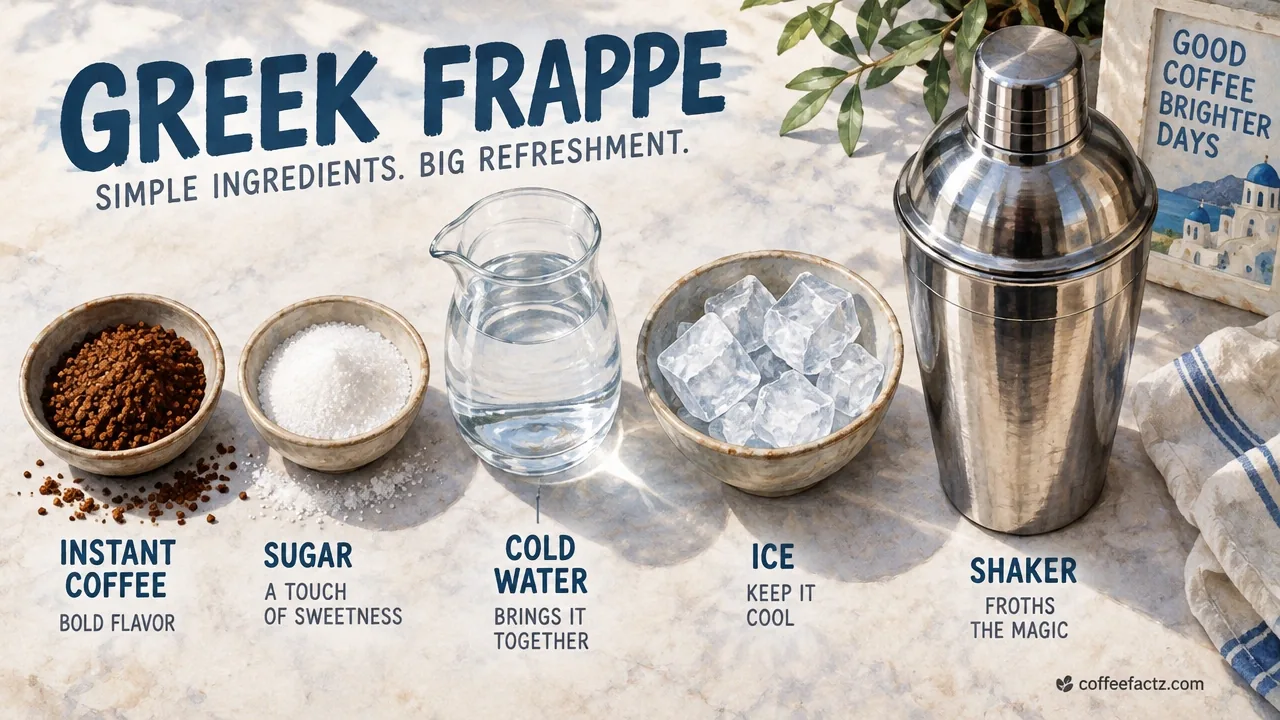
That foam is not accidental, and it does not come from milk. The modern coffee frappe was born in Greece in the late 1950s by accident, when a coffee representative shook instant coffee, sugar, cold water, and ice together in a cocktail shaker because no hot water was available. The result was a thick, stable, foamy drink that nobody had designed. Its DNA is agitation and instant coffee, not a pulled espresso shot. That single origin fact explains almost every difference that follows in this article.
A frappe reads like a milkshake and tastes like coffee, but it is genetically a shaken drink born from improvisation, not a recipe handed down from Italian espresso culture.
What a Latte Actually Is: Espresso Buried in Steamed Milk
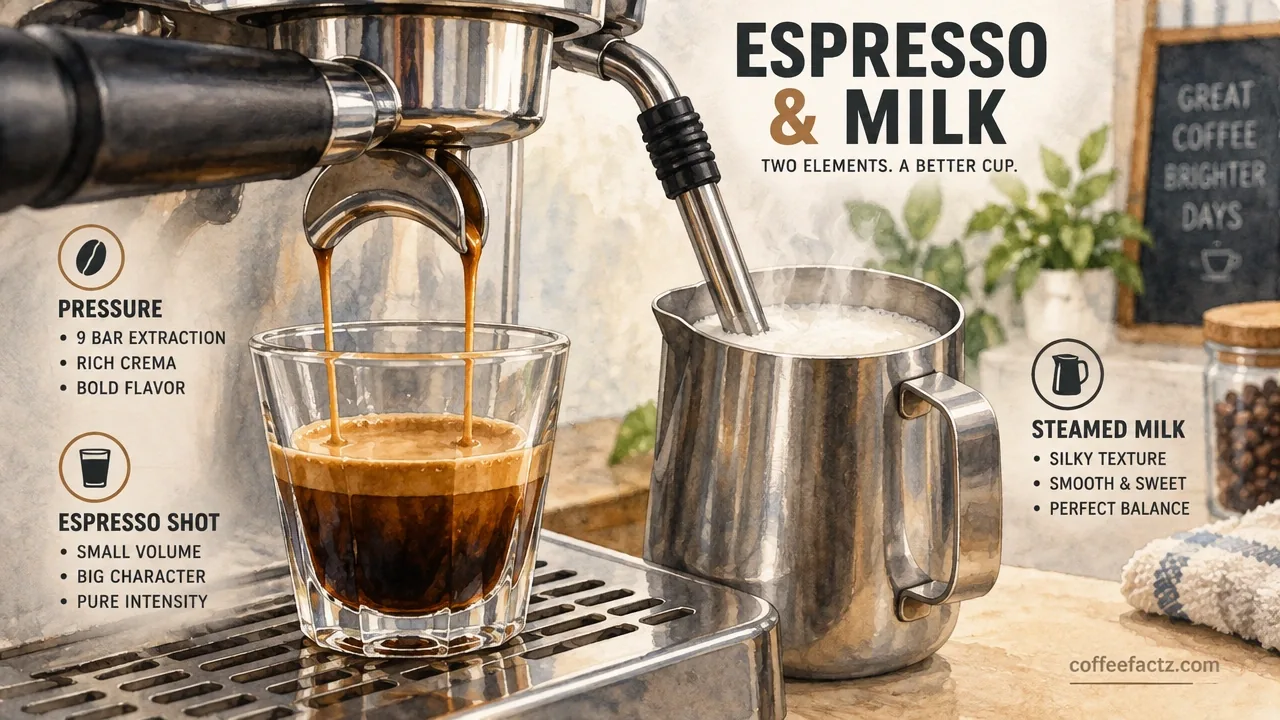
A latte is espresso plus steamed milk, hot by default. The defining move is injecting pressurized steam directly into cold milk, which heats it and changes its texture at the same time. That one step is what makes a latte a latte and not just coffee with milk poured in.
Espresso is the foundation. It is coffee brewed under pressure in a small volume over a short extraction, typically 25 to 30 seconds, producing roughly 25 to 35 ml per shot. That is not a full cup of coffee. It is a concentrated base, and its job is to anchor everything that follows.
Milk is the volume driver. A latte runs at approximately a 1:3 to 1:5 espresso-to-milk ratio, landing most commonly between 240 and 360 ml total, finished with a thin layer of microfoam on top. Do the math and you will see that the majority of what is in your cup is milk. That is why a latte tastes rounded and milky rather than sharp and coffee-forward. The espresso is present. The milk just outweighs it by a significant margin.
The fastest way to understand a latte is to think of it as mostly milk with a small, pressure-brewed coffee base underneath.
The 10 Points That Actually Separate a Frappe from a Latte
Here is the full map before we go deep. Ten comparison points, one contrast each, no jargon.
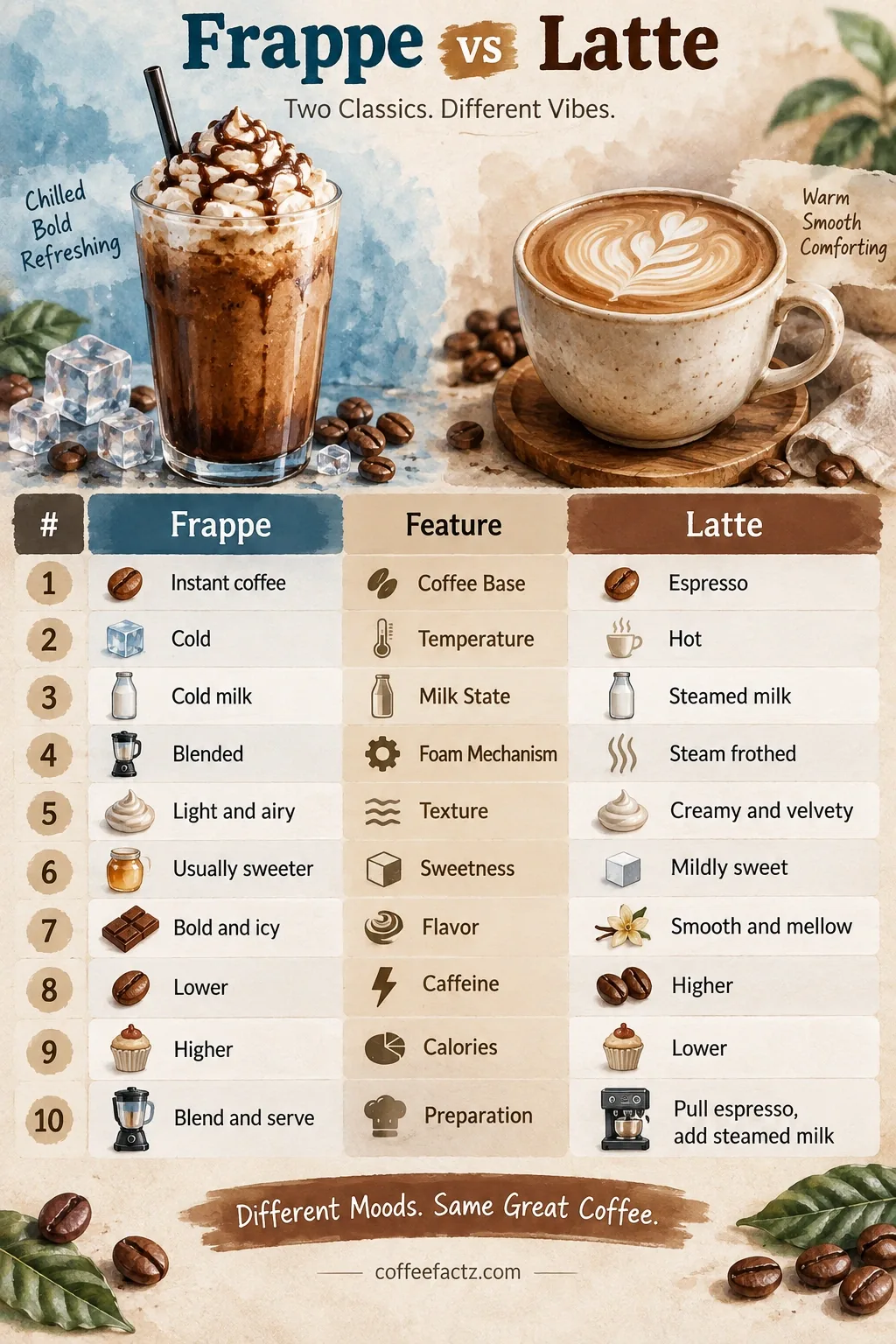
| Point | Frappe | Latte |
|---|---|---|
| Coffee Base | Instant or spray-dried coffee | Pulled espresso shot |
| Temperature | Ice-cold; served with ice still present | Hot by default; iced version exists |
| Milk State | Cold milk or no milk; ice does the chilling | Steamed milk, heated and aerated by steam wand |
| Foam Mechanism | Agitation of instant coffee creates surfactant foam | Steam injection creates microfoam from milk proteins |
| Texture & Mouthfeel | Thick, slushy, dessert-adjacent | Silky, smooth, liquid velvet |
| Sweetness | Sugar added as part of the build | Only natural milk lactose, unless you add syrup |
| Flavor Profile | Sugar, syrups, and toppings lead; coffee supports | Milk fat, roast level, and espresso ratio lead |
| Caffeine | 65–125 mg typical range; varies by build | 75–150 mg typical range; varies by shot count |
| Calories | Higher; added sugar, syrups, and whipped cream push the count up | Tracks mainly to milk volume and type |
| Preparation | Shaken or blended with ice | Espresso pulled, milk steamed, combined in cup |
Four criteria drive everything in that table: what the drink is built from, how hot or cold it runs, how the foam is made, and how sweet it lands. The next four sections unpack each one.
Temperature and Milk State: Ice as an Ingredient vs Steam as a Method
Hot versus cold is the surface read. The real difference is mechanical.
In a latte, heat is applied inside the milk. The steam wand forces pressurized steam directly into cold milk, heating it and aerating it simultaneously. The milk arrives in your cup already hot and already textured. The espresso base is also extracted hot. Nothing in the build is cold.
In a frappe, cold is structural. Ice goes into the shaker or blender at the start, and as it melts during agitation, it does not sit on top of the drink. It becomes part of the drink’s liquid volume. The water from melting ice is woven into the mixture. That is why a frappe gets thinner as it sits: the ice is still working.
Serving temperatures are not standardized across cafés, and quoting fixed numbers here would be misleading. What you can count on: a latte comes straight from steaming and is immediately drinkable at a hot temperature. A frappe is served ice-cold with ice still present in the cup.
One important correction before moving on: an iced latte is not a frappe. It uses the same espresso-and-milk recipe as a hot latte, served cold rather than blended. Many people use “iced latte” and “frappe” interchangeably, and the temperature axis is the cleanest place to break that habit. An iced latte is cold. A frappe is blended or shaken. Those are different things.
Temperature determines whether the drink is assembled from steam or from melting ice. That single distinction drives the texture difference we look at next.
Foam and Milk Physics: Microfoam vs Shaken Surfactant Foam
The foam on a latte and the foam on a frappe look similar from across the room. Up close, they are completely different materials, made by completely different processes.
Sohla El-Waylly, a chef and recipe developer who graduated from the Culinary Institute of America, explains why instant coffee is the non-negotiable ingredient in a real frappe: the spray-drying process concentrates the coffee’s solids, and when you dissolve them in a small amount of water, the resulting viscous solution traps tiny air bubbles the way a meringue does. The foam behaves like espresso crema, but it is thicker and more stable because dissolved instant coffee forms a more stable emulsion than regular brewed coffee.
That distinction matters. The foam is not decoration. It is the clearest physical proof that these two drinks are built by entirely different processes.
Steam-Injected Protein Matrix
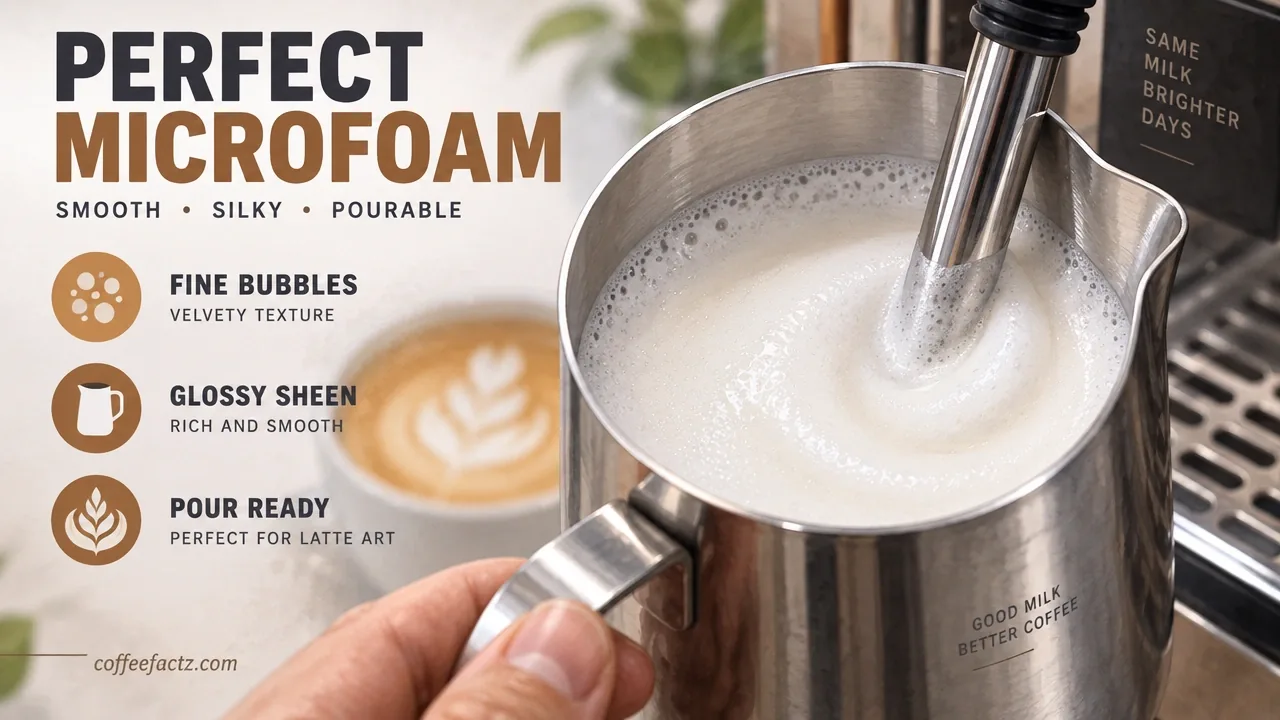
Latte microfoam is made by steam injection. A steam wand forces pressurized steam into cold milk, folding fine air bubbles into the milk’s protein-and-fat structure. The result is a glossy, pourable layer that sits thin on the surface of the drink. It is smooth, wet, and integrated into the milk below it. Run a spoon through it and it behaves like liquid.
This foam requires dairy’s protein-and-fat matrix to hold together. Without milk proteins and fat, the steam has nothing to anchor the bubbles to.
Agitated Coffee Bubble Layer
Frappe foam is made by agitation. Shaking or blending spray-dried instant coffee with water, sugar, and ice produces foam driven by the coffee itself. Foam-active compounds in the spray-dried powder stabilize air at the surface, and the mechanical agitation plus ice produces both aeration and chilling at once.
The character of the two foams is visibly different. Microfoam is fine, wet, and integrated into the milk below it. Shaken coffee foam is coarser, drier, and sits on top of the drink as a distinct layer. Foam volume and stiffness depend on how hard the drink is agitated and how much sugar is present, not on coffee type alone.
This foam is also less stable. It collapses faster than microfoam, which is exactly why blended café drinks lean on sugar and thickeners to keep the head intact. That leads directly into the sweetness question.
Sweetness, Flavor, and Mouthfeel: What Goes In Changes What You Taste
A frappe is sweeter than a latte. That is not a preference. It is a structural fact.
Sweetener and Aromatic Drivers
A latte’s only sweetness is the natural lactose in milk plus whatever flavoring syrup you request. Nothing sweet goes in by default. A frappe’s sweetness is added on purpose as part of the build. Sugar is not optional in a traditional Greek frappe; it is part of what creates the foam.
Where each drink’s flavor comes from is equally different. A latte’s flavor is driven by milk fat, the espresso-to-milk ratio, and the roast level of the beans. Change any one of those and the drink tastes different. A frappe’s flavor is driven by sugar, flavoring syrups, whipped cream, and toppings, with coffee often playing a supporting role rather than the lead. A latte’s flavor comes from two primary ingredients. A blended frappe’s flavor routinely comes from five or more.
Mouthcoat and Emulsion Stability
Mouthfeel is where the two drinks feel most different. A latte is warm, rounded, and silky. It coats the mouth lightly and finishes clean. A frappe is cold, thick, and dessert-adjacent. It coats the mouth heavily, the way a milkshake does, and the sweetness lingers.
There is a mechanical reason a well-made blended coffee tastes the same from the first sip to the last. Blended drinks want to separate because water, oil, ice, and dairy do not naturally hold together. Thick sugar syrup acts as an emulsifying base, increasing the viscosity of the liquid phase and slowing the separation of oil and water as the ice melts.
A study published in Foods on oil-in-water emulsions found that increasing sugar concentration raised apparent viscosity and reduced droplet size, which slows droplet collision and aggregation. Corn syrup in particular contains maltodextrin, which occupies a larger volume in the continuous phase, retards droplet collisions, and protects fat droplets against flocculation and coalescence during freezing and thawing. The maltodextrin network also blocks water migration and reduces serum loss.
That mechanism is exactly why blended café drinks use thick sugar syrup rather than plain sugar. The syrup does not just sweeten the drink. It holds the emulsion together as the ice melts, keeping the texture uniform from the first sip to the bottom of the cup.
Strength, Caffeine, and Calories: The Numbers Behind the Taste
Neither drink is automatically stronger than the other. The answer depends on how the drink is built, not what it is called.
Extraction and Dose Concentration
Separate perceived strength from caffeine content. These are not the same thing. Perceived strength is about coffee concentration and how much sweetness masks bitterness. A frappe can taste weak while still containing a full shot or two of espresso equivalent. The sugar and ice mute the bitterness, not the caffeine.
Caffeine dose is a function of coffee quantity, coffee type, and number of shots. Ice dilutes flavor and perceived strength, but it does not remove caffeine that has already been extracted or dissolved into the liquid. The caffeine stays. The sharpness fades.
Lattes typically fall in the 75–150 mg caffeine range and frappes in the 65–125 mg range, but those ranges come from different serving sizes and shot counts. Treat the café’s nutrition panel, not the drink’s name, as the source of truth.
On the direct question: which is stronger? A latte tends to deliver more caffeine per unit of volume because it is not diluted by ice and is often built with more espresso. A frappe’s ice and sugar volume water down the coffee’s intensity even when the shot count is identical.
Energy Load Composition
Calories follow the build, not the name. The drivers are milk type and total milk volume, added sugar and syrup, whipped cream and toppings, and total drink size. A frappe’s blended volume plus add-ins typically pushes it above a plain latte of similar size. A latte’s calories track mainly to the milk: skim milk produces a lighter drink, whole milk or oat milk produces a heavier one.
Inventing fixed calorie numbers here would be misleading. Café nutrition panels vary by build and size, and a large blended frappe with whipped cream and extra syrup bears no caloric resemblance to a small frappe with no toppings. Check the panel for the specific drink you are ordering.
Taste tells you sweet or bitter. Only the numbers tell you whether you are getting the caffeine and calories you think you are.
Ordering Clarity: Frappe vs Frappuccino vs Iced Latte, and Which to Choose
By now the drinks are clearly distinct. The remaining confusion lives entirely on the menu, where names are used far more loosely than the drinks deserve.
Here is the naming taxonomy in one block. A frappe is the generic name for a shaken or blended iced coffee, built on instant or spray-dried coffee in its Greek lineage. A Frappuccino is the chain-style blended drink built on concentrated instant coffee, milk, thick sugar syrup, and blended ice. The single fact that separates a Frappuccino from a Greek-style frappe is the build: the Frappuccino adds thick sugar syrup and blended ice as standardized components, producing a more uniform, dessert-leaning result. An iced latte is espresso plus cold milk and ice, never blended.
One regional trap worth knowing: in Italy, “latte” simply means milk. Order a “latte” in an Italian café and you will receive a glass of milk. Outside Italy, the word signals espresso with steamed milk. Ordering language shifts depending on where you are standing.
The decision itself is straightforward. Choose a latte when you want a hot, coffee-forward, silky drink with sweetness you control. Choose a frappe when you want something cold, thick, and dessert-like, and accept that added sugar comes with the territory. Choose an iced latte when you want cold coffee without the blending or the sugar load.
One edge case to confirm before ordering: coffee-free blended versions exist, and even within coffee communities their status is disputed. Some blended drinks are built with no coffee at all. If caffeine matters to you, confirm it is present before you assume.
A frappe is not a frozen latte. That answer has been true since a Greek coffee representative shook instant coffee and ice in a cocktail shaker in 1957 and accidentally invented a category.
Frequently Asked Questions About Frappe vs Latte
Is a frappe just a frozen latte?
No. A frappe is built on instant or spray-dried coffee, shaken or blended with ice. A latte is built on pulled espresso and steamed milk. The coffee base, the foam mechanism, and the sweetness level are all different.
Why is it called a frappe?
The word describes the preparation method: shaken, blended, and chilled. It does not refer to a specific bean, roast, or coffee type, which is why the name means something slightly different at every café and in every country.
Which is stronger, latte or frappe?
A latte typically delivers more caffeine per unit of volume because it is not diluted by ice. A frappe can contain the same shot count but taste weaker because ice and sugar mute the bitterness without removing the caffeine.
Is a frappe sweeter than a latte?
Yes, consistently. A latte’s sweetness comes only from natural milk lactose unless you add syrup. A frappe’s sweetness is added deliberately as part of the build, and in a traditional Greek frappe, sugar is required to create the foam.
Can you make a frappe with espresso instead of instant coffee?
You can blend espresso with ice and milk, but the result will not produce the same stable foam. The thick, frothy head that defines a frappe comes from foam-active compounds in spray-dried instant coffee. Espresso does not contain those compounds in the same form.
What is the difference between a frappe and a Frappuccino?
A Frappuccino is a trademarked chain-style blended drink built on concentrated instant coffee, milk, thick sugar syrup, and blended ice. A Greek-style frappe uses instant coffee, water, sugar, and ice. The Frappuccino adds thick sugar syrup as a standardized component, which stabilizes the emulsion and pushes the drink further into dessert territory.
Why does a frappe separate if you leave it too long?
Water, oil, ice, and dairy do not naturally hold together. As the ice melts, it dilutes the continuous phase and allows the components to separate. Well-made blended café drinks use thick sugar syrup to slow this separation by increasing viscosity and protecting fat droplets from colliding and breaking apart.
Is an iced latte the same as a frappe?
No. An iced latte is espresso plus cold milk poured over ice, never blended or shaken. A frappe is shaken or blended. The texture, foam, and build are completely different even though both drinks are served cold.
References
- Sohla El-Waylly: Frappe – Foamy Greek Iced Coffee | seriouseats.com
- Effects of Glucose and Corn Syrup on the Physical Characteristics and Whipping Properties of Vegetable-Fat Based Whipped Creams | pmc.ncbi.nlm.nih.gov