
Caffeine in a latte is one of the most misread numbers in daily nutrition, and the confusion traces back to one structural fact most people miss: milk is not an ingredient in the caffeine equation. Every milligram arrives in the espresso shot before the milk pitcher ever moves.
Five variables set that number, and none of them are printed on the menu board. Bean species, dry dose, roast degree, extraction parameters, and the shop’s size recipe each pull the final figure up or down. Understand how those five levers work, and you can reconstruct the dose in your own cup without guessing.
Key Takeaways on Caffeine in Latte
- Milk adds zero milligrams of caffeine to a latte; the entire dose arrives in the espresso shot before milk is added.
- Caffeine is a mass, not a concentration, so a larger cup with the same shot count delivers identical milligrams at a lower concentration per 100 ml.
- Bean species sets the chemical ceiling: Robusta delivers roughly double the caffeine per gram compared to Arabica.
- Roast degree comparisons are only valid when measured by weight; dosing by scoop volume inverts the ranking because darker beans are less dense.
- A standard double-shot espresso base yields roughly 126 to 150 mg of caffeine, and that number is the anchor for every latte size built on it.
- Caffeine jumps between latte sizes are shot-scaling events, not volume events; adding milk without adding a shot changes nothing.
Why Milk Volume Never Changes the Caffeine in Your Latte
A latte has two components: espresso shots and steamed milk. That’s the entire recipe. Dairy milk contributes zero milligrams of caffeine, and so does every plant-based alternative. The whole caffeine payload arrives in the shot glass before the milk touches the cup.
This matters because of a basic conservation rule. Caffeine is a mass, not a concentration. When milk is added to espresso, the milligrams don’t decrease. They spread across more liquid. A 16 oz latte and an 8 oz flat white built on the same two-shot espresso base carry identical caffeine loads. The latte just delivers those milligrams in a larger, gentler package because the concentration per 100 ml is lower.
That distinction between concentration and dose is where most caffeine tracking goes wrong. Nutrition labels and per-serving comparisons often report mg per 100 ml, which falls as cup size grows even when total milligrams stay identical. If you’re monitoring your intake, the number you need is total milligrams, not concentration. A 60 mg espresso base stays 60 mg in an Americano, a cortado, or a 20 oz latte.
Milk may slow caffeine absorption slightly by delaying gastric emptying, which could produce a steadier energy curve. But no pharmacokinetic data exists to quantify that effect precisely, so treat the milk’s role as sensory and temporal. It never changes the dose.
Because total caffeine is conserved through dilution, every lever that can actually move the milligram number lives upstream in the espresso basket. There are five of them.

Factor 1: Bean Species Sets the Absolute Chemical Ceiling
Bean species is decided at the roaster, before the barista touches anything. It sets the maximum caffeine available in every gram of ground coffee, and no amount of brewing skill can extract caffeine that isn’t there.
Arabica and Robusta Percentages
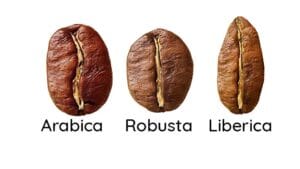
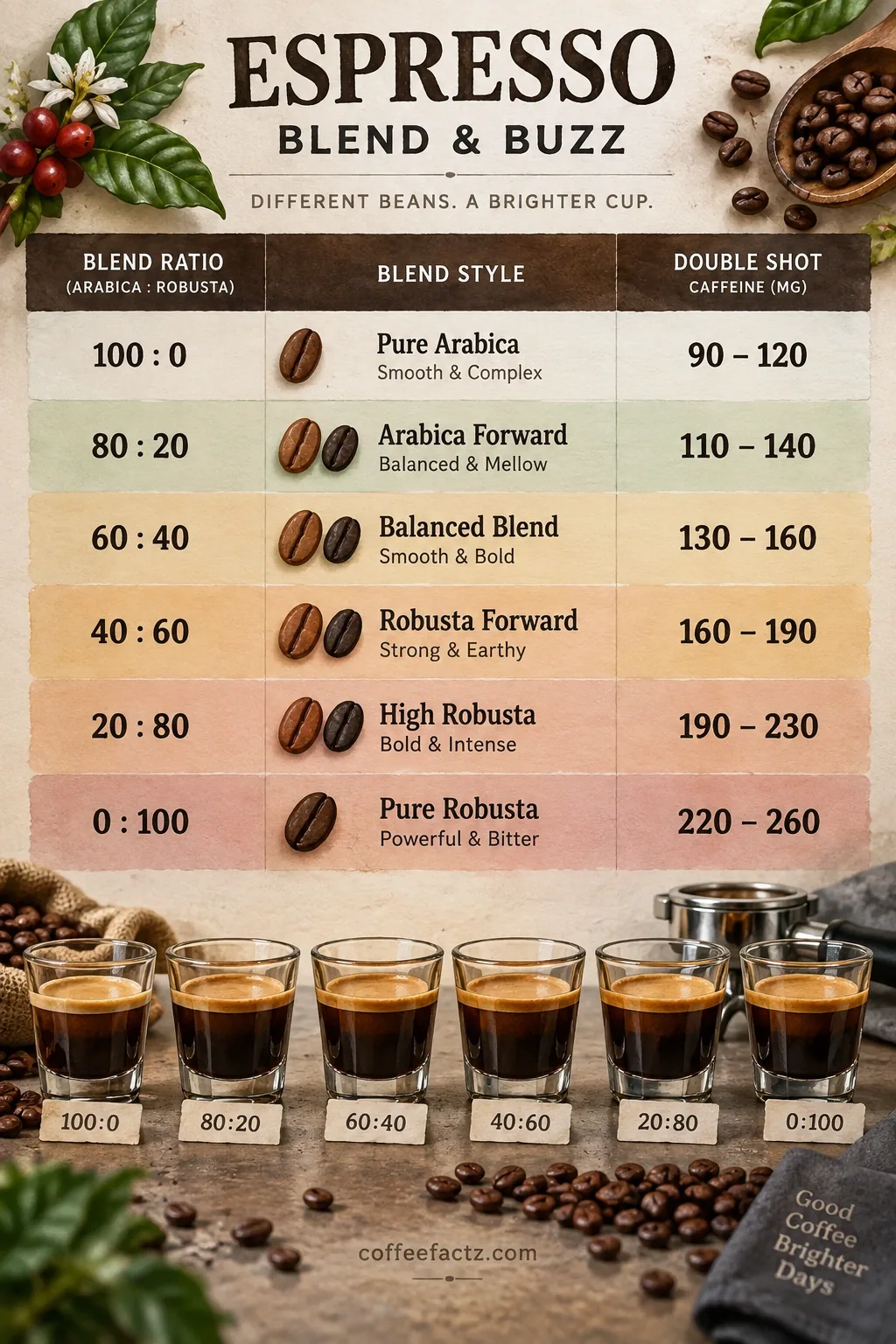
The chemistry is straightforward. Arabica carries roughly 1.1 to 1.5 percent caffeine by dry weight. Robusta runs 2.2 to 2.7 percent. Those percentages are stated per gram of ground coffee, so a fixed gram dose of Robusta delivers roughly double the caffeine of the same gram dose of Arabica before extraction even begins.
Blend Ratios and Milligram Bands
Nearly every cafe espresso is a blend rather than a single-origin species. Real-world drinks sit between the two poles, and the blend ratio is what drives the number. An Arabica-forward double shot lands in the lower half of the 126 to 150 mg range. A Robusta-heavy double pushes toward or beyond the top of that band.
The origin story on a bag of coffee tells you where the beans grew. The blend ratio tells you how much caffeine is in your cup. Those are different questions, and only one of them matters here.
Factor 2: Roast Degree and the Mass Loss Problem
Dark roast is not automatically stronger. This is the most contested myth in coffee, and the disagreement almost always traces back to people measuring differently rather than observing different chemistry.
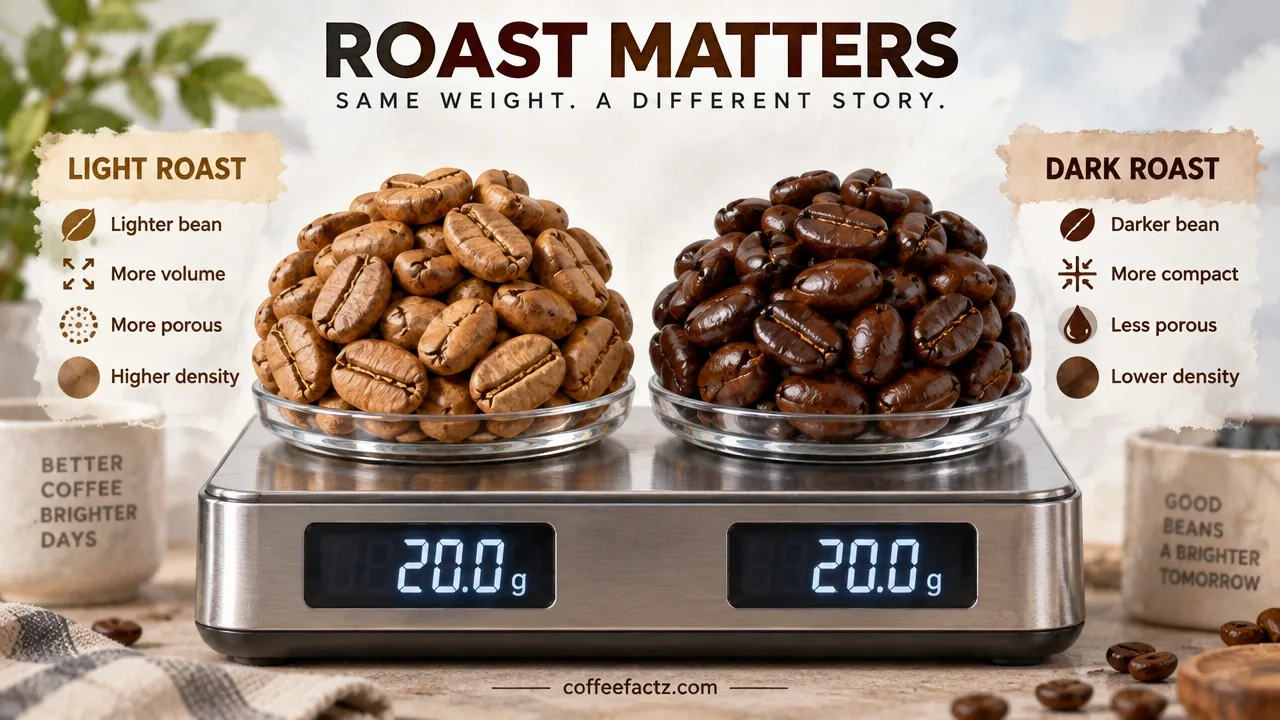
Here’s what actually happens during roasting. Heat drives off moisture and volatile organic compounds. Bean mass and bean density both fall as roast level increases. The same green coffee mass yields less roasted mass by the time it reaches dark. Caffeine, meanwhile, degrades far more slowly than water and organic matter during that process. So the caffeine that survives is now concentrated in less mass.
The practical consequence: a barista dosing on a scale neutralizes most of this variable. Eighteen grams of dark roast and 18 grams of light roast carry roughly equivalent caffeine, with dark edging slightly higher per gram because mass was lost while caffeine was largely preserved. A barista dosing by scoop or grinder timer does not neutralize it. Darker beans pack less densely into a scoop, so a volume-based dose of dark roast delivers fewer grams of coffee and, counterintuitively, often less total caffeine than the same scoop of light roast.
This is why the roast debate produces contradictory answers. Per bean, a light roast may retain more caffeine. Per gram, light and dark are roughly equal, with dark edging higher. Per scoop, the ranking can flip again because of density. All three answers can be correct simultaneously; they’re just measuring different things.
When someone insists a dark roast hits harder, they’re usually describing a hidden dose change caused by scooping by volume instead of weighing. The fix is a scale.
Factor 3: How Much Caffeine Actually Leaves the Puck
Extraction converts bean chemistry into delivered milligrams. Even a perfect dose sitting in a perfect basket can leave caffeine behind if the water doesn’t do its job. Temperature, ratio, grind geometry, and flow evenness all decide how much of the caffeine in the dry dose actually reaches the cup.
Thermal and Ratio Thresholds
Water temperature operates as a threshold, not a dial. The functional window is 90 to 95 degrees Celsius. Below that range, caffeine and acid extraction are both incomplete. Above it, harsh compounds arrive without a meaningful gain in caffeine. Staying inside the window is a floor condition, not a performance edge.
The brew ratio is the other structural constraint. Standard espresso targets roughly 1:2: 18 g of dry coffee in, 36 g of beverage out. A 20 g dose yields about 40 g out. A longer, more dilute shot extracts slightly more total caffeine at a weaker concentration. A shorter shot leaves more caffeine in the puck.
Grind Geometry and Flow Paths
Grind size controls two things simultaneously: surface area and contact time. Finer grinds expose more surface and dissolve caffeine faster, which is why espresso and Turkish coffee outperform coarse-ground methods on a per-gram caffeine basis. The relationship isn’t perfectly linear, though.
A peer-reviewed extraction-kinetics study published in Foods found that finer grinding increased coffee particle surface area in contact with water and enabled higher extraction yields, but the relationship showed non-monotonic behavior: grinding finer raised component mass in the cup up to a point, after which further refinement reduced caffeine, trigonelline, and total dissolved solids. The researchers attributed this to partial clogging and uneven flow through the puck at very fine settings, with brew pressure rising from 3.8 bar at the coarsest setting to 9.3 bar at the finest. Average repeatability across shots was 2.5%, with a high of 8.5%.
That last figure is the practical takeaway. Channeling is the culprit. When puck density is uneven, water finds the path of least resistance and punches straight through. Part of the dose over-extracts and part under-extracts, and the actual milligram yield drifts between otherwise identical shots. A shot cut short for any reason, whether by channeling, low pressure, or a coarse grind, leaves caffeine behind in the puck rather than in the cup.
Extraction is the least legible of the five factors. Grind setting, water temperature, and brew ratio are never printed on a menu. This variable cannot be read off a board and can only be inferred from shot volume and flavor after the fact.
Factor 4: Dry Dose, Shot Count, and Basket Geometry
Dry dose is where chemistry converts into a milligram number the reader can actually act on. The basket sets the ceiling. The barista fills the basket. The customer, in most cases, only chooses a size.
Portafilter Capacity and Gram Benchmarks
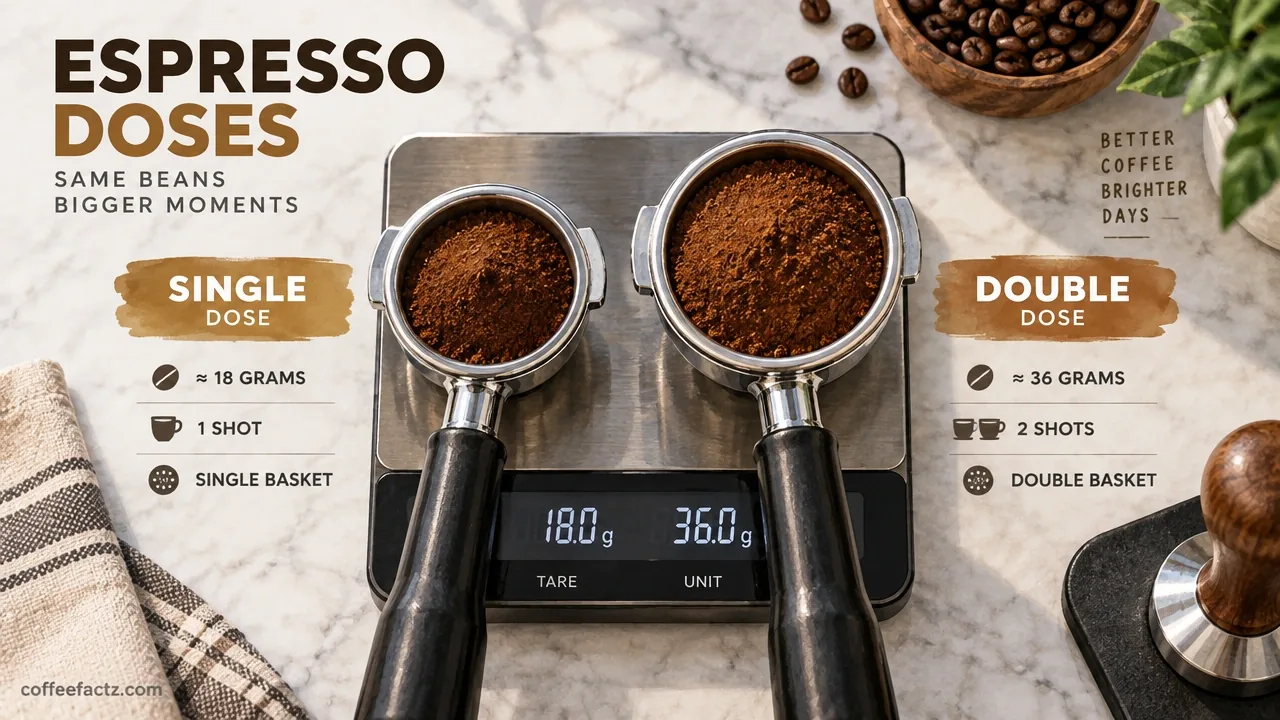
The numbers are straightforward. A single basket holds 7 to 9 g of ground coffee and yields roughly 63 to 75 mg of caffeine in a well-pulled shot. A double basket holds 18 to 20 g and yields roughly 126 to 150 mg. The basket, not the drink name, sets the ceiling.
Basket geometry adds one more variable. Deeper and wider baskets hold more coffee and change the distance and pressure profile that water travels through the puck. Two cafes can both say “double” and still deliver different yields if their baskets have different volumes or depths.
Menu Terminology and Puck Configuration
The phrase “double shot” means one 18 to 20 g dose pulled through one basket. It does not mean two separate 7 to 9 g pucks. The distinction matters because the two configurations produce different water paths and different extraction efficiencies, even if the total dry weight is similar.
Ordering language compounds this. Asking to “add a shot” adds one house-standard increment, and that increment varies by shop. A request for an extra shot at a specialty cafe running 18 g doubles adds a full double. At a chain running 9 g singles, the same request adds half that dry mass. The caffeine jump from the same four words can differ by 60 mg or more depending on which counter you’re standing at.
Moving from a single basket to a double is the largest single change a customer can request, because it roughly doubles the dry coffee mass and therefore roughly doubles the caffeine. Everything else is a smaller adjustment around that anchor.
Factor 5: Serving Size and How Cafe Sizing Actually Works
Serving size changes caffeine in a latte only because it changes the recipe. The milk added between a small and a large contributes nothing. The extra shot, if the recipe calls for one, is the entire delta.
Volume Ladder and Brand Labels
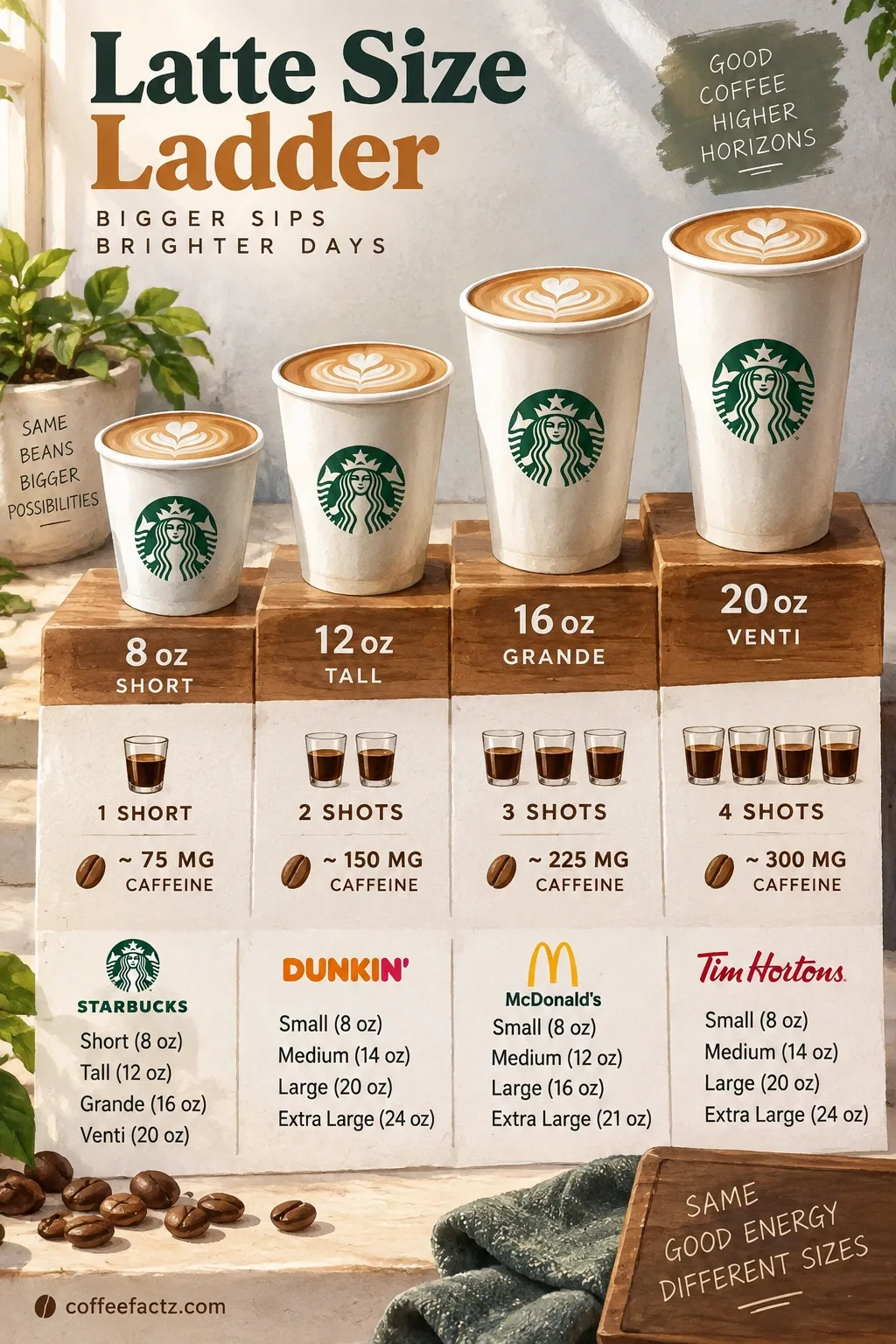
The standard latte ladder runs 8 oz, 12 oz, 16 oz, and 20 oz. Chain size names are marketing labels mapped onto those volumes, and the same label means different volumes across brands. Starbucks names the rungs tall (12 oz), grande (16 oz), and venti hot (20 oz). In US chain practice, a tall latte is built on one shot, while a grande and a venti hot are both built on two. Starbucks published figures confirm 75 mg for short and tall, and 150 mg for grande and venti hot. The caffeine step between tall and grande exists purely because the shot count changes.
Costa and other international chains run their own size tiers with their own shot conventions. Volume alone tells you nothing. The recipe is what matters.
Recipe Scaling and Concentration Inversion
The jump between sizes is a recipe step, not a volume step. When a latte moves from 12 oz to 16 oz, the added milk contributes 0 mg. The added shot contributes 63 to 75 mg. That’s the entire difference.
The concentration inversion is where intuition breaks down. A 20 oz latte on two shots has fewer milligrams per 100 ml than an 8 oz flat white on two shots, even though the cup is physically larger. The total caffeine is the same. The flat white just delivers it in a smaller volume at a higher concentration. Generic two-shot averages run about 130 mg at 12 oz, 173 mg at 16 oz, and 216 mg at 20 oz for shops that scale shots with size, but named chains follow their own recipes and those numbers will differ.
Iced versions add one more wrinkle. A hot and an iced version of the same named size can follow different shot conventions at the same chain. And as ice melts, it adds volume without adding caffeine, pushing the concentration lower over time without changing the total milligrams at all.
When a latte’s caffeine doubles between sizes, the recipe changed. The milk didn’t.
Reconstructing Your Own Latte Caffeine Number
Every published caffeine figure for a latte is an average, not a prediction. The five factors above adjust that average up or down for your specific drink. Here’s how to work the calculation yourself.
Milligram Estimation Protocol
Start with the most common mental jam: a 16 oz iced latte and an 8 oz flat white built on a standard two-shot espresso base carry the same caffeine. Same shots, same dry dose, same extraction. The size difference is all milk and ice. Any real difference in milligrams between those two drinks means one received an extra shot or a different dry dose, never that the larger cup added milligrams on its own.
The reconstruction model runs as a chain. Bean species ratio sets the caffeine percentage per gram. Multiply that by dry dose in grams to get the chemical ceiling. Multiply by extraction yield (typically 18 to 22 percent of dry mass for espresso) to get what actually left the puck. Multiply by shot count to get the espresso base. Then apply the size recipe to confirm whether the shop adds shots with size or keeps the base constant.
Of those five terms, shot count and cup volume are visible on a menu. Bean species ratio, dry dose, and extraction yield are not. That’s why drink names and roast labels are poor proxies for caffeine.
The audit script for the counter: ask for the dry dose in grams, the number of shots, and the bean or blend. Compare drinks by grams and shots, not by roast color or cup volume. If an actual milligram increase is the goal, ask for an extra shot. Changing cup size without changing the shot count changes nothing.
Tobias Weidner and Fani Madzharova, researchers behind an ACS Food Science & Technology study on milk-protein interactions in espresso beverages, found that the structural folding of milk proteins remained unchanged in the presence of caffeine, even in a cappuccino containing chlorogenic acid and other compounds extracted from coffee grounds.
This finding reinforces the practical point: the interaction between milk and caffeine in a latte is physical, not chemical. Milk proteins don’t bind or neutralize caffeine. They share the same liquid without altering each other’s structure. The milligrams in the espresso base arrive in the cup intact.
Daily Limits and Prediction Boundaries
One line of context for daily tracking: 400 mg per day is the general adult ceiling cited by both FDA and NHS guidance. Pregnancy lowers that threshold considerably. A standard two-shot latte at roughly 126 to 150 mg sits in the mid-range of a single serving relative to the daily ceiling, not near it.
The honest limit of prediction is this: no public source combines dry dose, brew ratio, basket geometry, and blend ratio into a single published figure. Every number you’ve read for a latte is a category average. The five factors in this piece are what convert that average into a usable estimate for your specific drink. Published figures are the starting point. The variables are what make it yours.
Frequently Asked Questions About Caffeine in Latte
Do lattes have more caffeine than regular drip coffee?
It depends on the shot count and brew volume. A standard double-shot latte has roughly 126 to 150 mg, while a 12 oz drip coffee typically runs 120 to 180 mg depending on the grind and brew ratio, so they’re in the same neighborhood rather than clearly ranked.
Is 200 mg of caffeine a lot for a single drink?
It’s a meaningful serving but not excessive for most healthy adults. FDA and NHS guidance sets the general adult ceiling at 400 mg per day, so 200 mg is half that daily limit in one cup.
How much caffeine is in a regular 12 oz cafe latte?
A 12 oz latte built on one shot carries roughly 63 to 75 mg. Built on two shots, it runs 126 to 150 mg. The shot count, not the volume, is the deciding factor.
Does an iced latte have less caffeine than a hot latte of the same size?
Not necessarily from the espresso, but the chain may follow a different shot convention for iced drinks. As ice melts it adds water volume without adding caffeine, so the concentration drops over time while total milligrams stay the same.
Why does a flat white sometimes feel stronger than a latte?
It’s almost always a concentration effect, not a dose difference. A flat white uses less milk over the same espresso base, so the milligrams per 100 ml are higher. The total caffeine is usually identical if the shot count matches.
Can I ask the barista for specific information to track my caffeine intake accurately?
Yes. Ask for the dry dose in grams, the number of shots, and the bean or blend. Those three data points let you estimate your milligrams without relying on roast color or cup size, which are unreliable proxies.
Does ordering a larger cup size always mean more caffeine?
Only if the recipe adds a shot with the size. At chains where a grande and a venti hot both use two shots, moving from 16 oz to 20 oz adds milk, not caffeine. Always confirm whether the larger size includes an extra shot.
Does plant-based milk change the caffeine in a latte?
No. Oat, almond, soy, and every other plant milk contribute zero milligrams of caffeine. Swapping milk types changes flavor, texture, and macronutrient content, but the caffeine number stays fixed by the espresso base.
References
- Influence of Flow Rate, Particle Size, and Temperature on Espresso Extraction Kinetics | mdpi.com
- How Milk Proteins Interact with Caffeine in Espresso | acs.org